7 1/2 Lessons about the Brain, by Lisa Feldman Barrett

 Why this book. Selected by a reading/discussion book I’m in, as a good follow up to Descarte’s Error.  One member of our group pointed us to a Lisa Feldman Barrett Ted Talk which impressed us all, then an interview with her on youtube, and as a group, we decided then to read this book. Good idea.

Summary in 3 sentences;  Lisa Feldman Barrett begins with a brief explanation of the evolution of the brain from a mini-worm amphioxus 550 million years ago, through many evolutionary iterations, until one of evolution’s branches and sequels, led to the human brain.  She then spends the next 7 1/2 chapters debunking  myths about how the brain works, and instructing us in the fundamental biological processes that govern our cerebral functions. And she makes clear that understanding these functions and processes are key to understanding why we are like we are, why and how people interact with each other and their environments like they do, and she offers a few ideas for how we can use that understanding to take some steps that could  help  us improve our lives.  

My impressions. A really well done overview of the role that our brain’s biology plays in how we think, behave, and live.  It is a short, easy, enjoyable read.  Professor Barrett takes some of the cutting edge insights about the human brain and mind (they are not the same) and shares them with us in language and conceptual descriptions that are easily understandable and accessible to someone with a  high school education or better, but not necessarily a strong background in brain biology.   She distills the insights of neuroscience and biology about the brain into insights that are useful for the rest of us. 

There is a lot to understand here – she presents her case simply and clearly, but the implications are mind bending.  She makes clear that we ARE biological creatures and the biology of the brain that we are born with very much influences how we perceive ourselves, the world, our relationships with others, and how we live.  That is such an important insight – and  I’m not even altogether sure what to do with it.  This book is a great primer on the brain and catalyst for reflection – as I try to understand how these insights should change and enhance my understanding of my own potential, my relationships to the people in my life and my environment, my “spirituality,”  my moods,  how I live.  Rereading my review of Sam Harris’s book Waking Up tells me that Waking Up would be a good companion book to 7 1/2 Lessons.  

A few of the Key insights I got from the book:

  • Body Budget.  A new concept for me, that makes sense. One of the brain’s key functions is to manage what she call the “body budget” and the brain spends or saves our mental and physical energy,  similarly to how we spend and save money.  Stress, busy-ness, physical exercise draw down our accounts, while rest, relaxation, nutrition and sleep replenish them.  The brain’s default mode is to be efficient and lazy – to save energy – but it develops strength and resilience by spending energy and then replenishing it.    

“your brain continually invests your energy in the hopes of earning a good return , such as food, shelter, affection, or physical protection , so you can perform nature’s most vital task: passing your genes to the next generation.” p10

  • Like a muscle, we keep our brains healthy by challenging them – this develops and strengthens neuro-networks, which if not used, atrophy.  Novelty, facing new challenges, learning new things strengthens the brain and its neuro-networks. The brain, like one’s physical muscles, is a “use it or lose it” organ.  But a constant diet of novelty and “resilience-building” experiences without  adequate rest and recuperation can create a chronic stress that is damaging to the brain.  


  • I kinda already knew this (from reading Descarte’s Error,) but LFB reinforces the point in terms that are easier for me to digest:  that the brain is a complex network of inter-dependent parts that work together in mysterious ways to give us our experience, AND the rest of the body is in on the conspiracy, sending and receiving signals that are outside our consciousness. There is an ecology to the brain whereby what happens in each part affects all the others.   AND the brain has a self-regulating adaptability that is key to survival, in which it constantly seeks to adapt to any change, injury, interruption that could hurt its chances to survive.  

——-

A brief summary of the 7 1/2 lessons – each Lesson gets its own chapter.

The Half-Lesson – your brain is not for thinking: this chapter walks us thru how the brain has evolved over the last half billion years.  She debunks the myth that our brain is for thinking – no, she says, its for optimizing our adaptation to our environment to help us better survive and pass our genes on to the next generation. 

Lesson 1: You have one brain, (not three) This chapter debunks the mythology of what she calls the “Triune” brain – broken up into three parts: a reasoning brain (prefrontal cortex), an emotional brain (limbic system), a primal or “Lizard” brain (amygdala).   Likewise, she debunks the Left-Brain/Right Brain dichotomy which I had take for fact, much influenced by my reading of Daniel Pink’s book A Whole New Mind.  We do not store memories on our biological hard drive.  Nor does “System 2/System 2 thinking,” popularized by Daniel Kahneman reflect the biology of the brain.  She describes these as useful, but misleading metaphors. 

Lesson 2: Your Brain is a network:  This chapter like the others elaborates on its title. She describes the “network” as integrated, functioning as a single whole, and is  not separate sections functioning independently.  While she debunks useful but misleading metaphors as not reflecting how the brain works, she says that it is NOT a metaphor to say that the brain is a “network.”  To make her point she creates her own different metaphor – the global air travel system with hub and spoke airports.  Information can travel from one part of the brain by many different routes – it seeks the most efficient route, but if that’s broken, it finds another way. She calls our neurotransmitters the metaphorical airport staff.  

She defines neuro-plasticity as the ability of the brain to create new neurons and neuro-pathways that find ways to fire together to adapt to new requirements, new environments, new stimuli. She concludes this chapter by explaining how complex the brain is – it is more than the sum of its parts and can reconfigure itself to deal with new challenges and new stimuli. She also notes that the human brain is NOT the pinnacle of evolution; it has simply adapted itself to the environment it has found itself in over thousands of millennia.   She points to the Octopus with a complex brain distributed throughout its body – much better adapted to its environment than a human brain would be.

Lesson 3: Little Brains wire themselves to their world: This chapter is about the developing brain of the baby and child.  Her main point is in the title – the brain adapts itself – wires’ itself – to the world it finds itself in. She points to the false dichotomy of nature and nurture, noting that a child’s nature is to adapt to its environment (nurture), whatever it may be. “Genes play a key role in building a baby’s brain wiring, and they also open the door for us to wire her newborn brain in the context of her culture.”  The child’s brain changes and adapts to its environment – plasticity – and care givers are tuning and pruning the brain by conditioning it to budget its resources to survive and thrive.  The “pruning” is letting unused neural connections die off, to save energy and keep brain functioning as efficiently as possible.  

She talks about caregivers creating a niche that helps the child make sense of its world, and create an optimally efficient body budget of energy as it adapts. “Caregivers curate a baby’s physical and social niche, and the baby’s brain learns that niche.”- which becomes its “cultural intelligence.”  She also addresses how long term stress and neglect negatively influence the development of a child’s brain, and the potential role that generations-long poverty can play in stymying brain development. 

Lesson 4: Your brain predicts (almost) everything you do:  What we see, feel do in any situation is usually a result of predictions that our brain makes as a result of past experience.  “The last time I encountered a similar situation, when my body was in a similar state and was preparing this particular action, what did I see next? What did I feel next?….your brain combines information from outside and inside your head to produce everything you see hear, smell, taste, and feel.” p 67  It predicts what will happen next, based on subtle cues outside of our awareness, and also launches our next set of actions, often outside of our awareness.  

But she makes the point that we are not necessarily puppets on a string.  By broadening our horizons, knowledge and experience we can teach ourselves to intercept many of these automatic responses consciously.  “This is a form of free will….We can choose what we expose ourselves to.”p80   And this puts the responsibility on us to change how our brain automatically sees the world – we ourselves are the only ones who can choose to change these automatic perceptions. 

Lesson 5: Your brain secretly works with other brains:  We know that we are social animals but this chapter reinforces how our social interactions actually “tune and prune” our brains and the various manifestations of this “herd instinct” we have which is built into our DNA. We adapt ourselves unconsciously in many ways to the social environment we live in, even mirroring what we see, because we need and find a connection to other people in order to live. This  behavior is “choreographed” by our brains, outside of our daily awareness.

She points out that it is natural to have empathy with people who are iike us; a lot harder with people who are very different from us.  It’s harder to predict how people who are different will react, and metabolically it uses more energy for us to try to imagine someone’s suffering who is not like us. And metabolically, it much easier to be with people like us, who think and believe like us, which that leads to the “echo chambers” we read so much about in political discourse.  “Birds of a flock….”

She also talks about the power of words to impact our brains – the impact of the things we say on others – all based on our socially dependent nervous system. Being outside our comfort zone is like an exercise in learning and can be good for us.  To a point, stress can be good, we get better at learning and become more resilient.  New, unusual, or uncomfortable experiences help us to maintain that plasticity that we need to adapt; However, constant change and stress without recovery creates a deficit that can hurt us in the long run. 

Lesson 6; Brains Make More than One Kind of Mind: Interesting chapter in that it goes into the difference between “brain” and “mind.”  She tells us that “…a particular human brain in a particular  human body, raised and wired in a particular culture, will produce a particular kind of mind….We come into the world with a basic brain plan that can be wired in a variety of ways to construct different kinds of minds.” p100/101  She discusses “mood” as something common to all humans as a mental feeling that comes from how we feel – in mind and body. This is scientifically called affect which is the source of joy, sorrow, enjoyable or unpleasant experiences, profound or trivial experiences, transcendent or skeptical experiences. “Affect” is a sumary of what your body tells your brain is going on in the moment. “Affect is like a “barometer” for how you’re doing.” p106 

..this transformation from physical signals to mental feelings remains one of the great mysteries of consciousness..”p107 

And she discusses acculturation as adapting to changes in our environment – from work to home, as well as between greatly different cultures in the world.  And of course body budget plays a role – the brain struggles, uses energy, wants to be where things are easier, using less energy.  “Human Nature” is the exceptionally complex brain adapting itself as efficiently as it knows how, to its physical and social environment

Lesson 7:  Our brains can create reality:  “We live in a world of social reality that exists only inside our human brains.”p111   “Social Reality” is unique to humans and she attributes this reality to the 5 Cs:

  • Creativity – our ability to create systems to make things that work, but which simply exist by agreement (eg, borders, money);
  • Communication, our ability to communicate ideas such that people actually understand each other and thereby can co-create new realities;
  • Copying, how we copy one another’s behaviors and actions to create norms that allow societies to function;
  • Cooperation, our ability to work together to create economies and society – which are increasingly complex in the global environment; 
  • Compression. A neural processes that filters, and summarizes massive amounts of neural (sensory) data as it gets sent to the frontal cortex, thus making it useful to interpret, understand and act on what we sense.  “Compression makes it possible for your brain to think abstractly, and abstraction, together with the rest of the Five Cs, empowers your large complex brain to create social reality.” p116

Abstraction is the ability to perceive meaning in symbols, art, other facets of our lives. 

“Compression enables sensory integration. Sensory integration enables abstraction. Abstaction permits your highly complex brain to issue flexible predictions based on the funcion of things rather than on their physical form. That is creativity….humans are the only animal whose brains have enough capacity for compression and abstraction to create social reality.”  p118-119

“Social reality is a superpower that emerges from an ensemble of human brains …We have more control over reality than we might think. We also have more responsibility for reality than we might realize…A superpower works best when you know you have it.”  p123 

Epilogue:  The Epilogue is a brief (2 page) overview, beginning with a list of 7 misunderstandings that most people have about themselves and “reality” based on misunderstanding of how the brain functions. She concludes that there is much still to learn about the brain.  But first, we must understand that the structure and functions of the brain itself are the source of our human strengths and foibles, and,  as she concludes, are  what “makes us simply, imperfectly, gloriously human.” p125. 

Posted in Uncategorized | 1 Comment

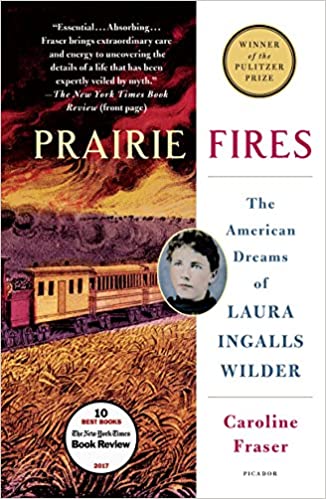
Prairie Fires – the American Dreams of Laura Ingalls Wilder, by Caroline Fraser

Why this book: As a boy and a young man, and like many young men and women then and since,  I loved reading Laura Ingalls Wilder’s books about her life growing up on the frontier.  I had read another biography of her (by Pamela Smith Hill) which provided some interesting background, but didn’t particularly grab me.  This one kept popping up on various lists of great books,  and as I was looking for a book to listen to on a long road trip, I thought I’d enjoy revisiting LIW again, so I bought it on Audible.

Summary in 3 sentences:  This is part biography of LIW, part a Life-and-Times description of America and the American West from the 1870s into the 1940s, and part a parallel biography of her daughter Rose Wilder Lane who played such an important role in LIW’s life and writing.  Because LIW’s parents play such important roles in her books, Prairie Fires begins with the lives of LIW’s parents, and their early lives in Minnesota and Wisconsin, and then moves on to the stories behind the autobiographical novels LIW wrote as the Little House series. The final part of Prairie Fires describes the last 25 or so years of LIW’s life, when she turned to writing her books, how the depression and Roosevelt’s New Deal impacted her and her daughter, their tempestuous but co-dependent relationship, and how it all fits into a fascinating period of American history.

My impressions.  Superb!   Fraser’s biography of LIW and exploration of her roots, her family and the challenges they had to overcome is a lens through which we look at the maturing of the American West from the 1870s into the first 5 decades of the 20th century.   Prairie Fires is the best biography I’ve ever read – right up there with David McCullough’s John Adams for thorough research, a life-and-times story told with sensitively, insight, empathy, and humanity. This is a book about the life of a woman and her daughter – written by a woman – but I didn’t feel like I was reading a book written “for” women.   As I got into it, I looked it up, and was not surprised to learn that it received the Pulitzer Prize for biography, and many other awards. Well deserved.

In addition to the “facts” about LIW’s life as she thoroughly researched them, Fraser is not afraid to share her own  personal views and perspectives regarding LIW’s life and decisions, decisions and actions of others in her life, and the politics of her times, for which a number of reviewers on Amazon castigate her.  Her “warts and all” look at the life of an American Icon did not please some readers. I found her editorializing fair and discerning, evident enough for the reader to sense her judgment, but not at all sanctimonious, and her perspectives are rendered with empathy and understanding.  Caroline Fraser is an amazing writer, and in addition to the fascinating story she tells, I loved listening to a master craftsman of English Language.   

Audible. I listened to the audible which was excellently rendered, but wish I’d read the book –  I can savor a great book better in print; I  can mark passages which I find particularly good, which I can’t do on an audible.  Fraser refers to a lot of pictures of Wilder and her family in her Prairie Fires, and of course, one doesn’t see those in the audible. I was hoping they’d be in the paperback, but no pics in the paper back – I am not sure about the hardback, but it doesn’t appear so.  That is a disappointment. 

Fact or Fiction.  One of the constant issues in the Prairie Fires story of LIW’s rendering of the Little House book series, was how much truth she should tell in her stories. The Little House series is listed as novels.  LIW always insisted that the stories within the books were all true, but not the whole truth. Since she was writing for young audiences, she studiously avoided much of the suffering and hardship she experienced and she didn’t include episodes or experiences which she thought might overly trouble or shock young audiences.  Her daughter actively encouraged her to shade the truth to help the books sell better, and Fraser actually found several fabricated incidents in the books, undermining LIW’s claim that it was all “true,” just not the whole truth.  It’s evident while the Little House books did include some of the hardship the Wilder family experienced, the true suffering and hardship she and her family experienced were significantly diluted in order to tell an uplifting, happy, and inspiring story.

Suffering.  In fact LIW herself and her whole family struggled and suffered a lot – much more than one would think reading the Little House books. That was one of the key messages of Prairie Fires – how indeed hard life was back then, living constantly on the edge, with little or no money in the bank, very little social safety net, vulnerable to the vagaries of weather, nefarious manipulators, the banks, the commodity markets, locust plagues as well as disease and hunger.  The Wilder family was often barely one step ahead of destitution.  Fraser makes clear that this was sometimes a result of poor decisions on the part of LIWs father – Pa in the books – an otherwise model father and all-round good guy.  LIW herself had to work for pittance pay in often unpleasant settings from the time she was about 10 until she married in order to supplement the family’s meager income, to help the whole family survive.  

Wilder’s daughter, Rose Wilder Lane.  The last half of the book is almost a dual biography of LIW and her daughter Rose Wilder Lane (RWL)   This in part because their correspondence is the source of much of Fraser’s content for the biography, but more importantly, RWL was a key collaborator and resource for LIW in editing, shaping and getting the Little House books off the ground and published.  It was RWL who inspired and encouraged her mother to write the books; she edited them for her, often improving the quality,  and provided valuable suggestions. She was also extremely mercantile and was less interested than her mother in a faithful rendering of what actually happened in her mother’s pioneering experience, ever ready to romanticize and even alter the stories to fit what she believed would best sell. In fact LIW supported much of this “white-washing” of her difficult youthful journey. 

One cannot fully appreciate LIW or her work without getting into this very complicated mother-daughter partnership.  In fact, it was often difficult for me to read about RWL and her capricious and self-serving decisions, her callously manipulation of her mother, and her calculated use of her mother’s success as springboard for her own career ends.   Fraser argued that without RWL, LIW would not have written the books she did, and they probably would not have been as successful nor as widely read as they were.  So credit given, where credit is due.  

That said, RWL’s bipolar and manic-depressive episodes caused real issues in her relationship not only with her mother, but with others in her life, and her impulsive manic energy routinely seemed to sabotage her relationships.   In her manic moments, she charged after new opportunities and new adventures, with apparently little regard for practical matters, and aggressively attacked those who disagreed with her or stood in the way of her projects.  In doing so, she spent money she didn’t have, was always in debt, and when the mania subsided, would retreat into suicidal depression.  When not depressed and blaming or feeling sorry for herself, she viciously blamed other people and institutions, and circumstances for her problems.   She also became a well known political figure in libertarian circles and a great proponent of individual freedom and independence, an opponent of government  regulation and intrusion into people lives.   

Rose Ingalls Wilder was indeed an intelligent and talented but troubled and unstable woman.  As a daughter,  as well as an agent and collaborator,  she was both a great resource and significant challenge for Laura ingalls Wilder.   The  tension between mother and daughter in the nurturing along, editing and publishing of the Little House books is an ever-present theme in Prairie Fires.  There was mutual love and respect, and at times a co-dependency between the two, but it was very often difficult for both of them.

Politics, then and now.  As Fraser describes RWL’s libertarian crusades and LIWs general agreement with her philosophy, I was struck by similarities with today’s philosophical tensions between the left and the right. Though LIW was not as strident nor proselytizing about her political beliefs as RWL, both were strong opponents of Roosevelt’s New Deal. Fraser describes how their anti-New Deal politics were part of a strong midwestern sentiment that hated Roosevelt and his relentless expansion of his and the US Government’s authority and reach.

LIW grew up in a world of small and limited government, few government programs for the poor and working people, and therefore, people made their own decisions, and were expected to live and deal with the consequences – relying on family, friends, and neighbors for assistance if needed.  Fraser offers many examples of “government men” intruding into the lives of farmers and working people, telling them what they had to do, how they had to live, because the the bureaucrats in government said so. LIW stoically believed in the basic independence and responsibility of individuals and resisted and resented governmental intrusion into their lives except to provide basic services for the common good, and to level the playing field.  RWL took that sentiment to the next level, writing editorials and books extolling the free American spirit and eviscerating New Deal and government over-reach.  The mistrust and antipathy between both sides in this debate was extreme.  Sound familiar?  

Mansfield Missouri. In Prairie Fires we learn of how the Ingalls family of Laura’s youth and later the Wilder family of her, Almonzo (her husband,)  and Rose, dealt with setback after setback, relying on friends and family to get by day-to-day,  frequently having to pack up and move to start all over again.  During the depression of 1894, when much of the country was barely surviving, LIW and her husband and daughter finally gave up trying to make a living farming in South Dakota, and left De Smet, South Dakota with little more than a horse and covered wagon to their name, and headed for Mansfield, Missouri where they settled down and lived for the next 60+ years.   In Prairie Fires we learn of life on a farm outside of a small Missouri town and how the Wilders barely scraped by for decades, until finally in the last couple of decades of their lives, they achieving some financial security, after LIW in her 60s, published The Little House in the Big Woods, the success of which spawned eight follow-on novels.

End of Life and Legacy. The final part of the book tells the story of  LIW in her 70s, and Almonzo in his 80s finally having the freedom to live without great concern for money to pay the bills.   LIW gets recognition and accolades from all over the world, and she and Almonzo are able to travel a bit by car to visit friends and family in South Dakota and even to go out to California.  As they both got older and energy waned,  these activities subsided.   Almonzo’s health begins to fail and he dies at age 92,  and LIW spends her last 10 years comfortable but in poor health, with little energy to take advantage of many offers she receives to bask in her success and public acclaim.   Living alone but with support from friends, she spent her last years enjoying her farm, answering fan male and reflecting on her life.  She died in 1957, a few days after her 90th birthday.

The last chapters of the book are about her legacy and the how her estate, inherited by RWL ended up after RIW’s death in the hands of one of RWL’s protégés, who was a lot like RWL – ambitious without conscience.  He personally profited from the Little House books for which he had done nothing, and ignored the desires LIW stated in her will  for how the long term proceeds and royalties from her work were meant to support the library named for her in Mansfield. Mo.    All of this eventually led to the Little House on the Prairie television series  in the 1970s, which, though it distorted much of LIW’s work and message, it significantly increased her popularity and readership. The stories Fraser tells of the television series are amusing and don’t reflect well on Michael Landon. 

In conclusion,  I was really impressed with this book, and in addition to learning a lot about the life of a girl I had a school-boy crush on from reading her books, I also learned a lot about America – some of the ugly truth about our frontier heritage, and life in midwest America in the later 19th and first half of the 20th century. 

Posted in Uncategorized | 1 Comment

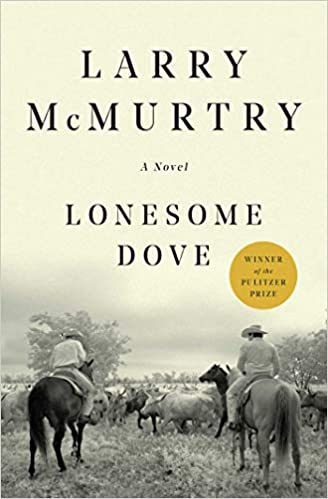
Lonesome Dove, by Larry McMurtry

Why this book I read it 25 years ago, remember loving it, though I didn’t remember the story very well. I have been wanting to read it again for quite a while, and prevailed upon my reading group to pick it for our annual long-book-over-Christmas selection.

Summary in 3 sentences Two former Texas rangers in the 1880s are living in Lonesome Dove, a small town in South Texas and decide to gather up some cattle and horses and be among the first cattle ranchers in Montana, which they’d heard was a paradise, compared to South Texas. They put together a crew and head north, finally arriving after several months on the trail.  But the story is about the rich tapestry of characters, their relationships to each other, how each individually and the group as a whole confront the various hardships and challenges along the way, and how the characters grew and evolved.

My Impressions: What an Epic! Reading it for the second time, I realize that there is so much in Lonesome Dove beyond “merely” a great story.   Friendship, Love, romance and sex (it is decidedly NOT pornographic,) human resilience, good and evil, the history of the American Frontier and the courage and adaptability of those intrepid pioneers who chose to venture into ungoverned and often lawless territory,  inhospitable terrain and climate,  where criminals roamed and often acted with impunity.    There was still a threat of hostile, Native Americans, wild animals, raging rivers, bugs, snakes, critters, and many more threats and challenges.   I  loved this book the first time, and even more the second.

The characters are interesting – some unforgettable, and we get to know them almost as if we were with them on the cattle drive

It’s a book written by a man focussing primarily on a group of men, mostly young, a few more mature,  working and living together on a mission which many don’t understand nor particularly believe in – moving a herd of cattle and horses from south Texas to Montana. They are there for a variety of reasons – adventure, the pay, or because they don’t have anything better to do.  They are confronted with a wide variety of unexpected and harrowing challenges in the months their cattle drive takes – and in the process several lose their lives. 

And because it’s a man’s book about men, there is a lot in it about women – since women are very much the focus of men’s thoughts and repartee.   There are weak and strong women in the story as well, arguably the strongest character in the books is a woman – the love interest of (arguably) the most interesting male character in the book – but she won’t have him. 

This book is a great story – but the theme is the strengths and weaknesses of men and women without many choices in a primal often hostile environment and where survival is often a day-to-day struggle,  and they must depend on each other to survive. 

Without giving away some of the key  events of the story, here are a few areas I found most interesting: 

The Two Protagonists – Woodrow Call and Augustus (Gus) McCrea  are the leaders of the men and the cattle drive. They are a more mature experienced pair of old cowboys who were partners in the Texas Rangers during the settling of Texas in the 1860s, and 70s.  They are very different from each other.  Gus is very relaxed, enjoys his whiskey, women, relaxing, thinking and talking, and is curious and humorous. Call is stern, stoic, duty driven, mission focused, has no impulse toward fun and prefers to be alone.  They chide each other constantly, like an old married couple, but there is HUGE trust between them – that is evident anytime there is a real problem or challenge. And they don’t/won’t let each other down.  This makes for a fun pairing. There is much to admire in each of them, and while I didn’t find anything particularly distasteful in either of them, they each had qualities that I would have difficulty calling “virtues.”  “The men looked to Call for orders, and got drunk with Augustus.”

Two other very interesting and important male characters in the novel are Jake Spoon and Newt. But you’ll have to read the book to explore the roles they play.

The Three Wise Men  There are three men in the story who seem to remain emotionally detached from the day to day chaos and challenges that others in the story struggle with but are key enablers to the success of the men.  When things got tough, those around them expected each of these three  to have a reasoned and healthy perspective and each could be counted on to do the right thing.   And each of these is a non-Anglo outsider.  Deets is an African American, trusted and even admired by all – which causes a bit of cognitive dissonance in some of the men.    Po Campo the cook on the drive is Mexican with an almost shaman-like wisdom and connection to nature.   Cholo an older (70s?) Mexican ranch worker who is a quiet and steadying presence helping Clara with her horse ranch and to deal with the challenges that arise for an isolated single woman running a ranch.  It is interesting that each of these would be considered among the more admirable characters in the novel, and none were part of the mainstream Western cowboy culture. 

Three Women  Though the book centers on men and their thoughts and actions, there are three women who have center stage in the epic. Lorena, a simple good hearted,  tough and resilient woman, who is regarded by nearly every man who sees her as the most beautiful woman they had ever seen.  Lorena is a prostitute, In the vernacular of the time, a “whore,” which she deals with be remaining completely emotionally detached from men.  Until….  Elmeira, a former prostitute, who after impulsively marrying a quiet, naive, and very unworldly  sheriff,  remains drawn to the dark and wild side. And Clara, one of the strongest and most independent characters in the book, the long time love interest of Gus.   Clara runs a horse ranch in Nebraska while taking care of two feisty daughters.

The banality of Sex  There is a lot of sex in the book, but it is not related to love, nor is it erotic.  It is what cowboys seek when they have a bit of money and time to go into town, to drink, play cards and find a whore.  Sex for most of them is a transactional event, a “poke” which whores do to service the cowboys or other men.  There is one scene whereby the young (teenage) cowboys go into town to have their first experience of sex with the whores working in a saloon.   It’s comic, banal, and decidedly not erotic.  Sex is something the men compulsively want,  and which some women do for them – for money, or to lure men into marriage, and after marriage, to have children and perhaps to keep the man at home.  There is only one woman in the book who seems to have sex for fun – a highly charged, somewhat unhinged whore who one of Gus and Call’s cowboys temporarily shacked up with. The concept of “love” was not associated with the act of sexual intercourse in Lonesome Dove.

Evil and Empathy The characters McMurtry gives us in Lonesome Dove are multi-dimensional and very human.  Each has their faults and strengths.  There are only three men who are clearly evil, and in whom we see no redeeming qualities – Blue Duck, a renegade Comanche, Dan Suggs a scheming and evil criminal, and Dixon, an arrogant scout who tries to take Dish’s horse. Otherwise, it was easy for me to appreciate and often admire the various characters, to empathize with their failings and their struggles to overcome challenges and difficulties, usually of their own making. 

Marriage, love, and infatuation. Marriage gets a bad rap in Lonesome Dove. We don’t see any marriages that we can admire, and few of the men aspire to the domestic life of a married man, not while there was fun, adventure, and good times to be had with one’s buddies, and whores were readily available for sex, for just a few dollars.  There was a lot of infatuation in the novel though,  which was routinely confused with love –  Dish for Lorena; Lorena for Gus, Elmeira for Joe Boot. Xavier and Lippy for Lorena,   July for Elmeira and Clara, Gus for Clara, even Clara for Gus….  None of these infatuations were given an opportunity to mature into “love” as I understand it, though there were a couple that I believe had potential.  My good friend Yolla pointed out to me that several of the unrequited infatuations in this novel showed how such disappointments can damage or even devastate a life – if the individual is not mature or otherwise equipped to deal with the disappointment of unfulfilled dreams.  

In my opinion, one of the most interesting sub-themes in Lonesome Dove was the relationship between Gus and Clara – which included elements of both infatuation and what I would call love.  The TV miniseries emphasizes their attraction for each other – certainly her attraction to him a bit more than the book.   But it seems they both ultimately realized that being married probably wouldn’t have worked – in that “successful” marriages require compromises and other dimensions apart from being “in love” that they may not have managed well.   

Life, Death, and Meaning The story begins with the characters living a squalid, boring existence in the small South Texas town of Lonesome Dove, and through a strange series of events,  become engaged in a major cattle drive for over two thousand miles into Montana.  The cattle drive and making it to Montana was a goal – but the characters had no real vision beyond that beyond Call wanting to be the first cattle rancher in Montana.  For Gus, it was an excuse to see Clara again, and an adventure.  For most of the men, the drive had no real meaning other than to get there and survive. There was little thought given to what it would mean to get there, and what that goal was in service of.  A number of the characters in the novel lost their lives along the way – and death became a constant companion.  Life was life and had inherent value – death was not so mysterious when it was such a constant presence – but it was feared.  Much of the death was just the result of accident, serendipity, and bad luck.  There was no overriding redeeming value in the cattle drive or the deaths that occurred along the way. It was something  most of the men just fell into, some people made it some didn’t ….and then what?  

The Lonesome Dove 1989 Television mini-series, available in the library or (to rent) on Amazon Prime, is unusual in that it indeed seeks to stay pretty close to the book and is very well done. It is altogether over 6 hours long and very much worth the time. The casting is quite good, starring Robert Duvall as Gus, Tommy Lee Jones as Call, Diane Lane as Lorena, Danny Glover as Deet, and Angelica Houston as Clara, but unlike most films based on novels, I believe this one is best appreciated after reading the book and I recommend a bit of a break between the book and the mini-series.  

The language of the West I loved how Lonesome Dove is written – McMurtry’s language is simple and profound, and fits the setting about which he writes.  Great wisdom is mixed in with the colorful and simple language of the cowboys, in their repartee with each other and their descriptions of what they see, describe and think.  Here are a few examples: (page numbers from my old beat-up paperback edition I include only for my own reference) 

Gus would rattle off five or six different questions and opinions, running them all together like so many unbranded cattle.  11

Gus:  “Call’s got to be the one to out-suffer everybody, and that’s the pint.  Glory don’t interest Call. He’s just got to do his duty nine times over or he don’t sleep good.” 26

Looking at Lorena was like looking at the hills. The hills stayed where they were. You could go to them, if you had the means, but they extended no greeting.   45

Jasper had a mustache not much thicker than a shoestring and a horse not much thicker than the mustache. 175

Deets had known several men who blew their heads off, and he had pondered it much. It seemed to him it was probably because they could not take enough happiness just from the sky and the moon to carry them over the low feelings that came to all men.  204

Gus: “Jake was up to being Jake. It’s a full-time job. He requires a woman to help him wih it.” 298

Gus to Call:  “If you got enough snakes around the place, you won’t be overrun with rats or varmints….Me and you done our work too well. We killed off most of the people that made this country interesting to begin with.” 349

Gus: “It ain’t dying I’m talking about, it’s living.  I doubt that it matters where you die, but it matters where you live.”  389

They stared at Roscoe and Janey, silent as owls. 439

In the morning they were right where they had gone to sleep, wet as muskrats but ready to drink a pot of coffee. 463

Call began to wish that somehow things could have been rounded off a little better. Of course he knew death was no respecter.  People just dropped when they dropped, whether they had rounded things off or not.  512

Gus: “Yes, but what’s good for me ain’t necessarily good for the weak minded.” 698

All of them envied him because he had a woman and they didn’t.  He envied them back, for they were carefree and he wasn’t….He would be lucky to get again such easy pleasures as the men enjoyed, sitting around a campfire swapping jokes. 722

Gus:  “It’s hard to enjoy a metropolis like this if you’ve got nothing but your hands in your pockets.” 743

He had seen many men die of wounds, and had watched the turning of their spirits from active desire to live, to indifference. With a bad wound, the moment indifference took over, life began to subside…most lost all impulse toward activity and ended by offering death at least a half-hearted welcome. 866

Gus about Call: “It wouldn’t be his way, to mention it. Woodrow don’t mention nothing he can keep from mentioning. You couldn’t call him a mentioner.” 833

Gus to Call on leadership:  “It ain’t complicated.  Most men doubt their own abilities. You don’t. It’s no wonder they want to keep you around. It keeps them from having to worry about failure all the time.”863

They were a young couple with two or three children peeking around them, narrow-faced as young possums. 941


Posted in Uncategorized | 1 Comment

By Honor Bound – Two Navy SEALs, the Medal of Honor, and a Story of Extraordinary Courage, by Tom Norris and Mike Thornton with Dick Couch

Why this book: I know both Tom Norris, Mike Thornton, as well as their co-writer Dick Couch.  I was interested in getting more of the details of their stories, which I thought I knew pretty well.  Indeed I learned a lot – there was much more to their stories than I knew.  

Summary in 4 sentences:  These are two inter-related Medal of Honor stories – in that Tommy Norris was a key player in each, and Dick Couch knew both of these men well and had served with them.   The first of these stories is Tommy Norris’s, how he went into enemy controlled territory 3 times to rescue downed aircrew near the end of the war when North Vietnam was rapidly consolidating its control over what was then South Vietnam. The second story takes place several months later, when Norris and Mike Thornton are leading a group of Vietnamese SEALs on a reconnaissance mission which for a number of reasons, goes bad. As they are trying to exfil under fire, Norris is shot in the head, left for dead by the Vietnamese, but Thornton fought his way back to Norris, engaged the enemy, and was able to get him to the beach and swim him out to ships off the coast. 

My Impressions: Not just a great historical look at operations during the final years of the Vietnam War, but a great true story of American heroes in action.  By Honor Bound provides an excellent perspective of what life was like for SEALs in Vietnam toward the end of the war, as well as offering great first person accounts of two operations that are legendary in the SEAL Teams.  Tommy Norris and Mike Thornton are living legends in the SEAL community, not only for the missions described in this book for which each was deservedly awarded a Medal of Honor, but for their lives since. 

Dick Couch had been a SEAL officer himself in Vietnam and had gone thru SEAL Training with Tommy Norris. He does a great job providing context to Tommy’s and Mike’s stories, explaining what was happening in Vietnam at the time and how the missions they conducted fit into other operations and the overall strategy of US efforts to keep North Vietnam from overrunning the South.   I grew up in the teams reading and hearing about these and other Special operations during this time window, but the context Dick provides between and around Mike’s and Tommy’s narratives added a lot of clarity to my understanding of their actions as well as this very tumultuous period of the war.  

The book was broken into four parts:  

Part 1 entitled “Bat 21” was Tommy’s story of one failed attempt and two successful rescues of downed aircrew who were deep in enemy controlled territory in Vietnam.  These were extremely dangerous missions, and highly unlikely successes, given the conditions, and the concentrations of enemy forces in the are around the men he rescued.  Tommy was fiercely committed to rescuing these Americans  – his focus, fearlessness, and tactical acumen are remarkable, even among Navy SEALs.   Tommy was preparing to rescue a third crewman when it was learned the crewmen had been discovered and killed by the North Vietnamese.  Afterward, Tommy then went on to continue serving as an experienced SEAL lieutenant in charge of other SEAL operations in Vietnam.

Part 2 is entitled “Not without my Lieutenant,” and transitions to Mike’s story – and of course Tommy was a thread that connected these two stories together. Tommy was in charge of the SEAL operations running out of their base, and insisted on going on this mission, and selected Mike to go with him and the other Vietnamese SEALs.  Both Mike and Tommy provide their inputs to preparations for the mission for which Mike was awarded his medal, describing the insertion, realizing they were inserted on the wrong beach, how they were discovered by the North Vietnamese, how Tommy was shot and how Mike went back to rescue him as the enemy was closing in on his position.  It also begins the story of Tommy’s long road to recovery after being shot in the head and losing his left eye. 

Part 3, entitled  “The Award and Life After the Award” is each of them telling  their stories of receiving the Medal of Honor, and then their lives and careers as Medal of Honor recipients after Vietnam. Tommy describes his multiple operations and years of treatment, the after effects of losing a piece of his head and brain, and learning to live with only one eye.  And then how he was able to enter the FBI and became a valued member of their elite Hostage Rescue Team,  describing some of the undercover FBI operations he participated in.   After 20 years of service in the FBI, he retired to a farm in northern Idaho.  Mike stayed in the Navy and continued to serve in the SEAL Teams, eventually getting commissioned and serving as an officer in the Diving and Salvage branch of the Navy.  Since retiring, both are quite active in the Medal of Honor Society, speaking at engagements and inspiring young and old around the nation. 

The fourth part is brief – entitled “Epilogue” in which Dick Couch shares some of his thoughts on writing this book, his own friendship with and impressions of these two very different men. Dick accurately describes Mike as having a presence and personality so large he has his own weather (!), and Tommy as the quintessential quiet and self-deprecating hero.  Mike and Tommy have remained very close over the years, and have continued to serve and take care of each other for nearly 50 years.  In this epilogue, Dick provides bit of an addendum to Tommy’s and Mike’s stories.  

This is a relatively short and very engaging read and a great story of American heroism in war.  I read the paperback, but I’d recommend purchasing hardback version – the quality of the pictures in the paperback version is poor – one can hardly recognize the people in the pictures, whereas the hardback pictures are glossy and add a lot to the story. 

Posted in Uncategorized | Leave a comment

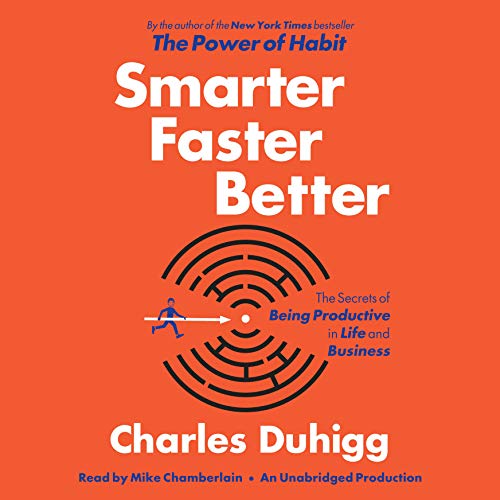
Smarter, Faster, Better, by Charles Duhigg

Why this book: Selected by two reading groups I’m in, based on Jay’s recommendation and the outstanding reviews of Duhigg’s Power of Habit.

Summary in 3 sentences: Duhigg was personally struggling to be well enough organized and motivated to be as productive as he felt he could/shold be,   and wanted to explore ways to improve his own productivity.  He decided this was a common problem, and decided to explore solutions that went beyond the good habits he’d written about in Power of Habit, so researched what had worked for others to see if their tools might work for him. He broke his findings and discussion into 8 chapters: Motivation, Teams, Focus, Goal Setting, Managing Others, Decisions Making, Innovation, Absorbing Data, and he concludes with an Appendix which shares how HE used these lessons. 

My impressions. An enjoyable, interesting, and easy read, with a number of great stories to help make his points and back up his arguments.  He offers eight major tools for improving productivity and success in one’s endeavors, explored in eight separate chapters.  These tools were not new to me, but in his exploration of them, he offers insights and perspectives based on his extensive research that are worthwhile to read and to reinforce  important lessons I’ve gotten from experience of other sources.  A few new ideas for me – particularly in the innovation and absorbing data chapters.    He concludes with an appendix  on how he personally has used each of these to help him in his own struggles to be more productive in a world full of chores and other distractions.  

The common themes he addresses are eternal and deserve repeating and revisiting – and Duhigg does a good job with the story telling and making the points relevant.   My main objection to the book is that, other than a series of success and failure stories that supported a desire to have more success, less failure, and be more productive, I failed to find a strong thread that tied the whole book together.  Also there were fairly significant overlaps between the chapters – for example much that he shared in focus, and motivation, could also have been included in decision making.  But that didn’t lesson the value of the ideas.  That said, I believe it is an excellent book to introduce and generate discussion with those new to leadership management literature.  A great book to review chapter by chapter among leaders within an organization.

It is very well researched.  Though I didn’t spend a lot of time exploring the extensive notes at the back of the book, the time I did spend was fruitful.  For the serious student of these concepts, spending sometime in the notes, reviewing his research and amplifying notes to the chapters will be of considerable interest.

Below are what I found to be the key insights and take-aways,  I got from each of his chapters with a few quotes: 

CHAPTER 1: MOTIVATION:  He introduces the concept of “Locus of Control”  – everyone wants to feel like they have some control over the factors that impact their lives, and he says that leaders understanding that is key to motivating their people.    It’s the difference between compliance-based cultures – where people just do what they’re told, and commitment-based cultures, where people are personally invested in what they’re doing, because they believe they had a voice in the decisions, and could influence their destiny through the choices they made. 

If you want to motivate people, give them a sense that they have some control.  It makes people believe that good results are a result of their decisions.  If they don’t feel like they have a voice, they often take control by passive aggressive behavior, or even aggressive acts of defiance. 

Interesting stories –

  • USMC bootcamp changes designed to develop greater initiative and buy-in to decisions in young marines.
  • Defiant nursing home residents 
  • An extremely driven auto-parts tycoon becomes apathetic and his wife helps bring back his motivation and energy.

Quotes:

  • “Make a chore into a meaningful decision and self-motivation will emerge.” p30
  • “Small acts of defiance were psychologically powerful because the subversives saw the rebellions as evidence that they were still in control of their own lives.”  p32
  • “People like Robert don’t lose their drive because they’ve lost the capacity for self-motivation. Rather their apathy is due to an emotional dysfunction.  They don’t feel anything.”  p35

CHAPTER 2: TEAMS: Great teams encourage and love each other’s crazy ideas – and people are supportive of each other even when they disagree. Duhigg argues that the most important thing in successful teams is the “How” they function, not “who” is on the team.  In great teams people talk about how teams “felt.”  He discusses the how of developing group norms, and creating non-punitive environments that make people more willing to take risks and admit mistakes.  Duhigg talks about developing “psychological safety,” that allows people to feel free to disagree.  

This chapter discusses “team intelligence” which is greater than the sum of the IQs of its members,  and he notes that many teams with lots of intelligent people make dumb decisions.  He notes how the team’s norms bring people together, and these norms,  not the individual people, make teams intelligent. But there is not a one-size-fits-all set of norms that optimize team performance – they must evolve and adjust to the chemistry of each individual team.

He points out that in meetings, all member of good teams spoke roughly the same proportion, and had high social sensitivity – meaning they were skilled at intuiting how members felt based on their tone of voice,etc. And good teams also contained more women.  The best teams have leaders who model the norms of listening and social sensitivity – they demonstrate behaviors that develop psychological safety.   In great teams, the whole team is rooting for each other and each person feels like a star.

Lazlo Bock (Google) listed five key norms of the most effective teams:

  1.  People in the team feel that their work is important;
  2.  Their work is personally meaningful;
  3.  They have clear goals and defined roles;
  4.  Members can depend on (trust) one another;
  5.  There is a sense of psychological safety

Interesting stories:

  • Saturday Night Live – how the team was formed, and got great results even through tension and disagreements,
  • Google – Lazlo Bock and how the team works is more important than who’s on the team.

Quote:

  • “During meetings, some team leaders at Google make checkmarks next to people’s names each time they speak, and won’t end a meeting until those checks are all roughly equivalent. p70 
  • And as a team member we share control by demonstrating that we are genuinely listening – by repeating what someone just said, by responding to their comments , by showing we care by reacting when someone seems upset or flustered rather han acting as if nothing is wrong.”  p70

CHAPTER 3: FOCUS:  A person’s attention span is like a spot light that can go wide and diffused or tight and focused. Our brains automatically seek out opportunities to disconnect and unwind. “Cognitive tunneling” can cause people to become overly focused on whatever is directly in front of their eyes, or become preoccupied with immediate tasks.  When we do cognitive tunneling, we lose the big picture and can miss key indicators that are outside the tunnel – key indicators that can save our lives.  

“Reactive thinking”  is a cousin – automatically reacting in ways we’ve repeatedly trained – reacting without thinking.  While this can often be a valuable tool, automatic reactive thinking can also overpower our ability to use our judgment to make the best decision for THIS particular scenario. 

Our most important decision in life is what we choose to pay attention to.

Interesting stories:

  • Air France Fit 447, as an example of cognitive tunneling, and
  • A good counter-example from an airplane that would have crashed, had the pilot not pulled back and looked at the big picture.

Quotes:

  • “We need to stop focussing on what’s wrong and start paying attention to what’s still working.” p98  
  • “We have to make decisions and that includes deciding what deserves our attention.” p102

CHAPTER 4: GOAL SETTING:   He discusses the psychological need many of us have for “cognitive closure” – the desire for a confident judgment – to reach a “final? conclusion that avoids ambiguity and confusion.   The decision is made.  Though it can be a strength, it can also trigger close mindedness, authoritarian impulses, unwillingness to consider new facts or input.  The instinct for decisiveness can make us blind to details that should give us pause.  

He describes how GE developed the SMART goals approach to systematize goal setting, but Jack Welch also demanded that executives identify stretch goals – a desirable goal so ambitious that it was hard to describe HOW to achieve it. Yet   “for a stretch goal to inspire, it often needs to be paired with something like the SMART system.”

Interesting Stories:  

  • Yom Kippur War – the intel officer w “cognitive closure” ignored the signs that things had changed.
  • How and why General Electric developing SMART goals to organize the goal setting process, and then how and Jack Welch then developed the concept of stretch goals.

Quotes:  

  • “It feels good to achieve closure. Sometimes, though, we become unwilling to sacrifice that sensation even when it’s clear we’re making a mistake.”  p109
  • “If you’re being constantly told to focus on achievable results, you’re only going to think of achievable goals. You’re not going to dream big.” p122

CHAPTER 5: MANAGING OTHERS:  In this chapter Duhigg outlines five different   cultural models he’s seen in organizations:

  1. The Star model built around hiring from elite universities or prestigious companies and give them lavish perks;
  2. The Engineer model – anonymous engineers solving technical problems; 
  3. Bureuacratic model -many middle managers with clear directions, charts, handbooks, charged w following and enforcing rules;
  4. Autocratic model –  built around the desires, goals, vision of one person – usually the founder or CEO;
  5. Commitment model – prioritizes creating a strong culture with committed employees over other priorities such as designing the best product.  

Research shows that the only one of these models that is a consistent winner is the commitment model. 

Managing others begins with hiring.  When you choose employees slowly you have time to find people who excel at self-direction – a key requirement for a commitment culture. That also allows the leader to decentralize decision making – which  speeds up progress and inspires the work force.  The best leaders devolve decision making to the employees that are closes to the problem – giving them great say in how it is solved.

By giving employees more say, they open the door, and create the right conditions for great ideas to be explored and to take root. But that requires experimentation and allowing for mistakes.  The biggest misstep is when there is never an opportunity for an employee to make a mistake. 

For example Pixar and Toyota succeeded by empowering low-level employees to make critical choices.  Similarly in healthcare, there has been a movement toward giving more authority to nurses and other non-physician health workers – this is referred to as “lean healthcare.: 

Interesting stories:

  • Solving a kidnapping crime by using a more effective team approach
  • General Motors setting up a car company in Fremont Ca, using Toyota management methods. 

Quotes:

  • “Employees work smarter and better when they believe that have more decision making authority AND when they believe their colleagues are committed to their success.” p165  
  • “In the end, the rewards of autonomy and commitment cultures outweigh the costs.  The bigger misstep is when tehere is never an opportunity for an employee to make a mistake.” p165

CHAPTER 6: DECISION MAKING:  This chapter spends a lot of time on Annie Duke’s approach to decision making as a bet – that every decision has uncertainty built into it,  and the decision is a bet that it will achieve the desired outcome.  He describes thinking “probabilistically”- that is, questioning assumptions and accepting uncertainty.  “Losers are always looking for certainty.  Winners are comfortable admitting to themselves what they don’t know.”   Just as every decision is a bet, it is also a prediction – of the outcome of that decision.  So predicting well is also a key aspect of decision making – but you have to start with the right assumptions if your predictions will work out for you. And those assumptions have to recognize and accept uncertainty to work.

Good decisions demand having realistic assumptions and accepting a realistic assessment of risk.  Making good choices relies on forecasting the future, and accurate forecasting requires research that exposes us to as many examples of both successes and disappointments as possible. (p196)  Many successful people spend a lot of time studying failures – to better understand mistaken assumptions and where uncertainty lies. 

Interesting story:  Annie Duke’s Poker playing background

Quotes: 

  • “Probabilities are the closest thing to fortune telling, but you have to be strong enough to live with what they tell you might occur.” p188
  • “A lot of poker comes down to luck, just like life. You never know where you’ll end up…You have to be comfortable not knowing exactly where life is going. p203

CHAPTER 7: INNOVATION:

This chapter is about fostering a creative process in an organization.  He points out that most creativity is combining old and often conventional ideas, concepts and practices in new and untried ways.  That process is usually facilitated by a certain degree of stress or tension, that forces people to throw out old ideas and try out new ones, in order to solve a problem.  This is referred to as “creative desperation” – when necessity pushes people to try something really different.   Idea brokers are those who facilitate cross-fertilization of ideas that may be conventional in one setting, and then applying them in a new setting to achieve a breakthrough result. 

The creative process is built upon failure – learning from mistakes and trying new ideas that don’t quite work and then figuring out why. “Every wrong step gets us closer to  what works.” 

Sometimes the best way to spark creativity is to disturb the status quo just enough to open the door to new thinking.  Disrupt the teams dynamic just slightly – changing settings for work, or roles of key players, or one or two of the key players – that might be just enough to stop everyone from spinning in place.     

For a leader to become an idea or creative broker they must 1.Look to their own life for creative fodder – be sensitive to their own experiences; 2. Add a bit of urgency or stress to force people to see old ideas in new ways; and 3. Maintain some distance form what they create, so as not to become blind to alternatives. 

Interesting Stories:  

  • How Disney developed the animation film Frozen
  • How the West Side Story became a paradigm busting success
  • How forests evolve and new plants can thrive when there is an opening – a slight disruption, which enhances bio-diversity

Quotes:

  • “Creativity is just connecting things.” Steve Jobs p223
  • “You have to be willing to kill your darlings to go forward. If you can’t let go of what you’ve worked  so hard to achieve, it ends up trapping you.” p227
  • “When strong ideas take root, they can sometimes crowd out competitors so thoroughly that alternatives can’t proper.” p231
  • “People who are most creative are the ones who have learned that feeling scared is a good sign.   We just have to learn how to trust ourselves enough to let the creativity out.”  p237

CHAPTER 8: ABSORBING DATA:

This chapter is really about how to deal with information overload, and explores how to organize, and harvest good decisions from unwieldy amounts of data.  He points out that our brains prefer to organize options into 2 or 3 possible options for decisions – which is a challenge when confronted with a large amount of information.

He offers examples of how to engage employees, teachers students with a lot of data,  and thereby help them distill it into practical applications.

He also shows how cognitive tunnelin and becoming attached to binary yes-or-no options blinds us to alternatives or 3rd of 4th alternatives,  He also describes how so many people are unable, or unwilling to seek to understand an opposing viewpoint or position, they are so entrenched in what they believe is right. 

And he concludes the chapter with examples of how people will retain and use information best if they force themselves to think about it, explain it, apply it in some way in their lives.  This helps us create the mental folders, or what he calls mental scaffolding allowing us to build upon the lesson, the information, the new data.   Which is also the lesson he teaches us in his Appendix.

Interesting Story:

 Cincinnati school systems spent huge resources to examine why students were failing w minimal results, until an experimental program taught teachers how to better utilize the extensive data to change their approach to teaching.

Quotes:

  • Our ability to learn from information has not necessarily kept pace with it’s proliferation. 243
  • The “engineering design process” forced students to define their dilemmas, collect data, brainstorm solutions, debate alternatives approaches, conduct iterative experiments….until an insight emerges.  258
  • When we encounter new information and want to learn from It, we should force ourselves to do something with the data 265

Appendix: A Reader’s Guide to Using These Ideas.

This chapter is a personal note from the author and offers practical advice about how to implement the lessons in chapters 1-8.  He provides several examples of how he struggled with writing this book, and then decided to follow his own advice, and then he tells us HOW he used the insights in his book to help him with motivation, goal setting,  focus, decision making, etc. 

He also provides brief and useful summaries of the chapters on teams, managing others, innovation, and absorbing data.   He concludes with a story of how he spent months researching an example of a man with a fanatic devotion to an idea (shipping containers) which ended up changing the world for the better.  But he didn’t include it because it didn’t fit with the message he intended.  He gave up his “darling.” 

For someone who just wants the bottom lines and the condensed version of Smarter Faster Better, reading the Appendix will offer that, without the stories and the examples to back up his points.


Posted in Uncategorized | 1 Comment

The Plague, by Albert Camus

This is the copy I read, after sitting on my shelf for decades, waiting, waiting…

Why this book: I’ve had it on my bookshelf for decades.  When my good friends Gary and Patsy told me they’d read it and found it insightful, esp during our pandemic, I decided that it was time to finally read it. Glad I did.

Summary in 4 Sentences.  This is a novel built upon real plagues that have happened in the past.  In this novel taking place in the mid-20th century, the large town of Oran on the coast of Algeria, is gradually and then overwhelmingly struck by the bubonic plague. The story is about how several individuals and the entire town respond to the increasing virulence of the plague, first with denials and a fumbling governmental response, and then a realization that this was a critical issue that required dramatic steps which included quarantining the entire town, suspension of most normal daily activities, and finally with the plague subsiding, the attempt at resumption of normal living.  The novel takes place entirely in Oran, and tells the stories of several individuals stuck in the city, dealing with it as best they could,  the central figure being a doctor who is busy 18+ hours a day helping individuals, working with authorities, and struggling with his own feelings and responses to the tragedies he encounters.

My impressions: A very powerful book, and a classic for a good reason.  Reading this while the COVID pandemic is on the rise in the US and around the world (Nov/Dec 2020),  it is tempting to see The Plague as a prescient book about pandemics.  The responses of the people and the government in Oran described in The Plague are very similar to what we have experienced in the US, as we (people, State and Federal governments) have fumbled through our responses to the Coronavirus.  But as the book concludes, Camus makes the reader aware that the book is really more about how people react to crises and death, and how these threats that upset their daily lives make clear their humanity and their true values.

Living in a quarantined city, there was no escape, and little that the outside world could do to help them – the people of Oran were largely on their own to deal with the plague as best they could. His description of people cut off from the rest of the world, their forced inactivity as the shops and businesses closed and the economy shut down, their sense of being prisoners  in their own homes, the doctors and health care workers exhausted and overwhelmed, and also becoming victims of the plague – is eerily familiar to someone reading this during the 2020 coronavirus pandemic.   The Plague tells a story I feel like I’m living in Covid, USA, seeing the increasing fear and helplessness as the death toll continues to rise,  the futility of efforts to halt it, and the rebellion of many against strict measures that the government put in place in an effort to control it.

It is similar to extended combat. As I read The Plague, I was struck by how much people’s responses resembled how soldiers respond to extended combat, being constantly exposed to death, dying, and the ever-present threat of death.  Camus anthropomorphizes the plague as a powerful “enemy” –  clever, devious and resourceful, and the fight against it resembling a military campaign.  Like soldiers in extended combat against an overwhelming and powerful  enemy, the people of Oran eventually took on a defeatist attitude, were mentally exhausted,  became emotionally numb and detached, no longer felt or exhibited any real joy or happiness. Many sought to escape into short term pleasures of alcohol, promiscuity or other excesses.  Eventually even hope began to die, as month after month they were exposed to relentless death and dying, delivered randomly, not respecting rank, wealth, or character.    Gallows humor, apathy, resignation and torpor, and eventual cynicism toward hope became the standard fare in Oran; these are also often characteristics of soldiers in extended and unrelenting combat, away from their loved ones, afraid to look to the future, afraid to hope that they’ll survive.

The central character in the novel is Dr Rieux, a competent, reserved, thoughtful, dedicated physician, doing all he could to help his patients.  He was fully aware that there usually wasn’t much he could do to save those who were afflicted.  And he also became aware how over time, and with increasing exhaustion, he also became numb to the suffering he saw and lost much of  his compassion and ability to feel.

All of the primary characters in the book are men living far away from the women they loved, so they sought comradeship and connection with each other. The center of this circle of characters is Dr Rieux, and his circle included the thoughtful, the eccentric, the conniving, the frustrated, the romantic,  the desperate, and confused.  And these very different men connected with and supported each other.  The need for human connection in times of crisis is a key theme in the book – even as our characters lose the emotional capacity to truly give of themselves or even feel great affection.  We see the importance of men’s need for love and intimacy from their wives or lovers, and how even that need can fall victim to having one’s emotions worn down by months of merely trying to survive – day after day. The plague was “all the more potent for its mediocrity.  None of us was capable any longer of an exalted emotion; all had trite, monotonous feelings.”  Women unfortunately do not play a prominent role in the novel, except as supporters and lovers of the men.  Several of these women we see only in the imaginings and memories of their men, as they reside outside of Oran.  The one exception is Dr Rieux’s mother, who is the steady presence of love and wisdom in his life, as he struggles to serve others during the plague.

The plague caught everyone by surprise.  In “normal” times, most people live as if nothing will ever change, and almost robotically go through their lives, as if  the simple patterns and routines of their lives will go on forever.   But this stable predictability is an illusion, and can lull us into a state of complacency.  In The Plague Camus makes the point that sometimes, in order for people to appreciate the simple pleasures and joys of life, it takes a catastrophe to wake them up.   His opening chapter describes Oran as a town where “ you can get through the days without trouble, once you have formed habits.  And since habits are precisely what our town encourages, all is for the best…glamorless, soulless, the town of Oran ends by seeming restful and, after a while, you go complacently to sleep there.” So much is taken for granted that shouldn’t be.   It took the plague to wake people up.

Here are what I saw as some of the key themes of the book;

Duty is a subtle and occassionally explicit theme in the book.  When Dr Rieux is asked, or asks himself how and why he carries on almost helplessly in the face of so much suffering and defeat, he simply reminds himself and others that he has no other choice but to carry on.  Knowing how much suffering there is, and how futile so much of what he does is, he sees carrying on and doing the best he can as the only reasonable option, and it is his best defense against giving in to despair.  He refuses to think too much about the suffering and tragedy he sees.  He just carries on, doing what he can.  His example inspires several of his companions, to get engaged and do what they could as well, even though it often seemed fruitless.

Heroism  Camus through Dr Rieux downplays and deflates the idea of heroism and the heroic ideal at several places in the book.  Simply doing what one must, doing one’s duty is, he claims, not “heroic.”  This is a theme I’ve frequently heard Medal of Honor recipients repeat when they talk about their actions – they insist that they are not heroes, but were simply doing their job as they understood it, and that most of their comrades would have done the same. And they were lucky.    Rieux refers to one of the least “heroic” individuals in the book (Grand) as the embodiment of “quiet courage” who when asked to help with the sanitary group and put himself at greater risk of infection, “said yes without a moment’s hesitation and with the large-heartedness that was a second nature with him.”  Elsewhere in the book, Camus says that “a little goodness of heart and a seemingly absurd ideal.. render…to heroism the secondary place that rightly falls to it, just after, never before, the noble claim of happiness.”   And later, one of the other main characters says, “I don’t believe in heroism… what interests me is living and dying for what one loves.

Love The tragedy of the plague also stresses and casts a different light on “love.”   The power of romantic love is expressed in the distress of one of the characters, who initially, will do anything to get back to his fiancé and lover – but even that love is set aside in response to a greater sense of duty, and takes on a different hue after the plague has run its course.  The love of good friends – very similar to comrades in war – is explored, and how men are often loath to express how important they are to each other – in fact often not realizing it until it’s too late.  Rieux’s mother’s love and the love he returned to her – was unexpressed, but understood in glances and mutual affection and commitment. We see how love is affected, even “infected” by the stress of constant fear, and the threat of death and loss.  In The Plague, love is a constant, and clearly the apogee of human connection, AND we see the challenge of sustaining it under great stress and fear, as people pull into themselves in their concern for their own fate.  But he concludes that “if there is one thing one can always yearn for and sometimes attain, it is human love.”

Religion and God. Camus was an athiest, yet one of the most powerful characters in the book is Father Paneloux, a Jesuit priest in Oran.  As the plague picks up momentum, Father Paneloux gives a sermon in which he argues that Oran deserved the plague, that it was God’s punishment for the sins and indulgences of those who live there.   Many of his parishioners felt that they were being “sentenced for an unknown crime.”   As ridiculous as this argument may sound, Camus does not make Paneloux into a caricature of a fire and brimstone preacher – rather he treats him with great  respect.   In spite of this absurd explanation for the plague, I thought this sermon was a masterpiece; Father Paneloux notes that the plague provides a time for reflection, and he tells his congregation that it should shake them out of their complacency.  He advises his congregation to look for and find the positives, to find joy and offer up a prayer of love.  Many of his insights are inspired and insightful. As the plague progresses, Father Paneloux’s own faith is challenged.

Conclusion – Finding meaning in suffering. The book concludes as the plague has wound down and Oran has opened back up, and people are adjusting to the new reality of the plague’s aftermath.  The novel ends on a thoughtful and reflective note, with Dr Rieux sharing his thoughts on how the plague has affected him personally, affected those who have lost loved ones, and the city as a whole. He shares his thoughts and insights about life, death, and what is important in life, gleaned from his intense and traumatic experience trying to help desperate people and hold himself and his close friends together during this very difficult period.  These reflections are reminiscent to me of the conclusion to Man’s Search for Meaning, when Viktor Frankl, like the narrator in The Plague, is numb and still processing the trauma and suffering he has experienced.

  • He notes that the trauma of the plague would leave it’s mark on everyone who lived through it.
  • He refers to suffering as a teacher. Which reminds me of Nietzsche’s famous dictum, “That which does not kill me, makes me stronger.”  But some in Oran were I’m sure, so traumatized by their experience that they never recovered.  Again, kinda like some soldiers in war.
  • He makes the point that high ideals mean little in a life and death struggle for  survival.  He stresses the importance of asking and living for the simple and most important things – those things one can personally influence – love and human connection.
  • The pestilence showed him “that there are more things to admire in men than to despise.” Many people in Oran rose to the challenge and readily put themselves at risk for their fellow man, to help each other and their community deal with the plague and to reduce suffering.
  • He concludes with a lesson that we in Covid, USA should heed – these upsetting and tragic events, such as war and pestilence, have always occurred and will continue to rise up out of the calm shallow sea of “normality,” to challenge us, bring out the best and worst in us, force us to face our humanity and mortality, and remind us of what is truly important in our lives.
Posted in Uncategorized | 1 Comment

Memoirs of a White Crow Indian, by Thomas Leforge with Thomas Marquis

Why this book: While visiting the Little Big Horn Battlefield, I visited a souvenir and curios shop run by the Crow Indian Agency (the Battlefield is on the Crow Indian reservation) and there was a motherlosd of great books about Native Americans in America.  This one caught my eye and I bought it.

Summary in 4 sentences: Thomas Leforge grew up in a white family that moved from Ohio to Montana in the late 1850s/early 1860s, where young Thomas grew up with many close friends in the Crow Indian village that was near where his family lived.  The more he engaged with them, the more at home he was with them, so in addition to his white biological family, he became part of a Crow family and part of the Crow tribe.  He continued to go back and forth between the two worlds,  serving as an interpreter, working for whites as well as gaining status as a full fledged Crow Indian warrior within the tribe.  He eventually had a Crow wife and family, and when his wife died, he married the widow of his best friend,  a Crow scout was killed while supporting Custer at Little Big Horn.  Eventually he chose to go back into white society as a business man and entrepreneur where he worked in Colorado, Seattle, eventually also the Alaskan gold rush in Nome, made and lost a fair amount of money, had two more white wives and families before finally returning to live out his final years with the Crow, where he felt most at home.

My impressions:  I thoroughly enjoyed this book and was fascinated by the stories he told, the rich and varied life he described,  looking back on it as an older man in his 70s.  His story was written down and published by Dr Thomas Marquis a friend and doctor for the Crow Indians in the 1920s, who says at the outset of the book, that after dozens of interviews and visits with Thomas Leforge “Horse Rider,”  all Marquis did was “merely arranging his tales into consecutive order and clothing them in suitable verbal dress.”  The book was published in 1928, three years before Leforge himself died in 1931 at the age of 81.

The book has a very valuable introduction written by Joseph Medicine Crow and Herman Viola provides which was copyrighted in 1974 which provides excellent  context for these memoir. Medicine Crow had known Leforge as a child, was actually related to him by marriage, and grew up with some of the people in Leforge’s stories, and he shares some of his experiences with Leforge himself.  He and Viola (an eminent Smithsonian anthropologist) fact checked much of what he recalled and found that with the exception of a few insignificant details, Leforge was accurate in the stories he recounted and of the descriptions he gave of life in a Crow Indian village.

The first nearly 300 hundred pages are Leforge’s early life story and his life as Horse Rider – the name the Crows gave him – with the Crows tribe, and includes chapters entitled “Life in the Lodges of the Crows” and “Old Crow Indian Customs and beliefs,” which include fascinating insights into the daily life and cultural practices of the Crows, told from the sympathetic perspective of someone who also knew white culture well.  

There is also an entire chapter on his role in  the campaign of 1876 against the Sioux which included Custer’s Battle of Little Big Horn. He also has a separate chapter on his active participation as scout and interpreter in the US Army’s post-Little Big Horn campaign against Sitting Bull and the Cheyenne and Sioux, though he doesn’t mention Wounded Knee at all.  The last 25 or so pages of the book are a brief synopsis of the final 40 or so years of his life, when he re-engaged in white culture, his various successful and not-so-successful business ventures in the Northwest and Alaska, and his final return to his roots with the Crow to live out the final years of his life, and during which he recounted his life story to Dr Marquis.   

Some of the many things I learned and found fascinating in Memoirs of a White Crow Indian:

White – Indian relations.  Like most men in my age group, I grew up playing cowboys and Indians, and in the SEAL Teams we often referred to enemy territory as “Indian country.”  In fact the Crow were considered friends and allies of the whites in fighting the Sioux, Cheyenne and a couple of other tribes of the Northern Plains Indians.  The Crow had no desire to “integrate” with white culture, but simply wanted to peacefully coexist, and early on chose to  ally themselves with enemies of their traditional foes – the much more numerous Sioux, Cheyenne and Piegan Indian tribes.   Leforge’s recounts many stories of good and mutually respectful relations between the Army and the Crow Indians, Bannacks, Flatheads, Shoshone and a couple of other smaller tribes who worked closely with the whites.  Leforge was one of many “squaw-men” – whites who married Indian women and lived with the Indian tribe of their wives as fully enfranchised members of the tribe. 

Marriage, Polygamy and promiscuity among the Crow.  Leforge describes courting his first Crow wife, Cherry, who he makes clear was the love of his life.  He also briefly had a second wife simultaneously and apparently with Cherry’s consent and approval as the second wife was a friend of Cherry’s and they got along well. But Leforge says their mothers quarreled about which was the better “wife”  – so there was the drawback of for him of having two mothers-in-law and two families to appease.  Leforge eventually had to ask his second wife to leave his abode while they were living at the Crow Agency because of the disfavor with which the whites looked upon polygamy.  But he says that bigamy was common, and it was common for a Crow warrior to take on a second or third wife, if the first or primary wife agreed, and if that woman was mature and otherwise living alone and needing a support infrastructure that a family could provide. This was also true of Eskimoes and other groups living in primal circumstances, in which a family unit including two women and a man were more efficient and effective at survival tasks, such as hunting, and taking care of a household and children.   In Tibet the relations were reversed – one woman could have two (or more) husbands – to facilitate survival.  The children belonged tot he family unit – which of the husbands was the biological father was not important.   

Though he doesn’t talk about sexual morays directly  (an awkward subject in the 1920s) it is implied that sexual relations did not have the same religious baggage that they do in Christian culture, and parenting of children was more a function of what best served the families, the children and the tribe.  Leforge was “adopted” by a Crow family while still a youth, and referred to his Crow father and mother as if they were his biological parents, and as an adult he adopted children and saw and treated them as his own.    “Family” and family responsibilities had more of a village sense to them than in white society. 

He notes that “sweethearts in every camp was the custom, either for single men or young married men” but he noted that it could get very expensive as it was customary to give presents to “the fleeting entertainers.”    After returning from one of his longer trips, he says his wife Cherry “playfully informed me of various supposed sweethearts of mine who had been anxiously inquiring as to when I might return to camp.” This and other stories he tells indicates that marriage was a friendship and partnership of mutual consent and did not necessarily include the assumption or contractual agreement of sexual exclusivity – at least for the men.   He makes no mention of any sexual promiscuity among married women. 

There was one comment Leforge makes about his first (and favorite) wife Cherry that caught my eye.  When he was about to go on a raid that anticipated a great battle, Cherry said to him: “Do not shirk.  Be brave. If you should be killed it would leave me very poor; but if there should be a fight, I want to hear of you being in it. Come back with a good name, and bring me a good horse.”  It reminds me of the Spartan mothers’ command to their sons as they left to into battle: “Come back with your shield, or on it.” 

Tribes within and against Tribes.  Leforge was part of one branch of Crow Indians, but there were other branches and sub-branches of the Crow, and he refers to the River Crow as having some different practices than his branch, and there were various villages and groups of Crow living at various locations in Montana.  The Crow were a relatively small tribe and allied with the whites to help protect themselves from the much more numerous, powerful and warlike Sioux.    The Sioux were a huge group and included many different branches and sub-branches, and in fact the group of 10,000 that Sitting Bull had assembled for the annual sacred Sun Dance ritual at Little Big Horn included multiple Sioux tribes as well as Northern Cheyenne and some Arapahoe.  But he notes that “friendly visiting between Crows and Sioux was an occasional event, notwithstanding their continual war status.”  There were signals that Indians would give to announce a friendly visit, and to harm a peaceful guest even from an enemy tribe was considered the height of dishonor within and between tribes.

Gift giving and relationships.  The Crow viewed gift giving as a sign of wealth, honor, and a means of building or repairing relationships.  Anytime an individual or family had good fortune, it was expected that they would aggressively give gifts as indicators of their increased status.  Anytime a good thing happened to a family, gifts were given to share that good fortune with others.  He notes that gift giving was in some sense a type of “loan” and though there were no debts recognized among the Crow, “honor led to compensatory giving, either at once or at a future time when the recipient became able to return the favor.” 

At one point in the book Leforge has performed some honorable act and as a result, he receives many gifts to thank and honor him for that act (blankets, tools, trinkets, even horses) and he says, “And of course my Indian relatives had to give away lots of presents to show how good they felt because of my high standing among the people.” And he notes separately, that “a man’s wealth usually was according to the estimation in which he was held by his people.” 

Honor culture.  Honor, especially among men (this is a warrior’s story) had many forms.  As noted,  gift giving was honorable and increased one’s honor, as was capably providing for one’s family.  Counting Coup against an enemy had many nuances and variations. Bravery in battle, and not committing dishonorable acts were key to a persaon’s honor. But he notes that  successful horse-stealing from the enemy was among the highest honors – in that it required cunning, courage, and skill.  Fighting and horse stealing were activities for young men – the upper age normally being about 40.  

Spiritual values It appears from this reading that the Crow saw themselves as a chosen people as did it seems, every Indian tribe.  The humanity of other tribes was on some occasions respected, on others not recognized. The Sun Dance was a sacred ritual performed by many tribes and included inflicting great pain on a chosen warrior (see the film A Man Called Horse w Richard Harris) who endures this pain to the honor of himself and the redemption of the tribe, and his stoic enduring of this pain is a gift to worship and propitiate the First Maker or “Person Above.”  Horse Rider Leforge himself believed he had had a vision which made the eagle his “medicine animal,” and afterward always paid tribute to it.  At the end of his life he said, “I worship the Sun and the Big Horn Mountains…to me both father and mother….their offspring lands and streams provided me with an abundance of good food and rich raiment.  I was born an Ohio American, I shall die a Crow Indian American.”  

—–

A fascinating and fun book to read to gain insights into this key aspect of American culture.  As noted above, his stories provide thought-provoking insights into Native American culture, within the context of a rich and varied life story told by a very interesting and adventurous man. 

Posted in Uncategorized | 1 Comment

Alaska, by James Michener

Why this book:  I’ve always been fascinated by Alaska, and also had never read one of Michener’s tomes.  I’ve only been to the state of Alaska once, but my daughter spends a lot of time there and I feel drawn to it and want to go back.   Alaska was recommended to me by a very good friend who has read a number of Michener’s books, so I decided to take it on. Glad I did.

Summary in 3 Sentences.   I can’t compare it to other books by Michener (since I haven’t read any others yet), but I understand Alaska  follows his  standard format – beginning with geology, then biological history, then human history – it is a series of inter-connected novellas that paint a broad picture of the evolution of human society in the geographical area about which he is writing.  In Alaska, Michener creates compelling characters struggling and thriving in early and then later Alaska, their struggles serving as a lens through which we learn about the broad scope of Alaskan history, with an emphasis on the last 200 years, which included Russian ownership and exploitation, the purchase of Seward’s Folly, the two major gold rushes and then the key 20th century issues leading up to the late 1980s, when the book was published. 

My Impressions: I really enjoyed this book – it’s long, as most Michener books are, but it’s broken up into sections of about 120-150 pages each of which has its own characters,  and context, their own drama, their own cultural and historical lessons.  It conveys a sense of the primal grandeur of Alaska – its size and unforgiving terrain and climate, the natural and uncontaminated splendor of much of its environment, and the courage and character of the pioneers who over the last two and a half centuries made it what it is today.  Characters do overflow from one section into another, and the children, grand children and great grand children of earlier characters dramatize the later parts of his story.   It is indeed a novel with continuity that flows through the book, but he is teaching natural and human history through the rich lens of the lives of some truly memorable characters – some historical, many fictional – who represent the world he describes, and who live the story he tells. 

I was fascinated by the Russian exploration and ultimate exploitation of Alaska – there were a few real good guys – even by today’s standards, and quite a few really bad guys and a lot of innocent victims – mostly native Alaskans – who suffered as a result. 

The proposal for the US to purchase Alaska from the Russians passed in Congress in 1867 by a very slim margin ( known as “Seward’s folly”) and then for 50 plus years, the US government essentially ignored and neglected the potential of that huge and largely unpopulated land mass, in practice turning it over to scalawags and nefarious profiteers and carpetbaggers.  I learned how business leaders in Seattle conspired to keep Alaska and Alaskans dependent on them, so that they could exploit and profit from it with impunity, and the rest of the US couldn’t have cared less. 

I had read a lot about the gold rush in the Klondike, but didn’t know that the vast majority of people who risked all to seek their fortune there came up empty handed.  A few of the original claims yielded gold, but those claims played out pretty quickly, while the fantasy and dream continued to lure people into a very remote and, for much of the year, a very cold and harsh enviornment.  Though most found nothing, for the rest of their lives these gold seekers savored the adventure they had undertaken and the lessons they had learned in the arduous travel to get there and life they lived there.  

I had never heard of  the gold rush in Nome which followed just a few years after the Klondike, which in contrast yielded tens of millions of dollars of gold for a lot more people – from gold found in the sand on the beaches.  Again, more scalawags, corruption, and nefarious activity well north of the Arctic Circle  – and all the vice that surrounds poor men trying to make quick and easy money. 

I also didn’t know about the exploitation of the salmon fisheries and how much money was involved in that endeavor early in the 20th century.  To help us understand that story, he creates a fictional salmon who we follow through it’s six year life-span until it returns to it’s native creek to spawn – helping me better appreciate the Alaskan wild-caught salmon I regularly feast on in California.   I was also fascinated with  a whole section Michener has on the evolution of the bush pilot culture – which has been essential to the growth and prosperity of Alaska.  And he offers us a fascinating stories of how Alaska mobilized to play its part in WWII  – as the Japanese sought to establish a foothold in the Aleutians and use it for access into the North American continent. 

And the political battle for statehood – which was emotional and had strong opposition from those who argued that Alaska could never govern itself and who were invested in keeping it dependent on a few easy-to-influence political appointees and self-interested businesses from the lower 48.  The book concludes with the impact of the oil industry on the native American and Eskimo cultures – the influx of huge amounts of money into communities that had for millennia been subsistence hunters of whales, seals, and other wildlife from the sea. 

All of these stories are populated with great characters who reflect the sensitivity and humanity of James Michener.  I can’t help but to truly appreciate and admire Michener the man, who conceived these characters and wrote these many stories in this book – the bad guys are never wholly bad, the good guys are not wholly good, women are admired and treated with respect and play key roles in Alaska.  

At the beginning of the book, he provides a couple of pages he calls “fact and fiction” in which he tells us which of the characters are historical and which are fictional.  Alaska the book has made me an even greater fan of Alaska the state, the culture, the people, the way of life – now that I have a better sense of the breadth and scope of its history and multiple cultures. 

Alaska is broken up into twelve sections or fairly long chapters.  Below is a list of these chapters and a brief look at what they cover. 

  1. The Clashing Terrains – about the plate tectonics in the Pacific. I dIdn’t know that in 28 million years, Los Angeles will be next door to Anchorage.  Guess we’ll have to wait and see…
  2. The Ice Castle – describes how mammals crossed the land bridge on what is now the Bering straits and how they prospered and lived – wooly mammoths and saber-tooth tigers – and more.
  3. People of the North – here Michener creates village in Siberia, as always with memorable characters, and we get to know it’s leaders and its people, and why they kept moving East – eventually to find themselves in a different world – in what is now Alaska 
  4. The Explorers – Here, at about page 107, we are introduced to intrepid explorers from Tsarist Russia in the late 1700s and the drama of their exploration and settling of coastal Alaska from the Aleutian Islands down to Sitka and the lower coastal areas. 
  5. The Duel – Is an amazing story of the tension/battle  between Russian Orthodox Christianity and the native  shamanistic religion of the Athapaskan Indians.  It also includes a tragic but largely unknown story of an almost genocidal racism and exploitation of native Alaskans by Russians. 
  6. Lost Worlds – In this chapter we move to the coastal Native Tlingit tribes in southern coastal Alaska and the battles that ensue when the Russians seek to subdue and harness them to their own ends. And in this section, the Americans appear and compete with Russians for furs and pelts and we learn how the Americans (barely) purchased Alaska from the Russians and ousted even the good and well-meaning  Russians from their new territory. 
  7. Giants in Chaos – describes the negligence of the American government toward its new property, the rise of the whaling industry and the exploitation not only of whales but of native Alaskans by both Russian and American whalers and fur traders. We learn of the historical figure Captain Mike Healy (an African American naval captain in the 1870s!) and a missionary Dr Sheldon Jackson and how they combined forces for good – and sometimes not-so-good.
  8. Gold – Fascinating story about the rush of poor and dispossessed Americans into the Klondike, the agonies of their travel and the challenges and disappointment of being there. 
  9. The Golden Beaches of Nome An incredible story.  While prospectors around Nome Alaska were searching the creeks and rivers for gold dust, an enterprising Siberian prospector found hordes of it in the sand on the beaches just outside of Nome. And a new gold rush was on, with all its tragedy, jubilation, sin and corruption. And then it was over. 
  10. Salmon – Mostly native Alaskan fishermen had been fishing for salmon for millennia, until some enterprising Seattle businessmen saw great opportunities for large scale capture of salmon and canneries.  More wealth and exploitation, drama, heroism, and compromise. 
  11. The Railbelt – In this section we are well into the 20th century and Alaska is attracting more adventurers from the lower forty-eight.  We get to know families that were incentivized to move to Alaska to farm, some who broke off to become bush pilots, and merchants, and they brought with them the racism endemic in the lower forty-eight against the native Alaskans. And we read of heroic stories of commandos at war with Japanese invaders on the Aleutian Islands. 
  12. The Rim of Fire – The book concludes with this fascinating story of a young woman who breaks out of a very conservative upbringing to teach in a remote Eskimo village in Northern Alaska. Her story provides a lens thru which we see how the incredible wealth that Prudhoe Bay oil brought to Alaska impacted the native Eskimo culture and the environment.  
Posted in Uncategorized | Leave a comment

The Fifth Discipline – the Art and Practice of the Learning Organization, by Peter Senge

FIfth DisciplineWhy this Book:  I had read most of this book about 10 years ago, and it really appealed to me – it’s easy to read, but it’s long and entailed.  I was invited to participate in a reading group discussion of the book with the Cleveland Indians, and agreed – which meant reading it again – just a couple of chapters at a time and then discussing.  Very worthwhile.

Summary in 3 sentences: In The Fifth Discipline Peter Senge describes a vision of what he calls a “learning organization” and offers a number of steps for how leaders and managers can move their organization toward that ideal. First he describes some of the many dysfunctions he’s found in many if not most of today’s organizations and explains why these dysfunctions inhibit productivity and performance.  Then he describes the “fifth discipline” itself – “systems thinking” – and then offers descriptions of four other essential personal and organizational disciplines which together, when integrated lead to systems thinking and a learning organization.

My impressions: This is the most impactful book of the many I’ve read on organizational culture and how leaders can positively shape it to the benefit of the people in it, as well as the purpose/mission of the organization or business.  It is not a difficult read at all – in fact I found it fascinating and engrossing – but it is not a quick, easy read. Weighing in at close to 400 pages, it is so rich in content that I recommend to others that it be read in small chunks with other thoughtful readers – and digested and discussed along the way. In the first chapter, Senge says “this book is for the learners, especially those of us interested in the heart and practice of collective learning. “ p16

The Fifth Discipline was first published in 1990, in paperback in 1994 and a second edition came out in 2006.  In 1997, Harvard Business Review named The Fifth Discipline as “one of the seminal management books for the previous 75 years.”  The idea of a “Learning Organization” certainly comes from this book, and I and many others aspire to be in, and ideally to lead such a “learning organization.”  I wish I had spent some time with this book absorbing its lessons and insights before leading commands I had in the Navy.  The page numbers cited in this review are from the 1994 paperback printing.

The Fifth Discipline is Systems Thinking.  Senge describes the learning organization as embodying five fundamental disciplines  – but the fifth of these – “systems thinking” – is the most important, and cannot be fully realized without the first four.  In fact the Fifth discipline of systems thinking is the integration of the other four.

The first section of the book “How our actions create our reality… and how we can change it”  introduces the concept of the “Learning Organization,” and he introduces the five disciplines and then how people and organizations can change or have a “shift of mind.”  He is careful to distinguish “learning” from “taking in information.” He also describes all-too-common problems in organizations in his chapter “Does your organization have a learning disability” and he describes the seven most common organizational “learning disabilities,” such as “I am my position,” or “The enemy is out there,” or “The illusion of taking charge.” His chapter “Nature’s Templates: Identifying the Patterns that Control Events” discusses positive and negative organizational archetypes, patterns of behavior, leverage within an organization and how to achieve it. Numerous examples from business case studies help him make his points.

The second section of the book is entitled “The Fifth Discipline: The Cornerstone of the Learning Organization,” and in it, he dives into  “systems thinking,” the Fifth Discipline itself.  He discusses the laws of systems thinking and makes the case that an organization is a complex “system,” and nothing happens in a system that doesn’t impact other parts of the system, and when something happens, its impacts, large and small, are systemic and are often subtle, hard to foresee, and separated from the initial incident in space and time. This section has a fascinating discussion of “feedback” in its various forms, and how it can be productive, and counter-productive.

Systems thinking is the ability to look beyond immediate cause and effect and understand that in sometimes obvious, but often very subtle ways, everything that happens in a system is connected to, and impacted by everything else.  He thoroughly explores the idea of systems thinking, seeing events not as isolated snap shots, and seeing relationships between events not as simply linear cause-effect chains, but rather as part of larger processes of change.  This is the fundamental insight of the book, but to get to it, and to create an organization that reflects this wisdom, the reader and the organization must develop and refine four other disciplines, to each of which he devotes an entire chapter in the next section of the book, entitled “The Core Disciplines: Building the Learning Organization.

The Four Core Disciplines  which together and when integrated, result in systems thinking. They are:

1. Personal Mastery “Personal mastery is the discipline of continually clarifying and deepening our personal vision, of focusing our energies, of developing patience, and of seeing reality objectively.”  P.7  “….people with a high level of personal mastery are able to consistently realize the results that matter most deeply to them – in effect, they approach their life as an artist would approach a work of art. They do that by becoming committed to their own lifelong learning. p. 7     In The Fifth Discipline, Senge is mostly focussing on the inter-relationships between personal life-long learning and organizational learning.  He delves deeply into this in his chapter on personal mastery.  

2. Mental Models.  These  are “deeply ingrained assumptions, generalizations, or even pictures or images that influence how we understand the world and how we take action.” p8  The discipline is to “unearth our internal pictures of the world, to bring them to the surface and hold them rigorously to scrutiny. “ p9  I found this to be one of the most powerful discussions in the book – emphasizing how awareness of and understanding one’s own, and one’s culture’s often unacknowledged mental models can accelerate growth, and how lack of such awareness can cripple growth.

3. Building Shared Vision – This chapter was very reminiscent of the shared vision idea  which 2+ decades later Stan McChrystal describes in Team of Teams.  It is the capacity of a team to hold a shared picture of the future.  It “involves the skills of unearthing shared ‘pictures of the future’ that foster genuine commitment and enrollment rather than compliance. In mastering this discipline, leaders learn the counter-productiveness of trying to dictate a vision, no matter how heartfelt.” p. 9   The idea of the leader helping the team develop and realize its shared vision, rather than the leader dictating his vision and commander’s intent, is contrary to the predominant practice in military culture.  

4. Team Learning I loved this concept and this chapter.  It is about how not only individuals learn, but how teams learn – through open dialogue, in which people feel free to share thoughts ideas and opinions, regardless of position or rank.  It demands an openness to and respecting ideas that may be different from one’s own ideas or beliefs, and avoiding defensiveness.  He distinguishes “dialogue” from “discussion,” which he says is often a battle of ideas, an effort to convince or persuade, rather than seeking to understand different ideas, and learn.  “Team learning is vital because teams, not individuals, are the fundamental learning unit in modern organizations…unless teams can learn, the organization cannot learn.” p 10

After discussing the four core disciplines, Senge offers us Part IV which he calls “Prototypes” and in it he explores common challenges within most organizations. Part IV includes chapters such as “The manager’s time,” “War between work and Family,” “Technology of the learning organization” (which certainly needs to be updated) and “The Leader’s New Work.”

The Fifth Discipline concludes with Part V which is short and which he calls “Coda.” He suggests the possibility of a “Sixth Discipline” which might emerge as organizations better understand the five he has proposed and as organizations evolve.  I found his final chapter entitled “The Indivisible Whole” especially powerful.  He expands the idea of organizational systems thinking to systems thinking about life and the universe itself, almost in a spiritual way, pointing to the subtle connections between all things, noting that cause and effect are complex – often too complex to fully understand. We are seeing that now, in how small man-made adjustments to an ecosystem can have profound unforeseen and unintended consequences, separated in time and space from the initial adjustment.

A lot has changed since The Fifth Discipline was written in 1990.  Reading it, one sees a lot of ideas that have since become part of any discussion of organizational change, but were not then part of the vocabulary and discussion of organizational leadership  – such as growth and fixed mindset, popularized by Carol Dweck in her classic Mindset. The impact of social media, remote working, distributed work forces are not explored in this book, but I believe that the sociology and principles of a great learning organization apply today, though some of these more recent developments will certainly impact their implementation.

My copy of The Fifth Discipline is so full of highlights, underlines, and marginalia that to simply go through these in reviewing the book would take me several hours.  It is so rich in insight and wisdom, I could read it again and again, and each time, walk away richer and with new insights.  It is hard to summarize in this review, but I’ve encouraged many people to read it, but to read it as a group – and to practice “dialogue” to practice “team learning” – to learn how a TEAM can learn so much more from this book than any individual reading it.

The best and most impactful book I’ve read on organizational culture and leadership, and I’ve read quite a few.

.

Posted in Uncategorized | Leave a comment

Water for Elephants, by Sara Gruen

Why this book: Selected by my literature reading group.  I was pleased with this decision, because my wife Mary Anne had read it years ago and told me I’d really like it, so I’ve been looking forward to reading it for years. 

Summary in 4 Sentences:  This is two stories running in parallel – and the story goes back and forth between the present day tribulations of an old man in his 90s  in a nursing home, and his memories of being a young man working in the traveling circus during the 1930s. He got into the circus by accident – he was distraught when his parents were killed in a car accident and he saw few options.  The story progresses with him learning “the ropes” of working in the circus, under the manipulating and exploiting circus director, under a charming but vicious bi-polar menagerie director, with friends who included the roustabouts, his dwarf compartment mate, various freaks and performers,  and of course the beautiful girl who did the rode the horses and did the elephant act with Rosie the elephant.  The story is about the dysfunctional dynamics of the culture of the traveling circus, the various power cliques, how these people struggled to survive performing a few days at a time, traveling by train from town to town mostly in the Northeast during depression era America. 

My Impressions: Fun read! And well researched, well written, and a great story.  I thoroughly enjoyed this novel, was fascinated by the culture she described and the adventures of our protagonist trying to adapt, stay out of trouble, get along and survive in an often cruel and unforgiving world of show business  – the story behind the glamor and excitement.  A lot of women authors don’t do a great job writing in the first person as a male, but she did.  I was pleased but not surprised to read at the end the author’s note about how much research she did on the culture and stories that grew out of the travelling circuses in the years before WWII.

Our protagonist Jacob Jankowski was just finishing veterinary school when his parents were killed, and he was therefore not able to complete his exams.  Distraught and somewhat disoriented,  with no-one to turn to, he jumped a train, which happened to be a circus train.  Some of the older workers took him under their wing and when the circus manager learned that he was almost a vet, he hired him as a vet.  Then as a “college boy” he struggled to integrate himself into the rough and tumble blue-collar culture of the circus.  

It was a cruel environment – the powerful managers in the circus exploiting the workers who during the depression had few options for other work. And they likewise exploited the animals, and Jacob’s job was simply to keep them healthy enough to perform. Jacob loved the animals as a vet should, but had little power to stop the cruelty he observed. 

There is also a love story complicated by the fact that the woman Jacob falls in love with is star of the animal show, and also the wife of his boss.  And the boss is a classic wife abuser – alternately charming and sweet, and violent and unpredictable.  This same boss is also in charge of the animals and is the same way with them – alternately caring and very cruel.

As a young man in this dysfunctional organization, Jacob doesn’t have a lot of options, and it was clear that Big Al the circus manager had his ‘enforcers’ who routinely and violently enforced Big Al’s directives – step out of line and people simply disappeared – including when they weren’t needed anymore.  The practice was called  “red-lighting” – getting visited in the middle of the night and thrown off the train, often as the train is going over bridges or trestles.  These men had no status or identification and the circus got away with it  for years. 

The story continues as Big Al’s circus comes on hard times and Big Al becomes more and more desperate to make ends meet. Jacob gets caught up in a web which clearly threatens him and those he cares about – as he tries to maintain a sense of humanity in a cruel, dangerous, and unforgiving world.  

All the while, as the story of Jacob in the circus unfolds, every few chapters we go back to Jacob in the nursing home, and we learn from his own internal dialogue of the challenges of being old and frail, treated like a child by the nurses in the home, tolerated, patronized and often forgotten by his own family.  He strives for some sense of control over his life, lamenting the loss of his physical and mental capabilities. And then, the story returns to the 1930s with the circus.  

How does it all end?  I liked the way Sara Gruen wrapped it up – there would certainly be room for a sequel.  

I really enjoyed reading this book – a fascinating look at a world that exists no more – at least in the US. 

At the conclusion of the book, there is an interesting interview with the author about her background, why and how she wrote the book,  as well as thought questions for book club discussions of Water for Elephants. Those will be useful for me as I prepare for our reading group discussion. 

Posted in Uncategorized | Leave a comment