The Song of Achilles, by Madeline MiIler

Song of AchillesWhy this book: I stumbled upon this wonderful book in the used books store at the Coronado Library. I recalled being intrigued by a review  I had read several years ago – it was published in 2012.    I have always been fascinated with Greek philosophy and the Homeric epics, and was intrigued by the idea of a condensed and novelized version of The Illiad, told from the perspective of Achilles’ close companion, Patroclus.   It is short – 360 pages– and very readable, written in modern American English very accessible to the contemporary reader.

My impressions: The Song of Achilles is built around the story of The Illiad, but includes much more – Madeline Miller creates a pre-Illiad past for Achilles and Patroclus, and includes pieces of Achilles’ story and the Trojan war that are not in The Illiad, but which are found in other sources such as The Odyssey and The Aeneid.  It is an enjoyable and interesting read – even more so, if one is familiar with the story and general themes of The Illiad.  Madeline Miller clearly knows and loves her subject – she is a classical Greek scholar who has been studying The Illiad since she was a child.

Ms Miller freely uses her creative license to make The Illiad – a testosterone-filled epic of men at war, into a love story between Patroclus and Achilles. The Song of Achilles is built around the events and context of The Illiad, but is told from the first person perspective of Patroclus,  Achilles’ closest friend and aide.  Patroclus tells us of his boyhood growing up with Achilles, and how they mature into young men, and ultimately find themselves fighting for Agamemnon’s army at Troy.

The Illiad never explicitly describes Patroclus and Achilles as lovers; in fact there are many references in The Illiad to their carnal relations with women.  However, given the culture of the time, and the nature of their close friendship described in The Illiad, most scholars accept that Homer meant to imply that they were lovers.  The relationship between Patroclus and Achilles has been debated over the centuries and in fact the issue has its own entry in Wikipedia .

In The Song of Achilles, Achilles is clearly devoted to Patroclus from the time they are boys and has no interest in women.  Patroclus is likewise completely committed to Achilles as a friend and lover.  Patroclus and Achilles are both portrayed as sensitive young men who are forced into the violence of war by fate, the wiles of Odysseus, and Achilles mother, who is almost an archetype of the cold and power-hungry mother, driven by ambition for her son.  In The Song of Achilles, as in The Illiad,  Achilles is the greatest warrior of the Greeks – Aristos Achaien.  Patroclus however is not the warrior he is in The Illiad. In The Song of Achilles he has neither the talent nor the desire to fight, preferring instead to work in the medical tent, gifted at tending to the battle injuries of those who do fight.

I enjoyed how Ms Miller portrayed the classic characters of the Greek expedition – Agamemnon, Menelaus, and Odysseus and Ajax. She also gives depth and character to Briseis, the beautiful young woman who ostensibly was the cause of the break between Agamemnon and Achilles.  In The Song of Achilles,  Briseis and Patroclus become very close, in a brother-and-sisterly way.  In The Illiad, Achilles refers to Briseis as his wife, while in The Song of Achilles, he shows no interest in her, except as a point of honor between him and Agamemnon.   Hector, Paris, Andromache, Priam, the principle Trojan players in the drama are only two dimensional players in The Song of Achilles.  Their stories are much more prominent in The Illiad.

I found Ms Miller’s treatment of the romance and affection between Patroclus and Achilles appropriately discrete and easy for me (a confirmed heterosexual), to relate to. After reading The Song of Achilles, I was inspired to take Robert Fagles’ wonderful translation of The Illiad off the shelf to read some of the most famous scenes to better understand how The Song of Achilles diverges from The Illiad in story, style, and intent.  Yes they are different – The Illiad is a story focusing on men at war; The Song of Achilles is a love story, but both describe that epic war that helped define Greek culture for centuries.  While The Illiad is wonderful in the original, Madeline Miller puts this timeless epic into a very readable and engaging story, which I strongly recommend – whether you have read The Illiad or not.


Posted in Uncategorized | 1 Comment

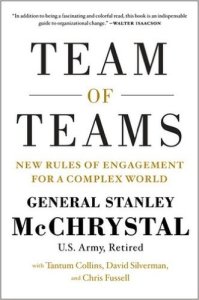
Team of Teams by Stanley McChrystal

Team of TeamsWhy this book: Team of Teams continues to be talked about in many of my circles of friends.    This book is retired Army General Stanley McChrystal applying lessons he learned fighting Al Queda in Iraq to leadership in other settings.  Given that much of what I now do is translate lessons learned from my career working with elite military units into useful guidance in the private sector, I knew I would find this book of interest.

My Impressions: The bottom line of Team of Teams as I read it:  McChrystal is advocating that an organization function more as an “organism” than as a “machine.”  He advocates that a great leader behave more like a gardener than a chess master.  He advocates that interactions between teams within an organization be modeled after interaction within great teams. If that is unclear, read on.

Team of Teams is a book for a thoughtful reader – it is very content rich and provocative. McChrystal, his co-writers and the rest of his team researched the evolution of leadership and management philosophies over the last 100 years to provide a background and framework for making his case:  He argues that an organizational culture that is transparent in its goals, objectives and decision making, that shares information extensively,  that has thoughtfully and deliberately pushed decision making authority down to the lowest possible level, is much more agile, creative, and effective than organizations that are led in a traditional top-down, what McChrystal calls a “reductionist management”  manner.  He is advocating a different leadership and organizational model from that which was the hallmark of the 20th century.  Old-style leadership – focused on faster, cheaper, more efficient –  privileged cost savings and timing over quality. In today’s rapidly changing world, he says, “Adaptability, not efficiency, must become our new central competency.”

The framework for his discussion was how the best counter-terrorism force in the world was getting its butt kicked by Al Queda in Iraq because it was too slow, too traditional, too stove-piped, too control-focused in its command and control.  He likened the US military to a dinosaur struggling to get out of a tarpit.  He said that “This was not a war of planning and discipline; it was one of agility and innovation.” So, as leader of one of the primary task forces fighting Al Queda in Iraq, McChrystal threw out the book on how to run military operations, and created a very different model.

McChrystal recognized what John Boyd postulated decades ago:  If your enemy is able to Observe, Orient, Decide, and Act faster than you, you will lose. McChrystal realized that he had to get his team inside of Al Queda’s OODA loop – otherwise, no matter how good his individual operators and staff, no matter how good his intelligence, no matter how extensive his resources, he would always be reacting, always be on the defensive.  He determined that Al Queda was evolving through ongoing adaptation; with more resources and better trained people, he realized he had no option but to seek to better them at their own game.  This book is about how he did that.

This book makes many points – these are the ones that resonated most with me:

  • The best organizations seek to enculturate adaptability, teamwork, and commitment more so than individual specialization. That doesn’t say that it isn’t important to have people with specialized skill sets – it just isn’t as important as adaptability, and the willingness to subordinate individual self-interest to group goals and purpose.
  • The 20th century was very much about leaders seeking to have their organizations run like machines – efficient, predictable, and scalable. The 21st century will be about the best organizations functioning more like organisms – adaptable, self-regulating, and inter-connected.
  • He made an interesting distinction between “complicated” and “complex,” noting that traditional organizational models (including the US military) deal well with the complicated, but are poor at dealing with the complex.  Complicated: Lots of discrete pieces interacting in a predictable manner – like a machine.  Complex: the number and nature of interactions and interdependencies between components yield consequences that are unpredictable.   He argues convincingly that the world is becoming increasingly complex.
  • Leaders must develop “shared consciousness” of context and purpose within their teams. He argues that a leader’s primary responsibility is to create a culture of shared consciousness, and that this is a pre-requisite to what he calls “empowered execution” –  empowering subordinates to make and execute decisions.
  • Regarding empowerment, he emphasizes that “…simply taking off constraints is a dangerous move. It should be done only if the recipients of newfound authority have the necessary sense of perspective to act on it wisely.”
  • Developing this “shared consciousness” requires transparency and extensive information sharing – and this requires assuming risk by trusting others, way beyond what most leaders and organizations are willing to do.  This information sharing must take place within the leader’s team, and between teams in the “Team of Teams.”
  • In the organization he describes, he turns the traditional leadership model on its head. Traditionally, organizations provide their leaders with information so that the leader can make decisions. In McChrystal’s organization, the leader provides the organization with information (context, transparency, big picture perspective, commander’s intent, the “vision” ) and then empowers the organization to make decisions.
  • Throughout the book, he repeatedly stresses the importance of information sharing. It demonstrates trust, and taps into what James Surowieki has called The Wisdom of Crowds.  It brings all the minds in the organization, including those closest to the problem, to bear in solving problems and improving operations.
  • Extensive information sharing  enabled what MIT professor Sandy Pentland called “idea flow.”   Idea flow he noted, has two major determinants: “engagement” within a small group or team, and “exploration” – frequent contact with other units. “The teams that had the highest levels of internal engagement and external exploration had much higher levels of creative output….” This describes McChrystal’s Team of Teams.
  • McChrystal argued that his task was to reverse the normal results of the prisoner’s dilemma. In the classic prisoner’s dilemma, people don’t collaborate, simply because there is less risk in pursuing one’s personal self-interest. Not the case in the Team-of-Teams-world McChrystal created.
  • I loved the chapter in which he describes the leader as a gardener more than a chess master.  As gardener, the leader’s primary purpose is tending the garden, pruning, watering, even fertilizing. “The gardener cannot actually ‘grow’ tomatoes, squash, or beans – she can only foster an environement in which the plants do so….Tending the garden –creating the culture – became my primary responsibilty. Without my constantly pruning and shaping our network…our success would wither.”
  • In building his Team of Teams, he said it was a struggle to overcome tribal boundaries, where elite teams were comfortable working in parallel, but not in collaboration with each other. Through trust-building, great liaison officers, and extensive information sharing, he was able to overcome much of the traditional tension that existed between loyalty to one’s “small team,” and a loyalty to what is good for the cause, the “big team,”  the Team of Teams.

What I see as a shortcoming to the book. McChrystal makes a strong case for information sharing, developing shared consciousness and and an execution empowered team, and then ultimately, a very collaborative “Team of Teams.”  But if it works so well, why isn’t more the norm?  Because leaders are people, and I’ve seen damn few people OR leaders who are as confident, as willing to assume risk, as engaged with their people, as dedicated to a larger purpose as Stan McChrystal was.  It must also be noted that he was working with the very best of the best in the US Special Operations community -he and his team had nearly complete hire/fire authority and the the most experienced operators with the strongest reputations gravitated to his task force and its mission.  This level of selectivity is seldom available to most leaders.  Also, McChrystal wasn’t randomly selected to lead such an elite team – he was extremely well prepared and personally selected for his unique talent.   In the “real world,” we seldom find such confident, insightful, and innovative leaders, able to effectively share information to build shared consciousness, able to judge when people adequately understand the leaders perspective, and are sufficiently engaged with the purpose of the organization to be empowered with execution authority.  Will this model work for most leaders? In most organizations?  I wonder.

I recently read a pretty amazing study by Gallup  which makes the case that only 1 in 10 people have the high talent to effectively manage others, and only another 2 in 10 have functioning managerial talent. Of those 3 in 10, I wonder how many have the experience, confidence, and belief in themselves, their people and their larger purpose to assume the risk necessary to push execution authority down as McChrstal describes in Team of Teams.   I am normally an optimist, but here, I’m wondering if the bar he sets may be too high for most leaders, and most organizations.

That said, I’m really glad he provided this model that the best leaders in the best organizations can strive to achieve.

Some of my favorite quotes from the book (with page numbers, refering to the 2015 hardback edition):

“Management systems can be efficient, but not adaptable….Many of the practices that are most efficient directly limited adaptability.” 82

“Team members tackling complex environments must all grasp the team’s situation and overarching purpose.”  99

“On a team of teams, every individual does not have to have a relartionship with every other individual; instead, the relationships between the constituent teams need to resemble those between individuals on a given team.” 128

<To defeat AL Queda> “…would involve a complete reversal of the conventioanl approach to information sharing, delineation of roles, decison-making authority, and leadership.” 131

“Most organizations are more concerned with how best to control information than how best to share it.” 141

“…whatever efficiency is gained through silos is outweighed by the costs of ‘interface failures.’” 151

“We wanted to fuse generalized awareness with specialized expertise…. We dubbed this goal – this state of emergent, adaptive organizational intelligence – shared consciousness. And it became the cornerstone of our transformation.” 153

“Our standing guidance was ‘Share information until you’re afraid it’s illegal.’” 162

“We decentralized until it made us uncomfortable, and it was right there- on the brink of instability – that we found our sweet spot.” 214

”..we found that, even as speed increased and we pushed authority futher down, the quality of decisions actually went up….We had decentralized in the belief that the 70 percent solution today would be better than the 90 % solution tomorrow. But we found our estimates were backward – we were getting the 90 percent solution today instead of the 70% solution tomorrow. “ 214

“An individual who makes a decision becomes more invested in its outcome.” 215

“Experience had told me that nothing is heard until it has been said several times.” 226

“The risks of acting too slowly were higher than the risks of letting competent people make judgment calls.” 209

“We had become not a well-oiled machine, but an adaptable, complex organism, constantly twisting, turning, and learning to overwhelm our protean adversary.” 243

“Shared concisousnesss is a carefully maintained set of centralizd forums for bringing people together. Empowered excecution is a radically decentralized system for pushing authority out to the edges of the organizations.….the union of shared consciousness and empowered execution is greater than the sum of their parts. “  245

Posted in Uncategorized | 1 Comment

The Martian by Andy Weir

martianWhy this book:  A couple of good friends said they had read it and really liked it.  Since I have always eanjoyed and learned from books about people struggling to survive in unforgiving environments, I figured I would enjoy this one – it certainly fits that genre!

My Impressions:  I liked the book, though I would not recommend it as “literature.”  It is written by an engineer,  and problem solvers with an engineer’s mind set will enjoy it most. It is not for those looking for emotional content or reading about someone’s inner life and development.

Our protagonist is  Mark Whatney, assigned as botanist and mechanical engineer to NASA’s Ares 3 mission to Mars.  Whatney is left on Mars after disappearing and being presumed dead, as a sudden and very violent storm forced the crew to leave immediately, or they would all die.  Obviously, Whatney regains consciousness,  and realizes that his crewmates had been forced to leave him for dead. And realizing that he is now alone and on his own, the problem solving begins.

The expedition had left an extensive amount of equipment at their station, to include a habitat and equipment to support the crew of six in what was planned to be a stay of a month or so for exploration and experimentation.  Whatney was able to live in the habitat, evaluate his situation and options, and figure out how he might be able to survive with  enough oxygen, water, heat, air pressure, and food for the several years until  another expedition might be able to rescue him. Initially he has no communications.  This is one of the problems he has to solve.  He faces mishap after mishap, one major challenge after another, and with each, he regroups, looks at his options and immediately commences problem-solving.  The book is a testament to the ingenuity of an engineer with a positive attitude

After we become acquainted with Mark Whatney and his situation, we are taken back to NASA  headquarters where we learn what is happening on planet earth after NASA realizes that Whatney is still alive.  An important part of the book is the contrast in perspectives between NASA headquarters and Whatney, and eventually the crew of Ares 3 which had left Whatney behind. The book takes us inside those three worlds – Whatney’s on Mars, NASA headquarters, and the Ares 3 space station.

The book is an amazing tutorial on the physics and practical issues associated with living in space – and Weir tells it well. I  am NOT an engineer nor a scientist, and yet I found his descriptions and practical problem solving compelling.  Weir also gave us a glimpse at crisis decision making that would make for a good leadership discussion: How the expedition leader decided to leave Whatney, NASA’s dealing with their options and priorities when discussing a rescue attempt, and the internal dynamics and decision making within the Ares 3 crew who were still in space, when they learned of Whatney’s survival.   The leadership model portrayed in this book is traditional – that of the heroic leader as expert and chess master – and to whom all look for wisdom and decision making.

What the book didn’t have was much “emotional content.”   I was over 200 pages into the book before I learned whether Whatney was gay or straight, and I never learned of any romantic interest. His connection to his parents was only briefly touched upon – and after months alone on Mars, no glimpses of an inner life.  It was as if his whole life was simply detached problem solving, with glimpses of frustration and his snarky sense of humor (which I liked.)

A couple of things Weir did that I liked – a real 21st century switching of gender roles. The Ares expedition commander was a woman and an impressive leader; the most profane and un-pc character in the book was the female Public Affairs Officer for NASA; Whatney himself was profane and un-pc, making goofy, almost immature off-hand comments that one might imagine coming from one of the techno-nerds in The Big Bang Theory.  He keeps his sense of humor throughout, even when his world is turning to kaka – but then he rapidly re-assumes his positive attitude and gets to work addressing, and solving the problem at hand, and finding a way to move forward.

Another interesting piece that Weir threw in:  The United States needed China to help them ultimately find a way to rescue Whatney, and China volunteered their help. While Whatney was stranded, the whole world was watching and rooting for him and rooting for America and her scientist-astronauts to rescue him.  The role that space exploration can play in helping us earthlings to see ourselves as one-world, was one of Weir’s not-so-subtle subthemes. But it was subtle enough -not overdone.

The day I finished the book, I went to see the movie.  It represents the book well, though the producers couldn’t help but overly-jazz up the ending, Hollywood style, and different (and less effective) than the book.   But, by and large it was faithful to the story, was well done and I recommend it.  I enjoyed both the book and the movie.

Posted in Uncategorized | Leave a comment

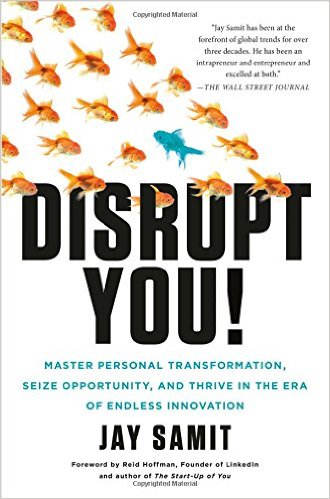
Disrupt You! by Jay Samit

Disrupt You!Why this book:  The All American Leadership team I work with designated Disrupt You! as a book to read and discuss as part of its on-going learning.  Also Rob Nielsen, AAL’s CEO, told me that if I liked The Innovator’s DNA, I would love Disrupt You!  I did like The Innovator’s DNA, as noted in my review of it , so I looked forward to reading Disrupt You!

My impressions: Disrupt You! reinforces many of the same points and insights as The Innovator’s DNA, but in a more personal style and with even more stories and examples. It is something of an autobiography of the author Jay Samit’s life and experience as a very successful  disruptive innovator from the early 80s to the present day.  Jay was one of the founders of Linkedin and was connected in some way to many of the technological innovations of the 80s, 90s, and early 2000s that have changed the way we live.  His book is his story, and reflects insights and anecdotes from one of the most dynamic change windows our economy has ever seen. Disrupt You! includes stories of many other successful entrepreneurs who either found, or created niches in the market for new and “disruptive” products or ideas, and thereby created great value for themselves, their investors and their customers.

The first 4 chapters in the book focus on personal growth and transformation.  He describes the disruptive mindset – thinking laterally outside of conventional patterns – and how to anticipate and become part of creative disruption. The next section of the book is how to succeed as a disruptor – within a larger corporation, or within the larger market.  He provides many examples of entrepreneurs building  businesses by solving problems that others didn’t see as opportunities. One of his key messages throughout the book is that successful disruptors don’t complain about problems; what others see as a problem or annoyance, disruptors perceive as opportunities to find a better way – a solution – and in the process, create or possibly disrupt a whole market.  He offers many fascinating examples.

The last several chapters of the book take a bigger-picture look, with titles such as: “Capital Revisited,” “Disruption in the era of the Crowd,” and “Disrupt the World.”  His chapter “Disrupt the World” looks at education, human capital, energy and transportation among other fields, and shows how all these areas continue to be disrupted by creative entrepreneurs who envision new possibilities. Each section of the book offers something different – and all parts offer a multitude of examples that help make his points.

One of my favorite chapters was “Disruptors at Work and the Value of Intrapreneurship,” in which he offers examples and insights for how disruptive entrepreneurs can change an organization from within. He does note however that disruptive change agents must have ‘top cover’  to be effective, and must be willing to swim up stream, since most organizations are focused on efficiency rather than innovation, and mid-level managers hate disruption.    “An intrapreneur disrupts from within the corporation rather than waiting for the company to be attacked by external forces.”

Another one of my favorite chapters is “Design: Disruption through Aesthetics.”  When he was a young man Samit boldly emailed Bill Gates, who he had never met, asking for an introduction to David Geffen, one of the most powerful men in the music industry, so that he could pitch an idea to him.  Remarkably, Gates provided this young stranger with the introduction he requested.  When he finally met Geffen, Samit offered him  50% ownership of his company, for no money and at no risk in order to simply get his endorsing support and connections.  Geffen accepted the offer and delivered on making the connections,  which led to enormous success and profits for both of them.  Samit’s point:  Fortune favors the bold, never underestimate good luck,  and “100% of nothing is nothing, but 50% of something can be worth millions.”

A constant drumbeat within Disrupt You! is that every market, every industry, the most well-established pillars of the economy are vulnerable to disruption, and WILL be disrupted. His message – better to be a disruptor than a disruptee. And Disrupt You!  provides guidance and insight to help, if not to become a disruptor yourself, to at least better understand and appreciate the creative value of disruption.

Samit highlighted his key points throughout each chapter, making it easy for the reader to quickly gather nuggets.  Some of my favorites:

“The trouble with most entrepreneurs is that they would rather be ruined by praise than saved by criticism.”

“Insight and drive are all the skills you need. Everything else can be hired.”

“Problems are just businesses waiting for the right entrepreneur to unlock the value.”

“‘Speed to fail’ should be every entreprenuer’s motto. When you finally find the one idea that can’t be killed, go with it.”

On Intrapreneurship: “…the problem I faced back then wasn’t senior management’s not getting it, but rather my inability to communicate my vision in a context that they could comprehend.  For all disruptors, this is the most important lesson anyone can learn”

“An average idea enthusiastically embraced will go further than a genius idea no one gets.”

“What I discovered was that the trick to disrupting from within an organization is you get what you want by giving the company what it thinks it wants.”

“The adage that the master appears when the student is ready to learn is only true if you make the effort to seek out advice.”

“If your idea is truly disruptive to a market, get used to hearing the word no.”

“The right passionate team is far more important to a start-up’s success, than the right idea.”

A couple of Downsides to the book: (1)  In the structuring of the book, sometimes the chapters seem a bit artificial.  There are so many stories and vignettes I sometimes had the feeling that many of them could have gone into any chapter. The content of the book doesn’t neatly fit into the chapters he created to structure it.   (2) I don’t believe Samit gives adequate credit to the non-disruptors who are essential to run businesses, who make the economy function.  Robert Solomon in his book A Better Way to Think About Business laments that American culture glorifies the entrepreneur often at the expense of, and certainly without giving adquate credit to the hard working people in the trenches who make a business run every day.  I would have liked to have seen Samit give more acknowledgement to the support that disruptive entrepreneurs need to carry out their ingenious and creative ideas, from the many of us  who may be less bold or creative.

Posted in Uncategorized | 1 Comment

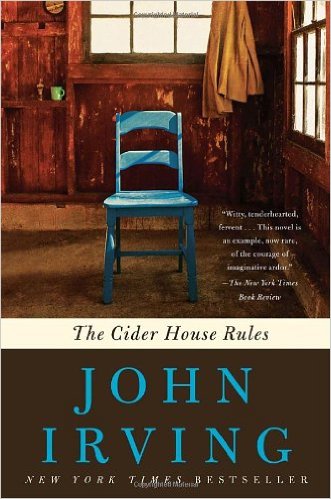
The Cider House Rules, by John Irving

The Cider House RulesWhy this book: Selected by my reading group for our meeting in late November 2015. I nominated it after hearing it referred to at a memorial service. The pastor  noted Wilber Larch’s imperative to “Be of Use” in one’s life, and in how one lives in a community.  I looked into it and found that The Cider House Rules is very highly regarded and considered almost a modern American classic.

My Impressions:  I looked forward to sitting down to immerse myself in the story of this book – mostly because of the interesting characters and the choices they made in their lives – not because it was a cliff-hanger or so-called page- turner.  The setting is rural Maine in the 1930’s through 1950s.  There is  section early on which takes us back to the slums of Boston in the 1880s to provide background on one of the main characters – Dr Wilbur Larch, obstetrician and director of a small orphanage in a remote part of Maine.  Going back to his earlier period is key to understanding how Dr Larch became who he was – not only an obstetrician and orphanage director, but also an underground abortionist, performing abortions whenever requested – not for money, but on principle.  He delivers children of women who come to the orphanage, pregnant with a child they can’t or don’t want to raise, and then his orphanage would raise and nurture the child, while Dr Larch sought a family to adopt it.   He performs abortions for women who come to him pregnant within the first trimester, who don’t want to bring their child to term.  In The Cider House Rules, Dr Larch is always in the background as the conscience of the book – an imperfect, but a very rational, selfless, and principled conscience.

THE main character of the book is Homer Wells, one of Dr Larch’s orphans who is truly exceptional from early on in his childhood.  Dr Larch essentially adopts him, and  given his unusual precociousness, trains him to be his assistant, and he becomes very good as an obstetrician. As an unlicensed doctor and obstetrician, Homer is uniquely talented – Dr Larch calls him his work of art.  But Homer has a philosophical position against abortion and refuses to participate in or support Dr Larch in these operations. When as a young man, Homer leaves the orphanage with a wealthy young couple, the story takes on and challenges conventional wisdom on:  Love, work, marriage, principle, duty, honesty, compromise, WW2, loyalty, and the racism and prejudice of the day.  It is truly a multi-dimensional and great story.

One of the sub-themes in The Cider House Rules is the tension between fatalism and free will, and John Irving definitely takes a stand. One also sees the subtle interplay between life and death, birth and dying. Religion, moral theory, spirituality are not directly addressed but are clear sub-themes in the book.  Much to discuss in these areas, where principle and theory bump up against practicality.   Following one’s heart is a key message in this book, that only by doing so can one find one’s proper destiny.  Throughout this story, we see how the good life, and the good in life come from feeding and nurturing the heart.   Much more so than following the “rules” of society.

The “cider house rules,” from which the book gets its name, are rules that are posted in a dormitory where migrant workers lived during apple picking season. No one reads nor follows these rules.  In the cider house, the workers follow their own rules, driven by their own imperatives, and the posted rules have little impact.  Lots of rules are broken in the cider house, and life goes on.  In fact people break the rules sometimes in order that life can go on. There are internal and external imperatives that drive people to act and live as they do – and people choose to live by rules that work for them in their specific circumstances.  The importance of listening to and living by the rules of one’s heart is an important message of this book.  Follow your heart, he tells us.

The story rolled along very well, unique and idiosyncratic without becoming too bizarre.   But Irving didn’t develop his cast of fascinating characters as well as I would have liked. The reader can’t help but like and admire Homer Wells, but we don’t learn much about his emotional life.  We learn a bit more about Dr Larch – but sense that he almost doesn’t have an emotional life, except in his devotion to Homer, his duty,  and his work.  There are several interesting women in the book, but I felt  I never really got to know them.  Compared to how Tolstoy developed his characters in Anna Karenina, the characters in The Cider House Rules were two dimensional.  Great story, great characters, I loved reading the book – but I wanted to know these fascinating characters better.

That said, the book deserves its outstanding reputation. A few lines from the book that caught my attention:

“You think an engine is so special? I could teach you how the heart works, thought Wilbur Larch- his own heart teaching him about itself, and much more than its function as a muscle.”

“Wasn’t life in nice places shallow?” (particularly meaningful to me, living in San Diego.)

Dr Larch: “What is this fascination the world has with death?”

A quote from Jane Eyre which was read and re-read to the girls in the orphanage: “…it is madness in all women to let a secret love kindle within them, which if unreturned and unknown, must devour the life that feeds it….”

Another quote from their reading of Jane Eyre: “It is vain to say that human beings ought to be satisfied with tranquility; they must have action; and they will make it if they cannot find it.”

“….never underestimate the darker necessities of the world…”

“You can’t protect people, kiddo. All you can do is love them.”

“’History,’ wrote Dr. Larch, is composed of the smallest, almost undetected mistakes.’”

“He knew what Larch would have told him: His happiness was not the point, or that it wasn’t as important as his usefulness.”

Posted in Uncategorized | Leave a comment

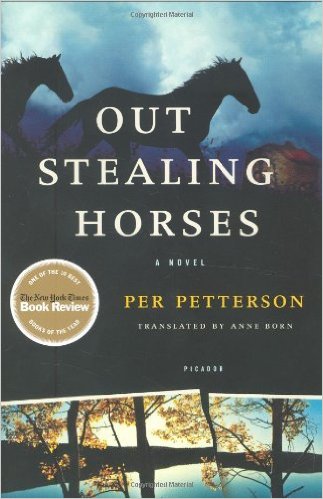
Out Stealing Horses, by Per Petterson

out stealing horsesWhy this book: It was recommended to me by Michael, with whom I shared a combination great bike ride and great discussion a couple of months ago. I noticed that the book got great reviews, won a number of awards, and it’s short length (238 pages in paperback) was not too daunting to take on between novels in my reading group.

My impressions: Out Stealing Horses was originally written in Norwegian – we are reading the English translation.  It is written in first person, and told by a 67 year old man who has retired and withdrawn to live out his remaining years in a rural Norwegian village.  The story focuses on a series of events he recalls from when he was  15 years old, growing up in a mountain village in Norway in 1948.  He tells of learning of mysterious and heroic roles that adults in his life had played in the Norwegian resistance to Nazi occupation in WW2.  One of those adults was his father,  who he loved and admired, and yet struggled to understand as he was coming to terms with his own budding adult-hood. His first romantic/sexual desires create a subtle but fascinating sub-theme in the confusing series of events he recounts.   Ultimately there is an unexplained violation of trust that has a powerful impact on the narrator.

He is telling us his story late in middle age, but we only learn bits and pieces of what happened in his life after the events he describes from over 50 years earlier.   It became clear to me that these boyhood events were somehow key to understanding the rest of his life and who he became.  I sensed also, that our narrator was still trying to sort it all out – and in the end, so was I – which is an important part of why this book intrigued me.

The book leaves a lot of questions unanswered and loose ends unresolved.  Though I wanted to know more, my sense is that there is a reason the author left me guessing.   Whatever happened to…?  or, Why did this happen…..?  or How/why did this person do that?  The answers to these questions may not have mattered.  At the conclusion, we are left with a story of powerful and poignant events from his boyhood in the mountains of Norway, which gave clues as to why he ultimately chose to withdraw from society and become a semi-recluse.

I believe the unanswered and unresolved questions are key to what makes this book so compelling, and why it won so many awards.

The book is very well done and enjoyable to read.  It is short,  but not fast moving.   I recommend reading it with another thoughtful reader, and after finishing the book, grab a bottle of wine and a couple of glasses and meet to discuss what Per Petterson may have been trying to say, and how this story affected you.  It’ll be an interesting discussion.

Posted in Uncategorized | Leave a comment

TRIGGERS, Creating Behavior That Lasts–Becoming the Person You Want to Be by Marshall Goldsmith

TriggersWhy this book: This book was selected by the team I work with – All American Leadership – to be read and discussed as a group. I am familiar with Marshall Goldsmith’s approach – have seen him speak several times, met him, read some of his other writings. And I like his approach.

My Impressions: Marshall Goldsmith offers us the practical advice he gives to his coaching clients on how to become better leaders and people.   To use his words: “One of this book’s central arguments is that our environment affects us in powerful, insidious, and mysterious ways.” Triggers discusses the interaction between who we are, and the environment in which we act, and offers simple and practical advice on how to be proactive in changing how we react to our environment. His point is that much of our behavior is driven by our responses to “triggers”- those situations and people in our environment that push our buttons, and drive us to behave the way we do.  He points out that we are often unaware of these triggers. The result is that we often impact others and our environment in ways that we either don’t intend, or are unaware of.

Triggers is a “self-help” book offering a very practical guide for changing our behavior, and in the process, improving our character.  He gives many examples of how his clients have used his approach to change their behavior and how those changes positively affected the way they think and see the world.  When his clients changed undesired or dysfunctional behavior, their improved behavior positively affected the worlds in which they lived and worked.

“My main goal in writing this book has been relatively modest: to help you achieve lasting positive change in the behavior that is most important to you.”    He says most of us need accountability measures – help from others, or from a coach – to keep us on track, and to help us determine whether we REALLY want to get better, or simply say we do.

What I like most about Triggers is that it does not allow the reader to be a victim and accepts no self-pity.   He states throughout the book that we must own our responses to whatever our environment throws at us. He effectively invokes simple Buddhist precepts in recommending acceptance of things we can’t control, while working hard to control what we can.  One is reminded of the Serenity Prayer. And of Stoicism.

A few ideas from the book, to perhaps wet your appetite:

He claims that there are two immutable “Truths” in changing our behavior:

  1.  Meaningful behavior change is hard to do.
  2.  No one can make us change unless we truly want to change.

He offers up 15 beliefs or misconceptions that get in the way of real behavioral change, to include one of my favorites: “An epiphany will suddenly change my life.”

He has a great chapter on “engagement” noting that he believes much of the data indicates that American workers are disengaged because of the way the questions upon which the data are based, are asked.  He puts a large part of the responsibility on the workers themselves. They are not “choosing” to be engaged.

Goldsmith strongly advocates “active” questions.   Rather than ask an employee “Were you engaged in your work today?” he recommends that we ask “Did you do your best to be engaged in your work today?” He notes that the second question puts much of the responsibility for engagement on the employee, not simply the management team.

He offers up six fundamental “active” questions – the cover of the book calls these “6 Questions to Kick-Start Change” – but suggests that each individual craft the questions that best fit their personal needs for growth in their own lives and work: He suggests:

Did I do my best to:

  1. Set goals today?
  2. Make progress toward my goals today?
  3. Find meaning today?
  4. Be happy today?
  5. Build positive relationships today?
  6. Be fully engaged today?

He points to the secret power of daily check-ins and self-questioning on whether we’re “doing our best” to be as good as we want to be.  He points out that if we keep falling short on a particular goal, eventually we realize that that goal is clearly not that important to us, and we will either  stop asking ourselves how we’re doing, or we will push ourselves to more effective action.

In answering these questions, he strongly recommends grading or quantifying our effort in each endeavor.  This allows us to better “structure” our effort, which he insists is essential for most of us to progress.

I enjoyed his discussion of the insidious effects of emotional and motivational “depletion” that come from the stress of managing our emotions and responses, in environments where certain behaviors are expected or demanded for us to be effective.  From my own experience running a large organization, I know that my decisions at the end of the day, or the end of the week were not as confident, compassionate, insightful, or wise as at the beginning.  “Depletion” as he describes it, is more than just being tired.

I loved his Buddhist parable of “the empty boat.” My wife and I now ask each other, when we start getting upset at something, whether we’re railing against an “empty boat.” There’s just no point in getting upset at an empty boat. Goldsmith the Buddhist, says, “It’s always an  empty boat.”

The bottom lines to Triggers:

  1. “Change doesn’t happen overnight;
  2. Success is the sum of small efforts repeated day-in and day-out;
  3. If we make the effort we get better. If we don’t we won’t.”

AND: “In order to make meaningful change in our lives, we need: commitment, motivation, self-discipline, self control, patience.

There is a lot of wisdom, and great practical advice in Triggers.  I recently told a friend/mentor about Goldsmith’s recommendations for daily questions.  My friend responded, “So, what are your daily questions?”  Hmmm…Wake up call. Ok. Time to get started, especially if I’m serious about becoming  a better person.

Posted in Uncategorized | 1 Comment

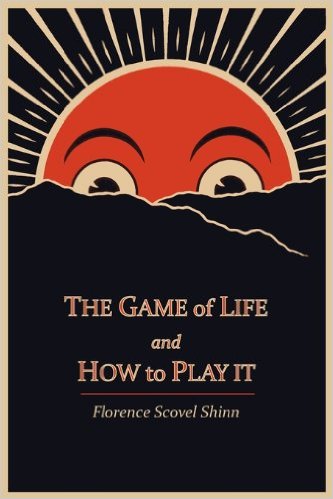
The Game of Life and How to Play It, by Florence Shinn

Game of LifeWhy this book: Recommended to me by a woman I often refer to as my “spiritual advisor.” I have considered her advice and perspective “sage” and very helpful to me, and when she suggested that I look at this little book, I did. Indeed I find that my friend’s insights seem to come in large part from what she has garnered from this book and how she has used it to understand her own experience.

My Impressions: I can’t say that I’ve read anything in The Game of Life and How to Play It that I haven’t read or heard before. But that doesn’t mean I shouldn’t read or hear it again, and again, and again. And I expect to re-read this book, perhaps several times. At least I should.   It is very nicely packaged into about 90 pages – almost a pamphlet of this woman’s perspectives, written down nearly a century ago, not published until 1925, and she has been dead for over 70 years. Yet in many ways, it is timeless.

It has a strong Christian message, but it is clearly written for those with a VERY broad understanding of Christianity. I almost sense that her strongly Christian approach is in order to appeal to her target audience of the early 20th century, but her message is very Universal Religion in its tone, and Buddhists, Jews, spiritualists, Hindus, agnostic spiritualists (like me) and many others would be very at comfortable with her message.

She strongly advocates the power of words to bring thoughts and desires into fruition. She advocates properly verbalizing what we want, putting these desires into the form of an affirmation, and then that we repeat these affirmations regularly and believe in them with an open heart, connected to the “Infinite Spirit.”   She offers us a number of universal or spiritual laws, and writes of The Law of Karma, The Law of Substitution,The Law of Non-Resistance, The Law of Use, The Law of Forgiveness, The Law of Love, Divine Pattern and Intuition.

The Game of Life could almost be a spiritual handbook to go with two books I’ve reviewed previously – Paolo Coelho’s The Alchemist, and the Business Leadership book Synchronicity.

Her message is to get in synch with the “Infinite Spirit” and in that process, to visualize what we want in life. With that connection to God, and her proposed method of visualization and affirmation, we should get the riches and life we deserve, “by divine right.” She goes back and forth between advocating affirmations that have a specific request, and advocating affirmations that ask the “Infinite Spirit” to provide the right thing – what one needs, what will fit “the divine pattern,” if that may not be what we specifically want.

She advocates expecting and believing in the good things we want -and preparing our heart, our mind, our lives to receive it. She offers many, many examples of people who have done so, and seemingly miraculously, their wishes have been fulfilled. Whether one fully accepts her thesis of visualization, affirmations, faith and spirituality leading us to the pot at the end of the rainbow, her message is compelling, and in my own opinion, powerful.


Posted in Reading | Leave a comment

Go Set a Watchman, by Harper Lee

Go set a WatchmanWhy this book: My reading group selected it to read and discuss. I had been wanting to re-read To Kill a Mockingbird for years, and selecting this book gave me the excuse to do so. I found it most interesting to read directly after re-reading Mockingbird.

My Impressions: Though I read several negative reviews of Go Set a Watchman, and I agree with some of the criticism I read, I liked the book and am very glad I read it. The review that I thought was most interesting was in the New Yorker and can be read at: http://www.newyorker.com/magazine/2015/07/27/sweet-home-alabama. I agree with the author of that review that, had this not been Harper Lee, this book probably wouldn’t have been released as it was. It still needed much editing and restructuring to be a book worthy of Harper Lee. That said, it WAS Harper Lee, with the same wonderfully comfortable writing style. Especially just after finishing To Kill a Mockingbird, it was a joy to meet Scout and Atticus, and Aunt Alexandra, and a few of the other characters, 20 years later. I don’t think it would have been as good a read, had I not read Mockingbird first.

At least two friends told me they didn’t want to read Watchman  because they didn’t want it to sully their idealized image of Atticus Finch as the wise and courageous Ward-Cleaver-in-Alabama father-figure, since this book is reputed to portray Atticus as less ideal than he was in Mockingbird.  It is true that he is not revealed as a 21st century enlightened egalitarian, but he is still a good and wise man –within his time and context.   Harper Lee reveals the recalcitrant South of the 1950’s, where most whites are still desperately holding on to the privileges and entitlements they felt were their due, simply by virtue of their race. This indeed is an important message of the book.   But I felt Watchman was really more about Scout growing up and maturing into Jean Louise, and that the issues of racism and bigotry in Maycomb were simply the context in which she was forced to choose between a path of love and wisdom, or to succumb to her own, different sort of “bigotry.”

The story takes place during a brief (two week) visit to Maycomb to visit her father and her (serious) boy friend Henry. Throughout the book, Jean Louise is torn between her nostalgia for the happy, secure world of her  childhood, and the voice of her “modern” sensibilities, revealing to her (again) the backward and unreconstructed side of Maycomb, Alabama. The freedom and worldliness she brings to Maycomb are not understood, nor welcomed by most of those still living in the post-reconstruction South.

I really enjoyed a number of the fascinating characters in this book and I would have loved for Harper Lee to have further developed them, so that I could have gotten to know them better and enjoy them that much more.    I truly enjoyed getting to know the central figure of the book – the intelligent, struggling, sensitive, and righteous Jean Louise Finch. So much energy and idealism, so much love, so much confusion and angst!  Harper Lee left us guessing what the next steps might be on the trajectory of her life.

Aunt Alexandra, Atticus’s sister, almost a caricature of conventional morality, was again, as in Mockingbird, a fascinating archtype. “She was the last of her kind: she had river-boat, boarding shcoool manners; let any moral come along and she would uphold it; she was a disapprover; she was an incurable gossip.” And as in Mockingbird, at the end, though we may not have liked nor agreed with her, we came to respect and perhaps even admire her.

Replacing Atticus as the main voice of morality in this book is his brother,  Uncle Jack Finch, the Doctor who “would unwind the reel of his strange lore to reveal reasoning that glittered with a private light of its own.”   Uncle Jack pointed out that, “Prejudice, a dirty word, and faith, a clean one, have something in common: they both begin where reason ends.”  It was Uncle Jack to whom Jean Louise turned when her world came crashing down.

And her boyfriend/fiance Henry, the Maycomb Kiwanis Club’s Man of the Year, a practicing attorney, Atticus’ protégé, striving for respectability in Maycomb, to overcome being considered “white trash” in his youth, based only on his parentage.   I liked and respected Henry, while also accepting some of Jean Louise’s accusations against him.

The theme, the setting and the writing are wonderful. What detracted from the book was that it does not flow smoothly and is not well laid out.  Watchman struggles to get its footing during the first half, and digresses into long retrospectives from Jean Louise’s childhood as Scout. Then suddenly, we are brought back to Jean Louise’s visit to Maycomb as an adult. Other than being nostalgic interludes for fans of Mockingbird, it wasn’t altogether clear to me the purpose of several of these retrospective vignettes.

There is however one long amusing digression into her teenage years, when she attended her first high school prom as a 15 year old. She didn’t want to go as the “Tom Boy” she was – and wanted this dance to be her coming out as a woman. In order to better fill out her newly purchased gown, she enhanced her figure with “falsies” (a term I haven’t heard since junior high school!) which, at a most inopportune time and manner, shifted out of place, leading to more embarassing and amusing results.

I felt that the main theme of the book stood on its own without the nostalgic references to Jean Louise’s To Kill a Mockingbird childhood.  How Jean Louise’s perspectives  had changed after leaving Maycomb, the righteous indignation with which she reacted to what was going on in her home town, her shock and disappointment at finding that people she loved and trusted were somehow associated with a reactionary movement, and then her eventual maturing and coming to terms with it, were enough to make the book a very worthwhile and fascinating read.

Why the title “Go Set a Watchman?”

A somewhat confused and unsettled Jean Louise thinking to herself after facing the prejudices and narrow perspectives of her former friends and school-mates: “I need a watchman to lead me around and declare what he seeth every hour on the hour. I need a watchman to tell me this is what a man says, but this is what he means, to draw a line down the middle and say here is this justice and there is that justice and make me understand the difference.”  Separately and later, Uncle Jack Finch tells her, “Everyman’s island, Jean Louise, every man’s watchman, is his conscience. There is no such thing as a collective conscience.”

Go Set a Watchman is about adapting to a changing world and understanding and loving people who are imperfect and see things differently than oneself. It is a wise and loving morality tale, written in Harper Lee’s beautiful prose. Though it could have been better structured and edited, I liked it and recommend it.

Posted in Reading | Leave a comment

Return on Character- The Real Reason Leaders and their Companies Win, by Fred Kiel

Return on characterWhy this book: I was intrigued after reading an excellent and very positive review of this book in Strategy and Business.  Since serving as the Naval Academy’s Director of Character Development, I have struggled with the three fundamental questions about character that my philosophy mentor Dr George Lucas posed: What is (good) character?  Can it be developed?  If so, how?   This book addresses all of those questions, and adds one more: Why bother? Well,  Kiel’s research concludes that virtue is not simply its own reward – there can be good money in it too!  While we all want to believe that, most of us don’t. So I wanted to read the book to see how he makes his case.

My impressions: In Return on Character ( “ROC” for shorthand) Fred Kiel seeks to discredit the old saw that “nice guys finish last” by showing the data that “proves” that in business, and over the long run, good guys and gals (who are also competent at business skills), finish first – or at least way ahead of the game.  In trying to tackle in a fairly comprehensive way, the huge topic of the role of character in business, this book is more ambitious than most business leadership books.  It does a good job of discussing this complex topic in terms that most can readily understand. Kiel doesn’t refer to the giants of western intellectual history who have wrestled with the nuances of character over the millennia, steering clear of academic philosophy in order to better connect with a larger target audience.

The author’s consulting company KRW International did a survey of 84 CEO’s and their companies over several years. Based on the responses of the CEO’s AND their employees, he identified 10 of who he called “Virtuoso CEOs” – those who best met the standards for good character that he establishes in his book.   These he compared to those he referred to as “Self-Focused CEOs” – the 10 whose character scores were lowest in his study.   The rest of the CEOs studied fell in somewhere along the spectrum between those two groups. He says that his book offers “a close and inextricable link between CEO character and value creation.” He makes the case that his study showed that a company’s profitability corresponded pretty closely to where its CEO broke out on his character spectrum, and those companies led by his Virtuoso CEOs were far more profitable than those led by the Self-Focused CEOs.

ROC Value Chain (from the book)

ROC Value Chain (from the book)

The book identifies four  “Keystone Habits” which form the basis of his concept of good character: Integrity, Responsibility, Forgiveness, and Compassion, and he explains what each entails how they are manifest in behaviors in the work place. He spends less time on the four key activities of what a leader does: Decision Making, Vision and Strategy, Senior Team Development, and Creating a Culture of Accountability. One could easily quibble with these two lists of four, but for the purposes of his book and his message, they work.   He does make clear that, for a CEO of good character to succeed s/he must also be proficient in the fundamental “skills” of business leadership. He says: “Character (who the leader is) + Skills (what the leader does) = Results (Return on Character.)”

One finding that surprised him and his team,  is the key role of the CEO’s executive team. This insight forced Kiel  and his team to change the criteria for a Virtuoso CEO.  He said a couple of CEOs who scored very  highly on all measures of character,  he did not include in the ten Virtuoso CEOs. Though employees scored these CEOs high in character, they scored these CEO’s  executive teams relatively low in character qualities, and this was reflected in levels of engagement and other measures in their companies. Kiel and his team concluded that a fundamental responsibility and “behavior” of a Virtuoso CEO is to select, support and inspire an executive team that reflects the CEO’s strong character and values.  He made this a key criterion for “Virtuoso” status.

Another interesting finding that came out of his research was how much more self-aware Virtuoso CEOs were than Self-Focused CEOs.  Virtuoso CEOs are more open to feedback, while Self-Focused CEOs are more likely to respond to unpleasant feedback with denial. And it is interesting that the next book on my Business Leadership agenda is Marshall Goldsmith’s Triggers – which is largely about how leaders – or anybody – can develop greater self-awareness as part of a personal development effort.

In the final section of the book, entitled The ROC Habits Workshop, Kiel tackles the ticklish question of whether and how one can improve one’s character, assuming one is convinced that it is worth the trouble.  In other words, how might I become a better person, so that I can garner all the success at work and in life that he describes? For those truly motivated, he offers a step by step process, which requires discipline, coaching and support from friends, family, and colleagues. I can imagine psychologists having a field day with his process, but in fact it makes sense to me – for those individuals who truly have the desire and will to improve, and whose character is not too far off the spectrum.

He summarizes his study on page 208: “We’ve learned… that character matters, that our character is a product of our genetic heritage and our life experiences, that we express character through our habitual behaviors, and that like all habits, we can change our character habits <italics his>. We’ve seen that by changing our leadership character, we can begin the process of improving the character and culture of the organization we work for. When we effect that kind of deep and meaningful change, we can change the lives of everyone our organization touches – our workforce, our clients, our communities, our world.”

A pretty idealistic outlook, I’d say.  There is certainly room for some skepticism, regarding whether self-focused leaders would be willing, much less able, to change their characters – even if motivated by the promise of more profits, or even spiritual rewards.  I do believe that true transformation is possible, but it is not all that common.  But I’d rather believe in Kiel’s idealism than the negativity of the cynic, who would dismiss such idealism as woefully naïve.  Recall Oscar Wilde’s description of the cynic as one who,  “…knows the price of everything, and the value of nothing.”

A good friend of mine is very interested in the subject of this book, but doesn’t think he can read it in its entirety, and asked that I recommend to him key chapters. Accordingly, I’ve recommended that in addition to reading the one page summaries at the conclusion of each chapter,  he read the Introduction, Chapter 1 (Character Defined), Chapter 6 (The ROC Ripple Effect); and Chapter 8 (Developing an ROC organization).

I recommend that anyone who finds this review of interest, read the excellent review that inspired me to read this book.  It is at Strategy and Business.

A drawback to this book: Kiel does not address examples that would not support his thesis. I suspect that his response to this objection would be that such examples didn’t show up in his study.   But to give credibility to the sweeping generalization he makes, he should have addressed the possibility that his theory MAY have some holes in it. There clearly are and have been business leaders whose people don’t like or respect them, who don’t embody his keystone character habits, whose characters are not “virtuoso,” but who have been financially enormously successful, and people have stayed with them because they just continue to make solid and successful business decisions that lead to “success,” as measured traditionally – by the single (vice the triple) bottom line.  Kiel’s argument that great business success comes with great character combined with great business skills, can be countered with examples of those who have succeeded in business with great business skills and (arguably) poor character. We seldom however, see people with great character and poor business skills succeed.  Who are the outliers, those self-focused leaders who have succeeded anyway, and from their success, others, perhaps many of us, have benefited?   We know they are out there (Steve Jobs? Elon Musk?).   The book would have been stronger had he addressed and made room for exceptions to the case he makes.

Posted in Business Leadership Book Review | Leave a comment