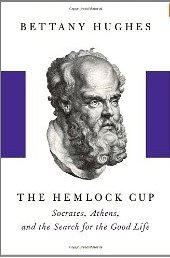
The Hemlock Cup: Socrates, Athens, and the Search for the Good Life by Bettany Hughes

Why this Book: I read a fascinating review of this book in the Wall Street Journal. Went right to my Kindle and had it downloaded.

My Impressions: I really enjoyed this book. The author of the WSJ book review is a classics scholar at Stanford, and though he pointed out some of what he called factual errors, he strongly recommended the book, and he was right to do so. Bettany Hughes writes very well, and she brought this fascinating and key period in our Western tradition to life.

The book looks at life in Athens during the Golden Age of Greece through the prism of Socrates’ life.  He fought in most of the wars and key battles of the era, knew and was well known by all of the influential people of Athens at the time.  Ms Hughes is able to connect Socrates to nearly everything that happened of significance during Greece and Athens’  golden age – the last decades of the 5th century BCE.  I was surprised to find that in some ways the turbulence Athens experienced at the end of the 5th century BCE has some parallels with our own.  The Athenians strongly believed in themselves as the most enlightened country in the world, and aggressively sought to expand their influence and their idea of democracy.  Pericles was a Bill Clinton-esque character; his mistress Aspasia was very controversial and hated for the power she exercised over and through him , and she was accused of corrupting the women of Athens.   The intrigue and back biting and viciousness of the era surprised me, while at the same time these people created perhaps the most enlightened government and culture in history to that point.  But most of the people in Athens and Greece were simply trying to live their lives and get along, as are we today.  And reading about how they lived, it doesn’t seem that they were much different from us in temperament.   I also enjoyed learning how much new material about this era is coming to light every year in archeological excavations.  Many of the most interesting facts and insights were based on findings in the last 10 to 20 years.

She offers an explanation as to why Socrates was such a controversial character and why he was sentenced to death. He drank the hemlock in 399 BC just after democracy had been restored after the infamous year of so of the Thirty Tyrants.  The Thirty Tyrants, led by Critias,  a former student of Socrates, overthrew the Athenian democracy and ruled Athens with terror, seeking to purge Athens of their enemies and to even-up old scores.  Shortly before Socrates’ trial, they were themselves overthrown and a fragile democracy was restored to Athens.  But , after so much internal blood-letting and terror, people were jumpy and scared, which in part explains why they were in no mood to continue to tolerate a Socratic gadfly. 

Yes, this was a short, easy to read, and very interesting book.

Posted in Uncategorized | Leave a comment

The Bridge of San Luis Rey by Thornton Wilder

Why this book:  Selected by my reading group.  I had read it twice before and was happy to read it again.

My Impressions: This is a short book, about 120 pages and won the Pulitzer Prize for literature in the late 1920’s.  It is a series of stories, within a larger story of a Franciscan brother in 18th century Peru trying to understand God’s justice.  After an ancient Incan bridge had collapsed and five people had fallen to their deaths, the brother decided to research their lives in the belief that this could not have been a random act – God in his wisdom and mercy must have had a reason for putting these specific five people on the bridge when it collapsed.  He believed that with enough research he could find a pattern that made sense of these deaths.  He believed that man must be able to understand God’s justice, and it was inconceivable to him that a merciful and just God would let people die capriciously. 

The book then commences to tell the stories of the people who died when the bridge collapsed.  Each of these people was at a different point in their life’s journey, and like each of us, taking care of life’s business while pursuing happiness, fulfillment, and meaning in their own ways.   We see each of the adults chasing happiness and fulfillment down a series of dead end and blind alleys, each sad and tragic in their own way, but none of them any more or less bad or deserving of an untimely death than any of the rest of us. Two of the people who died were children, innocent of the sins and excesses for which we hold adults accountable.  The stories of these individuals were (for me, but not for everyone in my reading group) fascinating, not only for their own unique approaches to living, but for the insights they gave to life in 18th century colonial Peru.  At the book’s conclusion, the Franciscan brother predictably reaches no clear conclusions about how these people might have deserved their fate.  His exhaustive research was unsuccessful in finding a meaning in these people’s lives and deaths, unsuccessful in decoding fate and chance.   He and his research are subsequently deemed heretical by the Catholic Church, for whom fate and chance, the meaning of life and death, and God’s justice are matters of faith, not science and analysis.

Within the small city of colonial Lima, Peru, our five victims had all in some way crossed paths with the Abbess of Lima, who ran a home for orphans, the sick and the destitute.  The Abbess is something of a peripheral player in most of their lives, yet, as the book concludes and we are no further along in understanding the purpose of these people’s lives and why they died, our author returns to the Abbess, and her life.    By looking at her and how she lives, we are led down a different path to find meaning and value in the lives not only of those who died, but also in those they left behind. The book concludes with the Abbess thinking to herself, “But soon we shall die and all memory of those five will have left the earth, and we ourselves shall be loved for a while and forgotten. But the love will have been enough; all those impulses of love return to the love that made them. Even memory is not necessary for love.  There is a land of the living and a land of the dead and the bridge is love, the only survival, the only meaning.”

I really like this book – it is an elegant little story about the search for meaning in life through the prism of a tragedy during a period in history and in a part of the world I find fascinating.  In a few years, I will read it again ‘for the first time,’ and again draw insight and inspiration from it.

Posted in Book Lists, Reading | Leave a comment

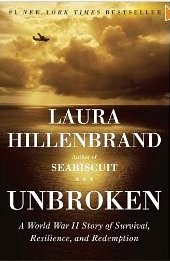
Unbroken: A World War II Story of Survival, Resilience, and Redemption, by Laura Hillenbrand

Why this book: My wife read this book and told me that I definitely needed to read it.  She reads more than I do and she doesn’t make that recommendation very often.  My friend Liz Train, a voracious reader herself, also suggested that I read it and that I would enjoy it.  But I was into about 4 books at the time, and knew that I might never get to it, so I purchased the CD version to listen to in the car while commuting.  So I didn’t really read the book, I listened to it, and listening to the story was a great way to enjoy this book.

My Impressions:  The book is written by a Laura Hillenbrand, a master story teller (Sea Biscuit), and belongs in the classics of survival literature about the triumph of will and the human spirit.    The book begins with stories of Louis Zamparini’s misadventures as a juvenile delinquent, then progresses to how he becomes a record setting distance runner and Olympian (1936 Berlin.)    After the war begins, he becomes an Army Air Corps officer, and when his plane goes down in the Pacific, the meat of the story begins.  The next section of the book describes how he (with two other men) survived 47 days adrift in the Pacific on a tiny rubber raft.  As they finally reach an island, they are taken prisoner by the Japanese, and the next section of the story is about his nearly 3 horrific years as a Japanese Prisoner of War.  At the end of the war, we learn of his liberation, his repatriation, and joyful reunion with his family.  Then more struggles ensue with his descent into alcoholism and other destructive behavior as he continues fighting the demons that he carried with him from his time in the Japanese Prisoner of War camps.   He eventually has a spiritual re-awakening, and creates a new life for himself– a life that still continues.  He was one of the torch carriers in the Olympics in the 90’s, became a prolific supporter of not-for-profit causes, and was an inspirational public speaker for decades.   Liz Train emailed me that she had lunch with him in April while he was in Hawaii promoting the book.

One of the shocking insights to come from this book was how the atrocities and humiliation that the Japanese inflicted on their prisoners rival the horrors the Nazis inflicted on their victims in the concentration camps in Germany and Poland.  Apparently because of his celebrity as an Olympian, Zamparini was allowed to survive when others were murdered; also perhaps because of his celebrity, he was targeted for even more concentrated and degrading abuse.   The dropping of the atomic bombs on Hiroshima and Nagasaki came two weeks before PoW camp commandants had been ordered to murder all their prisoners.

The books makes clear that Zamparini and other PoW’s realized that maintaining their sense of human and personal dignity, in the face of extreme and persistent degradation and dignity-robbing abuse, was key to their survival.  This point echoes Viktor Frankl in Man’s Search for Meaning.  Zamparini’s defiance in the face of brutal and degrading treatment was key to his survival.  He fought and struggled to maintain his human dignity in the most dehumanizing environment imaginable.  And somehow, he succeeded.  Laura Hillenbrand now calls him the Ambassador of Joy.  This is also a story of forgiveness and redemption.  A wonderful book.

Posted in Uncategorized | Leave a comment

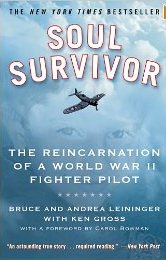
Soul Survivor: The Reincarnation of a World War II Fighter Pilot by Bruce & Andrea Leininger and Ken Gross

Why this book: I’ve always been interested in The Unseen Order of Things and have found the idea of reincarnation an interesting possibility.  I’ve done a fair amount of reading on the topic since reading the (now discredited) Search for Bridie Murphy, and visiting the Association for Research and Enlightenment in my home town of Virginia Beach, Va.  It’s hard to explain what Edgar Cayce was able to know, see, and do without at least considering the ‘truth’ of his claim of reincarnation and the evolution of the soul.

My Impressions:  The book tells the story of a young child who has uncanny knowledge of and interest in airplanes.  He also has nightly recurrent nightmares, in which he screams something to the effect, “Plane on fire! Plane on fire! Little man can’t get out!” during which he thrashes around and screams in his crib.    With this nightmare ocurring almost nightly, during the day, this young child makes statements about what airplane he used to fly, the aircraft carrier that he flew off of , the Pacific battle he fought in – history of which  his parents were unaware and to which this 3 year old boy had  never been exposed.  The father was a Christian with very strong traditional beliefs and embarked on a campaign of research to basically discredit this ‘fantasy’ by finding flaws and historical inaccuracies in his son’s story.  The book is largely about his extensive research, about the strain it put on the marriage of the parents, as well as about the mounting evidence that this young boy knew things that were very difficult to explain without believing in reincarnation.   The father learned the identity of the young naval aviator who the boy claimed to be when he was shot down, found friends and family whose names the boy mentioned.  The extensive research allowed them to introduce their 5 year old son to the people who were close to and still had vivid memories of the naval aviator who had died in 1945.  The boy knew things about this earlier man that people said only the man himself knew.  The stories are amazing, but the book is almost as much about the father’s struggle with his faith, and how the parents coped with this very inconvenient and awkward prediliction of their son.  My wife Mary Anne and I were a bit put off in reading so much about the parents, but in the end, the story was almost as much about them and what this story did to them as it was about a young boy who apparently had vivid and verifiable memories of a previous life.  There was a dateline story on this case several years ago that can still be viewed on-line.   Yes, after I got over learning more about the parents than I wanted to know, I very much liked the book.

Posted in Uncategorized | Leave a comment

A Million Miles in a Thousand Years – How I learned to live a better story, by Donald Miller

Why this book: Recommended to me by Ross MacKenzie, who I met at a conference.  It appeared to be a different sort of book, possibly with some unusual and interesting insights.  So I took a chance. It was worth it.

My Impressions:  This book is about ‘story.’  I could tell right away that this would be a different book, and at least entertaining. Miller has a kind of a ‘Forrest Gump’ self-deprecating innocence and wisdom.  It begins with a couple of Hollywood types who come to his house  to work with him to write a screen play of his life, meant to capitalize on a popular and somewhat autobiographical book Miller had previously written. Miller struggles to accept the idea of a movie of his life, since he believes his life to be pretty boring and unremarkable.  Indeed, so do the screenwriters who are working with him.  Predictably,  the screenwriters insist on changing his life’s story to make it more exciting and interesting, so that the movie will sell, and they’ll all make money.   It’s all pretty amusing, but this gives the author the opening to explore what he really wants to write about – the idea of our lives as a story.  

Throughout the booke, Miller explores the metaphor of viewing our lives as if we were screenwriters creating a story, and makes the point that in the choices we make in living our lives, we are creating the story of our lives.   He challenges us to understand our story, the thread that holds it together, the plot, the meaning – and possibly to inspire us to live a better story.  

The author is very clever in how he makes his points and repeatedly returns to the metaphor of our life as story. The book is full of great quotes, and I choose to share some of them with you rather than summarize the book. It’s also good for me to review these quotes – they can be very instructive.  Some of my favorites: 

  “A character who wants something and overcomes conflict to get it is the basic structure of a good story.”

 “If the point of life is the point of a good story, the point is character transformation.”

“The idea that a character is what he does makes as much sense in life as it does in the movies.”

“The stories we tell ourselves are very different from the stories we tell the world.”

“My entire life has been to make myself more comfortable, to insulate myself from the interruption of my daydreams.”

 “A general rule in creating stories is that characters don’t want to change. They must be forced to change.”

“Without an inciting incident that disrupts their comfort <characters> won’t enter into a story.”

 “… fear is not only a guide to keep us safe; it is also a manipulative emotion that can trick us into living a boring life.”

“…great stories go to those who don’t give in to fear.”

  “The whole point of the story is the character arc.  You didn’t think joy could change a person did you?  Joy is what we feel when the conflict is over.  But it’s conflict that changes the person.”

“… the reasons our lives seem so muddled is because we keep walking into scenes in which we, as well as the people around us, have no clear idea of what we want.”

“The stuff I spent money on indicated the stories I was living.”

“A story is based on what people think is important, so when we live a story, we are telling the people around us what we think is important.”

“…when something hard happens to you, you have one of two choices in how to deal with it. You can either get bitter, or better. I chose to get better. It’s made all the difference.”

“I realized how much our lives are spent trying to avoid conflict.  Half the commercials on television are trying to sell us something that will make our lives easier.  Part of me wonders whether our stories aren’t being stolen by the easy life.”

“…every conflict, no matter how hard, comes back to bless the protagonist, if he will face his fate with courage.”

“Viktor Frankl whispered in my ear all the time. He said to me that I was a tree in a story about a forest, and it was arrogant of me to believe any differently. And he told me the story of the forest is better than the story of the tree.”

 “A good movie has memorable scenes, and so does a good life.”

“Great stories give life to greater stories.”

As I was reading this book, I recalled that when I met Mike Richardson and we sat down to dinner to get to know each other, his opening question was, “So Bob, what’s your story?”  An interesting and telling question.  This was a provocative and very worthwhile book.

Posted in Reading, story | Leave a comment

Synchronicity, by Joseph Jaworski

Why this book:  I met David Winkelman, a fascinating man who is  a ‘Visual Problem Solver’ at a recent networking event. During our discussion, I mentioned that I had just read The Alchemist.  He told me that if I liked The Alchemist, I’d like Synchronicity.  It is almost a business leader’s handbook to The Alchemist. So I ordered it that day and began to read it.

My Impressions: Synchronicity is an autobiographical account of the evolution of Joe Jaworski’s beliefs about himself and the world we live in.  He began life as the son of world renowned Watergate prosecutor Leon Jaworski, then became a successful attorney and partner in a very successful law firm,.  Then his life fell apart, and in his recovery, he evolved into something of a guru and change-agent in the world of leadership, and business.

I can imagine that some people, especially pragmatic business people, will find Jaworski’s Synchronicity a bit too ‘woo-woo’ for their tastes.  Jaworski describes for us a metaphysics which says that with our attitude and openness, we shape the world we live in and create our own lives and opportunities. He gives numerous examples from his own life and regularly calls on insights from his discussions with David Bohm, renowned Quantum theory physicist and colleague of Einstein’s.  Bohm’s research and theories point to an inter-dependence of all of us as thinking beings. Bohm argued that our thoughts do not occur independently from others. Rather, our thoughts are connected to other people’s thoughts, influence and are influenced by others people’s thoughts, influence our reality and are part of a ‘system’ of thoughts and thinking.  In other words, we are not independent conscious beings, but our consciousnesses are inter-dependent and connected in ways most of us don’t realize.   Jaworski then seems to argue not only that we have a destiny, but also that we create our own destiny – there is a path we are on, but we can shape or create our path.  There is almost a freedom vs determinism tension in this view, similar to what one finds in Stoicism and other philosophies.

Jaworski says that life is really all about our ‘relationships.’  Our lives are defined by our relationships to people, things, our environment, and our society.   He takes this idea and expands on its implications for how we live and how we should lead – ourselves, our colleagues, our organizations, and our society.  It is an expansion on the theme of The Alchemist –that whatever our heart truly desires and believes in fully, the whole universe conspires to help us achieve it.  He makes the case that we attract the events that affect our lives, by ‘tuning in’ to our environment, paying attention to ourselves and what is happening around us,  and consciously or unconsciously, sending out the right signals.  Many will argue with this, and I could argue against this as well, but I find that in fact, I believe in his views  – they seem to fit with my own experience.

The title “Synchronicity” he takes from an essay of the same name written by Carl Jung to explain seeming coincidences.  Jung, like Bohm and Jaworski  didn’t believe in coincidences but rather that seeming coincidences reflect an ‘unseen order of things.’   Jaworki  was also heavily influenced by Joseph Campbell’s work on the Hero’s Journey, and by one of his mentors, Peter Senge author of the ground breaking ‘The Fifth Discipline’ and the writer of the introduction to Synchronicity.  The introduction is excellent and actually provides a nice summary of Jaworski’s philosophy.

I will want to re-read this book in about a year to revisit the concepts he describes.

Posted in Business Leadership Book Review | 1 Comment

The Pearl, by John Steinbeck

The Greatest Pearl in the world

Why this book: A selection for our book club – we decided to explore some of Steinbeck’s less well known novels.

My Impressions: ..for the evil song was in his ears…”  This is one of Steinbeck’s very short novellas in which he reveals his admiration for the strength of the poor, and his antipathy toward the upper classes and their natural propensity to exploit the poor, and keep them poor.   It is also a story about greed, and love.  The story is simple, and profound. 

In a small village somewhere on the Caribbean coast (one assumes Mexico), Kino, a young pearl diver and his wife Juana and their newborn son Coyotito, are living a simple life, working each day to meet their basic needs. They live in a thatch hut, have just enough to eat, and have almost no personal possessions, except for the small boat upon which they depend for their living.   The village is near and depends upon a nearby town, which appears to have the social structure that one finds in most towns.  In the village the pearl divers and fisherman all live on the edge of subsistence, and take care of and support each other.

One day when diving for pearls, Kino finds an oyster with a very large and nearly perfect pearl “…as large as a seagull’s egg. It was the greatest pearl in the world.”  This pearl will be worth a small fortune, and Kino and Juana see it as the key to opportunities that the middle class take for granted – a nice wedding for themselves, schooling for their new son, and the opportunity for their son to grow up in society, and not have to struggle to find food from day to day.

As soon as Kino and Juana find the pearl, they realize that the possibility of relative wealth separates them from others in their village, and they are no longer sure who they can trust.  Their simple life becomes complicated. Everyone wants a piece of the wealth the pearl promised.   Envy infects their relationships within the village, and they are targeted by the wealthier people in town to be exploited, even the priest.  They see Kino and Juana as vulnerable and are only too willing to take advantage of them.   Thieves try to steal the pearl. Kino and Juana are attacked at night, are injured and almost killed. As Kino recognizes their vulnerability, and that he cannot protect his family or the pearl, he takes his family and they flee on foot, across the mountains toward another town or city where he feels they may have a chance.  But they are pursued, by the forces of greed and treachery.  Juana had recognized early on that the pearl was only bringing grief and threats to her family, “This thing is evil. The pearl is like a sin!  It will destroy us!”  She argued that they should get rid of it.  But Kino had been captured by his dreams of a better life for himself and his family, and he refused to give up on this dream.   

Reading this story, one knows that it will not end well.  Steinbeck seems to be saying that justice clearly takes a back seat to power and greed, and the poor will always lose when confronted by the greed of the rich.   But it is also a story about the relationship between Kino and Juana – inspiring, intense, primal and powerful.  The reader understands and admires each of them, for different reasons.  Also, throughout the book Juana and Kino tune into their environment with a sixth sense, and Steinbeck uses the metaphor of music to describe it.  This is particularly striking throughout this parable:  “In Kino’s head there was a song now, clear and soft…the Song of the Family.” “Juana sang softly an ancient song that had only 3 notes, yet endless variety of interval.”   “…a new song had come, the Song of Evil, the music of the enemy, of any foe of the family …and underneath, the Song of the Family cried plaintively.” “…he could hear the evil music of the enemy..” “the pounding music of the enemy beat in his ears..” “…the Song of the Family had become as fierce and sharp and feline as the snarl of a female puma…<and> was alive now and driving him…”

It was ironic to read this book right after reading ‘The Alchemist’ – it almost has an anti-Alchemist message.  Whereas The Alchemist’s message is ‘believe in your dream, and the whole world will conspire to make it a reality’ – The Pearl’s message seems to be ‘dare to dream that you can break out of your social class, and the whole world will conspire to crush you.’  It is important to read and understand both of these perspectives – we can learn from them both.

Posted in Uncategorized | Leave a comment

The Alchemist by Paulo Coehlo


Why this book:  It was suggested by a member of my reading group.  I had read it before and had found it ceative, inspiring and meaningful, and looked forward to reading it again.

My Impressions:  It is a seemingly simple little fable, that becomes a spiritual, and multi-cultural  rags-to-riches ‘Horatio Alger story,’ but the riches represent both financial as well as spiritual wealth.  While the theme is a common one – follow your heart, don’t give up on your dreams, ‘The Alchemist’ is beautiful in its simplicity and multi-layered complexity, and can be appreciated on many different levels. Wikipedia notes that it is one of the most widely translated book by a living author and has been on best–seller lists in 74 countries.

In brief, it is about a young shepherd in Spain, one assumes in the 19th or early 20th century, who has had a recurring dream, and then meets an enigmatic man who claims (and somehow appears) to be a wandering and wise ‘king.’  This man inspires the young shepherd to sell his sheep and follow his dream to travel to Egypt to find his ‘treasure.’  There are many references in the book to fate, destiny, and reading of omens, all of which point to an ‘unseen order of things’ and the author’s belief in the basic goodness of the Universe.  He refers throughout the book to such things as ‘the Soul of the Universe’ and the ‘the Language of the World’   The shepherd learns that he can access the wisdom of this unseen order by listening carefully and quietly to ‘the Language of the World’ to access its wisdom.   One of the key messages of the book is this need to listen and pay attention to the greater world around us in order to tap into its wisdom.   Another message is a faith that ‘When you desire something with all your heart, the whole universe conspires to help you achieve it.’

The shepherd boy follows his dream, and though numerous setbacks test his determination, he persists and eventually realizes that these apparent setbacks indeed forced him to become stronger and more resilient, and put him on pathways that were key to helping him fulfill his dream.  He is constantly tempted to take an easier path, to give up and return to a simpler and more comfortable path, but he persists, and with a strong will and a good heart, and some luck and cleverness,  eventually he fulfills his dreams.

There is a lot in this simple story to discuss and to argue about, which we did in our reading group.  The young shepherd has a couple of love interests – the role they play is peripheral, but important.  Some in our reading group did not appreciate the spiritual under-currents; others found the spiritual aspects most appealing.  The story brings in metaphors from the Christian, Muslim, Mormon, and Jewish traditions. Given that I am approaching a transition in my life, I found inspiration in this little story which has helped me to continue to refine, believe in, and pursue my own dream.

Posted in Uncategorized | 2 Comments

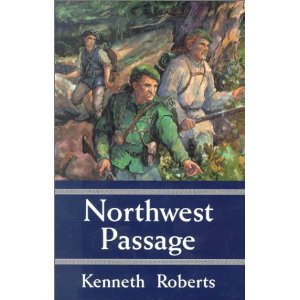
The Northwest Passage, by Kenneth Roberts

Why this book:  I recall reading the book when I was about 15 or 16 years old and it made quite an impression on me. I wanted to return to it and see what I think of it 40+ years later.

My Impressions:  This is the story of pre-revolutionary America, built around the life and career of Major Robert Rogers, a historical figure who is famous as the leader of Roger’s Rangers in the French and Indian War.  Rogers’  Rules of Ranging  are still published and distributed among US infantry men.  Rogers’ Rangers are the pro-genitors and spiritual forefathers of today’s Army Rangers.  I recently learned that William O. Darby, the father of today’s US Army Rangers tells in his autobiography how Gen George Marshall, Chief of Staff of the US Army during WWII created and named the US Army Rangers for these same Rogers’ Rangers.   The Northwest Passage,  published in 1938, was immensely popular in America at the time and was followed in 1940 by a movie of the same name , starring Spencer Tracy as Major Robert Rogers, and Robert Young as Langdon Towne, the protagonist who tells the story.   It is not too big a leap to assume that the book  and the movie may be largely responsible for inspiring the formation of the US Army Rangers.

The story is epic – about 630 pages covering about 15 years from the French and Indian Wars to the beginning of the Revolutionary War.  It is the story of the rise and fall of Robert Rogers as seen through the eyes of a young Langdon Towne, and since it covers approximately a decade and a half, the story is told in several phases.   Only the first part of the novel deals with Rogers’ Rangers and their exploits in the French and Indian War – the book continues well beyond that, concerning itself with other themes in the ‘life and times’ of Robert Rogers, and his fixation on winning glory by finding the ‘Northwest Passage’ to the Pacific Ocean.  The novel  includes stories that reflect on the relations between the provincials (colonials) in the British Army and regular British Army soldiers during the French and Indian War, the origins, tactics and exploits of Roger’s Rangers in that War, tensions between colonists and British officials in pre-revolutionary War America,  the full spectrum of life in London prior to and during the American Revolution,  and descriptions of various tribes of American Indians and their relationships to  Europeans in the North and Northeast, prior to the great expansion westward.

The story teller, Langdon Towne is a resourceful , resilient, and reserved young artist, who idolizes Robert Rogers, until near the end of the story, when Rogers’ behavior finally alienates the young idealist, and they become estranged.   I found the protagonist intelligent and appealing, but a bit too analytical and detached for my taste  – not a lot of testosterone, emotion, or passion.   Langdon Towne’s cautious and dispassionate idealism is in direct contrast to Robert Rogers, the central figure of the book.  Rogers is a flawed, but fascinating larger-than-life character, who reminds me in many ways of Ernest Schackleton.  Shackleton and Rogers were both men of enormous energy, charisma, passion, and ambition.  They were both great and confident leaders, nearly indomitable in physical adversity, but something of  ne’er do wells in civilized society.  Like Schackleton, Rogers was always on the make for a financial sponsor to support his grandious ambitions, and was a great salesman of himself and his plans.  But he was always in debt,  was unconstrained by much of the morality of civilized society, or only conformed to it when it served his immediate needs, and was uninterested in observing the conventions of married or family life.  Rogers also had a serious alcohol problem; Schackleton did not.

The Northwest Passage is a great novel covering a broad swath of the tapestry of life in pre-Revolutionary war America; it is very readable and an enjoyable story.  I checked Wikipedia to learn that the book accurately conveys the essential outlines of Rogers’ life.  A special edition (which I did not have) actually includes the transcripts of Rogers’ court-martial by the British.

Posted in Uncategorized | Leave a comment

The Call of the Wild, by Jack London

Why this book:  This book was a selection for a reading group I’m in. Everyone in the reading group had read the book in elementary or junior high school, and we were looking for a good short book that would generate some good discussion.  This is the one we agreed to read.

My Impresssions:  I understand how this book has become a staple of adventure reading  for young people – it is quite short, the prose and narrative are straightforward, there is no sex, there is a clear hero who thinks in a pretty straightforward manner (it’s a dog – so what would you expect?)  The violence is between animals, and on the surface its themes are simple – power, persistence, connection with nature, and survival.  But that is just on the surface.   This is much more than a simple adventure story for kids – it is a morality tale that says much about human beings and how they interact with each other and the world we live in. The story of Buck, the dog, is a metaphor for how we humans would interact without the thin veneer of civilization.

 Buck is a smart, healthy, and in fact ‘Alpha male’ dog living the good life on a ranch in California when he is ‘dognapped’ and sold to be shipped to the Klondike to pull sleds during the Alaskan gold rush.  London describes Buck and his perceptions in the third person without giving Buck overly human perceptions or sensibilities.  Buck is smart and clever to be sure, with a strong instinct to survive and to dominate, but he finds himself quickly in ‘over his head’ when he is taken away from the comfortable life of a ranch dog. But his instinct to survive is strong and he figures out the rules pretty quickly.  Within the team of dogs pulling the sled, the pecking order and the “moral” framework is pretty simple and clear: Pull your weight. Know your place.   Anyone who has been in a highly charged male environment recognizes the personalities of the dogs in the team from their own experience with humans.  London actually gets specific in stating how morality in this survival-of-the-fittest world becomes merely a matter of power and survival.

 “ This first theft marked Buck as fit to survive in the hostile Northland environment….It marked further the decay, or going to pieces of his moral nature, a vain thing and a handicap in the ruthless struggle for existence.  It was all well enough in the Southland, under the law of love and fellowship, to respect private property and personal feelings, but in the Northland, under the law of club and fang, whoso took such things into account was a fool, and in so far as he observed them he would fail to prosper.”   

 London’s message that human behavior is a different version of animal behavior is clear.  He also brings an interesting variety of humans into the story – though the only woman is a pretty but frivolous and self-centered nag who contributes to the demise of her equally stupid consorts.   Within this back-drop of quasi-civilized human interaction, Buck is constantly hearing and increasingly listens to his own primal and genetic instincts, and this instinctive attention to his primitive self is key to his survival and success.  Those dogs which don’t have strong primal instincts, or in whom these instincts have been bred or conditioned out, perish. 

I believe London shared Nietzsche’s belief that civilization and culture dilute the best in man’s primal  nature – the will to power.   Nietzsche (and I believe London) believed that good manners, conforming to social conventions and the temptations to live comfortably in the civilized world, breed weakness and mediocrity.    Both Nietzsche and London believed that our primitive instincts are our true source of power and creativity, and are what drive man and civilization forward.  If we fail to respect, cultivate and honor our primal instincts we eventually self destruct, or become victim to the whims and even primitive brutality of those who do hold on to their primal selves.   I believe that Buck’s relationship to John Thornton toward the end of the book represented London’s ideal compromise between civilized living and honoring one’s primal instincts.  

The key weakness I found in the book was the absence of the sex drive as an explicit factor in the ‘call of the wild’ that London portrays.  The one poor representative of a human female in the story has no canine counterpart– we read of no female dogs (I hesitate to say ‘bitches’) that Buck may have encountered.    Only in the end, when we read a single line referring to Buck’s progeny is there any indication that Buck had any draw to the female of the species. This may in part explain why this book has been so readily recommended to young readers in our own sexually suppressed culture.  I believe that the drive to reproduce, to seek powerful mate(s), and to fight to conceive and protect one’s progeny and thereby ensure the survival of the species, is a fundamental part of our primal ‘will to power’ and instinct to survive.  If Jack London shared this belief, there is no evidence of it in The Call of the Wild.

Posted in Uncategorized | 1 Comment