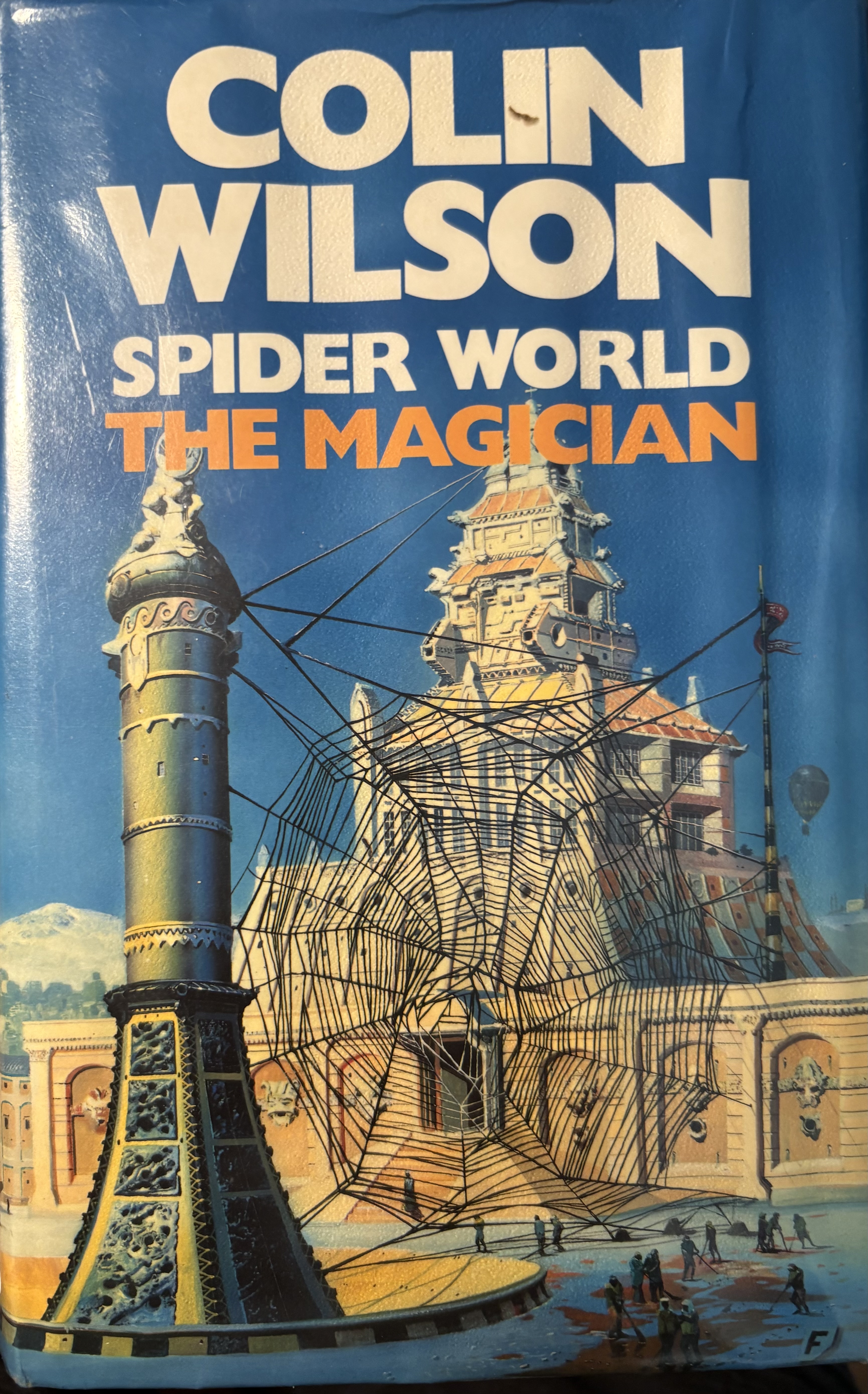
Spider World #4 The Delta, by Colin Wilson

Why this book: The next book in Colin Wilson’s Spider World Series, following The Desert, The Tower, and The Fortress.

Summary in 3 Sentences: After Niall and his co-conspirator Doggins face the masters of the world they were living in (the Beetles and the Death Spiders) they are given a choice to give up their Reaper weapons in exchange for guarantees of safety and other perks, but they reject that offer out of 1. distrust, and 2. their primary goal being to free humans from domination and servitude. So they are escape to The Delta – a mythical and mysterious world many miles across the water,  at the center of which they believe they’ll find the key to the Spiders’ power.  Arriving there with stolen spider balloons, they head inland and  confront many strange and dangerous creatures, powerful carnivorous plants and animals, and have many near misses.  Niall using his psychic senses follows his intuitions, is able to find the power behind the strange phenomona, and establish a telepathic connection and rapport with it.  This allows him and his team to return to Beetle and Spider world, where tensions are high, but Niall’s newly enhanced psychic and telepathic powers allow him to achieve a breakthrough in the tension between the humans, spiders and beetles. 

My Impressions: In this book, Wilson continues to develop Niall’s psychic and telepathic skills and power, through which he is able to connect to a much greater spiritual power.  Niall is still human but is able to tune in to mystical forces that help him not only survive, but defuse tensions between others, and survive threats to himself and his comrades. 

The Delta picks up right where The Fortress leaves off.  With the peace treaty between the Beetles and the Death Spiders in jeopardy,  Niall, Doggins and a small team of their compatriots realize that their position is untenable, and secretly and without permission activate the balloons they had captured from the spiders and escape.  With their powerful Reaper weapons, they float the many miles over the horizon to the strange world known as The Delta, which they believed may be the source of the Death Spiders’ powers.  The Delta was known as a mystical place, and they believed that with their Reaper weapons, they might be able to destroy this power source and gain leverage over the Death Spiders. .

Much of the book is about their journey inland to find this source of power of the spiders. They trudge by foot through swamps and over mountains, and grassy plains.  However it seemed that nearly every plant or tree they came to that appeared to offer shelter or sustenance was actually carnivorous predator luring them in.  Simeon an older man who’d been at The Delta,  before was able to warn them about some of these threats,  but there were many close calls – these strange plant-animal creatures had fascinatingly deceptive tools  to lure in their prey – and Niall, Doggins and their team realized that in The  Delta, they were clearly prey.

After a couple of days of travel, a couple in their group were injured or incapacitated from their near-misses with the creatures trying to prey on them, and while Simeon stayed back in a base camp with two of the injured,  Niall and Doggins went ahead.  When they were fairly close to their objective, Doggins was incapacitated and needed to sleep and recover, so Niall trusted his instincts and went on alone.  All throughout this journey,  Niall is tuning in to his intuitive psychic powers sensing danger and safety,  and using these same senses, he chose to climb alone at night to the top of the mountain that appeared to be the center of the island and potentially the source of the energy he was feeling – and seeking.   

When he got there, he rested, noticed a different feeling, and as he slipped into that liminal space between being awake and being asleep, he found himself tuned into a telepathic conversation with the Plant Goddess who indeed was the Source.  She explained to Niall how she got to where she was over millions of years of evolution, and shared insights about how to survive in The Delta. She also gave him some perspectives on the Death Spiders and how to find a resolution when he returned to Spider World.  

Niall, Doggins, Simeon and their team were able to return to their balloons and then to Spider World, where Niall imbued with new  insights from the Plant Goddess and enhanced psychic power and will, was able to navigate to a a successful interaction with the Master Beetle and Master Death Spider.  The Source power protected him from the Death Spider’s psychic attacks, and they ultimately recognized him as an envoy from the Plant Goddess and bowed down to him as representing her authority.  They recognized him as their new leader and agreed to his demands for harmony between Spiders, Beetles and humans –  that heretofore no one had thought possible.

Niall is then recognized as the legitimate leader of  human, Spider and Beetle worlds, and as a very young man, struggles with how he would handle his new status, and keep the harmony that he had brought about on a positive trajectory. The book concludes with Niall returning to his desert hovel to bury his father. 

Posted in Uncategorized | Tagged , , , , | Leave a comment

The Women, by Kristin Hannah

Why This Book: I have read many books about the Vietnam War, but almost all from the soldier’s or fighter’s perspective.  A lady friend of mine – also a nurse – told me that this was good and was worth readking.  I had read some good reviews of it, and thought this would be a good different perspective on that war.  It was. 

Summary in 6 Sentences: This novel is about a sheltered young woman who decides to follow her Naval Academy graduate older brother to Vietnam as a nurse in 1965/66. When she finally gets to Vietnam, she quickly realizes that she is completely unprepared for the austere and unpleasant working environment, the long work hours and the horror of the wounds and treatment she’d have to deal with – none of this was covered in nursing school. Over the course of her time in Vietnam she grows up and rises to her many and increasingly difficult challenges, with the support of her more worldly fellow nurses, and is inspired by the sense of mission and duty of the other medical personnel.  The second half of the book is about her struggle to adapt to coming home, having her service and experiences not recognized as being significant, and finding that much of the public blamed anyone who’d been in Vietnam for the immorality of and in the war.  As her life at home spirals out of control, she deals with all the classic symptoms of PTSD before it was recognized as a legitimate reaction to the trauma of war.  The final part of the book is about her difficult journey getting to a place where she finally comes to terms with her experiences in Vietnam.

My Impressions. This is a powerful book that takes the reader back to a window of turmoil and conflict in America -the height of the Vietnam War and its immediate aftermath. Through the eyes of Frankie McGrath, the novel’s protagonist and a nurse in a combat trauma unit, we experience much of the horror of the Vietnam War, then when she returns to the US, the challenges of coming back to one’s home country, and her service being not only unappreciated and unacknowledged, but also reviled by many.  Through her eyes and experiences, we return to this very tumultuous and chaotic time in American history when the country was torn apart by the VIetnam War.  Frankie  makes her own challenges worse by being unwilling to talk about her her experiences and emotions, by trying to deny them, or by numbing  herself through alcohol and pills.  This was not an easy part of the book to read.  

There are a lot of things I liked about this book, and several I didn’t care for.  I am glad I read (listened to) the book -it made a powerful impression on me.    We experience the dramatic culture shift occasioned by this very unpopular war,  from the perspective of a young woman who had grown up pampered in a well-heeled, upper class family in Coronado, Ca,  who volunteers to serve in Vietnam as an Army nurse. She chose  to follow her brother there in hopes of making her patriotic father proud.  She spends two years becoming an extremely competent surgical and OR nurse, treating severe and often mortal injuries of the soldiers who were brought in from combat, and she sees a lot of death, to include some with whom she is close.  And then upon returning to America, we experience her self doubt, insecurities, her anger and her inability to adapt her experience to the very different version of America she returned to.

So, what did I like and not like about the book?  I and my wife lived through that window of American history, and while we both remember the aspects of America she describes, we both felt her version was much more dramatic than our own memories and experiences.  The author seemed to give Frankie McGrath a concentrated experience of the worst of America’s reaction to Vietnam.  Frankie McGrath’s nurse friends adapted to their return to America in a more balanced manner, and represented a less traumatic reaction, so I’m not sure to what degree Frankie McGrath’s dramatic downward spiral upon return to America was representative.  

That said, you’ll see in the following that i found a lot of redeeming qualities in The Women, that in my mind outweigh those aspects of the book that I didn’t care for.   

What I liked – redeeming qualities: The reader experiences: 

  • the panorama and wide scope of what was happening in America during a time when I was a teenager and young man, regarding the impact of the Vietnam War on American culture and its people.  For me it evoked a lot of personal memories; 
  • the horror of the Vietnam war from the perspective of the medical teams in the trauma units;
  • the shock that young people felt when they arrived in Vietnam for the first time;
  • the challenges of the environment – the heat, rain, mud, humidity and lack of so much of what we take for granted – hot water, cleanliness, a comfortable place to sleep and relax;
  • the incongruity between rural village life and life in Saigon.
  • how the men and women engaged in the war were drawn to each other to combat their personal loneliness and need for human connection – both from others of their own gender and  from the opposite sex.
  • the sadness and helplessness of being with a wounded man who clearly isn’t going to live;
  • how the medical personnel had to harden themselves to the horror and sadness and do their jobs as best they could for each person;
  • how the medical people doing Medical Civic Action Programs in the villages were sad and frustrated to find children and others victimized by the war who needed so much more than the CAP Americans  could give..
  • the level of dedication of the nurses and medical people to their jobs and patients.  Frankie McGrath “re-upped” for a second year long tour, rather than leave her trauma unit understaffed and with only  inexperienced nurses;
  • how women can be quite loyal in taking carer of each other – Frankie’s nurse friends in Vietnam continued to be loyal to her and supported her long after they had left Vietnam, and when all were back in America;
  • the challenges that returning soldiers had reintegrating into a civilian society which didn’t appreciate, much less acknowledge their sacrifices.  
  • the traumatic effects of the protagonist’s PTSD, leading to self-destructive behavior and an inability to integrate with old friends or other social groups.  
  • the turmoil in America of the passionate anti-war marches and protests, and the discord that caused between the generations and between those who supported and opposed the war;
  • how the women who served in the war felt unrecognized and even disrespected – this was only a man’s war – women either weren’t there or were not important; 
  • the inadequacy of the VA’s response to our protagonist’s outreach for help.   PTSD was not widely accepted as a legitimate concern for those returning from Vietnam, especially not for women who were not directly engaged in combat. 
  • how smoking and alcohol were so much a part of recreational life in American culture at that time, and how easy it was for alienated returning vets to use alcohol to numb and self-medicate against PTSD.  
  • the power of  campaign to bring PoWs in the Hanoi Hilton home and the powerful impact it had when they finally did return.
  • the scope, emotion, and power of the Vietnam Vets Against the War marches against the war- how disparate were the participants.  
  • We are reminded that. many years after the war, many veterans were still struggling to cope with their experience and find a positive role to play in society. 
  • At the conclusion of the audible version, the author in her own voice shares what inspired her to write the book and named the individuals who were sources for her stories and  advised her on the book.  It is  an impressive list and adds a lot of credibility to the message she is conveying through the experiences of fictional Frankie McGrath.

What I didn’t care for:

  • To me it, The Women read like a book written by a woman not just about women,  but also FOR women. The book is almost exclusively from women’s perspectives and in language that made me feel at times like I was not the target reader;
  • The men in the book are often cardboard  stereotypes or caricatures, who served as little more than accessories in some way to the life of Frankie McGrath, the protagonist in the story. As a man, I would have liked to see more of their perspective and thought that mattered more than we got from the author. The men mattered too;
  • I often felt myself being led down a path that would lead to an emotional response to an upcoming or anticipated event – I could sometimes predict what it would be.  To enjoy the book, I let myself be led – but felt slightly used. 
  • I felt the author tried to jam too much about the Vietnam experience into this novel. The dead and wounded anonymous soldiers, the deaths and wounding of loved ones, the dysfunction of families because of the war, PTSD, social alienation, marching and protests against the war, POWs in Vietnam, the sexual revolution, alcoholism and drug abuse  – all are jammed into Frankie McGrath’s experience.
  • Poor Frankie McGrath had it all happen to her, except being herself physically wounded in the war. Her experiences with men seemed to be one bad luck event or bad decision after another. With each new relationship,  I just kept waiting for the other shoe to drop – and it usually did.  And each time, her disappointment set her back – WAY back, again.  To be honest, reading about all of her bad decisions regarding her family, the men in her life, her options to move forward, and then her woe-is-me-I’m-a-victim responses to where she found herself, began to exhaust me.   When is this woman going to own her life and take responsibility for herself?!!!  A couple of times I had to force myself to stay with the book.  

But I’m glad I did.  In the end, she finally does get the help she needs (though indeed it is forced upon her) and begins to heal.  It felt to me a bit like seeing the sun come up after a long, dark, cold night – and as I was approaching the end of the book, my hope was revived that things might work out.  I was pretty sure the author wouldn’t end on a negative note.   I was pleased with the end of the book and how the author brought a few loose ends together in a satisfying manner.   

The conclusion  caused me to revise upward my assessment of the book.  Hannah’s  writing is eloquent and compelling, but at least the second half of the book was not an easy read, given the plethora of bad experiences and trauma that she has us wade through.   That said, it made a strong impression on me, and for those interested in understanding the perspective of a woman Vietnam veteran, and that period of American history, Iwould indeed recommend it.  

The Audible is ably read by Julian Whelan, who credibly gives the various characters their own voices.  

OTHER REVIEWS

In looking at other reviews, the majority are very positive, and apparently it was #1 on the NYT combined fiction best seller list for 10 consecutive weeks, and was one of the most borrowed books in American Libraries. It was however panned by the Boston Globe for patronizing its readers with cliches from the era of the Vietnam War.

Many reviews I read,raved about the insights into women’s experiences in the Vietnam War, and during the counter-culture movement during and and immediately following war.  I read a number of reviews that echoed my criticisms of the the second half of the book of the amount and degree of anxiety and emotional trauma we had to experience suffer along with the protagonist.  The reviews I read in Reddit were mixed as well, for the same reasons.   81% of Amazon reviewers give it five stars,  14% gave it four  stars,  and 5% three or less.  

As noted above, I had mixed feelings, and go back and forth between 3 and 4 stars, but believe the positives well outweighed the negatives, and it was definitely a memorable experience.    I would give it 4 stars. 

Posted in Uncategorized | Tagged , , , , | 1 Comment

Unreasonable Hospitality – the Power of Giving People More than they Expect, by Will Guidara

Why this book: Selected by my SEAL book club, based on several strong recommendations

Summary in 3 Sentences: Will Guidara’s first-person account of growing up, deciding at a young age that he wanted to go into the hospitality business, and then, after a lot of experience, being given the opportunity as a young man  to manage a prominent restaurant in NYC.  The book relates how he developed his ideal of over-the-top hospitality and how he began to implement it at Eleven Madison Park (EMP) in NYC, in a way that took that restaurant from two Michelin stars to four, and ultimately being ranked #1 restaurant in the world. The book relates how his leadership philosophy evolved over the years, experiments that succeeded and failed, mistakes  made and short and long term consequences. 

My Impressions: My new favorite leadership book!  It is mostly about building a great culture – which takes time and patience.  Not so much “what” to do, but “how” to do it.  Though the context of his personal journey is the restaurant hospitality business – in NYC of all places – his approach and passion, and his philosophy will work in any context where the leader wants to build a strong and enduring culture of commitment, excellence and caring. but it takes time and persistence.

It is very much a personal/autobiographical story.  I read the book, but many of my friends listened to it and very much enjoyed that – since Will Guidara himself reads it, telling his own story. And several of my friends who listened to it, then bought the hard copy so that they could review and highlight the many ideas and principles he relates in his story of how he built a great culture which took him and his team to the top.  

For someone who just wants a sense of his message, Will helps us out with his chapter titles, section sub-titles within the chapters, and then he boldens/highlights key ideas and insights in his book. It may be tempting for someone in a hurry to just skim the chapter and sub-chapter titles to get the gist of the book – but the impact of those ideas and principles comes from the stories he tells about how he arrived at them and the impact they had on him and his team.  For example: 

Chapter titles include:

  • Restaurant-smart vs Corporate-smart
  • Breaking Rules and Building  a Team
  • Creating a Culture of Collaboration
  • Relationships are Simple.  Simple is hard.
  • Earning Informality
  • Learning to be Unreasonable.

A few of the many, many section subtitles within the chapters: 

  • Invite your team along
  • Leaders Listen
  • Find the Hidden Treasures
  • The Way you do one thing is the way you do Everything.
  • Keep the Team Engaged at all Costs
  • Language creates culture
  • Find the Third Option
  • Persistence and Determination alone are Omnipotent.
  • Make it Cool to Care
  • Slow down to Speed up

What is clear in reading this book, is that a key to Will Guidara’s success in implementing his approach to leadership was his passionate belief in it, and his willingness to live and lead by the example that his philosophy lays out. This is not a “paint-by-numbers” approach to leadership – do these things and you will succeed. That approach has it’s utility – but gets you paint-by-numbers employees – who’ll follow rules, do what they’re told, but without passion, commitment, or creativity. His approach is clearly about passion, commitment, and an intuitive love for people and the process. 

In this book we see clearly that Will Guidara believes passionately that great hospitality will lead to success – however one measures it.  But Unreasonable “hospitality” is another way of saying unreasonable “caring” for others – taking care of customers and other people – beyond what our culture normally expects.  The subtitle of this book is “the remarkable power of giving people more than they expect.”

One of the really fun things about this book are the examples he gives of “unreasonable” hospitality – examples of how and when he, vis-a-vis his employees, and his team,  vis-a-vis their customers go WAY out of their way to do favors and make them feel especially valued.  This is not always rewarded, but it very often is, when such gestures becomes part of the culture, you have  a culture in which people care about much more than their own immediate short term comfort.  In the culture that he created, the members on his team sought ways to one-up each other in hospitality gestures, within the guardrails that he created (they still had to make a profit!) 

It’s a reasonable question whether this approach could work in a large corporate organization.  He addresses this indirectly by pointing out that the CEO of the corporate group that owned his restaurant EMP encouraged and exemplified most of the principles that Will uses in his book, and this CEO gave him the latitude to be unconventional, creative, and to experiment. But even large organizations are made up of a multitude of teams.  It is worth considering what it would be like if a CEO’s executive team lived by the principles of Unreasonable Hospitality amongst themselves and toward their subordinate teams.  What would that do to organizational culture and cohesion?

I was pleased to see that he emphasized what I used to emphasize when I spoke and consulted on creating a great corporate culture:  that is, the importance of the hiring and onboarding processes. He personally was involved in all hires – at least initially, and with aspiring employees, emphasized the mindset and values his team expected and would hold each other accountable to. There are a lot of  competent and capable people looking for work, who look good on paper, but who would not be able to adapt to a culture based on innovation, caring, and “unreasonable hospitality.”     Guidara points out that he was always looking for people of strong character, who would be willing to experiment, had the capacity to care for others and put the team before themselves.  The right people he could teach the skills to do the job he needed done.  With few exceptions, everyone started at the bottom as a server/bus boy and proved themselves inorder to work their way up their hierarchy.  

Will’s creative approach to his job, willingness to try new approaches, innovate and experiment was what led to so much of their success. But Will was not a starry eyed idealist.  He was very much into and obsessed with details and finance, and meticulously went over the P&L records.  Not all of his or his team’s experiments/innovations worked.  He tracked the financial costs of each of his experiment and was willing to take some losses that might yield long term gains to their culture as well as their bottom line.  He saw that the costs of occasional failed  experiments were the price of fulfilling his vision of leading a  restaurant known for innovative and unreasonable hospitality, where people would love to eat and return to. 

I was reminded of one of my other favorite leadership books that I read a few years ago: Loonshots, by Safi Bahcall. In it, Bahcall noted that the best organizations have a balance between its artists and soldiers. The artists are the creative and imaginative ones, who generate new ideas, who want to experiment and maybe find a better way. The soldiers focus on efficiency and making shit happen, here and now, and they usually see the artists as time wasting nuisances, simply good-idea-fairies.  Experimentation often comes at the expense of short term results and efficiency.  Bahcall noted that a great organization needs both artists and soldiers, recognizing that there’s almost always a tension between those two groups.  But in the BEST organizations, the leader is a bridge, brings the two together and teaches both groups to respect each other’s contributions.   It seemed to me that Will Guidara is unique in that he seems to be strong in both qualities – artist and soldier. 

It may be surprising to some that a SEAL book club would select,  much less be over-the-top impressed with a book about leadership in the hospitality industry – but this book was a winner, with even the most hard core of the SEALs who attended the session.  They all appreciated the value that Guidara put on building a cohesive team with a common purpose and which teammates care deeply about each other and their mission. As noted, at least a few both listened to and read the book, and a couple who are now active in the corporate world wanted to contact him to speak to their teams. 

A couple of our SEALs knew Will, reached out to him and he agreed to join us (by zoom) for the discussion of his book.  A highlight of  that session was that one of the SEALs attending had worked for Will at EMP for four years a decade ago, but had since left, joined the Navy, gotten through BUD/S served in a SEAL team and then been selected to serve at our most prestigious SEAL Team.  This SEAL stated unequivocally that his time and what  he learned working for Will at EMP had been a significant contributor to his success as a SEAL.  He shared how at one point he was not doing well as an employee at EMP, that others were getting promoted and he was being left behind.  He shared how Will’s very professional and straightforward counseling got him on the right track.  One of Will’s principles: criticize the behavior or actions, not the person. The back and forth between Will and this SEAL was compelling and was a highlight of our session.

It should at this point go without saying that I strongly recommend this book to anyone who leads an organization and is open to a different but proven approach to building a strong and successful  culture.  


Posted in Uncategorized | 2 Comments

Spider World #3 – The Fortress by Colin Wilson

Why this book I’ve been a Colin Wilson fan for 50 years and decided to read his Spider World Sci Fi series.  This is book 3. 

Summary in 3 Sentences: Niall is able to hide from the Death Spiders and in the process reconnects with Jim Doggins, another human who is well ensconced in the Spider World.  Doggins believes he that there is a hidden cache of explosives and powerful weapons that were  left behind by the previous humans in a closed off ancient building called The Fortress.  He and Niall collaborate to find with what little evidence they had,  those hidden explosives and powerful weapons   When they find and demonstrate the power of these weapons, the balance of power between Niall and his team of remaining humans, and the Death Spiders shifts and it appears that a battle for dominance and freedom will ensue. 

My Impressions:  The Fortress follows immediately upon The Tower. Niall is outside the tower and realizes that he must not be seen, as punishment for being out alone at night is severe.  He has a sense of mission, to get out from under the yoke of the Death Spiders,  but knows that they are out to get him.  So where to hide – he decides that he would be most inconspicuous hiding among the other human “servants’ who do the work for the Death Spiders.

With some difficulty, Niall  is able to make it to the part of the city where the human servants work and inconspicuously joins a work party going to another area where he runs into and reconnects with Jim Doggins – a human who has a key leadership position and credibility working for the Beetles, another powerful insect group that has a mutual non-aggression treaty with the Death Spiders.  Doggins has been in this world for quite some time and knows the rules, risks, who has what power, and it seems has created a pretty lucrative life for himself working for the Beetles, protected from the Death Spiders.  But Niall learns that indeed, he is a closet revolutionary. 

Niall decides to trust Doggins and realizes that Doggins shares his desire to free the humans from domination by the Spiders and/or the Beetles. When Doggins realizes that Niall has a map of the Spider City provided him by the Steegmaster, he realizes that this map could be the key to finding “the fortress” where the earlier humans had stored their very powerful weapons – weopons that could help free them from domination by the Death Spiders.  Without permission from his masters the Beetles, Doggins leads Niall and a group of human “servant” laborers to what the map identifies as “the fortress” and after a series of close calls and a combination of inductive and deductive reasoning, they are able to locate and achieve access to the armory of the earlier humans, which includes weapons beyond the capacity of the Death Spiders to defend against. (weapons that soldiers only dream about today – lazar like hand-held weapons, with adjustable levels of intensity, from surgical to being able to destroy a city block.)

When the Death Spiders find and confront Niall, Doggins and their small team, and tell them that they have violated many of the rules of Spider World,  Niall responds that they are not accepting their rules, and insists that they be allowed to leave, and that it is his intent to free humans from their exploitation.  He does not want to kill all the Death Spiders,  but makes what he intends to be a relatively harmless show of force, demonstrating the power of these weapons. He is still unfamiliar with the weapon and inadvertently uses a high power that kills multitudes of spiders.  This is seen by the Spiders as an unforgivable act for a human and brings this explosive situation to a head. The Death Spiders all quickly leave and  Niall, Doggins and their small team head back to Beetle world.   The Master Death Spider is there waiting for them. 

This situation ultimately forces a confrontation between the Death Spiders and the Beetles who the Master Death Spider accuses of treachery, being accomplices in Niall’s empowerment and his killing of the spiders.  The Master Death Spider demands that the Beetles turn over Niall to them or he will nullify their non-aggression treaty, which will mean war. 

The Beetle leader refuses, but insists that Niall and Doggins must either leave or give over their weapons and submit to the Beetles to help avert war.  The book concludes with Niall and Doggins choosing to leave Beetle world (and obviously Spider World) to go to the Delta where they might find a clue as to what next.  They also want to avoid the prospect of war between Beetles and the  Death Spiders, and an unknown role for Niall and Doggins and their small team of humans – who, though a small group, still have devastatingly powerful weapons.  

Posted in Uncategorized | Tagged , , | Leave a comment

Spider World #2 – The Tower, by Colin Wilson

Why this book:   I’ve been a Colin Wilson fan for 50 years and decided to read his Spider World Sci Fi series.  This is book 2. 

Summary in 4 Sentences:  At the end of Book 1, Niall returns from food foraging to find his father dead and his mother, brother and sisters gone, all signs pointing to them having been taken as hostages by the spiders. So he follows their tracks and eventually is captured by the wolf spiders, a brave and efficient breed who work for the more intelligent and ruthless Death Spiders, and they are all delivered to the Death Spiders their masters.  Niall is then for the first time exposed to the civilization that the Death  Spiders have created and explores using his nascent telepathic powers to try to understand the humans that are working there, as well as their insect masters. At the end of the book, he meets King Kazan who has been co-opted by the Death Spiders to work for them, and Niall is faced with getting on board and submitting to the Death Spiders, or rebelling.

My Impressions: Book 1 was a prelude – to set the background for the rest of the series.  In Book two, the story really begins.  While the formidable wolf spiders are bringing Niall, his mother and brother to the city of the Death Spiders, they are met by other humans who also work for the Death spiders, to transport them in what seem like Viking long boats across a large body of water to the big city of the Death Siders. 

Upon arrival in the Death Spider city, Niall tries to sort out what kind of world he has entered, who are the players and what role will behis to play.   We learn about the impressive mental powers of the Death Spiders and Niall is delivered to his former friend King Kazan, who’d been captured long before and hsd submitted to the Death Spiders power and authoriry, and was now collaborating with them to save himself and his surviving family.  From King Kazan, Niall gets more insights into the nature of the Death Spiders and the world they run. King Kazan begins his process of bringing Niall into his arrangement of submission and acceptance. 

Niall’s mother, sister and brother were all under Kazan’s protection, and Niall reconnects with his love interests from his earlier visit to King Kazan’s kingdom. All of them are under King Kazans care and thereby gain many privileges and are protected from the Death Spiders.  But Niall  learns that the Death Spiders have a particular interest in him personally – as they see him as a unique threat to their world and power.  He discovers that a tool he’d picked up earlier while following the wolf spiders, near what appeared to be relic from the old civilization, seemed to have some special properties, which Niall doesn’t know or understand.

The book is titled The Tower because in the middle of the Death Spider’s city is a glowing white tower that has no apparent entrance and which the Death Spiders have tried wiwthout success to enter or destroy.   It is a mystery relic from when humans had controlled the land. Much of the rest of the Death Spider city consists of ruins of a former human city, occupied by those the Death Spiders control – many humans, as well as wolf spiders and others. The Death Spiders have a monopoly on power in thier kingsdom  through their formidable mental powers.  

But to Niall, the white tower is an intriguing  mystery – the Death Spiders don’t control or understand it.  This inspires Niall to sneak out one night and see if he can figure something out about it.     When he gets to the tower, when he pulls out the special tool  he has to see if it can help him enter, and notices that it is buzzing and suddenly he is inside the tower.  There he meets a hologram of a wise old man – calls himself the Steegmaster. The tower is a sort of time capsule, isolated from and uncorrupted by the Death Spiders, and it retains  technology and wisdom from when humans had occupied the earth. The Steegmaster enlightens Niall about the world he is in, how humans had evolved and why they’d left, and gives Niall some cryptic guidance before disappearing.  Then Niall then finds himself outside the tower, with some decisions to make. 

This sets up the next book – The Fortress. 

Posted in Uncategorized | Tagged , , , | Leave a comment

Without Hesitation – the Odyssey of an American Warrior, by Gen Hugh Shelton

Why this book:  I was looking for a book to listen to in my car and on my bike rides and selected this one, because I had briefly worked with Gen Shelton, and the time line of his career overlapped with mine, but in a parallel universe. Though he wouldn’t remember me, I hosted him at the Naval War College in 1995 when he was SOCOM commander, and served in the Pentagon while he was the Chairman of the JCS.

Summary in 3 Sentences:  General Shelton reads this audio book himself, telling his own story in not only his own words, but his own voice – from growing up to joining the Army, hitting the highlights of his career in the Army all the way to becoming the top miliary officer in the country.  Highlights include his 2 tours in Vietnam, his role in Operations Urgent Fury, Haiti, and other contingencies. It concludes with his perspectives at the political-strategic level of military leadership, as USSOCOM commander and then the Chairmen of the JCS. 

My Impressions: Really enjoyed listening to Hugh Shelton tell his story and was impressed not only with him, but how he told his story. One interesting dimension of the book – it begins with him in the hospital after a fall while trimming trees after he retired, paralyzed from the neck down.  Throughout the book, he interupts his story with the next chapter in what happened to him and how he dealt with it in the hospital – and then he’d return to where he left off in the story of his life. He comes back and deals with his in detail at the conclusion of the book – after he has retired.

His is almost a classic, traditional American  Horatio Alger story – only in this case, the “riches” were in leadership and influence in America.  The”rags’ part was not poverty, but a simple rural life.  Hugh Shelton grew up in Speed, NC, a small town ((today’s population 65) in the mountains of North Carolina, west of Rocky Mount.   Living on a ranch his grandfatther had purchased and farmed, his family were farmers, his mother was a school teacher, and he grew up with farm chores and hunted rabbits and squirrels in his spare time.  He did well in High School and found his way to NC State, which in the 1950s, required two years of military ROTC training of all males – after which he signed on for 2 more years to get the scholarship money.  He finished college and married Carolyn, his high school sweetheart.  

At 6′ 5″ tall, Shelton was an impressive and strong athlete, and volunteered for the most demanding training for elite soldiers.  That included parachute and ranger schools, and he succeeded in becoming one of he elite  “airborne Rangers.”   He later volunteered for and passed rigorous Green Beret training and was sent to Vietnam as a Special Forces officer.

Recounting  his experiences in Vietnam as a Special Forces Officer is where we truly begin to see his courage, integrity, and commitment to the values-based leadership he had learned growing up and which was reinforced by the Army. He did two tours in Vietnam and his stories from that war are unforgettable.  

Much of the rest of the book is about the evolution of his Army career, how he kept getting selected for higher rank and increased responsibility – while also his wife  Carolyn supported him and raised their three sons. 

Repeatedly he did not get the assignments he requested, but took what he was given and excelled.  His reputation for discipline, hard work and outstanding leadership led eventually bto his assignment to some of the plum jobs in the US Army, commanding the 82nd Airborne Division, the XVII Airborne Corps, United States Special Operations Command and finally the Chairman of the Joint Chiefs of Staff, the highest military officer in the nation.  His story includes interesting anecdotes and perspectives from each of these assignments.

Again, throughout the book his story is interrupted by brief chapters in the story of his path to recovery from his spinal chord injury.

His tour as Charman of the JCS – how he was selected and how he served primarily President Bill Clinton and SEDEF Cohen, was most fascinating to me. The terrorist attacks of  September 11 2001 happened just weeks before his term as Chairman concluded.  His account of that incident and how the Chairman responded was most interesting.  

Hugh Shelton doesn’t bad-mouth anyone, and gives praise and accolades to many.  I noted that he never mentioned West Point in the book, though in my experience, the “West Point Mafia” seems to run much of the Army.  He clearly enjoyed working for President Bill Clinton, had mixed feelings about President Bush, most notably because of his decision to invade Iraq, and he clearly didn’t care for working for Donald Rumsfeld after the 2000 election.  But throughout the book, he showed reverence for the values which underpin American Democracy and the foundational values of the US Army, of which he was a quintessential living example. 

The book concludes with the rest of his unlikely recovery (though not full) from his spinal chord injury – his soul-searching, treatment, and therapy  during his many months at Walter Reed Army Hospital, and then his activities after his release.  

Throughout the book, he repeatedly honors his wife Carolyn and in fact,  her voice is included in the audiobook’s introduction. He makes clear that she was a major player in his career and in all the key life decisions he made.  

Today, General Shelton serves as the Director of the Hugh and Carolyn Shelton Military Neurotrauma Foundation located in Washington, DC. while also supporting the  General Hugh Shelton Leadership Center at North Carolina State University in Raleigh which he helped to found. .

Posted in Uncategorized | Tagged , , , | Leave a comment

One Hundred Years of Solitude, by Gabriel Garcia Marquez

Why this book:  Selected by my literature reading group.  This was my 3rd time reading it.

Summary in 3 Sentences:  A tale of five generations of a family in a village/small town in the remote jungles of Columbia in South America.  It is a novel made up of multiple short stories of some normal, many eccentric characters,  beginning with the founder of the fictional town of Macando and his multiple progeny over a century of change and human drama.  “Reality” is somewhat flexible concept here, as there are occurrences that don’t seem to fit the world most of  us live in – in fact this book is considered one of the sources of the genre of “magical realism.” 

My Impressions: This very famous book is a panorama of life in a small town anywhere, but with a number of specifics related to Latin America in the early and mid 20th century.   It is more a series of stories that provide a trajectory of life that it is a single story – it is multiple stories that happen within a single family over multiple generations, over a century in a small town in a remote part of the jungle in Colombia.  We get to know a number of eccentric and interesting characters and their experiences in  the narrow mindedness peculiar to small town’s every where.  And we see the slow, almost insidious disruption brought on by 20th century modernity creeping into the culture of an isolated small town culture.  

There are a multitude of stories and fascinating characters, representing so many different types of people we all encounter – from the ambitious to libertines, to the most practical, to the cruel, deluded, and insane.   The book is a compilation of a multitude of stories that together create the mosaic of a family that fragments over many generations, and a remote town that struggles with making the transition from the 19th to the 20th century

After reading the book, and now trying to write e a summary of it, I am somewhat at a loss in trying to describe it.  So I have read a summary of it on the site “Super Summaries” and again, I am still somewhat at a loss.  Here are a few random impressions.

  • The flow of events is not logical – nor even completely sequential.  Timelines bounce around a bit.  The capriciousness of the many characters in the story take the story of Macondo and the Buendia family in so many different and directions.  There is no step-by-step pathway to a happy ending. In fact there are no classic, feel good happy endings. 
  • The matriarch Ursula is a constant throughout the book, as the one character with her  feet-on-the-ground with practical wisdom in the Buendia family focused on making prudent decisions, while her husband and sons chase chimerical dreams and adventures.  Her daughter and daughters-in-law eventually supersede her and assume more authority as she ages and her influence wains, but as her simple practical wisdom and influence is ignored, the family and household begin to fall apart.  She eventually is considered irrelevant and old fashioned by her children, grand children and their families – much to their detriment. 
  • Remedios the Beauty and Fernanda del Carpio were the most beautiful women in the book – and men became almost helplessly intoxicated and obsessed with their beauty and erotic appeal.  But their characters were the least appealing – they were two of the most psychologically screwed up characters in the novel.  Marquez is perhaps making a statement about how men are blinded by the beauty of such women.
  • Col Aureliano Buendia was perhaps the strongest character in the book.  He is self contained, not driven by sexual passions or greed and unlike many of the Buendia men, is deliberate in his decisons.  Over and over again, he instigated and led a revolution for idealistic reasons, but the years of war made him cruel and unfeeling, and eventually detached from life and his family. In the end he isolated himself into his own world, somehow having survived the many attempts on his life.  But in spite of his cynicism and bitterness, he was publicly hailed as an icon of patriotism, courage and character. 
  • Modernity was both welcomed and resisted in Macondo – much of it brought by a gringo owned Banana company.  The “Modernity” that slowly crept into Macondo included trains, and electricity, mail and postal service, connections with the world beyond, not only in Colombia but also Europe the US and beyond.  and toward the end telephones.  These innovations disrupted the tradtional values and patterns of life within Macondo and made the older citizens feel even more disconnected from the momentum of Macondo’s progress and adaptation to modernity.
  • Sexuality and the power of the sexual drive is a constant theme in the book. The men in this story always had the outlet of the French bordello in Macondo, while they followed the  protocols of their social class with the women they were courting.  Several had mistresses as well as wives, and some of the women were as ardently sexual as the men.  The spiritual connection between the men and their wives was largely a function of their sexual connection – and where it wavered or fizzled,  the relationships began to  fracture.  
  • The House that Jose Arcadio Buendia built when he founded Macondo grew and evolved into becoming the home of the greater Buendia family and legacy. This was largely the result of Ursula’s efforts and as such she became the proponrent and caregiver of the Buendia family.  The home she built came to represent the family  as later generations used it for good and then abused it for unseemly purposes, over time letting it decay and fall into disrepair, as did the legacy of the Buendia family.
  • Melquiades is a mysterious figure who appears early in the novel with a troupe of Gypsies and befriends and intrigues Jose Arcado Buendia – the pater-familia who founded Macondo. Melquiades is interested in new scientific discoveries, and instills that fascination and passion for new possibilities into Jose Arcado Buendia.  He returns to Macondo ever few years, then decides to stay there and live in the family’s house  working on a manuscript in a coded language until he dies.  After his death, the room does not decay and never changes, and follow-on Buendias become obsessed with understanding his writings.  When they are finally deciphered, it is realized that the Melquiades had predicted the entire chain of events leading up to the point at which these writings are decode.    At which point, the town and all in it, were wiped off the face of the earth by a hurricane.  Which leaves me the reader to ask whether Marquez was telling us that all that had happened to Macondo and the Buendias had been predestined.
  • Magical Realism.  This book is often used as an early example of the literary genre  called “magical realism” – in that events and occurrences are described as normal and real that defy the reality that most of us live in.  In One Hundred Years of Solitude we regularly see strange occurrences, psychic insights and supernatural events described as unremarkable.  We see flying carpets, ghosts, the ascension of Remedios the Beauty into heaven, the longevity of Ursula, Jose Arcadio Buendia living in his own reality for years, tied to a tree outside the home, the reappearance of Melquiades and his prognostications, and other events that bespeak the paranormal, but which are considered a normal part of the strange reality that exists in Macondo.  These paranormal events add to the “magic” of the book in my opinion. 

The NETFLIX series.  As of this writing, I have watched part of the NETFLIX series and agree with several reviewers that it is a worthy representation of the book.  Watching the various scenes played out that I had read in the book added some clarity and brought the book to life for me in a way my imagination sometimes struggled with in reading it.  If fact, a number of incidents in the story whose significance I missed or  didn’t quite get my attention while reading the book, were presented in the series in a way that helped me better realize their significance and broader implications.    Watch the series and then read the book, or read the book and then watch the series – the two complement each other and go together like peantut butter and jelly. In my view, they are better together than either one alone.  

My recommendation:  Yes, read the book – it is considered a classic of 20th century literature, and (I believe) deserves the attention it’s gotten.  But it is not a quick, easy read.  It is sometimes not easy to follow, but the reader has to be willing to go along for the ride – and let him/herself be amazed and surprised by what comes next.  One Hundred Years of Solitude has been widely praised as a classic example of magical realism, and of telling a long and strange story where the strange is normal, but also even the eccentric characters represent people all of us  know in our lives.  I ask myself whether the Grateful Dead were thinking of this book and the story of the Buendia family, when they wrote the lyrics to Truckin’  “What a long Strange Trip it’s been.” 

Posted in Uncategorized | Tagged , , , , , , | Leave a comment

Spider World #1 – The Desert, by Colin Wilson

Why this book:  I’ve been a fan of Colin Wilson since I was in college.  I’ve read many of his books, both fiction and non-fiction. He was very proud of this Spider World Sci Fi series and so I finally decided to dive in. This is the first book in the series. 

Summary in 4 Sentences:  The book (and I assume the series) takes place in a post-apocalyptic world in which humans are living in small stone-age-like tribes, trying to survive in a world dominated by killer spiders.  Insects and animals of many types have evolved to become  very large and often a grave threat to humans.  We are introduced to a family unit struggling to survive in the desert, and the protagonist, a young boy who has an innate ability to tune into the minds of other creatures, which he learns to develop. The story concludes with him being alone after the spiders find his family, kill his father and apparently enslave his mother and sister. 

My impressions:  This short book (180 pages) introduces Colin Wilson’s Spider World series by introducing the reader to the post-apocalyptic world in which humans have been forced into an almost a stone-age existence, struggling to survive in a very hostile world – facing very capable predators like the Death Spiders.  

We get to know the members of one family unit. They have a series of adventures which introduce us to the hostile world they live in,  and we get to know that family and that world through the eyes of Niall a young boy, who I believe will be a key protagonist in the series.  He and his  small hunter-gatherer family unit have little understanding of their history or of the world beyond their burrow/hiding place. They are very preoccupied with finding enough food to eat and water to drink, while avoiding detection from the Death Spiders  who are in constant search for humans from the air in their balloons.  And the Death Spiders are not the only predators who would gladly feast on human flesh – they are just the most advanced, powerful and threatening.  There are other spiders and predators who also pose a significant threat to humans. 

We travel with Niall on a couple of foraging expeditions with his father, during which we see the challenges posed by predator insects and other threats that exist in that desert world. The final expedition in the book is a several day trek to reconnect with another larger group of humans which has a more highly organized social network with a well developed means of defending against the predator spiders, which allows them to live and even thrive as an organized community.  Niall wants to stay with this group but chooses to return to his family with his father.  The book concludes with Niall losing his family, and reason to be uncertain as to the fate of the other larger, better organized group. 

Niall is young, courageous, determined and possesses a mental skill at sensing/reading the environment and the minds of adversaries that I’m sure we’ll see bear fruit in the next books. 

Posted in Uncategorized | Tagged , , | Leave a comment

Astrophysics for people in a Hurry, by Neil deGrasse Tyson

Why this book: I’ve always been interested in “the big picture” and I’ve been impressed when I”ve heard Neil deGrasse Tyson speak on podcasts.  This book is short and engaging.   

Summary in 3 Sentences: DeGrasse Tyson covers a lot of ground in this book, from the size and nature of the universe, to how we know what we know, how scientists measure time and distance, to the possibility of life on other planets.  He discusses the universe, our galaxy, within that universe and our solar system within that galaxy,  and where and how it fits into the “big picture.”  He also gives us fascinating background on the periodic table, quarks, and photons, and quantum theory and the ongoing effort by astrophysicists to understand dark energy, dark matter and other perplexing concepts that defy current understanding. 

My Impressions: I listened to rather than read this book – it was  beautifully read by the author.  What a great introduction to physics – and in particular how it applies to the study of not only the universe, but also of existence and ‘what is.”  DeGrasse Tyson touches on many topics that tie the laws of physics that define the physical world that we live in, to the effort by scientists to understand the size, scope and nature of the Universe itself. 

That is a daunting task, but he manages it beautifully in 200 short pages, or in about 3 1/2 hours on audible.  The easiest way to summarize the scope of the book is to give you a look at the table of contents:

Preface 
1.  The Greatest Story Ever Told  
2.  On Earth as in the Heavens
3. Let There Be Light
4. Between the Galaxies
5. Dark Matter
6. Dark Energy
7. The Cosmos on the Table
8. On Being Round
9. Invisible Light
10. Between the Planets
11. Exoplanet Earth
12. Reflections on the Cosmic Perspective
Acknowledgments
Index\

He begins with a fascinating look at the “big bang” theory and how astrophysicists believe the Universe actually began.    He goes over the history of humans trying to understand the heavens and then the evolution of Newton’s insight that the laws that govern physical bodies on earth apply universally.  Then a discussion of light, the speed of light, the illusion that “space” is empty, the mysteries that led to the assumption of “dark energy” and “dark matter” and how the “existence” of certain phenomena today can only be explained and understood theoretically, as effects of  “something” like dark matter and dark energy.   But dark matter and dark energy are themselves not understood, nor can astrophysicists today see, experience, or describe them. 

He also describes how new particles and forms of energy have been discovered such as photons, microwaves, positrons, neutrinos, bosons, hadrons, quarks, quasars,  and more – foundations of the physical world that have only in the last century been discovered and are still being understood.  He introduces us to the tension between the general theory of relativity and quantum gravity,  and how efforts to deconflict and unify these two have been on-going  for nearly a century.   

There is a lot of content in this book, but it is summarized and simplified so that someone like me, with only a HS understanding of physics can begin to comprehend. I will listen to this book again and certainly gain more the second time. 

I have described this book as a  good left-brain balance to much of the strange metaphysics that I have been reading about and listening to, regarding unexplained and unexplainable paranormal phenomena which seem to violate our understanding of the space-time continuum and the physical laws described in this book.  

In particular, I really appreciated and savored his final chapter on what all this might mean to us in our view of ourselves in the universe, and our daily lives.  He calls it the “Cosmic Perspective” – a wise and well informed view of our small place in the vast Universe.

Highly recommended.   

Posted in Uncategorized | Tagged , , , , | Leave a comment

The Heaven and Earth Grocery Store, by James McBride

Why This Book: I liked Deacon King Kong and had heard and read good things about this book

Summary in 3 Sentences: The novel takes place in the 1930s in a suburb of Pottstown, Pa, where Jews and Blacks lived apart from the main stream white culture.  Through the lives of several colorful figures in the Jewish and African American communities, we get to  know how life was constricted by prejudice and racist policies in America at that time.  Drama occurs when a prominent member of the community assaults a very popular Jewish lady who was harboring a black boy to prevent him from being unjustly institutionalized, and how the Black and Jewish communities came together to rectify this injustice. 

My Impressions  Enjoyed this book – and learned a lot, though I didn’t care for how he ended it – more on that later.   As he did in Deacon King Kong, McBride has a  meandering approach to describing the world of a poor under-privileged neighborhood in a different time and place.  We get to know the people who live in that world, and thereby come to understand and appreciate their lives, challenges and in some cases, heroism in dealing with their circumstances.   

The setting is a mixed Jewish and Black neighborhood in 1930s Pottstown, Pa. The story initially begins with the protagonist Moshe Ludlow, a rather dour Jewish theater manager marrying  and starting a life with the  crippled but otherwise beautiful, intelligent and congenial Chona, the Jewish daughter of the owner of the Heaven and Earth Grocery Store.  Chona is well loved within both the Jewish and Black communities. In spite of institutional prejudice and racism, Moshe does pretty well making a living as a theater manager in Pottstown but is very careful to stay within his limitations as a Jew in Pottstown.  We also get to know characters in the adjacent poor black community and how the blacks and Jew struggle to take care of each other and survive in a world with systemic prejudices and discrimination against both groups.  

Ultimately these two communities – Jewish and African American living in a section of Pottstown known as “Chicken Hill”  – support each other against the predominant WASP culture that runs suburban Pottstown, though not without sharing many of the same prejudices against each other that the whites have against each of them.  The book is populated by a goodly number of memorable and colorful characters from both Jewish and Black communities, and a few bad-apple characters representing the oppressive WASP culture of Pottstown.

I chose to listen to the book because I enjoyed the narrator  Dominic Hoffman’s vocal rendition of Deacon King Kong,.  Again in Heaven and Earth Grocery Store, Hoffman’s credible renditions of the accents and voices of the Black and Jewish and other characters in the book helped bring the time, and context of the story to life.  

The plot to this story is difficult to describe, as it meanders a bit – and  seems merely to serve as a venue for describing and developing the many colorful characters in this book, and for describing the culture of  Chicken Hill.   Moshe and Chona are key characters in the book but disappear for much of it as we get to know the many other interesting characters living on Chicken Hill.

Nate Timblin is Moshe’s lead employee and foreman for his theater and is a well respected black man on Chicken Hill.  Nate has a nephew who he wants to hide from authorities who intend to institutionalize him because they believe he is retarded – though in fact he is quite intelligent, but deaf.   Chona agrees to hide the boy, but he is eventually discovered and sent to the sanatorium reserved for the indigent – well known for poor conditions and abusing its patients.  They hatch a convoluted plot to rescue him from the institution, which takes up much of the latter part of the book – but again, it seemed primarily to offer a context for the author to further develop the fascinating characters in this community.  

The ending is satisfying but leaves a few strings untied.  What I didn’t care for was how as the book concludes, McBride felt compelled to give the reader a lecture that could have come out of a Marxist textbook. on how the capitalist system is rigged to permit the exploitation of the poor and the working class by the white wealthy classes.  That exploitation was evident and easily deduced from the story, as part of the reality of early 20th century America, but I didn’t need for him to preach it to me as The Truth. 

That said, I did enjoy the book – and indeed got many insights into Jewish-American culture and how Jews and Blacks lived in small town America a hundred years ago.   I was fully engaged in listening to the stories and the voices of the many memorable characters of Chicken Hill, and the descriptions of life in a semi-ghetto of Blacks and Jews outside of Pottstown Pa in the 1930s.  

Posted in Uncategorized | Leave a comment