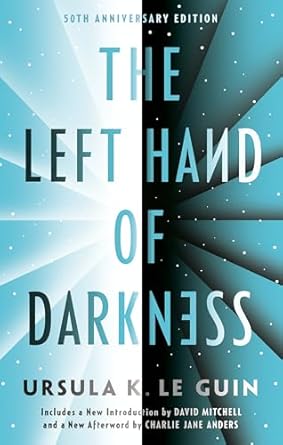
The Left Hand of Darkness, by Ursula Le Guin

Why this book: I suggested it to my Sci Fi reading group based on having used Le Guin’s award-winning short story “The Ones who Walk Away from Omelas” in ethics classes when I taught at the Naval Academy.  I’d heard and read much about her, but none of her novels. This is reputed to be one of her best.

 Summary in 5 Sentences: Genly Ai is an earthly human  envoy sent from Ekumen, a  consortium of inhabited planets across a number of galaxies, to meet with the inhabitants of the planet Gethen, which has human-like, sentient, conscious beings living in a climate/environment like earth in the highest latitudes – very cold and mountainous for most of the year.  The mission of the envoy/ambassador is to  make contact with the inhabitants of Gethen and  convince them to join the Ekumen consortium.  The envoy is received with suspicion and gets caught in an ongoing tension between two different societies on Gethen, and is put into prison with little hope of survival.  A Gethenian friend, also a political refugee, who believed in the envoy and the Ekumen mission, rescues him from prison, and together they escape by travelling for months across a barren inhospitable arctic landscape.  In the course of that long and perilous journey, the two become close friends, learn to appreciate each other’s differences, and we get to know each of them and their different cultures more profoundly   

My Impressions:  Fascinating book – not a quick read – hard to figure out at first, but worth sticking with it.  A  thoughtful reader will appreciate it – not a lot of action, but a lot of very interesting dimensions to this story about an earthling on another planet dealing with differnt beings and different cultures.  This book has won so many awards and has had so much impact, it is a classic of the Science Fiction genre.  

Le Guinn grew up in a home of anthropologists and she was very familiar with cross-cultural tensions and misunderstandings,  and cross-cultural bridge building was her specialty.  What makes The Left Hand of Darkness stand out is not lots of action or Sci-Fi technological wizardry, space ships, and battles.  She creates a human-like culture on an imaginary planet Gethen, many light years away from earth, that on the surface seems similar to ours, but as we get to know it, we learn that the differences are profound in ways that give us insights and force us to consider who we are.  

Gender and Sexuality

We learn early on in the book, that the main difference between Genly Ai, a human, and Gethenians is in the areas of gender and sexuality.  Genly as a human is a male and has the human orientation that people are born male or female, (though some today are challenging that concept) and most humans consider their gender to be a core part of who they are. That’s not the case with Gethenians.

Le Guinn challenges our concepts of gender by creating the ambi-sexual Gethenians, who are both male and female, and for most of the time,  are indeed genderless.  But they become male or female only when mating during estrus, and in that process can be either male or female, father or mother of a child they conceive, and they have no control over that. The next time they mate, they may be the other gender. 

When they are not in estrus, they are genderless and asexual, and have no sexual drive or hunger.  But when a Gethenian goes into estrus – every 26 days for 2-3 days (sound familiar ladies?) a Gethenian becomes in a random manner, either male or female and copulates as such.  During this period of estrus, a Gethenian is semi-crazy with sex – completely distracted by the drive to procreate,  and is given latitude to fulfill that natural drive, to fulfill that desire  during estrus, and then when it’s over, get back to work.   There are places dedicated for Gethenians in estrus to meet and fulfill that all-consuming drive.   The Gethenians saw Genly Ai as a pervert because as a human male, he had only one gender and was in mild estrus all the time.  

There is very little reference in the book to the idea of “romance” associated with sexuality that we are familiar with as humans.  Only in one case, we learn that Genly’s Gethenian mentor Estraven had a close emotional tie to one of his partners who was raising their children while Estraven was engaged in politics.  And apperently they had had a falling out.   

The Story

The story begins with us meeting the human envoy Genly Ai representing a multi-galaxy consortium of planets visiting the planet Gethen with the mission of convincing them to join the consortium of inhabited planets in the galaxy.  Genly is attending a political ceremony with his Gethenian host Estraven who becomes a key player in the book.  Estraven was the prime minister, and believed in and supported Genly’s mission of convincing the Gethenians to join the Ekumen consortium,  but his rivals convinced the king that Estraven had other motives and had him banished.

That left Genly with no sponsor, so he decides to visit a neighboring country to learn their ways and to see if his offer from the Ekumen may have more appeal.  But after a warm reception, those suspicious of his motives have him imprisoned in what is remarkably like a communist re-education camp. There he is drugged and constantly interrogated, and begins to lose his sense of identity – when Estraven succeeds at a daring rescue  from the prison. After which the two are “on the lamb.”

Genly’s visit to the neighboring country had exposed him and us to two very different Gethenian cultures – one ruled by authoritarian fear, the other by bureaucratic committees with a secret police in the back ground.  Though there is tension between these two societies on Gethen, there has been no war.  Le Guinn postulates that without the constant drum beat of male aggressiveness and will to violence and power, the possibility of war is greatly reduced. 

As the story unfolds, Genly Ai is sharing with us in a first-person narrative, his impressions of the Gethenian culture as he perceives it.  In the second half of the book, after Estraven rescues him from the horrors of his prison, their only real option to avoid recapture is to escape across a vast arctic wasteland in subzero temperatures.   Estraven has prepared well for this arduous journey of several months to reach a safe haven.  During this second half of the book, during their long trek over an arctic ice field, the chapters alternate between Genly Ai’s and Estraven’s first person perspectives, and we see how these two individuals – Genly Ai,  a human, and Estraven a neuter with both male and female characteristics, come to respect, work together, and even love (not in a physical way) each other, as they depend on each other to survive in their arduous trek over the arctic wasteland.

At one point Genly and Estraven are discussing the differences between men and women on earth, Estrahan asks if they are fundamentally different.  Genly responds that whether one is born man or woman determines almost everything – vocabulary, clothing, opporunities, roes in society – and he notes that it’s extremely hard to separate the innate differences from the learned ones. (P253)

During that months-long trek through an arctic waste land, Le Guin details how they moved and survived in the most inhospitable conditions.  I have some experience moving and camping in very cold environments,  and Le Guin’s novel accurately portrayed many of the difficulties and processes required to move and survive in that extremely challenging environment. I read separately that she had done research on arctic explorers and used what she had learned from their writings to describe how Genly Ai and Estraven worked together and survived on their long trek in sub zero temperatures.  

The book concludes with some drama and surprises and ultimately with contact established between Ekumen and the planet of Gethen.  

Some other interestng aspects of the book that caught my attention:

  • As a human from earth, Genly had mastered telepathy – what he calls “mindspeak” and teaches it to Estraven. Once Estraven had mastered it, much of their conversation in their tent at night was through silent mindspeak.
  • There is a subculture on Gethen of beings (again, neither men nor women, but both) which has many similarities to an Indian or Buddhist culture, that specializes in foretelling the future.  Genly Ai paid for their service, but it was an eclectic group that was not in the least materialistic. The responses that were given to questions about the future were ambiguous, clearly modeled after the Greek Delphic Oracle.
  • At the end of their very difficult journey over the ice field, there was an emotional  letdown that I recognized after completing an exhausting, all consuming task. “We were tired.  There was no more joy in us.”

Some good quotes that I found interesting.

  • “To exhibit the perfect uselessness of knowing the answer to the wrong question.”
  • “The Ekumen is not a government at all. It is an attempt to unify the mustical with the political, and as such is of course mostly a failure; but its failure has done more good for humanity so far than the success of its predecessors.” 
  • To go thru kemmer (estrus) without a partner is pretty hard on a Gethenian.  Suppression (of Kemmer) produced ont frustration, but something more ominous in the long run: passivity. 
  • Genly to Estrahan – “You’re isolated and undivided. Perhaps you are as obsessed with wholeness as we are with dualism”:
  • “Light is the left hand of darkness,  and darkness the right hand of light. Two are one, life and death, lying together like lovers in kemmer, like hands joined together, like the end and the way.” p 252
  • And I wondered, not for the first time, what patriotism is, what the love of country truly consists of, how the  yearning loyalty that had shaken my friend’s voice arises, and how so real a love can become too often , so foolish and vile a bigotry.  Where does it go wrong?”   p300

The interaction between Genly and Estraven, especially during their long trek over the arctic mountains and ice field was a key part of the book.   Genly as a human from a more technologically advanced society was insensitive to the androgynous, male-female dynamic on Gethen, and in fact came off a bit chauvinistic by today’s standards (again this was written in 1969).  Estraven was the moral hero of the book, with strong male and female qualities, selfless and wise, not as physically strong as Genly but physically strong enough, with great endurance and a more developed moral compass. . 

One of Le Guin’s primary themes in this book was to get the reader to imagine gender as mutable and not a core aspect of our being.  What would it be like for there to be no inherent gender, for anyone to be able to bear children, to not have gender specific roles in society, for all beings to have qualities of both men and women, and for both to have responsibility for bearing and raising children, as well as filling traditionally male professions.   Can we imagine a society in which “gender” is a temporary state, otherwise irrelevant?   These were revolutionary ideas in 1969 when she wrote the book, and some argue that The Left Hand of Darkness has significantly influenced our revolution in gender roles in Western Society.

There is also the theme/analogy of a more technologically advanced culture connecting with  less technically advanced, but in some ways, more intuitive and sensitive cultures.  We are all familiar with  the results of the Europeans colonizing less developed parts of the world in the 16th – 19th centuries on earth – and how technological power drowned or destroyed many more subtle qualities in the colonized countries.    Genly seemed to feel a bit superior to the primitives on Gethen and was insensitive to many aspects of Gethenian culture – until he’d been there a while and came to appreciate nuances he’d missed early on.  Though Ekumen’s and Genly’s goals seemed noble and non-exploitative,  the end of hte book begs the question: would they stay that way?  And what would the impact of opening up the channels of communication and influence from Ekumen’s consortium of planets to Gethen have on Gethenian cultures?  At the end of the book, we were already seeing the Gethenians fascinated with space ships, airplanes, and other technologies.  Where would all that lead? 

These are questions, issues that Le Guin leaves hanging, in her very provocative book.  

One aspect of the book that was awkward and for which Le Guin has been roundly criticized by feminists (male and femail)  was that she used the male pronoun for Gethenians – so it was easy to visualize the Gethenians as men.  “They” would have been awkward.  S/he would have worked better for me. But occasionally she reminded us that Estraven had female qualities and characterisitics, though reading the book, and having “him” referred to as “he” leads the reader to visualize and imagine Estraven as a male.  He was no more a male than a female. This is a shortcoming of this provocative book.  

Posted in Uncategorized | Tagged , , , , | Leave a comment

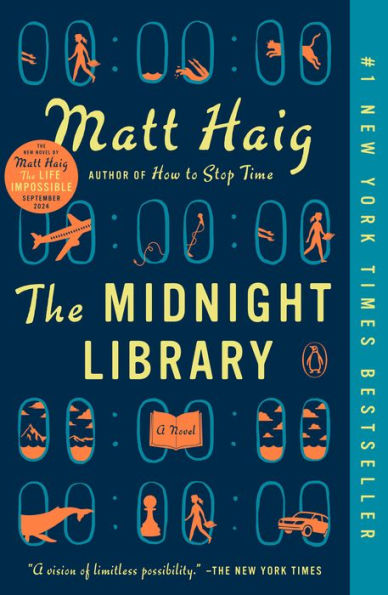
The Midnight Library. by Matt Haig

Why this book: Really liked The Life Impossible, and had heard good things about The Midnight Library. I liked Matt Haig’s writing so I listened to this book soon after finishing Life Impossible. 

Summary in 4 Sentences: A young woman (about 35) has a series of things go wrong in her life, realizes she is stuck because of a lifetime of bad decisions, has nothing to look forward to, and decides to end it all by OD’ing on anti-depressants.  When she passes out, she finds herself in a different dimension – a Midnight Library that exists in the moment between life and death, full of books of all the lives she could have lived, had she made different decisions.   In the Midnight Library, she is guided by her HS librarian who’d been very kind to her when she was going through hard times when she had been in High School, and she gets to experience many different directions her life could have taken had she made different decisons.  She comes to realize that even those fantasy lives are not all peaches and cream, finally realizing that the life she actually had, had a lot to offer  – and in a final dramatic scene, she gets a second chance. 

My Impressions:  I did enjoy listening to this book, though not as much as I did The Life Impossible.    The premise and setting, were cleverly done, and I thought the lessons our protagonist learned were valuable and useful for anyone.   But as I note below, this book would appeal more to someone younger and at a different stage in their life than I.  

I guess my challenge with the book was that I had trouble relating to Nora – the young woman protagonist of the book.  She seemed almost a caricature of a fearful, somewhat helpless and hapless young woman, intelligent and capable,  but without any self confidence.  Her family life had not been good growing up – her parents’ love for her was conditional, they didn’t get along and she felt on her own.  She did not have much understanding of the rough and tumble real world, where shit happens, people get knocked down, the strong get back up, while the weak stay down, feel sorry for themselves and/or get into alcohol or drugs.    She seemed to feel almost powerless to step up and take action – when things got tough, she folded, took the easy way out.   Sometimes I felt like the book was therapy for women who feel powerless to take responsibility for their own lives.  

   I recognize that Nora may represent a significant percentage of young women (and men) who’ve been dealt a tough hand and have essentially given up when things start going badly. And such women (or men) would be able to relate to Nora and get more out of this book than I did.  The setting and the theme of the book were clever and interesting, and several of the alternate lives that Nora stepped into were interesting and provided her (and us the readers)  with insightful lessons and useful perspectives.  But I did get tired of the melodrama, and with each alternate life, hanging out in her head with the drama, anxiety, excuses and unwillingness to accept some of the realities of life and her fate.

A couple of other things that frustrated me in this book.  

  1. Each time Nora stepped into a new setting as a “Nora” who’d made different decisions and therefore was on a different life trajectory, she had to spend her first hours/days figuring out who were these people around her and how did the Nora in this alternate life get here.  The Nora who was transported to this alternate life through the “midnight library”, and the Nora IN that alternate life were actually two different people,  because Nora would have evolved very differently on the path to this alternate life than she did in her “root” life.  They simply looked and sounded alike and had had the same childhood.  Having to go through that awkward transition period again and again in each alternate life was tedious for me the reader.  Couldn’t Matt Haig have let the two identities overlap a bit, so that Nora  could actually experience the new life without having to figure out who she was supposed to be, and how did this alternate Nora get into this alternate life? 
  2. In each of these alternate lives (except one,)  Nora was challenged and ultimately gave up – quit, and chose to go back to the Midnight Library. While experiencing the alternate life, she had not invested the years of work and sacrifice, ups and downs that are always on the path to becoming  a success –  that super athlete, or that rock star, or that professor.  She simply and suddenly found herself in that fantasy role, and when the going got tough, rather than embracing the challenge,  she bailed – back to the Midnight Library to try another life.   Isn’t that sort of how she got to that tough place in real her life to begin with – by bailing when things got tough and overwhelming?

All that said, a couple of other unusual things I DID like about the book.

  1. Matt Haig, through Nora explores the idea that what she was experiencing was not simply a dream but reflected a possible “reality” of an infinite number of alternate, parallel universes that quantum theory postulates.  We are briefly introduced to quantum theory, Schrodinger’s Cat, and the possibility that we exist simultaneously in multiple lives on multiple (infinite) planes.  Cleverly, the music story where Nora had worked, and from which she was let go, was called “String Theory.” 
  2. Nora had been a student of philosophy, and through her, Matt Haig introduces the reader to a number of great books in the canon of humanistic philosophy – books that were on Nora’s book shelf and that she had read. She also referred in the book to quotes from Sartre, Camus and others that resonated with me – a fellow humanities geek.  I would have enjoyed chatting with Nora about these thinkers and challenging her to incorporate their ideas into her life. 

For an older adult – I’d probably give this book a 7 on a scale of 1 to 10 with kudos for the clever idea, the writing, and the themes.     But I would make it a must read book for young women (or men) in their late teens or twenties, struggling with an identity crisis, unfavorably comparing their modest unfulfilled lives to those the media has inflated into always happy icons (who strangely enough, often commit suicide.)  This is an excellent book for those not happy with where they are in their lives, and are trying to figure out how they got there,  what to do about it, and how to move forward. 

At 72 yrs old, that’s not me….

Posted in Uncategorized | Tagged , , , , | 1 Comment

On Desperate Ground – the Marines at the Reservoir, the Korean War’s Greatest Battle, by Hampton Sides

Why this book:  Selected by my SEAL book club at my recommendation, after hearing so much good about it.  I read rather than listened to this book – and having the print copy has the advantage of photos.  This is also the 5th book by Hampton Sides that I’ve read – and each has been memorable and impressive.

Summary in 3 Sentences:The book begins with some background on what led to the Korean War, a brief look at the Inchon landing and other early successes and mistakes the US made at the beginning of the war fighting the North Koreans,  that led to the US invasion of the North and ultimately the Chinese entry into the war. The bulk of the book is about how the 1st Marine Division was assigned the mission of getting to the Yalu river to complete the conquest of North Korea, but enroute, were surrounded at the Chosin Reservoir by Chinese forces, and through amazing, courage, initiative, and lots of killing and suffering on both sides, the Marines were able to escape almost certain annihilation.  The book describes the battle through the eyes and experiences of a number of participants at every level of the battle, to includes some of the Chinese perspective.  

My Impressions: What an amazing story of suffering and courage.  And so well told.  After reading this, one can only say “God Bless the United States Marine Corps” for their courage and resilience under the most horrific of conditions.  Sides gives us the perspectives and personal stories of a wide variety of players in this drama – heroes as well as villains.  Villains were not only the Chinese but also American Generals MacArthur and Almond who underestimated the threat of Chinese involvement, and cavalierly and without serious consideration of risks and contingencies, sent the Marines into what ended up being a hell-hole.  

Sides interviewed dozens of veterans of the Korean war and included the personal stories of a number of them.  He also did not forget the Korean people and included the experiences and perspectives of a Korean family. These personal stories amplified the depth and drama of the almost hopeless situation that the Marines were put into by the poor decisions of Generals  Almond and MacArthur. 

The marines were cut off from support and resupply, separated into groups that were unable to reinforce each other and were attacked and surrounded by a huge force of the Chines army  that had not been detected earlier.  Thirty thousand Marinces and other UN forces were in serious danger of being annihilated by a Chinese force four to five times their size, but were able to slip out of the noose that was tightening around them by the amazing courage, initiative and resilience of the troops and their leaders.

In addition to the Chinese, the marines had to deal with extremely cold weather – regularly regreat battle and exceptional courage by  chapter in American history. 

The leading hero in this story was Marine Maj General Oliver Smith, whose calm and deliberate leadership resulted in the Marines being able to escape almost certain destruction.  The leading villain was Army Lt General Edward Almond, Smith’s superior who refused to acknowledge the risks that Smith brought to his attention, as General Almond would accept no challenge to his plan and uncompromising goal of marching a division though mountainous, inaccessible terrain to get to the Yalu River.  Right behind Almond on Sides’ list of villains was Gen MacArthur who directed the campaign from Tokyo and who would show up in Korea for brief photo ops, and then abruptly return to Japan.

At the conclusion of the book, Sides provides an epilogue to tell us what happened to the many characters we got to know in the drama of the battle and narrow escape from the Chosin Reservoir.  In his acknowledgments, he provides an impressive list of people, meetings, and other resources that shaped his story and experiences writing this book.  He also recommends a good list of books for further reading on this epic battle.   

Hampton Sides is a fabulous narrative story teller and writer of popular history.  This book deserves its place along with the other four books of his I’ve read (Blood and Thunder, Kingdom of Ice, Ghost Soldiers, and The Wide, Wide Sea) as inspiring history, bringing little known stories of our past to life.  He is so well known and widely read, he has done our country a service in writing this book and putting a spotlight on this great battle and exceptional courage and performance by Americans in war.  This battle, like the Korean War is often overlooked by Americans – but never by Marines! 

Posted in Uncategorized | Tagged , , , , | Leave a comment

A River Runs Through it, by Norman Maclean

Why this book: Selected by my Literature book club at my recommendation. It was strongly recommended to me by Rich Marshall. I listened to rather than read it. It is short – only 3 1/2 hours to listen to – probably only a bit more than 100 pages to read.  I chose to listen to it because it is narrated by Ivan Doig – one of my favorite Western authors. 

Summary in 5 Senences:   This is a novel, written as a semi-autobiographical  retrospective look by the older Norman Maclean, looking back on incidents that took place growing up in Montana in the first decades of the 20th century. His story focuses on his childhood with his brother, then later after her returns from college, when as young adults they reconnected in their 20’s.  Norman who narrates, is the more thoughtful and prudent  of the two brothers;  his younger brother Paul  was the rambunctious gifted athlete and fly fisherman, but also rebellious, charismatic and a risk taker.  The two brothers were very different, but were close and clearly admired and loved each other. Norman sought to protect Paul from himself by trying to get him to moderate his drinking, gambling and other risky behavior. Fly fishing is a theme throughout – as an activity t that brought them  together and in direct  contact with the wilderness and nature, but which I saw as mostly a metaphor for so much more.

My Impressions:  Short, subtle and powerful.  The backdrop of the whole story is the wilderness and rivers of Montana and life growing up in the small rural town of Missoula, Montana, where fly fishing is a widely respected sport and art form.  The characters are finely drawn in the book, and fly fishing in that part of Montana is an important activity that mostly men did together – the narrator’s father brought his boys up studying the art and craft of fly fishing.  Their father taught them fly fishing as an almost religious activity – he related it to the bible – Christ was a fisherman as were many of the disciples and Norman’s minister father treated it is treated as much more than a mere avocation.

But while much of the activity is centered around fly-fishing, the story is really about the two brothers their relationship to each other and how they evolved and developed in different directions.  Norman was studious, reserved, and well behaved, whereas his brother Paul was rebellious and extraverted, self confident and charismatic – and drawn to activities that would further enhance his risk taking – like drinking and gambling and the wild night life.  Paul was courageous and a tough fighter, whereas Norman, while tough, and courageous, avoided conflict and confrontation. 

Norman truly admires Paul  – Paul is a truly gifted fly-fisherman and his artistry with the fly rod, the depth of his understanding of trout and their relationship to the environment is extraordinary.  Norman is a good fly fisherman, but Paul is at a different level. 

As the story progresses we meet Norman’s wife Jesse and her family – and a subplot ensues when Jesse’s brother Neal who had left Missoula for the West Coast returns home and behaves in a condescending way toward those he regarded as the yokels in Missoula. Jesse’s mother wants Norman and Paul to take Neal fishing even though they clearly don’t like Neal, and Neal doesn’t particularly want to go fishing.  But the pressure of the mother-in-law makes it happen and the results are not pretty.

The sub plot around Neal is how his presence causes friction between Norman and his wife Jesse and how that brings out several things not only in their relationship, but in Norman’s relationship to her mother and family. Also in how Paul supports Neal in dealing with this dilemma.

There are several lasting impressions I have of from book.  

  • The simple joys of growing up in a less complex world, in small town, in the Rocky mountains a hundred years ago.
  • Relationship between brothers can be a tension between love and common family ties, and competition.
  • The magic of being alone and communing with nature by doing something active and in harmony with nature.
  • Family dynamics within Norman’s family and within Jesse’s family – tensions between stubborn people.
  • Aging and looking back on difficult personal times,  remembering and losing loved ones  as one gets older and processing what happened.
  • How Norman handled the difficult issue with his wife Jesse – “I don’t like your brother but I love you. Please don’t make me choose.”  How he expressed his love to her.
  • You can’t help someone who doesn’t want to be helped.  Sometimes the best you can so is let them learn for themselves, but let that person know that you are there if they need you.
  • The subtly spiritual side of this book – Norman’s father was a minister, the quiet spiritual kindness and humanity that was a current throughout the book – even the tough parts. 
  • Fly fishing is an art – which requires the fisherman not only to be an expert with the pole and line, but also in understanding trout and how they live and eat, streams, insects and more.
  • The river and water are themes throughout, as sources of wisdom, tranquility and transcendence.   Every time the characters are near the water, things are good and earthly tensions are mitigated or disappear.  I have asked myself if this is a primal sense that drives people to want to live near and be on the water.
  • The quiet and soft spoken tone of the book represented to me a quiet acceptance of life’s  big picture.   The mountains and the rivers have a spiritual quality that reminds us of the transitory nature of the drama of life lived day-to-day, month-to-month, year-to-year. 
  • I saw fly fishing as a metaphor for the role that art and skill can play in life as we live it in the moment.  But art and skill, while impressive and are to be admired, alone are not enough to live well. 

After reading the book, I watched the movie, directed by Robert Redford and staring Brad Pitt. I thought the movie was well done and followed the themes of the book, though the movie included some scenes not in the book, changed the story a bit, and deleted some other stories.  But the movie did credit to the book and I’d recommend it – to augment the wonderful writing of Norman Maclean

Posted in Uncategorized | Tagged , , , , | Leave a comment

By All Means Available – Memoirs of a Life in Intelligence, Special Operations, and Strategy, by Michael Vickers

Why this book: Selected by the SEAL book club I’m a member of. When we met to discuss it, Mike Vickers joined us for the discussion – it was a lively and very informative supplement to having read his book.

Summary in 1 (long) Sentence: This is Mike Vickers’ autobiography – presented in five parts – 1.”Preparation” – his early years and his time as a Green Beret; 2.”War with the Red Army” – his time in the CIA and playing a key role in US support to the Mujahideen fighting the Soviets in Afghanistan; 3. “War with Al-Qa’ida” his role in fighting Al-Qa’ida and the Taliban after 9/11, mostly in Afghanistan but also in Iraq and elsewhere; 4.”Fighting on Multiple Fronts” – as ASD SO/LIC and USD-I advising on and carrying out strategies to fight America’s enemies beyond Iraq and Afghanistan during and after the Global War on Terrorism; and finally, 5.”Reflections” his views on how the US should fight against current and future threats to national security, as well as an account of the honors he’s received upon leaving govt service.

Impressions: A fascinating look from an insider in America’s fight against terrorism and a number of small wars and conflicts over the 40+ years between the 70s and the mid 20 teens. Vickers served under six Presidents from Ford to Obama. As he got more senior, he shares how the strategic visions of the different Presidents changed and affected US strategy in dealing with conflicts overseas.

The book is part autobiography and part history – there were times when I fetl overwhelmed by facts that might be of value to a historian doing research but were more than I was interested in knowing. The lay reader like myself could have done without many of the facts and background material on weapon systems and other details that were apparently presented to fill in gaps in the history of the conflicts he writes about for those who might be doing research or using this book as a reference for either history or future operations. Stylistically, the writing was in straightforward narrative form and while Vickers did add personal notes, impressions and anecdotes to his story which added his personal views and occasionally even humor to his account, it was mostly his participation and role in “what happened.”

All that said, his life’s story and trajectory are impressive and fascinaing. He began as a very young man enlisting in the Army post Vietnam, was selected for and passed the Special Forces Basic training program and rose quickly through the NCO ranks to become an officer and eventually Captain. During his time in SF he participated in several high profile classified missions and attained a strong reputation as someone who could get things done. He then left the Army to pursue his dream of working for the CIA. His SF background made him a good choice to support the CIA program supporting the Mujahideen fighting the Soviets in Afghanistan during the 1980s, and he quickly became a key figure in that effort.

US efforts in support of the Mujahideen in Afghanistan, where Vickers became a major player, were dramatized in the movie Charlie Wilson’s War. The details and back-story of our support for the Mujahideen against the Soviets was indeed fascinating. He clearly admired CIA director William Casey and Ronald Reagan and Margaret Thatcher in making the tough choices that were crucial to America’s help to the Mujahideen who eventually drove the Soviets out of Afghanistan. Those decisions included providing weapon systems that had the potential of escalating the war, but proved critical to escalating the costs to the Soviets of continuing the war. Premier among those were Thatcher’s agreement to allow the Mujahideen to use the British Blowpipe and Reagan’s decision to allow them to use Stinger missiles agains the Soviets.

He noted that in the case of supporting the Mujahideen, we were playing to win – whereas today supporting the Ukrainians against the Russians, we are simply playing to play. Also surprising to me was the key support that China also gave to the Mujahideen, and the cautious role that Pakistan also played. At that time, China was at loggerheads with the Soviets, and the Pakistanis were very concerned about having a Soviet proxy on their border. The US was playing an interesting coordinating role between all these players who were invested in preventing the Soviets from owning Afghanistan. Lots of people died in that effort – mostly Afghanis and Russians.

Soon after the fall of the Soviet bloc, Vickers left the CIA to pursue graduate studies and got his MBA from Wharton and his PhD from Johns Hopkins, and eventually became a senior vice president for strategic studies at the Center for Strategic and Budgetary Assessments. It was in this role that Vickers cultivated relationships with senior governmental leaders and, at times, provided President George W. Bush and his cabinet with advice on the Iraq War. It was a position that undoubtedly set the conditions for his return to government service.

Under the George W Bush administration, he became Assistant Secretary of Defense for Special Operations/Low Intensity Conflict (ASD SO/LIC) with an increased portfolio to include “Independent Capabilities” – which included Counter-proliferation. Vicker’s title was ASD SO/LIC IC – the first and last to have that expanded portfolio. When President Obama became President, he kept Vickers on in that positon and eventually approved him for the more senior position of Under Secretary of Defense for Intelligence (USD-I)- responsible for the oversight of the entire Defense Intelligence portfolio.

In these two positons, as ASD SO/LIC IC and USD- I Vickers was at the top of policy during much of the war in Afthanstan and Iraq. In Part III of his book, “War with Al Qa’ida,” he provides fascinating insights into how decisions were made at the Political Strategic level in various aspects of our war with Al Qa’ida and he includes a couple of chapters on the search for, and finally the the decision to exeute the raid that killed Osama bin Laden. This successful raid fulfilled our objective of not only retribution for bin Laden’s many attacks on America, but also showed the world that you can strike America and run, but you can’t hide from the US forever.

The final sections of the book, under Part IV “Fighting on Multiple Fronts” and Part V “Reflections” : were of greatest interest to me. In these chapters he offers his perspectives on where we stand now in the world, and offers advice to America’s leaders for the future, based on his perspectives after a career of fighting Americas wars overseas at the tactical, operational, and strategic levels. He has sections on Counter-proliferation and what he calls “Counter narco-insurgency,” and how he views the return of Great Power competition and how he views what he calls “the New Cold War.”

Some of the key themes that he lays out that most caught my interest were:

  • The role of Iran has had, and continues to have in fomenting violence and terrorism across the Middle East and the world.
  • He often spoke of “escalation dominance” as key to winning a conflict. The principle of escalation dominance determines who can up the ante in a conflict until one side can’t accept the costs in keeping up and matching the level of violence, and therefore is forces to submit or back out. Vickers’ point: When we choose to fight, we should use “all means available” to achieve escalation dominance, and show that we play to win.
  • He pointed out that every time we’ve backed off, and cautiously used half steps – what he called “playing to play” rather than “playing to win” we’ve been taken advantage of by our adversaries, and have had to pay a higher price later. This is also the theme behind the title of his book – to fight and win “by all means available”
  • He points to the increasing use by us and our adversaries of “remote warfare” long range aircraft and missiles, unmanned systems, cyber, and space.
  • He talks about our adversaries using “anti-access” and “area denial” tools against the US to impede our efforts to project power and influence across the globe.
  • He points out that “covert and indirect war – activities below conventional war will likely by the dominant form of conflict between great powers, and …the line betrween peace and war will become increasingly blurred.” (p422)
    • A key lesson learned from Iraq and Afghanistan – invading a country is a lot easier than pacifying it afterward.
  • “The technology for decptive information influence operations is advancing more rapidly than the technologies needed to counter it. (p433)
  • He is very concerned about our vulnerability to catastrophic cyber attacks on our critical infrastructure for which he believes our defenses need to be significantly strengthened.
  • Many of the key strategic errors we’ve made in the last 20+ years have been because we’ve not succeeded in “keping the main thing the main thing” – we’ve gotten distracted and have dissipated our efforts and resources, have been unwilling to achieve escalation dominance, and thereby have ceded the initiative to our adversaries.

He concludes the book with Part V entitled “Reflections” shich includes what I view as some great insights based on his 40+ years fighting our enemies. These insights would be very useful for America’s leaders to consider as we go into the future against adveraries intent on crippling US power and influence. His chapter on Intelligence, Special Operations and Strategy lays out where he sees we may be falling short, and he insists we need to do better if we will prevail, and avoid our many mistakes of the past. And finally, his last chapter, “The Long Goodbye” talks about how he left the government, the honors and accolades he received as he left government service, and he thanks his many mentors and supporters for an amazing career.

Posted in Uncategorized | Tagged , , , , | Leave a comment

On Belay! The Life of Legendary Mountaineer Paul Petzold, by Raye C. Ringholz

Why this book:  I’ve been involved with NOLS for 20 years and have heard much about Paul Petzold – the charismatic founder of NOLS.  I had just read and enjoyed his book Teton Tales, so wanted to know more of “the rest of the story.”

Summary in 3 Sentences: This is a sympathetic biography of Paul Petzold written by someone who was a clear admirer of him, and she got a lot of cooperation from him. It covers his childhood, and years as one of America’s premier mountain guides – and in middle age, his service during WW2 and later devoting himself to teaching young people how to survive in, and take care of the wilderness. It concludes with his rather tempestuous relationship with the organization he founded – his departure and ultimately his return to work for and serve NOLS – the National Outdoor Leadership School. 

My Impressions:  I enjoyed this book – it was clearly written as a sympathetic biography by a friend and admirer of Paul Petzold, while he was still alive.  Though I felt that there were times the author pulled her punches and didn’t comment with a critical eye on some of Paul’s decisions and behavior, just the stories of his life and the challenges he faced and how he always seemed to land on his feet were not only interesting, but also entertaining and inspiring

The story of Paul Petzold’s life fits into a series of books I’ve been reading about life in the West and Midwest in the early part of the 20th century – when life was VERY much different from what it is today. It is said that at no time in history has civilization and life in civilized nations changed so much as it has in the last 100 years. 

Paul Petzold was born in 1908, and the book begins with his childhood in a farming family in Iowa.  His father died when Paul was still a young child, leaving his mother and brothers and sisters with few resources on their own in a very difficult world with no social safety net.  As things looked bleak, the family chose to move from Iowa to Idaho where they bought a farm which also didn’t do well.  They struggled financially and Paul had to work to help support the family, while also going to school. But he found time to climb the cliffs and mountains, and explore the outdoors, and thus built the foundation that eventually made him one of America’s premier outdoorsmen.  The farm eventually failed and was repossessed and Pual’s mother was forced to move to the East Coast to work as a housekeeper and care giver, and Paul, her youngest in his mid-teens was left essentially on his own.  This is when he at age 16, and a friend headed for Jackson Hole, and on a bold dare, became the 4th team to summit the Grand Teton.

A number of the stories in On Belay are related in Paul’s own words in Teton Tales – stories about his early mountain climbing successes,  how he became the first certified guide in the Tetons and earned his reputation as a great mountain guide in Jackson Hole, Wyoming.  What On Belay covers that Teton Tales doesn’t, is more about his personal life and about his time in the Army as an enlisted  mountain trainer for the 10th Mountain Division, how he was eventually promoted to an officer position, and served in logistics in Europe and Asia, 

We also learn of his marriage to his first wife Bernice in 1945, their ill-fated travels to India, their many adventures together and eventually their  divorce.  Bernice (as Patricia) Petzold wrote her own book about her life with Paul entitled On Top of the World: My Adventures with My Mountain-Climbing Husband – published in 1953 while they were still married, but perhaps after they separated (they were separated for many years before being divorced, because of her Catholic aversion to divorce). Bernice was quite a hardy outdoor person herself and her book was a source for many of the quotes and perspectives on their activities and adventures together while they were married.  

It isn’t clear how long Paul and Bernice were married, but many years later in 1965 we learn of his marriage to Dorothy the same year he founded NOLS.  Dottie became a key player in the early years of NOLS, but eventually her involvement led to their  divorce, when she sided with the board in protesting Paul’s handling of money and his otherwise entrepreneurial ways.  Then a few years later he had another marriage, with Joan Broadbeck which led to divorce in in 1985.  The book indicates that Joan believed Paul had a lot more money than he did and she wasn’t happy with the lifestyle she  had with him.  Finally in 1987, when Paul was 79, he married a long term friend and outdoors woman Virginia and they travelled the world together and seemed happy.    Paul once said of himself that he was a lemon in the garden of love.  None of this is reflected in Teton Tales. 

The last part of the book is about his involvement with Outward Bound, and his decision to break with them.  He didn’t feel that Outward Bound at that time adequately trained their instructors to lead novices in the outdoors, and didn’t adequately emphasize an ethic of caring for the outdoors and environment, and he was unable to convince them that these were important.    To rectify these shortcomings, he and some colleagues founded what is now the National Outdoor Leadership School in 1965.

After the initial founding of NOLS, and as NOLS began to achieve success and a national reputation, Paul’s relationship with NOLS did not go smoothly.  This was largely because Paul had also founded an outdoor equipment company which provided equipment to NOLS and NOLS students, and apparently his co-mingling of these responsibilities, and probably finances and books,  was messy and perhaps illegal. This led to Paul being ousted from the organization he had founded.  This part of the gook is complicated and not always easy to follow (perhaps because of Paul’s involvement with writing the book!)   But it was clear that Paul was not very adept at finance, book keeping or managing money. However, in the midst of all this drama, in 1984 at the age of 76 Paul Petzold summited the Grand Teton on the 60th anniversary of his first time summiting

After the disappointment and disillusion of being forced to leave NOLS, Paul and some of his colleagues founded the Wilderness Education Association  which continues to this day to be a prominent force in Outdoor leadership and education. Eventually, due to his prominence as NOLS  founder and as an icon of outdoor leadership education, Paul was eventually invited back into the NOLS organization as President Emeritus, which is the position he held when On Belay  was published in 1997.   Petzold Petzold died in 1999 at age 91.

This is a very good book to read for those like me, who have been involved with NOLS over many years, who want to understand the background and vision of THE key person who made NOLS happen  Paul Petzold’s original vision is still today, a driving force in the National Outdoor Leadership School,  as it serves and inspires people of all ages around the world.  But in addition to being a story about an amazing life of a very charismatic and influential man, it is also an engaging perspective on the world of outdoor adventure and of adventurous  young men and women in the first half of the 20th century.

Posted in Uncategorized | Tagged , , , , | Leave a comment

The Life Impossible, by Matt Haig

Why this book: Selected by my literature reading group – another winner by Patsy, who consistently convinces us to read wonderful books that we might not otherwise read.

Summary in 3 Sentences: A dowdy, sedentary, widowed retired math teacher gets a letter in the mail that a former colleague at the school where she taught had died and left her her house on the island of Ibiza in the Mediterranean.  Against her inclinations, she decides to travel to Ibiza to see what this is all about and to find out more about her colleague and how she died.  She reluctantly she gets involved in a series of mind- and reality- bending adventures that change her life, and challenge much of what she believed was true about herself, life, and reality.

My Impressions:  Really enjoyed this book.  The story is told in the first person by an older, rather conservative English middle class lady, telling a remarkable and life-altering story.  I listened to it and would recommend listening to the audible as an engaging way to “experience” this book.  The Audio book is read by an older English lady whose voice and tenor seem very authentic to the character she is representing. 

The story has a bit of a Carlos Castaneda flavor, a bit of Miss Marple from Agatha Christie, and even a bit of twilight zone.  The lead character is Grace Winters, a 72yr old widow, retired math teacher who was resigned to living out her life in a comfortable and stable groove, not particularly excited about, or looking forward to anything – in fact probably somewhat depressed.  Her only child – a son – was killed many years before when he was hit on a bicycle by a truck, and she blames herself for letting him ride in the rain.  And she continues to stew over that though it’s many decades ago.

The book is actually a retrospective.  It  begins with her receiving an email from a a young man – Morris, a former student – who feels that life has no more meaning, he’s a failure at everything and essentially is ready to give up.  The story in the book is a very long response to Morris’s cry-for-help email, Grace telling her young former student what had happened to her and how she got out of her funk.  In telling her story, she occasionally reminds us that it is a long response to Morris, but Morris is absent from the book except at the beginning and the end. 

Comfortable and complacent in retirement, she receives a letter that Christina – a colleague from many years ago, who she really had not known very well, had disappeared, and left Grace her house  in Ibiza, a well known tourist destination off the east coast of Spain.  Grace learns that no one knew what had happened to Christina.   Grace goes back and forth about whether to even go to Ibiza, but decides – why not, and finally does.   When she arrives in Ibiza and decides to look into what happened to Christina, that’s were things get interesting – then more interesting, and then even more interesting.

She meets the man who’d been Christina’s mentor, Alberto Ribas – a Don Juan- like (the Yaqui Indian in Castaneda’s books)  character who is a native of Ibiza. Alberto Ribas is as eccentric as Grace Winters is conventional.  Through his machinations, Grace has contact with some mysterious “presence” and through that contact becomes endowed with paranormal powers that she didn’t ask for or want.  She actually resents the complicatons these powers bring to her, but she is also intrigued.  Then here is where Grace becomes a bit of Miss Marple, using these new abilities and insights to try to put the pieces of the puzzle together about Christina’s disappearance, but she realizes something else is going on.

The book then becomes a combination of Grace’s, Alberto Ribas ‘s and a few others efforts, to solve a mystery, while Grace comes to terms with her new powers, which give her new insights as well as powers.   They  also give her some of the pleasures  and insights that many “normal people” seek through psychedelics, or other mind altering substances, or by going to India to meditate for months or years.  None of what she has acquired is unknown to us in some circles – clairvoyance, mental telepathy and a sixth sense.  And an appreciation for the simple joys and beauty of life. 

In Grace’s telling of her story, I enjoyed her regular return to her roots as a mathematician and pointing to how her experiences fit with the rules of math and her insights from a lifetime of working in that realm.

At the end of the book we return to Morris whose email inspired Grace to tell him (us) her story.  And we and he are left with the wisdom she has learned through her extraordinary experiences.  Great fun, if you’ll let yourself suspend disbelief and go with it.

And it is indeed worth asking ourselves –  is it SO unlikely that some people have been gifted extraordinary insights and powers by unsown beings from another galaxy or dimension?  It seems the lid has come off  of publicly sharing experiences that people and organizations have had with UFOs – who knows what to believe anymore….

One thing that occurred to me later – that Grace’s story fits the trajectory of the Hero’s journey that Joseph Campbell described as a universal.  That journey goes more or less as follows;  A person chooses to step out of his/her comfort zone, goes through a struggle in which their old identity and values are  challenged, then the person is transformed into someone stronger, wiser, more powerful through their struggle, and then finally uses that new strength, power, and wisdom to transform and help others.  The interesting thing about this book is that our hero is a dowdy middle aged retired woman math teacher!  

Posted in Uncategorized | Tagged , , , , | 1 Comment

Washington – a life, by Ron Chernow

Why This Book: I had read Chernow’s biographies Grant and Alexander Hamilton, and found them superbly written, fascinating and insightful. For Washington, Chernow was awarded the Pulitzer Prize for Biography.  So I wanted to read (listen to) it. 

Summary in 4 Sentences: The book covers Washington’s life from what little is known of his childhood and anecstors to his death, concluding with Martha Washington’s death.  His younger years were spent trying to rise in society from his rather humble beginnings and then moves on to his service in the French and Indian War and the following years as he became prominent in Virginia colonial politics.  A large section of the book covers the American Revolutionary War, followed by Washington’s role in the constitutional convention and the forming of the government.  It concludes with his 8 years as President followed by his nearly four years as the first Ex-President before he died.  The book makes clear that indeed Washington played a crucial and critical role in the winning of the Revolutionary War and the establishment of our government and Democracy in a way that probably no one else could have. 

My Impressions: I can’t say enough about how good this book is, how well written it is, and how impressed I was with it. Chernow says in his introduction  that his goal was for the reader to see George Washington as a human being, not as the mythological Father of our Country that he had become in the American consciousness.  In this I felt he did a superb job – and I finished the book admiring Washington more than ever –  now that I have a better understanding of him as a man, with not only strengths but also  character flaws.

As a leader, he excelled at patiently watching for the middle ground to keep antagonistic sides from destroying the desired end state that he sought.  He was able to compromise, and accept half a loaf, rather than take the brittle, hard stand and lose it all.  Accepting a compromise position on very controversial issues was exactly what he had to do to achieve his goal of uniting the colonies to defeat the British and create a new democracy. These were extremely contentious times , with many very strong personalities fighting for their strongly held beliefs. I finished the book realizing that without him as a unifying figure, it would be hard to imagine the success our country had in separating from England and forming a new Republic. .

Below are a number of the themes that I saw throughout Chernow’s biogaphy of the life of Washington

Personal and Political ambition.  From a young age, Washington felt a sense of being a second class cititzen in a culture that gave power, influence, and privilege to those born of the landed aristocracy and who exhibited the behavior, manners, and cultural traits of the upper classes in England.   His family was not wealthy or landed, and his parents had not supported their son George’s development and education in ways that would have helped him move into the elite class of the American colonies,  This sense of un-entitlement and his ambition to somehow become part of this privileged class of society was a driving factor in his youth.  He sought benefactors in the upper classes and in particular became a favorite of Lord Fairfax.  He maneuvered to receive a commission in the colonial army which led to his outstanding performance on behalf of the British in the French and Indian War, which enhanced his reputation to give him a position in Virginia colonial politics.   This pattern of subtly seeking and achieving respect, credibility, and thereby influence as he grew older  as well as his unique reputation for military bravery are what eventually led to his selection to lead the Revolutionary Army and eventually to chair the constitutional convention and become President. 

Washington on Slavery – this was a constant sub-theme of Chernow’s book – Washington’s ambivalence about slavery – and one area where he clearly felt some guilt about letting personal advantage supersede principle.  It is clear he had moral qualms about slavery, and yet he was personally ambitious and sought to  achievw and maintain the status and life style of the landed gentry in America.  In Virginia that meant having slaves necessary to attain  wealth, and maintain a plantation, which depended on slave labor.  To assuage his guilt at compromising on this moral issue, he sought to treat his slaves fairly and humanely, refused to break up slave families, and rewarded those who were especially competent and loyal to him with privileges and special treatment. He also unsuccessfully sought to build into governmental law the phasing out of slavery in the South where it was deeply ingrained as an institution.  But he backed down on this last when he realized that it was such an emotional issue in the south that it would tear the fragile union of the 13 states asunder.

Also, he was a strict task master with his own slaves, forcing them to work 6 days a week, all year long, in all kinds of inclement weather.  He demanded of them the same sense of loyalty to him and the demands of his plantations, that he demanded of himself toward his duties to his country and principles.  He had little sympathy for those who didn’t share his sense of discipline and work ethic. The tension between his moral discomfort with slavery,  and his unwillingness to take a hard stand against slavery and make the sacrifices that would mean to his lifestyle and political goals was a theme that Chernow returned to regularly in his biography.  When Washington died, he freed the slaves that he owned, but didn’t or couldn’t free the slaves that were part of Martha Washington’s inheritance to her children.

On Religion and spirituality Washington considered his spiritual and religious views a very private matter.  He went to church as his role or position demanded of him, and he was in word and deed a Christian. But many of his letters showed him in sympathy with Ben Franklin’s more flexible Deist perspective and he was not one to refer often to scripture as a source of authority or wisdom.  He clearly avoided sharing any religious perspective that would draw controversy or resistance from traditional Christian Orthodoxy and he was tolerant of other religions, specifically Judaism.

Iron-clad self discipline.  One of the hallmarks of Washington’s life was his iron-clad self discipline to do his duty, no matter the cost, to fulfill his obligations, and those social contracts which were expected of the upper class, and leaders of society.  It was his sense of duty that led him to accept the nomination and hardships associated with the Presidency, after his reputation and fortune were already assured after the revolutionary war, and after he’d alreayd been away from his beloved Mt Vernon for most of 7 years.  And it was his sense of duty to accede to running for a second term when he was tired and had no desire to, but  was called upon by so many to solidify the momentum of the new country he’d helped found.  His second term was anything but satisfactory for him. 

George and Martha George married Martha in part because of the wealth she had inherited from her first husband, and because his marriage to her would solidify his place in the “aristocracy” of the colonies at that time. They clearly liked and were drawn to each other and were a compatible couple, but that over time grew to become a mutual devotion and love that withstood many challenges, especially the strains of war and long separations.  George had had an infatuation with Lady Fairfax, unclear (unlikely) if it was ever consummated,  but after his marriage to Martha all indicators were that he remained loyal to her and their relationship, and had their marriage and partnership were admired by all who knew them.  Martha herself made many sacrifices being the wife of General and then President Washington, and he clearly appreciated that and admired her for it. Unfortunately, they decided together that after his death, they would burn all their letters to each other. 

Self Made Man-like Franklin – Like Ben Franklin Washington was a self-made man – rising through hard work, ambition and a keen sense of where his advantages lay. Hard work, luck, influential sponsors, and ambition propel him rise from respectable but poor middle class to a place of prominence in the colonies and eventually in the new United States. 

Tension between aristocratic tastes and Republican values and sensibilities.  Chernow pointed throughout the book at a tension in Washington’s values between his expensive and aristocratic tastes, and his respect and admiration for the common man – his belief in democracy and the values of the revolution to give equal rights to all men.

Profligate spender –  Washington eventually became quite wealthy in land but was always short of cash, largely because of his profligate spending in order to live and represent the life style of the upper classes.  There was always the effort to appear to have greater wealth than he had, which led to him being cash poor, and often in debt. This was a constant issue in his life.

There was so much content in this book, and it is so well done, it is difficult to give it a fair review.  For those interested not only in Washington, but in the birth of our nation and understanding the very rough go our country had in getting started, this is a must read. I’ve since visited Mt Vernon, which further augmented my appreciation for and understanding of Washington and the life and times in which he lived. .  

Posted in Uncategorized | Tagged , , , , | Leave a comment

Hacking Darwin Genetic Engineering and the Future of Humanity, by Jamie Metzl

Why this book: I read Jamie Metzl’s Superconvergence and was most amazed by the portions in which he spoke of genetic engineering. Also I really like his approach and ability to explain complex biology to a layman.

Summary in 3 Sentences:  Published in 2018, Hacking Darwin is a broad description of what Metzl calls the “genetic revolution” and covers the issues associated with genetic engineering from soup to nuts.  He describes experimentation that was (at that time) being done, where progress was being made as well as on-going challenges, and explains some of the very promising opportunities, as well as dangers and trends he foresaw in gene editing in the future.  And given the threats to humanity that he identifies should gene editing not be controlled, he finishes with an examination of options for a species-wide dialogue among international agencies and nations for how best to manage this incredibly potent ability to prevent it from becoming an uncontrolled human catastrophe. 

My Impressions:  Absolutely fascinating book – almost reads like science fiction – and what is hard to imagine, is how much progress – toward positive and negative outcomes – has been made since this  was published 6 years ago. 

He gives us background on reproductive science and technology, how In Vitro Fertilization (IVF) was developed and has become a standard and accepted practice for parents to have children. He then points out how IVF opens the door to genetic testing of a number of fertilized embryos and parents deciding which to bring to term, which to destroy.  He points to how this has the great advantage of significantly reducing the occurrence of diseases with a genetic causes, and foresees how he believes this will become standard practice in preventing diseases with genetic origins, and that childbirth through traditional means will be seen as playing Russian Roulette with children’s lives and futures. 

But he notes that genetic testing of IVF embryos also gives parents the chance to choose the gender of their children, and as genes associated with various characteristics and qualities are becoming identified, parents will be able to choose other genetic advantages they’d like  their children to have.  This opens the door for a number of difficult moral questions.

He not only tells how this is a possibility, but early on, he puts us in the hypothetical seat of a parent who is asked to make decisions about the various fertilized embryos that are available to be brought to term.  And he makes it clear that these are not easy decisions, noting that all parents want to give their children every advantage possible to compete well and succeed in life. And he postulates that as soon as the wealthy, the amoral, the privileged are doing enhancing their own children’s chances for success,  he believes  it is likely that others will do the same, so that their children are not genetically disadvantaged. 

He points to athletics and how those with clear genetic advantages are being selected for enhanced training in some countries.  Genes associated with exceptional athletic performance are being identified and children with those genetic markers are identified early and put into special programs to enhance those gifts. Think East Germany in the 80s.  Think Russia and China, and Uzbekistan today.  Where will that eventually lead us?  He somewhat apocalyptically foresees a potential genetic arms race between countries and races that will undermine what it currently means to be human.  

But genetic screening is very different from gene editing, and he gives CRISPR Cas 9 the famous and first effecdtive gene editing tool developed by American bio-chemist Jennifer Doudna considerable attention.  Different and more accurate tools were being developed as he wrote the book, and with the pace of research and change, undoubtedly today there has been even more transformative progress.  

One of the most controversial of the gene editing capabilities is making heritable changes in a living a person’s genes, so that future generations springing from that person’s DNA will have the altered gene.   If this capability becomes widespread, it could change humanity in ways that are hard to predict.  He is adamant that this procedure and capability needs to be strictly controlled by some authority – but the challenge is who?  And how?

He concludes the book by exploring the many challenges that are presented by the challenge of oversight over the genetic revolution. There is no governing body able to enforce guidelines or to punish those who cross red lines.  He points to  many moral dilemmas that will easily tempt those who have the ability to try to gain some personal,  national, or even racial advantage by editing genes that would provide competitive advantage.  He is not optimistic that this will be able to be controlled, but insists that we must try.  And hope that the worst abuses can be mitigated. 

Metzl’s book is a wake-up call – that genetic engineering and editing are already happening and he foresees that the genetic revolution will be one of the most important challenges to humanity in the future.  It is also a clarion call for leadership to keep the impact of this amazing capability entirely, or mostly positive, and to warn against the dangers of anarchy in the world of gene editing and genetic engineering.  

I listened to the book and found the reader’s slight lisp to be somewhat distracting.  I got used to it and it didn’t really affect my appreciation for the content, but it was a distraction. 

Posted in Uncategorized | Tagged , , , , | Leave a comment

Teton Tales – and other Petzold Anecdotes, by Paul Petzold

Why this book: I’ve been involved with NOLS for close to 20 years. Paul Petzold is the legendary character and outdoorsman who founded NOLS in the mid 60s, and I don’t know much about him. This copy of the book is signed by Paul himself and was gifted to me by long-time NOLS instructors John Wisnant and Diane Shoutis. So I was intrigued and inspired to read it.

Summary in 3 Sentences: A series of short stories and anecdotes from Paul Petzold’s youth and young adulthood in early 20th century.America as the premier mountaineer in the Tetons, and one of the premier mountain guides in America. He describes his youthful ambition to become a climber and his path toward becoming a well-known fixture in Jackson, Wyoming and in American climbing circles. It is also a look at life in general and climbing in particular in Northwest Wyoming a century ago.

My Impressions: Published in 1995 while Paul was still alive and able to recall his favorite stories and memories from his youth. The book was published with the help of a lot of people who he acknowledges up front. In it, we read stories from his life as a youth and as a more mature young man learning the ropes of being a mountain guide in in the 1920s, 30s, and a couple of stories from even later. It is also a look at American culture in the West during a period of significant change in the American West.

I was particularly amused by how he described the culture and people of what was then called Jackson’s Hole, now called Jackson, Wyoming. It was the Wild West meets 20th century America. Prohibition had no take in Jackson’s Hole – the federal agents wouldn’t go there as it was too hard to get to, and frankly, they were afraid of the reception they’d get. Gambling and drinking were not only tolerated, but were integral to the social structure of Jackson at the time. And as a boisterous young man, Paul Petzold took part in that world as well – but wisely kept his distance from the worst elements of the drinking/gambling crowd. But he was also reverred as the young man who not only respected, but was not afraid of the mountains that surrounded the town, and he was repeatedly called upon by local authorities when a particularly challenging problem came up in the high Tetons. But normally, he was taking up well-heeled, and well-paying clients with a sense of adventure who wanted an expert mountaineer to take them to the top of the Grand Teton. Paul’s hail-fellow-well-met personality along with his recognized expertise and the care and respect he showed his clients brought a lot of business his way.

Paul also dabbled in farmling and a number of other emergent opportunities that arose to help him make a living – and this was apparently the norm for entrepreneurial young men in the hard-scrabble world of the West. Somewhere in there it seems he got married, but though he dedicates the book to his wife, she and any family life are barely mentioned in this book. Paul was a guy’s guy, and a man’s man in the early 20th century, and he is tellling stories to other guys and men. That said, he helped open mountaineering up to women and helped some of the first women to reach the top of the Grand Teton.

Though many of his stories take place in Jackson, and the Tetons, there are many that are centered just outside of Jackson and in nearby towns. For many of the stories he tells in this book he lived in a well populated campsite at Jenny Lake north of Jackson. He also describes in one story his “riding the rails” with very little money, across America to get to New York, and bummed a trip to England on a freighter through a connection with Kermit Roosevelt (Teddy’s son). He was invited by one of his clients, the bishop of Windsor Castle and tells of his interactions with the English aristocracy at Windsor, and then of his trip across Europe – on a bicycle(!) – to climb the Matterhorn and other Alpine challenges. He was interested in learning how Swiss mountaineers guided their clients, and he wasn’t impressed. He noted that Swiss guides pampered their clients, did everything for them, and wouldn’t teach them climbing, in order to reinforce that clients needed the unique expertise of the climbers to ascend Alpine peaks. Paul on the other hand founded his own climbing school, and helped his clients to feel as self-sufficient as their skills would safely allow.

I have compared this book to John Steinbeck’s Cannery Row in that both are a series of connected short stories of young men and their hijinks in a small town, told with a wry smile, a good heart, and an appreciation for irreverent fun.

Teton Tales is a fun and light read – and I enjoyed reading a story (or two) at night befroe going to sleep. The book is available used on Amazon. I’d recommend reading the Epilogue first – it should be the preface – it helps explain the early parts of the book, where Iowa is sometimes mistaken for Idaho.

Posted in Uncategorized | Tagged , , , , | Leave a comment