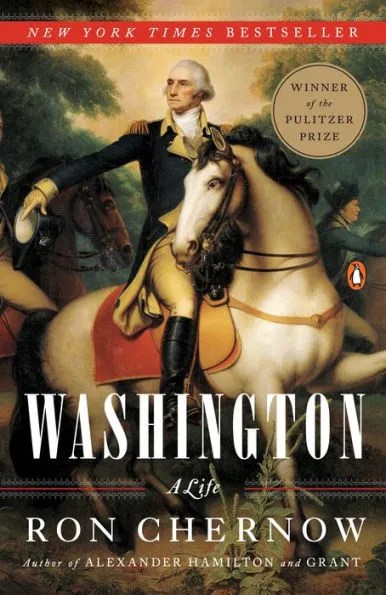
Why This Book: I had read Chernow’s biographies Grant and Alexander Hamilton, and found them superbly written, fascinating and insightful. For Washington, Chernow was awarded the Pulitzer Prize for Biography. So I wanted to read (listen to) it.
Summary in 4 Sentences: The book covers Washington’s life from what little is known of his childhood and anecstors to his death, concluding with Martha Washington’s death. His younger years were spent trying to rise in society from his rather humble beginnings and then moves on to his service in the French and Indian War and the following years as he became prominent in Virginia colonial politics. A large section of the book covers the American Revolutionary War, followed by Washington’s role in the constitutional convention and the forming of the government. It concludes with his 8 years as President followed by his nearly four years as the first Ex-President before he died. The book makes clear that indeed Washington played a crucial and critical role in the winning of the Revolutionary War and the establishment of our government and Democracy in a way that probably no one else could have.
My Impressions: I can’t say enough about how good this book is, how well written it is, and how impressed I was with it. Chernow says in his introduction that his goal was for the reader to see George Washington as a human being, not as the mythological Father of our Country that he had become in the American consciousness. In this I felt he did a superb job – and I finished the book admiring Washington more than ever – now that I have a better understanding of him as a man, with not only strengths but also character flaws.
As a leader, he excelled at patiently watching for the middle ground to keep antagonistic sides from destroying the desired end state that he sought. He was able to compromise, and accept half a loaf, rather than take the brittle, hard stand and lose it all. Accepting a compromise position on very controversial issues was exactly what he had to do to achieve his goal of uniting the colonies to defeat the British and create a new democracy. These were extremely contentious times , with many very strong personalities fighting for their strongly held beliefs. I finished the book realizing that without him as a unifying figure, it would be hard to imagine the success our country had in separating from England and forming a new Republic. .
Below are a number of the themes that I saw throughout Chernow’s biogaphy of the life of Washington
Personal and Political ambition. From a young age, Washington felt a sense of being a second class cititzen in a culture that gave power, influence, and privilege to those born of the landed aristocracy and who exhibited the behavior, manners, and cultural traits of the upper classes in England. His family was not wealthy or landed, and his parents had not supported their son George’s development and education in ways that would have helped him move into the elite class of the American colonies, This sense of un-entitlement and his ambition to somehow become part of this privileged class of society was a driving factor in his youth. He sought benefactors in the upper classes and in particular became a favorite of Lord Fairfax. He maneuvered to receive a commission in the colonial army which led to his outstanding performance on behalf of the British in the French and Indian War, which enhanced his reputation to give him a position in Virginia colonial politics. This pattern of subtly seeking and achieving respect, credibility, and thereby influence as he grew older as well as his unique reputation for military bravery are what eventually led to his selection to lead the Revolutionary Army and eventually to chair the constitutional convention and become President.
Washington on Slavery – this was a constant sub-theme of Chernow’s book – Washington’s ambivalence about slavery – and one area where he clearly felt some guilt about letting personal advantage supersede principle. It is clear he had moral qualms about slavery, and yet he was personally ambitious and sought to achievw and maintain the status and life style of the landed gentry in America. In Virginia that meant having slaves necessary to attain wealth, and maintain a plantation, which depended on slave labor. To assuage his guilt at compromising on this moral issue, he sought to treat his slaves fairly and humanely, refused to break up slave families, and rewarded those who were especially competent and loyal to him with privileges and special treatment. He also unsuccessfully sought to build into governmental law the phasing out of slavery in the South where it was deeply ingrained as an institution. But he backed down on this last when he realized that it was such an emotional issue in the south that it would tear the fragile union of the 13 states asunder.
Also, he was a strict task master with his own slaves, forcing them to work 6 days a week, all year long, in all kinds of inclement weather. He demanded of them the same sense of loyalty to him and the demands of his plantations, that he demanded of himself toward his duties to his country and principles. He had little sympathy for those who didn’t share his sense of discipline and work ethic. The tension between his moral discomfort with slavery, and his unwillingness to take a hard stand against slavery and make the sacrifices that would mean to his lifestyle and political goals was a theme that Chernow returned to regularly in his biography. When Washington died, he freed the slaves that he owned, but didn’t or couldn’t free the slaves that were part of Martha Washington’s inheritance to her children.
On Religion and spirituality Washington considered his spiritual and religious views a very private matter. He went to church as his role or position demanded of him, and he was in word and deed a Christian. But many of his letters showed him in sympathy with Ben Franklin’s more flexible Deist perspective and he was not one to refer often to scripture as a source of authority or wisdom. He clearly avoided sharing any religious perspective that would draw controversy or resistance from traditional Christian Orthodoxy and he was tolerant of other religions, specifically Judaism.
Iron-clad self discipline. One of the hallmarks of Washington’s life was his iron-clad self discipline to do his duty, no matter the cost, to fulfill his obligations, and those social contracts which were expected of the upper class, and leaders of society. It was his sense of duty that led him to accept the nomination and hardships associated with the Presidency, after his reputation and fortune were already assured after the revolutionary war, and after he’d alreayd been away from his beloved Mt Vernon for most of 7 years. And it was his sense of duty to accede to running for a second term when he was tired and had no desire to, but was called upon by so many to solidify the momentum of the new country he’d helped found. His second term was anything but satisfactory for him.
George and Martha George married Martha in part because of the wealth she had inherited from her first husband, and because his marriage to her would solidify his place in the “aristocracy” of the colonies at that time. They clearly liked and were drawn to each other and were a compatible couple, but that over time grew to become a mutual devotion and love that withstood many challenges, especially the strains of war and long separations. George had had an infatuation with Lady Fairfax, unclear (unlikely) if it was ever consummated, but after his marriage to Martha all indicators were that he remained loyal to her and their relationship, and had their marriage and partnership were admired by all who knew them. Martha herself made many sacrifices being the wife of General and then President Washington, and he clearly appreciated that and admired her for it. Unfortunately, they decided together that after his death, they would burn all their letters to each other.
Self Made Man-like Franklin – Like Ben Franklin Washington was a self-made man – rising through hard work, ambition and a keen sense of where his advantages lay. Hard work, luck, influential sponsors, and ambition propel him rise from respectable but poor middle class to a place of prominence in the colonies and eventually in the new United States.
Tension between aristocratic tastes and Republican values and sensibilities. Chernow pointed throughout the book at a tension in Washington’s values between his expensive and aristocratic tastes, and his respect and admiration for the common man – his belief in democracy and the values of the revolution to give equal rights to all men.
Profligate spender – Washington eventually became quite wealthy in land but was always short of cash, largely because of his profligate spending in order to live and represent the life style of the upper classes. There was always the effort to appear to have greater wealth than he had, which led to him being cash poor, and often in debt. This was a constant issue in his life.
There was so much content in this book, and it is so well done, it is difficult to give it a fair review. For those interested not only in Washington, but in the birth of our nation and understanding the very rough go our country had in getting started, this is a must read. I’ve since visited Mt Vernon, which further augmented my appreciation for and understanding of Washington and the life and times in which he lived. .







 Bob's Books