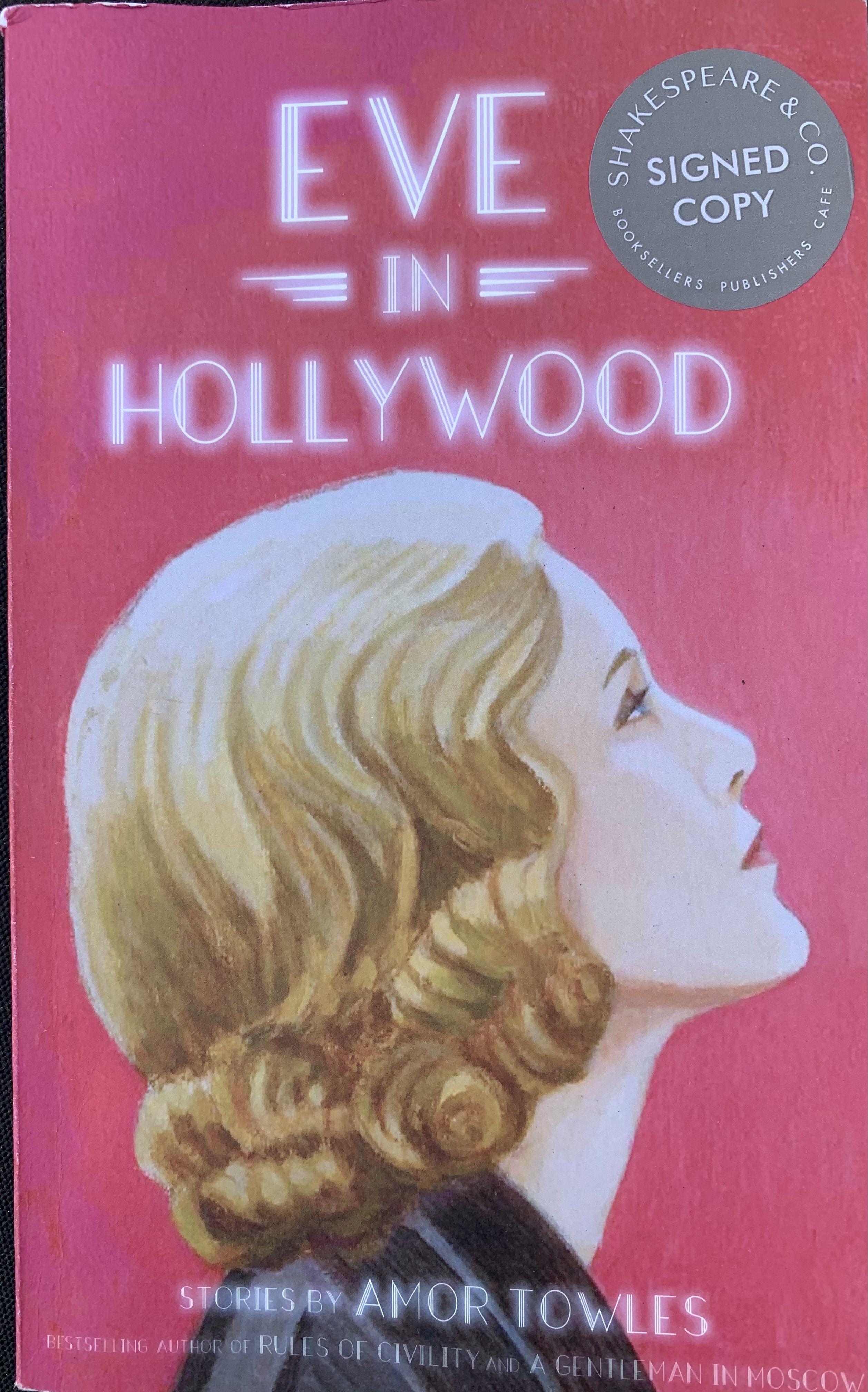
Eve in Hollywood, by Amor Towles

Why this book: I saw this book pop up as an opportunity after I had read and enjoyed Towles’ books Rules of CivilityLincoln Highway and Gentleman in Moscow.  Eve was a most interesting character in Rules of Civility who, part way through the story, had decided to leave the chaos of her life in NYC and headed West, but we didn’t hear much more about her thereafter. I was curious about how Towles would write “the rest of the story” on Eve  This novella is no longer available as a stand alone, but I understand that it is included as a novella in Towles’ recent book Table for Two. 

Summary in 2 sentences:  Eve was running away from a confusing and dissolute life in NYC and heading West to start a new life, and ended up in Hollywood.  This book is a series of six short stories in which different aspects of Eve’s character are expressed and manifest in each story –  as to how she handles various interactions and challenges in the rough and tumble “man’s world” of Hollywood in the 1930s.  

My Impressions: I described this book to a friend as a “confection” – short and not too deep, and great fun to read, but don’t look for any great profound message.  I was looking for something light but well written to read between a couple of more demanding reads I was involved with,  found this on my shelf and picked it up. It was a very enjoyable interlude between more substantial reading I’ve been doing.  Eve is a confident and intelligent femme fatal, but with a limp and a dramatic facial scar from an automobile accident (that takes place in Rules of Civility.)  These “flaws” to her beauty add to her mystery and power.  She is not intimidated in the least by the glory, power and glitz of Hollywood. 

It begins in the first person voice of a gentleman on a train heading to California from the East Coast, who is observing this attractive, detached, interesting woman in the dining car.  When the train reaches Chicago, and most of the passengers get off, he overhears her ask the conductor if she can extend her ticket to stay on the train all the way to LA, which of course she then does.   The gentleman eventually strikes up a conversation with her, and after a while,  asks her why she chose to extend her ticket from Chicago to LA.  She responded, “To be perfectly honest, I have no idea.”  That concludes the first story, and tees up the intrigue on her and her adventures in Hollywood. 

Though it appears that Eve and the gentleman may be on the verge of a closer relationship, in the follow-on stories, there is only a vague reference to him, as Eve purposely and confidently strides into the world of Hollywood, of stars and starlets on the make, and rich executives exploiting their power.    Her self-assuredness is obvious; her ‘purpose’ is not – she remains an enigma.   It isn’t quite clear what she’s doing or why, but each story describes her interaction with someone who represents a different facet of Hollywood in the 1930s and she deftly plays the Hollywood game with detachment, amusement, and prowess – like an old pro.  New York City had prepared her well. 

But there is one character who we see in several of the stories – Eve somehow finds herself in the role of guardian/protector of one of Hollywoods promising young female stars who is rather naive and vulnerable in that rather unforgiving world.  The young actress is about to star in a blockbuster film called “Gone with the Wind” and Eve is recruited to become a sort of older sister to a young Olivia de Haviland, who had been sheltered by the studios from the gossip and scandal mongers in the tabloids.  The studios desperately wanted to protect their investment in her image as pure and virginal starlet for the roles she would be playing, and couldn’t afford to have her mixed up with those who were regularly exposed in the Hollywood tabloids.  Eve not only protected her from the tabloids, but also subtly opened doors for her to have fun and experience some of the joys of LA that the studios were keeping from her. 

A few good quotes from the book. I loved Towles’ writing:

  • When she held out the flask, she could see that Olivia hesitated. “Come on, Livvy, even a church bell’s gotta swing, if it’s gonna chime.”
  • In Indiana, a young girl had a good reason to suspect that lists were the foot soldiers of tyranny – crafted for the sole purpose of bridling the unbridled.  A quashing, squashing, squelching of the human spirt by means of itemization. 
  • Pleased by his own poetry, Litsky smiled for the first time in a year. “Ooh,” she replied. “What big teeth you have, Grandma.” Litsky raised his glass in the affirmative and emptied in in her honor.  
  • Olivia extended her arm in an ironic flourish. “Give every man thine ear, but few thy voice….”
  • Olivia: “A lady never finishes a cigarette, a drink, or a meal.”
  • Eve:  “My mother told me that it was more important to be interested than interesting.” Olivia: “Have you heeded her advice?”  Eve: “Only as a last resort.” 

I haven’t read Table for Two by Towles, but if the other stories in it are as much fun as this one, it is certainly wortth a look.   Like I said, a confection, a well written break from heavier fare.   

Posted in Uncategorized | 1 Comment

Einstein – His Life and Universe, by Walter Isaacson

Why this book: I’ve read and been impressed with three other biographies by Walter Isaacson, Benjamin Franklin, Steve Jobs, and Elon Musk.  Like everyone else, I’d heard of Einstein, but didn’t know much about him other than E=MC-squared.  I listened to rather than read this book 

Summary in 4 Sentences:  This biography starts with what is known about his childhood and family, then his young adult life, 2 marriages, growing career and ultimately becoming a world renowned icon of theoretical physics. Isaacson does a pretty good job of explaining the physics and the various controversies around how sub-atomic particles react and are influenced, as he moves beyond the Theory of Relativity into Quantum Mechanics. Einstein becomes increasingly involved in world politics, pacifism, fighting anti-semitism and authoritarian governments after fleeing Nazi Germany and settling in the United States for the final 35 years of his life. He also stayed very engaged in seeking to refute Quantum theory as an incomplete theory of how matter behaves at the sub-atomic level. 

My Impressions:  Another great biography by Walter Isaacson, pulling back the curtain on a modern celebrity. I listened to rather than read this book, though there were numerous times I’d wished I had the printed copy to mark up and return to sections to review.  While I wasn’t able to follow the esoterica of the theoretical physics that Einstein was involved in, Isaacson made an admirable effort in dumbing it down to what a humanities major, science-challenged reader like me could at least appreciate. But the book gave great insights into how the leaders in the arcane world of theoretical physics interacts – the petty jealousies, disputes – trivial and of substance, the values and personality conflicts and more, that Einstein was involved in from being a very young man until his  death.

Einstein was a life long non-conformist and believed in questioning all conventional wisdom. He would never accept conventional wisdom as an article of faith – he always questioned it and strictly applied common sense – which is ironic, since much of his research and conclusions defy “common” sense.  But his willingness to question and challenge convention him at odds with the “establishment” throughout his life.  He rebelled against any effort to mold his thinking without discourse and logic, and he would never simply push the “I believe” button.  Whereas Harry Truman’s motto was “show me”  Einstein wanted proof – mathematical as well as empirical proof before he would accept a proposition. He had no patience for people who were unwilling to examine or question their own prejudices -and he applied this standard to himself as well. 

We learned that Einstein had a profound faith in the order of the universe based on all of his reasoning and mathematical studies  -that the physical world is as it is and does what it does as a result of immutable laws.  These laws are  “God’s Laws” and are subject to examination and proof.   This faith  that the laws which govern all activity in the universe could be discovered or uncovered by man’s reason was an apriori principle for Einstein, and this fervent believ is part of what drove him to his famous Theory of Relativity.  

This faith in the order of the universe and that nothing happens by mere chance, but in response to causes and effects that can be discovered and understood was Einstein’s apriori principle.  The laws of mathematics helped define the laws of physics. He considered himself a theoretical physicist and lamented that he was not more accomplished and stronger in math – so he frequently called upon colleagues who were extremely strong in math to help him define the physical laws that he instinctively intuited.

Physics. Einstein’s great contribution to physics which he initially intuited and then proved, was the interplay and connection between time, space, gravity and electro-magnetism. I can’t pretend to understand how he developed his theories,  but one of his great contributions to this field was proving that gravity from physical objects bends light waves, proving that matter and light have a connection. He is famous for his General theory of relativity which demonstrates that gravity includes (creates?) warps and curves in space and time, and his  Special Theory of Relativity that concludes that time is not constant, nor is weight or mass. There was much in the book that attempted to explain these theories in simple terms but was more than my ossified old brain could grasp.  But it was interesting to see how the greatest minds struggled to uncover and explore realities and inter-relationships in the universe, at the sub-atomic level, as well as in the grand scope of the universe, that most of us don’t see. 

Einstein’s theories of relativity – general and special – opened the door to Quantum Mechanics by describing for the first time light as quanta, that light behaves like a particle nature but has no mass.  As work and experimentation continued in the field of Quantum Theory, Einstein was troubled by the  conclusion that Quantum theory necessarily included an uncertainty principle – that the behavior of a particle is different, if it is observed, and that how it behaves is a function of probabilities rather than immutable laws.  This uncertainty principle Einstein said, undermined his entire world view, that cause and effect were functions of immutable, and certain laws.  

For the rest of his life Einstein’s “holy grail” was to discover a Unified Field Theory which united his physics of certainty based on immutable laws, and the apparently random behavior of quanta particles in Quantum experimentation. He did not claim that Quantum mechanics was “wrong,” rather that it was incomplete, and his mission in the last quarter century of his life was to find the bridge between Newtonian certainty and Quantum uncertainty.  He called this the “Unified Field Theory” which he never was able to develop or uncover, and nearly a century later is still being discussed, debated, and explored. 

Einstein’s Politics and Humanism:

Pacifism Einstein became a devoted pacifist as a result of the first World War which he essentially sat out. He had a life long aversion to nationalism and patriotic fervor, and was truly an internationalist – having held citizenship in Germany, Switzerland, and the US. This espoused pacifism and internationalism put him at odds with and in opposition to patriotic nationalists wherever he was – in Germany and the US.   J. Edgar Hoover’s FBI kept a large file on him and long suspected him of being a Soviet agent because of his socialist ideals and his internationalism, which Hoover and the FBI misinterpreted as support for communist ideals,  though in fact Einstein was repulsed by Soviet restrictions on individual freedom and expressly criticized the Soviet model.  

Zionism.  Einstein grew up in a non-practicing Jewish family.  As a young man he had renounced religion and was himself a non-practicing Jew, but as he witnessed and experienced anti-semitism in Germany and elsewhere, he embraced his Jewish heritage, if not the Jewish religion.  The  anti-semitism he experienced in Germany drove him to renounce his citizenship and to emigrate to America. He also became an active advocate for Zionism – a Jewish homeland, though he fought the Zionists on their treatment of the Arab’s who lived in the Jewish promised land that became Israel.

Religion. Isaacson writes a beautiful chapter on Einstein’s “religion” – he was not religious but would not accept the label of being an “atheist” – in fact he argued against angry atheists who he saw as merely disillusioned by their religious up bringing. He called himself an agnotic, and believed in what is often called “the God of Spinoza” – an impersonal God of principles beauty and order, which should inspire awe, and love and a good life.  Einstein’s faith in the order of the universe, colored with his appreciation for the beauty of that order, the awe with which he viewed the laws and order and magnitude of the universe – was what allowed him to call himself a man of faith – but he would not accept the existence of a personal God that look out after our interests. 

Family life- women.  Einstein was in some ways a dreamy romantic – not just about physics but also about women.  He was madly in love with his first wife Mileva Maric, a mathematician and physicist who he’d met at university, who he married, very much against his parents’ wishes. They had two children and then things got messy, they separated and eventually divorced. He then married his divorced cousin Elsa – more a marriage of close friendship and mutual support while he also apparently had numerous affairs – but none which he would allow to interfere with his physics nor his marriage to Elsa.  Elsa appaerntly knew of, and reluctantly tolerated some of his dalliances.  Apart from his rather cold treatment of Maric during their estrangement, he treated women well, and even with Maric they eventually become reconciled in parenting their children became friend again, and Einstein always supported her financially. Even in his last years, after the death of his wife Elsa, he had a ‘lady friend’ Johanna Fantova a librarian at Princeton some 40 years his junior, for the last 10 years or so of his life  Ms Fantova  like his two wives before her, played a key role in organizing his life – as Einstein had trouble giving attention to the practical matters of daily living – he needed a woman to help with that because his thoughts and attention were on the Universe and what makes it tick. 

Last Years Einstien worked at the Institute of Advanced Studies at Princeton the last 30+ years of his life and never returned to Europe. He was active in supporting the allied efforts to defeat the Nazis – the rise of the Nazis changed him from a pacifist to an advocate of military service for defensive purposes only. When Einstein was warned that the Nazis had embarked on a project to develop nuclear weapons, he wrote to FDR and it was at his suggestion that FDR initiated the Manhattan project. He was not involved in the actual Manhattan project itself (he could not get a clearance because of his previous support of pacifism) but knew of it, because he was close friends with Oppenheimer and many others working on the project. After Hiroshima he campaigned to ban nuclear weapons use in war – a futile effort.

When he died in 1955 at age 76, he was one of the most famous men in the world, regarded as a genius by most lay people, but as something of an anachronism by modern physicists exploring the implications of Quantum theory.  He once said that God punished him for his youthful exuberence in challenging authority, by making him and his defense of his ideas of certainty and immutable laws the “authority”  against whom young physicists and advocates of Quantum theory rebelled

Conclusion – For me the most interesting part of the Einstein’s story is his character – always a rebel as a youth, he struggled to be taken seriously, but was confident in his views and wouldn’t hold back his controversial opinions and ideas.  But he was never strident – invited debate, and except for the issue of anti-semitism and patriotic intolerance, he was always polite and genteel.   But in matters of physics and science, he believed in himself and his thought process, and he persisted to find out if his ideas could be proven right.  He did usually eventually succeed in proving himself right – up to and except for his Unified Field Theory. 

Einsteins was never (or rarely) mean and was always respectful in discussing views he didn’t agree with – always believed that personal freedom was built upon believing oneself free to express one’s  opinions whatever they may be, without compulsion.  Always considered a nice if somewhat dreamy man, he was respectful and respected and was not politically dogmatic except in his opposition to war and greed, in opposition to nationalism and aggression, and in support of whatever would support internationalism and humanitarianism.

Fascinating book about a fascinating man who was an icon of the 20th century.  

Posted in biography, Book Lists, Reading, Uncategorized | Tagged | Leave a comment

The Whiskey Row Fire of 1900, by Bradley G. Courtney

Why this book: I spend a week or so several times a year in Prescott Arizona where I inherited a vacation home from my parents. Prescott has a fascinating history for someone interested in the Old West, and while there, I picked this book up at the local heritage center – I want to know more about the place where I’m spending more and more time.  One of the things Prescott is famous for is Whiskey Row – which still has several establishments left over from over a century ago.

Summary in 3 Sentences: This short book covers a brief history of the town of Prescott and Whiskey Row which grew up in the 1860s and had already burned down once in 1883.  We learn about the different entrepreneurs who built up the town, the various saloons and other enterprises, and finally about what led to the devastating fire which destroyed not only Whiskey Row, but much of downtown Prescott. The author describes the night it burnt down, how the town responded and then the rapid rebuilding of the whole downtown Prescott including Whiskey Row which has served as the foundation of what Prescott is today. 

My impressions: This is a short book (about 150 pages) by a local historian who has done extensive research into the local history in general, and the fire of 1900 in particular. Not the most compellingly written historical narrative but not bad – his account is a prism thru which to look at how Prescott in particular evolved, but probably how all towns throughout the territories of the West evolved after the Civil War.

Prescott is located in the high desert with climate and other features that made it preferable to the desert town of Tucson – with which it was competing to be the center of the then Arizona territories, and Phoenix, the current capital of Arizona.  Prescott’s population grew when gold was discovered nearby and when the general mining industry established itself in the mountains nearby.  Fort Whipple was also established there  to protect settlers from local Indians.  Naturally with the dominant male population of soldiers, miners, prospectors and new settlers,  Prescott became a center for a culture of saloons and bordellos that thrived and drew more people. Such famous names as Doc Holiday and the Earp brothers spent time there.

The book briefly describes the fire of 1883, but then goes into how the town recovered and was just taking off as a boom town, when the fire of 1900 destroyed the most prominent buildings of downtown. These include not only the low class saloons and boarding houses but also the Palace saloon, the Grandview hotel, regarded as one of the classiest West of the Mississsippi. The author explores some of the myths that have grown up around the fire and validates the most famous of these  – that the long bar currently in the Palace saloon and restaurant was rescued from the original Cabinat/Palace saloons before the fire burned it all to the ground. 

We learn that with fire fighting still rather primitive combined with a shortage of water, and a town built largely of very flammable ponderosa pine (prevalent in the area,)  once a fire got going, it was hard to stop. So the population of Prescott helped store owners and commercial establishments in the path of the fire to rescue key items before the fire inevitably reached those establishments. Fortunately there was an open plaza across the street where these items could be deposited.  The famous bar had been built in San Francisco and shipped by rail to Prescott, just a few years earlier and was the pride of the owners, and probably the whole town. There were many saloons at the time in Prescott, catering to different levels of the social hierarchy, and a booming red-light district right behind the saloons.  The red light district burned down with the saloons.  Temporary tents and building had both up and running within days..  

This little book contains plenty of pictures from that era to augment the narrative and concludes with a satisfying epilogue, noting that the town of Prescott soon realized that the fire had been largely a blessing – in that it inspired a renewal, rebuilding and improvement of the whole downtown area.   The positive frontier spirit of the “Prescottonians” was lauded, for not dwelling on the misfortune of the fire, but immediately getting to work to put Prescott back up on its feet and poised to become a center of business and culture in that part of Arizona.  

Fun little book to read – next time I’m in Prescott (in just a few weeks) there are many places I’ll want to visit and others I’ve already been to, which I will visit with new appreciation.  

Posted in Uncategorized | Tagged , , , | Leave a comment

The Life & Death of St Kilda, by Tom Steel

Why this book;  I had read this book over 30 years ago and recall being moved and finding the story fascinating.  On my recent trip to the Inner Hebrides  with my son, my interest in this remote island, nearly 100 miles west of the outer Hebrides,  was renewed. So I purchased it and read it again. 

Summary in 3 Sentences;  This remote small Island has had isolated people living on it for thousands of years, barely surviving in an extremely austere environment.   Recorded history of the Gaelic speaking inhabitants and how they lived only goes back about 300 years and this book is the recognized best source on how those people lived, what led to the decision in 1930 of the 30 or so remaining inhabitants to leave.  And the book concludes with what happened to those who left, how they sought to integrate with a very different world, and how the British and Scottish governments and Trusts have sought to preserve the heritage of this unique island.

My Impressions: As noted, my second time reading this book – the first time over 3 decades ago and I only remember a few things.  – but I do remember how fascinated I was with the descriptions of this ancient Gaelic crofter culture isolated for centuries from the mainstream culture of Britain and Europe.  It was the last remaining hunter-gatherer society in Europe and there are scant records of how these people lived prior to the 17th century when the earliest chroniclers visited.  

St Kilda is the main small island in a grouping of rock outcroppings out int the Atlantic Ocean,  about 80 miles west of the closest land in the Scottish Outer Hebrides, and it’s population varied from at a high point about 140 to less than half that before the final decline and decision to evacuate the island in 1930.  This book describes the culture of St Kilda from the 19th century when mainstream Scotland became aware of St Kilda and Clan MacLeod of Skye assumed proprietorship over the island, which included Clan leader-like responsibilities for its inhabitants.  Archeologists are still finding evidence of human habitation on St Kilda going back a millennia before the first  appearance of St Kilda in Norse records a millennium ago 

The LIfe and Death of St Kilda begins by describing the sad and final exodus of the inhabitants in 1930.  Following chapters explore and describe the culture – how the people lived,  how they lived mostly on the birds they killed in their nesting grounds on the cliffs and rocks on the group of islands.  The author describes their social mores, how it was a very communal society, all sharing in the bounty and the sufferings that came with living on the island.  There are chapters on how the Church of Scotland sent severe ministers to live on the island to ensure that the inhabitants paid humble obeisance to an angry God, and forbade all forms of fun and joy – no dancing, singing, music, etc in the same way our Puritan forefathers forbade any activity that wasn’t working to survive or worshipping the Lord.  Life was hard enough – these ministers ensured that it stayed hard  

The author describes the slow influence that increased contact with mainland society during the 19th century, had on the islanders.  St Kilda eventually was provided a teacher to teach reading and English to the children, and this basic education was augmented by religious education (reading the bible) by the resident ministers.   Reading gave the islanders increased access to newspapers and other books that increased awareness of life beyond St Kilda, along with increasing visits from fishing trawlers, the factor from Skye and eventually tourists interested in this primitive Gaelic culture.  Eventually visitors wanted to buy their goods – knitting and other crafts and items with money, which the islanders had never needed in their barter culture.   Money and its value was new and had a subtle but profound influence.   And as the islanders learned of opportunities outside St Kilda – from stories that visitors shared and from the occasional emigrant from St Kilda who returned to visit, or shared stories in their letters, young people started to leave.  

One chapter that I remember most from when I first read this book was the very high child mortality rate – above 60%.  There were women who’d given birth to 10 babies and lose 8 before being a month old. When medical people on the mainland learned of this, they wanted to find out why and prevent these tragedies, but the islanders, led by their very conservative minister wouldn’t cooperate, believing that these deaths were God’s will, His plan to keep the population within what the island could support, and it was not for man to interfere.  Eventually it was determined that the deaths were caused by how they stored milk for the children, in containers unknowingly contaminated with the bacteria tetanus infantum, and as they gave babies milk from these containers, the children quickly developed tetanus and died within days.   The tragedy of so many babies dying so soon after being born is unimaginable, but it had been going on for centuries and was just assumed by the St Kildans to be simply the way it was supposed to be.  Just as tragic to me is the resistance the minister encouraged to finding out why.  

The book concludes with what happened to St Kilda after the last inhabitants left – the challenges they had in adapting to life on mainland Scotland.  Also,  during the 20th century the British Military built a small station on this remote outpost in the Atlantic for monitoring naval and air activity approaching the UK, and for supporting various exercises and equipment testing.  St Kilda and the ruins of the small village on Hirta has in the last half century become a tourist destination, and is now largely controlled by the National Trust of Scotland in cooperation with the military which continues to maintain a presence there.  The National Trust has refurbished many of the homes that were abandoned, and created a small museum to serve as a monument to the people and culture that once lived there.  Additionally, archeologists are exploring, and turning up evidence of people who lived there during the Iron Age and perhaps before. 

In the various bookstores I visited in Scotland, I found numerous books on St Kilda, but one of the booksellers told me this is the most comprehensive and the best.  Tom Steele first published this book in 1975 after doing extensive historical  research, and also was able to interview many people who had lived on St Kilda before it was evacuated.  He updated the book in 1988 and then, after his death, his relatives gave a final update in 2011.   For those interested in knowing more about St Kilda, there are some impressive videos and short pieces on St Kilda on youtube.

Posted in Uncategorized | Leave a comment

Calum’s Road, by Roger Hutchinson

Why this book:  I was recently on a bike ride with my son Brad in Scotland and we rode on the Island of Raasay, and rode all the way out to Calum’s Road.  I heard the story from our guide, who then bought us this book  My son and I rode Calum’s road – wish we’d read the book beforehand. 

Summary in 3 Sentences:  Calum MacLeod lived in a small village at the north end of the Inner Hebridean island of Raasay with just a few other families.  These families over decades petitioned the Scottish government for a road to lead to their village – which the various bureaucracies involved refused to do. This book is about the life and death of those villages and how one man, Calum MacLeod as a statement of resistance, decided to build the road himself and it took him decades.  

My Impressions: Short and powerful.  Beautifully written – fascinating, sad and joyful to read.  Calum MacLeod and his road on Raasay are a prism through which the author looks at the demise of small villages and crofter culture on remote islands in the Hebrides.  Though the book provides background from the 1800s, this story takes place primarily between the mid 60s and the early 80s of the 20th century.

The story of Calum’s Road is an extreme example of an independent, and powerful personality choosing by his actions to defy a government which doesn’t seem to care about him, his family, his village and way of life.  In Calum’s Road, we learn about the history of Raasay over the previous two hundred years, how the crofters and small villages were repeatedly exploited and abused by wealthy absentee land lords who owned the island, only as a financial investment and cared little for the people who lived there.  Raasay experienced its own version of the Scottish Highland Clearances, when the the great land barons of Scotland drove people from their homes and crofts and depopulated huge sections of Scotland in order to make room for sheep and deer to graze – the deer were hunted by wealthy gentlemen from England, Wales, Scotland who paid well for the opportunity to hunt on the property of the landlords.  The sheep and the wealthy hunting patrons provided easier and more money than dealing with the problems of tenant farmers, and collecting their rents. 

The culture of Raasay was broken into the north and the south of the island – the north end was farthest from the standard ferry landing and received the least support.  Calum lived in the village of Arnish which lay approximately 1 1/2 to 2 miles beyond the one road on Raasay that went from North to South. Those in Arnish and the several villages beyond had to walk and carry their goods on their backs on a path from the end of the road up to several miles to their villages.  This and a number of other factors that made life in the northern portion of Raasay difficult and even untenable, over a several decades led to all of the people in those villages either dying or leaving.  By the time Calum finished his road, he and his wife were the only ones living there.

In Calum’s Road, we hear the voices of those who grew up in and lived in those villages, talking about their lives there, talking about how they purchased food and goods from Skye, worked to make a living by whatever means were available, how they survived, and why the finally left.  They also talk about Calum MacLeod as a man and his project to build the road, on his own, in his spare time.   Calum himself was one of the strongest characters and personalities on north Raasay, and was the one others  looked to for help when they needed it, and was the most engaged in trying to save the villages.  He felt  a strong sense of duty to his community and to his ancestors who had lived and thrived in that part of Raasay, and did whatever he could to preserve that heritage.  We  read about Calum’s unsuccessful efforts over many decades to get basic government services to the villages in that part of Raasay – to include the road. So finally, convinced that the large centralized bureaucracy of the government could not be counted on, he began to build the road himself. 

In fact his building of the road is just one example of his amazing character.  He not only ran his croft, but also had been postman, lighthouse keeper, and fisherman and had a number of other jobs.  He and his brother had previously built a different short road in north Raasay to support the families isolated on the island of Fladda, just off the coast of Raasay.  Calum was an autodidact – he had no education beyond his 14th year, Gaelic was his first and primary language – English he had to learn.   Yet he was widely read, in both languages, wrote many articles and letters to governmental bureaucrats  and the press (all in English) about how the people in North Raasay were not being given a fair shake,  and he rightly predicted that government policies and neglect would lead to the depopulation of a whole section of Raasay.  He twice won awards for his writing and was regularly sought out by journalists for his character and comment.  He became a recognized expert on the history of Raasay – especially of the exploitation of the crofters by wealthy outsiders. But Calum MacLeod was no socialist – had no trust of centralized government.  He was much more of a libertarian, though he would never have identified himself as such.

Eventually his pressure, his notoriety, the positive attention his efforts got in the press had the intended effect, and the government chose to complete the  rough road he’d built with tarmac and other features of public roads, and completed it in 1982.  By that time Calum was in his mid 70s and was pleased that his efforts had paid off, but by that time, he and his wife were the only one’s living in northern Raasay.  Calum passed away in 1988.

The story of Calum’s road is well known in Scotland and a popular Scottish Strathspey is named for it.   On youtube you can meet Calum and get a good overview of Calum’s Road in a very short (4 mins) video  at https://youtu.be/LUh6ROorRUo?si=E6N3Imc_tGEAeipF   Another very short piece with some great pics can be viewed on TikTok at: https://youtube.com/shorts/n9KmJKDYat0?si=A86njZtkny_3Ezrmhttps://youtube.com/shorts/n9KmJKDYat0?si=A86njZtkny_3Ezrm

I really enjoyed this short book – it gave great insight into the how and why Scottish Highland culture has changed over the 20th century.    I just wish I’d read it before I actually rode that road that Calum built. I would have spent more time at the end visiting the abandoned crofts and village just a few yards beyond the end of the road.

Posted in Uncategorized | 1 Comment

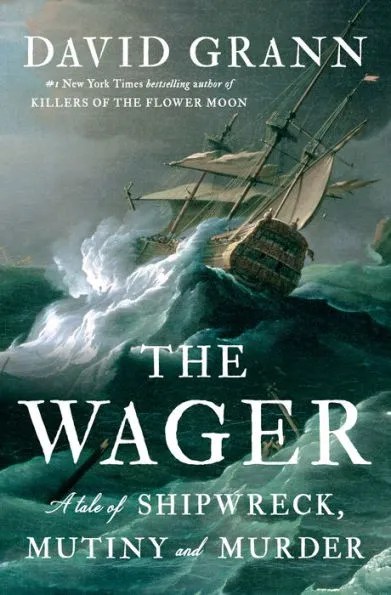
The Wager – a tale of Shipwreck, Mutiny, and Murder, by David Grann

Why this book: Sent to me by my brother who’d read it and thought I’d like it. He was right.  It was on the NYT best seller list right after it was published in 2023.

Summary in 5 sentences:  In the 1740s, the Royal Navy sent an expedition of several ships around Cape Horn to the Pacific to intercept and capture Spanish vessels carrying gold and other valuables from Peru to the East Indies to trade for silk, spices etc. The ships in the expedition got separated during the storms and tempests at the Cape, and the ship the HMS Wager, though separated and damaged gets around the Cape, but in a follow-on storm wrecks on a remote uninhabited Island off the south west coast of Chile.  Most of the crew survive  the shipwreck, but then have to find a way to survive on the island with little hope of being rescued.  As the heirarchy and discipline of the military chain of command break down, they face the reality that they may not survive.  Ultimately, two different groups from the crew separately are able to make it back to England years later, with very different stories of what happened. 

My Impressions: Fascinating book, thoroughly researched – providing great insight into the royal navy at that time, how sailors became ship’s captains, how expeditions were formed, how captains of ships were selected, and how they commanded their ships.  All of these insights were a prelude to provide greater perspective on how men lived on the ships during a long voyage,  and then the author’s description of the  almost unimaginable challenges and suffering they experienced getting around Cape Horn prior to the shipwreck.

The expedition included six ships and their transit around Cape Horn  (apparently there are multiple ways to get around Cape Horn) was devastating –  all the ships were damaged and lost much of their crews.  Scurvy is a brutal disease and fully 1/4 to 1/3 of the crews of the different ships were lost, either to scurvy or to accidents, partially caused by the debilitated condition of the crews because of it, as they fought to keep their ships afloat in the huge waves and gale force wind they encountered.  It was painful to read about the daily deaths and suffering, and the daily bad news as the expedition struggled to get through.  Though the several of the ships were severely damaged, they persisted and reached the Pacific Ocean.   HMS Wager was the smallest and slowest of the ships,  was separated from the others in the extensive and back to back storms.  The Wager’s captain knew he had to catch up, but after finally getting around the Cape, and before he could reconnect with the rest of the expedition, the Wager was hit by yet another brutal storm and in the fog ran into the rocks on an island they couldn’t see. That’s when Part 2 of the book begins.

The captain of HMS Wager had been injured during the storms and was also ill with scurvy, but survived the wreck and sought to keep the crew together, as they found themselves on a remote beach on a small remote island.   The ship was crushed on the rocks off shore, but was not completely sunk, so the crew was able to use their lifeboats to board the ship and ferry some of the food and equipment ashore to help them survive.  Their situation was dire – it was late fall and cold – they were not far north of the Antarctic circle.  And there was little to nothing edible on the island, so this situation tested their resourcefulness to the extreme.  In addition to the food they were able to  recover from the ship, much of it contaminated with salt water, they were forced to eat sea weed, crustaceans, occasionally fish, celery weeds and a few edible plants they found.  The plant food alleviated the scurvy, but at the time, they didn’t know why.  Now living ashore, they relied on their ship board organization and chain of command to work together to create shelter, find food and meet the new challenges that confronted them.

The captain had not been popular with the crew before the wreck and his moral authority began to diminish as he made unpopular and often unwise decisions.  His gunnery officer, a well respected and experienced seaman became a powerful and respected presence to whom the crew looked for leadership as a counterweight to the captain.  As things looked more and more bleak, discipline continued to break down, and a group of malcontent sailors refused to follow the Captain’s orders.  They broke off to live apart from the main group, but the gunnery officer stayed ostensibly loyal to the captain and sought to keep the discipline intact,   There was conflict between and within the groups and finally, even those who stayed with the captain were questioning his wisdom, his goals, and his leadership.

The gunnery officer was  repeatedly unsuccessful in his efforts to influence the captain to compromise with and support the crew and consider options they were proposing for their ultimate salvation.   Eventually, though he knew it meant being subject to accusations of mutiny and its harsh consequences, the gunnery officer broke with the captain and with a majority of the men on the island, chose to risk it all with an attempt in two of the surviving boats, to return to the Atlantic thru the Straits of Magellan to reach a town in Argentina.  

The story of the breakdown in the captain’s leadership, and the breakdown in discipline and group integrity on the island was fascinating.  The captain was a strict, by-the-book old-school British captain and was loathe to take input from subordinates that might be counter to his desires.  Some of his decisions that cost him credibility with his crew were driven by orders he wouldn’t share with them.   A series of events and actions by the captain cost him his authority and their respect for his rank and position.   The Captain had insisted on strictly following his orders to head north to try to rendezvous with the rest of the expedition; the others thought that was tantamount to suicide and refused his order. 

The majoirty of the remaining crew led by the gunnery officer in two small boats abandoned the captain and headed back to the Straits of Magellan.  They  succeeded to make it through the Straits  though only one boat survived; the other boat and all aboard were lost. The surviving boat, those aboard starving and suffering from exposure, finally and barely reached  a town on the coast of Argentina.  Several died just before and just after their arrival.  They were greeted warmly by the Argentinians, were fed, clothed and aided in their recovery, and eventually made it back to England, where they were received as returning heroes.  They had all assumed that the captain and the small group that stayed with him on the island had perished. 

But indeed the captain and his small team of loyal followers were able to craft a small boat, and with grit and luck, and some help from natives they encountered, over several weeks, succeeded in reaching a town on the coast of Chile.  Upon arriving,  they were immediately imprisoned as enemies of Spain.  But eventually they were repatriated to England, and when they arrived, there was a firestorm of controversy about the mutineers, conflicting testimony about what had happened on the island and eventually, a dramatic court martial.

The gunnery officer who led the mutineers and got them to Argentina, had kept a detailed journal and wrote extensively of his experiences, which was a major source for the author.  Also, one of the junior officers who stayed with the captain, had also kept a detailed journal and later in life wrote a book about his experiences which diverged from those of the gunnery officer after the mutineers left.  The author relied heavily on these accounts,  as well as having done extensive additional research to make a fascinating narrative of life, suffering, death and mutiny in the Royal Navy of the 1740s.

I wish I’d read The Wager before reading The Wide, Wide Sea about James Cook’s 3rd expedition some 40 years later.   Grann’s extensive explanations of the process of putting together the expedition would have been helpful in appreciating Cook’s expedition. Also, though the suffering that the crew endured from scurvy was painful to read,  it also helped me to appreciate how important Cook’s successful efforts to prevent it were on his voyage – forcing the crew to eat vegetables.  Cook’s expedition of nearly 3 years with no occurrences of scurvy was ground breaking for all navies of the world.  

For those interested in nautical history, or how a group can disintegrate under pressure, The Wager is a must read. I have compared the dynamics on the remote island to the Lord of the Flies story, but also to Shantung Compound a book I read a few years ago about how the Japanese isolated and imprisoned westerners who were living in China at the outbreak of WW2, how they broke up into small groups competing with each other for resources, and not accepting any authority. In both cases without positional or institutional authority to compel group compliance, group cohesion break down.  A group needs a Shackleton-like leader to keep it together to survive. 

Also for a bit more detail on the HMS Wager expedition and mutiny, without the detail and drama that Gann’s book provides, the Wikipedia article on Wager Mutiny is good.

Posted in Uncategorized | Tagged , , , , | Leave a comment

James, by Percival Everett

Why this book: I recently listened to a great audible version of The Adventures of Huckleberry Finn and was recently reading strong reviews of this revised version of the well known Mark Twain novel.

Summary in 3 Sentences  This is a the author’s re-imagining of Mark Twain’s famous novel written in the first person from the perspective of Jim, the runaway slave who accompanies Huck down the Mississippi River, both of them escaping their lives in 1830s Hannibal, Missouri.  In this book we experience many of the same “adventures” and challenges that Twain describes in the original novel, and additional ones that Everett adds to the original story – all seen from a recreated Jim – one with 20th or 21st century sensibilities.   We see Huck, white society, slave culture, and southern slaveholders and those who accept it from the perspective of a black man with wisdom, education and insight about freedom, human rights and the imperative for blacks to adapt to survive. 

My Impressions:  I wasn’t sure what to expect with this book and early on, I wasn’t sure where the author was going with it, and as I got into it I still wasn’t sure I’d like it.  But the more I read, the more I was pulled in and finally was very impressed with how he used this classic story to tell us a different story. 

In James, Everett creates the character Jim as externally the same (or very similar) to the character in Mark Twain’s novel, but in James, we are inside Jim’s head, and see the world from his perspective,  and this “Jim” has the consciousness and sensibilities of a 21st century educated black man, in the body and situation of an early 19th century slave in the South. It’s almost like a science fiction revision of the original story from Jim’s perspective.

In James, Jim plays the role of the stepin’ fetchit, good hearted, smart but simple minded slave that Twain creates in The Adventures of Huckleberry Finn and which has been caricatured in the years since.But in James it’s all an act – stressing that that the slave is a much more intelligent, sensitive and thoughtful character, and pretends to be what white people want him to be.  Being seen as simple minded was a tool to ensure their safety – so that whites would not feel threatened by someone intelligent or competent.  For a slave to show any intelligence or individuality or righteous indignation at the way he and other blacks are treated, invited severe punishment or death.  So Jim teaches his children to talk “slave talk” (“yasuh, massah” or “I don know nuttin’ ’bout birthin’ babies”) to protect themselves from whites who would feel threatened by intelligent, thoughtful,  and competent slaves.  In James, slaves spoke slave talk when around whites, but among themselves, spoke as people today would speak.  This “code-switching” – changing speach patterns to adapt to different social settings – was a tool that Everett used to emphasize how blacks were human beings relatable to us among themselves, but played the role that was expected of them by whites, in order to survive. 

The book is filled with the “n” word – necessarily, to ensure that we the readers fully understand the setting. Jim is “nigger Jim” to the whites and is careful to do all he can to be invisible, to not draw any attention, because most attention results in brutal punishment.

James follows the rough trajectory of The Adventures of Huckleberry Finn, Jim and Huck both escaping from Aunt Polly, meeting on Jackson’s Island and then heading down the river together on various flimsy rafts, getting involved with “the Duke” and the “King of France “and their fraudulent escapades.  But then James diverges from the Huck Finn story as Jim and Huck get separated and Jim gets involved with a minstrel group, is then sold as a slave, escapes and helps another slave escape, and on his own, secretly returns to Hannibal to reconnect with  his wife and daughter. Jim reconnects with Huck again on Jackson’s Island to get his help, and here Everett departs dramatically from the fairy tale happy ending of The Adventures of Huckleberry Finn.  Jim then chooses to become the agent of his own destiny.  The conclusion is inconclusive, surprising and very well done.  No spoiler, but while the ending is inconclusive, it is satisfying. 

James provides a valuable perspective on slavery, providing a sober 21st century first person perspective on what it was like to be a slave.  In one of the reviews of this book I read, it states that: “In Twain’s text, Jim is intelligent and honest, but also at times bumbling and the butt of jokes. In James, Jim emerges as a fully developed, multifaceted, and complex character. This is possibly only because he narrates his own story. ”  Huck represents a compassionate innocently naive white person’s perspective on slavery, and one of the themes of the book is Huck’s moral development and rising consciousness about the evils of an institution he’d come to take for granted.  But the majority of white characters in the book represent the prejudices of white supremacists, happily exploiting blacks and slaves. 

James was an engaging and enlightening read – very cleverly using The Adventures of  Huckleberry Finn story which so many of us know, to provide a rich perspective on how slavery felt to the blacks at that time. It was useful for me to have recently listened to The Adventures of Hucklebery Finn to better follow and appreciate Everett’s clever adaptation.

Posted in Uncategorized | Tagged , , , , | Leave a comment

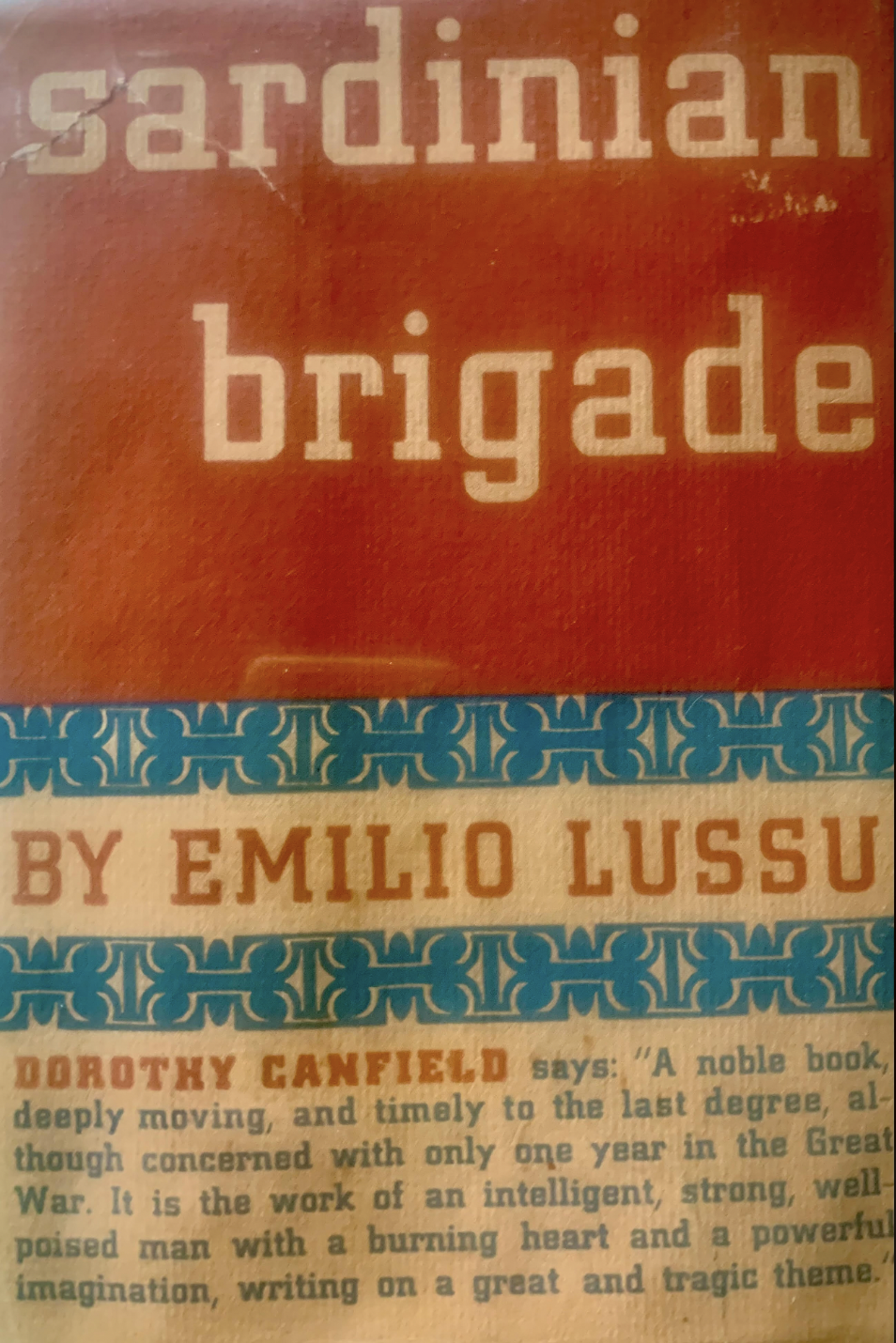
The Sardinian Brigade, by Emilio Lussu

Why this book: I have hiked in the Dolomites of Northern Italy and visited sites of WW1 Battles between the Italians and the Austrians, and twice visited a museum dedicated to these battles. I have also read other books on WW1 – a terrible and tragic war..  This book was recommended as an engaging first person look at that war.  I read an old first edition version I got on Abebooks, but it has been republished and is currently available as A Soldier on the Southern Front

Summary in 3 Sentences: A first person account by a junior officer in the Italian Army of one year during World War 1 fighting the Austro-Hungarian forces for control of Northern Italy.  The author was not a career army man, and viewed with dispassion and some alarm at the decisions made by senior officers. He wrote this book some 20 years after WW1 about his experiences fighting on the front under his Italian generals against a very different foe. 

My Impressions:  The cover of the edition I have was written by a reviewer in the late 30s, and I believe describes this book pretty well: “ It is the work of an intelligent, strong, well poised man with a burning heart and a powerful imagination, writing on a great and tragic theme.”   This book describes only one year of the four he spent in the Italian Army during The Great War.  

The author is an intelligent and well educated junior officer who had grown up in Sardinia and had just graduated from the university Padua in law.  He had joined Italy’s army to defend his country against the Austrian forces that had invaded Northern Italy as part of the German and Austro-Hungarian axis fighting the Allies.  He did not have strong Marshall impulses but did have  a strong sense of  duty to his  responsibilities as an officer in the army and to his country, but also a strong sense of compassion.  During the year of war he describes in this book, these two sentiments were often in conflict.

He says in his preface that he simply describes some of the incidents that made the greatest impression on him that he recalls from that one year – and he published this book 20 years after they had taken place.  

When I described this book to friends, I noted that the insane leadership and decisions that he described reminded me of Catch 22 and the author is an Italian Yossarian but one who is committed to his duty – but has retained enough common sense and humanity to see the sheer bald stupidity of orders that he observed – and even had to carry out, more often than not, with tragic consequences – resulting in pointless loss of life.

At that time and in that war, brandy was issued to all officers and seen as nearly indispensable to help soldiers and officers deal with fear and overcome inhibitions.  He describes several officers who, when the going got tough, retreated to the bottle and were drunk – sometimes sitting out the battle alone in a room drinking. In one case a Major dealt with his stress by getting roaring drunk and enraged at some of his men who refused to carry out a foolish order, and then ordered them to be executed.  When the other troops refused, he pulled out his pistol and started shooting them himself, until the other troops shot and filled him with bullets, their battalion commander. 

He movingly described how he and one of his men snuck up very close to an Austrian position where they could easily at close range shoot and kill an Austrian soldier making his coffee. Neither he nor his soldier could shoot an unarmed soldier, who was not engaged in combat, unawares in the process of daily non-combat activities.  This is an ethical/psychological challenge has often been discussed in journals of military ethics.

The disillusion of the junior officers and troops with the leadership of the Italian Army at the time was a constant theme.  The author saw and argued against decisions that were clearly foolish, futile and would clearly have disastrous consequences, but he felt bound by his duty and oath as an officer to obey orders – even stupid ones.  He described several mutinies against the leadership.  

It was clear that the career senior officers had been brought up with a romantic and heroic ideal of warfare and sought to impose that on their men – who they demanded behave in accordance with outmoded heroic visions of warfare – men blindly sacrificing their lives to fulfill the ideals of their bold leaders. The author’s common sense, practical and humane view of warfare was in direct contrast to that view held by so many of his leaders.  

This book describes the transition between 19th and 20th century warfare that was so tragic in WWI.  Another book – a novel – which describes this tragic transition is CS Forrester’s The General.  

This is a short and well written  and engaging first person look at the WWI trench warfare, and artillery battles in Northern Italy – a somewhat different version, but sill similar to better known battles  on the Western Front, described by Remarque in All Quiet on the Western Front, and Robert Graves in Goodbye to All That

Posted in Uncategorized | Tagged , , , , | 1 Comment

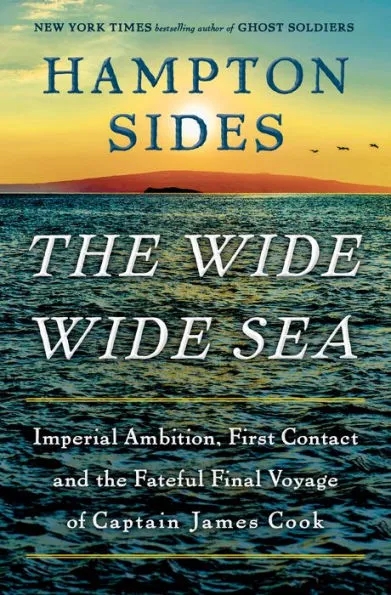
Wide Wide Wide Sea – Fateful Final Voyage of Capt James Cook, by Hampton Sides

Why this book: Selected by my literature reading group. Also I’d read three others of Hampton Sides’ historical narratives, and all were great (Blood and Thunder, Kingdom of Ice, and Ghost Soldiers.).  

Summary in 3 Sentences: The book begins with a background on James Cook and his previous 2 voyages to the Pacific and then how he was selected to captain this final most ambitious effort by the British Admiralty to explore the Pacific and find the Northwest Passage.  It covers the entire 3rd vosyage, of Cooks two ships, the  Resolution and the Discovery, around Cape Horn, Austraila and New Zealand, the encounters Cooks team had with the Polynesians of Tahite and what is now French Polynesia, and then their exploration of the north western coast of North America and Alaska and into the Arctic in search of the NW passage, and then finally returning to Hawaii where events took an unexpected turn for the worse.

My Impressions: Another fascinating historical narrative by Hampton Sides – revealing an important piece of history about which I was only vaguely aware.  I listened to rather than read this book, knowing from my previous experiences with the author that it would be captivating and easy to follow. The narrator had a British accent which was appropriate given that Cook not only was English, but his voyage was on behalf of the imperialist aims of 18th century England  The problem with listening is that I’m sure that the hard copy had maps which would have helped a lot – as it was, I had to remind myself when I got back to my computer to find maps which laid out his voyage. 

The main subject of the book, Cook’s 3rd and final voyage, begins with the long transit to the South Pacific around Africa, Cape Horn below Australia to Tasmania and then New Zealand before getting to the Tahitian Islands – and beyond.

But the book begins with a brief summary of Cook’s 1st and 2nd voyages which also serve as an introduction of Cook himself.  We learn of his background, how he came to be a highly regarded explorer before the 3rd voyage, as well as an introduction into how the Royal Navy functioned, how captains were selected and the preparation required for ambitious voyages of discovery and empire.

One of the key characters of the early part of the book was Omai who had been brought back to England from the Tahitian islands on Cook’s second voyage.  Sides goes into some length describing how he was received and feted in England, how he adapted and became a celebrity, wanting only to return to his home Islands to avenge his tribe after a war with another tribe. 

King George III directed that Omai be returned to his home islands on Cook’s 3rd voyage and the King also insisted that Cook bring a wide variety of animals and plants to help spread “civilization” to the Pacific Islands. Omai was indeed returned by Cook to his native Tahitian Islands, but that didn’t work out as well as had been hoped. Omai expected, in fact demanded that he be treated as a returning hero with privilges and power, which those in power in his native community resented. He alienated the people he returned to by “putting on airs,”  and his return was not as fortuitous as he’d desired. 

One of the key objectives and most interesting aspects of this book were the anthropological aspects of Cook’s contact – often first European contact – with islanders in many parts of the Pacific.  He was more respectful and sensitive than most to native cultures and endeavored to always build positive relations – which was often difficult, given that his crews did not share his same sensibilities.  This is perhaps understandable given the age of his crew, and the hardships of their voyage. When Cook and his crew  finally arrived in the islands, their primary goal was to somehow get something pleasurable from the natives – and that usually meant sex.  And in this, the natives were usually happy to comply, as the sailors were new and different, and the natives had no experience with Christian prejudices against recreational or transactional sex.  The native girls were often only too happy to trade sex for some of what the sailors had to offer that were valuable to them, such as nails, mirrors, cloth, etc. And the native men profited from these transactions as well, offering up their sisters, wives, daughters. 

Captain Cook only sought to inhibit these transactions when he realized that his sailors were spreading venereal disease (primarily gonorrhea) where it had been previously unknown. He tried, often unsuccessfully, to keep sailors on board who his surgeon knew had “the clap.”  

Cook was the first European to have recorded a visit to the Hawaiian Islands, though there is some scant evidence that perhaps a Spanish vessel may have visited, or been shipwrecked.  Cook’s expedition stumbled on the Hawaiian Islands on their way to the Northwest Coast of America in search of the Northwest Passage. They stopped to get supplies and fresh water and rest, then headed for what is now the coast of Washington State and Vancouver, and they continued sailing northwest, exploring every inlet they found in an unsuccessful effort to find a through passage.  They went north to Alaska, proceeded along the southern coast of Alaska through the Bering Sea and into the Arctic Sea before turning around, after hitting an impenetrable wall of ice.  Along the way they met with Inuit and other native tribes, many of whom had had contact with Russian traders, or knew of Russian ships which had been in the region.  

Cook then turned his expedition around and returned to the Hawaiian Islands to refit, recover, and spend the winter.  Cook planned to return to the Arctic the following summer in hopes of finding a passage before the ice closed in. But his arrival in Hawaii inauspiciously coincided with a major religious ceremony, and the native Hawaiians believed Cook to be a god returning to help and serve the people. This led to a series of misunderstandings and a series of bad decisions and bad judgement calls that Cook made,  culminating in a fight that led to Cook’s death and that of several of his crew.  The expedition’s second in command took over and reluctantly decided to carry out Cook’s plan, and returned to the Arctic the following summer, again hit the ice wall and then headed  the thousands of miles back to England. 

One of the sub-themes that Sides returned to frequently was that on this voyage, something didn’t seem right with Cook.  He seemed to have become angrier, less tolerant, and impetuous in ways that he had not been on previous expeditions. He had previously been known as a calm, steady, and dispassionate man of good judgment and a rational demeanor. On this expedition,  those who knew him were surprised when he regularly behaved or made decisions inconsistent with his previous character.  Anger, and bad judgment were instrumental in leading to the confrontation at which he lost his life. 

The Wide, Wide Sea was not only very engaging to read, but was informative and insightful, as have been the other historical narratives I’ve read by Hampton Sides.  I just read another book that I would recommend before reading this one – The Wager – about an incident in the Royal Navy that happened 40+ years before Cook’s 3rd voyage.  This book sheds light on some of the practices of the Royal Navy that would add to the appreciation of Cook’s voyage, and Sides’ account of it.  

image.png

Posted in Uncategorized | Leave a comment

The End – a Novel, by Fernanda Torres

Why this book:  Strongly recommended by my friend Janar to our literature reading group. Not selected by the others, but based on his recommendation, I wanted to read it.

Summary in 3 Sentences: This novel looks at the ends of the lives of 5 men living in the Rio de Janeiro region of Brazil – in their own words sharing their experience of old age and finally their own deaths, followed by the perspectives of (mostly) the important women in their lives – wives, lovers, and others.   A few of the five men lived lives of debauchery and libido satisfaction, a couple of the others at least tried to go straight.  This novel provides a perspective on men and women’s sexuality in the very libertine world of urban Brazil in the 1960s – 1980s – sexuality as banal amusement, sexuality as s a driver of love and passion, and as a purely recreational activity, fraught with danger. 

My Impressions: Fun to read about the reminiscences of the crazy debauched lives that some of these men lived as young men in the party life of Rio in the 60s, 70s, and 80s.  And then “the rest of the story”… failed marriages, the ultimate emptiness of the constant chasing of the next erotic adventure – but as they tell their stories, their emphasis was on the fun they had.  After looking back on their lives and sharing some of their favorite and not-so-favorite stories, each of the men’s stories ends with him experiencing his own death.  Then we get the perspectives from some of the women in their lives – their wives and girl friends, and some others who they touched in their lives. 

Each of these men knew each other – they were a group of buddies who  partied together into middle age and beyond – sharing in their dissolute indulgences and debauched life styles – which included not just a lot of recreational sex, but also drugs and alcohol.  They had their female accomplices in these adventures, but each of them did make a weak effort to get married and lead a normal family life, but all but one of them failed – and the one who did remain dedicated to his wife, can hardly be said to have had a joyful marriage – but he was indeed devoted to his strict and overbearing wife.

The book is broken up into five parts – each focussing on one of the five men, but a large portion of each section was given to the perspectives of those on the fringes of the man’s narrative of his experiences  – the wives and other enablers – what THEIR lives were like,  how they perceived the primary characters, how these men affected them, and some of the damage they left in the wake of their pursuit of pleasure.

Reading the stories these mens tell at the end of their lives, it’s almost as if some of it is fulfilling every man’s fantasy of constant partying and fun, lots of sex with lots of women, drugs, drinking, rock and roll – but not much of what I would call fulfillment.  And I think that was the point of the author – a women who has clearly lived the high-life in Brazil and has some first hand experience of the craziness of this world.

One of the men is extremely attractive to women – they are drawn to him as to none of the others and he gets more than his share of attention and affection from attractive young women. He finally falls deeply in love and marries, and the couple has ten years of a rich and fulfilling life. Then suddenly he realizes he is bored with his wife, deals with it by going on a rampage of extramarital carnality.  She is devastated, and he is consumed with guilt, but can’t control himself. He comes back to her but can’t walk away from the sexual circus. She goes down hill and he contributes to her demise by making her believe she is hallucinations about his extramarital affairs.  They both come to a sad end. 

The men in this novel are childlike in their inability to manage their lust; the women in this novel are either naïve victims of their unwillingness to recognize this in their men, or, in the case of their many girlfriends, are complicit partners in this game of partying, fun and uncommitted sexual recreation.  

This was a fun read, and also takes a bit of the glamor away from what on the surface appears to be the fantasy life of a lot of young men.  And the women’s perspectives are telling as well.  How the author reveals the first person perspectives on the experience of dying of these characters is well done and thought provoking.  The spiritual element was nowhere to be found in this hedonistic view of life – living for the moment, the next high and the next erotic adventure.  These men did not experience the simple pleasures of family life and of contented love and  friendship with a life partner, nor any spiritual transformation or insight  Their deaths were rather sad and lonely.   

I enjoued and am glad I read this – short and provocative book 


Posted in Uncategorized | Tagged , , , , | Leave a comment