
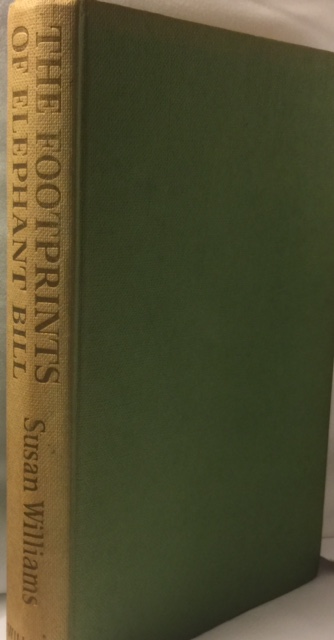
 Why this book: I had read and loved Elephant Company, by Victoria Croke, but felt that the author gave short shrift to Jim Williams’ wife Susan. I found this autobiography written by Susan, published in 1962, and ordered it through Abebooks. It has not been reprinted so far as I can tell.
Summary in 3 sentences: The is an autobiographical account of Susan Williams life as wife of Jim “Elephant Bill” Williams in Burma. The first part of the book is very much her perspective and impressions of living in Burma – it’s all her. The latter part of the book, after they separated after their harrowing evacuation from Burma, is more about her version of what her husband experienced. The last chapter of the book is a recap of their final years together in Cornwall after they returned from Burma after the War.
My impressions: I loved the first 3/4 of the book when she openly shares her own impressions and experiences, and the book is indeed very autobiographical. We get to know Susan Williams as an amazing, passionate and resilient woman and she writes beautifully. She begins her story as a young woman growing up in England and at about 18 years old accepts an offer from an eccentric uncle to become his assistant in Burma. A brave, intrepid, resilient and compassionate woman emerges from her descriptions of arriving in Burma, working for her uncle, then meeting, being courted by, and marrying Jim Williams. Then she tells of their first years with Jim Williams living and working in the remote jungles of Burma. From Elephant Company (my review is here) I was familiar with most of the story as told by Victoria Croke, but I found Susan Williams writing and descriptions superior. She had a gift of unpretentious sincerity and a gift for simple and evocative language.
She wrote of their life together including months moving through the Burmese jungles with her husband, checking on the harvesting of teak, taking care of the elephants and their Burmese handlers, describing how the elephants did their work and how amazed she was with their incredible intelligence and sensitivity. She clearly shared her husbands love of animals and people and they both had a special gift for acquiring their trust. She transmitted an utter amazement of and respect for the elephants she spent so much time with.
She told how young Burmese oozies – elephant handlers – were assigned to a baby elephant when the elephant was about 5 years old. The oozie would often stay with the elephant for all or most of his live, and the elephant would be not just a work animal but a quasi-member of the family, after the oozie later married and had a family. She told of how the elephants learned to understand and comply with human language to a remarkable degree. She told how an oozie family would have their elephant baby-sit their baby by putting the baby on the ground, drawing a large circle around it, and the elephant would gently nudge the baby back into the circle when it tried to leave, while the family went and took care of other chores.
Susan talks briefly about her and Jim’s trauma after losing their first child to a sudden disease, and then later of their joy in raising their son Treve, who, with the loving care of his parents and of Burmese care givers, thrived in what some might consider a harrowing environment to raise a child.
Susan Williams was perhaps typical of strong women of that era, raised with essentially Victorian sensibilities, self-effacing and humble, but clearly a force of nature in her own right. And she clearly loved and admired her husband and the world in which they spent their first 10 years of marriage.
The later part of the book was a bit disappointing since it was more about her husband’s experiences as she recalled him telling about them, than her own. At one point she recommends that the reader read his version for a better description of some of what he did to support the British Army in Burma fighting the Japanese. And because I was already familiar with the outlines of the story from Victoria Croke’s Elephant Company, and had come to so like and admire Susan Williams, I was disappointed when she shifted the narrative to describing his experiences rather than her own. I would have liked to know what she was doing, experiencing, feeling, while her husband was rounding up elephants to help General Slim fight the Japanese.
The book concludes with a very brief description of her and Jim’s efforts to make a life for themselves in Cornwall after the political environment in Burma made their former work and lifestyle untenable. Susan was raising two of her own children and a nephew and niece while Jim tried to find work in the UK that satisfied him. Ultimately he wrote a book Elephant Bill about his experiences in Burma which became quite a hit and he was in much demand as a speaker and lecturer. There were satisfactions in their life, but it was certainly an anti-climax after leaving Burma. He died suddenly in 1958 during an emergency appendectomy. This book was published four years later. In some ways the last part of the book seemed like a eulogy to her husband.
I really liked Susan Williams as she comes through in this book. I would like to know how the rest of her life went – but have yet to find anything more about her.


 Bob's Books
Thank you. I just read “Elephant Company” and wondered more about Susan Williams myself. Your commentary on her book was very informative and much appreciated. Have you been able to find any more of Elephant Bill’s books?
I only have his own book entitle Elephant Bill – nothing more. I tried to find out more about Susan Williams but after just a preliminary search on line, didn’t find out much. Her book ended pretty abruptly and I was unable to learn more about her later life. Thanks for your comment!
Our book club read Elephant Company and thoroughly enjoyed it. We were wondering what became of Lemorna since she was declared dyslexic. Was she successful in life?
I too would like to know what became of Lamorna
What ever happened to their daughter and what was her life like?
Was an elephant hospital or preserve established after the war? If so, does it still exist?
I don’t know about India or Burma. There is one in the US, though I don’t believe it is related to Elephant Bill or those efforts in the far East.