
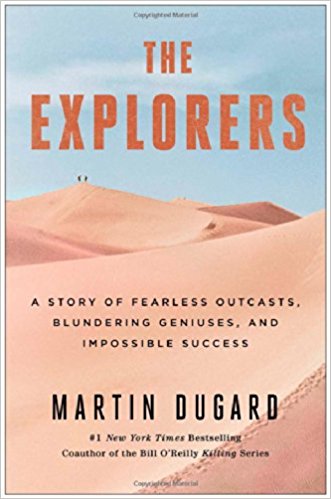
 Why this book: Given to me as a gift from my brother who had read it and thought I would like it.
Summary in 3 sentences: Martin Dugard had researched and written about a number of history’s most intrepid explorers, to include James Cook and Christopher Columbus. As he continued to research other explorers, he asked himself what attributes or qualities they all had in common. The book is broken into seven chapters, and while the story of Richard Francis Burton and Jack Speke’s competition to find the source of the Nile in the 19th century provides a continuing theme and backbone for the book, each of the chapters explores one of those qualities and gives a number or examples of renowned explorers and some little known ones, who exemplified that trait.
My Impressions: The Explorers included some interesting stories about explorers down thru the ages, but I felt like Dugard strained to apply his taxonomy to all of them. His thesis was that the great explorers in history exhibited seven qualities or characteristics to a greater degree than most people: Curiosity, hope, passion, courage, independence, self-discipline, and perseverance. While some of the explorers he profiled exhibited one or the other of these traits in abundance, I never felt that these qualities had any real credibility in explaining what makes explorers explorers. Great ambition is not one of his qualities, but was clearly a common denominator.
I also felt that his 7 traits taxonomy was only loosely applied to the stories he enjoyed telling. He had much to share and he seemed to simply stick some of his stories into chapters without any relevance to the title of the chapter. For example he has some concluding lessons learned for the whole discussion of The Explorers, but they are simply included in the final chapter on the final trait – perseverance. This was typical – I found good material in each chapter that just didn’t seem to fit the theme of that chapter. That said – I enjoyed reading the hodgepodge of fascinating stories and little known facts.
The backbone of the story was about the two explorers Richard Francis Burton and John Hanning “Jack” Speke – one time partners, eventual rivals and competitors for the honor of having discovered the source of the Nile – one of the great goals of adventurers of the 19th century. This story was particularly interesting to me since I had read a biography of Burton, but had only vaguely heard of Speke, who Dugard clearly admired more, and apparently with good reason. We learned of them and their exploration in considerable detail.
The book is a potpourri of adventure and exploration stories from the great age of exploration, from the early 1700s until the early 1900s. A few example of stories Dugard touches on:
- Robert Falcon Scott and his ill-fated attempt to be the first man to reach the South Pole, which cost him his life.
- Gaspar de Portola leading explorers inland in California searching for a location to build a mission, camping in what is now Orange County.
- Daniel Boone building a road through the Cumberland Gap that would open the westward expansion of the United States and which led to the purchase of the Louisiana Territory.
- James Cook circumnavigating the globe, charting the coast of New Zealand and discovering the east coast of Australia and mapping most of the Pacific Rim, including Oregon, Washington, British Columbia, Alaska and Hawaii.
- The amazing life story of Jean Godin and Isabel Grameson in Latin America where the married couple were separated in the 1700s and braved the Amazon river and the jungles to cross the continent to find each other again.
- Sir John Franklin, Royal Geographic Society founder and former governor of Tasmania, sought the Northwest Passage through Canada’s waters to reach Asia, never to be found, never to return.
- Ernest Shackleton, who sought to be the first to cross the Antarctic continent, but whose ship was crushed in the ice and after an epic 2+ years of struggle, brought all his men home.
- Paul DuChaillu, the inspiration for Edgar Rice Burroughs Tarzan, who claimed to be an American spent years exploring Africa with new discoveries in the center of the dark continent in the 19th century.
- Edmund Hillary, who in 1953 was the first to summit Everest after many before him had failed.
- William Dampier, something of an amoral opportunist, who circumnavigated the world 3 times, explored vast areas of the South Pacific, rescued the man from a South Pacific Island who became the inspiration for Robinson Crusoe and introduced the words barbecue, avocado, and chopsticks to the English Language.
- Alexander von Humboldt who travelled over r1500 miles up river explored the Orinoco River in South America in 1800 and eventually became the first mountain climbers in South American history, climbing the 20,564 foot Chimborazo.
The book concludes noting that while there are no longer new continents, new oceans or mountains to discover and explore, the spirit of adventure and exploration still exists and this intrepid human spirit finds other avenues for expressing itself. Testing man’s limits in aircraft, in space, new challenges out on the edge of science and knowledge, exploring new capacities of human endurance – these are all new opportunities for ordinary people to do extraordinary things.
Bottom line: A fun and interesting read, with lots of interesting stories that are only loosely held together by the theme of his book.


 Bob's Books