
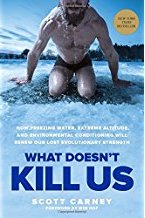
 Why this Book: I went to a Wim Hof half-day seminar in LA with a couple of crusty old SEAL master chiefs who had been following and practicing the Wim Hof method for a while. I went along out of curiosity, did the half day session, and was amazed and impressed. While there, I overheard someone mention a book by an investigative reporter who sought to discredit Wim Hof, but who became a convert. So I bought and read it to give me some background on this seemingly simple program to augment what I was already doing for my physical, mental, spiritual well-being.
Summary in 3 Sentences: Scott Carney is a journalist who had made a name for himself unmasking charlatans in the human potential world, and after reading about Wim Hof, he smelled another phony selling a weird formula for youth, power, and a better life. As an investigative journalist, he signed up for and went through Wim Hof’s program, stayed with it, and progressed in ways that Wim Hof had promised. Based on his own experiences and his research behind some of the claims about the experiences of others, Carney becomes a convert to the Wim Hof method, and explores how and why it seems to give him and his followers unexpected strength, physical resilience, and improved health.
My Impressions: I enjoyed the book and learned a lot about Wim Hof, got some background on the myths and stories surrounding him. And it reinforced my decision and commitment to continue following his simple method. Someone interested in the physiology of self-development, and in Wim Hof in particular will find this book at least interesting, and perhaps fascinating. I found it fascinating. The casual reader who is not an avid athlete or fitness nut, will not particularly enjoy or be inspired by this book.
The introductory chapter of What Does Not Kill Us is a scientific and anthropological look at why Wim Hof’s methods might work. In short, Hof claims that we all have much more mental and physical capacity to overcome environmental stresses – such as cold, heat, physical and mental exhaustion, stress, viruses, etc – than we, or Western medicine, realize. He argues that many of our in-born capacities to resist a harsh environment and other stresses have atrophied and become dormant from lack of use in our comfortable Western lifestyle. This is a claim that shamans, mystics, some philosophers (most notably Nietzsche) and other wise leaders, as well as any number of charlatans have made.
Wim Hof claims – and seems to prove – that these capacities can be awakened, activated, and enhanced by putting the body under managed duress (primarily cold) AND by regularly saturating our tissues with oxygen followed by breath holding. He claims these simple exercises enhance a broad spectrum of our natural capabilities. Wim Hof says, “(Rabbits) know fight and flight. The wolf chases them and they die. But everything dies one day. It is just that in our case we aren’t eaten by wolves. Instead, without predators, we’re being eaten by cancer, by diabetes, and our own immune systems. There’ no wolf to run from, so our bodies eat themselves.” (p. 114)
Hof and his supporters claim that when we put our body under duress through cold, we activate hormonal and adrenal capacities in our DNA that have evolved over millions of years to make us stronger, more resilient, and help us survive harsh and unforgiving environments. These systems, like any aspects of our physical being, atrophy if they are not used, and need to be activated and exercised regularly thru environmental stress (shocking the system with cold) to become strong. Cold exposure also apparently increases mitochondria formation throughout the body, which would mean more aerobic power. Add to this the advantages of exercising the heart and lungs through hyperventilating and oxygen saturation, and the stress of breath holding, and you have the essence of the Wim Hof method.
With the mental focus that comes from withstanding the cold and doing his power-breathing exercises, Hof claims that we can learn to exert our will over the body’s autonomic nervous system – those responses our bodies automatically have to external and internal stimuli – such as heart rate, immune system, heat/cold regulation etc. It is clear that Hof himself has achieved a level of mental control over his autonomic nervous system that is incredible. In What Does Not Kill Us, Carney explores these claims, and experiments with them himself, and claims that he and others have indeed increased their minds’ abilities to regulate or at least manage some of their autonomic responses.
An important part of the Wim Hof method is to strengthen what Carney calls the “wedge” – that ability of the conscious will to impose itself “between the autonomic and somatic nervous systems at the point where an environmental stimulus meets an innate response.” (p 50) In other words, Wim Hof seeks to strengthen the power of the will to “direct” the body to respond more powerfully and with greater resilience to everything from cold, to wanting to breathe, even to disease and other biological functions. Those who seek to go to the advanced levels of Wim Hof’s method follow a stricter and more demanding cold and power breathing regimen, and Hof offers nutritional and exercise advice to go with it – mainly yoga, meditation and intermittent fasting. But the essence is the same – cold and power breathing.
Those who have followed Wim Hof’s simple formula have had some amazing results, and in this book, Carney gives examples of some stunning transformations. In What Does Not Kill Us, Carney uses himself as a guinea pig to test and study Wim Hof’s method, actively participating in several of Hof’s multi-day camps, seeking other opportunities to push his limits, eventually climbing Mt Kilimanjaro with Hof, shirtless and with less than 2 days of acclimatization.
In addition to making healthy people like Carney healthier, it seems there is promising evidence that it can also help people with depression, PTS, and other disabilities. Carney researched and describes several cases in which people who were seriously debilitated by disease (Parkinson’s, Crohn’s, Rheumatoid arthritis) were helped significantly by following Hof’s protocols, after having had little success with conventional treatments.
Carney sees Hof as a crusader, intent on spreading the word that his simple method can help anyone live a healthier and happier life. He clearly admires him as an eccentric “genius,” a visionary, and an inspired crusader, but expressed reservations about his leadership when he left a number of people behind on the Kilimanjaro climb. I sensed Wim Hof’s eccentricity when I was at his seminar – he is like an ADHD saint on steroids – with more energy and enthusiasm than it seems he can fully control. His sons and other disciples help him with the organizational part of his demonstrations, seminars and his business. A big part of their challenge seems to be managing his energy and enthusiastic good will. But Wim Hof himself, his passion for what he does, and the experience he gives people, is the show.
What Doesn’t Kill Us swings back and forth between an explanation of Hof’s methods and Carney’s personal journey to become tougher, stronger, more resilient. While most of Carney’s journey is built around understanding and practicing Wim Hof’s method, there are chapters in which digresses to recount his participation in a Spartan Obstacle Course race in the Rocky’s and a Tough Guy competition in the UK – the inspiration and precursor to today’s Tough Mudder competitions. Carney concludes the book with an epilogue in which he explains the before and after effects of augmenting his relatively modest workout routine only with Wim Hof’s cold exposure and power breathing. The degree of improvement shocked the lead exercise physiologist at the Boulder Center for Sports Medicine, who measured Carney’s health and fitness before and after following Wim Hof’s method. Carney went from sceptic to convert, as he realized his new capacities, and the positive effects to his health and fitness that ensued from following the simple Wim Hof protocol.
My own experience with Wim Hof’s method: I’ve been practicing Wim Hof’s method for about 5 months and plan to continue it. It’s just a matter of discipline fueled by a faith that it is good for me – at least does no harm. I’m still a beginner, and haven’t yet taken the step that several of my friends have, who have signed up for Wim Hof’s 10 week program.
- For the power breathing, I have been able to do 2 or 3 breathing cycles once a day, most days. The power breathing is interesting in that I share experiences with my retired master chief friends with whom I started this adventure, all of whom are avidly sticking with it – and we each do power breathing somewhat differently Reviewing the book, I see that Carney distinguishes between breath holding with breath in, and breath holding with breath out (relatively empty lungs.) Each is good, and each has a different affect on how our will impacts the sympathetic nervous system. I so some breath-in breath holding, some breath-out breath holding, and mix them up.
- For cold therapy, my showers are cold, and 2 or 3 times a week, I go into the cold tank at the SEAL training facility. I’ve gotten used to the cold showers – they are short and invigorating. The cold tank is an amazing experience – and I mix sitting in the cold tank (water temp in the 40s) with power breathing. Amazing how focused power breathing can make the cold almost go away. Wim Hof: “Fortune favors the cold!”
- The power breathing has enhanced my meditation practice. Though I’ve tried numerous time, I’ve never been able to stay with meditating in the past, but with the power breathing and breath holding, I’ve found much greater satisfaction and motivation to stay with a meditation program. I’ve been able to achieve a state of detached calmness that I’d rarely gotten to before. And as Carney notes, the more you quiet your mind, the longer you can hold your breath.
- Exercising the self-discipline to stick with this program – to choose to be cold, to do the daily work of power breathing is an added strength and resilience builder.
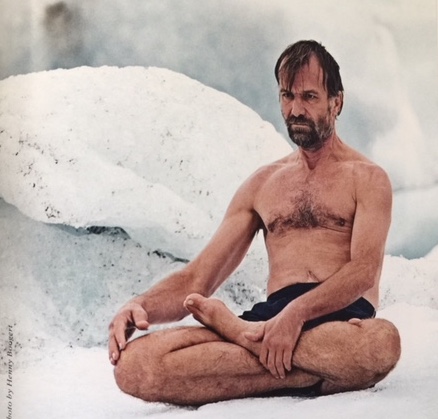
Wim Hof in a classic picture of him, sitting in lotus position on ice


