
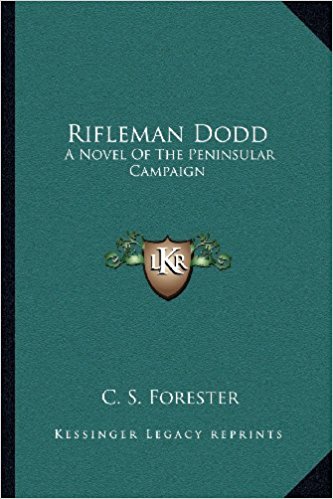
 Why this book: I was selecting books for a reading group of young men preparing to enter SEAL Basic Training. This is required reading for Marines. I had read it about 20 years ago and thought it had some good lessons learned for aspiring SEALs as well as good for them to know what the Marines are reading.
Summary in 3 Sentences: The story takes place in the Napoleonic Wars between Wellington’s army and Napoleon’s army in Portugal, where Rifleman Dodd – a five year veteran in England’s army who got separated from his regiment. He links up with – and is aided by – several different groups of Portuguese partisans who are fighting the French as guerrillas, who Dodd is able to organize and runs some harassing operations against the French while he tries to find his way back to the British forces. Through a series of hardships and close calls, Dodd is able to survive, maintain his focus on rejoining his regiment, while also never forgetting that he is in Portugal to defeat the French, and is able to make a difference with his Portuguese guerrillas on French operations.
My Impressions: An interesting little book – about 200 pages – which offers insights into the lives of common soldiers 200 years ago, and into the battle between Wellington’s British Army and the French forces of Napoleon in Portugal. The book was originally titled “Death to the French” and was written in the early 1930s when the British Army was still angry at the French for what they perceived as cowardice and lack of commitment to carry their load fighting the Germans in WW1. It was published in the US as Rifleman Dodd – simply the name of the hero and protagonist of the novel.
Dodd is one man caught in a clash between two large armies in Portugal and is lost in the shuffle as the armies move and maneuver against each other. But his world and mission are dire and dramatic and he must use his wits to communicate and work with the Portuguese partisans who save his life and who are also fighting the French. He is dependent on them, but they admire and take advantage of his military experience and tactical expertise in harassing the French forces. He is an experienced fighter – with five years in the army and a veteran of numerous battles and campaigns. His instincts for survival and for tactical success on the ground are well honed. Forrester makes him into something of a model soldier – uncomplicated, undemanding, physically tough and resilient, and focused on one thing -his duty as a soldier.
He was a soldier of his time, with very little education or knowledge of the world outside of what he had learned on the farm where he grew up in Sussex England, and as a rifleman in his regiment. But he is very practical, humble, and resourceful, and when during a battle he became separated and then left behind as either a casualty or missing in action, he had to fend for himself, and he missed his mates and his regiment. But alone or in his regiment, he was single minded in his focus on his duty, his regiment and his mission.
The essence of the story is Dodd’s character and soldierly virtues – and this is the reason this short book resonates so well with the USMC . The story is not only about what happens to him under those austere and challenging circumstance, but more about how he handles hardship and challenge with a selfless, singleminded focus on his mission and returning to his regiment. He was not tempted by comfort of mind or body, or by women, or even the opportunity for other comforting distractions with his Portuguese partisans. After a series of misfortunes, he does not succumb to despair – he simply soldiers on, not expecting to live, but committed to live or die doing his duty as best he can.
Forrester also gives us some of the French perspective, but he does not paint a very positive picture of French discipline or of them as a fighting force. We get to know throughout the book a particular French company of soldiers and their struggles and suffering under poor leadership, their poor morale, lack of food, shelter and a strong sense of purpose. We also get to see how the Portuguese civilian peasants suffered at the hands of the French, but we are led to believe they were helpless victims of both sides – their villages and fields burned, their women ravaged, their men killed, their food supplies destroyed or confiscated. And in the midst of all this, we follow Rifleman Dodd, alone and unafraid, organizing the peasants, attacking the supply trains of the French, doing his duty and doing whatever he can to return to his mates and his regiment.
There is a telling quote in the story as he was about to embark on a one man sabotage mission against the French. “Yet if he had been asked…if he were happy, he would not have known what to reply. He would have admitted readily enough that he was uncomfortable, that he was cold, and badly fed, and verminous; that his clothe were in rags, and his feed and knees and elbows raw and bleeding through much walking and crawling; that he was in ever-present peril of his life, and that he really did not expect to survive the adventure he was about to thrust himself into voluntarily, but all this had nothing to do with happiness: that was something he never stopped to thing about. Perhaps the fact that he did not think about it proves he was happy. He was a soldier carrying out his duty as well as he knew how.” (p 173-74)
When Dodd finally does return to his regiment, he does not regale his leaders or his mates with his adventures, nor of tales of his exploits against the French with the partisans. When asked “How did you live? What did you get up to?” Dodd responded, “Dunno, sir. I managed somehow, sir.” And Forester goes on to say, “..in those days there were no medals or crosses for the ranks. There was only honor and duty…”
This book is a great book for young men or women entering the military to serve in combat forces. The ideal – almost a caricature – is hard to imagine with today’s young people. At one point Forrester describes Dodd: “His mind did not constantly demand new little activities. He could lie and chew the cud of his observation as placidly as a cow.” That hardly describes today’s young warriors who are well educated, well informed, and have been exposed to so much more of the world than Dodd. But it is a good look at soldiering of a different era – and Dodd’s devotion to duty and honor and his unit are timeless virtues for those in the military.


 Bob's Books
you misspelled the author’s name