
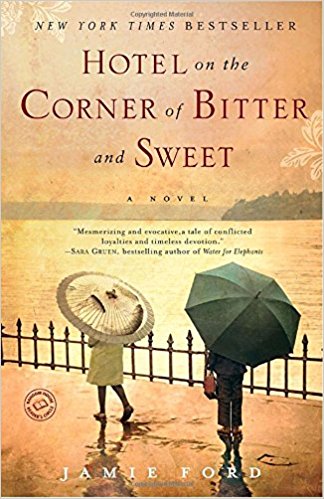
 Why this Book: Selected by my literature reading group. We wanted something a bit shorter and lighter than out last book The Goldfinch, and this came highly recommended.
Summary in 3 Sentences: This is two parallel stories – of a 12 year old young man in a Chinese family living in Seattle in 1942, and of the same man 44 years later coming to terms with middle age and his memories of that challenging period of his younger life. In 1942 our protagonist develops a crush on a girl of Japanese descent and together, the two of them deal with the prejudices and racism of the day towards Asians, as America is at war with Japan. There is a moving love story, but much of the book explores the cultural tensions between Anglo Americans and Asian immigrants, the injustices of the relocation of Japanese Americans into camps during WWII, and in-family tensions between American born Asians and their traditional parents.
My Impressions: I enjoyed the book – at about 300 pages it is not too long and an interesting story – a coming of age novel with the twist of it dealing with Chinese-Japanese Americans during WWII. The emotional hook is the love story between Henry – our young protagonist, and his mature and wise Japanese girlfriend Keiko – each about 12-13 years old. But the back story is the vicious racism that Japanese Americans – young and old – had to endure after the US went to war with Japan.
The book brings to light a lesser known story about how the Chinese also hated the Japanese for what they had been doing in China for years before Pearl Harbor, and as a result, they were fervent supporters of the US in its war with Japan. Yet most Americans can’t tell a Chinese from a Japanese, and the racism toward Japanese was extended to many Chinese.
A secondary theme of the book was the cross-generational challenge in Henry’s Chinese household. Henry felt himself to be very American, but his father was a very traditional Chinese father who demanded complete obedience from his son. Henry had to hide his relationship with Keiko from his parents because of his father’s hatred of all things Japanese, and when he found out – the family fractured and young Henry had very divided loyalties.
Keiko and Henry both considered themselves to be very American, and loyal to their American culture, but were forced to endure the taunts and abuses of anglo schoolmates, especially from a few of the bullies. This tension between their own sense of being culturally American, and yet being rejected by mainstream of American culture creates the strong undercurrent that moves the novel along.
The author injects Sheldon into the story, an African American jazz saxophonist who adds another dimension to the issue of racism in America. Quintessentially American, yet also an outsider to mainstream American culture, Sheldon is a mentor to Henry, supports him with his insights and wisdom, and occasionally even protects him from some of the more vicious of his tormenters.
And then we get to know Henry as a middle-aged man, 44 years later, not too long after the death of his Chinese American wife of over 30years. He has lived his whole life in Seattle, raised a son, retired from his career, and is now alone and trying to find his way. His son is fully American, much more assimilated into American culture than Henry had been, and he helps his father to find his way. The relationship between Henry and his son contrasts with Henry’s own difficult father-son dynamic in 1942. In Henry’s son’s full assimilation into American culture, we see the degree to which Asians have been almost fully integrated into American life since the time of Henry’s boyhood.
The evolution of anti-Asian racism, the changes in generational dynamics over 40+ years and the compelling love story between young Henry and Keiko make up the themes of the book. There is an interesting twist at the end which ties up some loose ends. Hotel on the Corner of Bitter and Sweet is an enjoyable read with some interesting insights into Japanese-Chinese-American cultural issues in the 1940s. The characters are probably not as well developed as I might have liked, but they were believable and enjoyable to follow.
Not the best novel I’ve ever read, but worth my time and I enjoyed it.


