
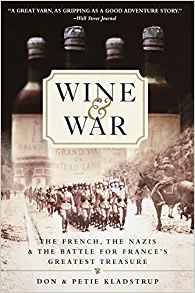
 Why this book: I was about to leave with a number of friends to do an 8 day bicycle tour of Burgundy, France, one of the worlds most famous wine regions. My wife handed me this book and suggested I read it to learn more about the region I would be traveling through. So I did. And I’m glad I did.
Summary in 3 sentences: Germany had always recognized France as the world leader in cultivating and distilling fine wine, and when Germany occupied France at the outset of World War II, one of their many objectives was to control and exploit the French wine industry, plunder their stockpiles of great wine and champagne, and subordinate France’s legendary wine industry to the goals of the Third Reich. This book outlines how Germany sought to brutally fulfill that goal, the damage they did, as well as how the extensive network of French grape growers and distillers, from small farmers to the great houses and brokerage firms sought to and with some success thwarted Nazi efforts. There is much in the book about the large scale participation by those in the wine industry in the Resistance, but also addresses the uncomfortable issue of collaboration of some in the French wine industry with the Nazis and the Vichy government, and how it all turned out in the end.
My Impressions: Wine and War is meant to be a quick fun read for those interested in the topic – specific to France and World War II. Though it is well researched and lists sources at the end, it is not meant to be an academic treatment of the subject. It tells the story, with some history and background, largely through vignettes and stories of individuals wine growers and leaders in the wine industry who experienced and suffered the trauma of Nazi occupation, primarily in the Bordeaux, Burgundy, and Champagne regions of France. The book would be more meaningful to someone who is already a wine connoisseur than it was for me, for whom wine is either red or white, tastes good or doesn’t. But I learned a lot about wine, its history, and the processes and challenges of creating fine wine with varying nuances that I didn’t know before. I know have a greater appreciation not only for the role of wine in World War II, but also for the art of selecting just the right wine to go with different types of food, and the art of the sommelier.
The individual stories were most interesting. The book includes stories of grape farmers who at great personal risk hid Jews and downed allied pilots from the Nazis, stories of the sons of these farmers who were conscripted into the German Army (from Alsace Lorraine) or were conscripted to work in factories in Germany. I read about leaders in the communities in the wine growing regions who through deception and subterfuge placated their new German bosses while also protecting the long term interests of the wine growers and distillers in the region.
Wine and War includes a lot about how many of those engaged in France’s wine industry supported the French Resistance during the war. Their resistance to Nazi leadership and policies took many forms, from conducting sabotage operations, to less aggressive acts of non-support to Nazi programs, to passive resistance, to providing the Wehrmacht with poor quality wine in bottles with the highest quality labels. The participation in Resistance operations increased after they realized that the Vichy French government of Marshall Petain was not going to protect them from Nazi plundering and exploitation. By 1943-44 the wine industry was broadly complicit in Resistance operations, which resulted in harsh reprisals by the SS and the Wehrmacht.
But the authors also give credit to some of the Germans who were sent by the Nazi regime to oversee the plundering and subordination of France’s wine industry. The Nazi regime sent experienced German wine merchants to France to be responsible for carrying out Third Reich orders regarding wine in France – and these key leaders were called “Weinfuhrer.” In several cases, these Weinfuhrer had long standing family ties to the French wine growers and distillers in the regions assigned to them, and had a great appreciation for the history, traditions and quality of wine making in France. Some of them insisted that Wehrmacht soldiers and other functionaries refrain from stealing and active sabotaging of French property, and that French wine makers be respected. They walked a fine line between protecting their old friends and a tradition they respected, while also placating their Nazi bosses in Germany. These Weinfuhrer recognized the imperative of protecting the traditions and quality of French wine, and of protecting their own relationships and credibility with those with whom they’d want to do business after the war.
The authors also shared the story of how, as the Allies were closing in on Paris toward the end of the war, the acting Mayor of Paris prevailed upon the German General von Choltitz, an old-school Prussian military officer, to not comply with Hitler’s direct order to destroy Paris upon withdrawing. Against all his military training, he disobeyed Hitler’s order, and thereby preserved for humanity the integrity and beauty of much of Paris. And then we read of his return visit to Paris 15 years after the war, to the city he could have significantly destroyed, but which because of his insubordination, remains one of the great cities of the world. It is an incredible story.
The villages I rode through on my bike tour of Burgundy that were mentioned in Wine and War as playing a role – greater or smaller – in the battle between the French and the Nazi regime over French wine: Close de Vougeot, Santenay, Chassagney Montrachet, Vezelay, Avallon, Saulieu, Nuits St-Geores, Laxe Corton, Auxerre, and the city of Beaune where we finished our tour, and which was and is a key city in Burgundy’s history.


 Bob's Books