
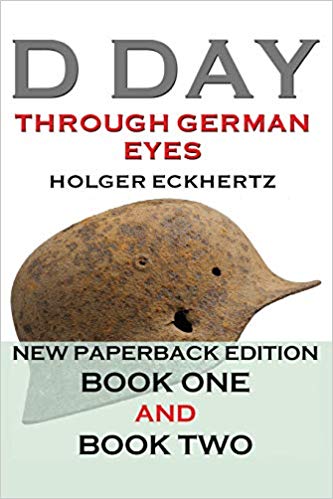
 Why this book: I’ve lived in Germany 3 times and studied a lot about Germany and German history. I thought this would be a good perspective to have. I was right.
Summary in 5 sentences: After WWII in the forties and into the fifties, a German journalist interviewed many German soldiers who were in Normandy and fought the Americans, Brits, Canadians on the beaches on D-day and was planning to compile these interviews into a book. He died before he could do it, and some fifty years later, the journalist’s grandson put the interviews into a book. The book includes the interviewers questions and the answers of the then soldiers, telling their very personal, tragic and incredible stories. He has one German soldier sharing stories from each of the 5 beaches the allies landed on on D-Day – what they were doing up to 6 June, what happened on that day and the immediate aftermath, how they felt, what they thought. HOWEVER, the authenticity of the book is highly questionable and it may be a hoax.
My Impressions: Fascinating. Whether true or not, these are some of the most intense accounts of combat and the collision between Allied and German forces on D-Day in Normandy that I have read. Very candid and personal accounts from interviews supposedly done only a few years after the events. The interviews include the interviewers questions and the (apparently) candid responses of the veterans. I’m sure some of it is edited in the process of translation, but the perspectives seem genuine and are definitely powerful. The horror, fear, and violence in wholesale killing in conventional war is vividly described by the interviewees. This was one of the most powerful and impactful of the seven excellent books on D-Day that I read.
This book makes the Nasty Nazis who are killing our boys into human beings. Like most westerners, I grew up cheering for our side – the good guys – and demonizing the bad guys representing the evil Nazi regime doing horrible things in Europe. There is clearly legitimacy in that position. But war is more complex than that.
These young German men telling their stories, are in may ways like the good guys on our side; they believed what their government told them about the justness of their cause, and were doing what their leaders trained and expected them to do. And just like our guys, they struggled to survive as they saw their buddies cut down in droves by the bad guys on the other side. Like the guys on our side, they were doing what they trained to do, and were mostly interested in surviving and taking care of their buddies.
Many of the German soldiers truly believed the they were fighting an invasion of United Europe and the German Third Reich by a coalition of forces intent on dominating them. Many of them had good relations with the French and did not necessarily support all the harsh measures their leaders were imposing on them. They believed the narrative that the Soviet bolsheviks were in league with the fat-cat capitalists in America and the UK to crush Germany and her vision of an independent and United Europe. Though apart from vague references to international banking and finance conglomerates seeking to rule the world, there was no anti-semitism expressed. Revisionism perhaps, but these guys came across as genuine to me.
While this combination of two books makes clear the similarities in outlook with soldiers on our side, there were some noteworthy differences between the experiences of the German and American soldiers.
- Many of the Germans on the Atlantic Wall had been previously injured or were too young or too old to be useful elsewhere. They were on duty defending the shores of Europe because this was light-duty compared to the other spots where Germany was fighting – Italy and Russia.
- They felt they were defending their homeland – whereas the Allies (with the exception of the French Troops on the allied side) were seeking to take back or conquer land that had never been theirs.
- The Germans were augmented by a good number of Poles and Russians, and others from countries the Nazis had occupied earlier in the war, who were either conscripted to fight for the Nazis away from their homeland, or had volunteered for whatever reason. We were working with willing allies while the Germans were working with often unwilling allies who they mistreated and did not respect. While many of these soldiers fought hard, it seems that a large percentages were reluctant soldiers, were considered unreliable by the Germans and were unwilling to make great sacrifice on behalf of the Germans, fighting in France, against Americans, Brits, and Canadians.
- The Germans were overwhelmed by the amount of equipment and resources the Americans had. They couldn’t believe how the Allies were unconcerned about fuel, or ammunition, or vehicles, or food – which seemed to be unlimited. The Germans were used to struggling constantly with shortages, and having to make do with much less.
- The Allies had air superiority and commanded the skies. The Germans had no or very few aircraft to use to attack allied ground forces, or to fight allied air power. Consequently anything that moved on the roads or on the ground, in the open, especially during the day, was a target. There were so many aircraft in the sky the Germans could count on being seen and attacked from the air.
According to the intro to Book Two, Book One got so many positive accolades for providing a much needed perspective on D-Day, the author decided to write Book Two almost as an addendum. In Book Two he included interviews that were not included in Book One. Book One interviews were one per beach of the invasion – the author apparently selected from the many interviews one interviewee who most dramatically represented the German experience at each of the beaches, from West to East – Utah, Omaha, Gold, Juno, and Sword.
Book Two was not so clearly organized – he seemed to select 8 interviewees who added different perspectives and represented different groups than were represented in book one. For example, he has a luftwaffe pilot, an engineer, a military policeman etc, and he included some passages that he knew would be quite controversial.
I recommend this book be included in any study of D-Day. It is a short (~240pp) and very compelling read.
Caveat: Just weeks after reading this book and after writing this review, I learned that most serious historians are calling this book a hoax. Apparently, there are no records to be found on the men interviewed, nor of the author, nor does he reference any sources. I suspect that in short order this will be sorted out, as it is the 4th best selling book on Amazon on WW2, outselling many outstanding books written by legitimate researchers and historians
That said, if it is a fake, it’s well done, and I found the perspectives and experiences related by the interviewees in this book interesting and credible. Though it may not be what it claims to be, whoever wrote it seems to have done some pretty good research, and the experiences included are probably worth considering as representative of many of the German soldiers on the beaches of Normandy, whether real or fiction.


 Bob's Books
Pingback: D-Day: My visit to Normandy | Bob Schoultz's Corner
‘Whether true or not, these are some of the most intense accounts of combat and the collision between Allied and German forces on D-Day in Normandy that I have read.’?! Surely, if the book is a fabrication (and there is some debate), it makes a massive difference! Its like reading Sven Hassel and believing it’s true! If its not true…its basically rubbish. If you KNOW its a novel, that’s one thing, but if its basically lies presented as the truth, that’s not something that can be ignored!
‘Whether true or not, these are some of the most intense accounts of combat and the collision between Allied and German forces on D-Day in Normandy that I have read.’?! Surely, if the book is a fabrication (and there is some debate), it makes a massive difference! Its like reading Sven Hassel and believing it’s true! If its not true…its basically rubbish. If you KNOW its a novel, that’s one thing, but if its basically lies presented as the truth, that’s not something that can be ignored!
Good point. It’s been 5 years since I read the book. Not sure how accurate it is. But like a lot of books like this, it DOES provide a perspective, and one senses that whether the facts are historically accurate, they represent things that might have or could have happened. The issue at hand is whether the author is trying to deceive the reader, or has an agenda and does not include facts or perspectives that dont’ serve that agenda, or whether the author is trying to represent to the best of his/her ability a human perspective that is as accurate and representative as possible of what he/she observed and believed to be true.