
 Why this book: Strongly recommended by my friend Jay Hennessey and selected as a reading for the Cleveland Indians.
Summary in 3 sentences: Provides Myles Downey’s philosophy of coaching after several decades of work with a variety of clients. The coach’s goal is to create a connection and environment that helps the coachee – who he calls the “player” – better understand his/her situation and make and commit to better decisions. He uses such terms as “following interest” with the player, non-directive coaching, and reducing “interference” from “self one” in helping the player to relax and perform at their best
My Impressions: This is one of the best, if not the best of the few books I’ve read on coaching. I liked that it included some technique, but also a general philosophy of what a coach’s role is, and how the coach best serves the coachee – who the author calls “the player” – finding the word coachee awkward and uncomfortable. The author’s approach is personal and easy to follow – almost as if he were talking to you and a group of others interested in being better coaches. Though the book focuses on developing executive and leader coaches, it also makes clear that some aspects of coaching are key skills for every leader and manager – to the degree that they want to help develop get the best out of their people. A well done book.
“Non-directive coaching.” The baseline approach Downey espouses is “non-directive” coaching and “following interest” of the player. That is, the coach opens the door for the player to explore what the player believes their issues to be, how they view their situation, whether they think it can improve, and help them find their own solutions. The coach does this by “following interest” – the areas of interest and passion of the player, not the coach. This is the art of coaching – at least of Effective Modern Coaching. The coach gives the responsibility for understanding the problem, looking at and deciding on possible solutions to the player – the coach is a facilitator – not a teacher, not a boss or parent, not a problem solver, but a facilitator to help the player to learn, find their own way, and develop their potential.
Flow. But the book is about more than coaching specifically. He opens the door to discussions of “flow” – and how that relates too coaching. “Flow” is a state when one is focused but not trying – when what one is doing feels natural. The coach should strive to be in a flow state in his/her coaching, and the coach’s job is to get the player to move toward being in a flow state in their work, or whatever the activity is for which they are being coached. What does that mean? Focus and performance without the “interference” of the self-critic, or of applying too much effort to achieve an expected or desired result. This effort and measuring of one’s efforts, and constant self-critique is called “interference.” One is in a state of flow when one is performing to one’s full potential at that time. He uses the equation: potential, minus interference = performance. Whenever we are not performing to our potential, it is due to interference of some kind – most often self-imposed.
Coaching, Management, and Leadership. Also valuable in the book is his discussion of the role of coaching in management and leadership. He argues that managers and leaders must ALSO be coaches, even though the coaching role is often very different from that of managing or leading, and sometimes the imperatives of coaching may conflict with the imperatives of management or leadership. In the world I came from, the Commanding Officer is primarily a leader, the Executive Officer and Executive Director are primarily managers. The Navy does not have someone who is primarily a coach – except perhaps the role of Chief helping an officer, or CMC developing subordinate chiefs. But as managers and leaders fulfill their specific roles, they should also be striving to do what coaches do – facilitate helping their employees perform at the peak of their potential. Coaching therefore is also an important part of their roles. When managers and leaders are overly directive in their relationship to subordinates, they take away responsibility, initiative, creativity and job satisfaction from their (best) employees.
Feedback. He has a great section on feedback, and notes that coaches, leaders, managers need to be careful how they give feedback. Coaches should ask if the player wants the feedback. And all feedback should be data and facts – without judgment or personal opinion thrown in, unless it is asked for. Feedback: This is what happened. This is what I saw. This is how I reacted.
Coaching Teams There is a valuable chapter on coaching teams and some techniques for how a coach can bring a team into flow. He describes characteristics of teams that clearly operate in a flow state, and characteristics of teams that clearly don’t. Most of these characteristics are based on relationships between players on the team, trust, and communications.
Effective Modern Coaching has a lot of content and covers a lot of ground. And he says that if a coach’s heart is in the right place, s/he can’t screw it up. He argues against the coach trying too hard to do what he says and therefore creating interference in his/her performance as a coach. When the coach is trying, their attention is on what they are trying to do, rather than with the player. The coaches key focus should be on listening intently to the player and seeking to understand – not on trying to follow a formula for being a good coach. The key ideas is for the coach to understand the player to facilitate unlocking the creative genius and full potential of the player -assuming that the player desires to improve and become better. He does note that anyone can be coached – who is willing to be coached and is open to learning.
This is not only an excellent book for coaches, it is an excellent book for anyone who considers him/herself a people-oriented leader, committed to developing their subordinates. Effective Modern Coaching offers not only valuable techniques but also very useful approach and philosophy for how to help others to develop themselves.
Below are my extensive notes to help me review Effective Modern Coaching for future reference. I offer these notes to you as well.
p12 Why settle for competence when genius is possible?… Tightening the process will not deliver (creativity and imagination). In fact, it disables genius.
p. 24 The player does the thinking, not the coach. The coach’s job is to create an environment where the player can do their very best thinking.
p. 29 Gallwey called thoughts like these “interference” Interference is usually rooted in fear and doubt. I would argue that nothing gets in the way of peak performance more than doubt. So the model becomes: Potential (minus) interference = performance.
p. 35 The more I concentrated, the less I noticed the other people, and I kind of forgot that I couldn’t catch the ball.
p. 36 The coach’s responsibility therefore, is not to teach but to facilitate learning.
p. 39 Coaching is the art of facilitating the performance, learning, and development of another….Development is about personal growth and greater self-awarness.
p 40 The role of the coach is to enable the player to explore: to gain a better understanding , to become more aware, and from that place to make a better decision than he or she would have made previously.
p. 40 If as a coach you get stuck in doing it by the book – you are truly stuck, for your attention is simply with the ‘right’ way of doing it, and not with the player.
p. 42 Frequently, teaching has little to do with learning.
p. 43 Effective coaching in the workplace delivers achievement, fulfillment, and joy… one other factor implicitly behind them all: Responsibility. Without responsibility and a sense of ownership, organizations quickly become ineffective.
p. 44 When the player defines his own goals, solves a problem for himself, or develops his own plan, the result is that responsibility stays with the player.
p. 44 A wholly directive approach reduces the opportunity for the player to think or be creative, limits the possibility of their taking responsibility, and takes any satisfaction or joy out of what limited achievement there might be.
p. 45 Listening is key, but there is a way of asking questions that I call ‘following interest’ — the player’s, not the coach’s – that is at the absolute heart of effective coaching.
p. 51 In effective coaching, I am suggesting that “following interest” is the core skill set.
p. 57 The coach’s primary job is to help the player get into the right mindset – relaxed concentration, or flow.
p. 58 The role of the coach is to reduce the interference, thus releasing more of the potential of the player.
p. 61 SELF ONE: the internalized voice of our parents, teachers, and those in authority. Self one seeks to control self two and does not trust it. Self one is characterized by tension, fear, doubt, and trying too hard.
p. 61 SELF TWO: is the whole human being, with all its potential and capacitie4s including the hard-wired capacity to learn. It is characterized by relaxed concentration, enjoyment, and trust.
p. 61 As a coach, your intention must be to operate from self two.. when you are coaching, the intent is also to help players get into- and stay in – self two.
p. 66 A key part of becoming aware is the act – or is it the art? – of noticing. Noticing is without judgment, and is untainted by fear, doubt, aspiration or wish. Noticing is the ‘not trying’ of thinking.
p. 68 If a coaching conversation is stuck, look for the interference.
p. 69 What is interesting in this is that you cannot make yourself enjoy something; awareness is curative, and in this case it transformed my performance…. I will frequently ask “what is your level of enjoyment?” I will then notice a slightly anxious face relax into a smile.
p. 70 and 71 Flow.
p. 73 To be effective when coaching, you need to manage yourself, and the structure and process of the session. The GROW model after selecting the Topic for the coaching session: Goal for the session; Reality – who/what/where/how much; Options – what’s possible – Wrap up – Clarity/commitment, support.
- p. 76 In the GOAL stage, the coach’s intention is to identify and are on a clear and achievable outcome of the session.
- p. 77 (in the REALITY stage, the coach encourages the player to discuss and become more aware of all aspects of the topic. The primary function of the coach is to understand; not solve, fix, heal, make better or be wise, but to understand.
- p. 79 OPTIONS – the intention here is to draw out a list of all that is possible without judgement or evaluations.
- p. 79-80 WRAP UP. The coach’s intention is to gain commitment to action.
p. 81 The role of the coach is to encourage players to think, but not to think for them.. to stay on their agenda and to follow their interest.
p. 81-81 The Model T – suggests that you expand the conversation first, then focus on the detail.
p. 83 It’s far better to follow what the player is interested in, where there is less danger of judgment. Interest allows room for intuition and feelings, among other things, and will almost always generate a richer conversation.
p. 89 The primary function of the coach is to understand. Not to solve, fix, heal, make better, or be wise; to understand. … In this way, coaching is profoundly simple, and simply profound. But most of us struggle to get above our own agenda, and instead went to be seen to be making a difference.
p. 92 There are a number of things you can do to improve your listening. The first is simple, but not necessarily easy. Start noticing when you are not listening, and then bring your attention back to the speaker.
p. 92 The second thing is a discipline called managing your communication cycles. …the first part of the cycle is called initiation: the coach asks a question or issues an instruction to the player. The second part is called the response, the player having understood the initiation, answers….The cycle is only complete when the player knows that he has been understood.
p. 95 Repeating, summarizing and paraphrasing – the intent: to help the player understand himself and his situation more fully, so that he can make better decisions than he would have done before.
p. 97 Silence is truly golden in coaching.
p. 100 How Much? adds clarity and raises awareness when matters of quantity , size, or scale are under discussion. “How concerned are you on a scale of 1 to 10?
p. 103 Please do not worry about the ‘right’ question to ask.
p. 105 I spend approximately 90% of my time following interest or, to use my previous term, at the non-directive end of the range, because that is what is most effective. There are occasions – fewer than you think – where the coach has something of value to add. This set of skills, which I call ‘proposing,’ is perhaps the most difficult to apply effectively because of the inherent dangers of removing responsibility and choice from the player.
p 110 Feedback; There is no such thing as negative feedback, and there is no such thing as positive feedback. There is just feedback – data. …The role of the coach is to give the data as cleanly as possible, so that the player can receive it, assess it, and make their own decision as to how to proceed.
p. 111 Feedback: The only intent that has integrity is to raise awareness..
p. 112. It is important that the coach does NOT make an assumption that the player will welcome the feedback.
p. 113 Making suggestions; The only issue is whether I can present them to the player in such a way as to give the player a genuine choice as to whether to accept them or not. Always present your suggestions as an offer: “I’ve got a suggestion. Would you like to hear it?”
p. 114 Giving Advice: When I give advice, I am making a stand for what I believer in, which means that I have probably stopped attending to the player’s learning. So I tend not to give it. But (if you do) make an offer, and if the advice is wanted, give it. Once it has been heard, return to the non-directive mode so that the player is left with a choice.
p. 116 Evoking Creativity is a vital part of coaching. It shows up in many ways, but the two that we will focus on here are concerned with creating the future (‘visioning’ and ‘goal setting’) and innovation (new ways of doing things, new options). I describe a third technique, generation of success criteria as part of setting goals for a coaching program.
p. 117 The funny thing is, the people who are supposed to have our best interests at heart are the people who do the most to ensure that we conform.
p. 120 If I have something to propose such as a suggestion to offer or some feedback, and I’m not sure that it is the right thing to do, I will ask myself the following questions:
- Will it raise awareness?
- Will it leave responsibility and choice with the player?
- Is the relationship strong enough to withstand the intervention (that is, is there sufficient trust in my intention?)
- What is my intent
p. 123-124 The “client” for a coaching intervention is frequently the organization, not the player. The organization and the player will have different needs and the coach needs to account for and accommodate these different needs in a coaching intervention.
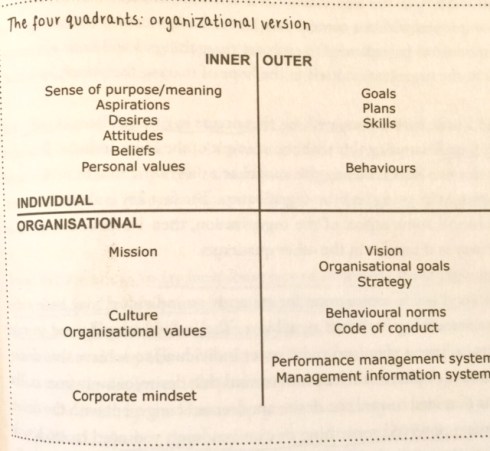 p. 124-127 These four quadrants reflect how the individual interacts with the organization. The right side is what is shown to the world. The left side is what is actually going on inside the individual and the organization. When there is incongruity between the right and left sides, there are problems. Whatever happens in one quadrant is reflected in all four quadrants. When coaching the player within the organization, this chart offers an insightful look at the interplay between the player and the organization – what is going on inside each, in contrast with what may the face of each shown to the outside world.
p. 130 The biggest reason why organizational value statements fail to take root in most organization is the schism between the lower left and the upper left quadrants – between an individual’s personal values and how s/he sees the real values of the organization, as expressed by behaviors and decisions. Often times, the leadership group does not create organizational values for themselves, but for everyone else – they don’t walk the talk. Individual’s see the hypocrisy.
Chapter 11 “Coaching for Leaders and Managers is particularly insightful
P. 142 In a similar way to how leadership has been distinguished from management, we need to separate coaching from management and leadership.
- Leadership – concerned with the future, role modeling, morale
- Management – subordinates perform roles w/in certain parameters – accountability
- Coaching – a series of conversations that help a person perform closer to his/her potential , understand roles/tasks, develop right skills, and on a good day, to be fulfilled and joyful at work.
p. 144. To be an effect manager, it is imperative to understand the nature of authority.
p. 145 Under a strongly hierarchical, authoritative regime, people do not take responsibility, do not take risks, are not creative, and are not proactive. They wait to be told.
p. 145 Many people do not understand that when they join an organization, they sign up to play the organization’s “game” – to play by its rules.
p. 146 There is an appropriate balance to be struck between individual and organizational authority, and the manager, caught in the middle, needs to understand how to strike it.
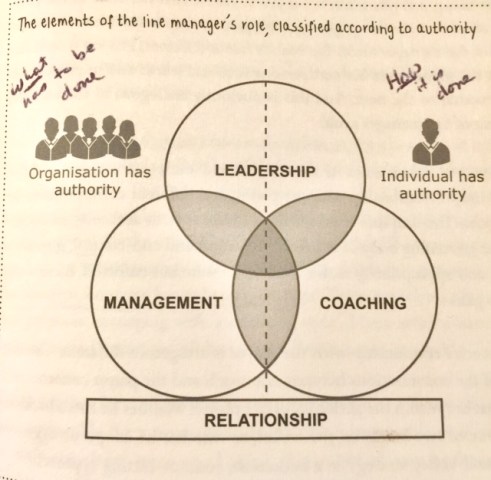 p. 147 The image to the left describes the relationship between leadership, management, and coaching, noting that they all are built on the relationship between the leader/manager/coach and the player. Also this graphic shows where authority lies between leader/manager/coach and the player.
p. 148 – Managing and coaching – there is an analogy between roles of umpire and coach for tennis, and the “organization” is represented by the size of the court and the rules of the game.
p. 149 Often, managers try to handle performance and learning with a management style – command and control – rather than a more facilitative style. Managers have to wear both manager and coaching hats.
p. 151 Organizations that are operating in “flow” are characterized by
- Clear goals every step of the way
- Immediate feedback to one’s actions.
- A balance between the challnges and skills required
- Action and awareness are merged
- Distractions are excluded from consciousness
- No worry of failure
- Self-consciousness disappears
- Activity becomes autotelic (driven by a sense of purpose and commitment)
p. 152 Formal coaching includes a formal and explicit agreement between coach and player, and frequently with the organization as client. Informal coaching on the other hand often happens on the spur of the moment – kerbside, or corridor coaching.
p. 154. It staggers me that there are still organizations where the manager sets the direct report’s goals. I can think of few quicker or more sure-fire ways to erode motivation and undermine responsibility.
p. 155 In change situations, where there are often no right answers, coaching will draw out possibilities and options from which the best can be selected.
p. 156 Coaching Upward: Anyone can be coached- if they are willing.
p. 157 In principle, mentoring is concerned with longer-term career issues, while coaching is concerned with more immediate performance issues. Many of the skills are the same….a mentor who can also employ a non-directive approach when appropriate – will have a much greater impact.
p. 159 Part of why coaching works is because when the player communicates to another and is understood, the thoughts are externalized, and a certain distance is achieved between the player and his thoughts and emotions.
p. 161 I’m not sure it is possible to be a “bad” coach if your heart is in the right place; a solide “inner game” spawns a solid “outer game.”
p. 164. Coaching should be introduced not as some new fad, but to facilitate learning and improved performance.
p. 165 When a direct report does not want to be coached and is not achieving his goals, the manager needs to make clear that it is no longer a coaching issue, but a management issue….The ability both to coach and manage another requires a strong, honest relationship, with clear performance goals and success measures.
p. 177 The truth is that the only thing that can cause coaching to fail is an insufficiently strong relationship. The coach must be able to create an environment in which the player feels safe and un-judged.
p. 177 You don’t have to like the player. You do have to care for the player.
p. 178 The player needs to be able to fully trust in the coach…Equally, the coach needs to be able to trust in the player.
p. 180 The quality of the goals and success measures that are agreed upon at the beginning of a coaching programme is the single greatest factor – after the relationship – that impacts on the success of the coaching.
p. 181. Key question: “When you have successfully achieved your goal, how will you know?”
Chapter 14 Coaching Teams is particularly interesting to me
p. 188 An individual can get to a level of clarity and make a decision relatively quickly. In a tream, that process takes much more time, as each person needs to be heard, disagreement needs to be handled, consensus and commitment need to be built.
p. 188. In teams, BOTH inner game and outer game need to be addressed.
p. 188 In a team, “interference” is multiplied – no, it is squared – and in the worst cases, performance diminishes to the point where one person could do the work of the team in a fraction of the time.
p. 189 One of the places where the impact of being a great team, without interference, is immediately noticeable is in sport.
p. 189 Interference in a team might include the following:
- Lack of trust in other team members
- Fear of ridicule
- Fear of being dominated
- Pursuit of personal agendas n
- Need to lead
- Lack of clarity about the task or the goals
- Pursuit of incongruent goals
- Hidden agendas
- Not understanding (or distrusting) each other’s intentions
- No agreed process for working together
- An absence of agreed ground rules
- Rivalries
- No listening
- No meaningful collective work
- Inflexible beliefs and positions (“this is how things are or should be”)
(That list is followed by a list of qualities that characterize a team that is successful in reducing interference.)
p. 193 – 195 He recommends the team coach reduce interference by helping the team deal with the WHO, the WHAT, and the HOW of the team. Get clarity on WHO each person in the team is – such that they can be trusted and their intentions are clear. Discuss WHAT in order to get clarity about the task facing the group, why they are doing ti and what would success look like. HOW is about the process of achieving the aims of the group- to include strategy and priorities, methods of communication, meeting frequency, agendas and ground rules.
P.195 The potential for friction within the team can be greatly reduced by creating an agreement about how the individuals will cooperate. And then get commitment on how teams will deal with tension and disagreements.
p. 195 Great teams have a process for feedback. It is good to create a standard format for giving feedback, as well as a standard response for receiving it.
p. 196 When a team is in conflict and is not making progress, try declaring one minute of silence. At the end of the silence someonew will usually take the risk and say what needs to be said.
p. 197 He gives an alternative to the standard stages of group development. The traditional stages are: Forming, Storming, Norming, Performing. Downey offers a different model: Pseudo community -> Chaos -> Emptiness -> Community. He describes how these stages look and notes that a sign that a team has achieved “community” is when people are reluctant to leave the room when the meeting is over.
p. 207-219 Chapter 15 discusses how coaches and coaching can open up the “genius” or better selves in the players, and open doors to creativity, learning, and growth that traditional management and bureaucratic approaches leave untapped.


 Bob's Books
Wow, thank you for the in-depth review. I really enjoyed the book as well. Love Gallway’s equation, Potential-Interference = Performance.
Also really love this idea of the Coach is there to facilitate learning. In your opinion what are some ways to do this in a way where the player will authentically answer?
The reason I ask is because with the athletes I coach and my 2 son’s sometimes I will ask them if they are getting the concept we are talking about but there body language may show differently.
Thanks!
Bob, no surprise – but you wrote an amazing synopsis of Downey’s book. Preparing for some work with a team of leaders right now – and your work here has been a terrific resource!
Many thanks!
-Paul
Paul – hope you can use it! pls share with anyone interested. I write these primarily for my own review – it’s a bonus if anyone else reads or can use them. Bob
Awesome summary of this book. Great job and thanks for sharing.
Thanks for the comment. Always nice to know someone reads these – I write them mostly for myself to see what I learned and to help me when I want to review the book – but am always amazed when someone else finds and reads these! So thanks! Bob