
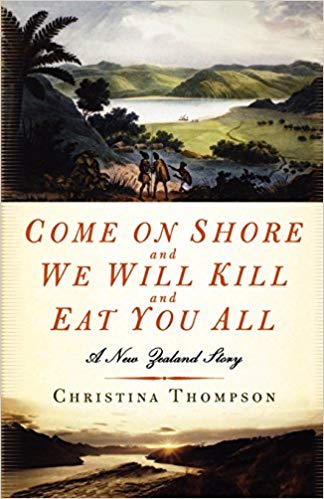
 Why this book: I was at the beginning of my trip to New Zealand and this book was recommended to me as a well-written and enjoyable introduction to Maori culture and how it interfaces with Western culture in New Zealand.
Summary in 3 sentences: This is a memoir of a well-educated American woman who, travelling in New Zealand after college became involved in the Maori culture, married a Maori man and how they made a life together, always tied to his roots in New Zealand. She regularly interrupts their story with digressions that tell the story of the Maori people in New Zealand, beginning with the first Polynesians inhabiting New Zealand, the early European visits to New Zealand beginning with Abel Tasman in 1642, the period of colonization beginning nearly 200 years later, tribal warfare among Maori tribes, and tensions and conflict between Maori and English colonists (she uses the Maori word “Pakeha”). Her stories and digressions address myths and realities surrounding the Maori culture, and are always tied to helping her explain the friction points between the western and Maori cultures and values, as reflected in her own family’s experience.
My impressions: I really liked this book – it is a fascinating and enjoyable read about New Zealand and the life of a very interesting woman, and how over a life-time, she and her American-Maori family come to understand the cultural forces that made them who they are. At the conclusion, I felt I had a good background on the fundamentals of the history and friction between the Maoris and white colonials which created the New Zealand we know today. After marrying into the Maori culture, the author goes back and forth between her family’s personal story and how New Zealand’s history with the Maori’s have served as a backdrop to help her better understand her and her family’s experiences.
The unusual title is a quote from how the Maori’s greeted James Cook when he visited and claimed New Zealand for the British crown in the 1760s. Christina Thompson is a great story teller – she can write – she’s the editor of the Harvard Review. She (almost) seamlessly weaves her story of her family’s evolution and frequent moves into her description of Maori culture and why the Maori’s were like they were, and are like they are.
She met her Maori husband Seven while essentially back-packing around New Zealand after college, when, needing a place to stay, he invited her to stay with his family in a small Maori town on the North Island of New Zealand. She was intrigued by Seven and his family – they were so very different from her and her own background. She and Seven came from two very different cultures and world views, but as opposites often do attract, they connected and eventually married. She was the product of a progressive western education, eventually earning a PhD and working as an academic and researcher, while Seven had a primary education and none of the ambition and concern for achievement and status that we westerners admire and foster.
Seven was solidly focused on what was in front of him, didn’t worry about personal slights or things he couldn’t control, and worried little about the future -the future would take care of itself. His relaxed imperturbability was a daily embodiment of Maori cultural values in her life. She describes him as almost Buddha-like in his detachment from the hurly-burly worries that consume most of us – and how his equanimity balanced her own anxieties and typical western concerns. That said, she was the primary bread winner in the family, while Seven calmly supported her, working in a variety of jobs that played to his practical strengths, as they raised three children often under financial stress, and frequently moving as she sought work, in Australia, Hawaii, and eventually, Boston.
As she shares with us her journey of discovery in getting to know the culture she was now a part of, the author devotes nearly entire chapters to explaining Maori customs and practices of the past. She explains and describes the practice of tattooing, of cannibalism – eating their enemies, how such peaceful people also had such a warlike culture, and she describes events that led to warfare among the Maori tribes during the early years of the colonial period. She includes a chapter on the “smoked heads” – the unusual ancient Maori culture of taking the heads of their enemies and preserving them, and how she and her husband requested and got a special viewing of specimens locked in the basement of a Boston museum. We learn about the Polynesian origins of Maori culture, how colonials exploited Maori innocence in the world of business – purchasing hundreds and thousands of acres of land for a few iron implements, western cloth and weapons. There are many analogies to how Americans similarly exploited native Americans – but she does not describe any whole-sale genocidal killing, as happened in the US.
In describing the differences between her own family history and background, and Seven’s family history and background, Christina Thompson explores differences in how Americans and Maori culture view family, belonging, individual and community responsibility, achievement, competition – and she addresses issues of race and prejudice that continue to exist in New Zealand. Within New Zealand, there is ambivalence toward “integration” of the Maoris, since that usually means absorption into white culture and abandoning the good that comes from the more communitarian and family Maori values.
Here is a telling quote from the book (p 192 in paperback edition):
Maori values are tribal values: what is good for the group is good for the individual, whereas the reverse does not necessarily hold true. In the ideal Maori community, there is a sharing of both resources and obligations. Sacrifice is often demanded; loyalty is highly prized. Competitiveness – unless in sports – is generally discouraged, while greed and selfishness are openly despised. The result is a society in which everyone is cared for, but also one in which individual achievement is the exception rather than the norm. One consequent of this is that from the Pakeha (white) point of view, Maoris often look unambitious, while Pakehas, seen from the Maori perspective, look ruthless, isolated and cold.
Christina Thompson not only writes a fascinating story of her own efforts to understand the culture she married into, but also how she and Seven raised their sons to understand, appreciate, and feel comfortable in both Maori and Western culture. Part of why I liked this book so much was that I liked the woman who comes through in the writing. Christina Thompson tells her story and shares her insights and research into the Maori culture from the perspective of a wise, humble and insightful woman.
I highly recommend Come on Shore… to anyone who would like to read and learn about New Zealand and Maori culture from the perspective of a modern woman of great wisdom who writes compassionately about a fascinating and very current subject.


 Bob's Books
Pingback: The Whale Rider, by Witi Ihimaera | Bob's Books
Pingback: New Zealand – my recent adventure | Bob Schoultz's Corner
I just happened upon this, I am the author of Come on Shore. It was a pleasure to read your commentary, not just because you were generous in your assessment of the book — thank you for that — but because you seem to read with an open mind, listening for what the author is trying to say. It’s not easy to get it right in a book (as an author); often we miss the mark or get it wrong. But it’s good to find occasionally that something came through, that someone heard what you were trying to say, that they found it interesting and gave you the benefit of the doubt. Thank you. — Christina Thompson
Thank you for your comments Christina – I just re-read my review and it reminded me how much I enjoyed your book. I read it while I was hiking the Heaphy Track in the South Island. I also enjoyed reading about Seven and your marriage with him – and how you made this marriage of two very different and fascinating people from two very different cultures work. The story of my “adventrure” in New Zealand is at:https://bobscorner.wordpress.com/2020/03/04/new-zealand-my-recent-adventure/ and at the conclusion, I recommend your book and provide a link to my review. I hope it inspires a few purchases. Thank you for writing it – It added a lot to my experience of New Zealand, and my complements of you at the end of my review are most sincere. Bob