
 Why this book: Selected by my literature reading group. I had heard so much about this book over the decades, I felt it was about time I read it. Brothers Karamazov is one of my top five favorite novels, and Drive and Punishment is considered Dostoevsky’s other master piece. So, time to read some more Dostoevsky.
Summary in 3 Sentences: This is a classic and well known story about a disturbed, intelligent, indigent, and somewhat isolated student in 1860s Petersburg, Russia who kills a greedy old woman pawnbroker (from whom he had recently borrowed money), in order to use her money to pull himself out of his poverty and provide him the resources to live up to his potential for greatness and do good in the world. In the process of committing the murder he kills another innocent person who stumbles upon him in the act, and then struggles with his own conscience, his sense of identity, his obligations to his family and friends, and the potential implications of his actions. It is a long hard look at his confused values, his moral anguish and disturbed psyche, and ultimately, at good and evil and redemption.
My impressions: This book has attained classic status for being about a lot more than simply “crime doesn’t pay” or that a guilty conscience is the road to hell. It is one of the early psychological novels, exploring the mind of an intelligent and self-conscious but disturbed young man who commits a heinous crime and what his anxiety, fear and conscience do to him and those in his circle of friends and loved ones.
Origins: Crime and Punishment was originally published in 1866 in monthly installments in a Russian literature magazine; the chapters are therefore pretty regular – about 10 pages long. Knowing that helps one to understand the structure of the novel as one reads it. Each chapter ends with a bit of a cliff hanger to keep the reader anxiously awaiting the next installment. For example, one chapter ends: “As he was leaving, Svidrigaylov met Razumikhin in the doorway.” – these two being intriguing characters on different sides of the good – evil spectrum.
Good and Evil: Good and evil are not so simple in this book – as our protagonist Rodion Raskolnikov is clearly not “evil” but neither is he “good.” The other characters in the book are indeed interesting, and also human – more or less flawed. There are a few characters who are agreeable and a few who are much less so – but Dostoevsky brings them all to life and makes them believable. The hard part about reading this book is that much of it – particularly the first half of the book is inside the thoughts and consciousness of Raskalnikov, a not particularly sympathetic character who is suffering great mental anguish and confusion and on the verge of mental illness. He is not at all easy to like, or sometimes even to tolerate.
Self-reflection: It occurred to me that part of what made it so uncomfortable for me to be inside Raskolnikov’s mind is that he represents so openly and explicitly those parts of my own character that I don’t like: self-absorbed, impulsive, insensitive, angry, bitter, alternating between passive and aggressive victimhood, between being compassionate and principled and completely selfish and self-centered. I suspect each of us has a bit of Raskalnikov in us from time to time, but we are (usually) mature enough to suppress and overcome those destructive and self-centered tendencies. In Raskalnikov, we see these tendencies up close and personal, in all their ugliness, in the full light of day.
Suffering: The idea of suffering is important in the book. Raskalnikov commits his crime in part to alleviate his suffering (and theoretically the suffering of others,) but as a result, he suffers more. Other characters in the book suffer as well – from poverty, self-delusion, alcoholism, from the bad actions of others, or simple bad luck. Raskalnikov is an unhappy character throughout the book – but at some points his misery becomes so excruciating that he seriously considers suicide. Ultimately he realizes that he can only be redeemed by atoning for his crime and suffering the consequences of his action
Petersburg Russia, 1860s. Dostoevsky introduces us to the world of Petersburg Russia in the 1860s – a sophisticated city with one foot in mid-19th century European culture and another in the world of pre-reform serfdom and the middle ages of Russia. We are exposed to much extreme poverty, including Raskalnikov himself, in a world with no social safety net. Shabby and dirty pubs and restaurants, and people begging and scrambling for kopeks, and for whom a ruble or two was a lot of money. There was a nascent revolution brewing in Russia – the early stages of what 50 years later became the communist revolution, and Dostoevsky lampoons one of the characters who represented pie-in-the sky ideals that are strikingly similar to the far left movement in the US today. He also caricatures those in the middle class for whom achieving upper class status and respectability is a primary life goal. I was reminded of the British series Keeping up Appearances.
I enjoyed getting to know the many interesting people who are part of Raskalnikov’s life – his mother and sister, his best friend, his landlady and servant girl, along with some of the less-reputable people he gets to know during the course of the book – each brings something different into the story. Raskalnikov’s interactions with them – especially while he is in the depths of his moral anguish and identity crisis – are difficult to understand and sympathize with. But that is an important part of the story; what his poorly considered actions do to a man who is already on the edge, and to his relationships with and the lives of the people on whom he depends.
Raskalnikov does show strength of character in his adamant insistence that his sister not marry a manipulating self-serving lawyer, who wants to use her to support his career. His love and support for his sister and mother are admirable. Though he ostensibly murdered for money, he is not money-hungry and as a matter of principle turns down money several times. He sticks up for and supports the poverty stricken family of a man he’d met in a pub. He recognizes the strength-of-character of Sonya – the eldest daughter of his former friend, and supports and respects her regardless of how polite society treats her as a social outcast. His charity and acceptance of her are rewarded – Sonya is almost a Mary Magdelin-like character, but Sonya becomes the savior, more so than the saved. At the end of the book we learn of supererogatory acts of charity and courage that Raskalnikov had performed before we meet him at the beginning of the book – which makes his character that much more interesting, and indeed somewhat more sympathetic.
The further one gets into the book, the more the story is about the other people in Raskalnikov’s life and his self-centered and rude behavior do not occupy center stage as much. That said, the care and concern of those who love him, and the impact of his behavior and his crime on them remains a key theme.
Nietzsche and the Ubermensch. As a fan and student of Nietzsche for many years, I was intrigued to learn that Raskalnikov’s crime was motivated in large part by a shallow understanding of Hegel’s philosophy that Nietzsche himself developed several decades later – the idea of the Ubermensch – a superior person – who lives by his own rules. As Raskalnikov saw it, the superior man – and he saw himself as such a person – should not feel compelled to abide by the rules of the the common people. The übermensch has a higher calling to greatness, and the laws and social rules meant to restrict the behavior of the common people should not stand in the way of one destined for greatness, and to accomplish great things for the greater good. Raskalnikov repeatedly referred to Napoleon as such an ubermensch, and he saw himself as having the potential for greatness as well, and that murdering the pawnbroker would be a justifiable step for him to achieve his destiny. This is of course a bastardization of the ideas that Nietzsche later developed, but it was interesting to me to see how this idea could be misunderstood and mis-applied by an immature mind like Raskalnikov’s, or as the Nazis did 70 years later.
Brothers Karamazov. Having read Brothers Karamazov several times (my review here), I see a number of interesting parallels in themes and characters in Crime and Punishment, written 15 years earlier. Dostoevsky’s empathy for the working class and those who struggle to maintain their dignity and get by in a highly class-structured society is evident in both books. His disdain for the pretensions and self-righteousness of those of the upper class is also evident in both books, and he caricatures those in the middle who so ardently aspire to upper class status. We see his strong spiritual sensibility in how Raskalnikov the atheist, with no spiritual foundation, struggles and suffers, as does Dmitri the oldest of the Karamazov brothers. In Raskalnikov’s intellectual rationalizing, we see elements of Smerdyakov and middle brother Ivan. In the sensualist Svidrigaylov we see elements of the senior Karamazov, father of the brothers K. And in Sonya we certainly see parallels with the almost saintly virtues of love and tolerance in the youngest of the Karamazov brothers Alyosha.
Crime and Punishment is not an easy read – but it is very much a worthwhile read. As with all Russian literature, one must get used to the multiple, long, and multi-syllabic Russian names – with family names, nicknames, and diminutives all mixed up. But after a while one figures it out. I recommend reading it with others who are willing to go the distance – in order to have someone with whom to discuss the various moral dilemmas and issues after finishing the book.
Aid to understanding. I also found it useful, as I do with most longer classics, to read cliff-notes or spark notes along with the text; I read a few chapters of the book, and then read the “notes” summaries and commentary. My Cliff notes version helped me keep track of names, and it provides a map of Petersburg with all the key locations. Reviewing the Cliff notes summaries revealed parts of the story I had somehow skipped over or missed, and though I didn’t always agree with the commentary, it was useful to consider. This book definitely deserves to be discussed – not just read and put back on the shelf. But the right translation is important.
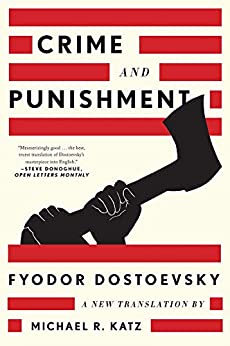
Which Translation: Depending on why you are reading the book, it’s important to find a translation that fits your needs. Knowing this from having read Dostoevsky in the past, I did some research which seemed to point to the Pevear and Volokhonsky translation, which many people seemed to prefer. I bought it read, the first half of the book and didn’t particularly care for it. If I were teaching a graduate class on Dostoevsky and Russian literature, I might use this translation – it is very well footnoted (which provides great additional background, but it is distracting having to go to the back of the book so often) and uses English language which evokes 19th century Europe, but which I found a bit off-putting- using terms that are not comfortable or familiar to most 21st century readers (like niggardly, pot-house, lackey, etc). So I did some more research and found the Michael Katz translation, which worked for me. I read the 2nd half of C&P using Katz’s translation and enjoyed it much more. He intentionally makes it easier to read – he doesn’t offer extensive background in footnotes, the footnotes he does provide are at the bottom of the page, and the language is much more accessible. I compared P&V and Katz translations of certain passages and still preferred Katz. SO – for a more enjoyable, more accessible read, get the Katz version!


 Bob's Books