
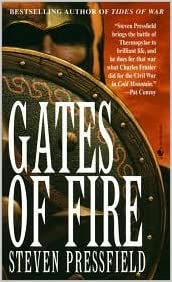
 Why this book: I had read this book maybe 20 years ago. It was selected as the book of choice by a group of young men getting ready to go through SEAL training – it is a very popular book among Navy SEALs. So I decided to read it again – glad I did.
Summary in 3 sentences: In 480 BCE ancient Sparta sent 300 of its best warriors to defend Greece from an invasion by an overwhelming Persian force. Gates of Fire tells this story in novelized form, in retrospect from the perspective of a young non-Spartan helot, who at the end of the battle, severely wounded and dying on the battlefield, was kept alive by the Persians, to explain to them – who were these men who had fought to the death so valiantly, killing thousands of Persian warriors? Our narrator shares the story of his very difficult childhood, how he became a slave in Sparta and eventually a squire to one of the leading Spartan warriors, who ultimately was selected to be one of the 300 selected to fight in Thermopylae. Though we all know how the battle ends, in his telling of the story, we get to know King Leonidas, many of the Spartan warriors, we learn about their culture and values, and we experience the brutality of their training and finally of the battle which inevitably led to the deaths of them all – except our severely wounded protagonist – a lone survivor.
My impressions: This book matures with age, like a good wine. When I first read it, it was a really good historical novel and adventure war story. This time, I got so much more out of it. Has the book changed? Of course not. But I have.
In the world I live in – Special Operations and more specifically the Navy SEALs, this book is well known and widely read. It describes an ideal warrior culture – one that transcends time and place. Pressfield’s story provides an inside look at an ancient Greek version of the ideal culture that I grew up aspiring to build in the various SEAL units I served in, and this ideal is shared by the US Marine Corps and US Army infantry and Special Operations Forces, as well as by the many non-US special operations units I trained with in my career. Different and less violent versions of it are reflected in the ideals of non-combat military units. The brotherhood and mutual commitment that these warriors felt for each other is an ideal that leaders in any organization should aspire to build.
But when I mention this book to my civilian friends, most had not heard of it. I shouldn’t be surprised. Different cultures and subcultures read different books, watch different movies, have different heroes, believe in different myths. This book and this story embodies much of the mythology that inspires the best military combat units as they seek to develop their warrior cultures. In Gates of Fire, Steven Pressfield writes a novel that seeks to be as historically accurate as possible, to tell the story of how a small group of uncompromising Spartan warriors performed in this epic battle for the ages, while reinforcing the mythology that backs up an ideal warrior culture. He describes the build-up to the battle, and then the courageous sacrifice of these warriors willingly fighting and dying to save Greece. Their courage in that place and time arguably saved not only Greece, but Western civilization from being subsumed into a more subservient and hedonistic Persian culture.
In addition to being a well told story and great read about a key event in Western history, Gates of Fire includes much wisdom and many insights of interest to warriors, young and old, and I would argue, to the rest of us as well. Some of these are: (page numbers refer to the 1998 hardback version)
Fear – Dienekes, one of the heroes of the book and the warrior to whom our narrator is a squire, is speaking to young and new warriors before their first battle, and asks them “What is the opposite of Fear?” The discussion obviously turns to courage, but Dienekes responds that courage is not the opposite of fear, because, much of our courage is based on fear of disgrace, fear of letting down our king, country, comrades, family. He says the opposite of fear is also not fearlessness. He leaves the question open – until the end of the book.
Andreia – the Greek word for “manly” or heroic virtue. Dienekes asks the young warriors who they believed best embodied andreia. Diekenes surprises his listeners by denying that Achilles had it – because he needed fear no death – he was (nearly) immortal. Polynikes comes close but not quite – his courage is too brazen and unconscious. He surprises all be saying that no one he knows embodies andreia more so than his wife. And he explains why.
Developing the strong warrior A good part of the book was about the brutal and relentless Spartan training, noting that this is what differentiated them from any other warriors in the world. At one point, Dienekes says the key to being a great warrior is to develop the right habits. “Habit will be your champion. When you train the mind to think one way and one way only, when you refuse to allow it to think in another, that will produce great strength in battle….Habit is a mighty ally, my young friend. The habit of fear and anger, or the habit of self-composure and courage.” (p 139)
The women of Sparta Gates of Fire is about men at war in ancient times – very much about male warrior virtues. But Pressfield honors women throughout. At the beginning of the book, Diomache – our narrator’s female cousin, is strong and virtuous. Dienekes declares his wife to be the embodiment of heroic virtue – based on how she violated so many of Sparta’s cultural norms to avert injustice to save her nephew, and calls out the men for their blind and cowardly adherence to tradition. One of the young warriors in the discussion of fear, observes in an admiring way, how women’s courage is different from men’s courage. And at the conclusion of the book, Leonidas reveals that one of the main criteria for selecting those who would accompany the 300 into battle was the strength of their wives.
Katalepsis – The Greek word for “possession” – a “derangement of the senses that comes when terror or anger usurps dominion of the mind.” Pressfield brings up katalepsis numerous times in the book – to maintain ones composure and not succumb to katalepsis was a a key Spartan value – which leaders struggled to maintain when the young warriors got fired up. To train themselves to resist katalepsis, Spartan warriors would abuse and bait young warriors-in-training as well as each other “to inure the sense to insult, to harden the will against responding with rage and fear, the twin unmanning evils of katalepsis – possession. The prized response, the one the (warriors) looked for is humor. Deflect defamation with a joke, the coarser the better. Laugh in its face. A mind which can maintain its lightness will not come undone in war. ” (p130) Leaders had to control and contain katalepsis in their men, or they would be apt to do things that were against the Spartan value of detached and impersonal violence.
Battlefield Ethics – there was no discussion of ethics on the battlefield as we know it today – no Law of Armed Conflict and no sense of obligation to the enemy’s humanity in those days. Polynikes in fact spoke of an almost sexual pleasure he got out of killing in battle. It was routine to offer “no quarter” to the enemy, and in fact the Spartans trained to become impersonal killing machines and to not see their enemies as human beings. The ideal Spartan would kill, machine-like, simply out of duty, but not out of rage. This was part of their proscription against katalepsis – succumbing to anger, rage and fury. In the story, we saw examples of Spartans going onto the battlefield after the battle and slaughtering the wounded enemy, and torturing and killing prisoners. This was a standard practice. But Pressfield, acknowledging that such was the way things were back then, includes Dienekes’ discomfort with such wholesale kataleptic slaughter, and Dienekes stepped in several times to successfully argue for wise and less violent alternatives to the primal and kataleptic responses warriors may default to, in an environment where killing and violence were routine.
The house with many rooms. Several time in the book Dienekes speaks of the mind as being a house with many rooms, and that “there are rooms we must not enter. Anger, Fear. Any passion which leads the mind toward that ‘possession’ which undoes men in war.” (p 139) He later relates that another room one should not enter is thinking about one’s possible death in battle.
Dienekes I felt he was the hero of the book. He was not the greatest warrior – but was the best man and was highly respected as such by the other Spartan warriors and the citizens of Sparta. He was not Achilles or Polynikes, but a fallible mortal. “He was just a man doing a job whose primary attribute was self-restraint and self-composure, for those whom he led by his example.” ((p112) He was contrasted with Polynikes who indeed was the best, most athletic and gifted warrior of the Spartans. Whereas Polynikes courage oozed from his muscles, bones and marrow, Dienekes’ courage came from his heart, “by a force of some inner integrity which was unknown to Polynikes” (p134) His courage and resilience were without question, and yet over and over, he is the “Solomon” in the group – the wise leader. He was a great warrior, who had not sacrificed his humanity to become so. When Leonidas asks Dienekes if he hated the enemy, he replied that he did not. “I see faces of gentle and noble bearing. More than a few, I think, whom one would welcome with a clap and a laugh to any table of friends.” Leonides nodded his approval of that response.
Polynikes was the Spartans’ most heroic and athletic warrior – he had been an Olympic champion in sprinting -and he was extremely competitive. He was also cruel, vain and self-righteous. His intensity scared people – including some of his fellow warriors. I saw some of Eddie Gallagher in him; with rage and fury (katalepsis) he went after some of the less athletic or talented young men in training, especially Alexandros. And yet in the chaos of battle he was unmatched. Exhausted and facing the inevitability of his own death at the end, he softened and became more human, humble, and giving – his talent and energy had met their match.
Alexandros Alexandros was my second hero in this book. He was a gentler soul, a singer with the heart more of an artist than of a warrior. He was not a natural athlete nor warrior, but it was his challenge and fate to become a warrior, and to live up to the expectations of his father as well as his mentor (Dienekes) – and he accepted it. He suffered mightily in the training and was tormented especially and repeatedly by Polynikes. But he persisted, never gave up, and though he struggled and suffered more than most, and worked much harder than most, he eventually became a valiant and valued warrior – which in the end was acknowledged even by Polynikes, who apologized for how he had treated him.
Leonides and “what is a king?” Leonidas, the king of Sparta who led the Spartan contingent to Thermopylae, is Pressfield’s ideal leader in this book. He is both father figure, and fellow warrior, and though close to 60 yrs old continued to fight on the front and with the men. He is the embodiment of leadership by example. He addresses them as a king, as a father, and as a fellow warrior – and they feel his love for them – but also his total commitment to the honor of Sparta. It is Leonidas who refuses the Persian offer to let them live in exchange for their arms – his commitment was to the greater cause of protecting Greece and the honor of Sparta. He shows compassion in letting the other allies leave. At the end of the book, our narrator boldly lectures the Persian Emperor Xerxes on “what is a king,” and then goes on to describe the attributes of Leonidas, concluding that a true king serves his people, not they him. .
The Warrior’s thoughts on the brink of battle. During the several days of the battle of Thermopylae we get inside the heads of the warriors – most are badly wounded and almost too exhausted to think or care, much less to continue to fight. But they do. On the final day, when all knew it would be their last, Pressfield tells us what the warrior thinks of when alone and facing his own death:
- The faces of his family and those he loves who he leaves behind;
- Those he loved who have already died – from his family, his friends, his fellow warriors;
- The gods.
Suicide’s soliloquy – Suicide was the name of Dienekes’ primary squire. He was given that name because when he began work for the Spartans he wanted to die because of a crime he had committed in his native Scythia, which forced him into exile to ultimately join the Spartans. He cared little for his life, and his reckless courage and willingness to die to support his master (Dienekes) in battle became legendary. Toward the end of the book, he shares why he loves serving the Spartans, why he loves being associated with and part of their brotherhood. He believes that their brutally arduous training is the glue that holds the Spartan phalanx together. “For what can be more noble than to slay oneself? Not literally. Not with a blade in the guts. But to extinguish the selfish self within, that part which looks only to its own preservation, to save its own skin. That, I saw was the victory you Spartans had gained over yourselves. That was the glue.” (p 332)
The opposite of Fear (redux) –Suicide’s soliloquy inspires Dienekes to finally reveal what he sees as the opposite of fear – he declares that to be love. When one sufficiently loves one’s country, comrades, family, and cause, fear is no longer a factor – one has NO fear facing the prospect of sacrifice to save them.


