
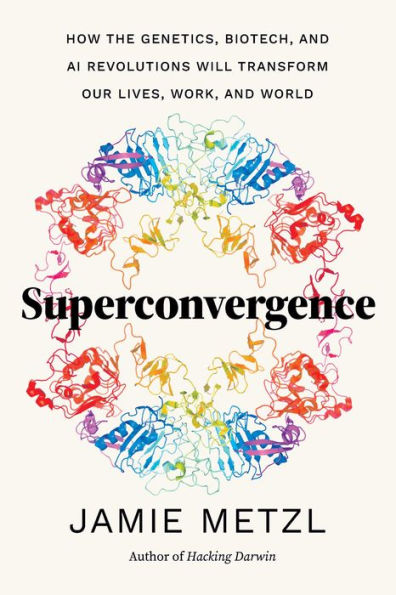
Why this book: A topic that facinates me. I was able to talk my science fiction book club into selecting it for our Aug 2024 read. I listened to rather than read the book.
Summary in 4 Sentences: The author in this book explores the convergence of three relatively recent developments in technology that together will significantly change our world – for the good and potentially for worse. He looks at genetic engineering and bio tech and (in addition to CRISPR on humans) he looks at how it has already and will increasingly change the food we eat, how it is produced and how it can increase our capacity to feed the world’s growing population. He examines how AI is accelerating medical research into understanding proteins and cell behaviour and creating digital twins of humans, to better understand how medicines will affect each individual, and explore how our current generalized sick-care can evolve to focus on prevention and medical procedures tailored to each individual’s biology, referred to as “precision health care.” And he balances all these exciting technological advances, bypointing out the many significant potential dangers and even “existential hreats” and challenges humanity will have in preventing those very bad outcomes from occurring.
My Impressions: Wow! Pretty much a mind blower! I thought I was relatively savvy in some of the more modern tech advances associated with AI and virtual reality and augmented reality, but this deep dive into the role that high tech is playing in biology opened my eyes to so much more – of exciting opportunities, and scary (even likely) potential bad outcomes.
He says that with these new technologies, humans now have the ability to hack the source code of life, to redirect evolution, and engineer new forms of intelligence. We will be able to find new cures for currently incurable diseases – even prevent them – with new bio-tech and genetic treatments. We can create new forms of agricultural products that are resistant to disease and insects (indeed we already have) that can feed many more people using less land and water, create animal protein from stem cells from living creatures rather than raising and slaughtering billions of them annually. He says the opportunities and possibilities are breathtaking, and so are the risks.
Each of the technologies he describes includes warnings about what could happen if safeguards are not in place and where bad actors, or well-intentioned but unguided good actors could create challenges, sometimes irreversible to our and other species. He points out that cutting edge research is being done all over the world, often unregulated and/or with inadequate safeguards in place. He is convinced that the COVID Pandemic was a result of such research done without adequate safety protocols and warns of more and worse possibilities in the future.
He points to the promise and threats of bio-tech, genetic manipulation and creating heritable changes in human genes (called gene drive technology) and the urgency that international protocols be agreed upon and somehow enforced to manage how this research is conducted. But given the nature of international competition and tensions, he is not optimistic in the short term for any enforceable regulation that will mitigate the threats he foresees.
The book also talks about how our current agricultural and meat processing has expanded to become a threat to our planet. He offers some eye-opening statistics on different ways that food production is contributing to green house gases and deforestation. He notes that using bio-tech and gene manipulation could significantly decrease the amount of arable land necessary to grow the food we need, or for grazing and sustaining livestock, and thereby improve our environment and planet. The numerous downsides to pursuing current processes to feed the worlds growing population is a constant theme in the book.
Two of the other mind-boggling and fascinating revelations in this book are
- Bio tech is rapidly developoing potential solutions to the increasing challenges of data storage, by storing retrievable data in DNA, which as he points out, is biology’s very effective mechanism for storing information.
- Scientists in biochemistry, microbiology, materials science and structural engineering are collaborating to genetically engineer bacteria to create useful minerals and polymers, and form them into living building blocks, stronger and more resilient and environmentally friendly than current building materials.
He constantly reminds us that technological advancements and scientific knowledge are increasing at an exponential rate and that rate of change continues to accelerate, and will disrupt much of what we now take for granted – hopefully for the better, but potentially for the worse. He emphasizes that technology itself does not have values – and whether these changes are for the better or worse will depend on the values we humans impose upon the research and experimentation in these fields – values of the technologists themselves as well as of governing bodies. But he points out that each individual will have a voice, and positive values must be embraced by a broad spectrum of humanity outside the tech communities. And he acknowledges that this is a real challenge.
He concludes the book with a series of recommendations for international protocols for managing the rapid acceleration of AI, bio-tech and gene engineering research, to maximize benefits and at least manage what he sees as the significant risks posed by unbridled and unregulated research and experimentation.
Metzl himself does a three and a half minute overview of his book on youtube at: https://www.youtube.com/watch?v=h_7g3ORGQB8
If this topic interests you, but you may not have time to read this book, Metzl’s 60 minute keynote presentation with Q&A at a Bio Conference in 2024 in San Diego is a good overview of the highlights of his book. It can be heard at https://www.youtube.com/watch?v=t-SSh796VFA
As I post this, I have downloaded to listen to Metl’s book Hacking Darwin which takes a deep dive into the issues of gene editing as a tool for human advancement, longevity, as well as the potential unintended consequences that put us at risk. This is one of many topics in Superconvegence, but Hacking Darwin goes into it in depth. The beginning has so far been intirguing and a great follow up to Superconvergence
=========


 Bob's Books
Is there a mistake on page 28?
adenine bonds with thymine
cytosine bonds with guanine.
that is not what is stated on page 28.
I have no idea. Sounds like you have a background that would know. Best reach out to Jamie Metzl and ask him…