
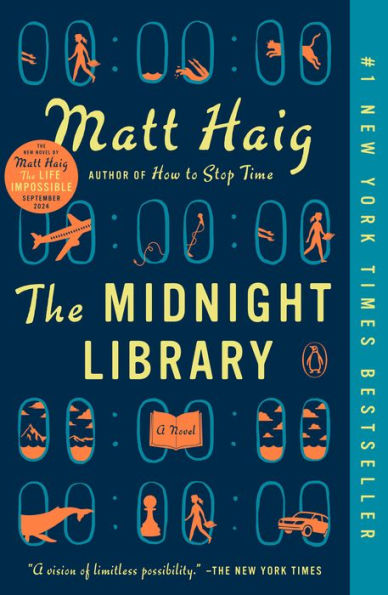
Why this book: Really liked The Life Impossible, and had heard good things about The Midnight Library. I liked Matt Haig’s writing so I listened to this book soon after finishing Life Impossible.
Summary in 4 Sentences: A young woman (about 35) has a series of things go wrong in her life, realizes she is stuck because of a lifetime of bad decisions, has nothing to look forward to, and decides to end it all by OD’ing on anti-depressants. When she passes out, she finds herself in a different dimension – a Midnight Library that exists in the moment between life and death, full of books of all the lives she could have lived, had she made different decisions. In the Midnight Library, she is guided by her HS librarian who’d been very kind to her when she was going through hard times when she had been in High School, and she gets to experience many different directions her life could have taken had she made different decisons. She comes to realize that even those fantasy lives are not all peaches and cream, finally realizing that the life she actually had, had a lot to offer – and in a final dramatic scene, she gets a second chance.
My Impressions: I did enjoy listening to this book, though not as much as I did The Life Impossible. The premise and setting, were cleverly done, and I thought the lessons our protagonist learned were valuable and useful for anyone. But as I note below, this book would appeal more to someone younger and at a different stage in their life than I.
I guess my challenge with the book was that I had trouble relating to Nora – the young woman protagonist of the book. She seemed almost a caricature of a fearful, somewhat helpless and hapless young woman, intelligent and capable, but without any self confidence. Her family life had not been good growing up – her parents’ love for her was conditional, they didn’t get along and she felt on her own. She did not have much understanding of the rough and tumble real world, where shit happens, people get knocked down, the strong get back up, while the weak stay down, feel sorry for themselves and/or get into alcohol or drugs. She seemed to feel almost powerless to step up and take action – when things got tough, she folded, took the easy way out. Sometimes I felt like the book was therapy for women who feel powerless to take responsibility for their own lives.
I recognize that Nora may represent a significant percentage of young women (and men) who’ve been dealt a tough hand and have essentially given up when things start going badly. And such women (or men) would be able to relate to Nora and get more out of this book than I did. The setting and the theme of the book were clever and interesting, and several of the alternate lives that Nora stepped into were interesting and provided her (and us the readers) with insightful lessons and useful perspectives. But I did get tired of the melodrama, and with each alternate life, hanging out in her head with the drama, anxiety, excuses and unwillingness to accept some of the realities of life and her fate.
A couple of other things that frustrated me in this book.
- Each time Nora stepped into a new setting as a “Nora” who’d made different decisions and therefore was on a different life trajectory, she had to spend her first hours/days figuring out who were these people around her and how did the Nora in this alternate life get here. The Nora who was transported to this alternate life through the “midnight library”, and the Nora IN that alternate life were actually two different people, because Nora would have evolved very differently on the path to this alternate life than she did in her “root” life. They simply looked and sounded alike and had had the same childhood. Having to go through that awkward transition period again and again in each alternate life was tedious for me the reader. Couldn’t Matt Haig have let the two identities overlap a bit, so that Nora could actually experience the new life without having to figure out who she was supposed to be, and how did this alternate Nora get into this alternate life?
- In each of these alternate lives (except one,) Nora was challenged and ultimately gave up – quit, and chose to go back to the Midnight Library. While experiencing the alternate life, she had not invested the years of work and sacrifice, ups and downs that are always on the path to becoming a success – that super athlete, or that rock star, or that professor. She simply and suddenly found herself in that fantasy role, and when the going got tough, rather than embracing the challenge, she bailed – back to the Midnight Library to try another life. Isn’t that sort of how she got to that tough place in real her life to begin with – by bailing when things got tough and overwhelming?
All that said, a couple of other unusual things I DID like about the book.
- Matt Haig, through Nora explores the idea that what she was experiencing was not simply a dream but reflected a possible “reality” of an infinite number of alternate, parallel universes that quantum theory postulates. We are briefly introduced to quantum theory, Schrodinger’s Cat, and the possibility that we exist simultaneously in multiple lives on multiple (infinite) planes. Cleverly, the music story where Nora had worked, and from which she was let go, was called “String Theory.”
- Nora had been a student of philosophy, and through her, Matt Haig introduces the reader to a number of great books in the canon of humanistic philosophy – books that were on Nora’s book shelf and that she had read. She also referred in the book to quotes from Sartre, Camus and others that resonated with me – a fellow humanities geek. I would have enjoyed chatting with Nora about these thinkers and challenging her to incorporate their ideas into her life.
For an older adult – I’d probably give this book a 7 on a scale of 1 to 10 with kudos for the clever idea, the writing, and the themes. But I would make it a must read book for young women (or men) in their late teens or twenties, struggling with an identity crisis, unfavorably comparing their modest unfulfilled lives to those the media has inflated into always happy icons (who strangely enough, often commit suicide.) This is an excellent book for those not happy with where they are in their lives, and are trying to figure out how they got there, what to do about it, and how to move forward.
At 72 yrs old, that’s not me….


 Bob's Books
Hello bob.
Really thoughtful review! I like how you connected your impressions of The Midnight Library to your own stage in life and explained why it might resonate more deeply with younger readers.
I agree that Nora can feel frustrating at times, but that very fragility is probably what makes her relatable to people who feel stuck or powerless. The mix of philosophy, quantum theory, and personal growth themes is definitely one of Matt Haig’s strengths, and I think you captured that balance well.
For anyone who wants a concise breakdown, I put together a full guide here: The Midnight Library Summary