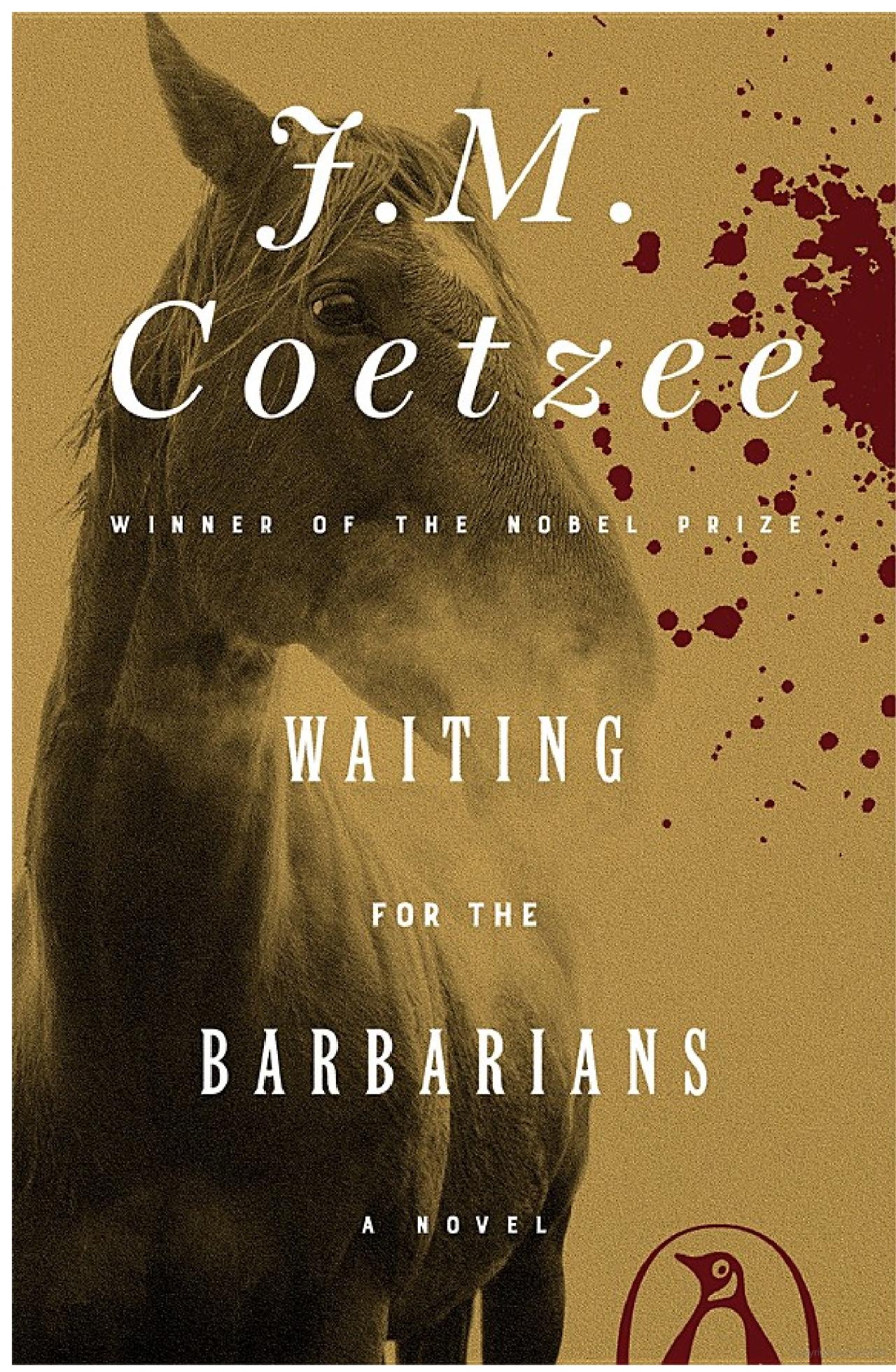
Waiting for the Barbarians, by J.M. Coetzee

Why this book: Selected by my litrature reading group. Coetzee is a Nobel Prize winning author and the only author to win the Booker Prize twice.

Summary in 3 Sentences:  Set in an unnamed “empire”, presumaly in the 19th century, that is fighting a primitive culture on it’s borders, it is in a first-person voice of the magistrate of one of the border towns near where the “barbarians” have lived for centuries. The magistrate is distressed by how the police and army sent from the capital of the Empire are brutally suppressing the natives of the area where he serves as magistrate,  He is caught between his duties as magistrate and his sense of duty to the people who he saw being tortured and abused unjustly. He becomes involved with one of the “barbarian” women, and in seeking to challenge and soften the army’s campaign against the barbarian natives, he becomes himself a victim of the Empire’s campaign.

My Impressions:  An interesting and powerful book.  Not a quick or easy read, and at the beginning, rather difficult – as it begins with graphic descriptions of the torture of the army’s captives in their efforts to subdue the barbarians.  We are never given the name of the “Empire” though it is easy to assum that it is Russia – perhaps soon after the Bolshevik revolution, seeking to extend their influence in the far east over Mongols or eskimos or other nomadic tribes. 

Written in the first person of a late middle aged magistrate, we experience his anger and frustration at how the representatives of the power of the Empire come into his territory and seek to apply blunt power to achieve their goals.  He shares his own sense of his decreasing power and helplessness to stop them, as an aging middle aged man and as a remote, relatively low level functionary of the Empire. He is very self conscious in his internal struggle and I was reminded a bit of Dostoyevsky’s Notes from the Underground – in the self-absorbed but also very self-aware way in which the narrator describes his internal struggles and conflicts.

Our magistrate encounters a young woman from the barbarians who had been captured on a recent raid begging on the streets in his town, who had been tortured and nearly blinded by the army.  Begging was illegal in his jurisdiction, but he feels he owes her his assistance after being mistreated by the army, and  offers her room and board to come into his household to help with cooking and chores.  He also seeks to take care of her injuries and gradually his care  and continues to caress and care for her. but he obsesses over his relationship with her, and his care for her takes on an erotic element.  Though they sleep together, he claims not to be attracted to her and doesn’t consummate his relationship with her, 

We are “treated” to his internal dialogue about his ambivalence about his relationship with this woman,  and eventually decides that his duty is to return her to her people, the barbarians, who live in distant mountains.  He recruits some men to help him return the girl to her people, and during their arduous journey, at her initiative, they do consumate their relationship, though it is purely a physical response.  He describes their very difficult and painful journey to the barbarians’  winter pastures, where he succeeds in returning the girl to her tribe.   Upon his return, he is accused of treason and consorting with the enemy and is subjected to the same torture and abuse that the army imposed on the captured barbarians.  Interestingly, though he is tortured and is confined to a squalid cell, he is relieved to no longer be a tool of the cruel Empire that is persecuting his town, and torturing the “barbarians” they capture. 

During this portion of the book we see how torture and isolation can reduce an intelligent and sensitive man to a cringing animal.  He struggles to hold on to his values, and we have to admire his courage.

Eventually the army of the Empire is reinforced and deploys into the mountains to finally subdue and destroy the barbarians, but the army doesn’t return.  The people left in the town begin to realize that the army was decimated, and there is fear that the barbarians will ravage the town as well, and many of the citizans leave.  The magistrate is released and without the army’s officers there, he re-assumes his position of leadership.  Finally, the head of the army returns from the mountains defeated, his  remaining soldiers plunder the town before heading back to the capital of the empire.  Our magistrate remains in the town, with the few people left, to continue trying to survive, with no further connect-in to the Empire.

Though this would seem to be a story about Russia, the author is South African and it perhaps could be South Africa – the empire representing the Dutch or English, or it could be the US Army seeking to subdue the native Americans.  Or it could be almost anywhere that Europeans have gone to spread Chistianity and Western values in conquering indigenous peoples.  This story is about the dilemma of a conscientious and humane man, caught in the middle, his conscience, his struggles and ultimately his courageous decisions.  And about the suffering of not only the indigenous peoples, but also of the soldiers and the inhabitants of the towns on the frontier, caught in the middle of the Empire’s imperialistic objectives..  

Posted in Uncategorized | Leave a comment

Where the Crawdads Sing, by Delia Owens

Why this book: Selected by my SEAL Reading group as our next selection

Summary in 3 Sentences:  This is a coming of age story of a young girl grwoing up  isolated in a shack in the marshes on the coast of North Carolina, Her parents have abandoned her, and she teaches herself to survive on her own with a bit of help from just a few people in the nearby town, as she grows from childhood, to teenage years to young adulthood. She lives in harmony with the plants, animals and the natural environment of the marsh, but in that process comes in contact with young men in the community, and eventually is accused of murder, when one of her former suitors is found dead.

My Impressions: An engaging, enjoyable, and quick read at 368 pages.  A fascinating and unusual story focusing on an imaginative and interesting protagonist. The cover endorsement reports it as “,,,At once a murder mystery, a coming of age narrative, and a celebration of nature”  which pretty well sums it up. 

The story features Kya, whose  mother and older siblings left their home to escape their alcoholic and physically abusive father. They simply disappeared, leaving their home, and the marsh and coastal community in North Carolina where they lived, leaving the youngest child of barely 6 yrs old, Kya alone with their disturbed father.  After their departure, he largely ignored her and left her on her own, and provided her very  little money or support .  She eventually found ways to make a little bit of money, taught herself how to cook what little there was to eat and she did her best to mimic what she remembered watching her mother do before she packed up and left, after a particularly abusive episode with her father,   

A year or so later, with no warning or notification, her father left and never came back and she had no idea what happened to him.  The truant officers were able to get her to attend school for only one day, but the other kids laughed at and made fun of her, so she never went back to school,  and learned to hide from the truant officers.  She felt alone and abandoned, but was determined to survive on her own. She never revealed to authorities that her father had disappeared, in order to avoid being put into a foster home.  Over time she learned what she needed to know to survive and with a bit of help from an old black man who ran a marina gas station where she bought gas for her boat, she made a life for herself – alone. 

As she got older and into her teenage years she spent much time out in the marsh areas adjacent to the primitive shack she lived in, and made friends with the animals and creatures of the marsh where she felt at home and unthreatened.  Out in the marsh she also ran into and made friends with boys of approximately her age, friendships that in a couple of cases led to romantic relationships.  One of those boys taught her to read, do simple math and other basic skills most children learn in elementary school, and he regularly brought her books, old textbooks and other items that allowed her to teach herself more about the world she lived in.  As she progressed into young adulthood, she became very proficient in reading, and spent much time increasing her knowledge of the biology, flora and fauna of the marsh.   She also  went thru the disappointments that most young people experience in unfulfilled love and dreams, but in her case,  these disappointments and trauma amplified her already sense of abandonment and distrust of town people – especially men.  

Meanwhile in Barcley Cove, the small town near her shack in the marsh, Kya was referred to as the Marsh Girl, and was demonized as strange and illusive, an object of ridicule and salacious rumor, and was made fun of by most of the town’s populace.  When one of the boys with whom she’d had a relationship is found dead under mysterious circumstances, she becomes a prime suspect, and is arrested and put on trial.   The last part of the book is largely about the trial.

The ending is surprising and satisfying.

Some of what I got out of the book, in addition to an entertaining read:

  •  We get inside Kya’s head, experience her fears and distrust, and see from her perspective how abandonment, disappointment and betrayal trust can affect sensitive people – how it can drive them into increased isolation and an inability to trust anyone.  
  •  We also learn from her how her connection to the birds, insects, animals, other flora and fauna can be a joy to those who take the time to commune with the natural world.  It was all she had, and she learned to love and trust it.  She felt part of that world, and fount there an acceptance and affection she didn’t get from people in the “civilized” world.
  • We got a glimpse into small town culture in rural coastal North Carolina in the 1950s and 60s.  The author represented with spelling the North Carolina accent, and we got cameo glimpses of several of the colorful old south characters in the town – some with very narrow prejudices, others much more open. 
  • Her trial at the end was a good tutorial on the judicial system, in small rural towns,  and how popular opinion can seek to influence justice, in spite of the system’s best efforts to be impartial and give the benefit of the doubt to the accused.

As much as I enjoyed reading the book and following the story,  I saw a few flaws that for me kept Where the Crawdads Sing from being a classic.

    • Kya developed talents and capabilities as an expert on marsh life that were beyond what I would expect even for a truly gifted student.   We didn’t get a convincing description of her efforts to achieve the level of expertise she achieves in the book.   Kya learned to read and then rather quickly it seemed, was reading text books and scientific journals.    We learned late in the book that her explorations of the marshes were recorded in intricate drawings with notations that garnered praise from experts in the field.  We learn that her work was praised by experts and then published, and I didn’t even recall that she had developed a talent for drawing and providing scientific notation! 
    • The ending was a surprise, as it was meant to be, but it didn’t entirely make sense to me.  Another friend of mine said she had guessed it all along.  Nothing to be revealed here, but I’d be interested in what others think – whether the ending worked for them.  

In our discussion with the SEALs,  nearly all really enjoyed reading the book, though most saw some of the same flaws I did.  A number of things were brought up that I thought were intersting:  Man’s law vs Natural law. the long term impact of child abuse, the racism that is described in the book, and how it has changed/evolved from the 60s which was the setting of the book. Also brought up were Pat Conroy’s books also set in coastal/marshy areas but in South rather than North Carolina – Prince of Tides and The Water is Wide.  And the idea that Kya referred to the marsh as her “mother” when her mother left, and how an isolated person can develop an almost supernatural relationship to nature.  

Posted in Uncategorized | Leave a comment

The Garden of the Finzi-Continis, by Giorgio Bassani

Why this book: Selected by my literature reading group. Two of us were about to go on an expeidition-hike in the Dolomites with NOLS, and this book was on the recommended reading list for this hike. 

Summary in 3 Sentences: AThis is a novel written in the first person by a Jewish boy of a middle class family growing up and into young adulthood in pre-WW2 northern Italy town of Ferrara.  Through tennis, and the synogogue, he develops a relationship with a very well-to-do Jewish family, the Finzi-Continis, that has been influential for generations in that part of Italy.  As he matures into his teenage years and into adulthood, he develops a crush on the daughter of this family, as he and she eventually matriculate from the gymnasium (high school) and go to different universities to pursue their doctoral degrees. This all takes place against the backdrop of increasing Fascism and racial laws imposed on the Jewish community by Mussolini as Italy and Europe lurch toward World War Two. 

My Impressions: Interesting book and a bit of a change of pace for me. It is a translation from the original Italian, written by a well-educated literary author, published in the early 60s.  The style did not flow easily for me, and was a bit awkward.  That said, the book took me into a world with which I was unfamiliar – the world of middle class and well-to-do Jewish families living in Northern Italy during the Fascist regime of Mussolini just prior to WW2.   

I did eventually watch the movie which apparently earned an Oscar as best foreign film in 1970.  It is a reasonable adaptation of the book, though the screenplay takes some artistic license with the ending, being a bit more explicit about events that the book only hints at, and there is a lot less in the movie about the heritage of the Finzi-Continis family. 

It is a coming of age novel for the protagonist –  whose name we never learn in the book. It begins with him describing the family cemetery of the Finzi-Continis family which had been influential for several centuries in that part of Italy – that cemetery was the “garden” on the grounds of the Finzi-Continis estate.  The protagonist is a middle class Jewish boy who sits in synogugue with other middle class Jews in a separate section from those with the wealth and resources to sit upstairs and apart from the rabble -and that upper class group includes the FInzi-Continis fmaily.

As our protagonist (our “P”) grows up, he has intermittent contact with the Finzi-Continis family since they attend some of the same schools, though the wealthy have their own tutors. From early on P observes from a distance and slowly builds a crush on the young girl Micol of the Fnzi Continis family,  but as a young girl, she seems aloof and indifferent to him.  They occasionally have chanes to interact and slowly develop a friendship.  As they move into their teenage years, even though he is not of her class or social standing, she invites him to join her and her brother and some of their friends playing tennis on their family courts inside their walled in estate. And over the years, he continues to be part of this tennis group, and his attraction to and friendship with Micol grows and blossoms, but is never expressed as more than good friends and pals. 

Meanwhile high school turns to university – and in Italy – that requires passing exams to get out of 1930s Italy’s university preparatory program. P is a humanities student, uncomfortable with engineering and math, and goes to University in Bologna, specializing in literature and languages, with a focus on Italian literature.  Micol also studies literature, but does so in Venice. They see little of each other but correspond by mail – still “just good friends.”  

P is intensely interested in literature – studies the styles and messages of various authors and he shares this interest with Micol.  P and Micol have studied hard to successfully enter graduate programs in their specific fields of the humanities, and we the readers are treated to references to what for me are obscure and unknown authors in the canon of European literature.  P also engages in political debates with a close friend who is an ardent socialist and anti-fascist. All the Jews are anti-fascist, since the Fascists under Mussolini are increasing restrictions and discrimination against Jews.   

This book was interesting to me for three reasons; 

  1.  The author describes the culture of the affluent Jewish community in Northern Italy- very similar to that of affluent gentiles, but the Cathedral and the Priests and Catholicism are replaced by the synogogue, the rabbis and Jewish tradition.  The Jews were very well integrated into the society and had been for centuries.  As we get to know these characters, we experience their effort to remain low profile in a world led by Fascists and Catholics, and how they dealt with incresing restrictions imposed by Mussolini’s “racial laws” in pre-WW2 northern Italy. 
  2. The coming of age story of a young Jewish boy and young adult in a period of great transition in Europe and Italy.  He is trying to live as he did before while Fascism is blossoming and affecting everything in Italy in particular, and of course throughout Europe
  3. The unrequited love romance between P and Micole – how he deals with it, how she responds.  

The Garden of Finzi Continis is short at only about 200 pages,  It started slow, and I struggled with it at first, feeling like I was swimming against the current. But at about page 20, the pace picked up and after a while i

Summary in 3 Sentences: AThis is a novel written in the first person by a Jewish boy of a middle class family growing up and into young adulthood in pre-WW2 northern Italy town of Ferrara.  Through tennis, and the synogogue, he develops a relationship with a very well-to-do Jewish family, the Finzi-Continis, that has been influential for generations in that part of Italy.  As he matures into his teenage years and into adulthood, he develops a crush on the daughter of this family, as he and she eventually matriculate from the gymnasium (high school) and go to different universities to pursue their doctoral degrees. This all takes place against the backdrop of increasing Fascism and racial laws imposed on the Jewish community by Mussolini as Italy and Europe lurch toward World War Two. 

My Impressions: Interesting book and a bit of a change of pace for me. It is a translation from the original Italian, written by a well-educated literary author, published in the early 60s.  The style did not flow easily for me, and was a bit awkward.  That said, the book took me into a world with which I was unfamiliar – the world of middle class and well-to-do Jewish families living in Northern Italy during the Fascist regime of Mussolini just prior to WW2.   

It is a coming of age novel for the protagonist –  whose name we never learn in the book. It begins with him describing the family cemetery of the Finzi-Continis family which had been influential for several centuries in that part of Italy – that cemetery was the “garden” on the grounds of the Finzi-Continis estate.  The protagonist is a middle class Jewish boy who sits in synogugue with other middle class Jews in a separate section from those with the wealth and resources to sit upstairs and apart from the rabble -and that upper class group includes the FInzi-Continis fmaily.

As our protagonist (our “P”) grows up, he has intermittent contact with the Finzi-Continis family since they attend some of the same schools, though the wealthy have their own tutors. From early on P observes from a distance and slowly builds a crush on the young girl Micol of the Fnzi Continis family,  but as a young girl, she seems aloof and indifferent to him.  They occasionally have chanes to interact and slowly develop a friendship.  As they move into their teenage years, even though he is not of her class or social standing, she invites him to join her and her brother and some of their friends playing tennis on their family courts inside their walled in estate. And over the years, he continues to be part of this tennis group, and his attraction to and friendship with Micol grows and blossoms, but is never expressed as more than good friends and pals. 

Meanwhile high school turns to university – and in Italy – that requires passing exams to get out of 1930s Italy’s university preparatory program. P is a humanities student, uncomfortable with engineering and math, and goes to University in Bologna, specializing in literature and languages, with a focus on Italian literature.  Micol also studies literature, but does so in Venice. They see little of each other but correspond by mail – still “just good friends.”  

P is intensely interested in literature – studies the styles and messages of various authors and he shares this interest with Micol.  P and Micol have studied hard to successfully enter graduate programs in their specific fields of the humanities, and we the readers are treated to references to what for me are obscure and unknown authors in the canon of European literature.  P also engages in political debates with a close friend who is an ardent socialist and anti-fascist. All the Jews are anti-fascist, since the Fascists under Mussolini are increasing restrictions and discrimination against Jews.   

This book was interesting to me for three reasons; 

  1.  The author describes the culture of the affluent Jewish community in Northern Italy- very similar to that of affluent gentiles, but the Cathedral and the Priests and Catholicism are replaced by the synogogue, the rabbis and Jewish tradition.  The Jews were very well integrated into the society and had been for centuries.  As we get to know these characters, we experience their effort to remain low profile in a world led by Fascists and Catholics, and how they dealt with incresing restrictions imposed by Mussolini’s “racial laws” in pre-WW2 northern Italy. 
  2. The wealthy Jewish community were overly complacent as the fascism of the Mussolini government gradually, but continually constrained and discriminated against them.  They couldn’t beleive that it would go as far as it did. Similar to well-to-do Germans and Jews.  
  3. The coming of age story of a young Jewish boy and young adult in a period of great transition in Europe and Italy.  He is trying to live as he did before while Fascism is blossoming and affecting everything in Italy in particular, and of course throughout Europe.
  4. The unrequited love romance between P and Micole – how he deals with it, how she responds.  

The Garden of Finzi Continis is not a long  book, only about 200 pages,  It started slow with background and scene setting that I found a bit tedious,  and I struggled with it at first. But at about page 20, the pace picked up and after a while I was enjoying swimming with the current and enjoyed the book. The ending left a lot of strings hanging though…

I did find this book interesting and compelling and enjoyed reading it. The ending however,  left a lot of strings hanging……

Books that I”d previously read that had some similar themes:  Love in the Time of Cholera, Remains of the Day, Rules of Civility.

Posted in Uncategorized | Leave a comment

That’s That – a memoir, by Colin Broderick

Why this book: Recommended to me by my son Brad

Summary in 3 Sentences: Colin Broderick recounts his life grwoing up in Northern Ireland from his earliest memories as a child to about age 20 when he decides to leave Nortern Ireland and emigrate to America.  His story is infused with the humor of growing up in a very Catholic small town in Ireland, going to strict Irish-Catholic schools led by narrow minded and very traditional teachers, into puberty and the rebelliousness of adolescence and young adulthood. Throughout the book there is the constant backdrop of “the troubles” between the British supported Protestants and the Catholics who were treated as a subversive underclass in Northern Ireland – and this tension grew in importance in Broderick’s life as he became a teenager and young adult. 

My Impressions: An interesting and very personal account of what life was like in the 1980s and early 1990s in Northern Ireland for a high energy young man – with the ever present sense of being discriminated against as a second class citizen in one’s own county. It is a coming of age story which includes many of the awkward instances I and most young men in the West can identify with, but in a world that is hard for many of us to relate to – very Catholic family and community, very strict Catholic schooling, and the bitter violence between the Protestant British Northern Ireland government and the Catholic minority.

The first third of the book reminded me of Angela’s Ashes.  Colin Broderick is a young boy growing up in a small town in Ireland, but whereas Angela’s Ashes has the ever-presenst negative backdrop of poverty and alcoholism, in That’s That,  this negative backdrop is the violence between Protestants and Catholics in a Protestant dominated country. The middle third of the book focuses on his sexual awakening, dealing with puberty in a very traditional Catholic household, in which his parents – especially his mother – were very restrictive on his freedom to become part of the adolescent culture of partying and dancing and dating. 

In the final third of the book Broderick is now an older teenager and young adult, and actively rebelling against his parents’ restrictions on his social life.  As soon as he can, he leaves home, connects with other angry young men,  and like them, over indulges in the vices of alcohol and drugs and rebellious behavior.  He eventually leaves home, goes to work in London and gets involved in petty crime and dealing drugs to wealthy Englishmen.    During his youth, he had passively absorbed the rage of his community against the discrimination and violence of Protestants against Catholics; as he got older it was natural for him to suport and slowly become engaged with those active in insurgent activity in Northern Ireland.  His secret associations with petty crime and life in the underground took him deeper and deeper into the dangerous territory of becoming an insurrectionist and terrorist himself. 

This is also a morality tale.  Broderick clearly has a sense of humanity, but his mother’s efforts to shape him into a good, well behaved Catholic boy backfired, as he thoroughly rebelled against her efforts to make him a well behaved young man.    But her efforts left in their wake a strong sense of guilt at anything that smacked of sin in a traditional Catholic culture.  “No! and that’s that” was how his mother routinely responded when he argued against her denial of his requests to join his friends at a party or dance, or go see a girl he wanted to see.   As soon as he could, he sought the freedom to experience the forbidden fruit of adolescent fun, but he couldn’t quite shake the guilt and sense of sin that he acquired during his strict Catholic upbringing. He tries to suppress the guilt but it is always there, along with his basic sense of goodness and humanity.  But he continues to rebel, and his split identity is difficult for him to reconcile.  That said, he is naturally drawn to the excitement and sense of purpose and community that he experiences when joining those fighting the Protestant system..  

This is a book about growing up, and is an example of how many young men and women over-react in rebelling against strict parenting.   And we learn much about the deeply ingrained anger and bitterness between Catholics and Protestants in Northern Ireland.  This book inspired me to go online and investigate the current state of the Northern Ireland Troubles. Apparently progress has been made in the last 25 years to bring these two communities closer together, but ALOT of distrust continues to exist. The good news is that violence between the two has largely abated and “the Troubles” as such are a thing of the70s, 80s, and 90s.  

This book is  followed by a sequel, Orangutan,  in which Broderick describes his life after moving to NYC. I haven’t read it yet, but I’ve been told that in NYC, he continues his self-destructive behavior – but survives until he finally gains some wisdom.  

Posted in Uncategorized | Leave a comment

Stranger in a Strange Land, by Robert Heinlein

Why this Book: Selected by my Science Fiction Reading Group.  A couple in the group wanted to read a Heinlein book and though Starship Troopers was the only Heinlein book I’d read, I also wanted to read this, his most famous work. 

Summary in 3 Sentences: An American child who had been raised by Martians on Mars returns to earth with a follow on expedition, and as a young adult is introduced to human values and culture in America.   As he learns the values of earthbound humans he realizes that Martian perspectives, values, and abilities could help humans live better and with greater fulfillment and love.  The novel is about what he learns about  human culture, and the different values and abilities he introduces to humans, the tension between the two, and how he fares in creating a new movement to improve human well being. 

My Impressions: Wow!  I don’t know how over these many years I missed reading this book.  Though I’ve heard about it for decades, I had no idea what it was about.  I would describe it as providing a vision for the counter-culture communal ideal that dominated the sixties and the so-called “hippie movement,” though Heinlein was anything but a hippy.  It is also a critique of American culture written in the 50s, published at the beginning of the 60s, but the critique very much resonates today, 70 years later. 

Though the setting for the book is post WW3 America, and the United Nations has morphed into a world governing federation, the language and the culture in which the story takes place are 1950s America, and as such, are full of quaint, and what today would be considered politically incorrect anachronisms. However, I found this aspect of the book enjoyable and familiar – being a child of the 50s and 60s myself. In particular the male/female roles and relationships are echoes of movies we’ve watched from the 40s and 50s – John Wayne or Cary Grant interacting and Doris Day or even Kathryn Hepburn.  That said, his satires and critiques of wealth, religion, marriage,  politics, government  ineptitude, and more are biting and still relevant.   Stranger in a Strange Land  also makes a strong case for the individualistic and libertarian ideals that initially drove the counter culture movement, before it was hijacked by Maoist and other authoritarian leftist ideals.

Our hero, Valentine Michael Smith or “Mike” is our “stranger in a strange land.”  After  Mike is brought to earth from Mars, and has learned and adapted to the ways of human – specifically American – culture – we see how he reacts to how humans live, how they interact with each other, and what they believe.  We also learn from Mike about Martians, as he explains and teaches the ways of Martians to those who are taking care of him.  Eventually, the superiority of Martian ways to what he was seeing on earth, convinced him and his close friends to start a movement.  We learn about Martian culture, wisdom and advanced insights, which I assume described part of Heinlein’s vision of a possibility for the evolution of human culture.

KEY CHARACTERS 

 Mike Smith was born of human parents on Mars, but his parents perished when their exploratory space ship to Mars encountered difficulties (not described in the book) and all died, except the baby, who was found and  raised by the native Martians,.  The child was taught Martian ways and brought up as one of them and grew up to young adult hood.  A follow on exploratory mission was sent to Mars twenty years later to find out what had happened to the first mission, and after this mission landed, Mike was delivered over to that exploratory team to be returned to his native planet.  The novel begins with Mike  Smith’s return to earth and continues with  how he adapted to and learned about human culture on earth, what he taught the humans he interacted with,  and how scientists, politicians, religious leaders and others responded to him and his teachings. 

Gillian, or Jill Boardman represents a traditional young woman of the 1950s, not highly  educated nor sophisticated, but good-hearted and possessing impressive wisdom and common sense.  We meet her as a nurse in the hospital where Mike was brought after returning to earth.   Ostensibly Mike was there for recovery, but it became apparent that isolating him was actually a political move to control and manage him.  Jill takes a big risk and breaks him out of the hospital, gets him to Jubal Harshaw’s remote home, and Jill becomes Mike’s first caregiver, first Water Brother,  eventually his lover and one of the leaders of his movement.

Jubal Harshaw perhaps the most interesting and enjoyable character in the book.  Jubal was Heinlein’s skeptic – an older experienced man who personified practical wisdom and questioned everything, but with compassion, integrity and an open heart.  When Mike was “kidnapped” from the hospital by Jill, she brought him to Jubal’s remote home – a sort of compound in the Appalachian mountains in New England.  He became Mike’s father figure, advising him, steering him away from the minefields of modern society and those who would manipulate and exploit him.  Jubal was the voice of the skeptical reader, agnostic to Mike’s parapsychological abilities, and paying close attention to how those in power (corporate and government) were responding to Mike’s increasing visibility and popularity.  Some time after Mike had left Jubal’s life and compound, and had gone into the world to learn about earthly culture,  Jubal was called to come give advice when it appeared that Mike’s movement was facing new challenges.   It was indeed amusing to read about this paragon of old-school wisdom engaging with the new-age culture that Mike was creating, having thrown out many of the old-school American cultural paradigms. 

MIKE’S REVOLUTIONARY NEW CULTURE:  Below are some aspects of the culture Heinlein has his characters adopting and internalizing as a result of Mike’s influence and example: :

  • Water Brothers.- Water was sacred on Mars where Mike had grown up.  To drink water with someone was a ceremony that made the two people “Water Brothers.” Becoming Water Brothers was a sacred  commitment, meaning that the friendship and commitment  between Water Brothers take precedence over all other considerations. Becoming a Water Brother with a person, makes you a Water Brother with all that person’s Water Brothers, and they are Water Brothers with your Water Brothers. It is a huge deal, and that sense of complete familial commitment solves most interpersonal problems that arise from putting self first – anger, jealousy, possessiveness, greed,  manipulation all go away. 
  • Life, Death, and Ghosts. In Martian culture, those alive or still “corporate” live to served those who have physically died.   Those who were once corporate continued to exist in another realm as The Old Ones. Dying was to  “discorporate” – lose one’s corporeal existence and move to another realm – the realm of The Old Ones.   The Old Ones conferred, made decisions and communicated with those physically alive.  In fact, with their perspective and wisdom. The Old Ones were actually the leaders/rulers.  Those still alive, or “corporate” responded to the wisdom and desires of the Old Ones, and served them, and in serving them, served all. .  
  •  Patience The Martians are never in a hurry. They always knew they had plenty of time, since after life, they exited for eternity as The Old Ones.  There was always plenty of time.  Those in Mike’s camp used the expression, “Waiting is” to mean, no hurry, we’ll wait and see. 
  • Mental powers – On Mars, Mike had  developed what on earth are extraordinary powers,  to include psycho-kinesis, telepathy, and clairvoyance, out of body travel, etc.  The Martian culture had learned to manipulate the laws of physics – and Mike taught his Water Brothers to use mental powers he claimed all of us have, to outflank or override the fundamental laws of physics that we have assumed are immutable.  Mike and his Water Brothers could move physical items with their will, could communicate telepathically, and could even make objects disappear.  They have learned to do what in fact yogis in India and the Himalayas have trained themselves to do over many centuries, which scientists have yet to understand (see my review of The Intention Experiment)   Mikes (and perhaps Heinlein’s)  point – when the mind is freed from the concerns of the ego, and has been taught to truly focus, all these things are possible.  
  • Marriage, monogamy, and sexuality – In Mike’s Water Brother-centric  culture, there is no place for the possessiveness and exclusiveness of monogamy and marriage.  In this new culture,  sexuality is primarily a means of developing closeness and pleasure between two people who are committed to each other as Water Brothers – and as such, sexuality is celebrated as a special gift that close and committed friends (Water Brothers) can share – what today we might see as a natural extension of engaged, respectful, and intimate conversation.  The exclusivity of sexual relations inherent in Western customs of marriage and monagamy robs individuals of an effective means of developing closeness with multiple Water Brothers.   Water Brothers are not interested in  “casual recreational” sex with someone with whom they are not committed. And since in Mike’s world, the men and women had multiple Water Brothers of the opposite sex, sex as a means of pleasing and growing closer to other Water Brothers was an attractive option.  “Marriage” still played a role as a partnership in sharing the primary responsibilities of child rearing and managing assets, but as with sex, one could always call on Water Brothers to help with these and other challenges.  Even nudity was encouraged as statement of non-attachment to old shames, jealousies and outmoded paradigms.  
  •  Disharmony and jealousy. Mike learned from his Martian mentors to never get angry or to lose his cool.  Part of this grew out of their culture of patience – there was always time to sort things out. Though he would become sad, or confused, he never lost his cool, nor was he ever jealous,  or an angry victim of an ego tirade.  In his team, it wasn’t as if these behaviors were forbidden, they just didn’t come up, once people had learned the skill of patience and had committed to the ideal of being Water Bothers.
  •  Meditation and “withdrawing”  Mike had the capacity to shut himself down physically, to the point that he appeared dead – it was indeed a very deep form of meditation.  He would “withdraw” when the environment became too hectic or when he needed to recover and re-energize himself. When he was withdrawn, his Water Brothers knew only to disturb him in case of dire emergency.   This was an early Sci Fi endorsement of meditation as a powerful self-discipline and tool for mental and phsical recovery and dealign with stress. 
  • NOT a Religion – Mike’s philosophy and adherents were accused of being a religion or a cult but he strenuously disagreed.  Like the Unitarians, he had room for people of all religious persuasions and included in his Water Brother disciples a Muslim and a Jew as well as many Christians.  He argued that he lived in the place where all religions overlap – there was no competition, or dogmatic belief in a personal or any other type of God or saviour

.As I’ve thought about this book, I see it as Heinlein’s view of an ideal of what humans could evolve toward, though he has said in his subsequent interviews that he was not prescribing his society as an ideal,  rather posing this alternative  as a challenge to consider – to stimulate thought and discussion. 

A CHRIST-LIKE FIGURE There are many analogies to Christ and Christianigy in this book.  Mike Smith is a Christ-like character from a different realm, who comes to earth representing and offering a different vision of how people should live, relate to each other and perceive their existence.  He draws a small group of dedicated “disciples” who help him spread the word.   Like Christ, Mike and his message were viciously opposed by those with a vested interest and investment in the status quo, and his ideas were regarded as immoral, subversive, and decadent. MIke’s message was that love and becoming committed to each other as Water Brothers was the key to fulfillment; that this life was not to be lived as a prelude to a life after death or in the interest of a supernatural being.   In Mike’s world, people greeted each other with “Thou Art God, “affirming their belief that each of them were an expression of a Transcendent Good. 

Mike also eventually came to realize that when enjoyed as an act of love, sensual pleasure is a gift  – indeed one of our greatest gifts, and in this he deviated from regarding the Martian culture as superior,  The ability of humans to connect spiritually AND physically through sexual and sensual connection was in contrast to and SUPERIOR to interactions in the asexual, detached, and cerebral Martian culture in which he grew up.  This final insight of Mike’s, that sensuality – the source of so much tension and suffering in humans is also the path to the best of what humans can become – and indeed can be a synthesis of the best of Martian and Human culture.

A quote from the book that makes this point:“The joining of bodies with merging of souls in shared ecstasy, giving, receiving, delighting in each other—well, there’s nothing on Mars to touch it, and it’s the source, I grok in fullness, of all that makes this planet so rich and wonderful. And, Jubal, until a person, man or woman, has enjoyed this treasure bathed in the mutual bliss of minds linked as closely as bodies, that person is still as virginal and alone as if he had never copulated.” 

Quotes from Stranger in a Strange Land – there were many great quotes, and I can’t do better than what I found at this website: https://www.readthistwice.com/quotes/book/stranger-in-a-strange-land

My reservations.  It seems to me that acquisitiveness, desire for power, the impulse fo immediate pleasure (sex, drugs, victory, ecstasy), and the competitive instincts we have with our fellow humans are part of our genetic legacy.  Overcoming these to live a better, more cooperative, spiritual and communal life may be the challenge each of us has in our own lives, and that no communal ideal can entirely eliminate these very human tendencies and impulses.  It is hard for me to imagine that even in Mike’s Water Brother culture, over the long run, individuals will not experience or act on being disappointed, or jeolous, or angry,  wanting more than they have, feeling slighted, and will always be able to overcome these un-enlightened but very human tendencies. 

I suspect Heinlein was often confronted with this objection to his Water Brother culture,  and I would imagine him responding: “But shouldn’t we always be striving to overcome these impediments to the best of what life has to offer?  My book was written to challenge you to see beyond what is, and consider what may be….maybe.”

Though as “literature” I’d give Stranger in a Strange Land not particularly high marks – perhaps a 6 on 10 point scale.  But for imagination, and a creative setting and source for the provocative ideas he introduces, especially given the time in which it was written (think McCarthyism) I’d give it a 9.7 (or better.)

Posted in Uncategorized | 2 Comments

A Crack in Everything, by Catherine Ingram

Why this Book: At a HS reunion, I reconnected with the author – a woman I’d briefly known in HS. In exploring how our paths had diverged over the last half century, I found her to be a fascinating and intrepid woman.  As our  discussion turned to books, she revealed that she’d written this novel, so naturally I wanted to read it.. Glsd I did.

Summary in 3 Sentences: The single mother of a girl/young woman living in Ireland is gravely ill, anticipates her death, and reconnects with the father of the girl with whom she’d had a brief affair 13 years earlier, and asks him to take care of the girl when she dies.  After the mother’s death, the girl moves from her small village in Ireland to live with her father in a very wealthy suburb in LA, and as she deals with her mother’s death, deals with rather traumatic culture shock as she gets to know her father in his very different setting and world from her village in Ireland.   The book takes us through her struggles to find connection in a world where the trappings of wealth, and the superficialities of appearance and  fame, trump most other concerns, as she confronts the many pathologies of the glitterati living in the fast lane of Hollywood and LA. 

My Impressions:  I very much enjoyed this book – very different from my usual fare.  I realized early on that the voice, tone and sensibility of this novel were different for me – and reminded me that most of the books I’ve read recently were written by men.  This may explain in part the softer more thoughtful and introspective tone of this book, which echoed themes from the last novel I’d read written by a woman:  The Red Tent, by Anita Diamant (my review here,) which is also about the struggles of a young woman in a challenging environment.

A Crack in Everything is not a long book at 270 pages.  It is a provocative look at love and conflicting cultural values, a subtle critique of popular American culture, and is populated with compelling and memorable characters.  In the book we are introduced to the cultures of rural village Ireland,  the world of Hollywood glitterati, elite academy high school culture of entitled rich kids, and additionally we spend time in Alaska, San Francisco, Hawaii, Greece, and Italy – all reflecting I believe, the life and experiences of our well-traveled author. 

There were five main characters in this book:

  1. Aine – the gravely ill Irish mother who dies early in the book, but whose presence is felt throughout the story
  2. Fiona – Aine’s daughter and the main protagonist.  She is also a prodigy fiddle and violin player, which of course heightened her appeal to me.
  3. Alex – Aine’s very well to do erstwhile lover and self-made man, and Sofia’s biological father who suddenly becomes Sofia’s guardian. 
  4. Joan – Alex’s sister to whom Alex is quite close, and serves as his conscience, and is Sofia’s closest friend and ally.
  5. Mandy – Alex’s beautiful and ambitious girlfriend. 

Catherine Ingram told me that  A Crack in Everything is about a clash of values, which indeed it is  – in part.  Fiona the young girl protagonist was a very precocious 13 year who had grown up  in a remote village in Ireland, insulated from the fsst-paced snd very commercialized culture of American and other large Western cities . Aine, her single mother was barely able to make ends meet, and the families of her friends were likewise not very well off – what Americans would call rural poor working class – good people who don’t have the means to purchase the latest gizmos, fashions or media-hyped extravagances.  

The first line in the book is “Aine knew she would die soon.”  Knowing this, Aine had arranged for Alex, Fiona’a American biological father with whom she’d had a brief affair many years before, to take care of Fiona after her death. After Aine dies, Fiona is delivered to Alex in LA,  and thrust directly into the epicenter of American crazy consumer culture.  Because her father was  a very busy, wealthy, and successful movie producer,  he arranged for a woman to take care of Fiona during his many and long absences, and insists on sending her to one of the most prestigious private schools, where the offspring of the rich and famous send their children. 

 Fiona obviously doesn’t fit in at school, or anywhere in LA.   She is naturally shy and reserved, and at school, she is perceived as an unsophisticated lower class rube, and her values are considered quaint and irrelevant to their culture and times. 

Her father Alex is crazy-busy with his career, and initially has trouble relating to Sofia, in part because he is in a long standing relationship with Mandy, a beautiful and narcissistic model and aspiring actress, with plans of marrying Alex. Mandy sees Sofia’s sudden arrival in Alex’s life, and Alex’s responsibilities toward her as a threat to her plans.  This of course puts Alex in a tough position.

Another key character is Alex’s sister Joan, who had been good friends with Aine during the window when Aine and Alex were lovers.  Joan lives near Alex and when Sofia arrives, Joan immediately bonds with Fiona and serves as Alex’s conscience throughout the book, taking care of Fiona when Alex drops the ball, and trying, usually unsuccessfully, to get Alex to come back down to earth and take care of his personal life.. 

This sets the stage for Alex to be pulled in multiple directions by 1. his growing attachment to and sense of obligations to Fiona.  2. by his very demanding career and responsibilities at work; 3. by Mandy who demands as much of his attention as she can get, and has no interest in supporting Sofia; and 4.by the reminders from Joan about what is important in life. 

 Alex is perhaps the most tragic character in the novel.  He seems to be essentially a man of good heart and character, who appreciates Fiona  as an extraordinary young woman, but who has let himself succumb to the siren song of wealth,  fame, power, and the allure of a beautiful young woman.  (Hard for this old man to be overly self-righteous in criticizing him….)  And Alex just doesn’t seem to know how to do what he senses he must, and still hold on to all those accoutrements and perks he enjys and feels he has earned from his success in Hollywood. . 

Meanwhile Fiona is simply trying to survive amidst all of this turmoils at home and in school.    Joan and Joan’s home are Fiona’s sanctuary from the pressures of the entitled kids at her school, and the tension at home – Alex’s distance and absences, and his relationship with Mandy.

And in the midst of all this,  a slowly blossoming puppy-love romance develops between Fiona and another outsider student at the school.  This young man – Joshua – also doesn’t fit the mold of the wealthy entitled child preparing to launch into the jet stream of Hollywood culture.  Joshua is a black African from South Africa who has qualities and talents that – like Fiona’s – are not recognized nor appreciated in the valley-girl social culture of their elite Academy.  The other kids at school, and Mandy, don’t particularly care for Joshua.

Obviously, with all this going on,   something has got to give – and it does.    

Catherine Ingram also told me that, in addition to being about conflicting values, she sees the book as “a story of the heart.”   I’d expand on that and say that it is about love in many of its guises.  Similar to Love in the Time of Cholera  which explored different dimensions of love in the context of early 20th century Cartagena, Colombia, we experience in A Crack in Everything some of the challenges and different dimensions of love in early 21st century LA.  There are obviously some overlaps, but also some striking differences, driven by these very different contexts.  In each case, we see how good, and not-so-good people respond to and deal with it. 

We find in A Crack in Everything compelling and believable characters, and her depictions of LA culture, Ireland, Alaska and other areas I’m familiar with rang very true. Well written, well researched and provocative.   Highly recommended.  

Posted in Uncategorized | Leave a comment

Ghost Soldiers – the Epic Account of WWII’s Greatest Rescue Mission, by Hampton Sides

Why this book:  Selected by the SEAL Reading group I’m a part of. Our second Hampton Sides book – the first was Kingdom of Ice.  People who’d read Ghost Soldiers spoke highly of it.

Summary in 3 Sentences: When Bataan and Corregidor surrendered to the Japanese, those soldiers were marched to Cabanatuan in what became known as the Bataan death march. The book goes aback and forth between the experiences of the prisoners in Cabanatuan over the3+ years they were there, and the training, preparation and conduct of the Army Ranger operation to rescue them.  The book concludes with the aftermath – the tense exfiltration after raiding the PoW camp, and then what happened after return to friendly lines and ultimately to the United States. 

My Impressions: Another great Hampton Sides historical narrative.  He writes two parallel stories in alternate chapters – First, about the Rangers and how they prepared for and executed the raid;  Second the story of the PoWs – what led to them all being captured, the infamous Bataan Death March, and the gruesome story of life in the PoW camp at Cabanatuan. In the last part of the book, the two stories converge with the raid itself, and its aftermath.  He includes a fascinating Epilogue in which he shares what happened to most of the key characters in this historic drama from nearly 80 years ago.

The Rangers were a relatively new group and were not well established in the Army at that time, but LT General Walter Krueger kept them on standby for any special mission that might come up that  conventional forces may not be ready for.  The Rangers’ leader was Col Henry Mucci – an energetic and charismatic leader who the men loved and trusted. He trained them to a level that  (by standards of the day) was well beyond that of normal infantry. The Rangers were certainly highly motivated, but had hardly been used. As the US Army was fulfilling the primary strategic objective of the campaign – driving the Japanese out of the Philippines  – rescuing the PoWs at Cabanatuan was not part of the campaign plan.  But the decision was made to try to rescue these PoWs, on a not-to-interfere basis with the larger campaign.  And so finally the Rangers got the job they were looking for.

The disparity between what the PoWs were experiencing over the several years that they were captives, and the experience of the Rangers preparing for and conducting the raid was striking.  So many of the PoW’s had either been killed mercilessly or died from wounds, disease, malnutrition and other environmental hazards to their existence.  The PoW population changed as the Japanese shipped many of the healthiest of the prisoners to Japan to work in their factories and other places where they needed labor.  Ghost Soldiers describes their perilous journey by land and under  horrific conditions on Japanese ships. Several times they were bombed by allied air and many US prisoners were killed.  But some did survive and survived the war, and thus were able to give Sides the stories of their travails.

There was a lot of evil and horrific treatment by the Japanese of US prisoners. But Sides avoids completely  dehumanizing the Japanese and does provides some of their perspective, of course without  justifying their cruelty.     In addition to the often sadistic treatment, Sides notes that some of the guards and leaders treated the POWs humanely.  Additionally, the Japanese General in charge of the Japanese Army invading the Philippines,  Generals Masaharu Homma had insisted on humane treatment of PoWs but his guidance went largely unheeded, and he didn’t enforce it – for which he was hanged at the end of the war.   Part of the Japanese cruelty came from their honor culture that made surrender and being a prisoner a sign of weakness and dishonor, not deserving humane consideration.  Also, after the siege of Corregidor and the US surrender,  the Japanese were not prepared to receive, feed, transport, care for thousands of prisoners, many of whom were already weak and malnourished from months of being isolated and under seige.  There were Japanese military leaders for whom the American PoWs were a mere nuisance and they would just as soon have killed them all. And more than once, atrocities were ordered by superiors and carried out without question.

Japanese cruelties and atrocities were known by the Americans still fighting the Japanese.  This raid was conducted in order pre-empt all prisoners being slaughtered as the Japanese were driven out of the area of Cabanatuan City as the Americans were retaking the Philippines.  The prisoners themselves  expected to be slaughtered and the US Army knew they had limited time to rescue them.

The raid itself was indeed well done, supported by Philippine guerillas who had been fighting the Japanese since the beginning of the war. Also the local civilian population hated the Japanese, loved the Americans and provided indispensable support.  As the Rangers stealthily approached Cabanatuan they had to change their plan as new information became available.  They knew that surprise was essential and it is actually surprising that they weren’t discovered or betrayed.   When it came time to attack, they were not just good, but lucky.  Col Mucci was overall in charge, but left the actual raid planning to Ranger Cpt Robert Prince.   Based on input from the rangers who were still living, Sides is able to provide a captivating description of the success and tactical details of the raid.

The book details how the raid was conducted, and the 2 day march of the soldiers and the 500 plus walking wounded and sick PoWs  back to American lines.  A few died along the way.  Then the book concludes with how the raid was received and perceived back in the states, the homecoming of the PoWs and what happened to many of them after the war.

Ghost Soldiers describes not only the raid, but also the horrific circumstances in the Japanese PoW camp, and belongs with King RatThe Narrow Road to the Deep North  and The Bridge over the River Kwai as chronicles of Japanese treatment of prisoners during WW2.  This book also serves as a valuable look at the origins of the US Army Rangers.  Hampton Sides writes a great historical narrative based on his personal contact with many of the survivors who were still alive in the 1990s while he was researching and writing this book.

Posted in Uncategorized | 1 Comment

Steve Jobs, by Walter Isaacson

Why this book: It had been gifted to me several years ago by a close friend but I’d never read it. I’m finding biographies and autobiographies enjoyable to listen to – so decided to finally engage with this one. I listened to this on audible and was pleased with the recording.  

Summary in 5 Sentences: Steve Jobs asked Walter Isaacson to write his biography and instructed him to include the good and the bad – he would not edit it.  He knew he didn’t have a lot of time left and wanted to make sure his own voice was included, and that he would have the opportunity to respond to some of the more controversial stories his biographer dug up.  The book covers his child hood and that window when he and Steve Wozniak started Apple in Jobs’  parents’ garage, all the way thru to his funeral in 2011. It provides a fascinating perspective on his Dr Jeckel-Mr Hyde character, his focus and vision, his genius and his failings.  Jobs and his relentless drive and vision are credited with revolutionizing the personal computer, the music industry, the tablet industry, the cell phone industry, and more, making him one of the most influential people of the digital age.  

My Impressions: Fascinating story, wonderfully written.  I’d previously read Isaacson’s  biography of Ben Franklin and both Jobs and Franklin had a huge impact on their times and the direction of American culture.  Isaacson is an engaging writer who shares a balanced perspective on the events and people he’s describing.  Jobs chose well when he asked Isaacson to be his biographer.

It is indeed a unique perspective (as far as I know) for a person who knows he’s dying, to pick his biographer, and then participate in the process of writing the biography. To his credit, Jobs did not insist on reviewing what Isaacson had written, and told him to put it all in there – good, bad and ugly – and there was plenty of all three.  Isaacson gave Jobs a heads up of some of the negatives he’d gotten and Jobs was able to provide his comment and perspective on those sides of his story, which Isaacson (always?) included in this biography.  Jobs sometimes got defensive, but often admitted his failings.

Isaacson provides a brief rundown of relevant stories from Jobs’ youth, most importantly that he was adopted and Isaacson also gives a thumbnail sketch of his biological parents.  Interestingly his biological father a PhD student from Syria, his biological mother from middle class America – he had no real relationship with either. And then the adoption process and his growing up in the Bay Area with solid working class parents – good people who gave Steve a good home and a lot of freedom to pursue his rather esoteric interests.

His late teens and college years were an almost cliche 60s early 70s search for identity, experimentation, and trying out of new opportunities and ideas – just to see what works.  I went thru that myself.  For Jobs, he went to India to develop himself as a Buddhist, tried out being a farmer, as well as (of course) being a computer engineer and developing new ideas in that nascent world of computers.  He experimented with psychedelics, became something of a new-age “hippy” and other 60s/early 70s counter-culture phenomena.  We learn of his partnership with Steve Wozniak, how that partnership spawned ideas that led to the now classic stories of building the first Apple computers in his father’s garage. Isaacson was able to talk to the many people involved with that and sorted out the various versions of that story – most of those early players are still alive – and proud to have been part of it. 

All the while, Jobs was still casting around for an identity – a zen buddhist, a vegetarian, as well as entrepreneur.  He had several girl friends including Joan Baez, fathered a daughter out of wedlock with one of his girlfriends.  This daughter initially plays very little role in his life, but as the years go on, she becomes increasingly important.  One of Jobs greatest expressed regrets was his early neglect of his daughter. 

The initial struggles to get the Mac into the market, his competition with Bill Gates, how and why he was initially fired from Apple, then went on to lead Pixar, and then how and why Apple asked him back.  Eventually he marries happily and fathers two more children who grow up in the household of an increasingly famous, influential and wealthy father, as Jobs and Apple become leaders in the home computer industry.  His development of the Ipod  “a thousand tunes in your pocket” revolutionized the music industry, and then the Iphone, which revolutionized the personal computer and phone industry,  and life for all of us. And then of course,  the Iphone and the Ipad.

 All of these stories are interesting, but the theme that runs through the book is Jobs’ character – a brilliant visionary, but a tyrannical boss, he could be charming and extremely personable, or a rude boorish jerk with little compassion for or sensitivity to other people’s feelings.  Some of this is painful to read – how could he be such an asshole! Treat people so poorly.  And at other times be so human and charming. Part of the mystery of Steve Jobs. 

One of the many things that struck me in this biography was how often he swam against the tide and succeeded.  So many of his ideas were opposed by those on his team, ran against all conventional wisdom, and no one supported him.  Yet with his drive, personality and attention to detail, he made them the ground breaking innovations in their field – the Mac computer, the Ipod, the Ipad, the Iphone.  This reality is part of my argument against the idea that AI can replace humans.  AI does well to integrate, and regurgitate conventional wisdom.  “Conventional Wisdom” said his ideas were impossible to develop, or wouldn’t work, or there would be no market for them.  History has proven conventional wisdom wrong and Steve Jobs right in so many instances.  And that is the case for how so much progress is made.

My view:  “Think Different” (at least for now,) is an argument against the idea that AI will drive everything.   Progress and new insights will depend on people with the vision, and the drive to leap ahead of conventional wisdom, .

I spent four of my most formative years in Palo Alto at the same time Jobs was breaking new ground, and I was  completely unaware of what he was doing. It was fun for me to read about his youth and young adult hood and then his development of Apple in the world that I’d spent so much time in my formative years.   But Jobs was in a different world than I; that said, I am typing this on a MacBook Air, used to have an Ipod, now I have an Iphone and an Ipad;  I am the happy benefactor of so much of what he did.

Fascinating book, fascinating man, and a fascinating look at modern history – at the key events and key personalities in the evolution of our current intense engagement with digital media.  Strongly recommended.  


Posted in Uncategorized | Leave a comment

Love in the Time of Cholera, by Gabriel Garcia Marquez

Why this book:Selected by my literature reading group. One of our members had been advocating for a Gabriel Garcia Marquez book for some time and we finally (thankfully) agreed to read this book.

Summary in 3 Sentences: A young teen aged girl and boy develop an infatuation in pre turn-of-the-century Cartagena Colombia and then their lives go in different directions over the next 70 years, but they continue to be aware of each other. The boy remains in love with her, as he pursues his own career and numerous different love interests, while the girl follows a more traditional path of marrying well, children and becoming an icon in society. In the end and through a rather tortuous process they find each other again, much older, more experienced, having suffered much, but in different ways. . The novel follows their lives their growth, trials tribulations, and increasing wisdom, as well as likewise exploring the lives of the many sub characters in the story.

My impressions:  I loved this book.  I got  so much more out of reading it this time than I did when I first read it about 15 years ago. While anyone will enjoy and learn from this book, I’d argue that people in middle age and beyond  might get more out of it, since so much of it is a perspective on life, love, and the process of maturing and gaining wisdom, as one passes from youth to maturity, and on into middle and finally older age, and finally preparing for death.  I’ll add that I both listened to and read the book. The audible version is very well done, and I listened to more of it than I read.  But I actually enjoyed reading the text more – it slowed me down and I savored the writing more.  

The character’s were competing and interesting – and there were many. The two primary characters were Florentino Ariza and Fermina Daza, who we follow and get to know throughout the book.  These two had a brief infatuated love affair at a distance as teenagers, and then their paths diverged and we follow their lives over the next fifty plus years, while they have little or only intermittent contact with each other.  But apart from these two, there are many, many fascinating supporting characters, some of whom are major players in the story – Fermina Daza’s husband Dr Juvenal Urbino and family, as well as several of Florentino Ariza’s most important connections – his mother, mentors and other connections, and his many lovers.  

This book is a love story, but not in the style of Nicholas Sparks or other modern romantic writers.  The love story is the context for Marquez to share his insights about love, sensuality, life, youth and young love, mature and middle aged sensuality and love,  marriage, and the declining energies, but increased wisdom of old age.  And death is always present. It is a novel about life in a classic Latin American city through the eyes of many interesting characters.  

We are taken back to Cartagena and Colombia a century and more ago, and we experience through the eyes of our protagonists the changes wrought by the introduction of western world medicine, and technology – airplanes, radios, telephone, automobiles, increasing contact with European and American visitors and more.  The book is also a description of a very traditional, stratified class structure, slowly transitioning into the twentieth century.

I found particularly interesting the ambivalence of Fermina Daza toward her marriage.  It wasn’t clear whether she truly loved Juvenal Urbino,  her husband and clearly a good man, or indeed was somewhat addicted to the privileges she had as his wife.  She wrestles with this, and Marquez expects us, his readers, to wrestle with this as well, as he explores the many variations on, and versions of “love” in this book.  As a relatively independent and stubborn woman, Fermina Daza chafed at being expected to live and comply with the rather strict social norms of upper class Cartagena society of which she was a key figure.  She realized and sometimes resented that in society’s eyes, she was largely an appendage of her well-respected and much admired husband. She was often unhappy, but went along with the flow – got along to get along – she didn’t know what else to do – while indeed she enjoyed the privileged life style her marriage gave her.  In some ways, she reminded me of my mother who as the wife of a very gregarious and successful man, her identity was so much tied to my father – and she quietly resented it. 

Florentino Ariza and Fermina Daza are believable, and flawed characters – and there was much to admire, and much to criticize in their decisions and lives.  But they came to life for me in the book, as they matured, grew older and aged.  Florentino Ariza’s character was always understated – he was not someone who attracted attention or stood out in a crowd, but his discipline, intelligence and sensibilities were often astonishing. Fermina Daza on the other hand was a classic upper class beauty and wherever she went, people noticed and admired her. A very incongruous pair of protagonists – which is why their paths diverged for most of the book.

I know in our reading group, there will be some who are uncomfortable with the explicit sensuality that Marquez brings to his characters.  He does not do it in a salacious or erotic way, but to make clear that these aspects of his characters were key to who they were.  In the case of Florentino Ariza’s many affairs, sometimes it isn’t clear who is exploiting whom, or whether both partners are using the other for their own means. Yes and Yes.  And sometimes he is clearly the manipulator/exploiter.  And Florentino Ariza’s life-long infatuation with Fermina Daza, based on a brief but intense infatuation as a young man, will be hard for some to understand.  But perhaps not for those who’ve suffered the pains of an unrequited total infatuation – or love.

I really, really liked this book and look forward to discussing with my reading group.  One of my favorites of the books I’ve recently read.   

Posted in Uncategorized | 1 Comment

Do Androids Dream of Electric Sheep? by Philip Dick

This image has an empty alt attribute; its file name is do-androids-dream-of-electric-sheep-1.webp

Why this book: Selected by my Sci Fi reading group, because it continues to appear on lists of best sci-fi novels, and most intriguing novels of the past half century.

Summary in 4 Sentences: After a World War apocalypse that has devastated the earth, androids have been developed to serve people as assistants and servants, but have evolved to develop agendas of their own, and human society feels threatened when some of them rebel and kill their masters.  The book describes this post-apocalypse America and introduces us to a police bounty hunter who is tasked with finding and killing a group of androids who have rebelled, killed humans and threaten to spread their rebellion.  In the process of interacting with these androids, the police officer begins to appreciate them as more than mere machines and has moral qualms about simply finding and exterminating them. This police officer is torn between his duty to civilization as he’s been tasked and his conscience which is repelled by what he is doing.

My Impressions:  Fascinating and strange book – notable especially for its prescience, having been written in 1968, and anticipating some of the ethical challenges that will ensue from current developments of cyborg-like capabilities in humans, like neuro-link, mechanical replacement organs, automation robots and Artificial Intelligence.  It is a short book at about 250 pages of normal sized print on reasonable-sized pages, and a quick and thought provoking read.  After a somewhat disorienting  initial scene-setting, the pace picks up and quickly becomes a more engaging  page-turner.

Setting: The novel is set 53 years into the future from when the book was written (1968), so the setting is 2021 in the post-apocalyptic city of San Francisco – after World War Terminus referred to as WWT. In addition to widespread death and destruction, WWT left the entire earth contaminated with radioactive dust, so the UN encouraged migration of humans to Mars by promising emigrants a human-like android as a servant/slave as an enticement to emigrate.  As a result, a significant percentage of earth’s surviving human population has emigrated to Mars.  Among those who had to stay behind are those with a low IQ, referred to as “chickenheads,” and those whose health is damaged by radioactivity, referred to as “specials.”   The places described in Androids/Sheep are largely depopulated, many empty buildings and expanses of desert and defoliated earth, where most wildlife, including insects have died from the radioactivity.  Thus live animals – even insects – are rare and valued.

Android technology has evolved to where the latest androids are so human-like that distinguishing them from humans requires a very sophisticated and sensitive test to see if they exhibit any human-like emotions or empathy, that at least theoretically, computer driven androids would not feel.   The latest Nexus 6 androids are manufactured on earth, and are a combination of organic flesh-and-blood material, and electronic/mechanical, computerized components that are programmed to learn and respond as humans would.  They are algorithm driven, extremely intelligent and rational and have been programmed to speak and behave very much like humans.   This level of advancement in android technology led some these highly advanced androids to resent their slave status on Mars, then to rebel and kill their masters and other humans, then to hijacking a rocketship  and returning to earth.  Humans still on earth are afraid that the rebellion that these androids fomented against humans on Mars will spread to earth.  In response, the police departments have initiated an extermination campaign to find and “retire” (the euphemism for “kill” when referring to androids)  the rebelling Androids who’ve escaped from Mars.  Androids are referred to in the pejorative as “andies.”

The Story: Rick Deckard is a police officer in San Francisco who is a “bounty hunter” assigned to find and “retire” these renegade androids from Mars.  In the process, he gets to know some of them and feels moral compunction about killing these very human-like androids, that though they may have committed  crimes on Mars and may not pass the sophisticated test to be classified as humans, seem to him (and to us the readers) to behave as human, or even more human than most  true humans.  In recruiting a female android to help him in his efforts, he actually gets romantically involved with “her” and eventually sleeps with her. Eventually, his moral qualms about “retiring” these seeming sentient beings gets the better of him, and he decides to quit this line of work, but the police department refuses to let him transfer, and he needs the bounty money he gets for each android he kills.  So he continues the work, leading him to “find, fix, finish” several more androids, and become one of the most successful bounty hunters ever – but he doesn’t feel at all good about it.

Themes: The obvious themes are how technology can develop robotic creatures to closely approximate and even surpass human capabilities and sensibilities, and as that happens, do these “machines’ have rights?  What does it to do humans to destroy, retire, “kill” a machine that in all visible and apparent ways resembles a human being? It is significant that having empathy, a sense of “I” and an emotional (loyalty, love, affection, etc) connection to others are the key distinguishing aspects of being human.  The androids we meet in the book already show recognizable versions of those human emotions, such as empathy, sadness, pleasure, excitement, fear, and loyalty – and we the readers and Deckard begin to see them as more human-like. At the same time, they also have a coldness and emotionally detached side, that we would associate with computers, but also with socio- and psychopaths. In the androids, as in humans, we see some of both.

I couldn’t help but see an analogy between the way that humans used their android servants as disposable means to their ends, not respecting them, ready to kill them as soon as they made demands upon them, as analogous to how the wealthy and privileged often viewed their slaves and employees for many centuries.  The human-android relationship has many similarities to the relationship between whites and black slaves/workers in America up until just a few decades ago.  Also I might note that police and government response to initial signs of rebellion in this book mirror what governments and human societies have always done in the past:   Stamp it out brutally.

Another sub-theme or message is about wildlife and other living co-inhabitants of our planet. The novel shows how important living creatures are and how we would miss them.  There is a message about how the apocalypse would affect more than merely human life and civilization.

Philosophies: There are several sources of external semi-philosophical input to both humans and androids that this book provides us:

  • First, there is the Penfield Mood Organ  – a device that a person can hold on to and will modify one’s  moods and feelings.  Each individual has a number which s/he can enter and get the mood s/he requests.  We see several of the humans resorting to this machine when they are depressed, tired, discouraged.  A technological version of taking a drink or getting high – a quick and easy antidote to unpleasant feelings.
  • Second, there is a mythological or real figure Wilbur Mercer and his philosophy of Mercerism which emphasizes acceptance, a positive attitude and empathy. : “Mercerism is a technology based religion which uses a pseudo virtual reality technology called ’empathy boxes’ that connects many users simultaneously to a virtual collective suffering experience. That is centered around a supposed martyr character, Wilbur Mercer, who in the context of the virtual reality, eternally climbs up a hill while being hit with crashing stones.”  (from Wikipedia)   Kind of a Sisyphean character. I frankly couldn’t quite figure out what role Mercerism played in the book, but Mercer and Mercerism became very visible themes at the end.
  • Third, “Buster Friendly and his Friendly Friends” is an insipid television show which is superficial,  light-hearted and amusing, like a Sitcom or the Mike Douglas show – meant to appeal as light weight entertainment to a broad spectrum of not-very-thoughtful humans and androids and clearly seeks to distract them from the daunting realities of their existence.   At the end, Buster Friendly announces a blockbuster breaking news bulletin  – that Mercer and Mercerism are fakes.  This leads to confusion on the part of those who look to Mercer as a spiritual guide, and begs the question what is the agenda behind Buster Friendly’s fake announcement?  To undermine humanity or support pogroms against the androids? o ne can’t help but think of our 24 hour news cycle with FOX, CNN, MSNBC competing for the short term attention of today’s Americans.

Blade Runner  I watched the movie Blade Runner – the Final Edit the day after I finished reading  Androids/Sheep.  It roughly follows the themes of Dick’s book with many of the same character names, and the plot similarly has Rick Deckard tasked with finding and destroying the androids who threatened human civilization.  But there are a number of supplemental features and sub-plots added,  that serve to “Hollywood-ize” the story, but in the end, we also see Rick Deckard in moral turmoil  with ambivalence about what he has done.  I recommend watching the movie in conjunction with the book – they support each other.  Not sure it matters which first – the book or the movie.

Final Words: This book foresees many of the moral dilemmas that we are beginning to grapple with now, but which I believe will become more pressing in the future. Do robots have rights? Is it ok to torture or abuse a human-like machine?  How do we distinguish between a human and a cyborg (part human augmented with machine and other technological enhancements,) and an android which is MOSTLY machine and technical enhancements?  Where does our understanding of “consciousness” fit in, and how much does it really matter.  Though certainly dated, this book tees these topics up well, and has had significant influence on Sci-fi and movies since.

Another more detailed review can be read in Wikipedia’s article on the book, available here..

Posted in Uncategorized | Leave a comment