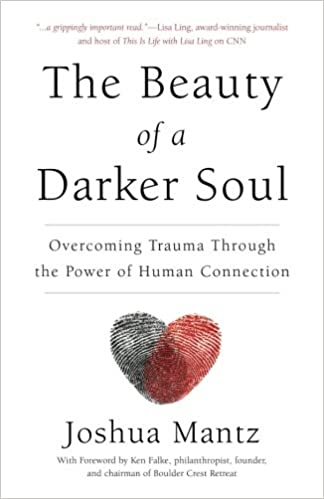
The Beauty of a Darker Soul, by Joshua Mantz

Why this book:  I met Josh Mantz several years ago when he was a guest speaker at an event I was organizing.  He came, he spoke, he impressed all of us.  Josh and I connected, became friends and have stayed in touch. He had given me a copy of his book, and I finally got around to reading it

Summary in 3 Sentences:  This is Josh Mantz’s story, beginning with a few brief chapters about his childhood and upbringing, describing his path through school to West Point to becoming an Army infantry officer, and ultimately to leading a platoon in a very violent part of Iraq in 2007. While there, an enemy sniper fired a high caliber round that went through and killed his platoon sergeant, before hitting Josh and severing his femoral artery. Bleeding badly, his platoon mates rapidly got him to the nearest medical aide station where he flat lined for 15 minutes while doctors and medics struggled to save him, finally detecting a pulse and bringing him back to life.  The second half of the book is about his recovery, and his efforts to continue to serve while still struggling with PTSD and other physiological and psychological challenges from his time in combat.   

My Impressions:   A short, captivating and very powerful read. I’m so glad I finally picked it up and read it. I found his entire story fascinating and inspiring. As an infantry officer, he studied counter-insurgency theory and as a leader of a combat unit in Iraq recognized that it applied to the work he was doing in and around Sadr City in Baghdad, the most violent and dangerous section of the city during the worst part of the war. He and his team were making significant progress building ties to the local police and Iraqis when a sniper’s bullet interrupted their operations, and his life.

 Josh’s life story had been one of succeeding by working harder and with greater focus and dedication than most others, and it usually worked for him – until it didn’t.  His life seemed to be one well-earned success after another, until he was shot in Iraq.  Josh applied his proven methods of focus and hard work to his physical recovery and amazed doctors and his team by returning to join them in Iraq just months after being shot, dying and being brought back to life.   But trauma and PTSD don’t succumb to simple hard work – they are much more complex than that.  

Josh learned that perseverance, hope, faith, patience, mentorship and support from others are essential to the healing process.  Josh’s story is about all these things,  built upon an amazing combat story, and his efforts to help others who have struggled with trauma – from battle or other sources.

Josh’s story of dying – his Near Death Experience is alone powerful enough to justify reading this book.  If you wonder what it might be like to know that you’re about to die, and then accept it and let go, here is one of the few who have had that experience and survived to be able to share it.   After letting himself go, and essentially saying goodbye to the world, when he woke up two days later, he remembered clearly everything that had happened to him before “literally everything faded to black.”  He describes a powerful and peaceful experience  – “the most peaceful experience of my life.” 

Josh shares how the convergence of good fortune and good people doing amazing work together led to the miracle of his survival.  He shares how his platoon and family reacted, and his months of recovery, and how after just a few months, he eventually, by hard work and a bit of bureaucratic conniving, made his way back to his men in Iraq, and continued to serve. But he was a changed man.

After his tour in Iraq was up and upon return to duty in the States, Josh continued to excel as he had before, with more focus, dedication, and hard work than almost anyone else. It was what had worked for him before, but again, he was a different man after his injury.   He initially stayed on track for advancement within his career, becoming aide de camp to a General officer and being given command of a Warrior Transition Unit, and eventually being sent to a graduate program to help his continued service and advancement.  Success and accolades kept coming.  But eventually he realized that working 16 hours a day was a coping mechanism to avoid dealing with the psychological residue and other issues relating to  his trauma.

Josh became a nationally recognized speaker and spokesman for the needs of soldiers to recover from trauma, speaking publicly in highly visible events and forums, impressing all who met him with his candor, humility, and willingness to share.  One of his primary goals was to take the stigma away from the struggles so many soldiers were having upon their return from combat.  

He described  what he and others refer to as moral injuries – feelings of shame, powerlessness, betrayal and guilt, to include survivor’s guilt, from decisions made and other experiences under the stress of combat.  Maintaining a grueling schedule on his speaking tour, he was still avoiding recognizing and dealing with the moral injuries he was experiencing himself.  Eventually he recognized his own pain and had to pull back.  While he was providing clear guidance to other soldiers and their loved ones about dealing with Post Traumatic Stress, and appeared to have it all together, he had difficulty following his own advice – until he found himself in a moment of severe personal crisis. Then he knew what he had to do – and reached out for help.

This is a powerful book, full of insights about life and death, success and struggle, and one man, connecting with and serving others who are similarly struggling, to find happiness and meaning after a severe traumatic event.  Josh has endured Post-Traumatic Stress and found Post Traumatic Growth.  He found not only pain, but also beauty, wisdom and insight in the struggle, and in this book, he celebrates the Beauty of a Darker Soul. 

Josh Mantz: “Giving someone the feeling that they’re not alone any more is one of the most selfless and courageous acts you can perform in this lifetime.”

Below is the TED talk Josh gave in 2015. In it, Josh tells a brief and powerful version of his story. There are other youtube presentations of Josh on Youtube, for those who have the time. 

Posted in Uncategorized | Leave a comment

Descarte’s Error, by Antonio Damasio

Why this book: Selected by Jay H’s reading group – an eclectic group of about 10 fascinating and curious people – baseball coaches, teachers, businessmen, veterans, consultants.  We met weekly to discuss this book – one chapter at a time.

Summary in 3 Sentences: In Descarte’s Error, Damasio argues against Descarte’s famous epigram Cogito, ergo Sum – “I think, therefore I am” to make the point that who we think we are, is much more than our ability to think and reason.  From many different directions, Damasio argues against the traditional mind-body dualism, that mind and body are fully integrated, and our existence is defined by much more and much more complicated than simply THAT we think. Our physiology and biology have a much greater affect on our thoughts, our sense of identity, our ability to reason, exercise judgement and make decisions than most of us realize. 

My Impressions: Damasio is a neuroscientist who has studied the brain and mind and explored the various bio and neural mechanisms that help explain how we think, decide, and behave. He describes Descarte’s error as the “dualist notion with which Descarte split the mind from the brain and the body…and the modern variants of this notion.” p247.  He says he wrote the book as an exercise to help him see if he could explain his insights and research in simple, non-medical terms to a lay person, and in so doing possibly find holes in his thinking.  Being that lay person, he only partially succeeded – I believe I understood his main points, but when he got into more detailed explanations, he often lost me. 

It is NOT a simple book to read, and I sometimes felt like a 3rd grader trying to read a book on – well – neuro-biology, but in parts,  his prose is clear and flows easily; in other parts I struggled to follow him. That said, I learned a lot – especially from the conversations we had in our reading group with smart lay people from multiple walks of life, many of whom also often felt like third graders reading Descarte’s Error, but each of us got different insights out of each “assigned” chapter that enriched our discussion. He certainly achieved his goal of convincing all of us that our thinking and decision making processes includes subtle (and some not-so-subtle) interventions from emotions and other biological functions, and that the human mind is much more complex than simply a bunch of interactions inside our brain housed inside our skull, operating independently of but supported by the body.

The main point of his book is probably summarized here: “The action of biological drives, body states and emotions may be an indispensable foundation for rationality …These lower levels maintain direct and mutual relationships with the body proper, thus placing the body within the chain of operations that permit the highest reaches of reason and creativity.  Rationality is probably shaped and modulated by body signals, even as it performs the most sublime distinctions and acts accordingly.”   p.200

He begins the book with fascinating chapters about two men who had significant injury to their pre-frontal cortices, who could think rationally, and one-on-one in-person, behaved in what seemed a perfectly normal way.  But after it was determined that in spite of outward appearances, their behavior was often irrational, their judgment was severely compromised, and their social interactions were destructive,  they were both studied extensively by doctors and psychologists.  Though both performed well on conventional tests of memory and intellect, this was not reflected in their decision making in real life.  They were emotionally detached from people, and often from the consequences of their decisions, and were unable to predict consequences (good or bad) from their decisions. Damasio points out that though many people try to take emotion out of decision making, these two men were living proof that emotional detachment from decision making  severely compromised the quality of their decisions. 

Damasio used the examples of these two men with apparently intact reasoning and rational faculties,  but who were dysfunctional in their social lives and dealing with the real world,  to show that for successfully adapted humans, there is much more going on in their thinking and decision-making than simply the ability to think logically. 

In his chapter Biological Regulaton and Survival he argues that “For most ethical rules and social conventions,” there is a “meaningful link to simpler goals and to drives and instincts. …Because the consequences of achieving or not achieving a rarefied social goal contribute (or are perceived as contributing) albeit indirectly, to survival and to the quality of that survival.” p125  Yep – our genetically driven biological imperative to survive and thrive is ultimately behind nearly all that we do. 

His chapter Somatic-Marker Hypothesis was for me the most interesting chapter in the book,  in that he explores how the body seems to have its own separate awareness and decision making capacity, and it subtly injects its subconscious insights and desires into our conscious minds and decision making.  He explores the “gut feeling” or intuition, that comes from outside our rational faculties to help us decide what to do – or in some cases decide for us,  when our brains are overwhelmed or acting too slowly to make a life-saving decision.  

He attributes intuition to the body, “the mysterious mechanism by which we arrive at the solution of a problem without reasoning toward it.” p188

He calls these bodily interventions into our thought processes “somatic” markers, after the Greek word for body – soma – and he notes that these somatic interventions increase the accuracy and efficiency of decision making – especially when we are faced with a decision with a possible strong negative outcome. Without the body’s subtle and sometimes not-so-subtle injection of itself into our decision-making, decisions would take an inordinately long time, or our careful and rational consideration of all options could inhibit decision-making entirely.

He points out that when faced with a wide variety of options, “a preselection is carried out for you, sometimes covertly, sometimes not.  A biological mechanism makes the preselection, examines candidates and allows only a few to present themselves for a final exam.” p189 This biological mechanism is part of our innate survival instinct, injecting itself into how we evaluate options and decide.

In his chapter The Body-Minded Brain he argues that “the body provides a ground reference for the mind, “(p223) and that  “when we see or hear or touch or taste or smell, body proper and brain participate in the interaction with the environment.” p224 The body is not merely a life support system for the brain – it is a fully engaged participant in how we think, feel, decide. 

In that same chapter he explores the neural basis for the subjective self,  discussing  the concept of “self,” stating that   “…the self is a repeated reconstructed biological state; it is not a little person, the infamous homunculus, inside your brain contemplating what is going on … not a central knower and inspector of everything that happens in our minds.” p217  What in fact is the self, after we deconstruct so much of what we personally identify with?  A complex question which Damasio spends some time exploring, but not really answering, noting that “today there are plausible if not yet proven hypotheses for the neural basis of the self.” p244  Sam Harris, whose podcasts I listen to frequently, will say that the “self” is an illusion, an artificial construct of all the processes that Damasio describes, that together, give us a “sense” of self and identity.

Several times in the book, he wants to ensure that we do not regard his theories as a purely mechanistic explanation of human behavior and accomplishments. “Realizing that there are biological mechanisms behind the most sublime human  behavior does not imply a simplistic reduction to the nuts and bolts of neurobiology.  In any case, the partial explanation of complexity by something tells complex, does not signify debasement.” p125-6

This is a fascinating book, but not one that can be read quickly.  Each chapter is full of insights and challenges.  I liked reading it with others, a chapter at a time. As a result, I now have a much better appreciation for how my brain operates, how my body is engaged with my brain and the many factors that unconsciously determine how I feel, and how I arrive at decisions.  I also have a much better appreciation for how complex the brain and mind are – and how little even the best neuroscientists understand of how it works.   

Posted in Uncategorized | 1 Comment

Wolf Hall, by Hilary Mantel

Why this book: Selected by my literature Reading Group based on excellent reviews and having won the Man Booker Prize. 

Summary in 3 Sentences:  Historical novel set in the early 1500s in England, built around King Henry VIII’s desire to divorce his wife of 20 years,  in order to pursue his infatuation with Anne Boleyn who he hoped would give him a male heir.   The central figure in the novel is Thomas Cromwell a man of working class background,  but who has become a trusted attorney and facilitator within the English court and who is somehow involved in all aspects of the King’s efforts to divorce his wife, and ultimately divorce England from Catholic church.  The author did an immense amount of research to ensure her novel is consistent with what is known from the history of that era, and she makes Thomas Cromwell a fascinating figure, deftly maneuvering in a world of political and sexual intrigue and the rise and fall of large egos, during a period of major transition of England from Catholic to Anglican Christianity.

My impressions: Wolf Hall is beautifully written, but not easy to read.  The story is complex, with a large caste of characters – so large in fact that I regularly referred to the list of characters at the beginning of the book to help me recall who many of them were.  In my reading group, some chose not to finish it – having struggled to follow the rather intricate plot, taking place among the multiple factions with vested interest in the outcome of King Henry’s desire to annul his marriage in order to make Ann Boleyn his queen.

The story of Henry VIII and Anne Boleyn is well known to many; HOW Hilary Mantel tells it is what makes this version stand out.  The true majesty of the book, and clearly why it has received its awards and so much positive recognition is in the quality of the writing, the author’s deep understanding of how people think and interact, and how she imagines the conversations between the articulate, intelligent, well educated, but often self-centered ambitious characters in the book.  I was continuously amazed at her insights and nuance that emerge from the conversations she describes.

I was not terribly familiar with the story of King Henry VIII, Katherine of Aragon, Anne Boleyn, and Sir Thomas More, though in Britain it is very well known.  Indeed I found  getting inside the story fascinating on multiple levels:

  • The political intrigue and maneuvering for power and influence is a familiar theme and resonates to this day;
  • the relationship between secular and religious authority was a key issue then – not so much now;
  • the role and power of the Catholic Church in Renaissance Europe,  and how its corruption cost it in credibility, and led to the power of the Reformation; 
  • the disruption caused by Martin Luther to European civilization, and how and why it was so controversial to translate the Bible from Latin into languages which the common people could understand; 
  • how different life was before electricity, and the many modern conveniences which we take for granted, but at the same time, the human issues remain very familiar;
  • the indicators of the transition of rule by fiat of a king, to rule by parliament and law are evident here. The King was frustrated that he couldn’t just do what he wanted; 
  • the helplessness of so many – the rich and the poor – in the face of the ravaging effects of disease and plague.  Cromwell lost much of his family, and getting sick was often a death sentence;  
  • and though we don’t read in Wolf Hall much of how the poorest people lived, even the wealthy and the aristocracy lived lives that we today would not envy. 

This is not a quick or light read.  To read Wolf Hall one must be patient and prepared for a deliberate and more subtle pleasure.  It is not “fast food” literature.   It must be read patiently and savored. I found I enjoyed it most when I read it in the morning when I was fresh; reading it tired and distracted late in the evening just didn’t work well for me.  In the end it was very much worth it for me. 

A number of themes rang out in the book.  Thomas Cromwell is the centerpiece and “hero” of the book, and is a model, and a modern character in many ways.  He was a commoner who rose to be one of the most powerful men in England, but was still looked down upon and resented by the well-born from the ancient and aristocratic families of England.  Mantel makes him into a reasonable, and practical man, compassionate and generous, but also very clever and politically astute in subtly accruing and retaining power and influence.  He was always very controlled and deliberate.  We get to know him well, his inner life, his doubts and conflicts.

But for him, personal survival and attaining the resources and influence to take care of his family and those closest to him was his primary objective.  Though loyal honest and often selfless, he still knew how to win the trust of those he needed, in order to protect his interests, and seemed always to land on his feet. Thomas More said of him:  “Lock Cromwell in a deep dungeon in the morning, and when you come back that night, he’ll be sitting on a plush cushion, eating larks’ tongues, and all the jailers will owe him money.” (p561)

In contrast to Cromwell we have the greedy but charming sensualist Henry VIII, the ambitious, cold and calculating Anne Boleyn, the many clumsy older Dukes and nobles of the English aristocracy, Cromwells first boss and sponsor, Bishop Wolsey, as well as numerous friends and enemies in the shark tank of the King’s court.  But most importantly Wolf Hall portrays Cromwell’s relationship with the cruelly principled Thomas More, the deposed Archbishop of Canterbury, who was zealously committed to the rightness of his principles and exercised his authority and conviction in a merciless “grand inquisitor” style.  The final part of the book pits Cromwell’s pragmatism against More’s very stoic principled view of life, and we the readers are left admiring both, but clearly the author’s favorite is Cromwell. 

In reading this book, it is useful to review the excellent summaries on Litcharts.com, as well as the background and character analysis they offer. Also, the PBS series based on the novel is very well done and complements the reading of this intricate novel quite well.  

I highly recommend Wolf Hall for the discriminating reader. 

———–

Some examples of the excellent writing which so impressed me: (page numbers refer to the paper back edition pictured.)

At court and in the offices of Westminster, he dresses not a whit above his gentleman’s station, in loose jackets of Lemster wool so fine they flow like water, in purples and indigos so near black that it looks as if the night has bled into them…p317

A man’s power is in the half-light, in the half-seen movements of his hand and the unguessed-at expression of his face.  It is the absence of facts that frightens people: the gap you open, into which they pour their fears, fantasies, desires.  p331

When he is admitted, she is pacing, her hands clasped, and she looks small and tense, as if someone has knitted her and drawn the stitches too tight.  p344

The world is not run from castle walls, but from countinghouses, not by the call of the bugle but by the click of the abacus, not by the grate and click of the mechanism of the gun, but by the scrape of the pen on the page of the promissory note that pays for the gun and the gunsmith and the powder and shot.  p349

“…it’s just that you are practiced at persuading, and sometimes it’s quite difficult, sir, to distinguish being persuaded by you from being knocked down in the street and stamped on.”  p406

..It is a lie so staggering that he has to admire it.  p420

She is a mouse under the cat’s paw.  p446

There’s a feeling of power in reserve, a power that drives right through the bone, like the shiver you sense in the shaft of an ax when you take it into your hand.  You can strike, or you can not strike, and if you choose to hold back the blow, you can still feel inside you the resonance of the omitted thing.  p479

(Thomas More to Cromwell:) “This relentless bonhomie of yours. I knew it would wear out in the end. It is a coin that has changed hands so often. And now the small silver is worn out, and we see the base metal.” p526

“Bishop Gardiner will be burning up inside.  His giblets will be sizzling in his own grease.” p530

“See these quails? You get more meat on a wasp.”  p530

Rafe says.. “I am violently in love with her”  “How does that feel? Is it like being violently angry?”  “I suppose. Maybe. In that you feel more alive.”  p531

…there is another landscape; there is a buried empire…all those unseen dead who hover in winter around forges and village hearths, trying to warm their bare bones. For they too are his countrymen: the generations of the uncounted dead, breathing through the living, stealing their light from them, the bloodless ghosts of lord and knave, nun and whore, the ghosts of priest and friar who feed on living England, and suck the substance from the future.  p534

The duke rants… You should have sent young Fitzroy to Dublin, he tells the council. An apprentice king – make a show, stage a spectacle, throw some money about.  p543

If Anne were my wife, he thinks, I’d go out for the afternoon. She looks haggard, and she cannot stay still; you wouldn’t trust her near a sharp knife. p552

The women laugh, but their laughter is cold.  p 559

“Mary wants money. She says, she knows she should not have been so hasty.  She says, love overcame reason.”  “Love, was it?” p560

(Thomas More’s wife about her husband:) “…he wore a shirt of hair beneath his linen. He did so when we were married and I begged him to leave it off and I thought he had. But how would I know? He slept alone and drew the bolt on his door. If he had an itch I never knew it, he was perforce to scratch it himself.” p 562

He is tired out from the effort of deciphering the wold.  Tired from the effort of smiling at the foe.  p569

Posted in Uncategorized | Leave a comment

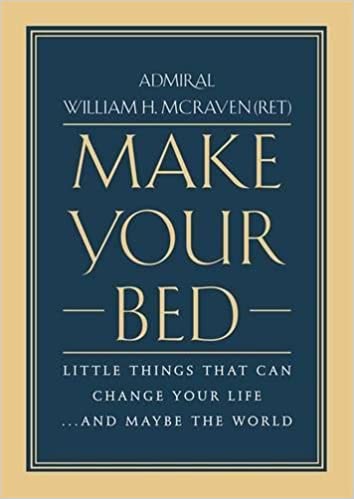
Make Your Bed, by Admiral Bill McRaven

Make your bedWhy this book: Selected as a book to discuss by the group of young men I meet with who are preparing to begin SEAL and SWCC basic training.  One of them had read it and said it would be a really good one for us to read and talk about. He was right.
Summary in 3 sentences.  This book is an expansion on the speech Adm Bill McRaven gave as the graduation commencement speaker for the University of Texas in 2014 which went viral and became an internet hit.  He offers the graduating seniors 10 lessons he learned during his career in the SEALs that may help them in their lives after graduation, in whatever field they go into.  Each lesson is from his SEAL experience, and begins with “If you want to change the world…..”

My Impressions: This is a  short, fun-to-read book that captures highlights of the wisdom  that Bill McRaven gleaned from his 36 years in the Navy, amplified by some great stories that drive home the lessons he intends to impart.  It is not an academic or pretentious book – very down to earth – and he tells simple stories from his life in the SEAL Teams and translates the lessons to apply to any walk of life.

Most of the 10 chapters begin with a story from his time in Basic Underwater Demolition/SEAL (BUD/S) training, with an instructor making him or his boat crew do something that they really didn’t want to do, but they did it anyway – because in order to become SEALs, they had to.  It wasn’t pleasant, but Bill shares why and how bearing down and completing as best he could these unpleasant tasks taught him lessons that helped him succeed throughout his career.

There are ten chapters in the book, each entitled with the lesson that chapter will impart, such as,  “Chapter One: Start Your Day with a Task Completed.”  And then each chapter gives a specific action to fulfill that lesson – “If you want to change the world….Start off by making your bed.” And then he launches into the stories that support that lesson.

Another example: “Chapter Five: Failure can make you stronger.  If you want to change the world…Don’t be afraid of The Circus.”   In the chapter he explains “The Circus” as a punishment meted out to BUD/S trainees who did not meet instructor standards.

Or “Chapter Three: Only the Size of your Heart Matters.  If you want to change the world…measure a person by the size of their heart.”  And here he goes on to tell a story from SEAL training how often the little guys, the ones who didn’t look like Hollywood’s version of a Navy SEAL, were often the ones who succeeded, while the biggest and the strongest often weren’t there at the end. That was also my experience.   Some of the most athletically gifted didn’t have the heart, the grit, or the desire necessary to get through the tough challenges of SEAL training. .

The beauty of this little book is in it’s simplicity.  It is short, easy and enjoyable to read, and profound in the lessons taken from the challenges one of our nations most prominent military leaders faced as a young man and what he learned from them to help him succeed in serving our nation.  How he applied his insights to overcoming challenges large and small offers wisdom that anyone in any walk of life can relate to. The final chapter is “Never Ever Quit. If you want to change the world….Don’t ever , ever ring the bell.”

At the conclusion of the book,  he includes the full text of his speech at the 2014 University of Texas commencement which inspired the book, and helped launch Adm Bill McRaven’s post-Navy career as an inspirational leader in the world outside the military and the Navy SEALs.

My good friend YK, an experienced and well educated  banking executive, tells me that she loves Make Your Bed,  as it picks her up and inspires her after a long day of dealing with difficult people and difficult issues.  It also inspired my young SEAL candidates, nervously preparing for basic SEAL training. And it inspires me as I deal with my own challenges, as a middle aged man making his way in a rapidly changing world.

It is a book I will gift to friends – it is short and easy enough to read that my non-reading friends will probably read it, enjoy it, be inspired by it, and gift it to others.  If you want to change the world….gift an inspiring book to those who will read it and learn from it.

———–

Bill McRaven is a friends of mine – I admired him when we served together during our careers in the SEALS, and I admire him even more today for his sacrifices and successes as a leader as his career continued, and mine was over. I also admire his courage in speaking up for what he believes in and subjecting himself to a lot of criticism.  So when our reading group selected this book, I reached out to him and asked him if he could join our discussion, answer questions from the young men and share his wisdom and insights with them directly.  He agreed and for an hour on Zoom, Bill answered questions about  some of his stories in the book, shared a few additional stories that reinforced his points, and answered questions about serving in combat that were not addressed in a book written for general consumption.  It was a great session, he was full of his characteristic positive energy and passion and he inspired these young men with simple lessons and wisdom that should help them succeed at whatever they end up doing – hopefully becoming Navy SEALs.  It was fully characteristic of him to willingly give up an hour of his time in the evening to meet with a group of young men who aspire to be better.

Posted in Uncategorized | Leave a comment

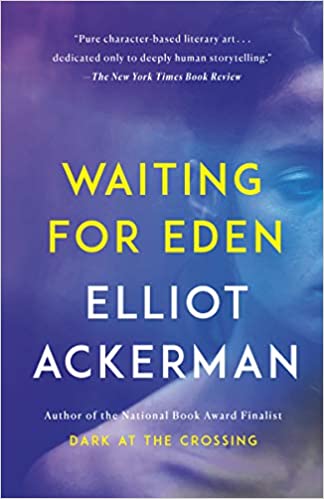
Waiting for Eden, by Elliot Ackerman

Waiting for EdenWhy this book: Suggested by my friend Janar in my reading group, as a short and powerful book.  We selected it as an optional addition to our longer selection for August.
Summary in 3 sentences: Two good friends and lance corporals in the marine corps are in a humvee that hits a landmine in the Hamrin Valley in Iraq – one of them is killed and the other severely burned and injured.  This story is told by the one who was “lucky” – the one who was killed,  as he observes from the “other side” his friend Eden barely conscious, severely burned and wounded, unable to speak, confined to a hospital bed, and he relates stories about their lives from before they deployed into Iraq.    A central character in the book is Eden’s wife Mary, how as now a single mother, she deals with having a husband who can’t be a “husband” and father, her guilt about her feelings and for some things in their relationship before he deployed.

My impressions:  Short very powerful and impactful.  Not a happy uplifting story, but a story of courage – Eden’s in some cases, and Mary’s in some cases – good and poor decisions they made, and how to live with moral and existential dilemmas that can’t be escaped. Our narrator dispassionately describes what he observes and gets into Eden’s and Mary’s heads, and we see how hard it is for husband and wife to accept and come to grips with their current reality.  It is a short novel – 125 pages of large print on small pages with short chapters – more a novella than a novel.  It is very well written. For the power and impact of this novel – it is very much worth the limited time and effort to read it.

This book reminded me in many ways of Johnny Got his Gun by Dalton Trumbo which I read maybe 50 years ago, about a soldier wounded in war, and left in his hospital bed, with no arms, no legs, blind, deaf, and unable to speak.  Only able to feel.  But fully conscious – and we experience his impressions of his very limited world.  Eden was similar, but burned as well, and not completely mentally coherent – in and out of clarity.  His world was vague impressions of what was happening in his hospital room, and some dreams and a few horrible hallucinations.

The narrator was watching all this from  “the other side.”  He would occasionally enter Eden’s dreams and he and Eden would converse – but he was “waiting for Eden” to die and join him.  He relates that he doesn’t know what would happen then – would they go to another dimension? Something else? But for the time being, he was “waiting for Eden.”

Eden’s wife Mary is actually the central figure in the book.  She is the heroine.  She is young, attractive, from a blue collar background, leads an exercise group in a local gym. She married Eden soon after the joined the Marines, with dreams and desires typical of young women anywhere.  And then after his 1st combat tour to Iraq, he changed and things changed between them – and she didn’t understand.  She tried to talk him out of reenlisting and going back. She got pregnant before he left.   Then an impossible situation was forced on her. She had to make and live with decisions she had made before he deployed, and then must deal with the reality of her husband returning a mere shell of the man she had married.   She is a powerful figure.

This is a short book and one I won’t soon forget.  I highly recommend it.

Posted in Uncategorized | 2 Comments

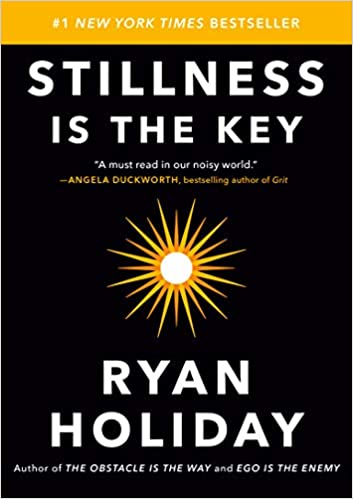
Stillness is the Key, by Ryan Holiday

StillnessWhy this book: Strongly recommended by Peter Attia on his podcast and I’ve listened to interviews with Ryan Holiday (author of The Daily Stoic, Obstacle is the Way, Ego is the Enemy) on other podcasts and he impressed me. Attia says this is the book he has gifted more than any other and he’s read it several times.  Good enough for me.
Summary in 3 sentences: This book has a simple message that the author skillfully and beautifully approaches from many angles and with many anecdotes, quotes and stories of people we’ve all heard of. That message is to slow down, seek quiet and stillness by separating from the noise and busy-ness and pay attention to who we are, how we are living, and what is going on around us.  He sneaks in other related insights to living well  – like seeking virtue, get a hobby, get enough sleep, appreciate beauty.  The book is short, easy and enjoyable to read and full of the wisdom of the ages for living well in busy and complicated times.

My impressions:  A wonderful little book – short, engaging with short chapters, full of great insights and wisdom – which we all need to be reminded of regularly.  He starts (p 2) with a quote from Blaise Pascal in 1654 “All of humanity’s problems stem from man’s inability to sit quietly in a room alone.”  He reminds us that thinking requires silence. Thinking deeply means regularly experiencing silence and stillness.

Holiday says “The premise of this book is that our three domains – the mind, the heart, and the body – must be in harmony.   The truth is that for most people not only are these domains out of sync, but they are at war with each other.” He divides Stillness into three sections – Mind, Spirit, Body, and addresses various aspects of his theme in the appropriate section.

Some parts of his message don’t quite seem to fit into the “stillness” theme, but I didn’t mind – his advice and stories were wise and useful, and all connected to living better in our busy complicated world.  His chapter titles offer insight into his approach:  Become Present, Slow down/Think deeply, Cultivate Silence, Start Journaling,  Choose Virtue, Seek Wisdom, Heal the Inner Child, Conquer your Anger, Take a Walk, Build a Routine, Find a Hobby, etc.

The chapters are short and easy to read. I found myself reading one or two in the evening before I went to sleep. Great insights and inspiration to consider before turning out the light.  Slow down, smell the roses, recoup your energy for those times when we need to have our wits about us to fully engage in our job, our community, the world to be at our best. Be wary of too much noise, activity, fun, excitement – Be wary of being too busy, stretched too thin, too distracted.   His message – we need intervals of sitllness, to be quiet, to pay attention to what is going on around us, and to remember who we are.

He spices up his chapters with stories and examples,  both positive and negative,  from the lives of well known people and historical figures, to include President Kennedy, Churchill, Tiger Woods, Fred Rogers, Leonardo da Vinci, Emerson, Anne Frank, Thomas Merton, and many more.   The book is treasure trove of great quotes to live by.  Fred Rogers: “The child is in me still…and sometimes not so still.”

He points out how the best CEOs recharge during their down time, by seeking silence – a quiet place with an absence of voices, media, and stimuli.  They recognize that they need a space to be out of the spotlight and under no pressure to perform, not having to make the tough calls, to be comfortably engaged and recharging, to let their inner wisdom bubble up.  “Stillness is no an excuse to withdraw from the affairs of the world.  Quite the opposite – it’s a tool to let you do more good for more people.”(p. 249)

He encourages us to seek wisdom by reading,  to access the insights and perspectives of the wisest people who have ever lived.  I would add, listening to podcasts to listen in on  conversations between some of the wisest and most interesting people alive today. That in fact is how I have been introduced to some of the best books  I’ve read recently — to include this one – listening to podcast interviews with the authors.

He warns us against focussing too much on our goals, and missing the joys in the process.       The process is life – attaining the goal is a short duration pleasure.  So he advises us to embrace the process, the individual steps on the journey, on the climb up the mountain. If we put all our hopes and dreams in summiting the mountain, we miss the joys along the way – and if we don’t summit, the trip has been a failure.

He uses the wonderful example of those who are so busy trying to capture that perfect picture of the sunset, that they miss savoring the beauty of the sunset.  The magic is in the moment of joy and beauty in watching the sunset.  The picture is but a cheap substitute.

In his chapter “On to the Final Act,” he tells us that “Seneca reminded himself that before we were born, we were still and at peace, and so we will be once again after we die.  A light loses nothing by being extinguished, he said, it just goes back to how it was before.” (p. 256) This resonated with me, after having jus posted my blog post  “200 days..”

There is so much wisdom, joy, and insight in this little book. Now that I’ve finished writing this review, I’l put it back on my nightstand to read again, a short chapter at a time, as I savor the Stillness I find, at the end of the day, as I’m preparing for the stillness of sleep.


Posted in Uncategorized | Leave a comment

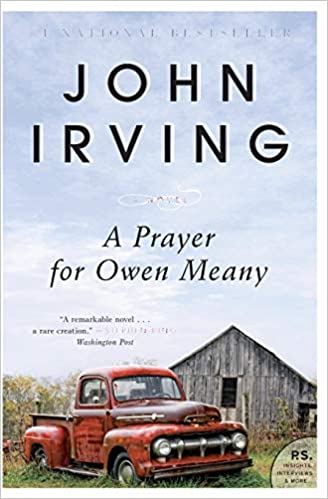
A Prayer for Owen Meany, by John Irving

Owen MeanyWhy this book: I’ve heard about it for years. I had enjoyed reading Cider House Rules a few years ago and wanted to read another John Irving novel.  Finally my reading group selected it for our August 2020 discussion.
Summary in 3 sentences: A coming of age novel told in the first person by Owen Meany’s best friend growing up in a small town in New Hampshire in the 50s and 60s,  to include a retrospective from the narrator 20 years later.  Owen Meany is a truly unique character in the following ways: very short and slight, a peculiarly high pitched, loud and obnoxiously scratchy voice, unusually intelligent, proud, opinionated, and articulate.  The story follows our narrator and Owen Meany’s lives from about age 10 until they are in their early 20s, looking at their lives and what was going on in America and the world, from their perspective as small town New Englanders maturing during a period of great change and upheaval in American culture.

My impressions: Very interesting book.  It meanders a bit,  and John Irving often   digresses into stories which add depth and perspective to his main characters, and provide humorous satire to small town New Hampshire living, but there were indeed times when I lost a bit of patience with the long digressions.  But I stuck with it and I’m glad I did.  And in the end, it all pretty much came together – as these sometimes seemingly pointless digressions actually play an important role in the totality of the story.  So many fascinating issues get brought up in this book with multiple subplots and themes and some fun and interesting supporting characters to John Wheelwright the narrator, and Owen Meany -the two main characters of the book.

The contrast between Owen Meany and John Wheelwright the narrator is pretty significant.  Owen Meany is clearly the stronger character of the two, self-aware and self confident, with a sense of purpose, direction, and a fatalistic detachment from issues big and small.  Wheelwright is timid and self-conscious, and basically lets himself be led by a strong personality – which usually is Owen Meany in this book.

Some of the topics and themes of the book that I look forward to discussing in my reading group are:

Small town New England life in the 50s and 60s.  Amusing but insightful look at small town living anywhere,  but especially in relatively isolated parts of America during a period when there wasn’t much input from outside their world. Television was in its early days and not everyone had it.  A train could get you to Boston a couple of hours away, but that was a big trip.  And as in most small towns, the controversies and feuds were vicious because the stakes were so small – which church would host a community event, who would play what part in the annual Christmas pageant, etc.  And then the issues of the outside world intrude to disrupt the insulated world of Gravesend, NH, in the form of the Vietnam War and the cultural disruption of the 60s.

Religion  – Catholics, Episcopalians, Anglicans and their individual prejudices and idiosyncrasies are all subject to affectionate criticism and satire.  Both John Wheelwright and Owen are regular church goers – a huge part of small town New England culture in that day.  Owen is a “believer” with a strong faith, but not afraid to criticize mindless convention and dogma, while John is a wishy-washy, along-for-the-ride agnostic.  The issue of “faith” is a constant in the book – Owen had it, most others didn’t – including the town’s religious leaders.

God, faith and fate Owen had complete faith in God’s will and that events that happen are not random  – they fulfill God’s purpose.  This was THE key driver in his life, which gave him his self -confidence and sense of perspectives and purpose. Others who didn’t have it, like John Wheelwright drifted from decision to decision.  It is almost unsettling  how clearly Owen describes and declares his faith and his fate – which he holds on to in spite of getting no support from friends, relatives, church leaders.   That said, at the end of the book, one senses that John Wheelwright’s life may have been as predetermined as Owen’s – though he didn’t have the wisdom to see it.

Counter-culture, protests and the Vietnam War – big issues for the US in the 60s and they are an important part of this book, which was published in 1989.  But as I read about the craziness of the anti-war protests, and the counter-culture movement of 50 years ago, I couldn’t help but see parallels with the disruption we see in today’s protests against racism and inequality, agains white-male privilege, and how many peripheral groups are taking advantage of the chaos and unchecked passion that these often well-meaning protests enable. Then as now, young people feel compelled to get involved and take a stand against something that they  see as clearly wrong, without giving careful considerations to the many nuances and challenges in forging a constructive way forward.  Therefore, then as now, they are ready to take drastic and dramatic action to make their points and bring attention to their grievances – which often have negative consequences they don’t foresee.  That was true in 1968 as it is in 2020.  Young impassioned idealists, against the establishment – in some ways it’s almost a re-run – but today we have social media and a 24 hour news cycle fanning the flames.

Adolescent male sexuality always a great topic for humor and satire, and the coming-of-age experiences of these two young men include a fair amount of humor. The posturing and sex-infused language of Owen’s and John’s school age buddies is always good for a laugh.  This was the era I grew up in – when good girls didn’t “do it” and most guys and girls graduated from HS as virgins.    Sex seemed to be a right of passage into respectability and adulthood for guys, who in a hurry to be perceived as “men” typically postured, and pretended to understand things that they were secretly scared to death of. This all seems rather quaint today, because beginning in the 70s, a much larger percentage boys and girls are sexually active in high school – for better or worse.

Nostalgia in movies and early TV.  The period of this novel is the same as when I and my wife were growing up, and the movies and TV shows that Owen, John, and John’s grandmother watched were very familiar to us, and evoked a smile of familiarity – “yeah, I used to watch that when I was a kid.” There were not nearly so many choices as today, so we all grew up watching most of the same shows,  but also there was no 24 hour news cycle fueling outrage, fear, and discontent.

The paranormal  Owen possessed a ‘second sight” which was a subtle theme throughout the book. Owen seems to tune into his parapsychological capability regularly, but doesn’t share much of that with his best friend, or with anyone else – this was part of the mystery of Owen Meany.  At the end of the book, John comes to recognize and appreciate Owen’s “gift” which he says helped him to find his own faith in God as well.

Death and Fear – hard to talk about this without doing a spoiler alert, but early on, Owen has a vision that foresees his own death, and he is absolutely convinced that the vision and what it told him were ordained by God. He completely believes in the vision and how he lives with this knowledge is an important theme of the book.     He knows how much time he has, and this insight allows him to remain detached from issues, annoyances, fears and frustrations that would dramatically disrupt the self-confidence and equanimity of most of us.  He does not share much of this insight with his best friend John- John is simply amazed at how Owen deals with the challenges that come his way.

My wife and I enjoyed reading this book together, and talking about it as we read it and after we had both finished it. Though I wouldn’t call this a book about religion and faith, these issues are certainly important in the lives of the main characters, and the issue of destiny is certainly a primary theme. My wife noted some of the interesting religious symbolism that I missed.  This will be a fun discussion in our reading group.  I recommend it –  to anyone interested in a different, fun, and sometimes idiosyncratic novel – not altogether unlike it’s main character – Owen Meany.


Posted in Uncategorized | 2 Comments

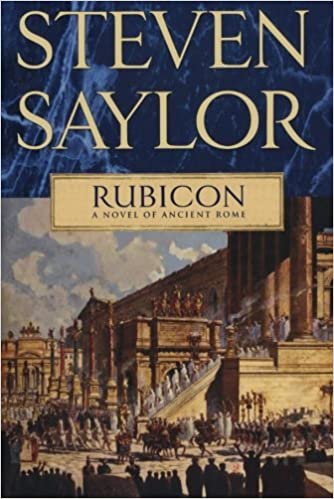
Rubicon, by Steven Saylor

RubiconWhy this book: I was looking for a “light” and enjoyable read and this book had been recommended to me many years ago.  I have also listened to Dan Carlin’s fantastic series “Death Throes of the Republic” which covers the lead up to the end of the Roman Republic, when Ceasor made himself emperor.
Summary in 3 sentences:  During the period when Pompey and Julius Caesar were preparing to do battle over the soul of the Roman empire, a close relative of Pompey is murdered on the estate of our protagonist.   Pompey takes our protagonist’s son-in-law as collateral until he can identify the murderer.  The story is a first person perspective of our protagonist, who also has a son who is a key member of Julius Caesar’s staff.  During the course of our protagonist’s investigation into Pompey’s relative’s murder,  we learn about Roman culture at that time, the chaos inside the city as people flee, it’s future is in doubt, how people lived and interacted, and how our protagonist carefully navigates the delicate politics between these two rivals.

My impressions: This is who-done-it that takes place in Rome during the window when Julius Ceasar has crossed the Rubicon and is about to take over Rome and become emperor, essentially spelling the end of the Roman Republic.  We see the world of Rome through the eyes of Gordianus, a Roman attorney who has been able to remain essentially neutral in the tension between Caesar and Pompey.  But when one of Pompey’s relatives is murdered on his grounds, he can’t stay neutral any longer and has to put himself on the line.  He must get involved in the deceit and intrigue and maneuvering for power, influence and money that inhere in such turbulent and uncertain times.  Through him we learn about what was happening in Rome in this chaotic time, as well as things about Roman culture.

It’s a good and fun read, not very long, apparently well researched.  Reading this during  the COVID Pandemic helped me realize that our panic is small potatoes compared to being on the edge of a civil war, with all the people of means fleeing the city for their lives, assuming that whoever wins between Ceasar and Pompey, there will be wholesale slaughter in the city.  Gordianus nicknamed  “the finder” is called upon and forced by Pompey to resolve a problem that has no good solution, and he and his family are at great risk, almost whatever happens.

I learned a few things about slavery in Rome.  Gordianus’s “children” were all adopted slaves.  His “son” who was a close associate of Caesar’s was an adopted slave.  One of Pompey’s key associates with whom Gordianus travelled to see Pompey was a freed slave.  Gordianus had two small boys in the house he was raising who were slaves that he expected to adopt.  The title “citizen” in Rome was a title that gave one real privileges.   Traveling through the country side in order to link up with Pompey’s forces fleeing Ceasar, we get to know something of rural Italy during this window, the taverns, the roads, how people travelled and lived, their fears of the soldiers. In their conversations and dialogue we learn of their beliefs, their religion, their fears, their hopes.

The ending is climactic and surprising, and leaves the door open to the sequel, Last seen in Massilia as Gordianus must continue to dance between multiple forces, and this time to connect with Caesar’s forces.


Posted in Uncategorized | 1 Comment

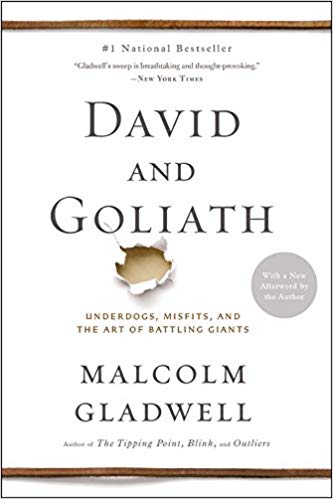
David and Goliath – Underdogs, Misfits, and the Art of Battling Giants, by Malcolm Gladwell

David and GoliathWhy this Book: Selected by my young SEAL gonnabes reading group for our group selection

Summary in 3 sentences:  The title tells the story – an amazing collection of stories of people who overcame great odds to succeed – sometimes choosing to take on great challenges – as David did in taking on  Goliath – and other stories of people being forced into situations when the odds were stacked against them.  The book is full of great stories of “unlucky” people being handed a raw deal, but then struggling and learning, developing more resilience and self discipline than their “luckier” peers, and turning a disadvantage into a life advantage.  The concept of desirable difficulties is key to this book and how some of our most successful people have chosen to make bad luck a springboard to great success.

My Impressions:  Like all of Malcolm Gladwell’s books I’ve read so far, this one is written to be very readable and engaging.  Great stories well-told,  make a series of points – built around the idea of reframing a problem, and that  “desirable difficulties’ – can lead to great success.  He gives many examples of people making an impediment a challenge, and then rising to that challenge to then because of the strength they developed in overcoming that challenge, then succeeding in a larger arena.

There were a number of take-away lessons from the book, apart from the inspiration that comes from reading stories of courage, persistence and intrepidity in the face of overwhelming odds.  One is the competitive and survival advantage of a growth mindset.   Being willing to consider possibilities apart from the standard, apart from the tried and the true. This was the case in the David and Goliath story; Goliath expected to be fought in the traditional way, and was defeated by an unconventional approach.

He made the distinction between success built on capitalizing on one’s strengths, and success built on compensating for one’s weaknesses. He wrote about how a disadvantage can become an advantage.   The  “desirable difficulties” he writes about  force young people to adapt and grow and become more resilient.  He told how several very successful CEOs – an amazing percentage – are dyslexic.  To succeed in school and life, they had to find ways to overcome their dyslexia, and they had to have patience and perseverance in the face of repeated failures due to this competitive disadvantage in school.   These adaptive mechanisms served them well in later life.

He noted that many people are afraid of being afraid, but that overcoming fear can be exhilarating.  Many of those who find the greatest joy in life seek challenges where they can overcome their fear and experience that exhilaration.

Another disadvantage that in several of his examples was turned into an advantage was poverty – and the work, discipline, and patience that it took to overcome poverty served a number of his “Davids” well in the stories he told.

He told a story of a woman who chose the traditional route to success by opting in to the most competitive environments, and was unable to keep up with the most talented, and so gave up her dream and the possibility of making great contributions. She wishes she had chosen to be a bigger fish in a smaller pond.

He told a story of how people in London persevered during the bombing of London during WW2 by believing in their own invulnerability after having survived numerous “near misses.”  My Army SF counterpart related to that story by sharing how many times he was nearly shot in combat, noting that the more often they missed, the less afraid he became.

We read of the story of how the civil Rights movement grew out of the patience of one of Dr King’s allies coupled with the aggressive take-no-prisoners approach of another.

We read of how the Irish Catholics in Northern Ireland responded to the overbearing crackdown by the British Army, by standing up to power and illegitimate authority.

We read of how Mike Reynolds changed the laws in California regarding prison sentences for criminals after his daughter was murdered.  And then how these stricter sentencing laws may have backfired, after sharing different approaches to criminal punishment in Canada and the Mennonites.

He wrote about courage, and how self-confidence and courage are mutually supportive.  Courage breeds self-confidence and vice versa.  He referred to Aristotle’s notion of courage and that it is a virtue that is earned. In order to become courageous, we must put ourselves at risk and be courageous.  We develop courage by doing courageous acts.

When we discussed this book in our reading group, my partner, an Army Special Forces officer posed the question to each of the young men there: What is your Goliath?  What is the thing you are afraid of that you most overcome, that may stop you from fulfilling your dream of becoming a Navy SEAL?    The answers were telling and very human – and these young men made themselves vulnerable to each other by sharing what they were afraid of.

A weakness of the book is that it doesn’t hang together all that well. These are great and inspiring stories of people showing great character, resilience and fortitude under adverse circumstances and achieving great things.  But some of the stories seem to bear little resemblance to each other – the type of courage, resilience, and persistence shown in very different circumstances.  But that is a quibble.  I really enjoyed the book – perhaps not the most academically tight argument, but entertaining and inspiring.

Posted in Uncategorized | Leave a comment

Sea Stories – my life in Special Operations, by Adm Bill McRaven

Sea StoriesWhy this book:  I know and admire Adm Bill McRaven  – we were contemporaries in the SEAL community and I was looking forward to reading his story.

Summary in 3 sentences This is not an autobiography nor a memoir – it is indeed a series of stories, in chronological order from Bill McRaven’s life.  But the stories tell a larger story about not only what made Bill who he became and is, but also about how our country has prosecuted the War on Terrorism.    He shares a few stories from his childhood that were foundational for him, then on to a stories from SEAL Training and his earlier years in the SEAL Teams –  key stories about life in “the Teams, and what prepared him for the stories in the second half of the book – after 911 and his time with the Joint Special Operations Command and his role in key events in our War on Terrorism.

My Impressions:  Very Well Done- not only thoroughly enjoyable to read, but it offers great insights not only into what shaped Bill McRaven’s life, leadership and decisions, but also into how our country makes key decisions in the strategic employment of special operations forces in our world-wide fight against terrorism.   The stories are very well told and provide a key piece of the puzzle of what made Bill McRaven into the leader and man of principle he became over a lifetime.  Most readers will be most interested in his stories from when he was leading at the cutting edge of our War on Terror after 911, but the stories that lead up to that are not only engaging and fun to read, but also help put the man in context, as we see how one of the great military leaders of our generation got to be that way.

The extensive dialogue he provides to these stories is  as he best remembers it, and (I’m sure) much of it is close to what probably was said, or what might have been said.  He provides detail that brings each of these stories to life. I asked him how he remembered so well these details and so much of what happened, some 30,40, 50 years later.  He replied that with the exception of a couple of his stories from when he was very young,  he is in touch with others who were there who helped him with his recollections.  The stories come to life, are very believable.  The book is a page turner.

Two halves of the book  The first half of the book is ten stories leading up to 911 – and we learn about some of his favorite stories as a child and young man growing up, then becoming a young SEAL officer and later, a senior SEAL Officer.  At about the half-way point in the book, we find Bill working in the National Security Council for President George W. Bush,  and he shares the interesting challenges of working in the inter-agency, trying to coordinate a national response to several key terrorism incidents then facing our nation.  That chapter is the transition chapter; in subsequent chapters, Bill is fully engaged leading Special Operators Forces overseas in Iraq, Afghanistan and Africa.  These include the operation which captured Sadam Hussein, the Captain Phillips Maersk Alabama rescue, a couple of stories I was unfamiliar with – our successful take downs of a terrorist leader in Somalia, and  the mastermind behind Al Quada’s suicide bombers in Iraq.  Fittingly enough, the longest chapter in the book is his key role in the successful mission to kill or capture Osama bin Laden.  These operations required that Bill coordinate closely with senior leaders in both the Bush and Obama administrations, and he shares his respectful insights into their concerns and decision making processes.

The Fourth Star.  After the bin Laden raid, Bill was selected for a fourth star and assigned to lead United States Special Operations Command – but in Sea Stories he doesn’t share anything from that final tour. I suspect it was somewhat anti-climactic for him, but I do know that his initiatives and decisions made significant positive impact that will last for decades in US Special Operations Forces.  His final chapter describes his retirement ceremony from USSOCOM, and includes excerpts from his retirement speech, honoring his family, his wife Georgeann, and the many men and women who had inspired him during his career. It was a fitting McRaven speech and conclusion to his book – humble yet confident and proud, giving mostly credit to others who helped him and our nation, and sharing his feeling of being blessed to have served our country with so many great American men and women.

The Wounded  Along the way, he shares stories of visiting the wounded service men nd women being treated in military hospitals, and how their courage moved and inspired him ( I teared up a couple of times  reading these.)  He has a whole chapter about these visits and the stories of some of these most impressive men and women recovering in various hospitals he visited.  He calls this chapter “The Next Greatest Generation.”

“Leadership” Though it is not a “leadership book” as such, there are many great leadership lessons in it.  Anyone who reads it looking for guidelines for being a great leader will be well rewarded.   He volunteered for the tough jobs.  Several times we see him choosing to put himself at risk to be with his troops, share their risk and better understand their world and conditions.   His leadership exemplified competence, character and caring. He trusted and empowered his subordinates.   He treated his men with great respect and that respect was returned.  He clearly cared about people – and made it a point to connect with those whose lives would be changed forever from their wounds in the war. He made mistakes and admitted them, learned from them and became better from them.   I never saw Bill McRaven – not in person, nor in the book, pretentiously trying to present himself as anything other than who he is.

Bottom line: Sea Stories is a fun read which gives great insights into Bill’s journey, life in the SEAL Teams as both a  junior and senior officer, what a great leader does and how he behaves, and an inside look at how he and our nation’s leaders made key decisions during our war against Islamic terrorists in the first decade of the 21st century.


Posted in Uncategorized | Leave a comment