The Bone People, by Keri Hulme

Bone PeopleWhy this book: I am making my first trip to New Zealand in a couple of weeks and a friend recommended this book to help me  get my head into New Zealand. It is a Pegasus Prize winner and a winner of the Booker Prize.

Summary in 4 sentences: Three good but psychologically wounded people try with the best of intentions to build a relationship that will serve each of them.   Kerewin a single woman and a loner, and Joe a  widower, both grew up in Maori households and are living lives of “quiet desperation.”  The third member of this trio is Simon, a child of about 7 or 8 years old, clearly with “issues,” whose parents are unknown and who Joe is trying to raise.   Just as things appear to be moving in the right direction, a misunderstanding leads to a dramatic incident that drives all three apart, and the remainder of the book is about how each finds a more positive path.

My Impressions: A powerful book – not an easy read – and not one I will lightly recommend to most of my friends, who prefer more uplifting literature, but I’m glad I read it. It was well written, in a creative style and approach, with a very different theme.   It is a story of love and acceptance, overcoming personal challenges to find connections, a story of forgiveness and redemption.  The author’s message and the story she tells to reinforce it, are powerful and impactful and it is a book I’ll not soon forget.   It’s a commitment to get through it, though.

The author takes the reader down a difficult path with the three primary characters in the book, and I was drawn in, trying to better understand and appreciate each of them.  We get to know the three main characters as they struggle to trust each other and connect in a world where none of them fits.  Each was a somewhat broken soul, trying to find their way, but struggling and often making decisions that were NOT helpful in their efforts to connect and find peace — and that was painful to read.  As I got into the heads and motivations and struggles of each the three characters, I came to like and root for each of them.

The story takes place on the South Island of New Zealand apparently in the 1970s or 1980s, since the book was published in 1984.  The three characters are carrying a lot of baggage – at first we don’t know what that baggage is – though we see its manifestations in their behavior and decisions.   The primary protagonist is a woman in her early to mid 30s, who it’s easy to assume is the author’s alter-ego –  the author Keri Hulme writing in the voice of  Kerewin Holmes.  The author’s preface to the first edition sounds almost as if it’s in the voice of the protagonist.

Kerewin Holmes is an artist and a loner, not at all interested in men (or women for that matter,)  preferring to live by herself, practice her art alone, very much on the outside of society.   She is friendly, polite, but distant to the people she meets.  The other adult character is Joe, a laborer and widower who is struggling to raise a boy for whom he assumed sponsorship after the boy was the sole survivor of a boat accident during a storm.  Joe is a lonely, probably early 30s, living alone with the boy – having lost his wife and child to a disease a few years earlier, and he finds what company he can in bars.    Both Kerewin and Joe drink a lot to psychologically self-medicate and deal with their loneliness – Kerewin often drinking alone, Joe in the bars.  The third character Simon, the  damaged but clearly precocious child, with no known history before he washed up on the beach.  He is mute  and can’t or won’t share any memories from his life before.  He is clearly very intelligent, and swings between needy curiosity, and bouts of uncontrolled anger.   Though he can communicate in writing and with simple sign language, he doesn’t share much.

The setting is a small town on the East Coast of New Zealand’s South Island and both Kerewin and Joe are mixed blood European and Maori heritage, and both grew up with significant Maori culture in their childhood – both speak Maori,  and when they communicate with each other, they often inject brief phrases from the Maori language – for which there is a glossary at the end of the book. For some, this could be distracting, but I found that it reinforced the mixture of European and Maori culture not only in the protagonists but also in much of New Zealand.  .

These three lonely and somewhat dysfunctional people come together and seek to find a modus operandi in which each can support each other in a way which gives each the space they need to deal with their own demons.   The first two thirds of the book is character development – we get to know our three main characters as they get to know each other.  And it was unclear to me where the story was going.  Then something dramatic and unexpected happens which tears asunder the partnership that had been developing between the three characters.  The remainder of the book is about how the three deal with their new situation, and the author goes deeper into the characters of each of the three.  Eventually the three re-assimilates into a partnership much stronger than before.  There were many surprises in the last portion of the book, and we learn more about Maori culture, mysticism, and metaphysics and how these bump up against the predominant Western-British culture of New Zealand.

Ultimately the book is about isolation and the need for community, home and family, about anger and forgiveness, redemption and renewal,  love and connection,  life and death. What for most of the book was not an uplifting story ends on a positive note in a surprising manner.  The final lines, in Maori are: The End, or the Beginning.

If you’re up for an interesting award winning read that is not a so-called page turner, that offers insights not only into New Zealand but how good people can inadvertently hurt each other and eventually find redemption, then you would probably like this book.

Posted in Uncategorized | Leave a comment

Effective Modern Coaching, by Myles Downey

Effective Modern CoachingWhy this book:  Strongly recommended by my friend Jay Hennessey and selected as a reading for the Cleveland Indians.

Summary in 3 sentences:  Provides Myles Downey’s philosophy of coaching after several decades of work with a variety of clients. The coach’s goal is to create a connection and environment that helps the coachee –  who he calls the “player” – better understand his/her situation and make and commit to better decisions. He uses such terms as “following interest” with the player, non-directive coaching, and reducing “interference” from “self one” in helping the player to relax and perform at their best


My Impressions:    This is one of the best, if not the best of the few books I’ve read on coaching.   I liked that it included some technique, but also a general philosophy of what a coach’s role is, and how the coach best serves the coachee – who the author calls “the player” – finding the word coachee awkward and uncomfortable.  The author’s approach is personal and easy to follow – almost as if he were talking to you and a group of others interested in being better coaches. Though the book focuses on developing executive and leader coaches, it also makes clear that some aspects of coaching are key skills for every leader and manager – to the degree that they want to help develop get the best out of their people.  A well done book.

“Non-directive coaching.” The baseline approach Downey espouses is “non-directive” coaching and “following interest” of the player.  That is, the coach opens the door for the player to explore what the player believes their issues to be, how they view their situation, whether they think it can improve, and help them find their own solutions.  The coach does this by “following interest” – the areas of interest and passion of the player, not the coach.  This is the art of coaching – at least of Effective Modern Coaching.    The coach gives the responsibility for understanding the problem, looking at and deciding on possible solutions to the player – the coach is a facilitator – not a teacher, not a boss or parent, not a problem solver, but a facilitator to help the player to learn, find their own way, and develop their potential.

Flow. But the book is about more than coaching specifically.  He opens the door to discussions of “flow” – and how that relates too coaching.   “Flow” is a state when one is focused but not trying – when what one is doing feels natural.   The coach should strive to be in a flow state in his/her coaching, and the coach’s job is to get the player to move toward being in a flow state in their work, or whatever the activity is for which they are being coached.  What does that mean? Focus and performance without the “interference” of the self-critic, or of applying too much effort to achieve an expected or desired result.   This effort and measuring of one’s efforts, and constant self-critique is called “interference.”  One is in a state of flow when one is performing to one’s full potential at that time.   He uses the equation: potential, minus interference = performance.   Whenever we are not performing to our potential, it is due to interference of some kind – most often self-imposed.

Coaching, Management, and Leadership. Also valuable in the book is his discussion of the role of coaching in management and leadership. He argues that managers and leaders must ALSO be coaches, even though the coaching role is often very different from that of managing or leading, and sometimes the imperatives of coaching may conflict with the imperatives of management or leadership.  In the world I came from, the Commanding Officer is primarily a leader, the Executive Officer and Executive Director are primarily managers.  The Navy does not have someone who is primarily a coach – except perhaps the role of Chief helping an officer, or CMC developing subordinate chiefs.   But as managers and leaders fulfill their specific roles, they should also be striving to do what coaches do – facilitate helping their employees perform at the peak of their potential.  Coaching therefore is also an important part of their roles. When managers and leaders are overly directive in their relationship to subordinates, they take away responsibility, initiative, creativity and job satisfaction from their (best) employees.

Feedback. He has a great section on feedback, and notes that coaches, leaders, managers need to be careful how they give feedback. Coaches should ask if the player wants the feedback. And all feedback should be data and facts – without judgment or personal opinion thrown in, unless it is asked for. Feedback:  This is what happened. This is what I saw.  This is how I reacted.

Coaching Teams There is a valuable chapter on coaching teams and some techniques for how a coach can bring a team into flow.  He describes characteristics of teams that clearly operate in a flow state, and characteristics of teams that clearly don’t.  Most of these characteristics are based on relationships between players on the team, trust, and communications.

Effective Modern Coaching has a lot of content and covers a lot of ground. And he says that if a coach’s heart is in the right place, s/he can’t screw it up. He argues against the coach trying too hard to do what he says and therefore creating interference in his/her performance as a coach.  When the coach is trying, their attention is on what they are trying to do, rather than with the player. The coaches key focus should be on listening intently to the player and seeking to understand – not on trying to follow a formula for being a good coach.  The key ideas is for the coach to understand the player to facilitate unlocking the creative genius and full potential of the player -assuming that the player desires to improve and become better.  He does note that anyone can be coached – who is willing to be coached and is open to learning.

This is not only an excellent book for coaches, it is an excellent book for anyone who considers him/herself a people-oriented leader, committed to developing their subordinates.  Effective Modern Coaching offers not only valuable techniques but also very useful approach and philosophy for how to help others to develop themselves.


Below are my extensive notes to help me review Effective Modern Coaching for future reference.  I offer these notes to you as well. 

p12 Why settle for competence when genius is possible?… Tightening the process will not deliver (creativity and imagination). In fact, it disables genius.

p. 24 The player does the thinking, not the coach.  The coach’s job is to create an environment where the player can do their very best thinking.

p. 29 Gallwey called thoughts like these “interference”  Interference is usually rooted in fear and doubt. I would argue that nothing gets in the way of peak performance more than doubt. So the model becomes: Potential (minus)  interference = performance. 

p. 35 The more I concentrated, the less I noticed the other people, and I kind of forgot that I couldn’t catch the ball.

p. 36  The coach’s responsibility therefore, is not to teach but to facilitate learning.

p. 39 Coaching is the art of facilitating the performance, learning, and development of another….Development is about personal growth and greater self-awarness.

p 40  The role of the coach is to enable the player to explore: to gain a better understanding , to become more aware, and from that place to make a better decision than he or she would have made previously.

p. 40 If as a coach you get stuck in doing it by the book – you are truly stuck, for your attention is simply with the ‘right’ way of doing it, and not with the player.

p. 42  Frequently, teaching has little to do with learning.

p. 43  Effective coaching in the workplace delivers achievement, fulfillment, and joy… one other factor implicitly behind them all: Responsibility.  Without responsibility and a sense of ownership, organizations quickly become ineffective.

p. 44  When the player defines his own goals, solves a problem for himself, or develops his own plan, the result is that responsibility stays with the player.

p. 44 A wholly directive approach reduces the opportunity for the player to think or be creative, limits the possibility of their taking responsibility, and takes any satisfaction or joy out of what limited achievement there might be.

p. 45 Listening is key, but there is a way of asking questions that I call ‘following interest’ — the player’s, not the coach’s – that is at the absolute heart of effective coaching.

p. 51 In effective coaching, I am suggesting that “following interest” is the core skill set.

p. 57 The coach’s primary job is to help the player get into the right mindset – relaxed concentration, or flow.

p. 58 The role of the coach is to reduce the interference,  thus releasing more of the potential of the player.

p. 61 SELF ONE: the internalized voice of our parents, teachers, and those in authority.  Self one seeks to control self two and does not trust it. Self one is characterized by tension, fear, doubt, and trying too hard.

p. 61  SELF TWO: is the whole human being, with all its potential and capacitie4s including the hard-wired capacity to learn.  It is characterized by relaxed concentration, enjoyment, and trust.

p. 61  As a coach, your intention must be to operate from self two.. when you are coaching, the intent is also to help players get into- and stay in – self two.

p. 66  A key part of becoming aware is the act – or is it the art? – of noticing. Noticing is without judgment, and is untainted by fear, doubt, aspiration or wish.  Noticing is the ‘not trying’ of thinking.

p. 68 If a coaching conversation is stuck, look for the interference.

p. 69 What is interesting in this is that you cannot make yourself enjoy something; awareness is curative, and in this case it transformed my performance…. I will frequently ask “what is your level of enjoyment?”  I will then notice a slightly anxious face relax into a smile.

p. 70 and 71  Flow.

p. 73  To be effective when coaching, you need to manage yourself, and the structure and process of the session.  The GROW model after selecting the Topic for the coaching session:  Goal for the session; Reality – who/what/where/how much; Options – what’s possible – Wrap up – Clarity/commitment, support.

  • p. 76 In the GOAL stage, the coach’s intention is to identify and are on a clear and achievable outcome of the session.
  • p. 77 (in the REALITY stage, the coach encourages the player to discuss and become more aware of all aspects of the topic.  The primary function of the coach is to understand; not solve, fix, heal, make better or be wise, but to understand.
  • p. 79  OPTIONS – the intention here is to draw out a list of all that is possible without judgement or evaluations.
  • p. 79-80 WRAP UP. The coach’s intention is to gain commitment to action.

p. 81 The role of the coach is to encourage players to think, but not to think for them.. to stay on their agenda and to follow their interest.

p.  81-81  The Model T – suggests that you expand the conversation first, then focus on the detail.Model T

p. 83  It’s far better to follow what the player is interested in, where there is less danger of judgment. Interest allows room for intuition and feelings, among other things, and will almost always generate a richer conversation.

p. 89 The primary function of the coach is to understand.  Not to solve, fix, heal, make better, or be wise; to understand.  … In this way, coaching is profoundly simple, and simply profound.  But most of us struggle to get above our own agenda, and instead went to be seen to be making a difference.

p. 92 There are a number of things you can do to improve your listening.  The first is simple, but not necessarily easy. Start noticing when you are not listening, and then bring your attention back to the speaker.

p. 92 The second thing is a discipline called managing your communication cycles.  …the first part of the cycle is called initiation: the coach asks a question or issues an instruction to the player.  The second part is called the response, the player having understood the initiation, answers….The cycle is only complete when the player knows that he has been understood.

p. 95  Repeating, summarizing and paraphrasing – the intent: to help the player understand himself and his situation more fully, so that he can make better decisions than he would have done before.

p. 97  Silence is truly golden in coaching.

p. 100 How Much?  adds clarity and raises awareness when matters of quantity , size, or scale are under discussion.  “How concerned are you on a scale of 1 to 10?

p. 103 Please do not worry about the ‘right’ question to ask.

p. 105 I spend approximately 90% of my time following interest or, to use my previous term, at the non-directive end of the range, because that is what is most effective.  There are occasions – fewer than you think – where the coach has something of value to add. This set of skills, which I call ‘proposing,’ is perhaps the most difficult to apply effectively because of the inherent dangers of removing responsibility and choice from the player.

p 110 Feedback; There  is no such thing as negative feedback, and there is no such thing as positive feedback. There is just feedback – data. …The role of the coach is to give the data as cleanly as possible, so that the player can receive it, assess it, and make their own decision as to how to proceed.

p. 111  Feedback: The only intent that has integrity is to raise awareness..

p. 112. It is important that the coach does NOT make an assumption that the player will welcome the feedback.

p. 113  Making suggestions; The only issue is whether I  can present them to the player in such a way as to give the player a genuine choice as to whether to accept them or not.  Always present your suggestions as an offer: “I’ve got a suggestion. Would you like to hear it?”

p. 114  Giving Advice:  When I give advice, I am making a stand for what I believer in, which means that I have probably stopped attending to the player’s learning.  So I tend not to give it.  But (if you do) make an offer, and if the advice is wanted, give it. Once it has been heard, return to the non-directive mode so that the player is left with a choice.

p. 116 Evoking Creativity is a vital part of coaching.  It shows up in many ways, but the two that we will focus on here are concerned with creating the future (‘visioning’ and ‘goal setting’) and innovation (new ways of doing things, new options).  I describe a third technique, generation of success criteria as part of setting goals for a coaching program.

p. 117 The funny thing is, the people who are supposed to have our best interests at heart are the people who do the most to ensure that we conform.

p. 120 If I have something to propose such as a suggestion to offer or some feedback, and I’m not sure that it is the right thing to do, I will ask myself the following questions:

  • Will it raise awareness?
  • Will it leave responsibility and choice with the player?
  • Is the relationship strong enough to withstand the intervention (that is, is there sufficient trust in my intention?)
  • What is my intent

p. 123-124 The “client” for a coaching intervention is frequently the organization, not the player.  The organization and the player will have different needs and the coach needs to account for and accommodate these different needs in a coaching intervention.
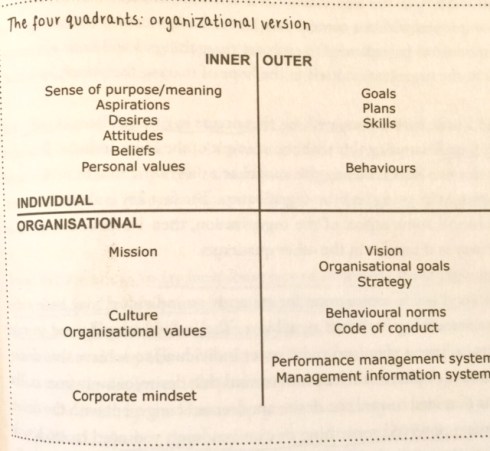
Effective Modern coaching p 127p. 124-127  These four quadrants reflect how the individual interacts with the organization. The right side is what is shown to the world.  The left side is what is actually going on inside the individual and the organization. When there is incongruity between the right and left sides, there are problems. Whatever happens in one quadrant is reflected in all four quadrants. When coaching the player within the organization, this chart offers an insightful look at the interplay between the player and the organization – what is going on inside each, in contrast with what may the face of each shown to the outside world.

p. 130 The biggest reason why organizational value statements fail to take root in most organization is the schism between the lower left and the upper left quadrants – between an individual’s personal values and how s/he sees the real values of the organization, as expressed by behaviors and decisions.   Often times, the leadership group does not create organizational values for themselves, but for everyone else – they don’t walk the talk. Individual’s see the hypocrisy.

Chapter  11 “Coaching for Leaders and Managers is particularly insightful

P. 142 In a similar way to how leadership has been distinguished from management, we need to separate coaching from management and leadership.

  • Leadership – concerned with the future, role modeling, morale
  • Management – subordinates perform roles w/in certain parameters – accountability
  • Coaching – a series of conversations that help a person perform closer to his/her potential , understand roles/tasks, develop right skills, and on a good day, to be fulfilled and joyful at work.

p. 144.  To be an effect manager, it is imperative to understand the nature of authority.

p. 145 Under a strongly hierarchical, authoritative regime, people do not take responsibility, do not take risks, are not creative, and are not proactive. They wait to be told.

p. 145 Many people do not understand that when they join an organization, they sign up to play the organization’s “game” – to play by its rules.

p. 146 There is an appropriate balance to be struck between individual and organizational authority, and the manager, caught in the middle, needs to understand how to strike it.
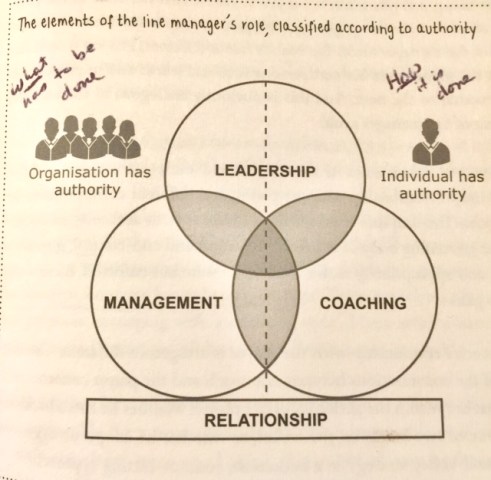
Effective modern coaching p 147p. 147 The image to the left describes the relationship between leadership, management, and coaching, noting that they all are built on the relationship between the leader/manager/coach and the player. Also this graphic shows where authority lies between leader/manager/coach and the player.

p. 148 – Managing and coaching – there is an analogy between roles of umpire and coach for tennis, and the “organization” is represented by the size of the court and the rules of the game.

p. 149 Often, managers try to handle performance and learning with a management style – command and control –  rather than a more facilitative style.  Managers have to wear both manager and coaching hats.

p. 151 Organizations that are operating in “flow” are characterized by

  • Clear goals every step of the way
  • Immediate feedback to one’s actions.
  • A balance between the challnges and skills required
  • Action and awareness are merged
  • Distractions are excluded from consciousness
  • No worry of failure
  • Self-consciousness disappears
  • Activity becomes autotelic (driven by a sense of purpose and commitment)

p. 152 Formal coaching includes a formal and explicit agreement between coach and player, and frequently with the organization as client. Informal coaching on the other hand often happens on the spur of the moment – kerbside, or corridor coaching.

p. 154. It staggers me that there are still organizations where the manager sets the direct report’s goals. I can think of few quicker or more sure-fire ways to erode motivation and undermine responsibility.

p. 155 In change situations, where there are often no right answers, coaching will draw out possibilities and options from which the best can be selected.

p. 156 Coaching Upward: Anyone can be coached- if they are willing.

p. 157 In principle, mentoring is concerned with longer-term career issues, while coaching is concerned with more immediate performance issues.   Many of the skills are the same….a mentor who can also employ a non-directive approach when appropriate – will have a much greater impact.

p. 159 Part of why coaching works is because when the player communicates to another and is understood, the thoughts are externalized, and a certain distance is achieved between the player and his thoughts and emotions.

p. 161 I’m not sure it is possible to be a “bad” coach if your heart is in the right place; a solide “inner game” spawns a solid “outer game.”

p. 164. Coaching should be introduced not as some new fad, but to facilitate learning and improved performance.

p. 165  When a direct report does not want to be coached and is not achieving his goals, the manager needs to make clear that it is no longer a coaching issue, but a management issue….The ability both to coach and manage another requires a strong, honest relationship, with clear performance goals and success measures.

p. 177 The truth is that the only thing that can cause coaching to fail is an insufficiently strong relationship. The coach must be able to create an environment in which the player feels safe and un-judged.

p. 177 You don’t have to like the player. You do have to care for the player.

p. 178 The player needs to be able to fully trust in the coach…Equally, the coach needs to be able to trust in the player.

p. 180 The quality of the goals and success measures that are agreed upon at the beginning of a coaching programme is the single greatest factor – after the relationship – that impacts on the success of the coaching.

p. 181. Key question: “When you have successfully achieved your goal, how will you know?”

Chapter 14 Coaching Teams is particularly interesting to me

p. 188 An individual can get to a level of clarity and make a decision relatively quickly.   In a tream, that process takes much more time, as each person needs to be heard, disagreement needs to be handled, consensus and commitment need to be built.

p. 188. In teams, BOTH inner game and outer game need to be addressed.

p. 188 In a team, “interference” is multiplied – no, it is squared – and in the worst cases, performance diminishes to the point where one person could do the work of the team in a fraction of the time.

p. 189 One of the places where the impact of being a great team, without interference, is immediately noticeable is in sport.

p. 189 Interference in a team might include the following:

  • Lack of trust in other team members
  • Fear of ridicule
  • Fear of being dominated
  • Pursuit of personal agendas n
  • Need to lead
  • Lack of clarity about the task or the goals
  • Pursuit of incongruent goals
  • Hidden agendas
  • Not understanding (or distrusting) each other’s intentions
  • No agreed process for working together
  • An absence of agreed ground rules
  • Rivalries
  • No listening
  • No meaningful collective work
  • Inflexible beliefs and positions (“this is how things are or should be”)

(That list is followed by a list of qualities that characterize a team that is successful in reducing interference.)

p. 193 – 195 He recommends the team coach reduce interference by helping the team deal with the WHO, the WHAT, and the HOW of the team.  Get clarity on WHO each person in the team is – such that they can be trusted and their intentions are clear. Discuss WHAT in order to get clarity about the task facing the group, why they are doing ti and what would success look like.  HOW is about the process of achieving the aims of the group- to include strategy and priorities, methods of communication, meeting frequency, agendas and ground rules.

P.195 The potential for friction within the team can be greatly reduced by creating an agreement about how the individuals will cooperate.  And then get commitment on how teams will deal with tension and disagreements.

p. 195 Great teams have a process for feedback. It is good to create a standard format for giving feedback, as well as a standard response for receiving it.

p. 196 When a team is in conflict and is not making progress, try declaring one minute of silence. At the end of the silence someonew will usually take the risk and say what needs to be said.

p. 197 He gives an alternative to the standard stages of group development.  The traditional stages are: Forming, Storming, Norming, Performing.  Downey offers a different model:  Pseudo community -> Chaos -> Emptiness -> Community.  He describes how these stages look and notes that a sign that a team has achieved “community” is when people are reluctant to leave the room when the meeting is over.

p. 207-219 Chapter 15 discusses how coaches and coaching can open up the “genius” or better selves in the players, and open doors to creativity, learning, and growth that traditional management and bureaucratic approaches leave untapped.

Posted in Uncategorized | 5 Comments

Shantaram, by Gregory David Roberts

ShantaramWhy this book:  For several years, one of the members of our reading group has been insisting that we read this book, but we have resisted because of its size – it is 930 pages long.  Finally we relented and selected it for a post-Christmas book – to give us the vacation window to read it. So glad we finally agreed.

Summary in 4 Sentences: This is a novelized autobiographical account of about 5 years in the life of the author, living in Bombay, India after having  escaped from a maximum security prison in Australia.  The author lives by petty street crime on the streets of Bombay, eventually becoming a medic in Bombay’s slums, until he is invited to join one of Bombay’s most powerful crime syndicates.  The author is tough and street-wise, intelligent, thoughtful, and wise – but haunted by his own personal demons.  His experiences and many adventures are fascinating, but what truly makes this book extraordinary is his commentary on what he does and sees, and how his experiences affect him as he comes to better understand himself and others, the world,  good and evil, love and hate, joy and sorrow, and what is worth living and dying for.

My Impressions: Wow!  What story! What a book!  It is indeed an epic – a rollicking adventure, a roller coaster ride,  beginning with his arrival in Bombay with little money and a fake passport as one of Australia’s most wanted criminals – all the way to the book’s conclusion, with the author still in India, a scarred survivor, a much wiser and more mature man, contemplating his future.

In between, he is constantly aware that if anyone looks carefully into his past, his cover will be blown and he’ll be extradited to Australia and returned to the “punishment cell” in the maximum security prison where he hd been routinely tortured.  He learns to live by facilitating drug deals for western tourists who can relate to a “white westerner,” more easily than to locals.  He lives on the streets for a while and then moves to a small cardboard/plywood hut in the Bombay slums where he uses his background in first aid to treat the poor, and becomes a highly respected healer among the inhabitants of the slum.  In the interim, he learns the culture, learns the local dialect as well as Hindi, the official language.

Then his talent and his skills are noticed by the bigger fish in the world of crime, and he is invited into counterfeiting and money laundering, and eventually passport and document forging, as his skills and reliability make him a trusted member of one of Bombay’s most powerful mafia syndicates.  He finds this mafia group to be a good fit – he likes the men he meets and works with, he is making good money, and the connections of this group protect him from the police and possible compromise of his illegal status. Also, he is drawn to this group because of his respect and eventual love for the mafia Don, a well-educated and thoughtful man who draws a line on what kind of crime he will commit: No prostitution, no drug dealing, no pornography, no trafficking.  Violence only when “necessary.”

There is a love interest in the story, which provides a romantic tension throughout the book.  Not only is our protagonist an intelligent, and appealing but troubled character, but so is Karla, the woman to whom he is drawn and who is drawn to him – intelligent, appealing, intriguing, but also damaged and haunted by her own demons.

Shantaram is an epic story, and includes many sub-stories in the author’s journey:  His time as a healer in the slum, several horrifying months in a Bombay prison, becoming addicted to heroin and the horrors of cold-turkey withdrawal, rescuing a woman from a powerful prostitution cartel.  He eventually gets caught up in a scheme which takes him to Pakistan, hiding from the Pakistani police and later fighting for his life with the mujahedeen in Afghanistan against the Russians.  He also gets involved in a battle over territory between warring criminal factions in Bombay.  And much more.  There is plenty of macho testosterone in the book, but it is always tempered by the author’s humility and vulnerability, and his love and loyalty toward the key men and women in his life.  His love for the people of India and Bombay are infectious and reinforced throughout the book.  There is something in this book for everyone.

What gives this epic its backbone is the appeal and self-awareness of the protagonist and his efforts to understand and grow from the good and the evil he not only observes but participates in. He is physically and mentally tough, and yet not afraid to be vulnerable and honest with us the readers about his own fears and weaknesses, and his struggles to overcome his own demons.  He struggles with the reality of his life of crime while trying to evolve as a human being.  He is still drawn to traditional civil and moral values, but also comes to realize that good and evil, right and wrong, luck and fate, love and honor are complicated, and cannot be adequately understood simply within the basic structures we are taught in civil, law-abiding society.  The honor of strong loyalty to friends, and the shame of betrayal are themes throughout the book – fundamental values which clearly form the backbone of his own moral hierarchy. There is a saying that his boss the mafia Don frequently uses, which troubles our protagonist, but to which he constantly returns: Sometimes we must do the wrong things for the right reasons. 

Shantaram can be appreciated on so many levels – as an amazing adventure story, as great insight into Bombay culture in India, as a look into the culture of honor in criminal activity, and as a love story about two very intelligent, but wounded people who love each other but don’t know how to deal with it.  And there is so much wisdom and insight into values and what motivates people. It doesn’t surprise me to learn that Roberts studied philosophy in college before his life went south, before despair drove him to drugs, criminal activity, and he found himself in prison and then on the lam in India.

Concluding Mystery: There is an abiding question about this book:  How much of this story is true?  Reading about the author on-line, clearly, much of it is.  But Roberts won’t share how much, nor which parts – insisting that it’s simply a novel based roughly on the broad outlines of his life and experiences during that window of time.  How much is true? That uncertainty is part of the appeal of this book and the author.

Note on PTSD:  There are some interesting insights about PTSD in this book.  There are several characters in the story – and I would include the author among them – whose nefarious and occasionally irrational actions are clearly driven by a reaction to previous trauma.   The author’s inability to deal with his own sense of hopelessness and occasional self-loathing leads him back to heroin.  Others commit much worse crimes because they simply don’t care, or are looking for something to break through their emotional numbness, or else are driven simply by anger, hatred, and/or a desire for revenge.


There are some great quotes sharing the author’s personal wisdom and philosophy.    Here are a few:

p. 9 I was what Karla once called the most dangerous and fascinating animal in the world: a brave, hard man, without a plan.

p. 96  “I want everything,” Ksrla replied with a faint, wry smile. “You know, I said that once to a friend of mine, and he told me that the real trick in life is to want nothing, and to succeed in getting it.”

p. 167 If fate doesn’t make you laugh, Karla said, in one of my first conversations with her, then you just don’t get the joke. 

p. 186  The worst thing about corruption as a system of governance, Didier once said, is that it works so well.  

p 189  “There is no act of faith more beautiful than the generosity of the very poor,” Abdullah said in his quiet tone.

p. 207 Abdullah: “Most of us – me and you, my brother – we wait for the future to come to us.  But Abdel Khader Khan dreams the future, and then he plans it, and then he makes it happen.”

p. 215 (On Abdullah)  He was the kind of man who tough criminals call a hundred percenter: the kind of man who’ll put his life on the line if he calls you his friend; the kind who’ll put his shoulder beside yours, without question or complaint, and stand with you against any odds.

p. 243  Fear and guilt are the dark angels that haunt rich men, Khader said to me once. I wasn’t sure if that was true, or if he simply wanted it to be true, but I did know from experience, that despair and humiliation haunt the poor.

p. 294 Madjid:  “Suffering, you see is a kind of anger. We rage against the unfairness, the injustice of our sad and sorry lot.  And this boiling resentment, you see, this anger, is what we call suffering.”

p. 384  There’s no meanness too spiteful or too cruel, Didier once said to me, when we hate someone for all the wrong reasons.  

p. 203 Silence is the tortured man’s revenge.

p. 432  The worst things that people do to us always make us feel ashamed.  The worst things that people do always strike at the part of us that wants to love the world.  And a tiny part of the shame we feel, when we’re violated, is shame at being human.

p. 451  There’s a little arrogance at the heart of every better self. That arrogance left me when I failed to save my neighbor’s life.

p. 454  Karla: “It isn’t a secret, unless keeping it hurts.”

p. 455 Vikram: “This is India.  This is the land of the heart.  This is where the heart is king, man. The fuckin’ heart.

p. 472.  Khaderbai:  “We concentrate our laws, investigations, prosecutions, and punishments on how much crime is in the sin, rather than how much sin is in the crime.”

p. 595. Each dead man is a temple in ruins and when our eyes walk there, we should pity, we should pray.

p. 596 I didn’t know the that good soldiers are defined by what they can endure, not by what they can inflict.

p. 607 I envied his (Anand’s) peace and his courage and his perfect understanding of himself.  Khaderbhai once said that if we envy someone for all the right reasons, we’re half way to wisdom.

p. 661 But friendship, for him (Nazeer), was measured by what men do and endure for one another, not by what they share and enjoy.

p. 707  Khaderbai:  “The Big Bang expansion happened from a point called a singularity – another of my favorite five-syllable English words- that is almost infinitely dense, and almost infinitely hot, and yet it occupies no space and no time, as we know those things.”

p. 709 Khaderbai: “Sometimes it is necessary to do the wrong thing for the right reasons.  The important thing is to be sure that our reasons are right, and that we admit the wrong – that we do not lie to ourselves, and convince ourselves that what we do is right.”

p. 712  She (Karla) said I was interested in everything and committed to nothing.  

p. 740 You can kill in-love, and loving, and even loveliness. You can kill them all, or numb them into dense, leaden regret, but you can’t kill love itself.  Love is the passionate search for a truth other than your own, and once you feel it, honestly and completely, love is forever.

p. 741  Men wage wars for profit and principle, but they fight them for land and women…..what makes men fight on, and die, and keep on dying, year after year, is their will to protect the land and the women.

p. 759 I didn’t know then, as I do now, that love’s a one-way street.  Love, like respect, isn’t something you get; it’s something you give.

p. 791 There wasn’t any glory in it (war.)  There never is.  There’s only courage and fear and love.  And war kills them all, one by one. Glory belongs to God, of course; that ’s what the word really means.  And you can’t serve God with a gun.

p. 805 Didier:  “The best revenge, like the best sex, is performed slowly and with the eyes open.”

p. 831.  She’d confused honor with virtue.  Virtue is concerned with what we do, and honor is concerned with how we do it.  You can fight a war in an honorable way – the Geneva Convention exists for that very reason – and you can enforce the peace without any honor at all. In its essence, honor is the art of being humble.  And gangsters, just like cops, politicians, soldiers and holy men are only ever good at what they do if they stay humble.

p. 837 The mafia was theirs, not mine.  For them, the organization always came first.  But I was loyal to the men, not the mafia; to the brothers, not the brotherhood.  I worked for the mafia, but I didn’t join it….I never found a club or clan or idea that was more important to me than the men and women who believed in it.

p. 851 I cut the last  mooring rope of grief, and surrendered to the all-sustaining tide of destiny.  I let him go. I said the words, the sacred words:  I forgive you…

p. 858  Fate always gives you two choices,  Scorpio George once said: the one you should take, and the one you do.

p. 870 Silences can wound as surely as the twisting lash, the poet Sadiq Khan once wrote.  But sometimes, being silent is the only way to tell the truth.

p. 871 I discovered something that I should’ve known, as Modena did, right from the start.  It was something simple: so simple that it took a pain as great as Modena’s to shake me into seeing it. He’d been able to deal with that pain because he’d accepted his own part in causing it.  I’d never accepted my share of responsibility – right up to that moment – for the way my marriage had failed or for the heartache that had followed it. That was why I’d never dealt with it.

p. 873  Didier:  I love money, but I hate the smell of it.  The more happiness I get from it, the more thoroughly I have to wash my hands afterwards.

p. 882 She (Karla) once told me that heroes only come in three kinds: dead, damaged, or dubious.

p. 905  The only kingdom that makes any man a king is the kingdom of this own soul.  The only power that has any real meaning is the power to better the world.

p. 915 Abdullah: There is no man, and no place, without war, The only thing we can do is choose a side, and fight.  That is the only choice we get – who we fight for, who we fight against.  That is life.

p. 918  “Luck is what happens to you when fate gets tired of waiting.” Karla murmered.  “Fuck you, Karla,” I replied laughing.

p. 929 Nazeer:  Good gun, good horse, good friend, good battle – you know better way that Great Khan, he can die? 

Posted in Uncategorized | 2 Comments

Island of the Lost, Shipwrecked at the Edge of the World, by Joan Druett

Island of the lostWhy this book: I have always been drawn to survival stories by and about people who find themselves in the most challenging of circumstances and must rely on their wits, creativity, mental and  physical toughness to survive. This one popped up on one of my Amazon searches and I jumped on it.
Summary in 4 sentences: In the 1860s, unbeknownst to each other, two different groups of men are shipwrecked at the same time on opposite ends of Auckland Island, an uninhabited island south of New Zealand and just above the Antarctic circle.  The two groups have no contact with each other, and both have a really tough time of it, as the terrain and weather were extremely inhospitable, and there were few prospects for rescue or long term survival. This book tells their stories in parallel: One group had a good leader and after 16 harrowing, touch-and-go months, all survived, due to working well together and some pretty ingenious steps they took to survive.  The other group had a poor leader and poor teamwork, and when rescued after about a year, only 3 out of 19 had survived. .

My Impressions:  Great story of survival – reminiscent of Shackleton’s Endurance, even a bit of Louis Zamparini’s Unbroken, and other great survival stories I’ve read.  Several of those who survived wrote memoirs afterward, which the author painstakingly reviewed, deconflicted and gave us a great account of how much these men suffered, how they struggled to keep hope alive, and how their suffering fostered a genius for developing options to keep themselves alive just a bit longer.

As noted in the summary above, leadership and teamwork were key.  In the one group of five men, all survived.  Similar to Shackleton’s Endurance story, the last desperate option was to modify their small boat and for a few of the men to make a several hundred mile ocean crossing to get to civilization (New Zealand) and muster a rescue for those left behind. As in Shackleton’s case, the small boat journey was through some of the most hazardous seas in the world had only a small chance for success, but they made it to civilization, exhausted and starving and near death.  When they did arrive, the captain struggled to find someone willing to undertake the return to Auckland Island to rescue the other two men, but he did.

The focus of the story was on these five survivors- since both the captain and first mate kept journals which eventually became widely read books about their story. The group at the other end of the island does not get as much attention, because those who survived did not write much.  There was clearly some shame on the part of the two officers who had so poorly led their team and survived,  The junior man, a seaman who was indeed the strongest and most resilient, innovative, and determined of the three, didn’t write his memoirs until nearly 60 years after the event.

In Island of the Lost, the author offers us interesting information about Auckland Island  –  it’s history, about unsuccessful efforts to colonize the island before and after the event, about the ecology, the flora and fauna of the island, its terrain and geography and what has happened to Auckland Island in the 150 years since the shipwrecks described in the book.  I felt this additional background added a lot to the book.    At the book’s conclusion, she shares with us what eventually happened to each of the survivors, as well as a fascinating account of her research into this incident, and her challenges in putting together a coherent story from a number of different accounts.

For survival enthusiasts like me, this is a fascinating and quick read. I read it in a few days and thoroughly enjoyed it.

Posted in Uncategorized | Leave a comment

Energy Leadership, by Bruce Schneider

Energy LeadershipWhy this book: Given to me as a gift from  my friend Paul Monahan, a professional executive coach who uses the methodology outlined in this book in his practice.  Paul impresses me as a man and a friend, and I promised him I’d read the book. So I did. And I’m glad I did.  It was a gift from him that I appreciate.

Summary in 3 sentences: The author uses  (I assume) a hypothetical coaching story as a basis for explaining his approach to leadership, as he coaches a CEO of a failing company out of a downward spiral using what he calls “Core Energy Coaching” – the model he describes in this book.   In this scenario Bruce Schneider, the author as coach, helps the CEO understand what is happening in his company in terms of the types of energy he transmits to others and that others transmit to each other, and then with this understanding, helps him increase this energy from negative, or catabolic, to positive or anabolic energy, and thereby increase positive energy, morale and profits. The result is a more creative and energized company, more engaged and fulfilled employees and greater success in the market place.

My Impressions: I really liked this book – and found it valuable in understanding how I see myself and others in my world  – in terms of the kind of energy I /we/ they transmit.  This model applies a positive psychology approach to people and how their interactions drive short or long term success in business.   Though there is no “religion” as such in the book, he does refer to the levels of energy he describes as synonymous with levels of consciousness, and the upper levels in his energy hierarchy are very reminiscent of levels of spiritual enlightenment described in many of the world religions.  I found that how Schneider applies his philosophy to the work-a-day world of business to be unique, interesting and insightful.

Energy Leadership Self Perception ChartHe describes his hierarchy of energy levels in what he calls his “I-chart,” so named because it is oriented on how the self – one’s “I” – interacts with the world.  The levels in the picture are reminiscent of other models I’ve seen,  from Kohlberg’s moral development hierarchy to Maslow’s hierarchy of needs to even Buddhist levels of enlightenment. He refers to levels of energy or levels of consciousness as key to who we are and how we affect the world and  people around us.  Schneider’s philosophy is based on the statement that “The only way to make real, sustainable changes in your life and your organization is to change (one’s ) level of energy,” (p75) and the book is a story about how he coaches a CEO into making his level of energy more positive, and thereby improving the level of energy of his company.
A very quick explanation of the above I-chart:  Though he shows 7 levels of energy, these 7 levels are within three main circles, beginning at the center with  Self, then  Self-Mastery, and finally, Self-Transcendence.  He spends most of the book on how to move from the first circle (levels 1 and 2) into the second circle (levels 3-5), since most struggling companies are at level 1 (apathetic, victims) or level 2 (anger and conflict).  In Energy Leadership, he works with his CEO to move him (and his company) into the second circle, which begins with level 3 – a more positive level of energy –  and then beyond, to level 4 and 5.

He notes that many if not most businesses operate at level 2 in in the market place, focused on “I win/you lose,” with the result that people in the company are also internally competitive, and see personal success as almost necessarily at someone else’s expense. Moving to level 3 is a HUGE step for the company, as well as for employees, in that it demands moving from friction and competition to cooperation, personal responsibility, teamwork, and working toward a common goal with people one may not even like.

Levels 1 and 2 are characterized by a bleak world view, in which leaders and employees  focus primarily on efficiency and dealing with problems, moving from crisis to crisis, rather than focusing on solutions and moving from one success to another.  Level 3 and beyond maintain a positive view of people, as well as current and future opportunities. Level 4 makes room for heart-felt compassion and empathy – a concern for others.  Level 5 sees ALL problems as opportunities with no judgment of “good” or “bad.”  This level 5 philosophy reminds me that the Chinese word for crisis is composed of two characters – one for danger and the other for opportunity.  It also reminds me of Jocko Willink’s response to every problem his subordinates brought him: “Good. This gives us an opportunity to…. (whatever.”)

He notes that progress for most of us is inhibited by 4 main “blocks” that we impose on ourselves to prevent us from increasing our level of energy and reaching our full potential:

  1. Limiting beliefs about possibilities and the world;
  2. False assumptions from our past experiences that affect us today;
  3. False interpretation of other people’s words, intentions and actions;
  4. Fear that we are not good or capable enough to achieve what we want.

He offers several tools for becoming aware of these blocks (which is the most important first step) and then afterward, how to not let them hold us back.  As a coach, helping his client to recognize and move past one of these blocks, he asks, “What might be another way to look at this? What new thoughts could you adopt that might lead to different results?    This question may open new doors of insight and understanding.

He doesn’t spend a lot of time on levels 6 and 7 – the self-transendence circle of his I-chart, I assume because it’s enough work to get from self-centered to self-mastery, from levels 1 and 2, to levels 3-5.  But he does give us a chapter on levels 6 and 7 to give us a glimpse of how he believes it is possible for a truly enlightened business, led and run by truly enlightened people to operate.  Whether and how this might be possible would be  another discussion.

Some other insights I found interesting”

  1. His guidance on “centering” is very consistent with what we teach the SEALs to do in what we call “arousal control.”  The breathing/centering practice is a standard in Yoga and other practices.  I use it myself.
  2. Emotions – he argues against the widespread view that emotions are out of place in the work space, noting that emotions are key to a positive energy work environment.  But emotions need to be managed, channeled, and positive. That is much of what this book is about.
  3. He speaks of Emotional Intelligence as “EI” instead of the more standard “EQ” and notes how expressing emotions “appropriately,” is key to achieve what he calls “IE” – interpersonal effectiveness.  “EI is not about just expressing emotions, it’s about expressing emotions appropriately.” (p 181.) Knowing what is “appropriate” and then being able to act on it is the challenge….
  4. “How we see ourselves determines everything.” p 135
  5. We are often victims of our inner gremlin – our inner critic, driven by fear and one or more of the four blocks.  But we also have a more positive self – what he calls a higher self or an inner genius. He says when we pit our genius agains our gremlin, our genius will trump the gremlin every time.
  6. In his discussion of levels 6 and 7, he talks about the paradox of “detached involvement’ – being totally engaged in a task or activity, yet completely detached from the result. This correlates closely with what I’ve read about a state of “Flow.”

Throughout the book he suggests viewing short videos (4-6 minutes in length) on his website, which explain different aspect of the Core Energy Coaching approach to leader development, and personal and organizational change.  I viewed several of these videos and they are a good supplement to the content of Energy Leadership. Were I to decide to adopt this as an approach to coaching, I would view all of these videos, and then work with a coach to help with the coaching side of this approach.  And if I were to decide to become a coach, I’d seriously consider this approach.

Energy Leadership is about a philosophy of personal and organizational development. It also applies a non-directive, inquisitive coaching style to helping a leader to understand this philosophy., understand him/herself and others in their environment.  It is a combination of teaching and coaching. I like it.  I think it would combine well with the coaching approach advocated in Effective Modern Coaching by Myles Downey.


Posted in Uncategorized | 2 Comments

Discipline Equals Freedom Field Manual, by Jocko Willink

discipline equals freedomWhy this book: Widely read by SEAL candidates and includes great advice for life for anyone, and especially for young men aspiring to be SEALs. I lead a reading group for SEAL candidates and we agreed on this book.
Summary in 3 sentences:  There is only one way to getting better at anything: Discipline. There are no easy ways, no hacks – getting better means having the discipline of focus and daily practice, and with it you can become better, stronger, smarter, faster, healthier and it will set you free.  He also addresses his philosophy on where and how to apply discipline in physical training, diet and nutrition, sleep, martial arts, humor, death, compromise, negative talk, and more – it is a compendium of Jocko’s recipe to become and be a warrior.

My impressions:  This was my second time reading this book and I enjoyed it and learned from it again. Reflecting its author, this book is direct, intense, and unpretentious.  It is a high-testosterone, aggressive, uncompromising,  no-nonsense prescription for developing and maintaining a warrior mindset. It is written in brief, simple, almost aphoristic style – two page chapters that grab you by the throat, tell you to quit whining and get on with it.  Develop and strengthen your Will. Develop and strengthen your self-discipline.  Embody a positive, aggressive attitude, with no apologies, and no excuses.

Though I think he misses some important nuances, I love it.  It is Aristotle’s prescription for erring in the direction where you are weakest in order to find that “golden mean” of virtue that works for you, between excess and deficiency. I’m not sure Jocko has a “golden mean” and he certainly doesn’t spend time defining it in this book – this is a prescriprion for how to stay focused and aggressively pursuing your own best self, always, every day, without pause, without question, without apology.

It It is a solid Stoic philosophy of total responsibility, no excuses – it doesn’t matter what got you here, it only matters what you do now.   Don’t wonder, don’t wring your hands, and go back and forth.  Prioritize and act.  You choose, you own it.  It is Nike’s “Just Do It” on steroids.

Though he does hint at nuance and judgment in this book, these are qualities that really only come with experience.  His default is “Just Go For It!”  In my discussion with young SEAL candidates, I suggested that this is the formula to get ready to get thru SEAL training, and I recommended that they keep a copy by their bed and read a piece of it every night, like Jim Stockdale did with Epictetus’s  Enchiridion.

Notes on a few of the short chapters in Discipline Equals Freedom:

In “Stress” he tells us to gain perspective from what others have gone through before us, and if the stress is something you can’t control, embrace it. You might as well.   Use the stress to make you a better you. 

In “Compromise“, he notes that we do have to compromise when working with other people – find common ground.  But with yourself, hold the line on your values your goals, the things that are important to you.

In “Default Aggressive” he advocates for an always positive and aggressive stance – a mental attitude with the will to win, succeed, a focus on winning, fighting smart to win.

In  “The Darkness” he admonishes us to know it will come, but don’t let it consume us.  Just keep fighting.  Feed your Will and determination.

In “Remain Vigilant” he warns us to fight the tendency to back off, to cut corners, to slack off our program, back off from our goals. Hold the Line he says, on the seemingly insignificant little things that shouldn’t matter, but do.

In  “Good” he describes the Growth Mindset approach to disappointment and disaster. When you get the flat tire, you don’t get the promotion, you get turned down for something you have set you heart on – Good.  That opens up new opportunities to develop resilience, be creative in dealing with the setback, learn, and to work harder.

In “Fear”  he says it is normal, but we should “step aggressively toward your fear-that is the step into bravery.” Be aggressive.

In “Fear of Failure” he says we should use that fear to work harder, plan better, to make success more likely.  BUT we should be horrified at the possibility of sitting on the sidelines and not taking risk, not doing anything.  THAT should be the greatest fear.

In  “Weakness,” he admits to many weaknesses, and he accepts that, but uses them to motivate him to strive to be a little less weak, a little stronger every day.

In “Staying Motivated” he tells us that motivation is fickle – don’t count on it – it is over-rated.  Count on Discipline – make yourself do what you know you need to do, what you have chosen to do it – whether you feel like it or not!

In “Death”  he says let us cry no more…let us not dwell on it. Instead let us laugh and love, and let us embrace life…let us live for those who live no more, let us live to honor them.   

In “Regret” he reminds us that the most important thing to learn from regret is that we have so much to learn and that the only thing valuable in regret is the lesson you learned.  So learn and move on.

In “Nature vs Nurture” Jocko says it is neither. Doesn’t matter.  What matters is what you choose.   Life is about choice.

In “Destroyer Mode” (I particularly liked this chapter) he says use both emotion AND reason.  When one fails you , you need to rely on the other.  Fight weak emotions with the power of logic; fight the weaknesses of logic with the power of emotion. 

In “Me vs Me” he talks about the battle within himself to become as good as he can be.  Becoming as good as you can be doesn’t happen in a stadium or at an awards ceremony. It happens in the heart – every day, in the darkness of the early morning.   

In “Laughter Wins,”  he reminds us that life is tough, but it gets a lot easier when you are laughing at it.  Suffering and hardship can’t stand it when you laugh – so laugh at them all!

The book concludes with additional chapters with specific advice on building the home gym, where and how to train, martial arts, diet and fasting, how to get started, and advice for how to work out for beginners, intermediate, and advanced athletes. 

I like his conclusion.    He tells us: Don’t just read, listen, watch, study, plan, talk, think, dream – none of that matters. What matters is what you DO.  So DO it!

My criticisms – I agree with about 90% of Jocko’s approach, but I am willing to give myself a bit more slack – which, according to his philosophy, is caving in to weakness.  But I am also not so focused on being among the hardest core warriors in the world.  I listen to my body and sometimes cave into it.

I find joy and pleasure in the occasional creme filled donut, chocolate chip cookie, or piece of key-lime pie. Jocko describes these as poison, and eating them a sign of weakness that one must fight to overcome.  Got it – but I also think there are things to be savored, that may not be good for us in excess, but yes, occasionally….I’ve also heard that it’s harder to be moderate than to be extreme – enjoying things in moderation requires constant decisions, whereas the  extreme all-or-nothing decision is made only once.

That said, I believe his message is very powerful and his model is worth considering and adapting to one’s own needs and ambitions.  As he says, it is a recipe for becoming faster, stronger, smarter, better – and there is no doubt: Discipline does equal freedom when it means that with discipline and will, we can decide and then do – whatever we want.


Posted in Uncategorized | Leave a comment

The Overstory, by Richard Powers

OverstoryWhy this book: Strongly recommended to me by my friends Auny, Di, and Liz.  Pulitzer Prize winner 2019.  A very different theme that peaked my curiosity.

Summary in 3 sentences: The book begins with a series of eight short-story biographies of very different people,  whose lives then converge in unexpected ways over the rest of the book.    The common theme that brings these people’s lives together is trees, and the different ways in which each of them came to realize the importance of trees to their own well-being and the well-being of the planet.   There is a story here, but in the drama that unfolds throughout the book, we learn how trees communicate with each other and other organisms, how they influence our environments, and how in industrial society, humans have become alienated from our natural environment and how that is subtly, slowly, insidiously, but definitely hurting ALL of us – which includes all of Life.

My impressions: An amazing book!  Unlike anything I recall ever having read – regarding message, story, structure, and style.  As I got into the book, early on I realized that this is indeed a classic.  It got a bit un-tidy at the end, and it didn’t wrap up with a bow on it.  But as clear-sighted as the author clearly is, I assume that was intentional – life and nature can be complicated and untidy, and it remains to be seen whether we as a civilization will find a connection to the larger nature we are part of, or remain tragically disconnected from the rest of life on this planet.   The stories in this novel are very human, but the context  is very much about LIFE  – of trees, plants, animals insects, fungi – nature – and where we humans fit into a much larger eco-system.

The first section of the book is entitled “Roots” and we are treated to the introductory background biographies, of the eight very different people who we will read about in the rest of the book. Each person gets his/her own chapter.   Thes are eight very different people who at the outset, are not connected in any social way.: A Vietnam war veteran, a Chinese immigrant, an Indian immigrant, a woman botanist, a yuppie couple in the midwest, a party- girl in a midwestern college, a geeky young high school kid trying to get into college.  These are fascinating short stories  in their own right, and they tee-up the rest of the book.

The second section of The Overstory is entitled “Trunk,” and here is where we find the meat of the book.  In this section, we watch the the slow connecting of the  lives of those very different people progress from where their stories had left off in Roots.  The paths of these characters begin to converge in unexpected ways – in ways that remind one of how organically and seemingly without structure, a forest can evolve.   The common theme that brings these people together and connects their lives is trees. Yes, trees – how they interact with each other and their environment.  And the insight that each of the characters has, earlier or later, to greater or lesser degree,  that they as individuals and we as humans are connected to and have more to learn from trees than they had previously realized.

The organic and seemingly haphazard connections between these seemingly unconnected people create a tapestry similar to the connections that happen within an organically evolving forest.  This book takes that simple little bromide – “We are all connected” – to a much deeper and more profound level.

An important part of the drama is the convergence of several of the characters in the movement to save the old-growth redwood forest in the Northwest of the United States. Though a few of them deliberately become activists in this movement, others are drawn in almost inadvertently and are won over to the importance of saving these ancient trees from being cleared by a rather rapacious logging company.  Then after several rather dramatic confrontations with industrial society,  the individuals go their separate ways, significantly transformed by their experience.

And meanwhile, on the periphery, one of the characters represents Richard Powers’ own fascination with AI and the movement that gives increasing priority to a rich “virtual” life.  One of the characters becomes a mega-successful silicon valley computer gaming executive whose goal is to create a computer game that as closely as possible simulates life and living in all its complexity.   In fact it seems that this wheel chair-bound genius seeks to develop a computer “game” that include so many of life’s variables and becomes so “real” to those who play it, that it can eventually become a quasi-legitimate substitute for the actual lived experience it simulates.  As his computer game integrates more and more of the pieces of our world, our genius gamer achieves a type of spiritual awakening regarding the connectedness that trees have with each other, with humans, and with all of life.   The pursuit of one (impossible) holy grail led him to another greater insight –   similar to the wisdom attained by some medieval alchemists.

There are also some semi-mystical pieces to this story, as at least two of the characters are driven by visions and spirit-beings that seem to direct their actions, and advise them on how to deal with crises.  This would seem to reinforce Roberts’ point that there is a dimension of reality that most of us don’t see or understand, levels of communication that are below our normal consciousness, and that indeed are part of an “unseen order of things.” These strange, paranormal experiences of some of his characters are not dissimilar to the hard-to-believe communication he describes between trees, and between trees and other living organisms, including humans – well below the consciousness of most of us.

The book concludes with a mixed message.  Our civilization continues to march into the future along the path of increasing growth and industrialization that got us here – with little understanding of the greater natural world of which we are a part.  On the more positive side,  the characters portrayed in The Overstory represent those who have had the important epiphany that we live in the midst of a much more interconnected eco-system that impacts us in ways the most of us can hardly imagine.

An amazing book, beautifully written with a message that should be taken seriously – and when we do, it is – should be – life changing.

Some quotes that struck me while reading the book. Page numbers from the Norton & Co paperback edition.

p 15. But for a moment each spring, the pale green catkins and cream-colored flowers put thoughts into Frank Jr’s head, thoughts he doesn’t know how to have….His pointless photographic ritual gives Frank Jr’s life a blind purpose that even farming cannot give.

p. 54 Patterns reveal themselves as he watches (the ants), and they’re wild.  Nobody’s in charge of the mass mobilization, that much seems clear. Yet they port the sticky food back to the nest in the most coordinated way. Plans in the absence of any planner. Paths in the absence of a surveyor…. The colony possesses something; Adam doesn’t know what to call it. Purpose. Will. A kind of awareness – something so different from human intelligence that intelligence thinks it’s nothing.

p. 61 The book shows how so-called homo-sapiens fail at even the simplest logic problems.  But they’re fast and fantastic at figuring out who’s in and who’s out, who’s up and who’s down, who should be heaped with praise and who must be punished without mercy.  Ability to execute simple acts of reason?  Feeble.  Skill at herding each other? Utterly, endlessly brilliant.

p. 61 Humans carry around legacy behaviors and biases, jerry-rigged holdovers from earlier stages of evolution that follow their own obsolete rules.  What seems like erratic irrational choices are, in fact, strategies created long ago for solving other kinds of problems.  We’re all trapped in the bodies of sly, social-climbing opportunist shaped to survive the savanna by policing each other.

p. 84 In fact, it’s Douggie’s growing conviction that the greatest flaw of the species is its overwhelming tendency to mistake agreement for truth.

p. 110 He rolls from planter to planter, touching the beings, smelling them, listening to their rustles.  They have come from hot islands and desiccated outback, from remote valleys in Central Asia, breached only recently. Dove tree, jacaranda, desert spoon, camphor tree, flame tree, empress tree, kurrajong, red mulberry; unearthly life, waiting to waylay him in this courtyard while he was searching for them on distant planets.  He touches their bark and feels, just beneath their skins, the teeming assemblies of cells, like whole planetary civilizations, pulse and hum.

p. 115 As certain as weather coming from the west, the things people know for sure will change.  There is no knowing for a fact.  The only dependable things are humility and looking.

p. 122 A secret suspicion sets her apart from the others. She’s sure, on no evidence whatsoever, that trees area social creatures.  It’s obvious to her: motionless things that grow in mass mixed communities must have evolved ways to synchronize with one another.  Nature knows few loner trees.  But the belief leaves her marooned.

p. 138  A person has only to look, to see that the dead logs are far more alive than living ones.  But the senses never have amuch chance, against the power of doctrine.

p. 162  She must still discover that myths are basic truths twisted into mnemonics, instructions posted from the past, memories waiting to become predictions.

p. 183  The smell grips her brain stem until she and the dead man are fishing side by  side again under the pine shade where the fish hide, in the soul’s innermost national park.

p. 244 This man tried to save her pines. Put his body between the saws and the trees. She wouldn’t  be out here, even in this endangered paradise, without him. But for her money, he’s more than a little wacked. His rangy gameness for anything scares her. The twinkle he fixes on the forest ahead has that look of the not entirely housebroken. His head swivels, marveling at the crowd, happy as a puppy to be let back in the house.

p. 282  A dead tree is an infinite hotel.

p. 332 At the corner he leans on a streetlight.  A fact struggles to escape him, one he has felt for a long time but has never been able to formulate. Almost every part of need is created by a reflex, phantasmal, and democratic committee whose job is to turn one season’s necessities into the next’s yard sales.  He stumbles on  into the park full of people dealing in excitement and night. The air stinks a little of Wet-Naps, weed, and sex.  Hunger everywhere, and the only food is salt.

p. 374  We are not, one of Adam’s papers proves, wired to see slow, background change, when something bright and colorful is waving in our faces.

p. 382-3 The books share a core so obvious it passes for given. Every one imagines that fear and anger, violence and desire, rage laced with the surprise capacity to forgive – character – is all that matters in the end. It’s a child’s creed, of course, just one small step up from the belief that the Creator of the Universe would care to dole out sentences like a judge in federal court.  To be human is to confuse a satisfying story with a meaningful one, and to mistake life for something huge with two legs. No: life is mobilized on a vastly larger scale, and the world is failing precisely because no novel can make the contest for the world seem as compelling as the struggles between a few lost people.

p. 386 The pen moves; the ideas form, as if by spirit hand. Something shines out, a truth so self-evident that the words dictate themselves. We’re cashing in a billion years of planetary savings bonds and blowing it on assorted bling.  And what Douglas Pavlicek wants to know is why this is so easy to see when you’re by yourself in a cabin on a hillside, and almost impossible to believe once you step out of the house and join several billion folks doubling down on the status quo.

p. 422 Wealth needs fences. But fences need wood. Nothing left on the continent even hints at what has gone. All replaced now, by thousands of miles of continuous backyards and farms with thin lines of second growth between them. Still, the soil remembers, for a little while longer, the vanished woods and the progress that unmade them. And the soil’s memory feeds their backyard pine.

p. 423   No one sees trees. We see fruit, we see nuts, we see wood, we see shade. We see ornaments of pretty fall foliage. Obstacles blocking the road or wrecking the ski slope.  Dark, threatening places that must be cleared. We see branches about to crush our roof. We see a cash crop.  But trees  – trees are invisible.  

p. 424 Trees know when we’re close by.  The chemistry of their roots and the perfumes their leaves pump out change when we’re near….When you feel good after a walk in the woods, it may be that certain species are bribing you. So many wonder drugs have come from trees, and we haven’t yet scratched the surface of the offerings.  Trees have long been trying to reach us.  But they speak on frequencies too low for people to hear.  

p. 456 These people need dreams of technological breakthrough. Some new way to pulp poplar into paper while burning slightly fewer hydrocarbons. Some genetically altered cash crop that will build better houses and lift the world’s poor from misery. The home repair they want is just a slightly less wasteful demolition. She could tell them about a simple machine needing no fuel and little maintenance, one that steadily sequesters carbon, enriches the soil, cools the ground, scrubs the air, and scales easily to any size. A tech that copies itself and even drops food for free. A device so beautiful it’s the stuff of poems.  If forests were patentable, she’d get an ovation.

Posted in Uncategorized | 2 Comments

Range Why Generalists Triumph in a Specialized World, by David Epstein

RangeWhy this Book: Strongly recommended by my friend Jay Hennessey and also a selection by the Next Big Idea Club to which I belong.  After Jay recommended it, I realized the NBI club had already sent me a copy – a sufficient confluence of events (synchronicity) to get me started. Glad I did.
Summary in 3 Sentences: SO many big ideas in this book, but the main point is that in order to make the best decisions in any context, one needs a broad range of experience, including experience OUTSIDE the specific problem area one is considering.  Epstein doesn’t dismiss specialists, but insists that specialists need to get out of their specialty for at least  two reasons: First, to best apply their specialist knowledge to the broader world, and second, to learn from the broader world lessons that may apply to their area of specialty.  He also provides insights from this theme against specializing early – he recommends playing the field and trying several possibilities before deciding on a life’s profession.

My Impressions:  One of the most interesting and insightful leadership, self-development books I’ve read in recent memory.  I had lots of Ah Ha! moments in reading this book, as Epstein pointed out trends and phenomena that I had observed with implications that I had never considered.   The fact that Range changed Malcolm Gladwell’s mind, or at least his perspective on his “10,000” hours rule is telling – not only about the cogency of his arguments against over-specialization, but also about Gladwell’s openness to have his mind changed. Gladwell and Epstein debated this book in public, and Gladwell’s mind was changed, and he strongly endorses this book and its message.

Epstein challenges conventional wisdom on the advantages of getting a head start in life, specializing early, the value of experts, the value of consistent “block” training.  He also argues for the advantages of “desirable difficulties” in training and learning, how expertise can inhibit creativity and so on.

Epstein  doesn’t dispute that we need specialists or experts, but argues that to deal with complex problems in the “wicked world” (complex, unpredictable, uncertain rules,) the specialists must serve the generalists who will have a much broader and wiser perspective.  He argues that the very best generalists are those who were once specialists but then broadened their knowledge and continued to feed their curiosity, explored other unrelated areas and became generalists.  Epstein argues we need both, but the big decisions need to be made by generalists. And this book tells you why.

I got this book through the Next Big Idea club which publishes a short pamphlet with each book they send.  Below is a very brief summary of the key points included in the pamphlet that came with Range.  They listed 9 big ideas in Range:

  1. The Cult of the Headstart points to how specializing early may not lead to the best results in the long run.  In the short run, yes, but overtime, usually not.   Research has showed that people who had a broad general education more often find what they love to do over the long run and succeed at it better than those who specialize early.  This is a theme that he builds on throughout the book.  People who start out highly invested in a specific path early, change paths much more often than those who try a number of paths before picking the one they will invest in for the long term.  Specializing early, before one truly knows oneself, can be a trap.
  2. Winners Quit and Quitters Win is a challenge to people who take Angela Duckworth’s Grit too seriously.  In fact one of the chapter titles is “The trouble with too much Grit”.  This big idea is not new.  Fail fast, fail often – while trying to find that “Match Quality” between what you love and what you do.   This message echos the message in You Are Awesome – “lose more to win more.”
  3. It’s a Wicked World distinguishes between “kind” learning environments, and “wicked” learning environments.  “Kind” environments are those with clear rules, similar patterns, predictable challenges, consequences of decisions are readily apparent.  He says that a lot of games or sports are “kind” learning environments – such as chess and golf.  They lend themselves to “deliberate practice.”  In “wicked” environments, the rules aren’t clear, or may change, there are no obvious patterns, and the consequences of decisions may not be apparent for quite some time, and immediate feedback may be inaccurate.   Specialists are most useful in “kind” environments, which are predictable and pretty well understood. Generalists who have a wide variety of experience in different contexts will often be most successful in “wicked” environments. From the pamphlet, “….learning in a wide variety of contexts will prepare you for the wicked environment, where the ability to learn without the benefit of prior experienced is critical.”
  4. Cognitive Flexibility comes from an ability to make connections across domains – to take lessons from one context and apply them in a very different context.   He offers a number of examples of how those with deep knowledge in a narrow area are often at a loss when it comes to understanding and applying conceptual schemes in areas beyond their own experience or expertise.
  5. The Power of Analogies is highlighted as another strength of the generalist to compare and see common lessons in two very different situations.  Similarities in structure between two very different situations that are not immediately apparent because on the surface they appear very different.  Seeing these similarities requires  “cognitive flexibility” and a broader scope of knowledge and experience than the expert specialist will usually have. He gives an example of how a military strategy helped doctors find the right treatment for a specific cancer problem.
  6. He has a chapter entitled “Learning to Drop your familiar tools” which makes the point again, how humans cling to what they know and how they are accustomed to  doing things.  He gives numerous examples of how people have held on to their well-entrenched and well-trained methods, often at great cost when the environment has changed.  He advocates getting used to doing familiar tasks with different tools, and changing the familiar tasks to force learners to ditch familiar tools and adjust to the situation. This section reminded me of the old saw, “Necessity is the mother of invention” – in that when we take away the old tools,  we often come up with new and better ones.
  7. Ditch your long term plans. This lesson emphasizes the point that we often make long term plans when we don’t have enough information, and really don’t know ourselves or what we want.  He gives the example of Frances Hasselbein who kept getting distracted from her long term plans by doing other things that really appealed to her,  and ended up being one of the most successful non-profit CEOs in America in the 20th century.  His point is that we learn about who we are and what we like by choosing to learn from each endeavor – and that our long term plans made when we are younger, often will not fit the person we become from new experiences.  Simple truth:  “We learn who we are by doing, not simply by thinking.”
  8. Making Learning Difficult enhances learning. This is a lesson from Make it Stick, by Brown, Roediger et al about how struggling to learn, enhances long term learning and retention, whereas easy learning, enhances short term learning and retention.  Here again, he argues against “block learning” – intense and focused deliberate practice – and instead argues for “interleaving” – learning spread out over time, coming back to what was learned before and testing it under different circumstances.  He talks about the “generation effect” in which we struggle to find the answer and how that is much more effective for long term retention of what was learned than when the answer is readily available.
  9. His argument for the Outsider Advantage in solving wicked problems is a warning against experts.  Experts and specialists have focused their study and attention on what they know and how conventional wisdom in their field has directed them.  That focus creates a set of blinders that the outsider doesn’t have.  Epstein gives a number of examples of how outsiders with an unbiased curiosity have asked questions that experts weren’t asking, have seen problems that experts didn’t see, and found solutions to those problems that experts often couldn’t envision.  His message:  Don’t overly trust the experts.  A curious and thoughtful outsider may have insights that the expert specialists are not trained to see.  And my own experience is that the designation “expert” can bring with it a bit of arrogance and closed mindedness that is difficult to overcome.

Quotes from the book – not exact, but a good review for me:  (page numbers from Riverhead Books hardback edition 2019)

P 21 In wicked domains the rules of the game are often unclear or incomplete, there may or may not be repetitive patterns or they many not be obvious, and feedback is often delayed, inaccurate, or both.

22 Marvec’s paradox: machines and humans frequently have opposite strengths and weaknesses.

P. 25 Chunking helps explain instances of apparently miraculous, domain specific memory, from musicians playing long pieces by heart to quarterbacks recognizing patterns of players in a split second and making a decision to throw.

P. 29  The bigger the picture, the more unique the potential human contribution.  Our greatest strength is the exact opposite of narrow specialization.  It is the ability to integrate broadly.

P. 33 But when the rules are altered just slightly, it makes experts appear to have traded flexibility for narrow skill.  …example:  When the order of play was altered experts had a more difficult time adapting to new rules than did non-experts.  – this is “cognitive entrenchment.”

P. 33 The scientist inducted into the highest national academies are much more likely to have avocations outside of their vocation.  And those who have won the Nobel Prize are more likely still.  The most successful experts also belong to the wider world.  Creative achievers tend to have broad interests. “this breadth often supports insights that cannot be attributed to domain specific expertise alone.”

P. 47 so long as they remain in the desert, the nomad is a genius.  …”The ability to freely shift from one category to another, is one of the chief characteristics of ‘abstract thinking.’

P. 53 Like chess masters and firefighters, premodern villagers relied on things being the same tomorrow as they were yesterday. They were extremely well prepared for what they had experienced before, and extremely poorly equipped for everything else.  …And that is what a rapidly changing, wicked world demands – conceptual reasoning skill that can connect new ideas and work across contexts.  …The ability to apply knowledge broadly comes from broad training.

P. 88 Struggling to retrieve information primes the brain for subsequent learning, even when the retrieval itself is unsuccessful.  The struggle is real, and really useful .  “like life, Kornell said “retrieval is all about the journey.”

P. 89 For a given amount of material, learning is most efficient in the long run when it is really inefficient in the short run.  If you are doing too well when you test yourself, the simple antidote is to wait longer before practicing the same material again, to that the test will be more difficult when you do. Furstration is not a sign you are not learning, but ease is.

P. 91 the professors who caused short-term struggle but long -term gains were facilitating ”deep Learning” by making connections.

P. 92 “Desirable difficulties.” “ Above all, the most basic message is that teachers and student must avoid interpreting current performance as learning.  Good performane on a test during the learning process can indicate mastery, but learners and teachers neeed to be aware that such performanc will often index, instead, fast but fleeting progress.”

P. 94 Practicing the same thing repeatedly, each problem employing the same procedure is “blocked” practice.  It leads to excellent immediate performance, but for knowledge to be flexible, it should be learned under varied conditions, an approach called varied or mixed practice, or to researtchers, “interleaving.”  Interleaving has been shown to improve inductive reasoning.

P. 95 The feeling of learning it turns out is based on before your eyes progress, while deep learning is not.” When your intuition says block, you should probably interleave.”   Interleaving is a desireable difficulty that frequently holds for both physical and mental skills.

P. 94  Deisrable difficulties slow down learning and make performance suffer in the short term.  That can be a problem because we all reflexicvely assess our progress by how we are doing right now.  .

P. 97  A head start comes fast, but deep learning is slow.  Learning deeply means learning slowly.  The cult of the head start fails the learners it seeks to serve.

P. 98 “Far Transfer” – When a knowledge structure is so flexible that it can be applied effectively even in new domains or extremely novel situations.

P. 102  Deep alnalogical thinking is the practice of recognizing conceptual similarities in multiple domains or scenarios that may seem to have little in common on the surface.    Analogical thinking takes the new and makes it familiar, or takes the familiar and puts it in a new light and allows humans to reason through prooblems they have never seen in unfamiliar contexts.

P. 104  A kind world is based on repeating patterns.  It’s perfectly fine if you stay in the same village or the same savannah all your life. The current world is not so kind; it requires thinking that cannot fall back on previous experience.

P. 110 Focusing narrowly on many fine details specific to a problem at hand feels like the exact right thing to do, when it is often exactly wrong.

P 112 Evaluating an array of options BEFORE letting intuition reign is a trick for the wicked world.  …. Just being reminded to analogize widely made the business students more creative.

P. 113 Like the venture capitalists, their intuition was to use too few analogies and to rely on those that were the most superficially similar.  “That’s usually exactly the wrong way to go about it,  regardless of what you’re using analogy for.”

P.115 An interdisciplinary team of scientists came to a pretty simple conclusion:  Successful problem solvers are more able to determine the deep structure of a problem before they proceed to match a strategy to it…. For the best performers, problem solving begins with the typing of the problem… a problem well-stated is half solved.

p. 128 Match quality is a term economists use to describe the degree of fit between the work someone does and who they are – their abilities and proclivities.

P. 129 If they sampled early, and focused later, they entered the job market with fewer domain specific skills, but a greater sense of the type of work that fit their abilities and inclinations

P 130  Learning stuff was less important than learning about oneself.  Exploration is not just a whimsical luxury of education; it is a central benefit.

P 136 Seth Godin disparages the idea that quitters never win – he argues that winners quit fast and often when they detect that a plan is not the best fit, and do not feel bad about it.  ….knowing when to quit is such a big strategic advantage that every single person, before undertaking an endeavor, should enumerate conditions under which they should quit.  The important trick he said, is staying attuned to whether switching is simply a failure of perseverance, or astute recognition that better matches are available.

P. 143 Finding a goal with high match quality in the first place is the greater challenge, and persistence for the sake of persistence can get in the way.

P 157 (chapter title:  flirting with your possible selves.)  Adults tend to become more agreeable, more conscientious, more emotionally stable, and less neurotic with age, but less open to experience.

P 161 We learn who we are only by living, and not before…..We maximize match quality throughout life by sampling activities, social groups, contexts, jobs, careers, and then reflecting and adjusting our personal narratives.  And repeat…..  precisely the opposite of a vast marketing crusade that assures customers that they can alight on their perfect matches via introspection alone.   Ibarra, in a clever inversion of a hallowed axiom,  “First act.. then think… We discover the possibilities by doing, by trying new activities and building new networks, finding new role models.”  We learn who we are in practice, not in theory.

p. 163  “ Who do I really want to become?”  It is better to be a scientist of yourself, asking smaller questions that can actually be tested – “Which among my various possible selves should I start to explore now?  How can I do that?”  Be a flirt with your possible selves.   “Test and learn,” Ibarra told me, “not plan and implement.”

p. 163  You’re supposed to be bound by some plan you made early on. The computer world has a name for this: “premature optimization”…Instead of working back from a goal, we should work forward from promising situations.  This is what most successful people actually do anyway.,

p173  Bingham calls it “outside-in” thinking:  Finding solutions in experiences far outside of focused training for the problem itself. History is littered with world-changing examples.

p. 177  Einstellung Effekt – the tendency of problem solvers to employ only familiar methods, even if better ones are available.

p. 178  Our research shows that a domain-based solution is often inferior. Big innovation most often happens when an outsider who may be far way from the surface of the problem reframes the problem in a way that unlocks the solution.

p. 179. “Knowledge is a double edged sword.  It allows you to do some things, but it also makes you blind to other things that you could do. “

p. 181 Sometimes the home field can be so constrained that a curious outsider is truly the only one who can see the solution.

p. 193  Lateral thinking is a term coined in the 1960s for the re-imagining of information in new contexts, including the drawing together of seemingly disparate concepts or domains that can give old ideas new uses.

p. 198 There is, to be sure, no comprehensive theory of creativity.  But there is a well-documented tendency to consider only familiar uses for objects, an instinct known as functional fixedness.

p. 200-201. We need both hyper-specialists and lateral thinking generalists… both frogs in the swamp and visionary birds.  The work is both broad and deep.

p. 210 Individuals are capable of more creative integration of diverse experiences than teams are.

p. 210 In kind environments, where the goal is to re-create prior performance with as little deviation as possible, teams of specialists work superbly.

p. 213 Facing kind problems, narrow specialization can be remarkably efficient.  The problem is that we often expect the hyper-specialists, because of their expertise in a narrow area, to magically be able to extend their skill to wicked problems.  The results can be disastrous.

p. 221  The narrow-view hedgehogs, who “know one big thing,: and the integrator foxes, who know many little things….Hedgehog experts were deep but narrow…The foxes, meanwhile, “draw from an eclectic array of traditions, and accept ambiguity and contradiction,..Where hedgehogs represented narrowness, foxes ranged outside a single discipline or theory and embodied breadth.

p. 221 Incredibly, the hedgehogs performed especially poorly on long-term predictions within their domain of expertise. They actually got worse the more information they had to work with  –  the more they were able to fit any story to their world view.

p. 225  Often if you’re too much of an insider (subject matter expert) it’s hard to get good perspective….Narrow experts are an invaluable resource, but you have to understand that they may have blinders on.

p. 227 A hallmark of interactions on the best teams is what psychologist Jonathan Baron termed “active open-mindedness.”

p. 246-7  Weick: “It is the very unwillingness of people to drop their tools that turns some of these dramas into tragedies.”…Experienced groups became rigid under pressure and regress to what why know best.

p. 248  Dropping familiar tools is particularly difficult for experienced professionals who rely on over-learned behavior. That is, they have done the same thing in response to the same challenges over and over until the behavior has become so automatic that they no longer even recognize it as a situation-specific tool.

p. 248  Overlearned behavior. That is they have done the same thing in response to the same challenges over and over until the behavior has become so automatic that they no longer even recognize it as  situaption-specific tool.

p. 248  “Hunches held lightly”  should be weighed against the need for data. Data is important, but hunches are not to be ignored (consistent with Daniel Kahneman’s  Thinking Fast and Slow)

p. 249 When you don’t have any data, you have to use reason.

p. 255 Congruence is a social science term for cultural “fit” among an institution’s components -values, goals, vision, self-concepts, and leadership styles – this is a long time pillar of organizational theory.

p. 255 Congruent institutions did have an easier time classifying the culture when asked, but there was no impact at all on performance….the most effective leaders and organization had range; they were, in effect, paradoxical.  They could be demanding and nurturing, orderly and entrepreneurial, even hierarchical and individualistic, all at once.  A level of ambiguity, it seemed, was not harmful.

p 257  The experiments showed that an effective problem-solving culture was one that balanced standard practice –  whatever it happened to be – with forces that pushed in the opposite direction…. The trick was expanding the organization’s range by identifying the dominant culture, and then diversifying it by pushing in the opposite direction.

p. 258 A paper written on the Challenger disaster had the subtitle:  “Balancing the Risks of Mindless Conformity with Reckless Deviation.”

p. 259  Effective leaders go looking for problems, hunches, and bad news, even rewarding those who exposed problems.

p. 260  Strongly congruent cultures often fail to learn.

p. 262  The chain of communication has to be informal, completely different from the chain of command.

p. 264 This difference between “chain of communication” and “chain of command” represents a healthy cross-pressure.  (One leader said) “I warned them that I’m going to communicate with all levels of the organization down to the shop floor, and you can’t feel suspicious or paranoid about that.”

p.273 An enthusiastic, even childish, playful streak is a recurring theme in research on creative thinkers.  

p. 275  He arrived in a workspace that treated mental meandering as a competitive advantage, not a pest to be exterminated in the name of efficiency….That kind of protection from the cult of the head start is increasingly rare (though) at some point or other, we all specialize to one degree or another.

p. 278 He compared the current system to a medieval guild, designed to maintain and protect specialized skills and trades….Training and professional incentives are aligning to accelerate specialization, creating intellectual archipelagos.  

p. 280  New collaborations allow creators to take ideas that are conventions in one area and bring them into a new area, where theyre suddenly seen as invention,” … Human creativity is basically an “import/export business of ideas.”

p. 281  Living/working overseas creates arbitrage opportunities, the chance to take an idea from one market and bring it to another where it is more rare and valued – to bring new skills to an old problem, or a new problem to old skills. 

p. 282 Casadevall:  “I always advise my people to read outside their field, everyday something. And most people say, ‘Well, I don’t have the time to read outside my filed.  I say, “No, you do have time, it’s far more important.’ Your world becomes a bigger world, and maybe there’s a moment in which you make connections.”

p. 283  The further basic science moves from meandering exploration toward efficiency, he believes, the less chance it will have of solving humanity’s greatest challenges.

p. 284 Casedevall’s overarching point is that the innovation ecosystem should intentionally preserve range and inefficiency.  He is fighting an uphill battle.

p. 286  At its core, all hyper specialization is a well- meaning drive for efficiency – the most efficient way to develop a sports skill, assemble a product, learn to play in instrument, or work on a new technology.  But inefficiency needs cultivating too.  The wisdom of laser-focused, efficient development is limited to narrowly constructed, kind learning environments.

p. 288  Creativity researcher Dean Keith Simonton has shown that the more work eminent creators produced, the more duds they churned out, and the higher their chances of a supernova success.

p. 288 Original creators tend to strike out a lot, but they also hit mega grand slams – every once n a while when you step up to the plate, you can score 1,000 runs.

Posted in Uncategorized | Leave a comment

Nickel Boys, by Colson Whitehead

Nickel BoysWhy this Book:  Selected by my literature reading group as our selection for September 2019. One of our members had read Whitehead’s Pulitzer Prize winning The Underground Railroad, and so liked it that he’d begun this book. We were looking for something not too long and we accepted his recommendation.

Summary in 3 sentences:  Nickel Boy is the story of Elwood Curtis, a particularly intelligent and idealistic young black teenager who in the early 1960s in Tallahassee Florida, listened to Martin Luther King’s speeches on the radio and in recordings, and believed in the ideals he was hearing Dr King espouse.  He was a good student on track to be the first in his family to go to college, when he was given a ride in what turned out to be a stolen car, and though innocent of any wrong doing, was sent to reform school.  The book is about his experiences as a thoughtful young black man in a brutal reform school in Florida in the Jim Crow South, where racism was a fact of life and black men could expect little justice or concern from the white establishment.

My Impressions:   Though uncomfortable to read, Nickel Boys was a well written book and very much worth my while.  The protagonist of the story is Elwood Curtis, an intelligent young black man, a senior in high school in Tallahassee Florida in 1962 who has been inspired by Dr Martin Luther King and aspires to get a college education and pursue Dr King’s ideals.   Then, he happens to be in the wrong place at the wrong time, is associated with a crime he had nothing to do with, and is sent to the Nickel Academy for boys, a reform school run by southern authoritarian white men who essentially act with impunity.  Arriving at the Nickel Academy, he enters a cruel new world, with  even more draconian rules and punishments than he had ever experienced living in Tallahassee.  And in this new world, he struggled to accept that getting ahead, going to college, living his dream had to take a back seat to the imperatives of survival.

It is hard to grasp what the impact on me would be of being forced into a world where one has no power, no status, justice is arbitrary or doesn’t exist at all, and one is completely at the mercy of merciless authorities who regard you as little more than an animal.  It sounds a bit like the selection phase of basic Navy SEAL training – which is meant to test one’s resilience under the harsh and arbitrary environment of the battlefield.   The Nickel Academy however was actually much worse than SEAL Training, in that Navy SEAL candidates CHOOSE to be there, they know that the injustice and harshness are meant to test their suitability for duty they have volunteered for, and they are there for limited time.   The harshness and cruelty have a larger purpose, and those who are going through it know that.  To paraphrase a famous Nietzsche quote, “He who has a why, can bear almost any how, if he so chooses.”

At the Nickel Academy, the cruelty was senseless and arbitrary, and indeed the stakes were much higher than in harsh military basic training programs. The experiences of the boys at the Nickel Academy remind me more of those of US prisoners in North Vietnamese or Japanese POW camps, where injustice and cruelty were the norm, prisoners had no rights, lives were not valued, and those in authority demanded timidity, a cringing compliance, and surrender of ones dignity and identity.   In the case of Elwood and the other characters in this novel, the only way out of the school was to draw little to no attention to themselves,  never complain, quietly endure the beatings and injustice, and stay out of the way of the whites who ran the school.   Furthermore, the black kids at the school knew that the injustice and cruelty at the Nickel Academy were only a more severe version of what awaited them on the outside if and when they were allowed to leave.   I say “if” because serious infractions, or displeasing those in authority resulted in severe beatings that that could be, and often were, fatal.

Though the Nickel Academy portrayed in Nickel Boys is fictional, Whitehead based it largely on the Dozier School for Boys that actually existed in the panhandle of Florid as a reform school for over half of the 20th century.  The story of the cruelty and murders at Dozier didn’t come to the public’s attention until 2014 when it was revealed that upwards of 80 bodies were discovered buried on the grounds of the school.  Reports from former students of  almost unspeakable cruelty of beatings, rape, and murder had been ignored or hushed for decades.  The story was brought to the public’s attention after archeology students found the buried bodies of students, and a reporter did an in-depth investigation of the school and published an expose.   Local community and government leaders had covered up evidence of criminal brutality and murder, and were indeed the beneficiaries of kickbacks and unpaid forced labor provided by the boys in the reform school.   In his acknowledgements at the conclusion of the novel, Whitehouse offers a good account of the backstory upon which he based this novel.

Back to Whitehouse’s novel.  The story of Nickel Boys is set in the early 1960s, when the United States was beginning to address and deal with institutional racism.  The armed forces had only recently been integrated, the impact of the Supreme Court’s decision on Brown vs the Board of education was still new, and the nationwide movement toward a Civil Rights Act was gaining momentum.  Martin Luther King, Rosa Parks, and demonstrations in southern cities against the treatment of black Americans were gaining national attention.  But the civil rights movement was still young and it was widely resisted in many parts of America, especially in the South, where the old Jim Crow establishment was still in power.   This is the setting for Nickel Boys.  Elwood Curtis’s experience of some of the worst abuses of white racism informs the reader of a story that was not unique in America’s past.

Elwood Curtis is the primary protagonist in Nickel Boys, but there are a number of other  compelling character, most notably, his friend and mentor “Turner.”   Turner was more worldly-wise and cynical than Elwood, knew the rules of the “game,” and had figured out how to play them to his own advantage.  While he admired Elwood’s principles and courage, he felt he had to protect Elwood from the potentially brutal consequences of his naive idealism.  Turner embodies the “slow moving’ cagey prisoner” that Solzhenitsyn referred to in A Day in the Life of Ivan Denisovich  and that Adm Stockdale said he had to become in order to survive as a POW in North Vietnam.  The Elwood – Turner partnership is a fascinating part of the story, and has a surprising twist at the end which serves to reinforce many of the points Whitehead is making in his novel.

Nickel Boys is a well written novel that exposes the reader to aspects of American history and culture that might be, but should not be forgotten.  It is a well-crafted slap-in-the-face reminder that in our past and to a lesser extent today as well, racism and injustice have made it very hard for some Americans to take advantage of opportunities to enjoy the fruits of Life, Liberty, and the Pursuit of Happiness that our country promises its citizens.   We also see the impact that arbitrary cruelty and injustice can have on the hopes and aspirations of young men.   Perhaps because reading this book can be disturbing, it is a worthwhile read – the best literature is supposed to make us somewhat uncomfortable.

Nickel Boys is worth getting into, and staying with all the way to the end, and learning from the experience of this fictional character under circumstances that unfortunately were anything but fictional.


Posted in Uncategorized | 2 Comments

An Artist of the Floating World, by Kazuo Ishiguro

Artist of the Floating WorldWhy this book: Selected by my literature reading group, based on recommendation from my son, and our general appreciation for Ishiguro’s Remains of the Day.

Summary in 3 sentences: Set in post-WWII Japan, a Japanese artist Musaji Ono is living in retirement as a widowed grandfather, enjoying being with his daughters, family, friends and colleagues.  He is looking back on his life and assessing how decisions he made while younger, during the aggressive and turbulent pre-war years in Japan have  impacted his family after the war is over and during allied occupation.  One of his daughters intends to be married, and in the Japan of that time, arranged marriages were preceded by investigations of the families of the betrothed before the parents would agree, and Mr Ono is concerned about whether his associations prior to and during the war might undermine his daughter’s chance for marriage.

My Impressions: Interesting book – which I enjoyed reading.  It’s a first person narrative of Masuji Ono – or “Ono-san” – about his life and the awkward implications his career had on his family.  But within his narrative, this book is about personal and social values, Japanese culture, moral courage, the nature of friendship, patronage and mentorship, parenting, teaching, and more.  We see the entire story through Ono-san’s eyes, as if he were relating it to a Japanese journalist.  The points Ishiguro makes are embedded subtly within his narrative.

In Ono-san’s story, as he looks back on his life, we learn much about Japan during a key period of cultural transition, and we learn about the rigid structure of education and career success in a very structured social world.  Those who have read Ishiguro’s Remains of the Day, will recognized the style and structure of this book, but the themes are different.

Ono-san tells us of growing up as a talented and aspiring young artist who takes all the traditionally accepted steps toward achieving recognition and success in his field. But then, when he is on the verge of achieving the success he had been striving for,  he rebels against the strict rules for getting ahead.  He chooses to not obediently follow his master’s path, and in straying beyond the bounds of what his master expected, he was expelled from his master’s school.   He chose to not simply follow accepted formulae for aesthetically pleasing but uncontroversial art, but instead to create art that made a statement that challenged traditional values of Japanese society at the time.  It turned out that his rebellion was in harmony with the message of the rising military class that was advocating a stronger more aggressive Japan on the world stage, and he became an accepted and prestigious member of the class that led the nation to its disastrous war.

Ono-san’s rebellion against traditional Japanese aesthetics and his association with the imperial elite eventually alienated him from most of his former friends, mentors and even students.  At the end of the war, those who had been associated with the imperial military elite were ostracized, and those who hadn’t sided with them were given moral credit for not having embraced the imperialist mood of the time. In retirement,  Ono-san was isolated from his former community.   This was not a matter of any great concern to him, until his reputation as a lackey of those who had taken the country to tragic defeat threatened to undermine his daughter’s chance for marriage.  At which point he felt he had to atone for the consequences of his actions to best serve his daughter’s interests.

Ishiguro’s  Ono-san is a complex character. We are not sure to what degree he is deceiving himself – and to what degree he is indeed a hero who simply took a courageous stand for the wrong cause.  He later admits openly that his service to the imperialist Japanese government was a mistake, but it is unclear whether this admission is truly heart felt, or merely expedient. And when he casually mentions that he served with the Committee of Unpatriotic Activities I can’t help but wonder if indeed there may be some hypocrisy here.  I wonder if  as a government authority, he may have actively repressed freedom of expression and art in others that he took such pride in during his own development.   An Artist of the Floating World is a character study of a complex man living in difficult times and it isn’t clear how much he isn’t telling us, how much self-deception is taking place, and to what degree his pride and self-satisfaction are indeed justified.

“The Floating World” is a term he used to describe  the world of the pleasure district of Japanese cities – the world of frivolity, drinking, geishas, and entertainment – the world from which he eventually rebelled.  His sensei Mori-san had his students painting almost exclusively scenes for that world, scenes that were aesthetically pleasing but very uncontroversial and had little to no social impact.   When Ono-san told Mori-san that he didn’t want to be “an artist of the floating world” and chose instead to paint for greater social impact and to address issues of morality and virtue in the world at large, Mori-san forced Ono-san to leave his school.  Afterward, Ono-san apparently was welcomed and embraced by those leading a movement for social and political change – the movement that eventually led to Japanese imperialism – and his position of influence and celebrity apparently lasted until Japan lost the war.

It was indeed courageous for Ono-san to step out of the tried and true path to success for a talented artist.  But what compromises did he have to make to succeed in that other world?  What price did his integrity pay for his eventual success? We don’t know, for he doesn’t share any concerns about that with us.  There was room for An Artist of  the Floating World to be a  longer book, and for us to have gotten to know more about Musaji Ono.

In the end, it is unclear to what degree he is being completely honest with himself in his descriptions of himself as courageous and free thinking, and to what degree he deserves his rather smug self-satisfaction.  As it was, An Artist of the Floating World is another fascinating and indeed subtly thought-provoking character study by Kazuo Ishiguro.

Some quotes that caught my interest. Page numbers refer to the Vintage paperback edition published in 1989:

Retirement places more time on your hands. Indeed, it is one of the enjoyments of retirement that you are able to drift through the day at your own pace, easy in the knowledge that you have put hard work and achievement behind you. Nevertheless, I must be getting absent-minded indeed to be wandering aimlessly into – of all places – the reception room.  p40-41

(from his son in law) ‘Brave young men die for stupid causes, and the real culprits are still with us.  Afraid to show themselves for what they are, to admit their responsibility… to my mind, that ’s the greatest cowardice of all.’ p 58

So I do not think I am claiming undue credit for my younger self if I suggest my actions that day were a manifestation of a quality I came to be much respected for in later years – the ability to think and judge for myself, even if it meant going against the sway of those around me.  The fact remains, certainly, that I was the only one to come to the Tortoise’s defense that morning.  p 69

‘In my opinion,’ I said, ‘Master Takeda doesn’t deserve the loyalty of the likes of you and me. Loyalty has to be earned. There’s too much made of loyalty.  All too often men talk of loyalty and follow blindly.  I for one have no wish to lead my life like that.’ p72

(recalling speaking to his students) ‘Being at Takeda’ I told them, ‘taught me an important lesson early in my life. That while it was right to look up to teachers, it was always important to question their authority. The Takeda experience taught me never to follow the crowd blindly, but to consider carefully the direction in which I was being pushed.  And if there’s one thing I’ve tried to encourage you all to do, it’s been to rise above the sway of things. To rise above the undesirable and decadent influences that have swamped us and have done so much to weaken the fibre of our nation theses past ten, fifteen years.’ p 73

If one has failed only where others have not had the courage or will to try, there is a consolation – indeed, a deep satisfaction – to be gained from this observation when looking back over one’s life.  p 134

For it is by no means desirable that one be always instructing and pronouncing to one’s pupils; there are many situations when it is preferable to remain silent so as to allow them the chance to debate and ponder. As I say, anyone who has been in a position of large influence will appreciate this.  p 139

You may gather from such recollections that our devotion to our teacher and to his principles was fierce and total.  And it is easy with hindsight – once the shortcomings of an influence have become obvious – to be critical of a teacher who fosters such a climate….His influence over us was not, of course, confined merely to the realms of painting. We lived throughout those years almost entirely in accordance with his values and lifestyle and this entailed spending much time exploring the city’s ‘floating world’  the night-time world of pleasure, entertainment and drink which formed the backdrop for all our paintings.  p 144-145

I suppose I do not on the whole greatly admire the Tortoises (“Tortoise” was a nickname of  one of his fellow painters) of this wold. While one may appreciate their plodding steadiness and ability to survive, one suspects their lack of frankness, their capacity for treachery.  And I suppose in the end, one despises their unwillingness to take chances in the name of ambition or for the sake of a principle they claim to believe in.  p 159

‘Tell me, Tortoise, don’t you have ambitions to one day produce paintings of genuine importance? I don’t mean simply work that we may admire and praise amongst ourselves here at the villa.  I refer to work of real importance. Work that will be a significant contribution to the people of our nation.  It’s to this end, Tortoise, I talk of the need for a new approach.’ p 163

But I am fully aware, of course, that “Eyes to the Horizon,” whatever its artistic merits, is a painting whose sentiments are now outdated.  Indeed, I would be the first to admit that those same sentiments are perhaps worthy of condemnation. I am not one of those who are afraid to admit to the shortcomings of past achievements.  p 169

(Ono-san’s word to his teacher Mori-san as he breaks away) ‘But I now feel it is time for me to progress to other things. Sensei, it is my belief that in such troubled times as these, artists must learn to value something more tangible than those pleasurable things that disappear with the morning light.  It is not necessary that artists always occupy a decadent and enclosed world.  My conscience, Sensei, tells me I cannot remain forever an artist of the floating world.’ p 180

‘I am Masuji Ono, the artist and member of the Cultural Committee of the Interior Department. Indeed, I am an official adviser to the Committee of Unpatriotic Activities. I believe there’s been some sort of mistake here and I would like to speak with whoever is in charge.’  – 182

For as he (Matsuda) pointed out himself, the likes of him and me, we have the satisfaction of knowing that whatever we did, we did at the time in the best of faith.          p 202

The likes of Tortoise – the likes of Shintaro – they may plod on, competent and inoffensive, but their kind will never know the sort of happiness I felt that day,. for their kind do not know what it is to risk everything in the endeavor to rise above the mediocre.  p 204  (Is this Ishiguro’s version of Teddy Roosevelt’s Man in the Arena speech?)

Posted in Uncategorized | 1 Comment