Pegasus Bridge, by Stephen Ambrose

Pegasus BridgeWhy This Book: I had heard about Pegasus bridge and it was mentioned in Ryan’s and Ambrose’s books.  it was a classic strategic special operation that succeeded.  I like the way Ambrose writes, and as this seemed to be a relatively short book (~200 pages) I thought it would be worth reading. It turned out to be one of my favorites.

Summary in 3 Sentences:  This is the famous story of the glider-born commando raid at the very beginning of the invasion –  British commandos inserted to land near a critical bridge on the east flank of the invasion beaches just 16 minutes after midnight on the morning of 6 June.  The audacity of the raid and how it succeeded by guile and by luck, aided by strategic errors by the Germans, was key to securing the eastern flank of the invasion against counterattack by a German tank division, and is one of the great stories and successes of the invasion.   The book was written in the 1980s when Ambrose had access to both British and Germans who had been involved in the operation, so the book is largely first person accounts expertly woven together by Ambrose into a page turning narrative.

My Impressions:  One of the most fun reads of the books I’ve read on D-Day.  We get to know the players well – from forming up the company, through their rehearsals and long preparation period, through the operation itself, and beyond.  Ambrose himself got to know these men and shared his own enthusiasm in the telling of this, one of the signature events of their lives.

One of the key sources of the book is Maj John Howard who Ambrose coincidentally met while leading American tourists to visit Pegasus bridge in the 1970s.  Ambrose befriended Howard and they went on to collaborate not only in leading tours, but also in giving publicity to this event and in writing this book.

The book is mostly about the build up, training, rehearsals and then the 36 or so hours from the time the gliders landed until they were relieved in place by Lord Lovett’s 10 Commando.   One of their key objectives was to keep the Germans from destroying the two bridges that crossed the river and the nearby canal, so that once the British forces had secured the beach head at Gold beach, they’d be able to move out to the east and continue to consolidate their gains in France and prevent the Germans from regrouping for a counter attack.

After surprising the Germans with their gliders and securing the bridges, they barely held on while the Germans regrouped and counter attacked during the day.  The force did lose quite a few of their men in this period, when the battle for the bridges could have gone either way, but the training and focus of the British, combined with the disorganization of the Germans allowed them to prevail until more substantial forces from the amphibious landing on Gold Beach could relieve them in place.  They had hoped to be augmented sooner by airborne troops, but those troops had been scattered all over the countryside and were ineffective until they could connect and regroup.   Then after being relieved, Maj Howard and his Pegasus bridge force went on to fight in follow on battles as the British moved east, and nearly all of the original attacking force eventually were wounded and some were killed in subsequent battles.

Ambrose originally published the book in the 1980s and is subsequent additions, he shares what happened later in the lives of the key players since the previous edition. In the paper back edition I read, Ambrose tells us what the key players did immediately after the war, and then there are 40 years later, and then 50 years later post-scripts.

Pegasus bridge

A picture taken of Pegasus Bridge shortly after the British Commandos’ successful operation. Note the glider in the background. I took this picture on my visit to the actual site in Normandy. It doesn’t look a lot different today.

Posted in Uncategorized | 1 Comment

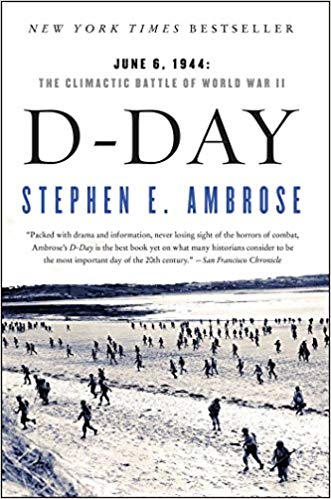
D-Day, by Stephen Ambrose

D- Day AmbroseWhy this book: I’ve enjoyed several of Ambrose’s other books (Band of Brothers, Comrades, Undaunted Courage) and this one has a great reputation. I was looking for more detail than The Longest Day offered.

Summary in 3 Sentences: This book covers a lot of different perspectives on the D-Day invasion – better than most.  Much more so than Atkinson, he includes a lot of vignettes from his extensive interviews with participants, while also covering a macro perspective.  It concentrates on the American participation in D-Day, but does give significant attention to the British and Canadian roles, their challenges, successes and failures as well.

My Impressions: This book is broad in scope, and is written in Ambrose’s engaging style, with emotion and energy, and we feel his own fascination with the subject and unrelenting admiration for the men who undertook this great endeavor.  He had already written two very well received books on specific aspects of this operation – Pegasus Bridge, and Band of Brothers, as well as Eisenhower- Soldier and President  which included much about General Eisenhower’s role in coordinating and leading the Allies during the invasion.  D-Day was his magnum opus  to bring it all together, to explore the whole operation, as well as include lots of great stories he’d gleaned from his extensive interviews with people who participated in each phase he described.  This book is almost like his letter to the American people about how amazing this operation was, and how amazing they and their men performed in this key event in Western History.

Ambrose spends a good bit of time on the extensive preparations and the final days before the launching of the invasion – not just the difficulties of Eisenhower making the decision to launch in marginal weather, but also the experience of the troops. I was unaware that many of the forces involved had been preparing for close to 2 years, and for most, it was their first experience of combat.

He then covers the invasion itself devoting separate chapters to many of it’s multiple facets.  Each chapter offers a broad overview and is full of stories from individual participants, adding the human drama that makes for great history and story telling.

I was also fascinated by the chapter on the Navy’s involvement which revealed aspects of this invasion which were new to me.  Over 5,000 craft of all typed were part of the invasion on D-Day, and bold action by ship commanders was key to the success on the ground – in the form of naval gunfire support.  They also played a key role in saving lives of the wounded – serving as hospital ships, and picking up ships crew and soldiers who in the water after their  landing craft had sunk.

One chapter that was unexpected and particularly interesting was entitled “The World Holds its Breath – D-Day on the home front” in which he describes what was going on at home in both Britain and America just prior to the invasion, and when they received word that the invasion had been launched.  He describes the jubilation that ensued when people got the word, and how they followed the progress.

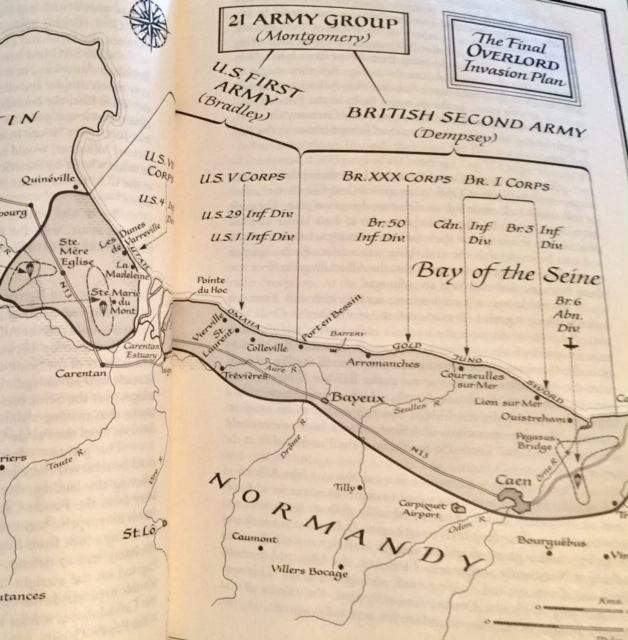
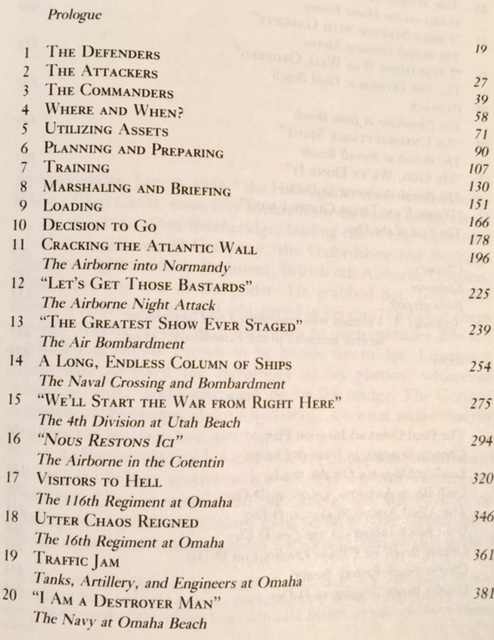
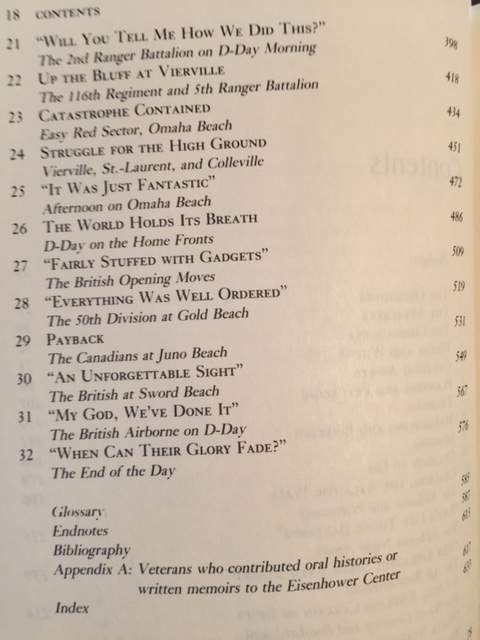
Below is a quick look at an overview map of the landing area -one of the many maps Ambrose provides.  Below that is a peek at the Table of Contents, to provide an idea of the scope of the book.  D-Day is not a short book, but it is a fun and fascinating all the way through.

Dday map

Dday ToC 1Dday ToC 2

Below are a few quotes that give a sense for Ambrose’s style, and how he tells the story:

In most cases anticipation overrode fear.  The men were eager to get going.  The excitement in the air was nearly overwhelming. The allied high command had deliberately brought the men to the highest level of readiness, mentally and physically.  Training had been going on, in most cases, for two years of more. Although there had been transfers and replacement, a majority of the men were in squads and platoons that had been together since boot camp.  They had shared the drudgery and the physical and mental demands of training, hated or loved their COs together, eaten their meals together, slept in the same foxhole on maneuvers together, gotten drunk together.  They had formed a bond, become a family.  They knew each other intimately, knew what to expect from the guy on their left or right, what he liked to eat, what he smelled like.  167

Not many of them were there by choice.  Only a few of them had a patriotic passion that they would speak about.  But nearly all of them would rather have died than let down their buddies or look the coward in front of their bunkmates. Of all the things that the long training period accomplished, this sense of group solidarity was the most important.  167

Pvt Tom Porcella, also of the 508th, was torturing himself with thoughts of killing other human beings (this was common; the chaplains worked overtime assuring soldiers that to kill for their country was not a sin).  “Kill or be killed,” Porcella said to himself.  “Here I am, brought up as a good Christian, obey this and do that.  The Ten Commandments say, “thou shalt not kill.’  There is something wrong with the Ten Commandments, or there is something wrong with the rules of the world today.  They teach us the Ten Commandments and then they send us out to war. It just doesn’t make sense.” 192

Lt Charles Skidmore, a glider pilot, landed safely in a flooded area.  He managed to get out of the water and immediately came under rifle fire.  It came from a bunker holding a dozen conscripted Polish soldiers with one German sergeant in charge.  The men Skidmore had brought in joined him and began firing back.  There was a lull in the firefight.  Then a single shot.  Then shouts and laughter.  Then the Poles emerged with their hands held high to surrender.  They had shot the German sergeant.  220

What the airborne troops had started, the seaborne armada was about to continue.  What Hitler had sown he was now to reap.  The free peoples of the world were sending the best of their young men and the products of their industry to liberate Western Europe and crush him and his Nazi Party.  262

The twenty-eight badly would men left behind and two of the three volunteers who provided a rearguard were captured. (The third volunteer, Sgt Bob Niland, was killed at his machine gun.  One of his brothers, a platoon leader in the 4th Division, was killed the same morning at Utah Beach.  Another brother was killed that week in Burma.  Mrs Niland received all three telegrams from the War Department announcing the deaths of her sons on the same day. Her fourth son, Fritz, was in the 101st Airborne; he was snatched out oft he from t line by the Army.)  316  (Bob’s note: this is clearly the inspiration behind the Saving Private Ryan story.)

Maj Sidney Bingham (USMA 1940) was CO of 2nd Batllaioan 116th. When he reached the shingle (on Omaha Beach) he was without radio, aide, or runner.  His S-3 was dead, his HQ Company commander wounded, his E Company commander killed, and in E Company there were some fifty five killed out of a total of something just over 200 who landed. 341

Bingham was overwhelmed by a feeling of “complete futility.  Here I was, the battalion commander, unable for the most part to influence action or do what I knew had to be done….the individual and small-unit initiative carried the day. Very little, if any, credit can be accorded company battalion, or regimental commanders for their tactical prowess and/or their coordination of the action.” 342

That was how most men got off the beach. Pvt. Raymond Howell, an engineer attached to D Company, described his thought process.  He took some shrapnel in the helmet and hand.  “That’s when I said, bullshit, if I’m going to die, to hell with it. I’m not going to die here.  The next bunch of guys that go over that goddamn wall, I’m going with them. If I’m gonna be infantry, I’m gonna be infantry. So I don’t know who else, I guess all of us decided well, it is time to start.”  345

General Cota came down the beach.. and started encouraging individuals and small groups to move out on their own, saying, “Don’t die on the beaches, die up on the bluff if  you have to die, but get off the beaches or you’re sure to die.”  430

(Bob’s note: BG Cota was played by Robert Mitchum in the movie “The Longest Day” – and was awarded the Distinguished Service Cross for his heroic actions and leadership on Omaha beach that day.  There has been an ongoing effort to upgrade it to the Medal of Honor)

Pickersgill himself met a French girl inland later that day; she had high-school English, he had high-school French; they took one look at each other and fell in love; they were married at the end of the war and are still together today, living in the little village of Mathieu, midway between the Channel and Caen.  557

Posted in Uncategorized | 1 Comment

The Longest Day, by Cornelius Ryan

the longest dayWhy this book:   A friend of mine, who is very well-informed and well-read on the D-Day invasion recommended this as the best book to start my reading and preparation.  Indeed it was a good one to start with.

Summary in 3 Sentences:  This book gives both German, British, and American perspectives on the invasion of Normandy by the Allies on 6 June 1944.  The book is broken up into three parts: The Wait, The Night, The Day, and provides an overview of key events, as well as personal perspectives from those who were there.  First published in 1958, the author was able to personally talk to many who were there and who played key roles in this key event.

My impression: This is a classic and a great starter book for anyone interested in gaining a broad understanding and appreciation for the build up and key events of that most important day in the Allies response to Hitler’s attempt to take over Europe.  It is relatively short at 277 pages (paper back version pictured) and easy to read. It was the basis of the well-known and star-studded movie of the same name of the early 1960s.  It includes a couple of sections of photographs which help the reader get a perspective on the players and the event itself.

What Ryan did very well was give a significant amount of attention to what the Germans did and didn’t do during the build up to and on the day of the invasion.  The reader truly gets a broad perspective of the many dimensions of the event, but the story is told with adequate references to individuals and personal experiences of not only key players, but regular soldiers on both sides.  We get not only the macro-historical/strategic view, but also the down-in-the-trenches human perspective – the fears and struggles of individuals, from the generals to the junior officers and soldiers parachuting in and storming the beach from the landing craft to fight the Germans.

As a first-read in my project to get familiar with D-Day prior to my trip to Normandy, this was indeed a great one to start with.  Not overwhelming, and easy and enjoyable to read. I’d likewise recommend it to anyone.


Posted in Uncategorized | 1 Comment

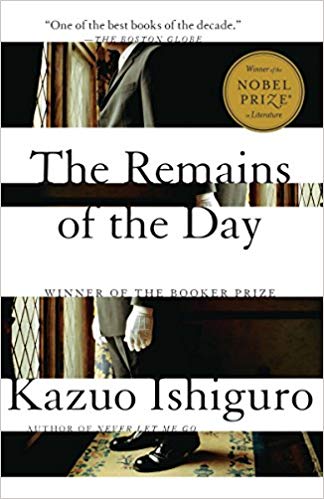
Remains of the Day, by Kazuo Ishiguro

Remains of the DayWhy this book:  Selected by my bi-monthly reading group as its selection for May 2019.  It is a modern classic: The novel won the Booker Prize and the author won the 2017 Nobel Prize for literature, and this is his best known work.  I and several others in the group had already read it and wanted to read it again.

Summary in 4 Sentences: A novel written as first-person reminiscences of a butler in one of the great houses of Britain in the period leading up to WWII.   He had aspired to a level of excellence in his profession that would put him in league with the greatest butlers of his day, and we learn not only of the art of serving an aristocratic lord, but of the sacrifices and challenges of aspiring to be a top notch professional.. While “butlering” is the setting of Remains of the Day,  the story is about so much more – work-life balance, and the costs of a super-charged self-discipline which subordinates one’s emotions and desires to achieving an ideal of greatness in one’s profession.  And how we never know the true value of what we serve, and to a certain degree, in today’s very busy and competitive world, we are all butlers.

My Impressions: Wonderful book.  Like a lot of great books, it starts slowly, and then builds subtly and beautifully to its conclusion.  It is beautifully and simply written, and is the best known of Ishiguro’s works before he was awarded the Nobel Prize in literature. The book’s fame was significantly enhanced by the movie staring Anthony Hopkins and Emma Thompson in 1993 – which is an excellent complement to the book.

It is written in the first person and as such, is a character study of a very disciplined ambitious man who has dedicated his life to achieving a professional ideal, to living up to the standards his father had set for him, which he set for himself, and to which he held others accountable.  It is an example of “leadership by example,” taken to an extreme.

The context of the books is a three day vacation taken in the early 1950s by a butler – Mr Stevens  (we never learn his first name) toward the waning days of his career.  The lord of his manor is away and suggests that Mr Stevens take the lord’s car and get away for a few days to see some parts of England he’d not seen in years.  Stevens decides to use this trip as an opportunity to have coffee with a woman with whom he had worked some 20+ years earlier at that same manor.  Through his recollections during this trip, we get to know Stevens, his principles and ideals, his self-deceptions and character flaws, the world and the times in which he worked and served his lord, and how he viewed his role in that world

As he shares his thoughts and memories, we get to know a man who has succeeded in subordinating his own emotional needs to his desire to fulfill his ideal as the perfect butler to a great house.  He viewed his own personal and emotional needs as  weaknesses to be recognized, managed, and overcome.  But as he shares his thoughts, we see that he had so successfully subordinated self to profession, he  barely recognized his own needs.  He believed that a great butler took care of himself almost exclusively in order to better serve his lord and his profession.

In reading this book, I saw parallels to the Samurai Code of Bushido, an ideal which imposed the strictest discipline on Samurai warriors to serve their lord at all costs. To become a “true” samurai, one had to dedicate oneself thoroughly and exclusively to the service of one’s lord – the one over-riding principle was to serve the lord – all other  principles and values were subordinate to that goal, and only meant to serve it.

A somewhat tamer version of this warrior ideal is the professional code and oath of the US military officer who will “bear true faith and allegiance” to the US Constitution and will “faithfully discharge the duties” of the office to which s/he is assigned.  Though the military does make compromises to such things as family and a personal life,  it does idealize service to others and nation at the expense of self, and revers such “warrior monks” as Jim Mattis and others before him, who have have forsaken family to serve their country and the military almost exclusively. In fact at the Naval Academy, midshipmen are taught the “Constitutional Paradigm” of values:  Constitution, Service, Mission, Ship, Shipmate, Self.  Self is at the bottom.

In reading how Stevens described his dedication to the ideal of being a great butler, I saw similarities to the military profession which demands that its members subordinate their lives and personal desires to something bigger than themselves.  The warrior profession demands a willingness to give ones life when called upon, for the demands of one’s country.  Even in peacetime and in garrison, soldiers are never “off duty” and must  stay prepared to be called at any time for the demands of combat; they are regularly asked to subordinate family and other personal callings to the needs of the nation, the Navy, their job, their shipmates.   If one buys into this completely and without balance, then one can never give enough.  Remains of the Day takes this ethos to an extreme and we see the costs.

In the military and other similarly demanding professions like medicine, the priesthood, police and first responders, we expect people to take care of themselves and their “human” and family needs as a concession to the long term needs of the profession:  We take care of ourselves so that we can better take care of our mission over the long term.  The opportunity for a balanced family life  is a concession to attract new recruits into the profession and to retain those who have achieved some level of experience and competence. And then there are those warrior monks like Stevens who have bought into the ideal entirely, and who have given their whole life to their profession.

In Remains of the Day, Stevens puts the pieces together of his professional ideal as he considers what it means to be a great butler.  He distinguishes between superficial qualities that are often admired, but the utmost criterion is to “be possessed of a dignity in keeping with his position.”  This point he returns to repeatedly

“The great butlers are great by virtue of their ability to inhabit their professional role and inhabit it to the utmost; they will not be shaken out by external events, however surprising, alarming or vexing. They wear their professionalism as a decent gentleman will wear his suit: he will not let ruffians or circumstances tear it off him in the public gaze; he will discard it when and only when, he wills to do so, and this will invariably be when he is entirely alone.  It is as I say, a matter of ‘dignity.'” 

I found his arguments compelling – to a point.  Stevens takes this position to an extreme which shows the  reader that it is not enough.  As an American, my ideal is for a leader in any profession to also be able to demonstrate shared humanity with others of all classes, while also standing apart to effectively inspire, motivate, and lead.   It reminds me of the tension between two principles of leadership: The leader should be “authentic” and human, while at the same time the leader should be a model of detached wisdom, as Colin Powell said, “Never let ’em see you sweat.”

Remains of the Day also points to the very conservative view that “ordinary people” should leave resolving the major affairs of the world to the aristocracy who are born and bred to lead, and who have the education and experience to make decisions in very complicated matters.  Stevens believes that these great men serve in what he called “the hub” of the world, and their decisions emanate out like spokes on a wheel to the rest of us who keep the wheel rolling.  He holds on to this position in spite of how wrong-headed his lord and his friends and colleagues were in their assessment of Hitler.

Ishiguro in the various interviews with him I’ve listened to, makes the point that in some sense, “We are all butlers” serving people, institutions, causes that we don’t fully understand.  But we serve with faith in their goodness.  Stevens had complete faith and trust in the wisdom and greatness of Lord Darlington, and only at the end realized that his Lord was misguided, though well-meaning.  Again, I think of the analogy of those of us in the military, going to war in Iraq (or Vietnam 50 years ago) on faith that our leaders were well-informed, wise, and doing the right thing.

Only in the end of the book does Stevens reveal a crack in the certainty of his conviction that he had fully done his duty as a man. He briefly acknowledges a hint of doubt that he had any other duty other than his complete dedication to Lord Darlington. He briefly acknowledges that perhaps he had abdicated his own moral decision making to his ideal of the great butler and to the decisions of Lord Darlington who he was serving.  He asks  “Where is the dignity in that?”  And then it seems, he dismisses the thought.

One of the other reviewers of this book placed a lot of importance on Stevens’ relationship to his father, and the incident in which he was torn between being with his father on his deathbed, or fulfilling his duties overseeing an important social event in Lord Darlington’s manor.  He chose the later, and (probably rightly) justified it that his father would have expected no less of him.

And then there is the Miss Kenton.

Though always professional, Stevens had been close to the woman he was going to visit during his three day sojourn.  She also had always been professional but the two of them had clearly been drawn to each other – but out of a sense of professional duty, never spoke of it to each other, never admitted it. She had sought to subtly break through his professional armor, but he had a always rebuffed her – as a professional butler should.  He was mildly aware that in his visit to her he was hoping they could rekindle their friendship and warmth toward each other – and perhaps more, but in his narrative, Stevens only admitted to wanting a competent housekeeper to better serve his current master.  This story of two lonely people, unwilling to address and confront their own emotional needs and connection to each other was a very powerful and sad sub-theme of the book.

SOME OTHER POINTS and QUOTES to serve me better in my future reflections on this book:

His discussion of “greatness” and “dignity” within the context of butlering, but which may apply in other contexts.

“the most crucial criterion is that the applicant be possessed of a dignity in keeping with his position.”

“dignity is something one can meaningfully strive for throughout one’s career.”33

His discussion of the moral distinction between private behavior and public service to a greater good -a distinction not made in politics or our culture today.114

He identified his own professional prestige as a reflection of the moral worth (public service) of his employer and this he applied to others. 114   We should serve those who are contributing to humanity and thereby do our small share to make the world a better place.  Serve a great house and gentleman and through that, serve humanity.  Like being in the Navy

The great butlers are great by virtue of their ability to inhabit their professional role and inhabit it to the utmost; they will not be shaken out by external events, however surprising, alarming or vexing. They wear their professionalism as a decent gentleman will wear his suit: he will not let ruffians or circumstances tear it off in the public gaze; he will discard it when and only when, he wills to do so, and this will invariably e when he is entirely alone. It is as I say, a matter of ‘dignity.'” 43

Great houses and the aristocracy are the “hub” of the world, where great decisions are discussed and made and emanate out to the rest of the world – rich and poor who revolve around them.

He was readily willing to tell white lies to avoid unpleasantness – as when several times, he denied  service to Lord Darlington, who after the war was reviled as a Nazi sympathizer  126

He struggled with bantering, and with the hazards of uttering “witticisms.”

The metaphor of the importance of polishing silver

The difference between Stevens’ and Ms Kenton’s responses to Lord Darlington dismissing the Jewish girls.

Reading literature – a pleasure – but it had to serve his goals – furthering his command of the English language – Confesses and does not apologize for at times gaining a sort of incidental enjoyment from these stories. 168

He was NEVER off duty. The professional must INHABIT his role.  169

How he reacts to the villigers in the home he stayed at – “ordinary people.”194 Democracy is for a bygone era ==  the world is too complicated for universal suffrage. Great affairs will always be beyond the understanding of those such as you and I.  We best make our mark by concentrating on that which is within our grasp -serving the great gentleman in whose hands the destiny of civilization truly lies. 198-9

“Why should I not admit it- at that moment my heart was breaking.”239

Aging:  “More and more errors are appearing in my work.”   (Lord Darlington) chose a certain path in life, it proved to be a misguided one, but there, he chose it, he can say that at least.  As for myself, I cannot even claim that. You see, I Trusted.  I trusted in his lordship’s wisdom…I can’t even say I mande may own mistakes. Really – one has to ask oneself – what dignity is there in that?”

Perhaps it is indeed time I began to look at this whole matter of bantering more enthusiastically…particularly if it is is the case that in bantering lies the key to human warmth. 245

Concludes with committing himself to more bantering and witticisms to better serve Lord Farraday.


Posted in Uncategorized | Leave a comment

Jungle Rules, by Paul Shemella

Jungle RulesWhy this book: Written by my good friend Paul Shemella who I know well from my time in the Navy, and for whom I have worked for several times since, when he was the Director of the Center for Civil Military Relations/Counter Terroris

Summary in 4 sentences: Carl Malinowski is a retired SEAL officer who on occasion is contracted to take on politically sensitive missions in Latin America for the CIA, and he conducts these with a loyal cadre of about 5 other former SEALs.  The book begins with a successful “rendition” mission – Carl and his team kidnap a Colombian drug kingpin from his jungle lair and return him to the US.  The ensuing political tensions between the US and Colombia, force the CIA to call on Carl and his team to conduct a recovery mission of a key US official who was kidnapped in retaliation.  But the political issues complicate the mission significantly, and all is not as it seems for Carl and his team – and of course there are some beautiful women in the story that further complicate Carl’s mission.

My Impressions: A good yarn,  fun read and a nice combination of a popular special operations adventure story, complete with a romantic element, and a pretty realistic portrayal of special operators working in the netherworld of strategic, political and military intrigue.  Paul Shemella has worked in that world, not only in Latin America as the senior SEAL working counter-drug operations throughout South and Central America, but all over the world in his subsequent positions in Europe and Africa on active duty, and then later travelling to capitals all over the world to teach political military affairs and leadership to senior military and civilian leaders on behalf of the Naval Post Graduate School. He’s seen America at its best and worst overseas, and also worked with special operators and country teams, senior military leaders, and other counterparts all over the world.

The book starts on a mission in Latin America in which the team of former SEALs abducts a major drug kingpin for return to the states for trial.  After that success, the team returns to their civilian lives, and we spend the next portion of book getting to know Carl, his life, and we get to know some of the other characters who will play key roles in the drama as tensions brew between the US and Colombia.  Then, Carl and his team are called on again to help resolve a crisis that requires particularly sharp and reliable special operations expertise and experience in Latin America, and Carl and his team are a proven resource.

From a special operations perspective, I particularly enjoyed his descriptions of how the operators worked together preparing for and conducting their operations.  His descriptions of scenes in the jungles and on the rivers of Latin America clearly indicated that he had been there, done that.  I also enjoyed his portrayal of country team dynamics in Colombia.  I have had some experience myself in the often chaotic world of  country-team politics, trying to get the job done while dealing with all the personality and ego dynamics, and inter-agency competition.  Paul’s depictions rang true and were reminiscent of my own experiences.

On the less positive side, I did feel that his former SEALs were a bit too idealized for my taste.   They were all really good guys, very skilled operators, super motivated and super locked-on and committed to each other and their mission.  My own experience has not always been so positive – a lot of SEALs are indeed selflessly committed to each other and their mission, but others are not quite so selfless.  Especially after leaving the culture of the Navy and the Teams, many if not most SEALs are ready to make other commitments in life.  When called upon to perform primarily for money, working for other agencies, defense contractors, or other corporate entities outside of the culture of the military, loyalties and commitments are often not as strong.   In fact, for Carl Malinowski himself, this tension between his commitments to serve military-like objectives outside the military, and his desire for a new life was a key sub-theme in the book.  

I also felt that the the bad guys in Jungle Rules were perhaps a bit too evil, and the women perhaps also a bit too idealized – I wish I could have met such super-hot, intelligent, multi-dimensional women as those portrayed in this story.   I would have liked a bit more depth and dimension to the interesting characters in this book – but perhaps that is a limitation built into making a popular romantic adventure novel in 230 or so pages.  As a guy who has lived in that world, I was sometimes not just letting myself enjoy the story, but was noting what didn’t quite jive with my own experience or what wasn’t there that I expected to see.   These weren’t big distractions, and I enjoyed the book.  Paul wrote a good adventure story for SEALs and non-SEALs alike, which indeed did do justice to the SEAL Teams and SEAL Team values.

As the story moved toward its culmination, I was truly drawn in, and the last half of the book became a real page turner.   The final operation brought the story to its fast-moving and satisfying conclusion.  And Paul put in a nice twist at the end – I couldn’t stop reading until I found out how it would all turn out.  I spent an enjoyable afternoon turning pages and staying very engaged, speeding through the last half to third of the book.

Jungle Rules offers not only a good adventure story, but also some great insights into special operations in the political-military counter-drug netherworld of Latin America.

Posted in Uncategorized | 1 Comment

The Choice, by Dr Edith Eger

The ChoiceWhy this book: Recommended to me by my friend Peter Rea and then a couple of weeks later by my friend Letizia Amadini-Lane.  Dr Eger is a holocaust survivor who tells an amazing story of survival – and she is alive and well and living in Southern California.

Summary in 4 Sentences:  This is Dr Edith Eger’s story – partly a memoir of an incredible life, but also a philosophy of recovery and empowerment that grew out of the horrors of her time in Auschwitz.  As a young girl in a middle class Jewish family in Hungary, she and her family were rounded up and sent to Auschwitz.   Her family was split up on arrival and she never saw her parents again, but she and her sister helped each other to survive – barely.  The book details the horrors of her time in Auschwitz and then goes on to cover how her life evolved over the next 7 and a half decades – the challenges and rewards of being an immigrant in America and how she struggled and overcame the trauma of Auschwitz to become a powerful voice in psychotherapy and dealing with Post-Traumatic Stress.

My impressions:  This is a powerful book.  It begins with a glimpse at life in a happy Jewish family in Hungary, but with the storm clouds of World War II and increasing anti-Semitism threatening.   She shares her story of the horrors of the concentration camp and then of her long recovery. Physically she recovered in a year or so; psychologically she is still recovering – the trauma and Post-Traumatic Stress was that severe.  It is a story of psychological recovery, of immigrant life in America, of redemption and forgiveness and of her message to all who have suffered and struggle to come to terms with their suffering.  It is not only powerful, it is a great and engrossing read.  I couldn’t put it down.  She tells her story and shares her message in beautiful, compelling and straightforward prose.

Part 1 – Prison.  The first part of the book is about her childhood and her time in the concentration camp. Dr Edie was an active young girl in school and dance, and other activities in Kosice, Hungary and she recounts her confusion as subtle anti-Semitism became more overt and eventually “legitimized” and institutionalized as the Nazis came to power in Hungary.  Then her family was forced out of their home in the middle of the night, with no notice, by the Nazi government, allowed just a few suitcases, and sent to a holding area, from which they were transported in trains to Auschwitz.

There what had been a bad situation got progressively worse, and she tells story after story of the horrors she encountered to include her encounters with the infamous Dr Mengele.  She quickly realized that her mother and probably her father had been killed shortly after arriving.  She and her sister Magda took great risks to stick together and to support each other.  As teenage girls, it was their decision to try to survive together, or perish together, and that decision became harder and harder to hold on to.  Somehow together, they survived the successive “selections” – those evens at which the Nazis selected those who would live and those who would go to the gas chambers.

The end of this ordeal came when her camp was liberated by American soldiers.  Edith and her sister Magda had become so weak, injured and incapacitated, and were so near death that they had been consigned to a pile of dead bodies.  Edith recalls being barely conscious, between life and death.  This part of the book concludes with the unforgettable story of how an American GI yelled to the pile of bodies  “Are there any living here? Raise your hand if you are alive.”  She was too weak to answer.  As he begins to walk away she is barely able to move her hand, and he returns and pulls her and Magda from the pile of the dead.  She concludes that part of her story with “We have survived the final selection.  We are alive. We are together. We are free.”

Part 2 – Escape. In this part of the book, she recounts the joyful and painful months immediately following her liberation from the concentration camp, her recovery, her repatriation to Hungary and eventually to her home town and adapting to a new world.  She meets and is courted by her husband Bela.  Soon after they marry, they realize that the horrors of Nazism are being replaced in Hungary by the oppression of a communist dictatorship.  They accept that there is no good life left for them in Hungary. They struggle with where to go, and the decision is between two places: Israel (then still Palestine) and the US.  They had been relatively wealthy in Hungary, but decide to emigrate to the US, leaving everything behind.

Part 3 – Freedom. They arrive in the US in 1949 and are among the tens of thousand indigent European immigrants who came to the US following WWII. She doesn’t speak English, they have no money, they face discrimination as indigent immigrants, and are living in Baltimore in a one room cold water flat, dependent on the help of relatives and other immigrants. Both she and her husband work at menial jobs to survive – because that is all that is available to them.

Eventually they have children and slowly climb out of poverty and decide to move to Texas, where their fortunes improve.  With hard work and discipline, they are able to move solidly into the American Middle Class and raise their children the American way.   She eventually gets a college degree and then finally a doctorate in psychotherapy.  Her marriage struggles under the stress of husband and wife both working hard while raising a family, and under her own struggles to process the horrors she wouldn’t confront from her time in the concentration camp.  She eventually connects with Viktor Frankl who becomes a mentor to her, and then she eventually becomes a voice and spokesperson for Holocaust survivors.   She also chooses to accept a speaking engagement in Europe and makes the very difficult decision to travel to Auschwitz to confront her demons.   This decision is key to her healing – which is the title of the final section of the book.

Part 4 – Healing.   She begins this final section describing one of the last times she saw Viktor Frankl, who she considers one of her two liberators – the first being the GI who pulled her from a heap of bodies at Gunskirchen, Germany.   Viktor Frankl  “gave me permission not to hide anymore, who helped me find words for my experience, who helped me to cope with my pain.”  He helped her discover a purpose for her suffering and a sense of meaning to apply to her life.    In this section of the book she shares how as a therapist she helped empower others to take responsibility for their lives, to NOT be victims of their past.

She talks about how she and her sister Magda have dealt differently with their pain and nightmares. Neither the psychic wounds nor the nightmares go away, but Edie insists that she is not a prisoner of her past any more. Revisiting Auschwitz and confronting the horror of her experience there were key to her sense of freedom. “I wasn’t a prisoner anymore,” she writes. “I went back to Auschwitz searching for the feel of death so that I could finally exorcise it. What I found was my inner truth, the self I wanted to reclaim, my strength and my innocence.”

She concludes the book with a story of  her visit in 2010 to speak to the 71st Infantry Division – the unit that 65 years earlier had rescued her from the concentration camp.  She writes how she was so full of joyful adrenaline she could barely speak.  She laughed and wept on stage, full of gratitude.  Many of the troops in her audience had experienced trauma and painful loss in the wars overseas.   She concluded her book with the words that were key to her message to the troops and are fundamental to her message to all of us:  “You can’t change what happened, you can’t change what you did or what was done to you. But you can choose how you live now.  My precious, you can choose to be free.”

————–

On 8 Mar 2019, I was able to go to lunch with Dr Edie Eger with my wife Mary Anne, my friends Peter and Letizia, and two of Letizia’s friends Amy and Isabel.  We had all read The Choice and wanted to meet Dr Edie, ask her about her book and her life, and hear what she had to say.  It was a lovely lunch and gathering.

Dr Edie is a petite, very well-groomed and attractive 91 year young lady who is energetic outspoken, and very compassionate.  She has dedicated her life to sharing her story in ways that will help others who may be suffering from past trauma or anxieties. She is very busy; when I picked her up I asked her what she’d been doing. She had had a speaking engagement almost every day that week, and in a few days,  she would be flying to Mexico City for another engagement.  She is very much in demand and has an executive assistant to help her manage her many commitments.  We were lucky that she was able to squeeze us in.

She asked each of us about our own lives but readily shared her own story and made regular references to what she has learned about self-forgiveness and self-empowerment from her experiences in Auschwitz. She told us that her decision to return to Auschwitz was one of the most important decisions of her life to help her with her own healing.

She shared with us that her publisher asked that The Choice NOT be primarily a memoir, but rather a book about her insights about life and healing. Though the book wasn’t published until 2017, it doesn’t cover much of her life after the early 1980s – merely a few  stories and anecdotes from her teaching and therapy sessions with her patients that help her make her points.  Her husband Bela’s death is not mentioned – though he died in 1993 of the tuberculosis he had contracted during WW2. She has lived in La Jolla for over 20 years, in a beautiful home that looks out over the Pacific Ocean that she bought from her daughter – a home that many years previously she had helped her daughter to buy. Her daughter is now living on the East Coast (Boston, I believe,) as her husband has won a Nobel Prize in Economics and is still teaching..

She is so proud of her daughter – who she reminded us was ashamed of her mother as she grew up – ashamed that her mother spoke English with a heavy accent and wasn’t like the other middle class American mothers she knew, or saw on TV in sitcoms and commercials while growing up in the 50s and 60s.  Of course, that has changed and they are now very close.

Dr Edie told us she is working on another book, but this one for children, which distills her wisdom into what she called “Edie-isms” that children can understand, relate to, and remember.  Over the course of our conversations, she shared with us a number of Edie-isms, some suitable for children, others more for adults.  These are the ones that I and the others who joined us for lunch were able to recall:

  • Respond, don’t react.
  • Turn Hate into Pity
  • Frame it, and then Reframe it
  • There is a little bit of Hitler in each of us.
  • There is no forgiveness without rage….
  • Jesus’s message was that we should love unconditionally
  • 4 words. “Please Tell me more.”
  • There’s a difference between Faith and Belief.
  • You don’t have to be a cow to know about milk!
  • “What now?” Rather than, “Why me?”
  • Auschwitz – where I was told I was subhuman, a cancer on society and the only good I can do is to come out a corpse.  I was victimized, but I refused to become a victim.
  • I have remorse (I still struggle with not saying my mother was my sister); not regret – I did the best I could at the time.
  • Rather than ask how your day was, say, “I missed you! It is good to see you!”
  • I like a man who is kind and who has integrity.
  • Don’t fight with someone who disagrees with you. Listen, and let them know that, if they are interested, you’ll share your opinion.
  • Ask, “How can I be useful to you?”
  • Revenge feels good in the short term, but I was interested in the long-term.  I forgave Hitler for me – so that I wouldn’t be consumed by hate.
  • You can’t control circumstances, but we can control what we feel, what we think, how we behave.
  • Our jailer is in our mind,  and the key to liberate us is in our pocket, but it takes an inner life.
  • We knew who the enemy was – the Nazis.  Children who are abused don’t know who the enemy is.
  • I don’t believe in retirement.  My mission is to educate the young and combat ignorance.
  • Would you want to be married to you?


Posted in Uncategorized | Leave a comment

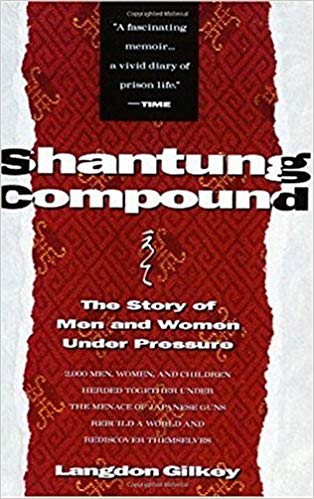
Shantung Compound – the story of men and women under pressure, by Langdon Gilkey

Shantung Compound

Why this book: Recommended to my by my friend Peter Rae.

Summary in 3 sentences:  Imagine taking a fairly random group of about 2000 civilians from a number of different countries, locking  them inside a small compound, taking away all rank privilege or previous status, providing food and basic necessities, isolating them from all contact with the outside world, and telling them to figure it out.  That’s what the Japanese did with western civilians in China when they occupied China during WWII. Langdon Gilkey, an idealistic young Harvard grad teaching in Peking was one of those 2000, and in Shantung Compound, he shares his experiences in that compound, and draws his very interesting conclusions about human nature and morality.

My impressions:  This is fascinating book that is full of wisdom and insight about human nature and man-the-social-animal.  It is a book I would love to read and discuss with people who are thoughtful about communities, society, politics and how people can best live together.  It is real – it really happened. This author was there, and writes about his experience with care and compassion, and shares the many insights and lessons learned he gained from his experience.  This book is a gift. I’m surprised it isn’t better known.

Shantung Compound is a fascinating memoir of approximately 3 years in the author’s life. He was an idealistic young man, a summa cum laude graduate from Harvard in philosophy,, teaching English as part of the faculty at a university in Peking.  In early 1943, he and other residents of northern China were rounded up and sent to a compound near the village of Weihsien, in Shantung province in China.  Here they stayed until late 1945 when the compound was finally liberated and its occupants dispersed to their various countries and future lives.   Gilkey wrote Shantung Compound 20 years later, when he had become an ecumenical Protestant theologian.  He based his detailed accounts of events and conversations in the compound on his very extensive diaries from his time there.   The insights he shared on what those experiences might have meant, and might mean to us today, came after 2 decades of living, teaching, and reflecting.

The internees in the compound were largely British and American, a number of missionaries, business people, British colonialists, teachers and representatives from a number of European countries and a few others.  There were families, as well as single men and women, children, teenagers as well as some older folks in their 70s and 80s. They had been allowed to bring just a few belongings from their homes.  The compound they were sent to was a looted monastery, almost in ruins. The new internees were on their own to repair the infrastructure and make it livable, sort out berthing, cooking, sanitation, work parties, managing relations with their captors.  Within the compound their movements were not restricted, but no contact was permitted with the world outside the compound walls.  For a while, a black market flourished with the outside villagers and a few of the Japanese guards (shades of Clavell’s King Rat.)

In short it was a mini-society of diverse people with mostly western values forced to live together and cooperate or perish.  And that is what made this “experiment” so interesting.  Gilkey noted, “Each of us had barely enough food and space to make living possible and bearable.  In such a situation, the virtues of fair-mindedness and generosity completely changed their complexion. ” 91

The idealism of the young Harvard philosophy graduate unravelled as a result of his experience of his fellow internees under pressure.  He came to realize that most people are driven primarily by self interest.  As a young, single, intelligent, and idealistic man,  he volunteered for and took on positions of responsibility that were essential to functioning of the camp.  But he had no authority (no one did – except their Japanese wardens), and taking care of the best interests of the group depended entirely on the willingness of various players to cooperate.  Here he was repeatedly astonished and disappointed at the selfishness, self-centeredness, greediness of many in the camp.  He noted that for the majority of his fellow internees, the ethic of preserving and enhancing their own personal well-being always took precedence over the welfare of others, or even of the group as a whole.

Throughout the  book he gives examples, and draws conclusions and insights from his experience of this selfishness.  While he also offers examples of a number of genuinely honest people who were willing to work extra hard, sacrifice and suffer for the good of the whole, they were the exception.  He gave an example of a woman who was not well regarded by other women in the camp for her rather progressive views on sex and relations between the genders. But her virtues of courage, “rugged and undeviating honesty,” and her sense of humor were the rare qualities that made her one of the most effective leaders in the camp.

He has a whole chapter on “meaning” entitled, “Living for What?”   Up front he states, “A man possesses a sense of ‘meaning’ when he feels there is a vital connection between the goals he values and the activities and relationships is which he is involved.” (p 193) He found that those who were not self-motivated for a bigger purpose than self-interest were bored, lazy and their behaviors were often detrimental to the group.  “Its was obvious that no great number of people would work for the sheer joy of it, or merely for the sake of their brothers’ welfare.”  (199)  That lack of “meaning” and larger incentive along with the lack of authority to punish or provide negative motivations, was a major challenge to those who sought to enhance the quality of life in the camp.

After telling his stories of life in the camp, his insights about human nature, and then of the final liberation of the camp by the allies (a great story in itself!)  Gilkey concludes with a final chapter in which he shares his perspectives about man, meaning, morality, and the life well-lived.

He realized that the same selfishness and unwillingness to share that he saw in the camp is also found in the the larger world outside the camp – in communities large and small, to include the community of nations.    When lecturing in America after the war about his experiences in the camp, he noticed how Americans found it hard to believe that other Americans would act so greedily and be unwilling to share when the American Red Cross provided them with food and other items that others in the camp did not receive.  But when he drew the analogy with how wealthy nations were unwilling to share their abundance with poorer nations, people drew back.

His final point was that without a loyalty and religious devotion to something larger than oneself and one’s immediate group, people will always eventually fall into self-centered and immoral behavior.  For Gilkey that something larger is God and God’s providence.

Fascinating book with some profound insights and implications for who we are, how and why we behave the way we do in groups, and concluding with his views on the spiritual implications of what he observed in the compound.

———-

There were a number of insights and quotes from Shantung Compound that captured my attention.  Here are quite a few of them:

Work was central  to each of us.  However dull it seemed, it gave a focus of interest and energy to a life that otherwise by its confinement and great limitations, would have been overwhelmed by boredom. 52

Those who had been poor and somehow risen to middle class were much less willing to do dirty labor, like latrine cleaning, than those who had no fear of falling back into the lower classes. Those who had been solidly in the middle or upper classes were generally more willing to do whatever needed to be done. 67

The intelligentsia tended to undervalue the importance of material goods – until they weren’t there.  But the value of the arts, the philosopher, the poet who feeds men’s souls is only possible when “material needs are so completely satisfied that they can be safely forgotten.”71

Intellectual, and especially “religious” vocations were so unrelated to the real needs of life that they became “avocations.” 74

Without moral health a community is as helpless and lost as it is without material supplies and services.76

Rational and moral arguments were futile when not backed by authority and when it meant asking someone to give up something s/he didn’t want or have to.   “Self interest seemed almost omnipotent nexts to the weak claims of logic and fair play.”79

Those with pretenses to virtue but driven by self-interest always found rational and “moral” reasons for what they had already determined was in their own best interest.

For one of the peculiar conceits of modern optimism, a conceit which I had fully shared, is the believe that in times of crisis the goodness of men comes forward.  ….Nothing could be so totally in error.” 92

Rational behavior in communal action is primarily a moral and not an intellectual achievement, possible only to a person who is morally capable of self-sacrifice. In a real sense, I came to believe, moral selflessness is a prerequisite for the life of reason – not its consequence, as so many philosophers contend. 93

For the first time it appeared to me that, contrary to most pacifist and anarchistic theory (to which I had been sympathetic), legitimate force is one of the necessary bases upon which justice can be established in human affairs. 119

Compromise is essential to politics.  “Can it be done?” is as relevant as the question , “Is it right?”  120  No program in the life of a community is really just if that program cannot be enacted.  121

We do not act in political life because our act is just. We act because the pressures of the moment force us to resolve in one way or another some vital problem in the community. 122

Gradually every position in camp which might become a focal point of conflict, suspicion, and turmoil, became an elective office….Democracy forces the strong to give up power, and the carping public to take it on – and with it a sense of responsibility. 128

How do you get lazy men to work and to work hard, if you don’t hire them,  if you don’t pay them wages and are thus unable to fire them?  No one in the camp ever discovered a way to stop a lazy man from being lazy.  129

The question of incentive remains one of the most serious problems for societies that offered total security regardless of work accomplished.   132

People claimed over and over, on no valid grounds, that they were special cases, and demanded “their fair extra portions.”137

The only place moral pressure or moral force really works is where the government is immensely respected, where an absolutely unified public opinion can be created and where each member is so intimately related to the others, and so dependent on them that disapproval really hurts him. “155

Without the threat of some sort of harm to the offender, without some form of force, no system of law is possible in a world where universal morality cannot be assumed. And if it could, then after all, no system of law would really be necessary! 156

No group can legislate itself above its own moral level.  157

Apparently,  as long as men did not feel a sense of identification with and moral responsibility for the community of the camp, they would continue both to steal from it and to vote against punishment for stealing. 160

Any civilization rests only on some ethical basis.  160

Hardheaded men of affairs are inclined to smile at the moralist and religionist for concentrating his energies on the problems of morality and conscience far removed from what he considers to be the real business of life:  that is to say, producing food, building houses, making clothes, curing bodies and defining laws.  But as this experience so cogently showed, while these things are essential for life, ultimately they are ineffective unless they stem from some cooperative spirit within the community  161-62

I was even more surprised when I found that it was Claire to whom he had given charge of women’s labor in the kitchen….It took courage enough to enforce the working rules..it took a sense of humor to do this without causing too many conflicts, and it took a rugged and undeviating honesty to stem the mounting tide of stealing.  Looked upon by most of the pious as so wicked they were embarrassed to be seen talking with her, she had in fact a higher moral character than they did.  164

The Catholic fathers possessed a religious and moral seriousness free of spiritual pride. They communicated to others not how holy they were but their inexhaustible acceptance and warmth toward the more worldly and wayward laymen. Nothing and no one seemed to offend them or shock them; no person outraged their moral sense.  172

Above all, it was evident that among all the Westerners of many nations who had left their massive imprint on China, the missionary was the only one who had had a sincere wish to help the Chinese rather than either to dominate or to milk them.  178

The merchants’ picture of the missionary is more familiar to us all.  To them, the missionary was a loveless, sexless, viceless, disapproving, and hypocritical fanatic.  He was repressed and repressive, trying to force others into the narrow straightjacket of his own list of rigid “do’s and don’ts,” and thus squeezing out of his own life and out of theirs all its natural and redeeming joys.  180

For him, holiness had so thoroughly displaced love as the goal of Christian living that he could voice such a prejudiced and inhuman policy with no realization that he was in any way compromising the character of his Christian faith or his own moral qualities.  182

Protestantism has produced a degenerate moralism, a kind of legalism of life’s petty vices that would be boring and pathetic did it not have such a terrible hold on so many hundreds of otherwise good-hearted people. For many of them being a good Christian appeared to mean almost exclusively keeping one’s life free from such vices as smoking gambling, drinking, swearing, card-playing, dancing, and movies.  185

In their frantic effort to escape the fleshly vices and so to be “holy,” many fell unwittingly into the far more crippling sins of the spirit, such as pride, rejection , and lovelessness. This, I continue to feel, has been the greatest tragedy of Protestant life.  188

A man possesses a sense of “meaning” when he feels there is a vital connection between the goals he values and the activities and relationship in which he is involved.  193

Why do men work hard? What goals call forth their ambitions and so their energies? For most of us the answer involved two interrelated concerns:  our progress in our careers and our status in the community in which we live.   196

If a difficult task seems to provide a man with no desired values, then his ambitious for that task withers, however prestigious it may seem to be.    Without a sense of the significance of what they do, men become too indifferent to use their full powers and they do merely what they have to do to keep going.  196

“Yes, ” Matt replied, “coming here is not unlike death: you can’t bring your career or your social eminence with you. ”  197

Only if a man can find a creative role in some community – be it his local community , or the wider society of scientist, writers, or artist – can a man be a creative person inside.  198

We were puzzled, among other things, by the problem of incentive.  It was obvious that no great number of people would work for the sheer joy of it or merely for the sake of their brothers’ welfare.  Is the problem of meaning resolved then by the familiar capitalist solution: reward a man with money and the problem of the meaning of his work is resolved?  199

Work is not merely an economic reality, producing only material results and running only on material fuel. Its motivations lie in the most central meanings of a man’s life, be they self-centered, trivial, or  profound.  If men work only for their own material profit and are motivated by no further goals, their only interest will be self-interest. Our experience had shown overwhelmingly that a society based on self-interests alone was, as St Augustine pointed out long ago, a self-destructive society.  199

These (trivial) efforts reveal one common factor: the frantic attempt to escape from a pointless boredom, when what one does has no important or significant meaning, when one’s life is caught up in no great passion or concern.  200

(After the allies arrived) Now we had all of these delights in abundance; yet we continually had to remind ourselves of this fact in order to appreciate them. We were not really any happier. Our wants and desires had only become a little harder to satisfy.  Instead of freedom we now wanted “home”; instead of enough to eat, we now dreamed of cocktails and seafood.  Now that we had the necessities of life, we tended to take them for granted and look for the luxuries – such are the insatiable desires of the human animal. 213

Only when destiny gives us the great gift of an open future are we able fully to live, for intense life in the present is made up in large part of expectancy. Whenever we are alive and excited, it is the future and not the past that enlivens the present moment.  223

It is above all things difficult to be good, and in all of us – the wise, the idealistic, and the religious alike – lie deep forces beyond our  easy control which often push us seemingly in spite of ourselves into selfish acts.  230

The goodness of mankind and man’s consequent capacity to be moral, is refuted by any careful study of human nature.  230

Two things can be safely said about mankind. First, it seemed certain enough that man is immensely creative, ingenious, and courageous in the face of new problems.  but it was also equally apparent that under pressure he loves himself and his own more than he will ever admit.   230

Whenever the security of the object of man’s commitment is threatened, be it power, job or profession, or the status of their family or social group (class, nation, race) he is driven by an intense anxiety to reinforce that security. 231

The more educated and respectable people defended their self-concern with more elegant briefs.  We came indeed, to have a grudging respect for the open rascal.  He, at least, was forthright in admitting his selfishness.  232

It is what we can only call the religious worship of a finite creature –  that creature being one’s own life or that of his group – that causes the disruptions and conflicts of society.  When our ultimate concern is direct to some partial or limited interest, we can, as I found, scarcely avoid inhumanity toward those outside that interest.  232

Sin may be defined as an ultimate religious devotion to a finite interest; an overriding loyalty or concern for the self, its existence and its prestige, or for the existence and prestige of a group.  233

A man’s morality is his religion enacted in social existence.  The rare power of selflessness, what we call true “morality” or “virtue,” arises only when a life finds its ultimate devotion to lie beyond itself, thus allowing that person in times of crisis to forget his own concerns and to be free to love and help his neighbor.  233

The question is: To what sort of deity are we ultimately loyal, and what kind of god claims our deepest love and devotion? 233

The otherwise admirable trait of loyalty to one’s family, one’s group or nation which, when it becomes central, is the root of much of the injustice, pride, and selfishness we have described and with which we are surrounded.  234

The man of real faith is the man whose center of security and meaning lies not in his own life but in the power and love of God, a man who has surrendered an overriding concern for himself, so that the only really significant things in his life are the will of God and his neighbor’s welfare. 234

If a man is too sure that he has, through his religion, surrendered his concern for himself and achieved virtue, it is fairly safe to conclude that his security no longer rests in the love of God but in his own holiness. 234

Such a view of the vulnerability of life’s meanings was one of my deepest experiences in camp, and it helped to prepare me off the even deeper abyss into which the postwar Western world has been forced to stare.  The universal problem of selfishness,  I found, called for the grace and forgiveness of God – both in camp and in the affluent society of America.  Similarly the problem of fragmentariness of every human meaning seemed now to me to call for the answer of God’s Providence, for that unity of divine power and meaning in the course of events that is not threatened by the historical catastrophes that overwhelm us.  239

Fate is usually in part the consequence of sins in which we share communally if not personally, the effects of some former misuse of freedom. Fate is thus the mask God’s judgment in history wears to those who do not know Him 240

The creation and preservation of life so that it may be enjoyed by all, the development of community in the direction of justice, the satisfaction of the needs of all our fellows through some practical work well done, and finally  the creation of fellowship with others – these fundamental tasks, communal expression in each case of the love of one’s neighbor, are present in any historical situation.  In each circumstance they call for courage, integrity , self-sacrifice, energy, and intelligence; and on them depend the life of civilization.  241

Final paragraph of the book:   Men need God because their precarious and continengen lives can find final significance only in His almighty and eternal purposes, and because their fragmentary selves must find their ultimate center only in His transcendent love.  If the meaning of men’s lives is centered solely in their own achievements, these too are vulnerable to the twists and turns of history, and their lives will always teeter on the abyss of pointlessness and intertia.  And if men’s ultimate loyalty is centered in themselves, then the effect of their lives on others around them will be destructive of that community on which all depend. Only in God is there an ultimate loyalty that does not breed injustice and cruelty, and a meaning from which nothing in heaven or on earth can separate us.  242

Posted in Uncategorized | Leave a comment

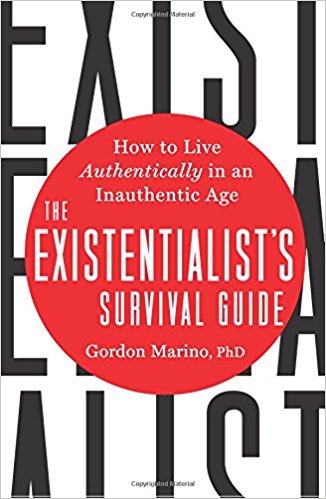
The Existentialist’s Survival Guide, by Gordon Marino

Existentiailists Survival GuideWhy this book: Suggested by a senior Naval Officer to my good friend and naval officer extraordinaire Emily, who suggested it to me.  I have been interested in existentialism since my college days and the philosophers who are referenced in this book as “existentialist” have been great resources to me in helping me to flesh out my own personal philosophy.

Summary in 3 sentences: Gordon Marino is a philosophy professor who once was an accomplished athlete in football and boxing, and has stayed engaged in the sports world as a writer and commentator.  But his path from rebellious athlete to philosophy professor took him through some very dark places, and in this book he examines, with the sensibilities of a wise old philosopher, how  existentialist philosophers have helped him deal with such life challenges as Anxiety, Depression and Despair, Death, Faith, Morality, and Love – the titles of the chapters of this very insightful and well-written book.  Marino is a Kierkegaard scholar, and Kierkegaard is the major influence on his thinking, but he brings in Nietzsche, Sartre, Camus, Dostoyevski and others in his very personal look at how existentialism can help us  “survive” – maintain a sense of self and identity in today’s fast moving consumer-oriented culture.

My Impressions: A very personal look at how existentialism can be not just a strange philosophy for nerdy maladjusted philosophers, but a useful philosophy for the rest of us – or at least those of us who think about how crazy – or to use the term favored by the French existentialists – “absurd” life can be.

Existentialism is a very profound search for “meaning” in a world which doesn’t make sense.   Through the 7 topics he addresses in this book Gordon Marino introduces us to how a number of the world’s more renowned existentialist philosophers address this fundamental meaning question.  It is a “survival guide” for those who may at times feel lost, or awash in chaos, trivialities, dysfunction,  fruitless pursuits, and unhappiness.  And he ventures to say that such feelings affect (or should affect) us all from time to time, and when they do, the insights of the existentialist philosophers can be of value to us.

Viktor Frankl’s Man’s Search for Meaning provided his insights based on his experience in the hell of the Nazi concentration camps.  Marino’s Existentialist Survival Guide is also quite personal, and much more so than Frankl, calls on the insights of other philosophers to guide him and us.  As a philosophy professor and Kierkegaard scholar, we spend a lot of time with Kierkegaard, but he calls on the ideas of others as well, to include Nietzsche, Camus, Sartre, Dostoyevsky.  Some he notes have conflicting views, and Nietzsche in particular, doesn’t always agree with Kierkegaard’s passionate Christianity

He conveniently breaks his book down into chapters that focus on the the issues of many of modern-day existential crises.  He has chapters on anxiety, depression and despair, death, authenticity, faith, morality and love. I found it valuable to go back through the book, re-read my underlines for my own future review, and I include many of them below for the edification of whatever reader may be interested.

This book is not for everyone, but I found it enlightening and a pleasure to read.  And I have found it enlightening to go back through it and review the wisdom it contains.

——-

Quotes – some of my favorites, broken out by chapter titles.  Page numbers refer to the hardback version printed in 2018:

Chapter 1: Anxiety: 

Without distinguishing between anxiety and fear, the rationalist Spinoza wrote,  “Fear arises from a weakness of mind, and therefore does not appertain to the use of reason.”  42

Kierkegaard describes anxiety as “the dizziness of freedom.” …Looking over the lip of a thousand foot drop, our stomachs quiver , we experience anxiety, not because we are in danger of falling but because we feel that we have the freedom to leap.  44

Unlike other moods and emotions, anxiety is  something that can inhabit us without betraying its presence. Kierkegaard sighs:  Deepest within every person there is nonetheless an anxiety about being alone in the world, forgotten by God, overlooked among the millions and millions in this enormous household. …46

Get it all figured out and there is always something else to be anxious about.  Anxiety is about the future, and, because of this, it impedes our ability to live in the moment.  47

One of the mistaken ways we respond to the dizzying feeling is to attempt to steady ourselves by converting existential anxiety into a revolving worry about this or that finite concern.  53

Kierkegaard: With faith you understand the one thing that you should be anxious about, namely, your relationship to God, and with that anxiety, all your other sources of anxiety become relativized.  54

Kierkegaard is adamant that courage comes when one fear/anxiety drives out antother.  55

Chapter 2 Depression and Despair

Among other things, depression is a disturbance in the way that we talk to ourselves.  58

A Buddhist teacher once told me that all the self-improvement regimes were tinged with violence, since they all presupposed a lack of self acceptance, that you are not good enough to start with.  63

Kierkegaard shed fresh light on a long lost distinction between depression and despair, between a psychological and a spiritual disorder….the difference between a disruption in the way we feel, and a sickness in our very being.  63-64

To paraphrase the author of The Sickness unto Death (Kierkegaard), happiness is despair’s greatest hiding place, which is to say that happiness is not the right touchstone for spiritual well-being.  68

Kierkegaard attests that depression develops into despair – into a spiritual malady – only when we let ourselves be defined by our depression and, in our hopelessness, toss in the towel on our moral and spiritual aspirations.   That surrender is despair, not depression.  76

Depression is not despair, but depression can certainly lay down the tracks to despair.  Circumventing despair requires keeping a third eye on your inner life. It requires keeping a part of yourself outside the inner morass of bilious moods.  79

Chapter 3: Death

The Tolstoy of Ivan Ilyich wanted his readers to understand that, with its lack of authenticity and brotherly love, modern life is spiritual death.  92

Personal meaning is the bulls-eye of existentialist investigation; in this case, it helps answer the “What does it mean that I will die?” 96

“Eat , drink, and be merry” is another gambit, which Kierkegaard casts as a hysterical “cowardly lining to life.”   97

One day and again, who knows when, all will be over.  You won’t be able to change a sentence of the story of your life.  99

Today, and in Kierkegaard’s time, people long to die in their sleep, that is, to die without experiencing death; if not in their sleep then a quick death, one that affords the least amount of time, the minimal awareness that while life moves on for everyone else, it is over for you.  100

Nietzsche once quipped, “You only live once…if then.”  101

Speaking for both Kierkegaard and Heidegger, Barrett adds, “Yet if we do not turn away in panic, this vision of our radical finitude brings its own liberation.” 102

At the risk of being pedantic, the Kierkegaardian understanding of death might be this: don’t be careless with the people you walk through life with.  Don’t have arguments and leave them unsettled.  10

The bracing awareness of death, coupled with the angst that it brings, grabs us by the wrist and pulls us out of the crowd.  117

Philosopher Mike Martin:  Unconfronted, death is dreadful. It generates vague fears and anxieties that drive us away from authenticity and toward immersion in conventionality and everyday pleasures…In fully acknowledging death we are pressured to unify our lives.  117

Chapter 4: Authenticity

Literary characters like Holden Caulfield and Willy Loman, like Ivan Ilyich long before them, hinted at an undercurrent of fear about become a cookie cutter of a human being, a crowd person, the kind of individual who was defined by externals.  108

…the once urgent issue of authenticity seems to have been lost to selfies,  social media branding, and managing your profile on LinkedIn and Facebook, as though everyone has become their own unabashed publicist. It is not who you are, but who you seem to be! 108

Is the litmus test of authenticity the gap between who we feel we are and who we present ourselves to be?  “Above all,” Camus wrote in his Notebooks,  “in order to be, never try to seem.”  This advice is easier written than followed.  112

With a delicious metaphor, Nietzsche announces, “Truth is a mobile army of metaphors.” 115

To reiterate a common theme, we are relational entities. We exist in relation to ourselves, in relation to others and to our surroundings, and for some of us, we deliver or try to trust that we exist in relation to God.   115

When Nietzsche implores, “become who you are,” like Heidegger, he is prodding us to create ourselves.  For Nietzsche, Sartre, and Heidegger, we are a witch’s brew of culture, feelings, experiences, and evaluations, and we create ourselves out of this melange, as though our lives were an artwork.  118

We make our views our own not by hitting “like” on Facebook but by passionately relating ourselves to those ideas and expressing them in the medium of action.  119

I ought to consider the possibility that my convictions about kindness are a story I tell myself about myself that may not be as close to my heart as I would like to imagine.  121

Relational creatures that we are, it could be that become our own person is only possible vis-a-vis strong bonds to something outside of ourselves.  For Kierkegaard, it is God….122

Such an admission would hav involved stripping myself of my armor and accepting a degree of vulnerability.  123

However we define it, authenticity does not seem to be something we can work at, save in the sense that we can make strides to avoid inauthenticity.  123

Chapter 5: Faith

Do we lose our faith or push it away?  128

For Camus, the  conflict between our need for meaning and a meaningless world is the absurd.  Camus’s existential prescription is that we accept the futility of our innermost desires and remain faithful to the recognition of the absurd.   133

Consciousness of the aabsurd is supposed to remove the sting from the absurd.  The gospel according to Camus teaches that the dnizens of death row, which mens all of us, should be freed from the fetters of worries about figuring out the best kind of life.  The cosmos is chaos.  There is no right way to live: “one life is as good as another” and just as meaningless.”  134

Camus’s muse, Nietzsche, warned that when you look into the abyss too long, the abyss looks back and through you.   134

Viktor Frankl, a survivor of Auschwitz and founder of logo therapy, lived by Nietzsche’s adage,  “If you can find a why, you can find a how.”  136

Though dead for 150 plus years, Kierkegaard was a therapist of mine. Much of his therapy took the form of spurring me in the direction of taking faith more seriously.   138

Kierkegaard’s Fear and Trembling indirectly reveals that religion cannot be reduced to the ethical, since there was no ethical justification for what Abraham was poised to do.  142

Since the movement of faith and, ultimately its object are paradoxical, faith cannot be comprehended, which is tantamount to saying , that if faith has any validity, it cannot be unpacked in terms of reason; it cannot be understood as a set of stories for edification or as a kind of philosophy for dummies.  143

In more ways than ten, Kierkegaard acknowledges that faith involves a collision with understanding.  He was clear that neither the ontological nor any other form of argument will turn the water of unbelief into the wine of faith.  144.

Without offense, there would be no need for faith; there would be no need for anything other than knowledge.  145

Today, we worship autonomy. Years ago, obedience was a quality that was always included among the virtues. No longer.  If we find anything offensive today, it is the notion of being told what to do or who to be.   145

In his The Sickness unto Death, Kierkegaard, the high priest of existentialism and choice, asserted that where there is no authority there is no obedience, and where there is no obedience, there is no seriousness.  145

With regard to faith and everything else Kierkegaardian, the accent is on passion and action.  149

In Postscript, Kierkegaard proclaims, “where there is certainty, there is no faith.”  or again, where there is certainty, there is no risk, and “where there is no risk, there is no faith.” 150

Indeed one of the criticisms that Nietzsche leveled against Christianity was that it cultivated a suspicion about anything and everything connected with abundant pleasure.  151

The need for God for Kierkegaard is unlike other needs in that it does not reveal a lack.  The need for God is a human being’s highest perfection. 153

For not-so-holy fools like the present author, it seems perfectly fitting to pray to a God you don’t believe in for faith in God. Dostoyevsky taught that the worry about faith is faith, and Kierkegaard, who likened prayer to listening to God, remarked, “Prayer does not change God, but it changes him who prays.”  154

I have come to think of faith as trust, the kind you might have in a friend or loved one. where knowledge and a lack of certainty are the rule, trust would seem the most appropriate term.  154.

Chapter 6: Morality

The love that philosophy refers to is not a love of knowledge but a love of wisdom, an understanding of how to live a moral and good life. 158

Nietzsche, the philosopher with the hammer, banged out his own unhinging questions: What is the value of our values?  Or again, are our values adding value to our lives or are they making us sickly.  .. Nietzsche declares the the grand moral theories of most philosophers are essentially self-portraits. 168

A sickly individual, Nietzsche had an ideal self that was an extrapolation from the desire for health and vigor that always escaped him. .. Health was the god term for Nietzsche and the scale for his re-evaluation of values.  168-9

Nietzsche described humanity as slipping toward a wariness that, a la “the last man,” aches for nothing more than “pitiable comfortableness” – a pair of slippers, a flat screen television and some action movies.  … Nietzsche regarded today’ everyman/everywoman as slouching toward becoming huge bourgeois Babbitt whom, in contrast to his Superman or Übermensch, he baptized “the Last Man.”  170-171

Lessons drawn from Aristotle and Nietzsche. Both taught that character is sculpted by how we cope with our fears.  173

Today the young and the privileged get very little practice in sparring with their angst.  174

Most philosophers (Socrates, Kant, Schopenhauer) bid us to go to war against our instincts – overriding our inclinations.  In contrast, Nietzsche tries to reunite us with our instincts, no matter how base or unshaven they prove to be. 175

One of Nietzsche’s gripes about Christianity, the old moralists, and the ascetic idea was that they inculcated a distrust of anything that smacked of the ecstatic or, or as he termed it, the “Dionysian.” It is an ice-cube down the back…. 175

Nietzsche wanted us to own a side of ourselves that we lock in the basement.  176

Nietzsche does not prescribe self-forgiveness, but something even more radical.  Healthy consciousness requires forgetfulness.  As Nietzsche describes it, you don’t need to be able to forgive; you need to be able to forget both the transgressions of others and your own missteps.  177-178

Forgetfulness is a form of spiritual digestion essential to spiritual well-being. We need to resist becoming moral stamp collectors.  We need to be strong enough to let things go.  178

Like Nietzsche, Kierkegaard was a  free spirit who found the cleverness and relentless, narrow-minded pragmatism of bourgeoisies society repugnant.  179

Remember Kierkegaard claims that happiness is despair’s greatest hiding place.  Nietzsche would’ve had a belly laugh or perhaps wretched at the idea that we ought to have third thoughts about those rare moments when we feel joyful and at home in ourselves.  180

Kierkegaard reminds us that to become who you are, namely, a child of God, you must “die to this world,” an age-old notion that would have given Nietzsche another of his debilitating migraines.  180

Kierkegaard: The more time you put between yourself and an action, the more likely you are to convince yourself that the right thing to do is the easy thing to do.  186

Morally speaking, the temptation is not just to take the path of least resistance but to convince ourselves that the path of least resistance is the righteous path.  187

Careerism, the comfort and sense of belonging that success yields provides one of he most powerful impetuses for convincing ourselves to look the other way when a scarified is demanded.  188

Nietzsche: Remorse is case of “adding to the first act of stupidity,  a second. ”

For Kierkegaard, prayer does not change God – it changes, it develops the person praying. Perhaps it is the same with regret. I can’t rewind and expunge my past actions, but perhaps I change who I am in my act of remorse. 193

Sartre urges us to recognize that our radical freedom breeds anxiety and that we have a proclivity to try to escape the angst in bad faith by denying our freedom.  193

If Nietzsche were to offer a homily it would include the suggestion that rather than torture ourselves and others, we ought to learn to let transgressions go and be attentive to emotions and power interests that stealthily infuse our moral sensibilities. 193

Kierkegaard instruct that the main obstacle to leading a righteous life is our predisposition to hoodwinking ourselves by talking ourselves out of doing the right things when it requires sacrifices that diminish our happiness and satisfaction.  194

Chapter 7: Love

The Greeks distinguish between eros (erotic love)) agape (selfless, sacrificial,)  and philos  (friendship, brotherly love.)  196

How to give, find, and accept love? What do Kierkegaard and Dostoyevsky have to teach us ton this triad of existential questions.? 197

Today we take about a pandemic of narcissism, symptomized by the likes of selfies and self-promoting messages on Facebook.  197

As (Sartre’s play No Exit) closes, the murderer Garcin gets the idea and exclaims “Hell is other people” because life is an endless struggle to establish yourself as a subject among others trying to do the same.  198

At one level, The Fall (by Camus) is a reflection on the problem of guilt in a world in which there is no longer any possibility of forgiveness.  201

If love is caring about someone else as you care about yourself, how many of us can rise to the task? When fortune smiles on my friends, I effuse, “I’m so happy for you,” but few and far between are the times when I can actually share in someone else’s joy.  202

Kierkegaard articulate the austere idea that preferential love, loving someone fo the  qualities they posses – a curvaceous figure, a razor-sharp intellect, wit, or whatever – or because they are blood related is at bottom an expression of self-love.  You love them either as an extension of yourself or because they fulfill some deep-seated desires.  Preferential love comes easy to anyone with even a dab of humanity.  207

In opposition to sSartre, Camus, and Nietzsche, Kierkegaard believes that we are duty bound to presuppose an essential ability to love in everyone, not only in people we feel simpatico toward but also in those whom we cut across the street to avoid.   207

Kierkegaard maintained that we are so attached to comparisons and our differences that we take them into the cemetery, with the big shots getting large monuments and maybe even a small chain-link fence to keep the hoi polloi out of their eternal resting place.  209

One of the cavils that I have with Kierkegaard’s otherwise rich, illuminating interpretation of love is that he may’ve given a cold shoulder to the feeling aspects of love.  Kierkegaard describes love as a duity, a passion, a need, but tenderness is certainly not foremost in his analysis.   Any account that excludes tenderness is lacking  210

According to Plato’s Diotoma (in the Symposium) we begin spellbound by the beauty of the physical form, then, if and when we mature, we are attracted first to the loveliness of the virtuous soul, and then to the beauty of laws that nurture souls.  212

(Marino devotes a whole section in his chapter on Love to Dostoyevsky’s Notes from the Underground as a study in moral self-degradation.)

Perhaps as a way of defending ourselves against our own doubts and inner voices, many of us hanker for admiration.  We yearn to be desired , valued.  We want to be loved as the people we aspire and perhaps imagine ourselves to be, not the flesh-and-blood fallible creates that we are.  222

Kierkegaard taught that Jesus’s love commandment, namely, love thy neighbor as thyself, first and foremost requires proper self-love. This non-narcicssist caring relationship to the self is remote from the vanity and self-obsession that we tend to equate with self-love.  224

Earlier in this chapter, I mined Kierkegaard’s insight that the duty and work of love is to presuppose love – not just the love in others, but perhaps above all, the love in ourselves. Had he done that work, Dostoyevsky’s Underground Man might have been able to let Liza hold and comfort him.  He might have ceased being the Underground Man.  225

EPILOGUE:

‘But how many of us are similarly able to appreciate Dostoyevsky’s insight that because we need to feel in control, accepting love for who we are (as opposed to wanting to be loved for our accomplishments or looks) is one of the most daunting stumbling blocks to true intimacy? 228

From Kierkegaard to Camus, the existentialists are profoundly aware that life is an incomparable gift, albeit a gift that is also a challenge.   228

Aristotle contended that life is too complex to come up with a universal moral rule book to cover every situation. 229

Anxiety is not simply a disrupting affect accompanied by sweaty palms and an increased pulse rate.  It is a feeling with a message, one with an important cognitive component. 229

An abstract understanding of your mortality is a distant cry from a personal grasp of what it means that there will come a time when there will be no more time, when “all is over.” 232

Kierkegaard maintained that thinking of yourself as dead is good medicine. Earnest reflection on the meaning of our inevitable death, Kierkegaard promises, will allow every moment to become more valuable and endow finite issues with new and more powerful significance.  233

Tolstoy also intimated that the ubiquitous denial of death was partially responsible for the inauthentic personal relations of modern society. 233

Like Kant, Kierkegaard assumes that anyone aiming to lead a moral life would have to walk through the fire of times when doing the right thing will incinerate their prospects for happiness.   234

Nietzsche: for anything to be termed “good” it had to at least appear to involve an element of self-sacrifice. For example, I can’t just charge forward and insist that I want to be the best; I have to adorn my ambitions in altruistic motives.  236

Nietzsche can make us attentive to the subterranean power interests possibly lurking behind our so-called better angels. 236

Kierkegaard: the choice between the sacred and the profane is not one that reason can make.  237

Kierkegaard: faith is not so much a matter of belief as it is a matter of how you relate to your unbelief…..faith and doubt are not opposites because both are expressions of passionate concern.  239

The how-to in the book is one of how to lead an authentic life in an inauthentic world.  240

Posted in Uncategorized | 2 Comments

Beautiful Boy – a father’s journey through his son’s addiction by David Sheff

beautiful boyWhy this book: Recommended to me by my son Brad . He thought it might help me better understand my other son, his brother Patrick.  It was a good recommendation.

Summary in 4 Sentences: This is the very personal first person account of a father’s intense and painful struggle to deal with his son’s addiction.  The author’s son Nic appeared to be on track to be an over-achieving young man – intelligent, articulate, creative, athletic, charming and witty – he was the son almost any parent would be very proud of.   The author shares his own pain and struggle as his son became a meth addict,  displaying all the horrifying pathologies one imagines with that, as the author tries to come to terms with how that could have happened, what he can possibly do to help get his son back on track.

My Impressions: Powerful and beautifully written.  David Sheff shares his very personal story, about his nearly a decade long effort to process and deal with his son’s addiction.  We get to know not only David, but his immediate family as they try to live normal fulfilling lives, with the specter of one of their family being meth-addicted to methamphetamines,  going back and forth from being the young man they know and love, to the near-psychosis of meth addiction.  Nic – the “beautiful boy” – is indeed a charming, talented and remarkable young man – a joy to his father, siblings and friends.  Until he gets caught in the undertow of addiction. And then he becomes a slave to his addition, willing to lie, cheat, steal, hurt the ones he loves – to get his next high.  It is painful to read, but enlightening, and sobering.

There is so much pain in this book – but it is compellingly written by David Sheff, a professional journalist who knows how to write a searingly personal story about his own, his son’s, and his family’s struggles.  In his efforts to help his son, and to help him understand his own and his son’s predicament, he leaves few stones unturned in his research into the psychology of drug addiction and the various pathways to recovery.

The book begins describing the author’s journey – his early marriage and divorce, shared custody of his son, subsequent marriage to his current wife with whom he had two more children.  He shared custody of Nic with is mother; Nic lived with his father in a small town north of San Francisco during the school year, and with his mother in LA during the summers.   Nic seemed to be doing everything right – with school activities, good grades, friends, surfing, sports, school theater  – all the things proud parents love to brag about a high- achieving son.  At about age 10 his father discovered marijuana in his day pack, confronted his son, spoke to school counselors about it.  No big deal. Kids experimenting.  It’s everywhere.  Don’t over-react.   Having grown up in the 60s and 70s, Sheff himself had been through that and wasn’t overly concerned.

But with Nic as with a certain percentage of people, marijuana was a beginning and indeed a gateway drug – leading to alcohol binges, then other drugs and eventually by the  time he was ready for college, methamphetamines.

Beautiful Boy describes the roller coaster ride that Sheff’s family had in trying to track, manage, and help Nic as he careened down the self-destructive path of meth addiction.  In and out of rehab. Disappearing for days and weeks at a time.  His father frantic and obsessed with worry and fear that he would die.  And he nearly did.

We learn about the pathology of addiction.  And the damage it does to the families of the addicted.  The author initially resisted Al-Anon but became a regular, needing the comfort, support and understanding that he could only get from others who were suffering as family members of an addict   He also required his own therapy.  He called, read, visited anything/anyone he could find who might help him understand and better deal with his son’s addiction.  Sometimes he was overcome by guilt and struggled to accept the Al-anon three C’s:  You didn’t Cause it; You can’t Control it;  You can’t Cure it.   All while trying to mitigate the impact that Nic’s addiction would have on his other children, who adored their older brother.

Beautiful Boy begins with Nic’s childhood but focuses primarily on about 6 years of Nic’s addiction, from about age 17 to about 23.  And throughout it is David Sheff’s very personal journey, alternating between guilt, fear, anger, resentment, and finally acceptance.  Interspersed throughout the story are vignettes reflecting the pleasures of being a parent, the joys of daily life within the family,  family adventures which are so simple and yet so real.   Outings with his wife and two other; with Nic when he’s sober.  A happy family – with one member who is severely addicted to drugs.

A few key points that I believe David Sheff wants us to take out of his personal story:

  • Addiction is indeed a disease.  It is much more a disease than a character flaw.
  • Relapse is part of recovery. Nearly all recovering addicts relapse multiple times before they recover….or die.
  • The suffering they cause other people is only part of the story.  The addicts themselves are suffering  – the drugs are a response to pain, which is made worse by the guilt and self-hate for the pain their addiction and behavior inflicts on their families and friends.
  • There is no well respected clearing house to provide guidance for parents/loved ones trying to find a program to assist a family member addict.  There are many, many approaches, some good, some not so good, some very expensive, some less so, but underfunded. He felt like he was in a maze.
  • Our treatment and rehabilitation programs in the United States are woefully inadequate to the need.
  • Never give up – but it is never clear what will actually be a turning point in an addict committing to rehab for the long term.
  • Many, many parents are losing their children.  Nic finally does find his way out. David Sheff considers himself,8 his family – and Nic – very lucky.

A quote from the book (p 179):

But I remind myself: Nic is not Nic when he is using.  Throughout this ordeal I strive to understand this force that has shanghaied my son’s brain, and I sometimes wonder if his recidivism is a moral failing or a character flaw.  I sometimes also blame the treatment  programs. And then I blame myself. I go back and forth. But I always come back to this:

  •  If Nic were not ill he would not lie.
  •  If Nic were not ill he would not steal.
  • If Nic were not ill he would not terrorize his family.  
  • He wouldn’t not forsake his friends, his mother, Karen, Jasper, and Daisy, and he would not forsake me. He would not. He has a disease, but addiction is the most baffling of all diseases, unique in the blame, shame, and humiliation that accompany it.  

I was strongly encouraged to read this book to help me understand my own son’s struggles.  My son isn’t struggling nearly as much as Nic – and his issues are different, but this book was very helpful to me.  I’d recommend it to anyone who has a close friend or family member who is struggling with any sort of addiction, or to anyone who desires insights into the very personal effects of drug addiction, not only on the family, but also on the addict.


Posted in Uncategorized | 1 Comment

Billy Lynn’s Long Half-time Walk, by Ben Fountain

Billy LynnWhy this book:  Suggested by my good friend Carl Czech to be read by a reading group I’m in at work. I hadn’t heard of it, but after getting started, I found out that it is winner of the National Book critics circle award for fiction, winner, LA time Book award for fiction, finalist in the National Book Award and a number of other awards.   SF Chronicle called it Pulitzer Prize-quality good.

Summary in 3 sentences:  A squad of army infantry soldiers is engaged in a firefight in Iraq in which  with heroism they overcome a superior force – which is  caught on film by an embedded FOX news crew, and the film goes viral in America.   The Army then decides to capitalize on this engaging image of their soldiers perfuming at their best and brings the squad back to the US on a “victory” tour for two weeks,  to help promote the Army, help with recruiting and win support for the war – similarly to what the US military has done in previous conflicts. This book covers one day of that trip – when they are hosted by the Dallas Cowboys, to be shown on the jumbotron,  meet the celebrities, players, cheerleaders, and participate in the half-time show.

My impressions:   I loved this book – it was not only insightful and thought provoking,  but also fun to read and filled with satire and wit.   I actually listened to most of it on audible, but purchased the book after I started listening to it, since I wanted to compare the reading to the listening experience.    Reading it was good, but I really enjoyed the audible version – the reader, Oliver Wyman, not only read it – he performed it, using different voices and accents to craft very credible versions of the multitude of characters in the book.  He is in fact an accomplished professional voice actor.

Time frame of the story was when the Iraq war was at one of its early violent peaks –  2004 – 2005-ish.  Bravo squad – referred to throughout the book as “the Bravos” – is all enlisted led by their very competent and assertively sardonic sergeant.  For their two week victory tour, they were chaperoned by a Public Affairs specialist, and a rather disengaged Army Major.  This book is about the last day of that victory tour, when they were guests of the Dallas Cowboys organization, and were included as VIPs in a number of pre-game events and then participated with Beyonce and Destiny’s Child in the half-time spectacle.  After the game they were to be driven back to Ft Hood, Texas to then fly back to Iraq the following day, to then surrender their celebrity status for the life of a grunt, fighting an implacable enemy in ground combat.   The victory tour and the Dallas Cowboys experience was a brief interlude, shoe-horned into their 12 month combat tour in Iraq.  The contrast could hardly have been greater.

Billy Lynn is the protagonist in this story.  At only 19 years old, he is the youngest of the Bravos, and was also the hero of the firefight that was filmed and which generated the victory tour. For heroically rescuing and trying to save the life of his close friend, Billy was put in for the Medal of Honor, but the award was downgraded to the Silver Star for gallantry, still a very high award.  Such downgrading is not at all unusual.    Billy is also  the most sensitive, self-conscious, humble, and introspective member of the Bravos.   And it is from his perspective and through his eyes that we get to know the other Bravos and experience the hospitality they are shown by the Dallas Cowboys organization on the particular day covered by this book.

The rest of the Bravos represent the Army infantry – young, a bit cocky, street smart, not particularly cultured nor sophisticated, distrustful of authority, still testing out their manhood, mostly from broken or dysfunctional families, each with nicknames they’ve given to each other:  Crack, Mango, A-bort, Day, Lodis, Shroom, and Dime, their sergeant.  Each with his own distinct personality.  A few we get to know; others are just bit players in the story.

The Bravos also represent the diversity of American culture that one finds in the Army infantry:  Hispanic, African-American, po-white-trash,  Amerindian  – Billy is an anglo from a family down on its luck.  In short, they represent that part of America which is not doing so well, those for whom the American Dream is fairly elusive  They enlisted in the Army because they didn’t see any better options – they volunteer to fight Americas wars on behalf of people who don’t need, nor want to join the Army.  Through Billy’s eyes, we get to know and love his fellow Bravos – quirky, crude, immature, profane, cynical, disrespectful of most of polite society’s norms, loyal to each other, and tough – kept in line by Dime, their sergeant, who they fear and respect.

The real humor in the book is how Ben Fountain clearly contrasts the Bravos from their handlers and hosts at the Dallas Cowboys football game.  As celebrities-of-the-moment, they are hosted and toasted by the representatives of another universe in America –  the main power players in Dallas Cowboy football, and a broad spectrum of others in the mainstream of success in America.   These include Josh, their polite, well-groomed nice-guy public affairs escort;  Albert from Hollywood, a successful movie producer trying to find a studio to finance a movie he wants to make about the Bravos; Norm, the mega-wealthy owner of the Dallas Cowboys and his entourage of wealthy hangers-on; the Dallas Cowboy cheerleaders, the Dallas Cowboy football players, the Dallas Cowboy fans.  All very different from the US Army, very different from the culture of soldiers in combat.  Ben Fountain is sometimes subtle, sometimes not-so-subtle, always clever in how he highlights these differences.

Fountain’s satirical depiction of all of these characters is brilliant and not at all over the top.  As he satires them, he respects them all.   His descriptions are often so spot on, it’s hard to tell when he’s pulling our leg with absurdities – because in today’s America, it is often hard to know what to believe, what is real.  For example, Albert is proposing Hillary Swank to play multiple male roles in the movie about the Bravos – arguing that would virtually guarantee financial success.  Albert’s riff on the absurdity of Hollywood is classic.  Another example:  Billy is still a virgin, but while out with the Bravos on their victory tour visit to Las Vegas, he did get a blow job.  Does that count?  He doesn’t know.  Ask Bill Clinton.  Billy wasn’t impressed – he just wants to fall in love.

The humor the Bravos use among themselves is profane, aggressive,  good natured, and NOT-AT-ALL politically correct.  Many of those who enthusiastically “support the troops” and proudly thank them for their service would be shocked and offended if confronted with the reality of who these young soldiers truly are – cocky and profane, red-blooded, working class American men.

Billy Lynn’s Long Halftime Walk is one of the most creative and enjoyable books I’ve read in a long time.   Fountain’s writing (and narrating) brought the main characters to life – I could almost see them as we got to know them through the story.  He holds up an uncomfortable mirror to American Culture and gives a great perspective on why I feel just a bit uneasy  – maybe even just a bit used – when people thank me for my service.   The book portrays in a very clever and subtle way, the collision between two cultures in America:  the poor and struggling – who make up a large percentage of those fighting and dying on the ground in our current wars, and the wealthy and privileged, for whom life in America is just one great opportunity after another.

The language is amazing – juxtaposing the profane street language of young male soldiers,  talking shit, talking about meeting chicks, getting laid, getting drunk, getting money, posturing before each other as young men (all men) tend to do, and the amazing language that Ben Fountain, the author and narrator, uses to  describe what’s happening.

As I was considering why this book so appealed to me, I realized that I had just read three successive books by women, about women, telling a woman’s story – all excellent and insightful – Crux, Eternal Life, The Silence of the Girls.   Reading Billy Lynn, however was a pleasant break – I really enjoyed a well-written book by a guy, about guys, military guys, doing the kind of work I used to do.  Ben Fountain accurately portrays the culture of young men who do the toughest ground combat jobs in the military.  He also cleverly uncovers some of my own ambivalences about American culture and how main-stream and affluent Americans often patronize in subtly condescending ways, those it sends overseas to fight its wars.   Like so few books – it can be appreciated on many levels – as a fun and funny satire,  and also as deeply profound.

This book gets five stars from me.

——

Some notes for myself before we discuss this book in my reading group – in fact, two reading groups – my literature reading group and my at-work leaders reading group:

Contrasts between The Bravos, their experience in combat, and:

  • Hollywood thru Albert
  • The PA guy and the press
  • The people who gushingly thank him for his service.
  • The fans at the Football Game
  • Norm and his entourage of wealthy hangers-on
  • Beyonce and her team
  • The stage crew
  • The Dallas Cowboy Football players
  • The Dallas Cowboy cheerleaders
  • Their own families
  • The American public and how they perceive the war and the military.
Posted in Uncategorized | 1 Comment