The Coaching Habit, by Michael Stanier

Coaching HabitWhy this book:  In the All American Leadership (faculty) Reading Group, this book had been proposed numerous times and a number of us had already read it and found it well done.  It was finally selected by the group for the group to read and review.

Summary in 3 sentences:  Stanier argues that all leaders should be coaches and that coaching should be key part of a leader’s  everyday interactions with individuals on their teams in order to continually develop them as leaders .  He first talks about breaking bad habits and developing new and better habits – specifically applied to how leaders interact with their subordinates in the way of “coaching.”   He then goes on to suggest 7 questions that leaders should use to stimulate thinking in their subordinates which will develop them into thinkers, and problem solvers themselves, rather than depending on the leader to think and problem solve for the team.

Impressions: Short and very readable.  Easily read in about 2 hours on an airplane.  But after reading it, I needed to go back and review each chapter. There is a lot of content that can easily be passed over as self-evident, but which I’ve realized, deserves more attention.

I really like the apparent simplicity of his approach.  I say “apparent” because most of us are in a pattern of behavior that is difficult to break, and he suggests some simple, understandable NEW approaches to interacting with subordinates that shifts much of “Leadership” into a “coaching” activity as opposed to giving guidance, direction, and telling people what to do. His suggestions look simple, but are not easy in practice – because they often run against many leaders’ ingrained habits.  It is hard to break an old habit and create a new one.

His opening chapter briefly discusses habits – how we recognize them and a process for breaking them to create new habits.  He refers to Charles Duhigg’s book, The Power of Habit, and a few other works as well, though he doesn’t refer to Marshall Goldsmith’s Triggers, which would have been appropriate, since Stanier does talk about breaking the habit of being “triggered” into old patterns of behavior.  He argues that our habitual responses are normally triggered by some external factor, and notes that we need to recognize those triggers before we can create a new habitual response.  Two of the most counter-productive habits that most leaders associate with their responsibilities, but indeed run counter to the coaching habit, is telling people what to do and giving advice.

The book makes the useful distinction between “performance coaching” and “development coaching.”  Sometimes performance coaching is necessary – showing someone how to do something and solving everyday problems. Development coaching however shifts the focus from the problem to the person being coached –  he uses the analogy of shifting the focus from the fire, to the firefighter.   Development coaching  helps them to figure out what to do, what the right thing to do is, and develops them into more self-sufficient leaders.  This book is about development coaching.

The book is structured around Seven Questions – each question has its own chapter which discusses and elaborates on why this question is so important, and he offers different approaches to using it. He also offers at the end of each chapter a link to his website (Thecoachinghabit.com/videos) for a brief video (usually 10-15 mins long) of him discussing the topic of that chapter.

Below are the 7 questions and a very brief description of points he makes as to why each is a fundamental coaching question:

Question 1.  The Kickstarter Question:  What’s on your mind?  This question puts the onus on the person being coached to think about what their issue is and what they want to talk about.  It forces them to decide what they want to address – this question tells them that THEIR needs are driving the conversation.  Stanier offers alternatives: Where should we begin?  or Where’s the best place for us to begin? or Where’s the most useful place for us to start?

Question 2.  The AWE Question: And What Else? He calls this the best coaching question in the world.  “With seemingly no effort it creates more – more wisdom, more insights, more self-awareness, more possibilities – out of thin air.”  It puts the ball in the court of the person being coached.  It opens the door to what may REALLY be on their mind – the issues behind the issue.   In this chapter he warns against binary choices, and asking the “And what else could you do?” question should help the subordinate look for 3rd or 4th options when someone is struggling to choose.     He also introduces the “Advice Monster” in this chapter,  the bain of great coaching, because it “leaps out of the darkness and hijacks the conversation.”    He says he normally asks the AWE question  at least 3 times in any coaching conversation.   Amazing what comes up.   After the “And what else?” question has been answered, finish up with “Is there anything else?”.   Celebrate success when the response is “There’s nothing else.”

Question 3. The Focus Question: What’s the real challenge here for you?  This is the question you ask when your subordinates come to you and want YOU to do THEIR work for them.  It will also slow down the rush to action, and helps make sure that you or they are working on the right problem, instead of spending a lot of energy working on the problem that isn’t really THE problem. He says, “Focus on the REAL problem, not the FIRST problem.” The “for you” in this question pins it to the person you are talking to, and focuses on what they need to help them address the problem.  In this chapter he warns against “coaching the ghost” as discussions can divert to what other people are doing, or  what someone else could be doing better.  “What’s the real challenge here for you?” brings the discussion back to the person you are talking to.

Question 4: The Foundation Question:  What do you want?  He calls this the adult-to-adult question, since adults are able to ask and tell specifically what they are looking for. To ask this question, you have to be ready to answer “No” to what they want, but he suggests that you ensure that the No is to the request, but not to the person.    The corollary question is, “What do you REALLY want.”  It often stops people in their tracks.  He also has an interesting section on the difference between wants and needs, and offers  another corollary quesition, is, “Yes, but what do you really NEED.”  Understanding needs should give a better background to help define or satisfy the want.  He concludes that a coach gets more credibility when the coach also shares what s/he really wants or needs as well.  He offers up a couple of prefixes to help soften the tone and take the edge off of the direct question:  “Just out of curiosity, do you really think….” or “Just so I know…” or “To help me understand better….” or “To make sure I’m clear…”

Question 5:  The Lazy Question:  How can I help?  In this chapter he distinguishes between truly helping and being “helpful,” the later being a negative – always seeking to help others with their problems, and not helping them to grow.    He talks about the Karpman Triangle –  the three corners of which  are The Victim, The Persecutor, The Rescuer, representing roles we can inadvertently let ourselves be triggered into playing.  And when we let ourselves slip into The Rescuer mode, we are constantly leaping in to help others, when often the best thing would be to let them (or help them) figure things out for themselves.  The “How can I help?” question serves two purposes: First it forces a specific “ask” from the person being coached, and second, (and more importantly) it stops you from thinking YOU know the answer to what the other person needs, and puts the Advice Monster back in its cage.  The goal is to help people get better at finding their own answers….

Question 6: The Strategic Question: If you’re saying Yes to this, what are you saying No to? He wants to ban the phrases “good busy” and “work smarter, not harder” and quotes business strategy guru David Porter: “the essence of strategy is choosing what not to do.”   A “Yes” is nothing without a “No” that gives it boundaries and form.   Stanier calls getting things done  “good work.”  He calls work that has meaning and great impact “great work.”  The coach seeks to help people do less good work and more great work.   He says that asking, “What does being fully committed to this idea look like?” should bring an idea into sharper, bolder focus.   He also suggests strategies for saying “yes” more slowly, to allow time to stay curious, ask more questions, and examine the tradeoffs  in making a decision before committing.

Question 7: The Learning Question:  What was most useful for you?  This question creates the learning moment at the end of a conversation, forcing the participant to reflect on the discussion and what they got out of it. (Kind of like why I write these reviews.)  This question forces people to extract value from the conversation.  It bookends a conversation that begins with “And what’s on your mind?”  After hearing their response to the What was most useful for you? question, Stanier recommends you tell them what YOU found most valuable in the conversation – making you a partner with them in learning.  It is a strong and powerful way to end a conversation.

THREE EXCELLENT and SHORT CONCLUDING CHAPTERS:  He notes that these questions also work well in other-than-face-to-face media – email, text, phone.  He notes that when he gets an email that triggers the Advice Monster, rather than getting sucked in to a long response, he gives one of the 7 questions back to the asker.  “I’ve scanned your email. In a sentence or two, what do you want?” or “Before I jump into a longer reply, let me ask you: What’s the real challenge here for you?” He notes that “the real secret sauce here is building a habit of curiosity.  I love his concluding take off on the world’s most interesting man’s imperative to “Stay thirsty, my friend.”  Stanier tells us to “Stay curious, my friend.”

His final guidance is:  “A little less advice, a little more curiosity.  Find your own questions, find your own voice. And above all, build your own coaching habit.” The book concludes with a chapter listing additional resources and books he’d recommend for additional work in the areas he discusses in his book.

———

Here are the seven questions – with the order slightly adjusted:  What’s on your Mind?, And What Else?  What’s the Challenge in this for you? What are you saying No to? What do you Want?   How can I Help?   What was most Useful for you?

And in case this may be helpful to you, here is a silly pneumonic that helps me remember these 7 questions: My Aardvark Can Not Wear Heavy Underwear.  That said, if I were an executive with my own office, I’d probably have these questions framed and up on the wall, to remind me everyday to better solidify my “coaching habit.”


Posted in Uncategorized | 1 Comment

The Warrior Ethos, by Steven Pressfield

Warrior EthosWhy this book:  I lead a volunteer reading group for young men early in the pipeline to become SEALs or SWCCs (Special Warfare Combatant-craft Crewmen). We pick relatively short books related to the profession they are entering, and we meet and discuss them.   I had read several of Steven Pressfield’s books, and followed a couple of his blogs and assumed correctly that this short book would fit well in the “curriculum” I am creating for these young men.
Summary in 3 Sentences: Pressfield uses the extensive research he had done for his historical novels set in ancient Greece as a source for much of the wisdom in this book – especially the culture and values of ancient Sparta.  It is less an examination of the Warrior Ethos, and more of an unstructured discussion broken up into 30 short chapters (in a 90 page book!) in which he addresses a variety of aspects of what he considers to be perennial and universal warrior values.  He concludes by making the point in the final chapter that warrior virtues should be internalized into the warrior’s heart to serve the warrior not just in battle, but in a broad range of contexts where virtues such as courage, patience, loyalty, perseverance, and love also define the great and successful.

My impressions:  This book is a short meditation that Pressfield says naturally arose out of writing his most recent novel about future “warriors” unconstrained by a national purpose.  He had been grappling with the question, What is a warrior, beyond a tool of the state? This book is a loosely structured compilation of his thoughts.

It is not a complete, well-researched exploration of the subject.  Nor does it pretend to be. But he makes some interesting and occasionally controversial claims, and it is worth reading for anyone in or considering  joining the military profession, especially combat arms.

This book is his effort to define and describe universal warrior virtues, that apply to warrior cultures across time and space.   I am reminded of Joseph Campbell’s similar but much more exhaustive and more thoroughly researched effort, The Hero with a Thousand Faces, and Shannon French’s examination of various warrior cultures in history and around the world in her book Code of the Warrior.  These are actually much better books for students of warrior values and cultures, but are also much more demanding to read.

Pressfield begins with reference to the role of mothers, spouses and families supporting the men of Sparta who went to fight and die in Thermopylae – the subject of his highly acclaimed novel, Gates of Fire.  The warrior virtues in Sparta he claims, were upheld and reinforced by the strength of the women.

He devotes a couple of chapters to distinguishing between guilt and shame – that guilt is an internal sense of having sinned, whereas shame is based on how one is perceived by others.  He argues that though Western cultures value meeting obligations, following norms and avoiding guilt, warriors are driven to seek honor and avoid shame – especially in the eyes of fellow warriors.

He devotes a whole chapter to the differences between warrior cultures and the civilian world.  He notes the disparity between warrior values – the warrior ethos – which demands that the warrior seek adversity and put him/herself at risk for honor and higher purpose, and the values of most civilians to seek comfort and avoid danger or risk.  He asks the question:  “What is the place of the Warrior Ethos within the greater civilian society?…The greatness of American society is that our citizens are still debating it.”

I liked his point about the value of warriors dining together – amongst themselves as a bonding mechanism.  The Naval Special Warfare community is seeking to create dining facilities for their warriors and staff, for that very reason.

He includes numerous references to the Bhagavad-Gita and the metaphor of fighting enemies on the battlefield and enemies inside oneself.

The Warrior Ethos is a short, enjoyable and provocative read. It is not a deep look at warrior cultures, nor does he examine nuances or alternative views.  It catalogues  his own musings based on his research into (mostly) ancient Greek warrior cultures and to a lesser degree Asian – Bushido and the Bhagavad-Gita, and of course brings in his own experience as a US Marine in the 1960s.

I found a book of similar length entitled Steven Pressfield’s The Warrior Ethos: One Marine Officer’s Critique and Counterpoint, by Edward Carpenter.  This book roundly criticizes Pressfield’s book as superficial and not accounting for significant differences between the needs of warriors in today’s world and those of earlier times.    He pulls the string on the implications of many of Pressfield’s claims and argues that some are based on an overly romantic understanding of history, and many of his values are not completely valid in today’s world,  or are completely invalid. He argues against using Sparta as a model, that Alexander is no hero by today’s standards, that there are misogynistic overtones in his book, and that the tribal ethic Pressfield seems to advocate is inappropriate to today’s warriors.   He concludes with a rough outline for a warrior ethos for the 21st century.

While I agreed with most of the specific points of Col Carpenter’s criticisms, I disagreed with his overall point – that Pressfield’s ideal is not valid today.  The Colonel it seems to me, doth protest too much.  In his critique, Carpenter actively seeks possible negative implications of Pressfield’s points, rather than considering broader and possible positive interpretations.  For example he argues that Pressfield’s claim that warriors seek adversity is not true – they prefer comfort like everyone else, and indeed most military personnel deployed overseas are indeed living in what in previous eras would be considered the lap of luxury.  He also points out that Pressfield does not explore the meaning of the word or concept “warrior” noting that the vast majority of our military forces are not engaged in combat, nor in any real danger.

That said, I think he misses a point – the warrior “ideal” is of men and women who harden themselves by seeking demanding and adverse conditions and are not undone by difficulty.  And perhaps “warrior” doesn’t refer to a profession or a title, but rather to a mindset – that clerks and mess-stewards might have a greater warrior ethos (mindset) than a-less-than-committed infantry soldier.   I didn’t like the self-righteous tone of his critique – though again, he made points that in their specificity, were accurate.  In his rejection of Pressfield’s book, I believe he throws the baby out with the bathwater – but it is worthwhile to read his counterpoints.   I would recommend reading the two books together – and then reading Shannon French’s Code of the Warrior.

Attention getting quotes from The Warrior Ethos (page numbers from the paper back edition):

“the Warrior Ethos evolved as a counterpoint to fear”  10

“…an ideal of manly virtue – andreia in Greek – that praised valor and honor as highly as victory.”

Greek poet and Mercenary:  “Be brave my heart. Plant y our feet and square your shoulders to the enemy. Meet him a among the man-killing spears. Hold your ground. In victory, do not brag; in defeat, do not weep.” 10

The warrior ethos evolved to counter the instinct of self-preservation `12

Against the natural impulse to flee from danger, the warrior Ethos enlists three other equally innate and powerful human impulses:  Shame, Honor, And Love. 12

The Spartan king Agesilaus was once asked what was the supreme warrior virtue, from which all other virtues derived. He replied “Contempt for death.” 13

The dictionary defines ethos as: The moral character, nature, disposition and customs of a people or culture.  14

Warrior cultures enlist shame, not only as a counter to fear, but as goad to honor. 25

But Cyrus knew as the proverb declares that ‘Soft lands make soft people.’  His answer became famous throughout the world: ‘Better to live in a rugged land and rule, than to cultivate rich plains and be a slave.’ …The idea of a rugged land can be applied psychologically as well. 34

The Soldier’s prayer today on the eve of battle is not ‘Lord spare me.’ But ‘Lord let me not prove unworthy of my brothers.’  40

Courage is inseparable from love and leads to what may arguably be the noblest of all warrior virtues: Selflessness. 41

There is another key element of the Warrior Ethos: The willing and eager embracing of adversity. 50

The payoff for a life of adversity is freedom. 51

In Warrior cultures – from the Sioux and the Comanche to the Zulu and the mountain Pashtun – honor is a man’s most prized possession. Without it, life is not worth living.  53

Honor connects to many things, but one thing it’s not connect to is happiness.  In honor cultures, happiness as we think of it – “life, liberty and the pursuit of happiness” is not a recognized good.  Happiness in honor cultures is the possession of unsullied honor. Everything else is secondary.  52

The will to fight, the passion to be great, is an indispensable element of the Warrior Ethos. 58

The warrior sense of humor is terse, dry – and dark.  Its purpose is to deflect fear and to reinforce unity and cohesion.  61

The returning warrior may not know it but he has acquired an MBA in enduring adversity and a PhD in resourcefulness, tenacity and the capacity for hard work….The returning warrior possesses the Warrior Ethos, and this is a mighty ally in all spheres of endeavor. 76

But the Warrior Ethos commands that brute aggression be tempered by self-restraint and guided by moral principle.  77

The capacity for empathy and self-restraint will serve us powerfully, not only in our external wars but in the conflicts within our own hearts.  79

The Bhagavad-Gita takes the Warrior Ethos and elevates it to a loftier and nobler plane – the plane of the individual’s inner life, to his struggle to align himself with his own higher nature.  80

Here (in the Bhagavad-Gita) is the Warrior Ethos directed inward, employing the same virtues used to overcome external enemies – but enlisting these qualities now in the cause of the inner struggle for integrity, maturity and the honorable life.  81

FINAL PARAGRAPH-  Let us be, then, warriors of the heart, and enlist in our inner cause the virtues we have acquired through blood and sweat in the sphere of conflict – courage, patience selflessness, loyalty, fidelity, self-command, respect for elders, love of our comrades (and of the enemy), perseverance, cheerfulness in adversity and a sense of humor, however terse or dark.  90

Posted in Uncategorized | 1 Comment

The Sandcastle Girls, by Chris Bohjalian

Sandcastle GirlsWhy this book:  Selected by my literature reading group, because it had been selected as the NPR 2017 One Book, One San Diego selection.  Over the years we have tried to read the One Book, One San Diego selections and have never been disappointed.
Summary in 3 sentences: It is a novel built around the  Armenian genocide of 1915-17 – often referred to as the genocide that nobody knows about – which the Turks undertook to rid their land of the largely Christian Armenian population during World War I.  The novel is structured around two main stories running in parallel, taking place nearly 100 years apart:  The narrator is a woman of American- Armenian descent  in present day America, tells her story of seeking to uncover the mysteries surrounding how her grandparents who met in Syria while assisting refugees from Armenia. The second story runs parallel to the first in alternating chapters and sections of chapter – and is indeed the compelling history of her grandparents: a young American woman doing philanthropic work in Syria in 1915, and the Armenian engineer she falls in love with.  It is a book about love, empathy, courage, and self-sacrifice amidst brutality and horror taking place in a setting in which ultimately half million people were murdered or starved to death.

My impressions:  It is very well written – Bohjalian’s 14th novel – and he is excellent at his craft.  He weaves the stories of multiple characters together to smoothly create a mosaic of experiences that makes a fascinating cross-generational picture of this horrible example of man’s inhumanity to man.  And most of the victims in this story are women and children.

The story goes back and forth from present day Boston, written in first person from the perspective of Laura Petrosian a young American woman who grew up hearing bits and pieces of stories  from and about her grandparents, knowing that there was much unsaid, much they were unwilling to talk about.  In her investigation she researches the time and place, finds old letters written by her grandparents, and bit by bit pieces together the evidence to learn  how her grandparents met and what they experienced.   The story goes back and forth between her life in present day America and the world of Aleppo, Syria in 1915 and the story of how the very different trajectories of her grandparents’ lives came together.  Aleppo was to mostly die of starvation, and maltreatment. Aleppo was a  main stopping off point where Armenian refugees mostly women and children were being herded by Turkish soldiers and then subsequently driven into the desert to die.  Here Laura’s American grandmother, and herArmenian grandfather met.

Ultimately Laura uncovers a secret that helps explain some of why her grandparents were so circumspect in talking about that period.

There are multiple parallel stories:

  • The story of Laura Petrosian, married mother of two in modern day America, living the middle class life that most of us are familiar with, but captivated by the details she is uncovering about the lives of her grandparents, how they met and survived amidst the horrors of a genocide many of us know little or nothing about.
  • The story of Elizabeth Endicott – Laura’s grandmother – as a young idealistic American woman from a wealthy Bostonian family who goes to Syria to try to provide assistance to Armenian refugees prior to the US entering WWI.  While there, she falls in love with Armun Petrosian
  • Armun Petrosian an Armenian refugee, who as an engineer was able to escape the prison or execution by providing key engineering expertise for the Germans who were allied to the Turks in WW1.  He is struggling to come to terms with the losses of his family to the Turkish “cleansing”  – his brothers fighting the Turks, or in the case of his wife and daughter,  simply slaughtered by them. He falls in love with Elizabeth, but his and Elizabeth’s paths diverge, before they come together again.
  • Two German military engineers who were in Syria to assist their allies the  Turks, but who are appalled by the treatment of the Armenian refugees. They were also friends and the employers of Armun Petrosian
  • Nevart, a middle aged and formerly well-to-do Armenian refugee who Elizabeth is able to rescue from the almost certain death of the refugee camps and bring to live in the embassy. Nevart had taken a young girl Houtan under her wing and was committed to protecting her as best she could from the fate of most of the refugees.
  • Hatoun -the young girl who Nevart was caring for who survived the death march into Syria after watching her mother killed.  Houtan was psychologically traumatized by the experience, would barely speak, her behavior was erratic, and did not trust anyone.
  • Ryan Martin, the US consul in Aleppo who is appalled by what he is seeing, appalled that his country is not doing more to stop the genocide, and is determined to somehow get word back to the United States about what is happening. He feels helpless as he is stymied at every turn by the Turkish and Syrian authorities in his efforts to inform his country, or mitigate the suffering he is seeing.

All of these individuals have key roles in the story and their lives converge, then diverge, then converge again.  Their stories make up a mosaic which provides a picture of some of the tragedy and heroism in this little known but horrible time and place in history.  It is also the story of a comfortable middle-class woman exploring her roots and realizing some of the heroism that had made her relatively secure lifestyle possible.

When we discussed this book in our reading group, all of us were glad we had read the book – it was well written, a fascinating story and informed us of events about which we had little previous knowledge. Most said that the plethora of characters did not allow the author to give them the depth we felt they deserved. Many of us agreed we’d have preferred the book to have been longer to make the key characters fully three dimensional.   And one of our group noted that he would have wanted some background as to why the Turks were so adamant about ridding their country of Armenians? What were the sources of this genocide ?   What was the cultural backstory behind this ethnic cleansing?

An interesting and good read.  Another good One Book, One San Diego selection.


Posted in Uncategorized | Leave a comment

Rifleman Dodd, by C.S. Forester

Rifleman DoddWhy this book:  I was selecting books for a reading group of young men preparing to enter SEAL Basic Training. This is required reading for Marines. I had read it about 20 years ago and thought it had some good lessons learned for aspiring SEALs as well as good for them to know what the Marines are reading.

Summary in 3 Sentences:  The story takes place in the Napoleonic Wars between Wellington’s army and Napoleon’s  army in Portugal, where Rifleman Dodd – a five year veteran in England’s army who got separated from his regiment.  He links up with – and is aided by – several different groups of Portuguese partisans who are fighting the French as guerrillas, who Dodd is able to organize and runs some harassing operations against the French while he tries to find his way back to the British forces.   Through a series of hardships and close calls, Dodd is able to survive, maintain his focus on rejoining his regiment, while also never forgetting that he is in Portugal to defeat the French, and is able to make  a difference with his Portuguese guerrillas on French operations.

My Impressions: An interesting little book – about 200 pages – which offers insights into the lives of common soldiers 200 years ago, and into the battle between Wellington’s British Army and the French forces of Napoleon in Portugal.  The book was originally titled “Death to the French” and was written in the early 1930s when the British Army was still angry at the French for what they perceived as cowardice and lack of commitment to carry their load fighting the Germans in WW1.  It was published in the US as Rifleman Dodd – simply the name of the hero and protagonist of the novel.

Dodd is one man caught in a clash between two large armies in Portugal and is lost in the shuffle as the armies move and maneuver against each other. But his world and mission are dire and dramatic and he must use his wits to communicate and work with the Portuguese partisans who save his life and who are also fighting the French.  He is dependent on them, but they admire and take advantage of his military experience and tactical expertise in harassing the French forces.  He is an experienced fighter – with five years in the army and a veteran of numerous battles and campaigns. His instincts for survival and for tactical success on the ground are well honed.   Forrester makes him into something of a model soldier – uncomplicated, undemanding, physically tough and resilient, and focused on one thing -his duty as a soldier.

He was a soldier of his time, with very little education or knowledge of the world outside of what he had learned on the farm where he grew up in Sussex England, and as a rifleman in his regiment.  But he is very practical, humble, and resourceful, and when during a battle he became separated and then left behind as either a casualty or missing in action, he had to fend for himself, and he missed his mates and his regiment.  But alone or in his regiment, he was single minded in his focus on his duty, his regiment and his mission.

The essence of the story is Dodd’s character and soldierly virtues – and this is the reason this short book resonates so well with the USMC .   The story is not only about what happens to him under those austere and challenging circumstance, but more about how he handles hardship and challenge with a selfless, singleminded focus on his mission and returning to his regiment.   He was not tempted by comfort of mind or body, or by women, or even the opportunity for other comforting distractions with his Portuguese partisans.  After a series of misfortunes, he does not succumb to despair – he simply soldiers on, not expecting to live, but committed to live or die doing his duty as best he can.

Forrester also gives us some of the French perspective, but he does not paint a very positive picture of French discipline or of them as a fighting force.    We get to know throughout the book a particular French company of soldiers and their struggles and suffering under poor leadership, their poor morale, lack of food, shelter and a strong sense of purpose.  We also get to see how the Portuguese civilian peasants suffered at the hands of the French, but we are led to believe they were helpless victims of both sides –  their villages and fields burned, their women ravaged, their men killed,  their food supplies destroyed or confiscated.  And in the midst of all this, we follow Rifleman Dodd, alone and unafraid, organizing the peasants, attacking the supply trains of the French, doing his duty and doing whatever he can to return to his mates and his regiment.

There is a telling  quote in the story as he was about to embark on a one man sabotage mission against the French.   “Yet if he had been asked…if he were happy, he would not have known what to reply. He would have admitted readily enough that he was uncomfortable, that he was cold, and badly fed, and verminous; that his clothe were in rags, and his feed and knees and elbows raw and bleeding through much walking and crawling; that he was in ever-present peril of his life, and that he really did not expect to survive the adventure he was about to thrust himself into voluntarily, but all this had nothing to do with happiness: that was something he never stopped to thing about.  Perhaps the fact that he did not think about it proves he was happy. He was a soldier carrying out his duty as well as he knew how.”  (p 173-74)

When Dodd finally does return to his regiment, he does not regale his leaders or his mates with his adventures, nor of tales of his exploits against the French with the partisans.  When asked “How did you live? What did you get up to?”  Dodd responded, “Dunno, sir.  I managed somehow, sir.” And Forester goes on to say, “..in those days there were no medals or crosses for the ranks.  There was only honor and duty…”

This book is a great book for young men or women entering the military to serve in combat forces.  The ideal – almost a caricature – is hard to imagine with today’s young people.  At one point Forrester describes Dodd: “His mind did not constantly demand new little activities. He could lie and chew the cud of his observation as placidly as a cow.”  That hardly describes today’s young warriors who are well educated, well informed, and have been exposed to so much more of the world than Dodd.  But it is a good look at soldiering of a different era – and Dodd’s devotion to duty and honor and his unit are timeless virtues for those in the military.


Posted in Uncategorized | 1 Comment

The Ocean at the End of the Lane, by Neil Gaiman

Ocean at the end of the LaneWhy this book: I had heard Tim Ferriss strongly endorsing Neil Gaiman’s Graveyard Book.  I was away from home unexpectedly without my current reading, so visited a book store and found this one.  It looked interesting and not too long.  So I thought I’d give Neil Gaiman a try.
Summary in 3 Sentences.  The protagonist of The Ocean at the End of the Lane  is a middle aged man who returns to the town of his youth, and lapses into memories from his childhood.  The book is written from his perspective as a lonely introverted 7 year old living on a farm in England, when without much warning, reality seems to bend and warp and things start happening that don’t fit the reality that you and I live in.  Reality and fantasy get shuffled and our protagonist comes face-to-face with supernatural versions of good and evil, must decide, react and respond, and grow.

My Impressions: I really didn’t know what I’d gotten myself into as I started this book but soon realized it would fit into the genre of “magical realism.”  The story takes place in about the 1970s or 80s in rural England, and begins with a middle aged man visiting the small town of his youth to attend a funeral – we don’t know whose – and takes a break from the various events to go sit at a spot where he’d had unresolved childhood memories.  Then the book becomes the first person account of a bizarre set of occurrences from the perspective of this man as a seven year old boy.

A stranger comes to stay with his family and is found dead in his car, an apparent suicide  from carbon monoxide – with a hose leading into the car with closed windows.  Near the scene of the suicide, with the police and other adults sorting things out, our young protagonist joins his neighbor, a girl of 13, who is confident and commanding, so he  follows her as she invites him to walk out into some nearby fields.  Then things get strange, and the reader  begins to realize that “we are not in Kansas anymore” as the sky turns a different color, and supernatural beings converse with the girl, and she converses with them,  quite comfortably and confidently.  She tells the boy to NOT let go of her hand, and when he inadvertently does, he feels a sharp pain in his foot, which has significance and opens the door to the rest of the story.

Soon our young protagonist returns home to seeming normality but the strange occurrences in that field continue to enter the boy’s world in the form of a woman who he senses is not what she claims to be, and his intuition is correct, as he see her disrupting his family’s life.  And the 13 year old girl is not what she seems to be either, nor are her mother and grandmother.  But they are clearly “good guys” in this battle between good and evil spirits.  But, it seems in this book, nothing is quite what it seems. The story culminates with an other-worldly confrontation between good and evil spirits on this and some other dimension of reality, where different rules seem to apply.

And then, we return to our middle aged man visiting his town, remembering this strange incident – but there are some things left over from that strange story when he meets again some of the players in that rather bizarre drama from his youth.

An interesting, and unusual book – a cross between a fairy tale and science fiction.  Not a genre I’m at home with.  I would read it again, but with someone else, with whom I could discuss metaphors and symbols, what the author may be trying to get at.   A group of creative people could read this book – it is short, about 180 pages – then get together, drink several glasses of wine, and have a rollicking good time figuring it out.

Posted in Uncategorized | 3 Comments

The Explorers, by Martin Dugard

ExplorersWhy this book: Given to me as a gift from my brother who had read it and thought I would like it.
Summary in 3 sentences:  Martin Dugard had researched and written about a number of history’s most intrepid explorers, to include James Cook and Christopher Columbus.  As he continued to research other explorers, he asked himself what attributes or qualities they all had in common.  The book is broken into seven chapters, and while the story of Richard Francis Burton and Jack Speke’s competition to find the source of the Nile in the 19th century provides a continuing theme and backbone for the book,  each of the chapters explores one of those qualities and gives a number or examples of renowned explorers and some little known ones, who exemplified that trait.

My Impressions: The Explorers included some interesting stories about explorers down thru the ages, but I felt like Dugard strained to apply his taxonomy to all of them. His thesis was that the great explorers in history exhibited seven qualities or characteristics to a greater degree than most people: Curiosity, hope, passion, courage, independence, self-discipline, and perseverance.  While some of the explorers he profiled exhibited one or the other of these traits in abundance, I never felt that these qualities had any real credibility in explaining what makes explorers explorers. Great ambition is not one of his qualities, but was clearly a common denominator.

I also felt that his 7 traits taxonomy was only loosely applied to the stories he enjoyed telling.  He had much to share and he seemed to simply stick some of his stories into chapters without any relevance to the title of the chapter.  For example he has some concluding lessons learned for the whole discussion of The Explorers, but they are simply included in the final chapter on the final trait – perseverance.  This was typical – I found  good material in each chapter that just didn’t seem to fit the theme of that chapter.  That said – I enjoyed reading the hodgepodge of fascinating stories and little known facts.

The backbone of the story was about the two explorers Richard Francis Burton and John Hanning “Jack”  Speke – one time partners, eventual rivals and competitors for the honor of having discovered the source of the Nile – one of the great goals of adventurers of the 19th century. This story was particularly interesting to me since I had read a biography of Burton, but had only vaguely heard of Speke, who Dugard clearly admired more, and apparently with good reason.  We learned of them and their exploration in considerable detail.

The book is a potpourri of adventure and exploration stories from the great age of exploration, from the early 1700s until the early 1900s. A few example of stories Dugard touches on:

  • Robert Falcon Scott and his ill-fated attempt to be the first man to reach the South Pole,  which cost him his life.
  • Gaspar de Portola leading explorers inland in California searching for a location to build a mission, camping in what is now Orange County.
  • Daniel Boone building a road through the Cumberland Gap that would open the westward expansion of the United States and which led to the purchase of the Louisiana Territory.
  • James Cook circumnavigating the globe, charting the coast of New Zealand and discovering the east coast of Australia and mapping most of the Pacific Rim, including Oregon, Washington, British Columbia, Alaska and Hawaii.
  • The amazing life story of Jean Godin and Isabel Grameson in Latin America where the married couple were separated in the 1700s and braved the Amazon river and the jungles to cross the continent to find each other again.
  • Sir John Franklin, Royal Geographic Society founder and former governor of Tasmania, sought the Northwest Passage through Canada’s waters to reach Asia, never to be found, never to return.
  • Ernest Shackleton, who sought to be the first to cross the Antarctic continent, but whose ship was crushed in the ice and after an epic 2+ years of struggle, brought all his men home.
  • Paul DuChaillu, the inspiration for Edgar Rice Burroughs Tarzan,  who claimed to be an American spent years exploring Africa with new discoveries in the center of the dark continent in the 19th century.
  • Edmund Hillary, who in 1953 was the first to summit Everest after many before him had failed.
  • William Dampier, something of an amoral opportunist, who circumnavigated the world 3 times, explored vast areas of the South Pacific, rescued the man from a South Pacific Island who became the inspiration for Robinson Crusoe and introduced the words barbecue, avocado, and chopsticks to the English Language.
  • Alexander von Humboldt who travelled over r1500 miles up river explored the Orinoco River in South America in 1800 and eventually became the first mountain climbers in South American history, climbing the 20,564 foot Chimborazo.

The book concludes noting that while there are no longer new continents, new oceans or  mountains to discover and explore, the spirit of adventure and exploration still exists and this intrepid human spirit finds other avenues for expressing itself.  Testing man’s limits in aircraft, in space, new challenges out on the edge of science and knowledge, exploring new capacities of human endurance  – these are all  new opportunities for ordinary people to do extraordinary things.

Bottom line: A fun and interesting read, with lots of interesting stories that are only loosely held together by the theme of his book.

Posted in Uncategorized | Leave a comment

What Doesn’t Kill Us, by Scott Carney

What doesn't Kill usWhy this Book:    I went to a Wim Hof half-day seminar in LA with a couple of crusty old SEAL master chiefs who had been following and practicing the Wim Hof method for a while.  I went along out of curiosity, did the half day session, and was amazed and impressed.  While there, I overheard someone mention a book by an investigative reporter who sought to discredit Wim Hof, but who became a convert.   So I bought and read it to give me some background on this seemingly simple program to augment what I was already doing for my physical, mental, spiritual well-being.

Summary in 3 Sentences: Scott Carney is a journalist who had  made a name for himself unmasking charlatans in the human potential world, and after reading about Wim Hof, he smelled another phony selling a weird formula for youth, power, and a better life.  As an investigative journalist, he signed up for and went through Wim Hof’s program, stayed with it, and progressed in ways that Wim Hof had promised.  Based on his own experiences and his research behind some of the claims about the experiences of others, Carney becomes a convert to the Wim Hof method, and explores how and why it seems to give him and his followers unexpected strength, physical resilience, and improved health.

My Impressions: I enjoyed the book and learned a lot about Wim Hof, got some background on the myths and stories surrounding him. And it reinforced my decision and commitment to continue following his simple method.  Someone interested in the physiology of self-development, and in Wim Hof in particular will find this book at least interesting, and perhaps fascinating.  I found it fascinating.   The casual reader who is not an avid athlete or fitness nut, will not particularly enjoy or be inspired by this book.

The introductory chapter of What Does Not Kill Us is a scientific and anthropological look at why Wim Hof’s methods might work.  In short, Hof claims that we all have much more mental and physical capacity to overcome environmental stresses – such as cold, heat, physical and mental exhaustion, stress, viruses, etc – than we, or Western medicine, realize.  He argues that many of our in-born capacities to resist a harsh environment and other stresses have atrophied and become dormant from lack of use in our comfortable Western lifestyle.  This is a claim that shamans, mystics, some philosophers (most notably Nietzsche) and other wise leaders, as well as any number of charlatans have made.

Wim Hof claims – and seems to prove – that these capacities can be awakened, activated, and enhanced by putting the body under managed duress (primarily cold) AND by regularly saturating our tissues with oxygen followed by breath holding.  He claims these simple exercises enhance a broad spectrum of our natural capabilities.  Wim Hof says,      “(Rabbits) know fight and flight.  The wolf chases them and they die. But everything dies one day.  It is just that in our case we aren’t eaten by wolves. Instead, without predators, we’re being eaten by cancer, by diabetes, and our own immune systems.  There’ no wolf to run from, so our bodies eat themselves.” (p. 114)

Hof and his supporters claim that when we put our body under duress through cold, we activate hormonal and adrenal capacities in our DNA that have evolved over millions of years to make us stronger, more resilient, and help us survive harsh and unforgiving environments.  These systems, like any aspects of our physical being, atrophy if they are not used, and need to be activated and exercised regularly thru environmental stress (shocking the system with cold) to become strong.  Cold exposure also apparently increases mitochondria formation throughout the body, which would mean more aerobic power.  Add to this the advantages of exercising the heart and lungs through hyperventilating and oxygen saturation, and the stress of breath holding, and  you have the essence of the Wim Hof method.

With the mental focus that comes from withstanding the cold and doing his power-breathing exercises, Hof claims that we can learn to exert our will over the body’s autonomic nervous system – those responses our bodies automatically have to external and internal stimuli – such as heart rate, immune system, heat/cold regulation etc.  It is clear that Hof himself has achieved a level of mental control over his autonomic nervous system that is incredible.  In What Does Not Kill Us, Carney explores these claims, and experiments with them himself, and claims that he and others have indeed increased their minds’ abilities to regulate or at least manage some of their autonomic responses.

An important part of the Wim Hof method is to strengthen what Carney calls the “wedge” – that ability of the conscious will to impose itself “between the autonomic and somatic nervous systems at the point where an environmental stimulus meets an innate response.” (p 50)  In other words, Wim Hof seeks to strengthen the power of the will to “direct” the body to respond more powerfully and with greater resilience to everything from cold, to wanting to breathe, even to disease and other biological functions.  Those who seek to go to the advanced levels of Wim Hof’s method follow a stricter and more demanding cold and power breathing regimen, and Hof offers nutritional and exercise advice to go with it – mainly yoga, meditation and intermittent fasting.   But the essence is the same – cold and power breathing.

Those who have followed Wim Hof’s simple formula have had some amazing results, and in this book, Carney gives examples of some stunning transformations.  In What Does Not Kill Us, Carney uses  himself as a guinea pig to test and study Wim Hof’s method, actively participating in several of Hof’s multi-day camps, seeking other opportunities to push his limits, eventually climbing Mt Kilimanjaro with Hof, shirtless and with less than 2 days of acclimatization.

In addition to making healthy people like Carney healthier, it seems there is promising evidence that it can also help people with depression, PTS, and other disabilities.  Carney researched and describes several cases in which people who were seriously debilitated by disease (Parkinson’s, Crohn’s, Rheumatoid arthritis)  were helped significantly by following Hof’s  protocols, after having had little success with conventional treatments.

Carney sees Hof as a crusader, intent on spreading the word that his simple method can help anyone live a healthier and happier life.    He clearly admires him as an eccentric “genius,” a visionary, and an inspired crusader,  but expressed reservations about his leadership when he left a number of people behind on the Kilimanjaro climb.   I sensed Wim Hof’s eccentricity when I was at his seminar – he is like an ADHD saint on steroids – with more energy and enthusiasm than it seems he can fully control.   His sons and other disciples help him with the organizational part of his demonstrations, seminars and his business.  A big part of their challenge seems to be managing his energy and enthusiastic good will.  But Wim Hof himself, his passion for what he does, and the experience he gives people, is the show.

What Doesn’t Kill Us swings back and forth between an explanation of Hof’s methods and Carney’s personal journey to become tougher, stronger, more resilient.  While most of Carney’s journey is built around understanding and practicing Wim Hof’s method, there are chapters in which digresses to  recount his participation in a Spartan Obstacle Course race in the Rocky’s and a Tough Guy competition in the UK – the inspiration and precursor to today’s Tough Mudder competitions.  Carney concludes the book with an epilogue in which he explains the before and after effects of augmenting his relatively modest workout routine only with Wim Hof’s cold exposure and power breathing.  The degree of improvement shocked the lead exercise physiologist at the Boulder Center for Sports Medicine, who measured Carney’s health and fitness before and after following Wim Hof’s method.  Carney went from sceptic to convert, as he realized his new capacities,  and the positive effects to his health and fitness that ensued from following the simple Wim Hof protocol.

My own experience with Wim Hof’s method: I’ve been practicing Wim Hof’s method for about 5 months and plan to continue it.  It’s just a matter of discipline fueled by a faith that it is good for me – at least does no harm. I’m still a beginner, and haven’t yet taken the step that several of my friends have, who have signed up for Wim Hof’s 10 week program.

  • For the power breathing, I have been able to do 2 or 3 breathing cycles once a day, most days.  The power breathing is interesting in that I share experiences with my retired master chief friends with whom I started this adventure,  all of whom are avidly sticking with it –  and we  each do power breathing somewhat differently Reviewing the book, I see that Carney distinguishes between breath holding with breath in, and breath holding with breath out (relatively empty lungs.)  Each is good, and each has a different affect on how our will impacts the sympathetic nervous system.  I so some breath-in breath holding, some breath-out breath holding, and mix them up.
  • For cold therapy, my showers are cold, and 2 or 3 times a week, I go into the cold tank at the SEAL training facility.    I’ve gotten used to the cold showers – they are short and invigorating. The cold tank is an amazing experience – and I mix sitting in the cold tank (water temp in the 40s) with power breathing. Amazing how focused power breathing can make the cold almost go away.  Wim Hof: “Fortune favors the cold!”
  • The power breathing has enhanced my meditation practice. Though I’ve tried numerous time, I’ve never been able to stay with meditating in the past, but with the power breathing and breath holding, I’ve found much greater satisfaction and motivation to stay with a meditation program.   I’ve been able to achieve a state of detached calmness that I’d rarely gotten to before. And as Carney notes, the more you quiet your mind, the longer you can hold your breath.
  • Exercising the self-discipline to stick with this program – to choose to be cold, to do the daily work of power breathing is an added strength and resilience builder.
Wim Hof 1

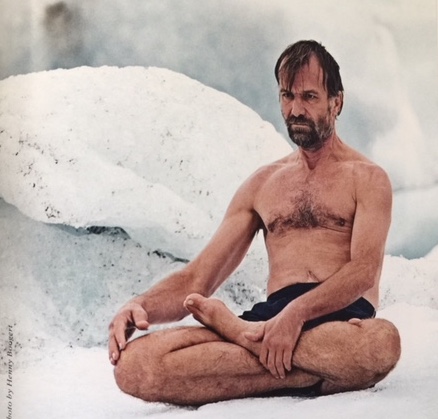
Wim Hof in a classic picture of him, sitting in lotus position on ice

Posted in Uncategorized | Leave a comment

The Elegance of the Hedgehog, by Muriel Barbery

Elegance of the HedgehogWhy this book: Selected by my literature reading group.  Patsy – you have lobbied hard for a couple of real winners, and this is another one! I understand why you were willing to read it for the 3rd time!
Summary in 3 sentences. Two very intelligent, well read and eccentric women share their perspectives on their worlds, how they think and how they live. One is a 54 year old concierge of an apartment building in Paris, who describes herself  (more or less) as a frumpy, ugly, and poor; the other is an extremely precocious 12 year old girl in a wealthy family who is cynical and disenchanted.  In the first part of the book, the narrative alternates between the perspectives of these two women, and the chapters are brilliant, almost standing alone as essays on the world these women are viewing – until about halfway through the book, their lives converge in an unexpected way.

My Impressions: I loved this book. One of my favorite reads in recent years.  If you  enjoy getting inside the heads and hearing the perspectives of intelligent, thoughtful and observant women, and reading their thoughts beautifully expressed in wonderful prose, I expect that you would thoroughly enjoy this book.

Two main characters occupy center stage for most of this book:

Renee: The lead character is Renee Michel, a 54 year old woman who presents herself to the world as overweight, unattractive and uninteresting –  a typical grumpy concierge – who has managed her apartment building for 27 years.  She indeed believes herself to be dumpy, frumpy, and unattractive, but not unintelligent.  She is a voracious reader, who avidly studies history, philosophy, and literature (especially Tolstoy), and is a connoisseur of the arts.  She is is a sensitive thinker and student of life, with a Buddhist monk’s appreciation of beauty, simplicity, and the joy that can be found in moment or insight.

BUT,  she actively hides this side of herself from the world, preferring to remain a non-entity, playing the role of the grumpy and dull concierge, so that people will  ignore her and leave her alone.  She is careful not to arouse anyone’s interest and is determined to protect and hide who she really is.   People in her apartment see her as little more than a bland functionary, a non-person, not worthy of their attention, or even their respect. Nurturing this perception gives Renee the privacy, freedom and space to explore the world of ideas and the arts on her own terms, without being invited, nor expected to participate in the superfluous social rituals that characterize much of modern urban living. “Thus am I,  poor concierge, resigned to a total lack of luxury – but I am an anomaly in the system, living proof of how grotesque it is, and every day I mock it gently, deep within my impenetrable self.” (p 124)

Paloma:  The other main character in The Elegance of the Hedgehog is the youngest daughter of a well-to-do family living in the apartment building Renee manages. With a precocious wisdom beyond her years, she is disenchanted with the lives and values of her parents, her older sister, and others in her social class, and simply sees no way out for herself.  She is angry and frustrated but feels powerless, except to express her cynicism and anger in her journal.  We hear her voice through her journal, each journal entry a separate chapter in the book, full of her humorous and condescending observations of her family and upper-middle class values in general.  The world she observes and comments on is so superficial and pretentious that she wants no part of it. She unemotionally plans her suicide as a statement to shake up the complacency of her family, for whom she has so little respect.  Her voice is not as sophisticated as Renee’s, and though the author/translator attempts to give her something of a teenage girl’s irreverent voice, it isn’t very convincing.  It’s just a bit hard to believe how a young girl of her age can have arrived at her sense of history, social awareness and philosophy.  Her cynicism and insights are merciless and often deliciously biting and on target.  I distinctly heard the influence of the French existentialists I’ve read (Sartre and Camus) in her commentaries, though they were never mentioned by name.

These two very different women share an alienation from the values, behaviors and pretentiousness of normal society and polite social intercourse.  And they express their alienation in very different ways.  As we get to know them individually, we know that their lives will eventually and somehow converge. And they do.

A couple of important supporting players help provide context for getting to know these two fascinating women.  About halfway through the story, a third important character – a successful and worldly Japanese business man – enters the story and unconsciously and with little fanfare, changes the dynamic of all the relationships in the story.

Camellia lying on moss.  Renee’s image of a beautiful camellia lying on bed of moss is an image that returns in the story again and again, and gives meaning to this story, from multiple perspectives.  And by the way, Renee is the “hedgehog.”

I loved this book.

———————

A few quotes. It was a joy to go back and review the many passages I had marked.  I was again struck by how well Muriel Barbery (and her translator) captured the Buddhist wisdom of Renee and the existential cynicism of Paloma.  I know I include a lot of quotes here, but these are but a few of those I marked as noteworthy or remarkable:

Paloma:  – even for me life is already all plotted out and so dismal you could cry: no one seems to have thought of the fact that if life is absurd, being a brilliant success has no greater value than being a failure. It’s just more comfortable.  And even then: I think lucidity gives your success a bitter taste, whereas mediocrity still leaves hope for something.  p 24

Paloma: We are, basically programmed to believe in something that doesn’t exist, because we are living creatures; we don’t want to suffer.  So we spend all our energy persuading ourselves that there are things that are worthwhile and that is why life has meaning.  p 24

Renee: (referring to her Portuguese cleaning woman) Manuelais an aristocrat.  an authentic one, of the kind whose entitlement you cannot contest: it is etched onto her very heart, it mocks titles and people with handles to their names   What is an aristocrat?  A woman who is never sullied by vulgarity, although she may be surrounded by it. p 32

Paloma: With the exception of love friendship and the beauty of Art, I don’t see much else that can nurture human life. I’m still too young to claim to know much about love and friendship. But Art…if I had more time to live, Art would be my whole life.  p 37

Renee: I have read so many books…And yet, like most autodidacts, I am never quite sure of what I have gained from them.  There are days when I feel I have been able to grasp all there is to know in one single gaze, as if invisible branches suddenly sprung out of nowhere, weaving together all the disparate strands of my reading – and then suddenly the meaning escapes, the essence evaporates, and no matter how often I reread the same lines, they seem to flee ever further with each subsequent reading, and I see myself as some mad old fool  who thinks her stomach is full because she’s been attentively reading the menu.  p 53

Renee:  We are all prisoners of our own destiny; must confront it with the knowledge that there is no way out and, in our epilogue must be the person we have always been deep inside, regardless of any illusions we may have nurtured in our lifetime. Just because you have been around fine linen does not mean you are entitled to it – no more than a sick person is to health.  p 90

Renee: Elsewhere the world may be blustering or sleeping, wars are fought, people live and die, some nations disintegrate, while others are born, soon to be swallowed up in turn – and in all the sound and fury, amidst eruptions and undertows, while the world goes its merry way, bursts into flames, tears itself apart and is reborn, human life continues to throb….   So, let us drink cup of tea. p 91

Paloma: In our world, that’s the way you live your grown-up life; you must constantly rebuild your identity as an adult, the way it’s been put together it is wobbly, ephemeral, and fragile, it cloaks despair and, when you’re alone in front of the mirror, it tells you the lies you need to believe.  p 92.

Renee: We talk about love, about good and evil, philosophy and civilization, and we cling to these respectable icons the way a tick clings to the nice big warm dog.  p 97

Renee: The camellia against the moss of the temple, the violet hues of the Kyoto mountains, a blue porcelain cup – this sudden flowering of pure beauty at the heart of ephemeral passion; is this not something we all aspire to? and something that, in our Western civilization, we don not know how to attain? P 101

Renee: I find this a fascinating phenomenon: the ability we have to manipulate ourselves so that the foundation of our beliefs is never shaken. p 108

Renee: ….there are marvelous poets born in stinking caravans, or high-rise slums who do have for beauty the sacred respect that it is so rightfully owed….To the rich, therefore, falls the burden of Beauty.  And if they cannot assume it, then they deserve to die.  p.110

Paloma: What is love? How will we love? Who will it be? When? Why? Our opinions differ. Oddly enough Marguerite has an intellectual vision of love, whereas I’m an incorrigible romantic.  She sees love as the fruit of a rational choice (of the http://www.sharedtastes.com variety) whereas I think it springs from a delicious impulse.  There is one thing we do agree on, however: Love mustn’t be a means, it must be an end.  p 194

Paloma: Our other favorite topic of conversation is fate, and people’s prospects in life…and if you want my opinion, the most awful thing is not that we’re playing this game, but that it isn’t a game. p 194

Renee: But when we gaze at a still life….we delight in its beauty…we find pleasure in the fact that there was no need for longing, we may contemplate something we need not want, may cherish something we need not desire….In the scene before our eyes – silent, without life or motion – a time exempt of projects is incarnated, perfection purloined from duration and its weary greed – pleasure without desire, existence without duration, beauty without will…. For art is emotion without desire.  p 204

Renee: Entrusting ones life is not the same its opening up one’s soul, and although I love Manuela like a sister, I cannot share with her the things that constitute the tiny portion of meaning and emotion that my incongruous existence has stolen from the universe.  p 224

Paloma: Personally I think there is only one thing to do: find the task we have been placed on this earth to do, and accomplish it as best we can, with all our strength, without making things complicated or thinking there’s anything divine about our animal nature.  This is the only way we will ever feel that we have been doing something constructive when death comes to get us. Freedom, choice, will, and so on? Chimeras. We think we can make honey without sharing in the fate of bees, but we are in truth, nothing but poor bees, destined to accomplish our task and then die. p 238

Renee: Like any form of Art, literature’s mission is to make the fulfillment of our essential duties more bearable…something has to save us from the woeful eternal fever of biological destiny.  p 248

Renee: Every gray morning, day after gloomy day, secretaries, craftsmen, employees, petty civil servants, taxi drivers and concierges shoulder their burden so that the flowor of French youth, duly housed and subsidized, can squander the fruit of all that dreariness upon the alter of ridiculous endeavors.  p 249

Posted in Uncategorized | 1 Comment

Captain Class, by Sam Walker

Captain ClassWhy this book:  Selected by the All American Leadership Reading group to read and discuss.  Several other friends  had already recommended the book to me.

Summary in 3 sentences:  In the opening section of the book, Sam Walker explains his criteria for deciding which were the 16 most successful sports teams in history – criteria that will naturally be very controversial and contested.  Then he explores the one characteristic that all of these super-elite teams had in common – each had a strong player-captain who served as the glue and driving force that propelled these teams to stay great over a period of numerous years to become among “the Greatest Of All Time,” and break out from those which were great once, or twice.  He explores each of seven characteristics he found were common to each these team captains – and there are some surprises here – before he concludes in Part III, with what he calls “The Opposite Direction – Leadership Mistakes and Misperceptions.”

My impressions:   I liked and learned a lot from this book.  It is a book which will stimulate thinking and controversy – and in a positive way.  The Captain Class arrives at some conclusions that are not part of the conventional leadership curriculum.   Though his lessons learned are written to apply to highly competitive teams – and I would include elite Special Operations Forces in that group – they may be of less relevance to most business organizations, which are not made up of elite players, nor players who aspire to being elite.  That said, there are lessons learned that can make any team better – IF a CEO or leader is willing to find and empower the right “captain” within the organization, with the respect and moral authority to serve as a sparkplug, motivator, and disciplinarian within the team.  Walker does go to some effort to apply his criteria for excellence of team captains to settings outside of the most elite sports teams, including the corporate world.

The Best Teams: The first part of the book would be of interest to any avid professional sports fans, as he breaks down in some detail how he arrived at the criteria by which he selected the best sports teams in history.   BUT he also categorized great teams into Tier 1 (the 16 teams he designated as the elite of the elite) and Tier 2 (108 teams which were among the very best – but not fully achieving his criteria to qualify as Tier 1.  His Tier 2 list include such redoubtable teams as the New England Patriots 2001-2017, San Francisco 49ers 1981-1995, Chicago Bulls 1991-1998, NY Yankees 1936-41.  This section of the book includes a fair amount of analysis and a few stories to back up his culling and selecting – fully anticipating push back to which teams he included and excluded from elite Tier 1 status.

The teams he lists and discusses, not only Tier 1 but also many of the Tier 2 teams, include teams from all over the world and from less popular (at least in the US) sports such as field hockey, volleyball, water polo, and team handball, and he includes men and women’s teams as well. In fact, three of his Tier 1 teams are women’s teams.   His list of Tier 2 teams is included in an Appendix, broken out by sport and includes a brief description of each.

The Seven Traits. The meat of the book is in Part 2, in which he explores each of the seven qualities he found that the captains of his Tier 1 teams shared. Each chapter begins with stories of great captains exemplifying the particular characteristic of that chapter.   These stories make for compelling reading and are effective in helping him make the case for how the specific trait being addressed in the chapter is manifest in Tier 1 captains.

He writes a separate chapter for each of the Seven Traits he found were common to all of the Tier 1 team captains.  Those seven traits (p 91) were:

  1. Extreme Doggedness and focus in competition (Chapter title: They Just Keep Coming)
  2. Aggressive play that tests the limits of the rules (Chapter title: Intelligent Fouls)
  3. A willingness to do thankless jobs in the shadows (Chapter title: Carrying Water)
  4. A low-key, practical, and democratic communication style (Chapter title: Boxing Ears and Wiping Noses)
  5. Motivates others with passionate nonverbal displays (Chapter title: Calculated Acts)
  6. Strong convictions and the courage to stand apart (Chapter title: Uncomfortable Truths)
  7. Ironclad emotional control (Chapter title: The Kill Switch)

Walker explains all the reasons why these men and women didn’t fit what he expected to be the profile of the key leaders of great teams.  These included (p 50:)

  1. They lacked superstar talent;
  2. The weren’t fond of the spotlight;
  3. They didn’t “lead” in the traditional sense;
  4. The were not angels;
  5. The did potentially divisive things;
  6. The weren’t the usual suspects (i.e. the well-known stars of great teams;)
  7. Nobody had ever mentioned this theory (i.e., that the captain might be the team’s driving force;)
  8. The captain isn’t the primary leader (i.e., not the coach or manager).

Bending/Breaking the rules: The most interesting and controversial chapter was Intelligent Fouls- Playing to the Edge of the Rules.  He  points out that all of the captains were focused on winning and would bend and stretch the rules when they could get away with it, to win. He points out (arguably) that:

“There are two activities in polite society in which it’s okay to do harmful things to other people in the pursuit of victory.  The first is war. The second is sports. Part of the deal, however, is that there are some lines not to be crossed.  (p116)

Such aggressive bending of the rules he divides into two important categories:  hostile and instrumental.  Breaking the rules out of “hostile” motivations, driven by anger or frustration in order to hurt or punish the opponent are forbidden, and the Captain Class would not go there.  Instrumental bending or breaking rules isn’t motivated by a desire to injure, rather by the determination to achieve a worthwhile goal.

Later he says that:

“The captains of the world’s sixteen greatest sports teams were not angels. They sometimes did nasty things to win, especially when the stakes were highest.  They didn’t believe that being sportsmanlike all the time was a prerequisite for being great…..

“The world puts a lot of pressure on athletes, especially captains, to be champions and paragons of virtue. But these two thing do not always correlate. It’s sometimes one or the other. The most decorated captains in history understood this.”  (p 130  131)

Walker is being descriptive, not prescriptive.  He’s saying that whether we like it or not, this is what his research has found.  In sports as in war, however, there are lines not to be crossed, and I really found his distinction between hostile and instrumental bending/breaking of the rules insightful.  I think of the battles between offensive and defensive linemen in football often as a battle for who can get away with bending or  breaking the rules in order to better get at, or protect the quarterback.

Captain Class Communications – It was interesting to me that Walker spends much of the book directly or indirectly addressing how captains communicate with their teams, noting that they communicate differently than most leaders in other contexts.  Tier 1 captains prefer not to communicate in public, often don’t do it well, and are not effective at giving motivational speeches.  They communicate best during play, or in closed circles with their team, and communicate best when coaches, managers, or outsiders (the press especially) are not around.  Their communication is practical and direct, often silently,  with gestures, or body language.  Walker devotes a whole chapter (Uncomfortable Truths) to describing how Captain Class captains were not afraid to put themselves at risk, sometimes in a shocking manner, by challenging management on behalf of the team.

My good friend Mike Lerario – author of Leadership in Balance (my review here) – noted in his review of Captain Class that the reserved approach to communicating in public  characteristic of Tier 1 captains diverges from what is necessary to succeed in most senior leadership positions.   CEOs and leaders of large organizations are required to effectively represent and “sell” their organizations to the public and audiences outside of their own.  Tier 1 team captains were uniformly poor at this.  I can only think of two successful senior military leaders I knew – one a man and one a woman – whose communication styles approximated the Captain Class formula. While adequate when called upon to communicate in public to broader audiences, they excelled so well in other aspects of their leadership that their very reserved public personas didn’t seem to matter.

Walker describes the quintessential Captain Class team captain as someone who:

  • Does not want, nor seek the spotlight, nor personal stardom. Avoids the press and publicity.  Is focused on Team, first, second and third.
  • Is willing to do the small, non-glorious jobs that don’t get much attention, but which s/he considers to be essential to the team’s success. Is not too big or important to do anything that needs to be done which will help the team succeed.
  • Is not only willing, but chooses to be in the shadow of the star players and the most talented performers, and thereby help them better help the team;
  • Though quiet in public and in front of coaches and managers, is vocal and communicates actively when among teammates.  Sees his/her role as keeping open communications within the team, and letting each team member know that they are valued and important.
  • Communicates most forcefully through actions, gestures, and body language. Is not usually a dramatic or effective speech giver;
  • Is willing to push limits and bend rules – to a point – to help the team win. When the rules are bent, or even broken, it is with one goal in mind – helping the team win, not to fulfill any personal agenda;
  • Takes great care of individual players, in order to take care of the whole team. No one individual, including him/herself, is more important than the success of the team.
  • Is all-in, all the time, and therefore has the moral authority to demand that of others on the team.
  • Is passionate about the team and winning, but manages passion and emotions – especially in public – so that passion and emotion work for, and not against the goal of team – to win.

He describes Valeri Vasiliev as typical of the Captain Class:

He was dogged on the ice, carried water for others, and played to the edge of the rules.  He didn’t give speeches, but teammates say he was constantly advising the coaches and  counseling the players without ever raising his voice. “When there were no coaches around, he would talk to the players,” Tretiak told me.   “He always said the right thing in the locker room and on the ice.” (p 190)

Captain Class echoed many of the themes that James Kerr makes in his outstanding book Legacy (my review here), which describes the culture of the New Zealand All Blacks rugby team.  There are many great parallels between these two books.  Walker describes his Tier 1 captains as metaphorically “carrying water” for their teams, while Kerr describes how All Blacks team captains “sweep the sheds” with their teams, as a hallmark of All Blacks humility.    It is no coincidence that two of the Tier 1 teams, and one of the Tier 2 teams were All Blacks.

This book was a fun read with compelling stories and an original approach.  His point: If we define truly exceptional teams as those who have succeeded at the very highest levels for an extended period of time, that level of success may require a somewhat different style of leadership, than what works to be “merely” very good or great.  Walker reveals what for some may be uncomfortable truths in his analysis.

————————

Some other interesting and telling quotes from Captain Class (page numbers refer to 2017 hardback edition:)

<This is> ultimately a book about  a single idea – one that is simple, powerful, and can be applied to teams in many other fields, from business and politics to science and the arts… It’s the notion that the most crucial ingredient in a team that achieves and sustains historic greatness is the character of the player who leads it. p xvii

The longer he played, and the more Barcelona won, the more acutely Puyol felt the need to keep the team focused, to keep pulling hard on the rope. “Winning is difficult,” he said, “but to win again is much more difficult – because egos appear.   Most people who win once have already achieved what they wanted and don’t have any more ambition.”  p110

…most of the Tier One captains had zero interest in the trappings of fame.  They didn’t pursue the captaincy for the prestige it conveyed – if they pursued it at all.. 137

One of the great paradoxes of management is that the people who pursue leadership positions most ardently, are often the wrong people for the job.  p 141

A water carrier can improve a team by focusing on shoring up weaknesses and enforcing high standards – this much we’ve seen.  But there was still one missing piece of the puzzle.  If the chief responsibility of a team leader is to direct their players on the field, then by all rights these captains must have found ways to influence, if not control the team’s tactics.  p 145

To Deschamps, carrying water wasn’t just a servile act, it was a form of leadership – the sort of command that most of us, up in the stands, don’t appreciate or even notice. “I knew I couldn’t make a difference with a single move,” Deschamps said. “but over the long run, through hundreds of small acts of service and management, I was able to balance things out and to be come indispensable”….In other words, while the television cameras tend to focus on the players at the front, the hard work of leadership is often conducted from the rear.  p 147

I wondered if the communication style of great captains wasn’t solely a matter of how much they talked but also of the emotional energy they put behind their words through body language, facial expressions, gestures and touch.  p.164

The teams in Tier One had talkative cultures – and the person who fostered and sustained that culture was the captain.  Despite their lack of enthusiasm for talking publicly, most of these captains, inside the private confines of their teams, talked all the time and strengthened their messages with gestures, stares, touches, and the other forms of body language.  The secret to effective team communication isn’t grandiosity. It’s a stream of chatter that is practical, physical, and consistent.  p 170

What all of this research shows is that anyone who wants to change the emotional composition of a group – whether it’s a Viennese mob or a football team – can do so by tapping into an invisible network that connects all people together.  Strong leaders, if they are so inclined, can bypass the conscious minds of their followers and communicate directly with their brains.  p 178

…the difference between positive dissent and the negative, destructive variety…..teams that had high levels of conflict were often more likely to engage in open discussions that helped them arrive at novel solutions to problems. The worst outcomes came when groups engaged in thoughtless agreements….There was a difference…between teams that squabbled because the members didn’t like one another and teams that fought over their different views of how to solve a problem they were working on.  p 199

To lead effectively, Lahm believed, a captain has to speak truth not only to power but to teammates as well.  “It’s a totally romantic idea that you have to be eleven friends,” he said.  p. 201

A leader who isn’t afraid to take on the boss, or the boss’s boss, or just stand up in the middle of a team meeting and say, “Here’s what we’re doing wrong, ” is an essential component of excellence. p. 202

During their careers, the Tier One captains all faced some issue that stirred up powerful negative emotions – an injury, a rebuke, a personal tragedy, even a climate of political injustice. These captains not only continued playing through setbacks – they excelled. They walled off these destructive emotions in order to serve the interest of the team. p. 228

Posted in Uncategorized | Leave a comment

John Adams, by David McCullough

John AdamsWhy this book: My literature reading group decided to select a topic rather than a book, and the topic for this session was John Adams.  We selected him in part because we were approaching the 4th of July, and in part because several of the women in our group wanted to read more about Abigail Adams. McCullough’s bio of John Adams has a great (well deserved) reputation and had been on my shelf un-read for years.  So I finally decided to read it. So glad I did.

Summary in 3 sentences: It is a biography – about John Adams’ life – from birth until his death, at age 90 – but  focuses largely on his efforts leading up to and during the American Revolution, the forming of the Republic afterwards, his time as Washington’s Vice President and then as President. The final 20 percent of the book is about his life after the Presidency, his mentoring of his son John Quincy, and most notably his relationship with his political rival Thomas Jefferson.

My Impressions:  It’s a long and very worthwhile read.  McCullough is a great storyteller and his story of Adams was a great immersion experience into 18th century New England – leading up to, through, and after the revolutionary war.  McCullough is clearly a great admirer of Adams; that comes out in how he describes his integrity and character. But he doesn’t refrain from being critical when he felt that Adams was occasionally overly principled and inflexible, and at other times when he allowed himself to be cajoled, for example when he signed the infamous Alien and Sedition act.

This is probably the most widely read and popular biography of Adams, and served as the basis of the HBO seven part part series staring Paul Giamatti which I highly recommend. I saw the series before reading the book, and look forward to watching it again. But the two go well together.

Here are a few of the things that most surprised and impressed me reading about Adams’ life and that period of time in our nation’s history:

  • The Depredations of Disease. Though we all know that disease and infection were a much greater scourge to society two centuries ago than they are today, that message is brought home when we read about SO many people dying of typhoid, malaria and other diseases. Every summer in Philadelphia, hundreds and sometimes thousands of people died of typhoid fever, so many that those who could and had the resources to do so, left the city – including the Continental Congress. Those without the means to leave, and especially the very young and the older, died in the hundreds and sometimes the thousands.  Also during this period, we are reminded that almost every family lost one or more children in childhood – an almost routine, heart wrenching tragedy.
  • I was stunned by the viciousness of the politics – actually making what we currently deplore in the ad hominem attacks between political competitors, look tame. There were fewer news sources then, so a brutal attack in a newspaper or magazine could have a huge impact.
  • Adams tempered his responses.  Though he had a well known capacity for anger – the dark side of his positive passion – Adams was unusual in that he refused to get into the mud with those who attacked him, as vicious as those attacks often were.  He never attacked an opponent’s person or character in public, though he did in some of his private correspondence.
  • There were many times when Adams stood on principle against popular opinion of his colleagues and often of the public.  As a young attorney he successfully defended some of the English soldiers engaged in the infamous Boston Massacre the he felt were being unfairly railroaded because of the anti-English sentiment in Boston. Later as President, he stood fast against the widespread desire to go to war against France, which may have cost him his reelection. Though history shows that to have been the right decision, a better politician – one more attuned to public opinion – certainly could have achieved the same result while still placating the public animosity toward France.  Though very principled, his unwillingness to bend and play the political game, gave his enemies much ammunition, and often cost him in outcomes.
  • His focus on duty has seldom been equaled in a political leader.  At great cost to himself and at great risk, he accepted direction to cross the Atlantic to France twice. Without question.  He did whatever his country asked. He seemed to have little ambition for personal glory.  In fact, for much of his life he would have preferred to stay at home on his farm in Braintree Massachusetts.
  • I had hard a lot about Abigail Adams.  McCullough – as do all biographers of John Adamsemphasizes the very strong and positive role she played in John Adams’ life.  She supported him through thick and thin, and the strength of their relationship, and her equally principled and strong will transferred to and supported his own unusually strong and principled stances.   They spent extensive time apart – sometimes years, when Adams was assigned overseas.  Most of the time he spent in Philadelphia writing the Declaration of Independence and the Constitution, they were apart, but he always claimed that she was a main source of his strength and conviction.  They wrote to each other constantly – and most of these letters survive.
  • Jefferson and Hamilton actively undermined Adams during his presidency, and McCullough was unsparing in his recounting their uncompromising opposition to Adams and efforts to undermine his policies and decisions while he was President.   But at least Hamilton was fairly open in his opposition to Adams, whereas Jefferson worked primarily through surrogates, and his opposition was subtle and insidious.
  • Adams reached out to reestablish a warm relationship with Jefferson after they had both been presidents,.  This spoke highly of Adams’ character, since he was very aware of much of Jefferson’s treachery, which he did not reciprocate while Jefferson was President.   After all of that, one can’t help but be amazed and impressed that he initiated the reconciliation, which resulted in a long and close friendship, and one of the most extensive collections of  (post) presidential letters in history.
  • I was impressed at how Adams grew old. He was a happy, expansive, and very engaged older gentleman – an excellent model for an ex-President.  Even after he lost his beloved Abigail, one of his sons, and many of his closest friends, he remained grateful and happy, and shared the joy he saw in life – in things large and small.  He was a highly respected and admired elder statesman and projected the best in American and human values.

McCullough concludes the book with the following paragraph describing Adams’ approach to life in his later years:

“…Nor did he love life any the less for its pain and terrible uncertainties.  He remained as he had been, clear-eyed about the paradoxes of life and in his own nature.  Once, in a letter to his old friend Francis van der Kemp, he had written, ‘Griefs upon griefs! Disappointments upon disappointments.  What then? This is a gay, merry world notwithstanding.’  

It could have been his epitaph.” 


Posted in Uncategorized | Leave a comment