The Shadow of Kilimanjaro, by Rick Ridgway

Shadow of KilimanjaroWhy this Book: I was scheduled to travel to Tanzania to climb Mt Kilimanjaro and then afterward participate in a follow-on safari tour of the Serengeti and other wild animal parks in northern Tanzania. Though this book takes place mostly in Kenya, it was suggested by the tour operator as providing good insights into the culture, wildlife, and environment we would encounter in Tanzania.

Summary in 3 Sentences: The author Rick Ridgeway is a renowned mountaineer and adventure writer who has been all over the world.  He and a good friend who leads safaris in Kenya hatched the idea of making a foot safari from the peak of Kilimanjaro through Kenya’s  famed Tsavo   wildlife parks, out to the Indian Ocean, a distance of about 250 miles.  While the book does describe the trek and their adventures along the way, Ridgeway uses the trek as a backbone around which to share engaging stories about many fascinating personalities who have been involved in managing the parks, the movement to preserve wildlife, the fight against poachers, and various legends of man’s interface with wild animals in the region.

My impressions:  I really liked this book – very well written, and I liked the humility, curiosity, insights and perspectives of the author. In many ways this book is as much about the history of the white man in Kenya – beginning in the early 19th century- as it is about the trek from Kilimanjaro to the Indian Ocean.  Given that Ridgeway is a professional mountaineer and adventurer, a journalist, travel writer and amateur naturalist, it is also very much about the interface between  man and the environment – especially as it has related to the impact of Westerners on the previous balance between native African tribes and the wildlife in the area.  The encroachment of humans on what had been previously shared habitat has had a profound impact on wildlife – but humans have clearly suffered as well.

Ridgeway’s three main companions are the subject of much of his narrative.  His good friend and fellow mountaineer Iain Allen was  “widely regarded as the most experienced mountaineer in East Africa,” ran a safari business, leading climbs, safaris and other adventures in East Africa. And as experts and guides,  he brought along Bongo and Danny Woodley, brothers and both hunters and park rangers themselves, following in the footsteps of their father Bill Woodley, one of the great hunters and park rangers in Kenya in the 20th century.  Many of the stories he shares are from them – about their experiences in the bush, as well as stories from their father and his friends and acquaintances. Fascinating stuff.  Additionally he had two armed Kenyan park rangers with them and a cook and driver who met them with food and provisions at various campsites throughout the trek.

The book is filled with a fascinating narrative and vignettes from their trek.  But as I’ve noted, a highlight of the book was the many digressions he made into the history and stories of the area through which they were hiking.  Some of the stories I found most compelling were:

  • The fascinating story of the man-eating lions that plagued the effort to build the railroad into the interior of Kenya at the beginning of the 20th century.  Two lions had developed a taste for human flesh, and nearly every night would stalk, kill, and devour one (occasionally two) of the railway workers, eluding all attempts to capture them, defeating all attempts to protect the workers from the lions. These lions killed and ate nearly 30 railway workers before effort to kill them finally succeeded. The account of the personal efforts of the head of the railway project to finally defeat these very clever predators was a great page turner.  Based on accounts of other people disappearing without a trace, it was estimated that these lions may have killed and eaten over 100 human beings.  The stuffed skins of these two lions are in the Chicago museum, and one member on our safari had seen them.


  • The fascinating story of the focused efforts to defeat poachers in the Tsavo parks of Kenya, culminating in the 1980s.  The park rangers had been up against native Kenyan tribes, small time criminals, as well as corrupt officials who were  profiting from the ivory trade.  The poacher issue seemed to be more or less under control, when armed Sudanese rebels realized that poaching ivory was an easy and profitable source of revenue, and began sending fairly well trained and ruthless para-military criminals into Kenya.  At this point, the park rangers, with the support of some influential government leaders, created a para-military counter-guerilla force which fought back.  It has been an on going battle, which at the time of the writing of this book in 1997, had reached a delicate level of stasis.  But Rhinoceros populations were decimated and elephant populations remained under threat.


  • And finally, related to the poaching stories, the park rangers struggled to find accommodation with a native tribe of African bow-hunters whose culture for centuries had evolved around the art of hunting and killing elephants for ivory. The ivory trade had existed for centuries, and the Waliangulu tribe were among the most proficient big game bow hunters in the world.  They had shared the environment with elephants for centuries and their culture was built around hunting elephants as an ethos. They were poachers only as defined by the game laws that came into being in the 20th century.  The story reminded me of Alaskan Eskimos and whales, or native American cultures built around following buffalo, and warrior tribes counting coup against each other.   Ridgeway sadly notes how population growth in Africa, the encroachment of 20th century civilization on tribal and wildlife lands, and the legal prohibitions on hunting had already led to the demise of the once proud Waliangulu culture.


Throughout the book Ridgeway sought to understand the relationship between hunting and wildlife conservation.   Ridgeway was not a hunter,  hadn’t had much sympathy for big-game hunting, and was somewhat surprised to find that a large percentage of strong advocates for protecting and preserving wildlife were indeed hunters.  And getting to know some of the most prominent of these men, he realized that their efforts to preserve wildlife were due to more than a selfish motivation to simply preserve targets for their hunting.  The experience of hunting, and the delicate relationship between hunter and hunted is much more complicated than that.

When stalking game and being on the hunt, the hunter must venture into the wild lands and the discomfort of being in the field, and enters the primordial food chain, putting him/herself at risk in the search for game.  The hunt is very often unsuccessful, after much effort.  Serious hunters experience a primal connection to nature in which one eats only what  one is able to kill, and which we in our comfortable and civilized lives don’t often experience.  Hemingway alluded to this several times in Green Hills of Africa and some of my best and most environmentally conscious friends in the National Outdoor Leadership School are also hunters and have  partnered with hunters for years in lobbying to preserve wild lands and protect wildlife.

I really enjoyed reading Shadow of Kilimanjaro.   I like Ridgeway’s voice, how he wove fascinating stories from the history of the interface between white Western culture and the local tribes and wildlife into his narrative.  As something of a small time adventurer myself, I found Ridgeway to be a very appealing character, and I loved his descriptions of the many interesting and eccentric characters who populate his book. As an adventure and travel writer, he has a well-respected gift for writing and description. Whether one is going to Africa or not, this is a really good read.

Posted in Uncategorized | 1 Comment

Green Hills of Africa, by Ernest Hemingway

Green HIlls of AfricaWhy this Book: I was scheduled to travel to Tanzania to climb Mt Kilimanjaro and then afterward participate in a follow on safari tour of the Serengeti and other wild animal parks in northern Tanzania. This book is Hemingway’s account of his big game hunting trip in that same part of Africa and I  hoped to learn something about where I was going.

Summary in 3 sentences:  Hemingway had  hunted in his youth and after some of his initial successes as an author, found a sponsor to subsidize this trip to fulfill one of his manly-man dreams. He took with him a friend and his wife Pauline – the “other woman” from the book, The Paris Wife – as well as guides to help him find and identify his game, and a number of local porters to provide for a comfortable camp life, and to butcher and transport game he had killed.  Hemingway writes about his adventure in first person as a story teller, with drama and context, detailing the challenges, excitement, dangers of many of his stalks and kills, his frustrations when he failed, and generally describing his experiences as a big game hunter in 1930s Tanganyika – now Tanzania.

My Impressions:  This is not one of Hemingway’s classics, but it does give some insights into the man, the era and the manner of wealthy Western big game trophy hunters. Teddy Roosevelt, who must have been one of Hemingway’s heroes, set the standard and in fact, Hemingway hired the same guide, Phillip Percival (“Pop” in the book,) to lead him through this expedition.  It is written in first person and includes Hemingway’s thoughts and musings on more than the hunt.  But it is mostly about his feelings and experiences hunting big game in Africa.

The Forward, written by Hemingway’s son Patrick, and the Introduction, written by Hemingway’s grand son Sean offer interesting insights into the background to the book.  After reading the book, I found Pauline’s journal, which is provided in the back as an appendix, to be very enlightening as a very different perspective to the events Hemingway describes in the book.  Pauline herself was a published writer for magazines and I found her account more straightforward, with less of Hemingway playing the role of man’s man and literary icon on the hunt.  Pauline’s account seems more sincere and descriptive of the actual events of the safari.

I wish I had waited until after going on the safari to read the book.  Reading it before arriving in Tanzania, much of it was hard for me to relate to – the animal names and locations were often unfamiliar to me.  But reviewing it afterward, was more rewarding – I had been to many of the places mentioned and had seen, up close and personal, most of the animals he observed and hunted.  Hemingway’s expedition spent time in the Serengeti and the Ngorogoro crater, both of which we visited on my safari.

I read the book with 21st century sensibilities about killing wild animals merely for sport, and the killing of (what are now) endangered species.  Frankly, I was disheartened by SO much killing with high powered rifles.  Reading Pauline’s journal, it seemed that they were on a killing spree to get great trophies, and just because they could.  I can hardly imagine that they needed or were even able to use that much meat.

That said, the guides and Hemingway did show an appreciation for the limitations of the animal resources.  They sought to kill only older and mature males, which of course also usually made the best trophies, expressed regret when they unintentionally killed a cow, and scrupulously avoided killing the young.  Hemingway spent a whole day trying to follow an animal he had wounded, finally giving up, expressing regret and even a sense of moral unease at being the cause of the likely painful death it would experience,  from its wounds, or being ripped apart by hyenas.   And in one instance he noted how certain areas had already been overly hunted.  At one point he writes, ” We are the intruders and after we are dead we may have ruined it but it will still be there and we don’t know what the next changes are. I suppose they all end up like Mongolia.”

I recommend this book to anyone studying Hemingway the man, or who, as was the case with me, is going to East Africa on safari.  This edition of the book includes a number of appendices to provide detailed background and supplementary material for those interested in understand Hemingway, his style, writing process and other background. To me, the appendix of greatest interest was Pauline’s diary.  I recommend scanning the Forward and Intro before reading the book and then going back and reading them (with greater interest) after reading Hemingway’s published version of Green Hills of Africa.

Posted in Uncategorized | 2 Comments

True North, by Bill George with Peter Sims

True NOrthWhy this Book: Selected by the All American Leadership reading group as our pick  to discuss for June 2017.

Summary in 3 Sentences: Bill George adds his own experience into the mix of stories and insights from over 125 key business leaders in the US, some in their 70s and some as young as in their 20s, who he and Peter Sims had interviewed and researched.   The message and focus is on “authentic” leadership, based on self-knowledge and passion driven commitment to a purpose bigger than self and career.  These are almost cliched ideas in 2017, but the points are well made, reinforced with many compelling stories and first person accounts of leaders who have struggled and succeeded.

My Impressions:  This book reinforced points I’ve read in many other leadership books –  so there wasn’t much “new” in it.  Of course, it was written 10 years ago, and there have been hundreds of leadership books written since then making many of the same points,  a few of which I’ve read.  The strength of the book is in the illustrative stories.  Bill George and Peter Sims interviewed and/or researched over 125 leaders for this book and many of their compelling and sometimes truly memorable stories are included,  which help reinforce the points of the book.

A couple of other things make this book stand out.

I like how they begin with an emphasis on the leaders’s personal life story as key to his/her leadership, a point which they reinforce later when they discuss how leaders must select a “style,’ that is most appropriate not only to their experience, but also to the situation. The uniqueness of one’s life story should determine one’s “authentic” style.

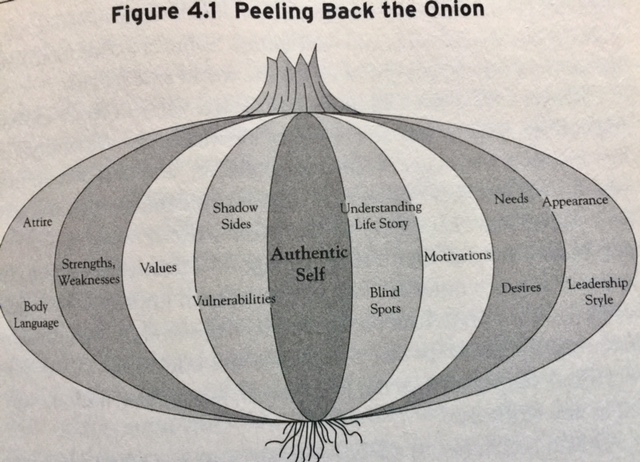
Related to that, the book emphasizes the importance of self-knowledge and self- awareness, as necessary to “discover your authentic leadership” (from the cover) and becoming a mature  leader.  He used the following graphic to to help describe his idea of the “authentic self” as central to who we are:

TN Authentic Self

The Leadership Exercises that were offered for each chapter in Appendix C at the end of the book were excellent, and included some probing and provocative questions.  While I did look at the questions, and recognized them as thoughtful and very worthwhile, I did not spend time thinking about or writing responses to the questions posed.  Doing these exercises however would be a very worthwhile investment in time – particularly toward the goal of  inspiring thinking, and self-knowledge.  I could imagine a leadership course going chapter by chapter through this book, and requiring the participants to write down their own answers to the probing questions in Appendix C, and then share and discuss them with each other.

I thought many of the graphic representations were a real strength.  I include  several below with the quotes I offer, which will help me (and perhaps you) with a quick review of the contents of the book – of course without the strength of the stories.

Possible Weakness:  Throughout the book, the authors write about the importance of a leader being “authentic.”  I recalled how in Leadership BS (my review here)  Jeffrey Pfeffer challenges this concept, noting that an important part of leadership is in role playing, appropriate to the demands of the situation.  The idea of the leader finding the balance between playing the role expected of a leader, and wearing his/her feelings on their sleeve was not addressed.  In True North, Bill George points out how being open about one’s shortcomings can yield positive and more trusting relationships with colleagues, teammates, or subordinates.  On the other hand, in his section on building one’s personal support team, he alludes to how we need a friend, mentor, partner, spouse with whom we can REALLY be vulnerable and authentic. The issue of “authenticity” is more interesting and complex than he describes. And in Waking Up (my review here) Sam Harris emphasizes how and why he believes that there is no “authentic self” at the center of the onion – that our “self” is really made up of the sum of all those outer layers.

————

Some quotes:  Below are some quotes I found representative of the message of the book. I’ve included a few of the excellent graphics.  (page numbers from the 2007 Hardback edition.)

To lead others, you must know what you are doing, have deep curiosity, and develop keen judgment.. Competence counts.  xvii

True North is the internal compass that guides you successfully through life. It represents who you are as a human being at your deepest level.  It is your orienting point 0- your fixed point in  spinning world  that help you stay on track as a leader. Your True North is based on what is most important to you, as your most cherished values, your passions and motivations, the sources of satisfaction in your life.  xxiii

TN Compass for the Journey

Leaders are highly complex human beings, people who have distinctive qualities that cannot be sufficiently described by lists of traits or characteristics.  Leaders are defined by their unique life stories and the way they frame their stories to discover their passions and the purpose of their leadership.  xxvii

Yet by acknowledging their shortcomings and admitting their errors, (authentic leaders) connect with people and empower them.  xxxi

Five dimensions of authentic leaders:

  1. Pursuing purpose with passion;
  2. practicing solid values;
  3. leading with heart;
  4. establishing enduring relationships;
  5. demonstrating self-discipline. xxxi

The test of authentic leaders’ values is not what they say, but the values they practice under pressure.  xxxii

Asked what motivates them to lead, authentic leaders consistently say they find their motivation through understanding their own stories….What emerges from these stories is that virtually all the leaders interviewed found their passion to lead through the uniqueness of their life stories….not by being born leaders….not by believing they had the characteristics, traits, or style of a leader… Not by trying to emulate great leaders.  8

Many people with painful stories see themselves as victims, feeling the world has dealt them a bad hand.  Or they lack the introspection to see the connection between their life experiences and the goals they are pursuing now.  Some get so caught up in chasing the world’s esteem that they never become genuine leaders… The different with authentic leaders lies in the way they frame their stories.   14

Novelist John Barth once said, “The story of your life is not your life. It is your story.”  In other words, it is your story that matters, not the fact of your life.    15

Vanguard CEO Jack Brennan believes that the worst thing people can do is manage their careers with a career map:  “The dissatisfied people I have known and those who experienced ethical or legal failures all had  a clear career plan….If all you’re interested in is advancing your career, you’ll be dissatisfied at the end of the day.”  15-16

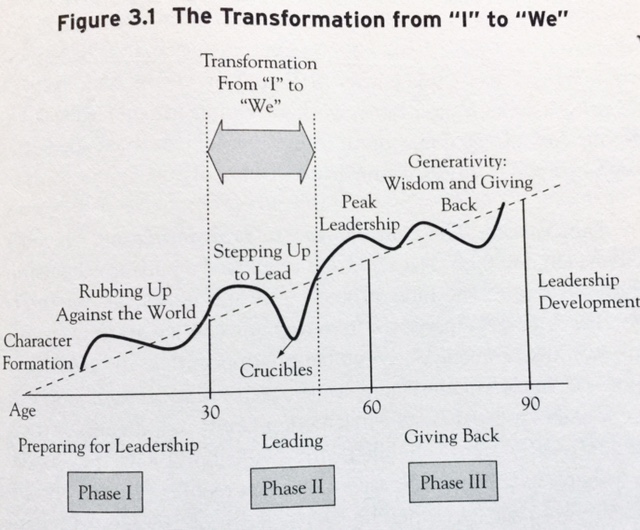
…The leaders journey followed the new span of life and subdivides into three periods, each of roughly thirty years. …Phase I is labeled: “Preparing for Leadership.” Phase II, from thirty to sixty years of age, is the “Leading” phase, in which leaders take on successive roles until they complete their peak leadership experience…Finally, Phase III is for “Giving Back”… 17

“(Phase I)) is your opportunity to rub up against the world.” 17

Two thousand years ago Roman statesman Marcus Cicero declared that “old age is to be resisted.”  24

There is nothing wrong with desiring these outward symbols as long as they are combined with a deeper desire to serve something greater than oneself.   28

The other side of fear of failure is an insatiable craving for success. …along the way, success can go to their heads and they develop a sense of entitlement…they are prone to pushing the limits and thinking that they can get away with it.  30

..authintic leadership is about empowering others on their journeys.  The shift is from “I” to “We.” ….If our supporters are merely following our lead, then their efforts are limited to our vision and our directions about what needs to be done.  44

TN I to We

Only when leaders stop focusing on their personal ego needs are they able to develop other leaders….A  lightbulb goes on as they recognize the unlimited potential of empowered leaders working together toward a shared purpose.  45

When you face your own mortality, as Mike Sweeney did, your priorities and your True North become crystal clear.  The same is true when someone close to you passes away.  58

Too many leaders believe that by being the smartest person in the room, they can use their intellect to carry the day….Wells Fargo’s Dick Kovacevich argues that high IQ can actually be an impediment to leadership. “Above the 99th percentile of intelligence, there is an inverse correlation between leadership and intelligence,” he says…Leaders with an exceptionally hight IQ get too intellectually involved and have trouble being tolerant of others.   68-69

Stanford’s Joel Peterson calls feedback “the breakfast of champions.” 77

When leaders accept who they are and release the need to be on someone else’s fast track, they can be comfortable in their own skin. 79-80

One fear all of us have to confront is whether others will accept us if we show our vulnerability. We fear being rejected if we admit our mistakes.  Will others take advantage of our weaknesses? Will they think less of us? As hard as we try to deny them, these questions continually nag when we are feeling most vulnerable.  80

Piper said he never would have opened up like that had he not found himself in the middle of a crisis. “As a result, I’ve learned the power of being vulnerable.  Most leaders’s are afraid to be vulnerable. They think, ‘I’m supposed to be strong and have all the answers.'” 81

Self awareness is only half the challenge. You still have to accept yourself….The key to self-acceptance is to love yourself unconditionally…(which) requires self compassion.     82

Leadership principles are values translated into action.  86

After defining your leadership principles, you need a clear understanding of your ethical boundaries. 86

…you do not know what your true values are until they are tested under pressure.  87

As we search for our True North, it is important to acknowledge how easy it is to get pulled off course.  The pressures to perform, the ingrained fear of failure, and the rewards for success can cause us to deviate from our values.  By knowing our ethical boundaries and testing our values under pressure, we are able to get back on track.  102

Alice Woodwark, McKinsey: “If you’re chasing the rabbit around the course, you’re not running toward anything meaningful.”   103

There are two types of motivations – extrinsic and intrinsic. Extrinsic motivations, such as getting good grades, winning athletic competitions, or making money are measured by the external world….Intrinsic motivations, on the other hand, are derived from your sense of the meaning of your life – your True North.  106

Motivations

Many leaders turned down higher-paying jobs in early career decisions in order to pursue roles they would enjoy.  110

The key to developing as an authentic leaders is not eschewing your extrinsic motivations but balancing them with intrinsic motivations.  112

But what some people fail to recognize, especially aspiring leaders, is the importance of the two way relationship with their mentors.  Lasting relationships must flow both ways.  122

To have great mentors, Warren Bennis tells young leaders, they have to recruit them.  124

Dillon’s story illustrates the importance of having mentors who challenge rather than just support you.  126

Personal support groups are one of the most powerful ways of gaining wisdom and advice that will help you grow as a leader.  The most effective groups are made up of peers who meet on a regular basis and talk about what is important in their lives.  128

Getting back on track alone is very difficult.  That is when you most need your support team.  131

Life humbles you.  137

Warren Bennis does not like the word balance.  “Balance is an engineering term that means you put the little weights on each side, and if you’re really a good person, you’ll come out equal. We have to be aware that we swing back and forth. It is choices all the time, not balance.”

Ultimately, our life stories become an expression of the choices we make.  138

Integrating life

For some of us, it takes many years to find the purpose of our leadership – and the right place to devote our passions.  155

Joel Peterson believes that many people are cause-driven and don’t start out thinking about being leaders. “They have so much passion for the cause that they naturally become the leader. When they are pulled to something that matters a great deal, leadership followed their passion.”  160

Narayana Murthy:  “You cannot sustain long-term shareholder value unless you create sustainable value for your customers, while assuring fairness to all stakeholders: customers, employees, investors, vendor partners, governments and society.” 167

To bring out the best from teammates, authentic leaders must develop trusting relationships based on mutual respect.  There is no substitute. Like loyalty, respect provides a basis for empowerment, but it must be earned. Here are some of the things leaders do to gain the respect of their colleagues:

  • Treating others as equals.
  • Being a good listener
  • Learning from people
  • Sharing stories.

Woody  Allen once remarked, “Eighty percent of success is showing up.” 177

Often, the most empowering response is to challenge people’s ideas, to ask why they are doing something a particular way, and to help them sharpen their ideas through dialogue.  179

Curtis Carlson: “Monday through Friday are about staying even with the competition. Saturday is when you get ahead.” 181

(Marilyn Carlson) Nelson decided to reinvent Carlson as a company that cared for customers by creating the most caring environment for its employees.  183

Once you empower people to lead around a shared purpose, you are well positioned to achieve superior result through your organization.  185

Using your power is directly linked to your style, as you convey power through style.  186

You also need to adapt your leadership style to the capabilities of your teammates and their readiness to accept greater power and responsibility. For example, if your teammates need clear direction they may not be ready to respond to a consensus style. Conversely, creative or independent thinkers will not respond positively to a directive style.  186

If you simply adopt an organization’ normative style or try to emulate someone else’s style, your lack of authenticity will show through.  Under pressure and stress, leaders tend to revert to their least attractive styles – from being highly directive or passive aggressive to completely withdrawn. That is why you should find a leadership style that inauthentic to you and continue to refine it.  191TN Leadership styles

Posted in Uncategorized | Leave a comment

The Death of Ivan Ilyich, by Leo Tolstoy

Death of Ivan IlyichWhy this book:  Recommended by my son, and then selected as an optional add-on book to Lincoln in the Bardo, my reading group’s selection for our bimonthly reading.  Ivan Ilyich is short – less than 100 pages.

Summary in 4 sentences:   The book takes place in Russia in the second half of the 19th century.  After a happy uneventful childhood followed by law school,  Ivan Ilyich was contentedly becoming an important figure in his community as an attorney and then judge when he became ill of mysterious causes. In the second half of this short book, Ivan Ilyich struggles with his illness, slowly gives up hope of recovery, and we experience his frustrations and painful realization that he is truly alone in his suffering as he faces death. In his last weeks and days, he resents the injustice of becoming fatally ill, since he had lived just as he was supposed to, following the well-trodden path to success  – and he finally realizes that so much that had previously been important to him was a sham.

My impressions:  Interesting that our reading group selected this book along with Lincoln in the Bardo, given that both books deal explicitly with death and dying.  Thinking, talking, writing about death is very much about how we live – and this book indeed is not only about how Ivan Ilyich lives his last months, but how he had lived up to that point, before he fully realized that indeed death also applied to him.  The book is about an unreflective man facing the reality of his own mortality – and how finally accepting his mortality changes his values and how he viewed his life.

The book begins with Ivan Ilyich being already dead,  his former colleagues talking about him, visiting his widow, attending the viewing and the funeral.  His “friends” and colleagues view his illness and death from a very self-centered perspective – though Ivan Ilyich’s death may be sad,  they are mostly concerned with how it affects their immediate concerns, the inconvenience of it all, how it may open up some opportunities for them.  Tolstoy is at his best getting at the truth of how people feel and think – the hypocrisy and prevarications in how people live and behave with each other.  This quality of his writing characterized War and Peace and Anna Karenina, the other two books of his that I have read.

After the opening scene, we are introduced to Ivan Ilyich and his life, and we learn about his happy childhood, how he was a good student,  attended law school, and then about  his successful career as an attorney and jurist, and eventually becoming a judge.  We learn of his courtship and  marriage, having children, and then how his marriage stagnates.  He then puts more  energy into his work, and takes satisfaction in his rising stature within his community.   It is a quick overview of a conventional life, lived in accordance with conventional values of the day – not unlike our values today.     As he reaches his 40s, his family life is not particularly satisfying, but his priority is on his career and his reputation in his community, which continue on a positive glide path as a result of Ivan Ilyich having done everything in accordance with the accepted conventions of the day.  Then he becomes ill.

In the second part of the book he confronts his illness – initially it as a mere inconvenience, and he believes he will get past it and get on with his life.  But he doesn’t get better, in fact gets worse, and he as to deal with conflicting medical advice from indifferent doctors, and he begins to become concerned.    From his family and “friends” he perceives feigned concern.   Tolstoy takes us inside the perspectives of his family and friends and we see that their concern is primarily for how Ivan Ilyich’s illness will affect them and their lives.

Most telling is how Ivan Ilyich notices and reacts to the insincerity of attempts to help and comfort him.  He despises those who visit him out of obligation  rather than out of real concern.  He does establish a bond with his son – a young boy who is confused and too young to be self-interested in his fathers death.  And he also bonds with one of his servants who is a friendly and good natured young man who is happy to help him with no apparent concern for what he might get out of it.

But in Ivan Ilyich’s story we see karma at work.  As a judge, he made judgments that determined the fate of those who were brought before him, with little real concern for them as human beings – rather dispensing the state’s justice and enforcing the laws impartially, only with the state’s interests  and his own career in mind. He showed no particular interest in whether “real” justice was being served, nor was he particularly interested in the individual stories and lives of those whose fate he decided. The doctors he visited treated him with a similar aloof indifference to his personal suffering.  Just as he had focused primarily the legal issues when deciding the fate of those brought before him as judge,  his doctors focussed on his illness as an interesting puzzle to solve, a dilemma, a challenge, but with little regard for his personal suffering.

As his suffering increased, he isolated himself more and more, while more people came to see him as he was clearly close to death.   He looked back on his life and wished he’d realized earlier that so much of what he had considered important meant nothing now.  He knows he is about to die and begins detaching from his suffering and his life.   The book concludes with, “He drew in a breath, broke off in the middle of it, stretched himself out, and died.”

The first part of the book reminded me a bit of Sinclair Lewis’s Babbitt, the protagonist of which is also an unreflective man following the formula for conventional success in one’s community.  In Babbitt however, our anti-hero never really realizes why things simply don’t seem to turn out right for him; Ivan Ilyich is forced to confront his own existential crisis – with no time left to make amends.  Funny how I keep stumbling on this theme. I just finished Hemingway’s Snows of Kilimanjaro – a short story in which the protagonist, a Hemingway-esque character, confronts, accepts and then experiences his own death.

The introduction to the Bantam Classic edition I read is an amazing essay by Ronald Blythe on the theme of “death in literature” and how this book fits into Tolstoy’s life and work.  I  recommend waiting until reading Ivan Ilyich the book before reading the introduction – it meant so much more after reading Tolstoy’s novel.


Posted in Uncategorized | Leave a comment

Super Consciousness, by Colin Wilson

Super ConsciousnessWhy this Book: I’ve read many of Colin Wilson books and have been a big fan of his since I was in college. After reading Stealing Fire on ecstasy and the ecstatic experience, I was inspired to read what Colin Wilson had to say about “peak experience.”

Summary in 3 sentences: This book provides numerous case studies to describe and explain “peak experiences” –  what they are, what they indicate about us, and how to engender them.  He says that the peak experience is available to all of us, and drawing on his work with Abraham Maslow, argues that they are fundamental to true happiness and to “self actualization” at the top of Maslow’s hierarchy of needs.   The peak experience is a merging of what he calls the worm’s eye view in our day to day “robotic” experience, and the bird’s eye larger perspective, and while peak experiences can happen spontaneously –  most often when we get out of our comfort zones – they can also be engendered with an act of will and focus.

My Impressions:  This book is a great companion to Stealing Fire. Both books explore various approaches and efforts to find ecstasy, or a happiness or fulfillment that is “out-of-our-heads,”  but Wilson brings a more traditional perspective, with references to many earlier philosophical, psychological, and literary efforts to understand happiness and peak experiences.   But like Stealing Fire, Super Consciousness is all over the map and lacks focus.   That said, I got A LOT out of the book.

Super Consciousness  is Colin Wilson’s exploration of the idea of “peak experiences” that he borrows from Abraham Maslow, who he knew well and with whom he collaborated earlier in his life.  The peak experience is a moment of intense appreciation of one’s experience and one’s surroundings. You can learn more about this concept in an article in Wikipedia.

My own impression is that there is a spectrum of peak experiences.  On the low end, they may be a relatively mild ‘Wow!’ experience, in which we momentarily step out of our role as practical doer of deeds and actor in the world, and simply surrender to a sudden  full appreciation of the beauty and wonder of the situation in which we find ourselves.  On the high end of this peak experience spectrum, it may be a satori-like mystical experience infused with qualities described in Stealing Fire  with the acronym STER: Selfless, Timeless, Effortless, and Richness.  While the literature on peak experiences focuses on the later, Wilson’s description seems to include a spectrum: On the more “mundane” end, a sudden infusion of joy, wonder and appreciation; on the other end, the Apostle Paul on the road to Damascus.

Wilson’s key claim is that we can will ourselves to have more peak experiences by recognizing them, acknowledging them, valuing them, and opening the door to them.  He points out that over 50 years ago, when Maslow described peak experiences to his students and asked them to describe their own similar experiences at each of his class sessions, the more they described them to each other, the more often they occurred.  Maslow associated peak experiences with the apex of his hierarchy of needs – self-actualization – and there seems to be a symbiotic relationship between peak experiences and being self-actualized.   They seem to reinforce each other.   Self-actualization is associated with a strong sense of fulfillment coming from living in accordance with one’s personal sense of meaning and purpose. And the peak experience (as I understand Wilson’s interpretation of Maslow) is a guidepost to that sense of harmony with one’s world.  It is an experience that not only shows the way – it may also be the way.

Wilson is an existentialist philosopher and as such, gives the individual ‘full responsibility” for his/her experience.    He argues that we can choose to seek peak experiences , and will them to happen more frequently.   Or we can choose to simply be practical, or morose, or victims of whatever our environment imposes upon us.   He argues that many of the existential philosophers of the 20th century sought and chose to live in a meaningless and uninspired world, dismissing those happy souls who experienced joy and appreciation as naive, and blind to life’s tragedies and senselessness.  In Super Consciousness Wilson detailed (too much so from my perspective) Samuel Becket’s pessimism and joy-denying philosophy, and also argues against Sartre, and Kant, and others who he believed did not recognize or accept the life-affirming possibilities of an optimistic approach to life.

Wilson claims that the experience of intense of joy, and appreciation of the simple things in life is just as valid as the experience of meaninglessness, boredom or nihilism that many in the intelliegentsia have come to regard as a more sophisticated interpretation of our daily experiences.   So why not choose to experience joy rather than boredom, or an ecstatic sense of wonder and one-ness, rather than debilitating pessimism and meaninglessness?

Good question. Why not?

In the forward of Super Consciousness, Wilson states, “I am now 75 and most of my life has been devoted to a search for what might be called ‘the mechanisms of the Peak Experience’ or ‘power consciousness.’   This book might be regarded as a DIY manual on how to achieve it.”  I don’t think the book quite fulfills that promise, though it does open the door and begin the discussion.

So how might we have more Selfless, Timeless, Effortless, and Rich experiences of sudden joy wonder and appreciation?  Wilson is not overly specific, but he points to how such experiences often follow periods of intense concentration on survival and/or avoiding harm or tragedy.  He argues we have to get out of our routine, out of our comfort zones to increase the likelihood of peak experiences.  Building on Maslow’s claim, his argument is that heightened awareness of our capacity for such experiences can be an important part of having them, and we must constantly be aware of our often “robotic” approach to life. And when appropriate, fight it.

Wilson’s claims that we each have a  “robotic”  level of consciousness in which we take care of practicalities, and when in this mode, we go about our lives like a machine – just taking care of the business of life, not experiencing the joy of life.  The robot is indeed necessary, and helps us to identify and deal with threats, simplify our environment, and make ourselves safe and comfortable. But if we let the robot take over our lives, we miss the joy, the newness, the wonder that is part of the fully self-actualized person.  Wilson describes peak experiences as being infused with childlike wonder,  amazement, and surrendering to the fascination of seeing things as if for the first time.  They are like the experience of being in love, when the world seems to glitter.   This is the peak experience, which Maslow and Wilson say is key to living a fully self-actualized life.  The more of these we can have, the better.

Wilson says that in order to control our robot, we must be aware of, understand and even appreciate it.   But if we let the robot take over, we miss beauty and joy – we miss peak experiences. Our robot doesn’t appreciate the beauty of a sunset or the wonder of a child’s first steps, or how amazing it is that somehow things happen as they do.  Wilson says we have to keep the robot on a leash, otherwise practicalities will take over our lives.  In his own case, he says he sometimes even catches himself in his robotic mode  making love to his wife!  Whether we let ourselves get caught in entirely robotic living is up to us.  It is a choice – an act of will.  One way to open the door to peak experiences is to take the robot from the steering wheel, and put him/her in the passenger seat.

Wilson says on a day to day basis, our robot experiences life from a “worm’s eye view,” seeing only that which is in front of us. This he contrasts with the bird’s eye view available to us when we consciously step back and look at the big picture.  Wilson says the peak experience occurs when the worm’s and bird’s eye views suddenly and spontaneously merge – and when this merged full perspective is infused with energy and appreciation.

The peak experience requires energy – psychic energy to fuel the experience of total immersion joy, wonder, and gratitude that are characteristic of the peak experience.  I am reminded of how in his book The Pursuit of Happiness, Bertrand Russel argued that to be happy, we need periods of relative boredom – to let our energy build, to allow us to fully enjoy new experiences.  I think that this insight is particularly valid in todays overstimulated and hyperactive world.  And I also must take heed.

Just like Sam Harris’s Waking Up, and Stealing Fire, Wilson talks about the need to get the thinking mind out of the way, in order to let the peak experience in.   I recently attended a seminar on the Wim Hof method of using the mind to control environmentally imposed stress (heat, cold, other environmental factors.)  Wim Hof also pointed to the necessity of getting our pre-frontal cortex out of the way to let the limbic system – the seat of emotions and intuition – the freedom to allow us to reach our full potential.

It seems to be a common theme.

Super Consciousness is not Wilson’s best work, but rather a compilation of much of his thinking built around Abraham Maslow’s concept of the peak experience.   I doubt if there is anything truly original in this book, but I truly like Wilson’s writing style and approach and I got a lot out of the book. It is an easy and fun read and I believe has a very important message.

Posted in Uncategorized | 3 Comments

Lincoln in the Bardo, by George Saunders

Lincoln in the BardoWhy this Book: Selected by my literature reading group, based on reviews we’d read.

Summary in 3 sentences: The focal point of this story is the death of Lincoln’s son Willie a year after Lincoln assumed the Presidency and just as the Civil War was picking up momentum.  But there are many themes in this book, ranging from Lincoln’s character, to the mood of the country at the beginning of the Civil War, to the trivialities that consume most of us during life, to a rather bizarre fantasy look at how those in purgatory after death consider their own lives and the lives of those still living.  The book is a morality tale about what is important in life, how we take so seriously issues which from a larger perspective are trivial, told in the context of a key window in American history, centered around the suffering of one of America’s great leaders.

My impressions:  This book is not for everyone – it is not a page-turning “fun” book to read.  It is a very different book, written in a style that is a combination of poetry, drama, and short vignettes. It was not difficult to read, and I in fact found the unique style interesting, and part of the author’s message. But it is not exactly a page-turner. I’d recommend it to a thoughtful person who thinks a lot about life and death, is willing to experiment with a different style of literature, and does not demand that a book (or a television show, or movie for that matter) be attention-grabbing entertaining to be edifying.

The story takes place over a single night in a cemetery in Washington DC, and consists largely of conversations between “residents” of the cemetery – those who are stuck there in purgatory, after death, but not yet ready for whatever comes next.   It also includes views of what was happening in the world of the living with excerpts from letters, diaries, first person accounts of people close to Lincoln, or from those who observed or were reacting to him while he was dealing with the illness and death of his son.  It also includes reactions to him as President at the early stages of the Civil War, which reveal how he was hated and vilified by many who did not support the Civil War.    The story is built around the historical fact of Lincoln actually going alone in the middle of the night to visit the crypt where his son Willie had just been buried, the night after the funeral.  The book includes passages from witnesses that verify that visit.

While the centerpiece of the story is the death of Willie Todd Lincoln, and Lincoln’s visit to his crypt, the book is about so much more. A key aspect of this book was the character of Lincoln: his devastating sadness after the death of his favorite child, but also at the enormity of death that he foresaw resulting from the war over the Union and slavery.  We are also given passages that offer clues about the chaos and challenges of his family life, and later in the story, the ghosts in the cemetery get into Lincoln’s head and we get clues about his youth and events that shaped him.

The short excerpts of letters and impressions from actual people of that day create an image of a much divided America and a President under siege,  unsure of his ability to govern well in these very turbulent times.  When his son died, Lincoln lost a major source of joy in his family life, which added enormously to his stress under the turmoil he was experiencing as President.   The impressions of his actual contemporaries and of the fictional ghosts in the cemetery repeatedly emphasizes how sad Lincoln was, and how he steeled himself to continue, with a strong sense of duty and principle.

Through the letters and remembrances of Lincoln’s contemporaries and the stories of the ghosts, Lincoln in the Bardo offers us many insights into the culture of America in the first half of the 19th century.  The crypt where Willie Lincoln’s casket was placed was in a  white upper class cemetery, but was adjacent to a black cemetery, and ghosts from the black cemetery join into the interactions surrounding Lincoln’s visit.  We get to know them, and their unwillingness to let go of anger and sometimes horrific abuses they experienced in life, as well as the continued bigotry and attachment to a sense of racial superiority of some of the ghosts in the white cemetery.

The ghosts in the cemetery, share not only how they perceive Lincoln as he visits his son,  but also their own lives, their petty grievances, the things that they remained attached to from their already-lived lives:  their loved ones, their angers and resentments, guilt, their unfulfilled ambitions and dreams, their sadness.   These attachments from their incomplete lives were what held them in purgatory – willingly.  They chose to stay there – they were attached to their attachments.   We see in the story how giving up the things that were unfinished in their lives, was essential to their moving on.  The book never reveals just what “moving on” meant – to what – whether “heaven” or back into the cycle of  birth and rebirth, or something else.  But in Lincoln in the Bardo Saunders makes clear that being stuck in purgatory is not a place where one evolves – spiritually or otherwise.  One is stuck there, until one is ready to, decides to, let go.

Evolving spiritually is a key theme of this book.  Some die and seem to go straight to that next stage – whatever that is – and some stop briefly in “the Bardo” before they move on.   Others – like most we meet in this book – are stuck there for as long as it takes for them to be willing to let go of whatever passion or attachment holds them there, before they can  move on. Many were unwilling, but some attained insights during this story, and with a “poof” – what Saunders referred to as the “bone chilling fire-sound of the matterlightblooming” – they disappeared – moved on to that next stage, leaving whatever remnants of their earthly life behind.  The message – we can always learn and evolve – if we’re willing.

While Lincoln is the central figure in this story, his son Willie is a key figure as well.  In fact, Willie lands in the Bardo because of his strong attachment to his father, and this attachment is mutual.  Willie is much admired by the ghosts in the cemetery and they want to protect him from some of the pathologies of those still inhabiting the cemetery.   In the end, we see that both Abe and Willie Lincoln have to let go of each other to move on – Lincoln to get back to being the head of his family and to leading the country, and Willie to move on from “the Bardo,” to whatever comes next.

“Bardo” is a sanskrit word for “in between state” and comes from the stages of the afterlife described in The Tibetan Book of the Dead and other Buddhist scriptures. One can read more about the Bardo and the Buddhist stages of the afterlife by googling “Bardo.”

Lincoln in the Bardo recalled to me four other books I’ve recently read:  Our Town by Thornton Wilder features people in a cemetery looking back on their lives, struggling with letting go, and dismayed by how little they appreciated what they had while they were still living.    Spoon River Anthology by Edgar Masters is a book of one page prose/poems,  each “written” by the person under the headstone in a cemetery in a small midwestern town, sharing their angers and unfinished business from unfulfilled lives.  Man and Superman, by George Bernard Shaw is a conversation between interesting, charming, and gregarious people enjoying the good life of earthly pleasures in hell, arguing that hell is a much more fun place to spend eternity than heaven.  Why would anyone want to go spend eternity contemplating spiritual beauty and God?  And finally in The American Book of Living and Dying, by Groves and Klauser a minister describes how he helped eight terminally ill people prepare for their own peaceful deaths by helping them to let go of passions that were so important to them in life, but which were keeping them from dying in peace.

One final note.  In the Lincoln in the Bardo, Lincoln opens the casket of his dead son and gazes upon him and actually holds him – though it is never clear if this act was actually verified. To us this seems a strange, even macabre thing to do.  But Ralph Waldo Emerson, three decades earlier,  is known to have done the same with his deceased first wife Ellen, whom he dearly loved and who had died of tuberculosis at age 20 soon after they were married.  So perhaps at the time it was not as unusual as it might seem to us.


Posted in Uncategorized | 1 Comment

News of the World, by Paulette Jiles


News of the WorldWhy this book: I’d heard good things about it, and proposed it to one of my reading groups. We were looking for something of quality, but short. This fit the bill – only a bit over 200 pages.

Summary in 3 Sentences: In 1870, an older man (72 yrs old) is making his living reading articles from newspapers to townspeople in Texas when he agrees to return a 10 year old girl who had been captured by Kiowa Indians several years earlier to her family  She resisted this effort, didn’t want to return to white culture and he really didn’t want to take her the 400+miles from North Texas to the San Antonio region, thru country still subject to attacks by bandits, and hostile Comanche and Kiowa Indians. The story is about their adventures and  evolving friendship through the tribulations of making this trip together.

My impressions:  I enjoyed reading this book – it was short, a simple but nicely done story, and provided a fascinating look at the almost anarchic conditions in post Civil War Texas.  The evolving relationship between the older man and young girl was predictable but HOW it evolved and the challenges they faced together that brought them together made the story.

After being returned to white culture after only 4 years with the Kiowa, the young girl Johanna was unwilling to return to white culture, or give up her Kiowa way of living. But slowly she did – in large part due to the patience and sensitive  manner in which our protagonist – The Captain (the title from his service in the Confederate Army) – slowly and with great respect eased her into the white way of living.  His patience was often in contrast with the attitudes of more strident people he met along the way on their journey south, who wanted to impose white standards by force onto the young girl.

The context of the book is fascinating. The story takes place in unreconstructed Texas, where small townships sought to build stable civilized lives for themselves, while surrounded by countryside controlled by Indians, bandits, and occasionally, the occupying army of the United States.  As the story unfolds, we experience the anxiety and vulnerability of an older man and a young girl traveling in a wagon on roads through these ungoverned and dangerous areas to get from town to town.  They confront and must deal with a myriad of potentially life threatening challenges. When they did reach the towns, we get glimpses of life in the small and somewhat isolated settlements that existed in the great stretches of land between North and South Texas.

There are only two characters who we get to know in this book:  We get to know The Captain best, as we are inside his head as he worries  making enough money to survive, about surviving the hazards of being vulnerable in dangerous territory, taking care of the details of the trip, and taking care of the girl.  Johanna we observe from the outside. She is a mystery – to him and to us – since she has fully assumed the Kiowa mindset and is wary of all things from the white culture. And while she is in some ways very independent, courageous and resourceful, in other ways, she is still a scared, lonely 10 year old girl.  We see both sides of her. The other characters in the book show up, play their roles and disappear.

The Captain is indeed an interesting character.  As a very young man, he had been active in the Seminole wars in Florida, then made a living as a printer and raised a family. His life was disrupted by the death of his wife and then the Civil War, in which he fought for the South.  As the story begins, his daughters were married and living in Georgia, trying to survive in the reconstruction South, while he made a meager living traveling from town to town informing and entertaining isolated people by reading newspapers that were weeks and months old that he had picked up on his occasional visits to larger towns.  People paid a dime to spend an evening listening to him read articles he selected from various newspapers he carried with him.  He selected articles for each group,  based on his understanding of the interests, prejudices,  and mindsets of the people in the town he was visiting. He is a cross between an educator, a news anchor, and entertaining speaker.  Eventually on his way south to deliver Johanna to her relatives, she learns to help him by sitting at the door and collecting dimes from those who come to spend an evening having their horizons broadened while they are entertained.

In the afterward, Paulette Jiles tells us that the main character is based on a real figure who is the ancestor of a friend of hers.  And she shares that most children who were taken hostage by American Indians did NOT want to return to white civilization – even if they only lived with the Indians for a year.  There was something in the sense of community,  culture, purpose, connection to nature that they did not want to leave.  Most people in white culture did not understand this; they saw it as a simple choice between primitive barbarity and and the pleasures of civilization.  Sebastian Junger explores this theme in his book Tribe (which I review here) in which he tries to explain the phenomenon of whites being drawn to the Indian tribal life by noting that the organization and structure of civilization have taken us away from our primal need for a tight sense of belonging within a smaller community.

I read this book immediately after reading A Gentleman in Moscow  and I enjoyed that both stories were built upon the moral development of an older man who reluctantly took on the care of a young girl who was separated from her parents.  In both books, the relationship served both the older man, and the younger girl well.  In each, our male protagonist provided kind, patient, and occasionally stern guidance, which was key to the development of the young girls. And serving as a mentor/father figure provided a sense of purpose and focus for the wisdom of the older men.  The young girls inspired the older men with their energy, creativity, focus and ambition, and with the strength and power of their femininity.  The writing style of A Gentleman in Moscow was elaborate and descriptive, reflecting the refinements of the educated class in Europe of the late 19th, early 20th century.  The writing  style of News of the World is simple and sparse, reflecting the hard and austere life styles of the people in the story and the environment in which they lived.


Posted in Uncategorized | 1 Comment

Stealing Fire, by Steven Kotler & Jamie Wheal

Stealing FireWhy this Book: Selected by my All American Leadership Reading Group.

Summary in 3 sentences:  This book is a no-holds-barred look at our efforts to find “ecstasy” – that magical state where we are so engaged in an experience, that all of our senses are heightened – even supercharged – to the point that we forget ourselves.   The authors look at everything from individual and team flow, to extreme and high risk sports, to super-charged sexuality, to psychedelic and mind altering drugs, to meditation and yoga, and even touches on what we might call “mystical experience” – all of which the authors claim are our efforts to  “get out of our head.”   The authors argue that this desire to get out of our head is our fourth natural impulse, behind water, food, and sex, but just like the other three, must be moderated to help sustain and improve life, or it can lead to ruin.

My impressions:  This book is a fun as well as scientific joy ride through various ways humans choose to suspend their thinking minds.  It is playful and irreverent while also being a well researched and scientific exploration of various ways by which we seek the the joy and ecstasy of  “ecstasis” – the Greek word for “stepping beyond oneself” and (obviously) the etymological source of our word  “ecstasy.”   The title “Stealing Fire” refers to Prometheus in Greek Mythology stealing fire from the gods and sharing it with humans.  Fire represented the knowledge, insights and capabilities previously possessed only by the gods, but necessary for humans to build civilization.  Obviously, ecstasis is an experience that brings us closer to the gods, or to God.   Zeus did not intend to give humans those powers, and so was not happy.  He punished Prometheus by chaining him to a rock and having eagles eat his innards for eternity.

In Stealing Fire, the authors explore the rich rewards that come from the ecstasy of getting out of our heads.  They share research that ties peak performance in sports and other endeavors to the ecstatic experience of suspending our analytical minds, drawing  from Kotler’s previous work exploring the state of “flow” in his book The Rise of Superman.   They discuss how conventional society has sought to limit and control our access to this experience, which can easily seduce us away from doing our chores. They identify the church, our views of the limitations of our bodies, and the state as primary forces restricting further exploration and experimentation of ecstasis.

Stealing Fire points to how we seek the experience of losing ourselves in a variety of ways, from the joy of being part of an enthusiastic crowd at a rock concert, a religious revival or political rally, to ecstatic sex, to hallucinogenic or other drugs, to computer games, to high risk activities.   They even look at how the intense focus of combat can create a version of this ecstasis.  They begin the book with stories from SEALs deployed to Afghanistan switching on as a group with an interconnected focus that can lead to peak performance in groups – that group flow that professional sports teams all know and try to engender when it counts.

Kottler and Wheal break Stealing Fire  into three main parts:  Part One: The Case for Ecstasis  in which they make their case that this impulse is the source of innovation, creativity, and peak human performance.   Part Two is The Four Forces of Ecstasis  in which they look at  1. Psychology of our drives toward religious ecstasy, sexual ecstasy, Near Death Experiences, and more;  2. Neurobiology – how the brain creates the ecstatic  experience, 3. Pharmacology – the use of psychedelics and other mind altering drugs as short cuts to ecstatic experience;  and 4. Technology – how technological breakthroughs are facilitating greater access to ecstasis. In Part Three: The Road to Eleusis, they look at the various movements to legitimize these trends, especially the annual Burning Tree experience in Nevada.

In Stealing Fire we read about many of the various forms – licit and illicit  – that the new search for ecstasis is taking.  Those who are sticking to the old methods  – alcohol, coffee, meditation/prayer, rock concerts and team sports – of escaping the chiding parent in our heads, may feel left out of the adventure.  Indeed the book’s introduction concludes with,  “ …this book is about that revolution.”

The authors conclude the book by advising that in seeking our own preferred pathway to ecstatic experience,  we should consider the following formula: Value = Time x Reward/Risk.  Your best path depends on how much time you have, how much risk you are willing to take, and how great a reward are you seeking.  In any case, they are insistent that we stay grounded in the reality of the world as we know it, as we look for brief opportunities to understand it better ,by stepping out for a while.

A criticism:  While I thought it interesting how the authors found a common drive behind the various routes to “ecstasis,”  I believe there are distinctions that are significant that they didn’t address. I believe the experience of Team flow in a SEAL platoon, or a basketball team, or the use of hallucinogens, or the ecstatic experience of sex, or the complete focus of high-risk extreme sports, or the experience of satori or samadhi associated with religious enlightenment have differences that the authors didn’t address.   The commonalities are interesting, but then, so are the differences.

————————————————————————————————————————————

Some representative quotes from Stealing Fire (page numbers from the 2017 hardback edition)

So in the same way that the biological mechanisms underpinning certain non-ordinary states are remarkably consistent, our experience of these states are, too…..we find four signature characteristics underneath: Selflessness, Timelessness, Effortlessness, and Richness, or STER for short.  36

When you think about the billion-dollar industries that underpin the Altered States Economy, isn’t that what they’re built for? To shut off the self.  To give us a few moments of relief from the voice in our heads..… Or more specifically, the inner critic we all come with: our inner Woody Allen, that nagging, defeatist, always-on voice in our heads.  You’re too fat. Too skinny. Too smart to be working this job. Too scared to do anything about it. A relentless drumbeat that rings in our ears.  37

The benefits of selflessness go beyond silencing our inner critic.  When free from the confines of our normal identity, we are able to look at life, and the often repetitive stories we tell about it, with fresh eyes. Come Monday morning, we may still clamber back into the monkey suites of our everyday roles – parent, spouse, employee, boss, neighbor – but by then, we know they’re just costumes with zippers.  38

With these developments, psychedelics, have begun moving from recreational diversion to performance enhancing supplement. 50

During ecstasis, our sense of being an individual “I” gets replaced by a feeling of being a collective “we.”  68

Communitas is the term University of Chicago anthropologist Victor Turner used to describe this ecstatic sense of unity….But it’s a double-edged sword. When we lose ourselves and merge with the group, we are in danger of losing too much of ourselves.  68

As Buddhist scholar Alan Watts puy it, “Western scientists have an underlying assumption that normal is absolutely as good as it gets and that the exceptional is only for saints, and it is something that cannot be cultivated.”….But many of the same interventions that can help us get our heads above water can just as effectively be devoted to raising our heads above the clouds. 90

So while ecstatic states (which are brief and transitory) aren’t the same as developmental stages (which are stable and long lasting,) it appears that having more of the fomer can, under the right conditions, help accelerate the latter.  In short, altered states can lead to altered traits.  93

When we can consistently see more of “what is really happening,” we can liberate ourselves from the limitations of our psychology.  We can put our egos to better use, using them to modulate our neurobiology and with it, our experience.  We can train our brains to find our minds. 114

Researchers have been pondering this for a while now, and have concluded that intoxication does play a powerful evolutionary role – “de-patterning.”

And these newly discovered mechanisms (fMRI) shed more light on two of the fundamental characteristics of ecstasis: selflessness, and richness.  Earlier in the book, we explored how the deactivation of key parts of the brain, what’s called transient hypofrontality, is largely responsible for selflessness.  125

But say what you will about pharmacology being a cheat code to the mystical, there’s no question it works.  128

Ecstasis only arises when the attention is fully focused in the present moment. 136

And whether you’re judging by the growth of our meet-ups, the millions of dollars hitting this market, or the technology that’s already available, lots of us are really interested in spiritual innovation…”Consciousness-hacking technology is going to become as dynamic, available, and ubiquitous as cell phones.” 148

“We learned that when you take a bunch of really bright, diverse people, explains Rosenthal, “and let them share a dynamic immersive experience, you get powerful results. Lifelong friendships were formed.  It removed the tedious, transactional nature of networking.   170  (Note: This is the point of our NOLS Executive Leadership Expeditions)

By realizing that non-ordinary states are more than just a recreational diversion and can, in fact, heighten trust, amplify cooperation, and accelerate breakthroughs, a new generation of entrepreneurs, philanthropists and activists is fundamentally disrupting business as usual. 174

At the tail end of the twentieth century, we started moving from the selling of ideas, a so-called information economy, toward the selling of feelings, or what author Alvin Toffler called the “experience economy.” …the next step: the move from an experience economy to what author Joe Pine calls the “transformation economy.”   In this market place, what we’re being sold is who we might become….195

Open-sourcing ecstasis remains one of the best counterbalances to private and public coercion.  And once we do take these freely shared ideas and use them to unlock non-ordinary states for ourselves, what do we find?  A self-authenticating experience of selflessness, timelessness, effortlessness, and richness.  In short, all the ingredients required for a rational mysticism.  200

“Most people overestimate what they can do in one year, ” Bill Gates once said, “and underestimate what they can do in ten.”  205

In 2014, Ryan Holiday released a bestselling book on exactly this subject, The Obstacle is the Way.  It offered an update to the Roman Stoic Marcus Aurelieus’s claim that “the impediment to action advances action. What stand in the way become the way.”  And this is certainly true of the ecstatic way. All that “effortless effort” takes a lot of work.  …And no matter how tempting it is: Don’t become a Bliss Junkie. 206

Invariably, in those same conversations, someone always asks “but what’s the best way to get into the zone?” To which we respond: it depends.  It depends on your tolerance for risk, and how far over the edge you’re willing to hang.  It depends on your sense of urgency, and whether your goals can be reached in minutes or decades. And it depends on how reliably  your preferred approach delivers actionable information and insight….Value = Time x Reward/Risk    211

“the road of excess leads to the palace of wisdom,” William Blake once wrote.  216

There’s one final caveat worth keeping in mind.  Namely, there’s no escaping the human condition.  We’re born, we die, and figuring out the in-between can be brutal.  As Hemingway reminds us, “the world breaks everyone.”  216

And this may offer the greatest hope of all. We no longer have to rely on someone stealing fire for us….Finally, we can kindle that flame ourselves.  222

Posted in Uncategorized | 2 Comments

What it is Like to Go to War, by Karl Marlantes

What it's like to go to warWhy this book: Karl Marlantes is scheduled to speak at USD and though I will not be in town, I’ve strongly encouraged several friends to read the book and attend his remarks.  I hope to discuss the book and his remarks when I meet with my friends afterward.  This was my second time reading this book.

Summary in 3 Sentences: In the mid 1960s, Karl Marlantes was a 2nd Lt in the Marine Corps at Oxford University on a Rhodes Scholarship, when he chose to leave Oxford early and go to Vietnam, even though he strongly disagreed with the war.  The book is his effort 40 years later, to come to terms with the psychological, physical, moral, spiritual trauma that his experiences in Vietnam had on him.  He draws on psychology, anthropology, philosophy, religion, the classics to help him extrapolate from his own experience generalizations about man’s experience in war. He argues that war fulfills fundamental human needs of men and women, and that if we are to seek more constructive/less horrifying ways to fulfill those needs, we need to look at and recognize what it is about human nature that can find war so appealing.

My impressions: While on first blush this book is about war and combat, in reviewing it again, I realize that it is really about life – all of our lives – not just military men in combat.  Marlantes’ bigger message is that combat gives us in a very primal context, many of the same challenges that we face in every day life, but which we often don’t recognized because our every day context is “routine,” while combat  is extraordinarily intense, and the stakes are very high.    Every day each of us faces decisions in which our values are challenged by expediency or what feels right at the time.   If we look closely at  his stories of  high-intensity, high-stakes combat, we see Marlantes shining a light on challenges we all face.  There is much wisdom in this book – not just for warriors.

In league with The Warriors, by J. Glenn Gray (about WW2) and War by Sebastian Junger (about Afghanistan) What it is Like to Go to War is one of the finest books I’ve read that seeks to understand and explain man’s experience in war to a thoughtful reader.  All three of these books are by and about Americans at war; we should therefore be  cautious about drawing too many universal generalizations from them, but I’ve found each to be extremely insightful.   Of the three, I probably relate best to  What it is Like to Go to War, given that Marlantes is generally of my generation, and I spent much of my early adult years in the military trying to absorb and learn from seniors and elders, the lessons of the Vietnam War.

While I have been sent to “war,” and have been on operations where I was prepared to kill or to be killed, I never experienced the intensity of combat that Marlantes or many warriors did in Vietnam, Iraq or Afghanistan.  I prepared for combat for most of my adult life by intense training, and by reading first person accounts like this one – of how others have experienced and dealt with the fear, stress, horrors, and demands of war.   Marlantes’ book adds not just powerful personal stories, but also gut-wrenchingly honest self-criticism, and insightful philosophical, psychological and spiritual perspectives.

His chapter titles give you a sense for his approach.   Chapter titles such as Killing,  Guilt,  Numbness and Violence,  The Enemy Within,  Lying,  Heroism.  Each chapter draws insights from Marlantes’ own experiences, while also drawing from a wide range of other sources.   His final chapter Relating to Mars bookends his first chapter Temple of Mars, by distilling his key insights about men at war into lessons he believes can help us deal with the challenges we face in fighting today’s wars.

Much of this book is about helping the reader to understand how human nature reacts to the context of combat, and the struggles warriors have juxtaposing the values they have learned in civilized society with the horrors and demands of the battlefield.  In the dynamic interplay between environment and character in driving our behavior, he  emphasizes the power of the combat environment.   The brutality of combat is a strong force which naturally seeks to pull us into a world of amoral carnage and violence.  Marlantes argues that character must  resist the temptation to surrender to ruthless brutality and wanton killing, resist being pulled down into the primal brutality that characterizes so much of combat.   One of the key points of this book I thought was that the conscious, ethical warrior must be aware of this on-going  dynamic between context and character, and to do his best to reinforce character in this constant struggle.  But he has a lot of sympathy for how difficult this can be, sharing his own failings, and those of others.

In a section on atrocities, he shares how one man who he calls “Mike” surrendered to his inner rage and did horrible things to a prisoner.  He says, “I become very uncomfortable when I’m around people with a superior and self-righteous attitude – a conviction that they could never have done such a thing as Mike did.”  After showing some sympathy and understanding for what drove Mike to such cruelty, he says, “Still we can’t let the Mikes of the world off the hook…But when we punish, the correct attitude should be not self-righteousness but sorrow. There, but for the grace of God, go I.” 107

A constant theme throughout the book is that while we must own, understand, and embrace the warrior spirit in each of us,  we must do all we can to channel that power and energy in positive, civilization-enhancing directions.  If we deny and sublimate it,   as many guardians of civilization’s values would have us do, it emerges in often dark and unnecessarily violent ways, and we lose control of it.

“It is well that war is so terrible, otherwise we should grow too fond of it.”  Robert E. Lee


Quotes and Insights (page numbers from hardback edition printed 2011.  This list is rather long because I expect to refer to it regularly in reviewing the wisdom in this book.  I hope this rather extensive list of quotes may also serve you.)

Mystical or religious experience have four common components: constant awareness of one’s own inevitable death, total focus on the present moment, the valuing of other people’s lives above one’s own, and being part of a larger religious community….All four of these exist in combat.  The big difference is that the mystic sees heaven and the warrior sees hell.  7-8

In a combat situation you wake up from sleep instantly aware that this could be the last time you awake, simultaneously grateful you’re alive and scared shitless because you are still in the same situation.  17

What I’m arguing is that the chances of transformative psychological experiences are decreased enormously when you wage war with all the comforts of home. 19

There is a very primal side to me. I suspect we all have this, but are so afraid of it that we prefer to deny its existence.  This denial is more dangerous than acceptance because the “Killer,” that mad primitive chimpanzee part of us, is then not under ego control.  30

Empathy comes with years, and most fighters are very young.  This is why politicians and generals need to see these kids as their weapons and use them with care and  consciousness.  Ideally, I would hope that in spite of the adrenaline, I’d at least stay conscious of a terrible sadness while I burned these people.  But burn them I would.  42

When you dedicate the work… it means acting in the name of a universal spiritual, ethical, or political principle.  Dedicating the work is precisely what I and many others did not do in Vietnam.  55

There will still be less guilt if you kill for these wrong transpersonal reasons than if you kill for selfish ones….If we perform with a noble heart and dedicate our efforts to some higher good, we minimize the suffering of guilt afterward, (but) this unfortunately will not eliminate the suffering of mourning. Guilt is different from mourning. 56

I don’t think (Lincoln) felt guilty about fighting to save the Union or end slavery.  He mourned the dreadful cost. If I were able to choose, I’d choose sadness over guilt.  57

In the divine play of opposites the warrior knows only one thing for certain, that a side must be chosen.  Once a side is chosen, the actions have to be dedicated to what is beyond the world of opposites. 59

Having chosen a side, we cannot do so thinking we are knights in shining armor.  59

There is no foolproof formula for choosing the right side, there are only guidelines.  The warrior operates in extreme zones.  The more removed a situation like combat gets from every day life, the less applicable the guidelines get. This is why we must rely so much on character rather than rules when discussing and experiencing extreme situations like war.  60

The least acknowledged aspect of war, today, is how exhilarating it is.  This aspect makes people very uncomfortable. Not only is it politically incorrect, it goes against the morality taught in our schools and churches.  62

What’s scary is that it is far easier to take the path of transcendence through destruction than to take the path of transcendence through creation.  63

The easier the path of destruction gets, the more likely we’ll be to take it. This is another reason why warriors, above all, must fundamentally be spiritual people, that is, people who are on a different path to start with. 64

Self – righteousness is one of the best ways invented to fall into the rapture of violence: witness the terrorists who are waging holy war and taking “justified revenge.” 73

Everyone has his or her equivalent of “the gook inside.” It’s what Carl Jung called the shadow.  People who say they don’t have one have an even bigger one. 82

If you go to war singing “Onward Christian Soldiers” you’re going to raise the devil.  87

We all have shit on our shoes.  We’ve just got to realize it so we don’t track it into the house. 88

We have an idea of what is right and wrong.  And we can debate moral issues as ideas.  But moral standards are not ideas; they exist in the form of observable measurable behavior. 112

Behavior stets standards, not ideals….We talk about moral ideas.  We operate on standards. 113

The answer to fallen-standard kinds of atrocities is quite simply to never allow behavior to differ from what is stated publicly. We do this by very quickly punishing even small lapses.  We punish with compassion and understanding. War is cruel. People crack under its pressure.  But we punish – and we try to help the one who failed to unravel the complex feelings afterward.  113

One of the greatest tests of character is telling the truth when it hurts the teller.  114

Why don’t decent people stand up and scream?  It’s because there’s nothing in it for them. They’re in a system in which they wish to survive. 118

When the system starts seeking goals that are out of line with individual values, the individual, who is usually trapped in the system, can either get hurt or survive by lying. We all like to survive and people lie all the time because of this.  119

Cynicism is simply the flip side of naïveté.  You’re no more mature, just more burned. 120

For me, my loyalty was to the mythic/historic/psychological projection called “the unit.”  It has a thousand specific names….You know that tens of thousands of people before you have listened to thousands of similar asses and still gotten the job done. You would be letting down all those bighearted ghosts who waded in and did the job in spite of the idiots.  141

(on the dark side of great loyalty to the unit) There’s a dark side to this surrender, however.  You impair and in some cases lose altogether, your ability to make sound judgments as an individual, whether in the mud of war with all these frightened kids around you or in the battle for corporate survival.  142

The primary reason you don’t make sound judgments in combat is that you too often are exhausted and numbed. There is little that can be done about this except training under extreme duress to learn how to function at such times – one very strong reason why I deplore ignorant attempts by civilians and noncombat veterans to make boot camp more “humane.”  There is nothing humane about dead kids because someone cracked under pressure. 142

We are generally delighted to be cogs. 143

The more narrowly defined the unit, the more often one will get into situations of conflicting loyalties and murky ethical water.  143

Troops won’t fight for oil.  They will fight to stop murder and torture of other human beings and to stop terrorism and threats of mass destruction to their people.  “Diplomacy by other means” is going to have to line up with nineteen year old psychology or it will fail.  This is not at all bad.  150

When you are confronted with a seemingly painless moral choice, the odds are that you haven’t looked deeply enough.  154

(Bill) Moyers then asked (Joseph) Campbell, “Doesn’t heroism have a moral objective?” Campbell replied, “The moral objective is that of saving a people, or person, or idea. That is the morality of it. Now, you, from another position, might say that ‘something’ wasn’t worth it, or was downright wrong….But that doesn’t destroy the heroism of what was done.  171

The psychology of the young warrior is, I think, almost entirely related to hearth and kin. 179

The hyper masculine warrior energy has to be balanced by feminine energy, but it must come home to this. 186

It is primarily women who reintegrate the warrior back into society, the energy of the queen, not the king.  Women carry this queen for most young men.  Joking about men getting in touch with their inner woman aside, this is healthy, but it usually doesn’t happen until they’re quite mature, at least in their forties.  When a young man comes home from war, he’s all testosterone and he’s scary.  190

There is also a deeper side to coming home.  The returning warrior needs to heal more than his mind and body.  He needs to heal his soul. 196

The spiritual component, however, must never take second place to the physical – always a danger in a society dedicated to separating religion from government and a culture conditioned to favoring the practical over the impractical.  Training must move beyond here’s how you kill. It must include why you kill, and here’s how killing fits in the great scheme of things, and here’s how you are likely to feel afterward.   202

You’ve got to engage the bodies of these young warriors, before you engage their spirits. 206

When the child asks, “What is it like to go to war?” to remain silent keeps you from coming home.  207

If you can’t or won’t talk about it, you can’t get clear about it.  213

Warrior energy is fierce and wild. It upsets men who don’t have it, and women who are afraid of it, primarily because the only form of it they know is the negative one that is a result of repression. 218

Society needs veterans to express all sides of their experience, the guilt and sorrow and the pride. Cut off one and you cut off the others.  218

Without integration of the positive and negative sides of war, the experience isn’t transmitted in any practical and meaningful sense, and we will continue to seek the glory of war unchecked by wisdom about all the costs of war.  219

Choosing sides is the fundamental first choice that a warrior must make… The second fundamental choice of the warrior is to be willing to use violence to protect someone against intended or implied violence. 222

Doing the above eliminates any need to use the adjective “ethical” in front of the noun “warrior.” A warrior, by my definition, acts ethically.  Using violence other than to protect makes a person a bully or a murderer.  222

This is the warrior’s dictum: “No violence except to protect someone from violence.” 223

A warrior cannot commit to combat tentatively. 225

Without such character the ego simply abandons ship when it faces this situation.  There’s no ego strength left to control the unconscious forces that come ripping through the abandoned channels of the body and mind.  The loss of this “I” is, according to most mystical traditions, the way to ecstasy, but it can also be the way to horror. 235

“Command thyself” is the second great principle of the ethical conscious warrior. 237

How can we kill to protect without releasing the dark warriors of pseudo-speciation, racism, hatred, and slaughter? 237

Repressing natural aggression until it becomes passivity works only temporarily; the aggression will be released as unconscious rage years later, through either physical violence or ugly, damaging verbal aggression. 239

The message is that aggression is bad.  It doesn’t recognize the healthy aspects of aggression. 239

We also need to teach the difference between empathy and sentiment.  Warriors need empathy but a warrior must not fall into mushy sympathy.  241

Women choosing the military as a profession are going to have an immense struggle not to become pseudo-men.  It’s not just a woman’s problem, however. There are a lot of male pseudo-men in the world, still behaving like forty year old frat boys. A pseudo-man, whether male or female, can be an effective killer but cannot be a conscious warrior. 243

We will find ourselves increasingly embroiled in wars where the primary goal is to restore or even establish for the first time, civil order and a workable system of justice, not to defeat a clearly defined enemy who is trying to harm us.  It behooves us to recognize the difference in order to make it clear whether troops are acting in the role of warriors or the role of police… Warriors choose sides.  Police cannot choose sides; they must be on the side of the law.  252

The offspring of Ares and Aphrodite is Harmonia, harmony….what I think the mythology is telling us is that inner harmony, personal harmony is the result of the union of Aphrodite and Ares, the integration of love, sex, justice and war.  Without this union there is no harmony. 254

(After a battle…) Leaders should say a prayer, out loud, thanking these dead on both sides for their fully played part in this mysterious drama. We should allow people to curse the dead for murdering their friends, and then, if the younger ones can’t, the older ones, officers and NCOs, should be trained in conducting the rituals of forgiveness and healing. Something like:

Bless these dead, our former enemies, who has played out their part, hurled against us but the forces that hurled us against them. Bless us who live, whose parts are not yet done, and who know not how they shall be played. Forgive us if we killed in anger or hatred.  Forgive them if they did the same. Judgment is Yours, not ours. We are only human.  79

Posted in Uncategorized | 1 Comment

The Footsteps of Elephant Bill, by Susan Williams

Footprints of Elephant BillWhy this book: I had read and loved Elephant Company,  by Victoria Croke, but felt that the author gave short shrift to Jim Williams’ wife Susan. I found this autobiography written by Susan, published in 1962, and ordered it through Abebooks. It has not been reprinted so far as I can tell.

Summary in 3 sentences:  The is an autobiographical account of Susan Williams life as wife of Jim “Elephant Bill” Williams in Burma. The first part of the book is very much her perspective and impressions of living in Burma – it’s all her. The latter part of the book, after they separated after their harrowing evacuation from Burma, is more about her version of what her husband   experienced. The last chapter of the book is a recap of their final years together in Cornwall after they returned from Burma after the War.

My impressions:  I loved the first 3/4 of the book when she openly shares her own impressions and experiences, and the book is indeed very autobiographical.  We get to know Susan Williams as an amazing, passionate and resilient woman and she writes beautifully.  She begins her story as a young woman growing up in England and at about 18 years old accepts an offer from an eccentric uncle to become his assistant in Burma.   A brave, intrepid, resilient and compassionate woman emerges from her descriptions of arriving in Burma, working for her uncle, then meeting, being courted by, and marrying Jim Williams.  Then she tells of their first years with Jim Williams living and working in the remote jungles of Burma.  From Elephant Company (my review is here) I was familiar with most of the story as told by Victoria Croke, but I found Susan Williams writing and descriptions superior.  She had a gift of unpretentious sincerity and a gift for simple and evocative language.

She wrote of their life together including months moving through the Burmese jungles with her husband, checking on the harvesting of teak, taking care of the elephants and their Burmese handlers, describing how the elephants did their work and how amazed she was with their incredible intelligence and sensitivity. She clearly shared her husbands love of animals and people and they both had a special gift for acquiring their trust.  She transmitted an utter amazement of and respect for the elephants she spent so much time with.

She told how young Burmese oozies – elephant handlers – were assigned to a baby elephant when the elephant was about 5 years old.  The oozie would often stay with the elephant for all or most of his live, and the elephant would be not just a work animal but a quasi-member of the family, after the oozie later married and had a family.  She told of how the elephants learned to understand and comply with human language to a remarkable degree.  She told how an oozie family would have their elephant baby-sit their baby by putting the baby on the ground, drawing a large circle around it, and the elephant would gently nudge the baby back into the circle when it tried to leave, while the family went and took care of other chores.

Susan talks briefly about her and Jim’s trauma after losing their first child to a sudden disease, and then later of their joy in raising their son Treve, who, with the loving care of his parents and of Burmese care givers, thrived in what some might consider a harrowing environment to raise a child.

Susan Williams was perhaps typical of strong women of that era, raised with essentially Victorian sensibilities, self-effacing and humble, but clearly a force of nature in her own right. And she clearly loved and admired her husband and the world in which they spent their first 10 years of marriage.

The later part of the book was a bit disappointing since it was more about her husband’s experiences as she recalled him telling about them, than her own.  At one point she recommends that the reader read his version for a better description of some of what he did to support the British Army in Burma fighting the Japanese.  And because I was already familiar with the outlines of the story from Victoria Croke’s Elephant Company, and had come to so like and admire Susan Williams, I was disappointed when she shifted the narrative to describing his experiences rather than her own. I would have liked to know what she was doing, experiencing, feeling, while her husband was rounding up elephants to help General Slim fight the Japanese.

The book concludes with a very brief description of her and Jim’s efforts to make a life for themselves in Cornwall after the political environment in Burma made their former work and lifestyle untenable.   Susan was raising two of her own children and a nephew and niece while Jim tried to find work in the UK that satisfied him.  Ultimately he wrote a book Elephant Bill about his experiences in Burma which became quite a hit and he was in much demand as a speaker and lecturer. There were satisfactions in their life, but it was certainly an anti-climax after leaving Burma.  He died suddenly in 1958 during an emergency appendectomy. This book was published four years later.  In some ways the last part of the book seemed like a eulogy to her husband.

I really liked Susan Williams as she comes through in this book. I would like to know how the rest of her life went – but have yet to find anything more about her.

Posted in Uncategorized | 7 Comments