The Little Prince, Antoine de Saint-Exupery

little-princeWhy this book: Selected by one of the reading groups I’m in.

Summary in 3 sentences: A classic children’s story with lessons that are important for adults as well.  A young prince from another planet meets our narrator – a downed pilot in the deserts of North Africa – and with complete innocence and wonder The Little Prince tells him what he has experienced of the Universe, and asks lots of questions about why things are the way they are on earth. The two develop a friendship that transforms each of them.

My Impressions: I read this in college when it was cool -regarded as a kids book that had great insight and a piece of the wisdom of the ages -like Alice in Wonderland.  It’s short, cleverly illustrated and fun and easy to read.  My other two reading group members read it to their kids. It is clever and nicely done and makes some well-worn points about what is truly important in life, and how most people miss those things, being too busy with chores, making money, whatever.  It reminded me a bit of Kurt Vonnegut’s Breakfast of Champions, in how it exposes how ridiculous so much that we take for granted appears to someone whose sensibilities have not been corrupted or made numb by our social and cultural practices and prejudices.

The story begins with a pilot who has crashed in the desert and is frantically trying to repair his airplane before he dies of thirst.  A young boy stumbles upon him in the desert and claims to be from another planet.  Most of the rest of the story is the young boy telling the pilot – the narrator of our story – how he got there.

He tells of the very small planet he grew up on – he was essentially alone and lonely on the planet but eventually became friends with a rose – which on this planet could talk and had a personality. He and the rose loved each other, but were different and struggled to get along, so The Little Prince goes on an expedition through the galaxy and visits various planets that represent different personalities that magnify human strengths and craziness.  We learn of his experiences meeting and talking to a king, a vain man, a drunkard, a businessman, a lamplighter, and a geographer. Each was a strangely preoccupied individual, living alone on their planets. He meets, talks to, and tries to understand each,  before he comes to earth, and meets our downed aviator.

The aviator gets his plane fixed but is concerned for The Little Prince, who wants to get back to his planet and his rose.  The Little Prince was looking for water and meets a snake who tempts him and a fox who shares with him great wisdom.

Eventually The Little Prince is ready to return to his planet and our aviator/narrator is sad to see him go. But then the snake bites him – and he falls down and disappears.  Does he really go back to the planet?  Or does he die in the desert?  The story concludes with the aviator looking at the stars and thinking that the dreams and innocence and goodness of the Little Prince are there and always to be had by looking at the stars.

This little book is full of metaphors which are sometimes quite clever, other times just a bit too obvious, but then this was written as a children’s book.  My friends who read it to their children found that their kids didn’t have a lot of patience with what 70 years ago was an exciting and fascinating story -today’s world moves so fast and is so constantly exciting and stimulating, it’s hard for kids – and even fro most adults – to slow down and enjoy a simple little story.

This is short and a fun one for good friends or a family to read and discuss – as long as all are willing to take Saint Expupery seriously -and think about what he was trying to say. Antoine de Saint -Exupery indeed disappeared over the Mediterranean while flying a mission in WW2.

Some Quotes: (page numbers from the paperback edition)

If you tell grown-ups, ” I saw a beautiful red brick house, with geraniums at the window nd doves on the roof…, ” they won’t be able to imagine such a hose.  You have to tell them “I saw a house worth a hundred thousand francs.”  Then they exclaim, “What a pretty house!” 10

And I might become like the grown-ups who are no longer interested in anything but numbers.   12

“I know a planet inhabited by a red faced gentleman.  He’s never smelled a flower. He’s never looked at a star.  He’s never loved anyone. He’s never done anything except add up numbers. And all day long he says over and over, just like you, ‘I’m a serious man! I’m a serious man!'”  20

“In those days, I didn’t understand anything. I should have judged her according to her actions, not her words.  She perfumed my pant and lit up my life. I should never have run away!  I ought to have realized the  tenderness underlying her silly pretensions…. But I was too young to know how to love her.” 25

He didn’t realize that for kings, the world is extremely simplified: All men are subjects.  33

“If I were to command a general to turn into a seagull, and if the general did not obey, that would not be the general’s fault.It would be mine.” 29

To vain men, other people are admirers.  33

But the vain  man did not hear him. Vain men never hear anything but praise.  34

The only things you learn are the things you tame” said the fox. “People haven’t time to learn anything.  They buy things ready-made in stores.”   60

“Yes, ” I said to the little prince, “whether it’s a house or the stars or the desert, what makes them beautiful is invisible!” 68

And at night I love listening to the stars. It’s like five-hundred million little bells…81


Posted in Uncategorized | Leave a comment

Gilead, by Marilynn Robinson

gileadWhy This Book: Chosen by my literature reading group because 1. we have been on a great run of Pulitzer Prize winners, 2. it’s relatively short, and we were looking for something good AND short.

Summary in 3 sentences: Reverend John Ames is in his mid seventies and has a severe heart condition which he knows will kill him soon.  He knows he won’t be there to see his young son grow into maturity, so this book is the journal he writes as a letter to his son to share his thoughts about his own life and life in general for him to read when he is an adult.   In this letter/journal, we learn of Ames struggles to be a good man and live up to his and his community’s expectations of him, of his struggles with his faith, family and values, and of the wisdom of a life well lived which has helped him to appreciate life’s small pleasures and to accept what comes his way.

My impressions: A very powerful book.  Reverend John Ames is a thoughtful, well-read, and very self-aware man in his mid 70s who knows that his heart is very weak, he hasn’t much time left.  He intends for  his son to read the words he is writing when he matures into adulthood many years later.

John Ames is a congregationalist minister and his letter to his son reflects his struggles to understand and reconcile his very liberal and non-traditional  theology with the world he lives in.  While he is very devoted to his faith and Christianity, he is also very willing to question and challenge his own views and he does in his letter to his son.    Throughout his life he preached and sought to live as a spiritual example to his congregation, and  he shares with his son that he never quite lived up to his own standards.

Ames is writing this letter in the 1950s, in Gilead, Iowa, where he grew up and lived his whole life.  The town is small and not very affluent, was founded as a place for abolitionists to aid  runaway slaves on the underground railroad. Ames’ grandfather was a  zealous abolitionist, supported John Brown in his Kansas campaign prior to the Harper’s Ferry disaster. The abolitionist background of his family and the town of Gilead is a recurring theme in the book.   Ames’ very religious and righteous grandfather was a central figure in his upbringing.

Three characters appear regularly in Ames’s letter to his son:  Lila, Ames’ wife and his son’s mother;  Reverend Robert Boughton, Ames best friend and a minister in the Presbyterian church in Gilead;  and Reverend Boughton’s son named for Ames himself, John Ames Boughton, known as Jack.  They are only mentioned in Ames’ journal-letter to his son and he shares brief vignettes about each of them, but we don’t get to know them very well.   Marilynn Robinson resolves this shortcoming by writing separate novels that fill in the gaps: Her novel Home is about the Boughton family, and was named by the Washington Post as one of the best books of the year for 2008.  Her novel  Lila is about the life of  John Ames wife prior to and during her marriage to  John Ames and won the 2014 National Book Critics Award.

One theme that Ames returns to throughout his narrative is his preoccupation with his relationship to his namesake John Ames  Boughton, the troubled adult son of his best friend.  There are unresolved tensions between the two, that both of them awkwardly seek to resolve.  Throughout the book we get more background on Jack Boughton and Ames’ relationship with him.

At the end of the book we are brought back to Ames special relationship to the town of Gilead, its people and and the life he has lived and savored there.   The joy he has found in the simple town of Gilead is part of the joy he has learned to find in so many small and on first blush, insignificant activities.  And  we get a sense for why  “Gilead” is indeed a fitting title for this book.

I’ll finish wth what my friend Gary wrote after finishing the book:

“It was difficult for me to read the last few pages of “Gilead” because of my farewell tears to a good and wise friend.  The book brings to mind Ecclesiates, the parables of the prodigal son, the lost coin, and the lost sheep; Henri Nouwen’s essay about Rembrandt’s Prodigal Son, and a bit of Oedipus Rex.

Above all else this is a love story–God’s love for his creation, people’s refection of God’s love by loving and forgiving each other, and the centrality of the commandment for children to honor their parents as the connecting tissue between God and man. (A corollary must be for parents to honor their children.)

 “Gilead” is an essay on many of the ineffable and eternal topics such as the existence of God, the nature of sin, the power of loneliness, the need for sound relationships with people and God, the vast range of emotions brought on by love, our power to hurt and heal people we love; the efficacy and justice of wars between the Civil War and WW II, and our never ending sin of slavery.

What I missed:  Reverend John Ames never mentions in all his narrative about his life, any struggles with his sexuality. This strikes me as odd, from a man whose first wife died when he was in his early 20s and who doesn’t marry again, nor apparently have any lovers, until he meets and marries Lila in his late 60s.   John Ames makes no references, discretely nor obliquely, to missing physical intimacy with women, nor to that as part of his relationship with his own wife – the mother of his son – apart from the obvious implication of what led to the conception and birth of his son.  This is either a misunderstanding by Marilynne Robinson of men, or a deliberate omission by a woman author writing from a man’s perspective.  While I found the spiritual and intellectual dimensions of this book inspiring, thought provoking, and powerful,  I did feel that  Ames’ story deserved a bit more testosterone.

For another interesting perspective on growing old, I recommend an article from the New Yorker Magazine written by a 93 year old man (he’s now 96 as of November 2016, and is still alive and writing!)  The article is entitled This Old Man. 

A few quotes:

<referring to his grandfather> When someone remarked in his hearing that he had lost an eye in the Civil War, he said, “I prefer to remember that I have kept one.”

He was just afire with old certainties, and he couldn’t bear all the patience that was required of him by the peace and by the aging of his body and by the forgetfulness that had settled over everything.  He thought we should all be living at a dead run.  I don’t say he was wrong.  That would be like contradicting John the Baptist.  32

<after an unexpected hardship, his mother>…closed one eye and looked at me and said, “I know there is blessing in this somewhere.”  35

To be useful was the best thing the old men ever hoped for themselves, and to be aimless was their worst fear.  49

It was the most natural think in the world that my grandfather’s grave would look like a place where someone had tried to smother a fire.  50

Calvin says somewhere that each of us is an actor on a stage and God is the audience. That metaphor has always interested me, because it makes us artists of our behavior, and the reaction of God to us might be thought of as aesthetic rather than morally judgmental in the ordinary sense. 124

If you think how a thing we call a stone differs from a thing we call a dream – the degrees of unlikeness within the reality we know are very extreme…143

Your mother wanted to name the cat Feuerbach, but you insisted on Soapy. 143

I would advise you against defensiveness on principle. It precludes the best eventualities along with the worst.  154

To say a thief is a brother man and beloved of God is true. To say therefore a thief is not a thief is an error.  156

Sinners are not all dishonorable people, not by any means.  156

I wish I could leave you certain of the images in my mind, because they are so beautiful that I hate to think they will be extinguished when I am. Well, but again, this life has its own mortal loveliness…A moment is such slight thing, I mean, that its abiding is almost a gracious reprieve.  162

Don’t look for proofs .. because they claim for God a place within our conceptual grasp….It was Coleridge who said Christianity is a life, not a doctrine….179

He could knock me down the stairs and I would have worked out the theology for forgiving him before I reached the bottom.  But if he harmed you in the slightest way, I’m afraid theology would fail me.  190

We fly forgotten as a dream, certainly, leaving the forgetful world behind us to trample and mar and misplace everything we have ever cared for. That is just the way of it, and it is remarkable.  191

Every single one of us is a little civilization built on the runs of any number of preceding civilizations…197

You can spend forty years teaching people to be awake to the fact of mystery and then some fellow with no more theological sense than a jackrabbit gets himself a radio ministry and all your work is forgotten. 208

The Lord absolutely transcends any understanding I have of Him, which makes loyalty to Him a different thing from loyalty to whatever customs and doctrines and memories I happen to associate with Him.  235

There are a thousand thousand reasons to live this life, every one of them sufficient. 243

It has seemed to me sometimes as though the Lord breathes on this poor gray ember of Creation and it turns to radiance – for a moment or a year or the span of a life.   And then it sinks back into itself again and to look at it no one would know it had anything to do with fire, or light.   245

Wherever you turn your eyes the world can shine like transfiguration.  You don’t have to bring a thing to it except a little willingness to see.  Only, who could have the courage to see it? 245

Posted in Uncategorized | Leave a comment

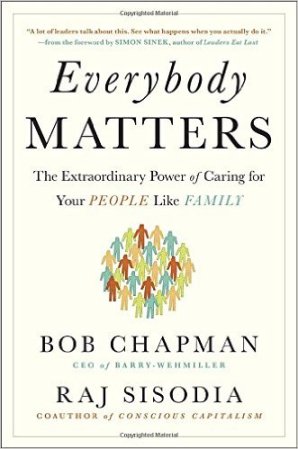
EVERYBODY MATTERS – The Extraordinary Power of Caring for Your PEOPLE Like FAMILY, by Bob Chapman & Ray Sisodia

everybody-mattersWhy this Book: It was selected by my All American Leadership reading group for our bi-monthly reading group.

Summary in 3 Sentences: Bob Chapman, CEO of Barry Wehmiller, a $2+ billion company tells the story of his conversion from traditional management practices – using people as resources to help the company profit – to believing that the purpose of his company is to enhance the lives of the people the company touches, beginning with employees.  Under his leadership his company began to  “measure success by the way we touch the lives of people,” and as that became embedded in the culture of the 10+ companies in the Barry Wehmiller portfolio,  profits grew to significantly exceed the Dow Jones an S&P averages.  In the second half of the book, he describes the specifics of how they have  turned companies and people around, and changed leaders from manipulative supervisors and bosses to practitioners of their people-centric “Truly Human Leadership” philosophy.

My Impressions:  I really liked this book.  Though his thesis sounded awfully mushy and feel-good to me initially, as I read his story, I became more impressed with what I read. The co-author Raj Sisodia, is also John Mackay’s co-author in Conscious Capitalism and it is no surprise that there are many similarities between the two books.  I was skeptical of his vision of treating employees as family,  as I suspect most would be,  but reading his story and of the successes they’ve had,  I’m impressed not only with the idealism of his vision, but also with the the practical manner with which he set about to realize it, and the success with which he’s implemented it.

Everybody Matters is about caring for and treating people in your organization as if they were, (and in a sense they are) your family.   He emphasizes that true leaders realize that all of their people are mothers, fathers, sons, daughters, sisters, brothers with lives that matter. They are not merely employees to help an organization succeed, or to use to help the leader succeed.  He says that “caring” is the key difference between leading and supervising, whereas most people in leadership positions are merely supervising.

This is very consistent with one of the key moral imperatives I used to teach in ethics – never treat people as mere means to your ends, but also always as an end unto themselves.       Bob Chapman is advocating that as a fundamental principle for business leaders as well.

In Everybody Matters, Bob Chapman tells us how Barry Wehmiller develops leaders with a profound sense of responsibility for the lives entrusts to them.

Some of what I saw as highlights of the book :

During the 2008-09 economic downturn, they did not lay anyone off. They found creative ways to share the burden of keeping people on, when revenue shrunk.  Salaries were cut across the board and Chapman took almost no pay, in order that no one was forced into unemployment in a bad economy.

The importance of purpose and vision was highlighted, as they are in many business books, but his description of the visioning process BW used was very useful. HOW an organization creates a vision is more important than the vision itself – to get buy in and tap into the ideas and collective wisdom of the whole organization.

They created a leadership training program to instill their people-centric  values into those who wanted it. It was not mandatory – all people could apply and criteria were established intending that only those who truly wanted to be there were accepted.   Floor workers worked with senior managers. Rank was not a criteria, nor given special consideration (at least theoretically.)

Their focus on communications  skills was impressive. The focus on deep listening as a key leadership skill was highlighted.

The Leadership Checklist is reminiscent of Marshall Goldsmith’s daily accountability checklist.

The metaphor of family is powerful. How would you treat your own family member? How would a family react to this situation?  On page 101 he asks, “What would a caring family do when faced with such a crisis?”

He spoke of his triad  of priorities as People, Purpose, Performance in that order, for creating a great company.

Possible Shortcoming:  Chapman focuses on the good in people – which is a KEY piece of his leadership philosophy.    For me, his case and the book would have been stronger had he given us more insights into the challenges and setbacks they HAD TO HAVE experienced in implementing this very idealistic approach to business, which runs so counter to what most people have grown up with and experienced at work.  When asked how they dealt with people who “don’t get it,” he responds that they focus on the people who DO get it, and their approach is to continue to shine the light on the good that exists in everyone.  He makes the point that every company they took over, they left the team in place and spent the time and resources to convert them to the Barry Wehmiller way of doing things, to great effect.  OK, great response BUT this is the real world  – they must have encountered some situations where the “ethics of necessity” forced them to let some people go – who wouldn’t cooperate with their approach.  Given his triad of People, Purpose, Performance, I just have to ask myself how they dealt with the people who couldn’t or wouldn’t meet their standards of purpose and performance.

Some Quotes which I believe capture the essence of the book (with page numbers):

Question: “Does everyone here believe in the change that’s happening?”  Response “No, but we’re focusing on those who do believe.”  13

The creative gifts of our people were being suppressed by classic “management” practices. 47

We simply asked, “Why can’t business be fun?” 51

But deeper insights had come from a simple question we had started asking people: “How did it make you feel?” 52

“I’m not about getting the best, I’m about enabling the people I have to be the best they can be.” 65

We’re not forcing or commanding followers, we’re inspiring and guiding them. 69

I believe the greatest charity is what we could do at work every day to take care of the people entrusted to us. 70

Truly human leadership means sending people home safe, healthy, and fulfilled.  71

Be patient with those who don’t “get it”:  People may have been abused by other leaders. Give them time and space to heal.  73

..we have 7,000 people under the influence of our leadership for forty hours a week! We have a profoundly greater opportunity than the church to uplift and inspire people and to shape their lives by the way we lead them. 74

We give awards to people who achieve something that is important to our culture, not just to our bottom line. 76

Most corporate cultures are filled with fear, stress, gossip, and politics.   83

It’s easy to celebrate success when you’re successful.  The real achievement is remembering your core beliefs when things get hard and when everyone else is moving in a different direction.  92

What might have been a challenging process became quite simple,  given the wide acceptance of the idea of shared sacrifice.  101

Your values, beliefs, and culture don’t really get tested when times are good.  105

We are not running a company to maximize our profits for this quarter or this year or even this decade.  We are striving to build an institution that will endure and create value for all stakeholders.  111

We believe, and have repeatedly experienced, that if you take care of your people, they will take care of the business. If you genuinely let them know that they matter, they will respond in kind.  Trust is the foundation of leadership; if you trust people, they will trust you back.  116

The people you lead are primed; the real resistance is likely to come from your leadership team, who have never been taught this or experienced it.  117

The best time to transform a culture is when the business is healthy, when there is no crisis and it isn’t a matter of life or death – just as people should adopt healthier lifestyles when they aren’t already riddled with disease.  118

We can’t be good stewards of the team members in our organization if our business model is flawed.  120

Every single person in the organization should be aware of the vision and be inspired by it. 122

Having a vision is not a radical idea. But we have a specific point of view about vision, which is that it should be centered on people.  122

Most businesses use people to build products and make money; we use our products to build people.  123

We are not a nonprofit organization…..If we don’t create sustainable business value, we can’t create a future for our people or give them opportunities to grow.  123

It’s not enough just to be a great place to work; people also want to be part of a winning team.  124

When we discarded traditional incremental thinking and started exploring together what might be possible, we opened up a new way of thinking and leading.  126

Eighty percent of the people in most companies report to front line leaders like Steve. Their way of leading is your culture. 138

At Barry-Wehmiller, we refer frequently to “the awesome responsibility of leadership.”  This is an acknowledgement that being a leader means actively choosing to be a good steward of the lives entrusted to you.  141

We have found three master keys to our leadership culture – deep listening, authentic vulnerability, and courageous patience.  144

One great truth that we’ve learned is this:  The people are just fine; it’s our leadership that’s lacking.  152

If leadership isn’t about fighting fires, what is it about?  We believe it is about lighting fires.  178

In most organizations, people do the right thing most of the time, but most communication is about the things that go wrong.  190

We recognize and celebrate people simply to let them know they matter. 194

Here’s the cutting edge of common sense:  organizations should recognize and celebrate the things they want more of.  195

Barry-Wehmiller University is not about getting more out of people or enhancing performance.  It isn not about improving productivity, and we don’t expect a particular return on investment. We go to great lengths to make sure that people understand that Barry-Wehmiller University exists to enhance their ability to touch people’s lives and equip them to be successful with others, both inside and outside Barry-Wehmiller.  207

We don’t focus on the people who don’t get it.  We focus on those who do….None of our training is mandatory or automatic; everyone who takes a course must go through an application process.  We are not in the conversion business; we want all participants to be intrinsically motivated. 209

There is no other KPI that you can have that is greater than people saying they are happy and they are fulfilled….Money obviously matters and profits are important.  But it isn’s  the only thing that matters. 230

We want to show everyone that business can be done in a better way, that when you pay people fairly and treat them superbly, you can not only compete globally but also enrich  and elevate the lives of everyone the business touches.  231

Our cultural journey began with the simple idea of making work more fun. 236

A spread sheet can’t show you how to treat people. 242

We have paid people for their hands and they would have given us their heads and hearts for free, if we had only known how to ask. 243

Posted in Uncategorized | 1 Comment

English Creek, by Ivan Doig

english-creekWhy this book:  This is the 4th Ivan Doig book I’ve read – loved them all and so I decided to take on his Montana Trilogy.  English Creek is the first book in the trilogy, but chronologically, the second.  I chose to read Dancing at the Rascal Fair ( the second book ) first – what was actual the pre-quel to English Creek, since a couple of my Doig loving friends suggested that it was the next Doig book I should read. Read it, loved it, and wanted to read the whole trilogy – even if not in the order written. English Creek won the Western Heritage Award as the best novel of 1984, and is widely regarded as a classic of modern Western literature.

(To my friend who insists that a trilogy must be read in the order the books are written, and  therefore insists that English Creek should be read first, perhaps you’re right – but it also worked reading Rascal Fair first.)

Summary in 3 sentences: English Creek is a novel of an older man relating  events that occurred over a period of several months in his life when he was 14 years old, living in the fictional English Creek area of northwestern Montana.   He tells the story through his own eyes as that young man, facing the challenges of coming of age in rural and small town Montana in the late 1930s, and through those eyes we get to know the mountains and forests, the work on the farm and in the field, his family and the social fabric of that rural community.  English Creek is not full of great drama or big-adventure excitement – but Doig’s amazingly descriptive language breathes life into the people and the events of these important five months in the life of this young man and his family, and captures the mood of that time and place.

My Impressions: A wonderful book – if one enjoys getting  getting to know the people, culture and the world of rural and small town America, which I do.

Life in rural Montana – especially in that era, is simple but hard, and has an integrity and honesty that I find very appealing.   Survival is not a given, and the people in the community take care of each other .  While each family has its own struggles, they help each other as best they can with whatever they have.  The community has a life of its own – people know each other and understand their inter-dependence.  There isn’t a lot of anonymity –  they grow up together, not much goes unnoticed, even less is forgotten, and they all know they have to count on each other to deal with the challenges of farming and living in a difficult environment.

The theme running through English Creek is the McAllister family as seen through the eyes of Jick – the youngest of two sons.  His parents keep their feelings pretty much to themselves –and as a young man Jick tries to understand his parents and help mend the break between them and his gifted older brother. Neither side in that argument shares much with him, so he observes and tries to understand.   Within that context, Jick is also trying to learn to be a man from his male role models – especially his father, but also from other men he observes, in particular, an alcoholic but wise old former forester and farm hand, with whom his father had had a falling out many years before.

To give an idea of the book – Jick spends nearly 80 pages of the book describing a series of events surrounding the 4th of July celebration of 1939.  The 4th of July is still a major event in small western towns  – often called the “Cowboy Christmas.” It was a magical day for Jick, and his description of the day truly captured the feel of the town and its people.  We also join Jick as he works for nearly a month on his uncle’s farm raking and stacking hay with a group of neighbors and other part time help.  Sound boring?  Not the way Doig describes it.  And the book concludes with a compelling description of the technical and very human side of wildland firefighting, as Jick joins his father in fighting what could have been a disastrous forest fire.  The  interaction between Jick, his father and between his father and the others fighting the fire is very telling.

The story is told from Jick’s perspective, looking back as a mature adult decades later.   Only occasionally does he inject his retrospective perspective into his story telling –for the most part we are seeing the world through Jick’s 14 year old eyes. The book concludes with an epilogue; we learn what happened to the people and the community in the months and years following that fateful summer, which turned out to be a turning point in the lives of all those described.  In the acknowledgements, we learn that it is all fiction, but based on extensive research into the people and way of life around Depuyer, Montana.  The story fride-w-me-mariah-montanaelt very, very real.   Doig did a masterful job creating and bringing to life a fictional world of rural Montana, that felt so very real.

The next and last book in Doig’s Montana Trilogy is Ride with Me Mariah Montana  which I will get to by next summer.

Some Quotes:  Doig told a great story and part of it was how well he seemed to captured the language and the spirit of the people in that time and place.   Great stuff – here are a few of the many expressions I marked:

Casual as a man waiting for eternity. 73

Putting this day out of its misery seemed a better and better Idea. 76

“Doctor Hall, ” he repeated as he brought out his good hand from a pack, a brown bottle of whiskey in it. “Doctor Al K. Hall.” 77

At that age I could have slept through a piano tuner’s convention. 77

If you’re going to be in the Forest Service, you better be able to fix anything but the break of day. 84

..dry farting like the taster in a popcorn factory.  85

…the fascination of pawing over old times. 92

Alice always was as flighty as a chicken looking in a mirror. 104

I heard somebody say once that the business section of every Western town..looked as if it originated by falling out the back end of a truck. 133

<He’s> green as frog feathers, ain’t he? 148

Glacier Gus was an idler so slow that it was said he wore spurs to keep his shadow from treading on his heels.  153

As tidy as spats on a rooster 169

…my chin session with Dode Witherow at the beer booth. 171

Heads swiveled like weathervanes being hit by a tornado. 173

Earl held the job of announcing the Gros Ventre rodeo on the basis by which a lot of positions of authority seem to get filled: nobody else would be caught dead doing it.  175

..faster than Houdini can tie his shoe laces. 177

It sounded like hell changing shifts. 190

The night’s still a pup. 194

I tell you, a situation like that reminds a person that skin is damn thin shelter against the universe. 252

Innocent as a bluebird on a manure pile.  256

That joke had gray whiskers and leaned on a cane. 259

It was aining like bath time on Noah’s Ark. 260

Wendell Williamson always looked as if he’d been made by the sackful. Sacks of what, I won’t go into. 264

She’s Hungarian…she leaves you hungrier than when you came to the table. 265

Each day is a room of time. 274

He sailed off to worry the camp into being. 295

Paul had been going through the camp at such a pace that drinks could have been served on his shirttail.  297

It was a matter of grit and bear it. 306

Hotter than dollar chile, aint it? 317

The ride to town was mostly nickel and dime gab. 323

Posted in Uncategorized | 1 Comment

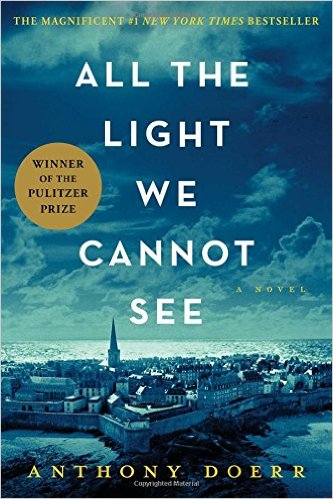
All the Light We Cannot See, by Anthony Doerr

all-the-lightWhy this book:  Selected by my Literature Reading Group. We are on a run with Pulitzer Prize winning Novels and this won the Pulitzer Prize in 2015.

Summary in 3 Sentences: The main part of the story takes place over a period of 5 or 6 years – beginning in the years leading up to WWII and progressing thru the war.  The focus is on two lives:  A young man, gifted in electronics, living initially in an orphanage and later in the German Wehrmacht, and a young blind girl initially living with her father in Paris during the anxiety  of the pre-war years and later in the French coastal town of Saint-Malo.  The story follows the lives of the young man and the blind girl in parallel, as the war impacts them each directly, alternating chapters from one to the other, until their lives converge in a very unforeseen way.

My impressions: The book is beautifully and creatively written.  The author jumps in time back and forth between different periods and experiences of the two protagonists. With the young girl, we experience the disruption of normal life in occupied France when the Nazis invaded.  Through the young man we experience how the single-minded fanaticism of the Nazi regime impacted the lives of those who had no particular interest in their agenda, but were forced along and conscripted to serve their cause.

There were several very interesting characters in the book who were well developed and intriguing, apart from the two protagonists.  More than I want to list here, but the dark circumstances of the war brought out the best and the worst in several of the fascinating characters.

There are a couple of noteworthy themes I saw repeatedly:  No matter what was happening, no matter how horrible or distasteful, we are always made aware of nature continuing around us – birds, insects, animals, plants, oblivious to the drama going on in the human world.  The author has us step away briefly to see the wind, the trees, the birds while people are self-focused and engaged in the drama of their lives.  The other theme was aesthetic beauty – in the form of music, gems, stories that served as an escape and outlet from the tragedy of war.  Music in particular had transformative powers.  It reminded me of stories I heard from both world wars in which soldiers would stop fighting and in some cases even come together to listen to or participate in beautiful music.

One of the sub characters in the book who was serving as one of the hunters and stealers of art on behalf of the Nazis , served as a warning against being too taken with aesthetic beauty. Beauty can also serve evil causes.  One of the centerpieces of the book is very analogous to Tolkien’s ring – entrancing, but a source of pain, suffering and even evil.

At the end of the book we are taken decades into the future and experience how the wounds of the war did not heal, continued to impact the lives of those who lived through it.

The joy in the book was in the perspectives of nature and the healing power of music.  Otherwise, there wasn’t much joy in this story.  Some relationships were especially tender, but always transitory.  It is a sad, and not particularly joyful book, describing the experiences of a few fascinating characters in a very difficult time.  As already stated,  beautifully and memorably written.  I see why it won the Pulitzer – a creative, thoughtful and engaging story of people rising to the challenges of very difficult times. We see good, evil, beauty and ugliness, and experience it with compelling and believable characters.

Key Takeaways for me:

  • How beauty – music, art, nature – exists and can provide depth of meaning and experience even in times of violence and brutality.
  • The descriptions of how a blind person perceives the world were very insightful
  • The incongruity between the inner-life of people and the often cruel and impersonal world they experience and live in.

An excellent book review of All the Light We Cannot See with which I was very much in agreement is written by William Vollmann in the New York Times – but if you are planning to read the book, I’d recommend not reading this one until after reading it. It is at New York Times Book Review of All the Light We Cannot See.  

Posted in Uncategorized | Leave a comment

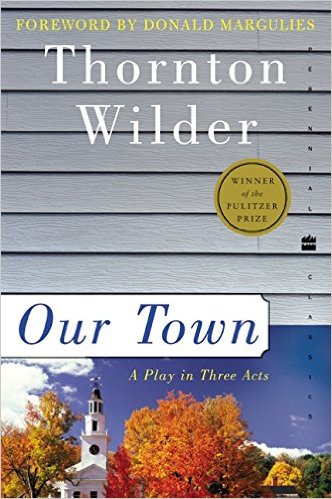
Our Town – a Play in Three Acts, by Thornton Wilder

our-townWhy this book: Selected by my literature reading group and also by my family to read and discuss at a family reunion.  It won the Pulitzer Prize for drama in the 1930s – continues to be a classic  and is a very short read.  Also, I have read and been moved several times by  Thornton Wilder’s other Pulitzer Prize winning work, The Bridge of San Luis Rey.

Summary in 3 Sentences: The play offers  three snapshots of life in a small town in New Hampshire in the early 1900s narrated by the stage manager – an omniscient God-like figure, compassionate and wise who speaks directly to the audience.  We get to know two families and a number of figures in the small town, and through them, the tempo and rhythms of life in that town, but by analogy, life in almost any community.  We see how the little things that happen in all of our lives – family, love, loss, joy, disappointment – are the essence of our lives – and the play delivers this message simply and powerfully.

My Impressions:  I loved watching this play and I loved reading it.  I had seen it performed many years ago on TV with Hal Holbrook playing the stage manager, and after reading it this time, I watch it again on DVD  – with Paul Newman (2003 production) playing the stage manager.  It was very powerful and moving watching it after reading it – Paul Newman was superb as the stage manager, and the other characters were also excellent. I saw several things that touched me that I had missed in reading the play.  I can’t recommend highly enough reading the play, then watching it – especially the Paul Newman version.

Because of its short-length (about 100 pages) and the simplicity of the language and style, it is often assigned reading in high-school, but I believe it is best appreciated by a more mature, and life-experienced audience.  By seeing the lives of a few people in this New England town at different points in their lives, and with the added omniscient perspective offered by the stage manager, we gain a perspective on the moments we live within the larger context of our whole lives,  the life of our community and of our nation.

The three acts of the play are: 1 Daily Life, 2 Love and Marriage, and 3 Death and Dying. The first two acts give us glimpses into the simple joys of life in Grovers Corner ,New Hampshire at the beginning of the 20th century and are insightful and moving in their innocence and simplicity.  The most powerful part of the play is in the third act – the culmination of the play – when one of the characters in the book who has passed away joins the ranks of the dead, and we are given a different perspective on the world of the still-living.  This character chooses to go back and revisit  a moment in the life she had lived, though the other no-longer living souls she had joined strongly recommended against it.  With the perspective of beyond the grave, she realizes how wonderful the little moments in her life were that she had failed to appreciate while experiencing them.  It was extremely sad and frustrating for her to see how unconsciously she and others in her life were going through their daily rituals and lives.  “Do any human beings ever realize life while they live it- every, every minute?” she asks.  “No.” replied the stage manager. “The saints and poets maybe.  They do some.”

The third act is powerful. It was particularly moving for me as I watched the Paul Newman version of it at our family reunion, with every one of the 4 generations of my family – to include my 91 year old father and 88 year old mother.

The copy of the book in the image with this post includes an extensive afterward about how the play was initially received,  more about Thornton Wilder and about the impact the play has had.  It was initially panned in many cities – due to its sparse scenery and somewhat mystical message.  Then its popularity grew and continues, nearly 8 decades later.   I might argue that it is timeless, in how well it treats timeless themes.

Two descriptions of the play in the afterward that I thought captured how I felt about the book:

“Brooks Atkinson in the New York Times: <Our Town>  “…transmitted the simple events of human life into universal reverie and contained nothing less than a fragment of the immortal truth.”

Wilder’s fiction includes the themes  “…of the repetition of family life, the chorus of life and death, and man’s relation to time and space.”

Key Take Aways for me:

  • The main take-away, and this isn’t trivial:  Whenever I can, I should step back and look at what I’m doing, how I’m treating people, and where I’m giving my energy and priorities – as if I were coming back from beyond the grave and observing myself.  Am I focusing on the right things? Am I realizing what from the BIG picture perspective, is TRULY important? Am I making decisions, or behaving in ways that  I may regret later?
  • This is related:  Don’t take anything for granted.  What we accept as “the way things are” is only temporary.  The rhythms of life in our community – patterns of life which we count on every day will change.  People grow older, technology changes the way we live, accidents happen, people move away, people we know well and some we don’t, die.
Posted in Uncategorized | 1 Comment

I’m Staying with My Boys – the Heroic Life of Sgt. John Basilone, USMC, by Jim Proser with Jerry Cutter

basiloneWhy this book:  A good friend of mine was reading it and I decided to read it as well.  I had heard of Basilone – there is a statue of him in Little Italy in San Diego, and part of Highway 5 going thru Camp Pendleton is named for him.  And I was aware that he was featured in the HBO series The Pacific, but knew very little about him.

Summary in 3 Sentences: This is a full-life “authorized” biography of John Basilone, USMC Medal of Honor recipient from Guadalcanal,  but it is written in the first person as an autobiography. The author, speaking as he believed Basilone would candidly tell his own story, begins with his childhood,  continues into his troubled teenage and young adulthood years, and finally tells of his time in the Marine Corps, which of course include his actions at Guadalcanal, for which he was awarded the Medal of Honor.  A good portion of the book takes place after Guadalcanal, and covers his recovery from that battle, his struggle with what we now call PTSD, and his discomfort as a war hero selling war bonds,  until he returns to the war and ultimately is killed in Iwo Jima.

My Impressions:  When I began the book, I wasn’t sure I wanted to read a novelized version of Basilone’s life –  “authorized” by his family perhaps to enhance the already iconic image of this WWII marine hero.    But I stuck with it and I’m glad I did.  I thought the author did a credible job of making him into a real person, representative of the strengths and weaknesses of working class Americans of that era – what Tom Brokaw called “the Greatest Generation.”

In many ways this book was reminiscent of Unbroken, Louis Zamperini’s story of growing up in a first generation Italian immigrant family. Both grew up very Catholic, did not fit in at school, were inspired by their older brothers, and felt an agonizing tension between their need for excitement and adventure, and their need to not disappoint their traditional Italian immigrant parents, who simply wanted their sons to get a respectable job, a wife, and raise a family in the community. Both found an outlet for their energy in outstanding  athletic performance, eventually found themselves in the military and World War Two, and became war heroes.  Both became celebrities, were lionized by the public as war heroes, succumbed to excess with alcohol, women, partying, and found redemption in returning to religion to help deal with their confusion and identity crises.

There are however significant differences.  Whereas Zamparini became a collegiate and Olympic hero before the war, Basilone was a classic n’er-do-well with an 8th grade education, and found no inspiration or opportunities in depression-era America.  With few other options, he enlisted in the Army in 1935, excelled as soldier, was sent to the Philippines where he worked under Gen Douglas MacArthur, fought Philippine guerrillas for several years and became a boxing champion.  But he became  very disillusioned with the Army, got out after his 4 year hitch, and returned to New Jersey.  He drifted again  and did not finding anything that fit, until again, he joined the military – this time the USMC where he found a home.  It was 1940, and he knew, as did many in America, that we would be going to war, and the Marines were seriously preparing for it.

Basilone’s first call into combat was to reinforce the Marines who had withstood the initial Japanese attacks on their foothold in Guadalcanal.  The book describes several months of extremely intense combat, when Basilone served under his hero and legendary Marine, Chesty Puller, as the Marines desperately withstood all that the Japanese could throw at them. Their success was the first Allied victory against Japanese ground troops in the war.  It is an incredible story of heroism in the most challenging and desperate of circumstances.  Afterward, Basilone and his Marines were relieved and sent to recover in Australia where he was awarded the Medal of Honor for his actions on Guadalcanal.  When his unit was ordered back into the war, Basilone was ordered home to serve as a spokesman to help drum up support for the military and the war bond effort.

Though Basilone was never comfortable as a war hero and public figure, he did enjoy the partying on the celebrity circuit selling war bonds.   While he was living the high-life, he also experienced a lot of survivor guilt – guilt at being lauded a hero,  after so many of his men, who he had felt responsible for, were killed on Guadalcanal.  It didn’t feel right to be staying in nice hotels and treated to the best while his fellow Marines were still in the swamps and jungles, still in the fight in the South Pacific.  After his war bond tour, he was ordered to a staff position in Washington DC to be available to be a show-horse to represent the Marine Corps at fund- raising and publicity events.  He rebelled and requested that Gen Vandegrift, for whom he had served in Guadalcanal, get him orders back to the front.  He was then sent to Camp Pendleton where he prepared himself and his new platoon to go back into the Pacific.  Hence the title, “I’m staying with my boys.”

Basilone  was an admitted lady’s man and unapologetic in telling of his playfully uncommitted sex life with women of “easy virtue,” and of his several mistresses. He was attractive to ladies, and loved their company and attention, but was not one to commit.  There were four women he identifies with whom he had close and emotional relationships, to include the woman he eventually did choose to marry just before he was shipped back to the Pacific, where he was killed during the assault on Iwo Jima.  One of those special women lovers was Virginia Gray, a well known movie actress of the day, who he met while on the celebrity war bonds selling tour.  This relationship was apparently very close, though it had no future.  It got into the press which enhanced his celebrity image, and also was highlighted in the HBO series The Pacific. 

I found the book engaging and enjoyable.  I felt I got to know, admire, partially understand  and sympathize with Basilone’s struggles. I didn’t feel like the author tried to make him into a superhuman hero – really sought to make him humble, human and approachable.    The author does well in capturing the voice of a working class Italian American hero of the 1930s and 40s telling his story, and in capturing the mood of America, and the Marine Corps in that era.  Who’d a thunk – he was also a golfer and an amateur opera singer!  It is a very American story, of an immigrant kid who struggles, takes on America’s values and lives to embody much of what makes America great.

A couple of quotes I marked:  

It’s a terrible feeling when you know there’s something you could be great at but you just don’t know what it is. p47

Not doing things right becomes a habit, like anything else.  Pretty soon nobody expects you to do anything right and you get shipped off to a relative like I did. Then the other side was, like in Army basic, you do something right, you get used to doing everything right, people expect you to do everything right and that’s how you become Manila John, undefeated in nineteen fights.  118

This was it then.  It was the way you did things, not what y ou did, that mattered.  119

It looked like my path was something more slippery, something inside me that no one could see and was even hard to explain.  Maybe my path was a way of thinking. p 120

I saw the blueprint for how I was connected to everything else and believed that I was onto something.  More than anything I saw that I was the main ingredient in the recipe.120

Like the rest of us, he knew it didn’t really matter what you were doing or where you were.  If you were in a frontline combat outfit like ours, the only things that mattered were the guys next to you. If they were alive, your chance were a little better than if they were dead. That was about it. So we didn’t care much for anything except each other anymore.   p 193


Posted in Uncategorized | Leave a comment

Grit – the Power of Passion and Perseverance, by Angela Duckworth

GritWhy this book:  Selected by the All American Leadership reading group for our bi-monthly discussion for July-August 2016.

Summary in 3 sentences: Angela Duckworth dives deep into a quality which all of us recognize as strength of will, fortitude, stick-to-itiveness, focus, among other names.  She writes in first person, sharing personal anecdotes, some of her own struggles and doubts, and various scientific studies that help us understand her conviction that “grit” is ultimately what differentiates those who truly make a difference from those who don’t.  Most importantly she discusses how we can develop grit in ourselves, in our children and those we mentor, as well as in the organizations we lead.

My Impressions: Angela Duckworth explores and dives pretty deeply into the idea of grit in an engaging and very personal way.  She offers us not only edifying, but also an interesting and entertaining read. It is as much a story of her own journey into understanding this well known, but somewhat illusive quality, as it is an exploration.  In addition to her many examples of people – many celebrities – who she refers to as “paragons of grit” she also admits where she is not clear, where she has struggled, and in some cases where she still may be a bit confused. In her section on goals, she admits that she struggles to reconcile her personal goals (be a great mother, friend, spouse) with her professional goals (use psychological science to help kids thrive) when her efforts to excel at both often seem to bring these two goals into tension.

I would highly recommend the chapters on parenting for grit and the playing fields of grit for parents.

I really liked this book and learned a lot from it. Here are my Key Take-Aways:

  •  Effort counts twice.  Consistency of effort, over time is the key ingredient to success.
  • Passion can be developed – beginning with interest.  If one is willing to practice and get better, passion can grow. Passion for one’s work is not (necessarily) a flame in the heart, an immediate sense of a  God-given calling. It can develop over time.   She makes the obvious analogy with finding a mate.
  • Growth Mindset->optimistic self talk -> perseverance over adversity.
  • Her discussion of the difference between deliberate practice – which is effortful – and “flow” – which is effortless.  Lots of deliberate practice leads to increasing experiences of flow.
  • The hugely important balance between being challenging and supportive that  parents, coaches, mentors must find to develop grit in others.

My challenges to her position, as I understood it:

  • I found her grit scale based on self-assessment to be less than adequate.   We tend to compare ourselves to others we know, and in each judgment, I questioned “compared to what?”  It is easy to have over-inflated, or under-appreciated views of oneself.
  • While I appreciate her advocacy of deliberate practice, I felt she under-appreciated the value of constant continuous, if not necessarily focused practice as an element of grit.  Staying with something for years, even if not particularly focused in one’s practice toward becoming great or mastering the activity, also demands commitment and grit.  I appreciate that quality because that’s me in most of what I do – golf, swimming, playing the fiddle, triathlons, and more.  I believe there is grit in staying with the habit of practice and pursuing one’s activity, through thick and thin, even if one doesn’t have the energy to truly focus on effortful, deliberate practice.
  • She also doesn’t mention the down sides of very gritty people who through their grit pursue excellence in one activity, but miss the joys of a wide variety of activities. She doesn’t discuss the opportunity costs of being a “paragon of grit.”
  • I wish she’d addressed the grit required to overcome bureaucratic or cultural intransigence.   There is a special type of tenacity and perseverance that is necessary to get any large organization to change or adopt a new program, unless the organization is forced to change by powerful outside forces.  This type of grit requires a level of patience and emotional intelligence that is not addressed in her formula, which focuses mostly on personal performance.  Many of the changes that have had the most dramatic effects on peoples lives have come because of the passion, grit, and perseverance of a few people in the face of cultural and bureaucratic opposition – eg, civil rights movement, women’s suffrage, gay rights, establishment of US SOCOM, etc.
  • I know some people who are not at all achievement oriented, but are very relationship oriented and are very happy and well adjusted.  For example, the amazing woman I’m married to.  I appreciate (more than most I believe) the advantages of grit, but I also appreciate that at least in some cases, it may be over-rated.  Duckworth does address in her conclusion that grit may not be the most important character virtue, but it is very much an American model to judge a people, organization, and cultural success largely by where and how they have excelled in measurable or competitive activities. I accept that family, relationships, and sense of community may be more important to some.

Here is an interesting article  by NPR in which Angela Duckworth responds to criticisms to Grit, and an article in The Atlantic Monthly with the provocative title “Is Grit Overrated?”  

—-

Below is a brief summary of the book, chapter by chapter for my review when I return to this book, which I expect to many times.

Chapter 1 -Showing Up:   Reminded me of Woody Allen’s line that 90% of life is simply showing up.  She makes the point that scores on her grit self-assessment test bore no relationship to IQ nor to great resumes, which often seem to reflect innate talent.  And yet grit scores were much more closely aligned to success in completing arduous training programs (1st year West Point, Army SF training) than most other selection criteria. Grit is different from talent.  Talent is potential.  What we do with it depends on grit.

Chapter 2 – Distracted by Talent: This chapter reiterates what I’ve read in Mindset and Bounce that though we have a bias toward natural talent, this distracts us from what really makes a difference – the grit to make it mean something.  Effort counts twice.

Chapter 3 – Effort Counts Twice:  Unlike Dweck’s Mindset, she does give talent its due,  but noted that effort and grit count for much more. Talent is merely potential.  Grit is what actualizes it.  She has a graph that says that Talent x Effort = Skill, and Skill x Effort=Achievement.  Effort figures into the calculation twice.

Chapter 4 – How Gritty are you?:  Grit is more about stamina – consistency over time – than intensity. She offers a version of her “grit scale” that she developed for her study at West Point.  It is a self-assessment.  She distinguishes between passion and enduring devotion – between enthusiasm, which she says is common, and endurance which she says is rare.

  • This chapter introduces us to Pete Carrol of the Seattle Seahawks and his philosophy toward grit. Also she talks about focus on a top-level goal and the need to set mid-level and low-level goals to reach that top-level goal. She also notes the need to have the wisdom to change low and mid-level goals if they aren’t getting one to that top-level goal. This is where grit becomes problematic and requires judgment – to know when to give up on intermediate level goals in the interest of the top-level goal. “The higher level the goal, the more it makes sense to be stubborn.” 74
  • She also offered an assessment of some of the greatest “geniuses” in history and found that there were four qualities that distinguished the best from the rest: two were reflections of passion, two were reflections of perseverance.

Chapter 5 Grit Grows: She discusses how grit evolves and grows as we get older, “…that indeed, grit grows as we figure out our life philosophy, learn to dust ourselves off after rejection and disappointment.”

PART 2 Growing Grit from the Inside Out  Four qualities that mature “paragons of grit” have demonstrated that led to great achievement: Interest ,  Practice, a sense of Purpose, Hope.

Chapter 6 – Interest: First one must have some interest in something, and that interest serves as the seed which over time, with practice and commitment, can grow into  passion.  I like how this chapter reinforces a great line from Mike Rowe (of Dirty Jobs fame) who argued AGAINST the idea of following your passion – advice which stalls so many people who are looking for something worthwhile.  He said, “Don’t follow your passion, but take it with you wherever you go.”  Duckworth says, “Passion for your work is a little bit of discovery, followed by a lot of development, and then a lifetime of deepening.”  103

Chapter 7: Practice: As in Mindset and Bounce, she emphasizes not just quantity of time on task, but quality of time on task, and the importance of deliberate practice – reaching toward “stretch goals.”  She makes the point that deliberate practice takes effort and is often uncomfortable – sometimes supremely effortful. She says that most “experts” can only handle 1 hour of deliberate practice before needing a break.  She advocates studying the science of practice and offers suggestions.

  • A fascinating part of this chapter is where she contrasts deliberate practice, which she identifies with grit, with flow.  “Deliberate practice is carefully planned,  and flow is spontaneous.  Because deliberate practice requires working where challenges exceed skill, and flow is more commonly experienced when challenge and skill are in balance….deliberate practice is exceptionally effortful, and flow is by definition, effortless” 129

Chapter 8- Purpose: After people find something they love to do and enjoy practicing it in order to develop their skill, most find that to stay motivated over time, they need a greater good that pursuing that interest serves.  Most start out with a self-centered  purpose (this feels good and is fun) to an other-centered purpose (this activity can serve a greater good.) “Purpose required a second revelation: ‘I personally can make a difference.'” 163

Chapter 9 – Hope:   She identifies two kinds of hope: 1. Hope without responsibility – a yearning for a sunnier tomorrow – where the onus is on God or the Universe to make things  better. 2. Hope with responsibility – grit depends on the expectation/belief that our own efforts can improve our future.  “The Hope that gritty people have has nothing to do with luck and everything to do with getting up again.” 169  She talks about suffering where we have no sense of control, which can lead to learned helplessness, and contrasts that with learned optimism.  She gives examples of people who are taught a fixed, pessimistic, fatalistic view of life, versus those who are taught that they can overcome adversity with their own efforts.  Her “paragons of grit” explain events and setbacks optimistically.  Quite a bit of this chapter is about Carol Dweck and Growth Mindset and how attribution of success to effort rather than fate or talent are key qualities of grit.  Hope:  “Just keep working hard and learning, and it will all work out.”  187

PART 3: Growing Grit from the Outside In

Chapter 10- Parenting for Grit: The main points from this chapter are that in order to develop grit in a child, the  parent must 1) find the proper balance between challenging and supporting the child, 2) that surrogate parents, in the “ecosystem” of adults that influence a persons life, can play a huge role in challenging and supporting a child.  One of the main examples she offers is of Steve Young, whose parents epitomized the “tough” and the “love” in “tough love.”  Parents must stress and exemplify the importance of  what it means to “commit.”

Chapter 11 – The playing fields of grit:  She stresses that activities that develop grit in young people should involve an adult in charge -ideally one who is not a parent, but also is wise, challenging and supportive.  And these activities should be  designed to cultivate interest, practice, purpose, and hope.  These activities could be anything from dance, to the arts, to sports – doing hard things that interest them.  These extra-curricular activities need to be structured, skill-focused, and (wise) adult-guided.  And she says, these activities need to be pursued for at least 2 years.  There is too much temptation to quit after 1 year. Stay for at least 2.  She emphasizes purposeful, continuous commitment to certain types of activities (in high school) versus sporadic efforts in diverse areas.  “Following through on our commitment while we grow up both requires grit and at the same time builds it.”  233  Grit takes practice.

  • She refers to how she grew up in her family with “The Hard Thing Rule” and  she strongly advocates using some version it to develop grit in children.  Parents must comply and lead by example.  The Hard Thing Rule has 3 parts:
    • 1. Everyone has to do a hard thing.
    • 2.You can quit, but not until the season is over, the tuition payment is up, or some other natural stopping point has arrived.
    • 3. You get to pick your own hard thing.

Chapter 12 –  A Culture of Grit:  “The bottom line on culture and grit is: If you want to be grittier, find a gritty culture and join it.  If you’re a leader, and you want the people in your organization to be grittier, create a gritty culture.”  245  She says you must make a categorical –  complete – commitment to your culture – not to be half-way, or a sort-of member.  She refers to the reciprocal effect of a team’s particular culture on the person who joins it.  When we become part of a great, or gritty culture, we ask ourselves “Who am I? What does a person like me do in a situation like this?” “Thinking of ourselves as a person who overcomes great adversity often leads to behavior that confirms that self-conception.” 252.  And she talks about how West Point has evolved from an “attritional model” to a “developmental model.”  Grit is about “finishing strong.”  Anyone can begin strong.

Chapter 13- Conclusion:  Grit goes hand in hand with happiness and well-being, no matter  how she measures it. She addresses what having “too much grit” might mean, and notes that grit may not be the most important thing in one’s character, but perhaps is the most important thing for achieving one’s goals. She says that “character is plural”  – there are many virtues that encompass it.  She breaks character down, as Aristotle did, into intra-personal, interpersonal, and intellectual, and places grit in the intra-personal category.

Some useful quotes from Grit – with page numbers from the hardcover edition

I grew less and less convinced that talent was destiny and more and more intrigued by the returns generated by effort. 20

There is a gap between potential and its actualization. 21

During the next several years of teaching, I grew less and less convinced that talent was destiny and more and more intrigued by the returns generated by effort.  20

“With everything perfect, ” Nietzsche wrote, “we do not ask how it came to be.”  Instead, “we rejoice in the present fact as though it came out of the ground by magic.”  39

In other word, mythologizing natural talent lets us all off the hook.  39

Most of us become more conscientious, confident, caring, and calm with life experience. 86

To do anything well, you have to overextend yourself. Necessity is the mother of adaptation. 87

Lectures don’t have half the effect of consequences. 89

Interests are not discovered through introspection. Instead, interests are triggered by interaction with the outside world. 104

Interests thrive when there is a crew of encouraging supporters, including parents, teachers, coaches and peers. 105

Half of grit is perseverance…but..nobody works doggedly on something they don’t find intrinsically interesting. 106

For parents: Before hard work comes play.  106

(Quoting Jeff Bezos’ mother) “It is not important that I understand everything. It’s important that I listen.”

For the beginner, novelty is anything that hasn’t been encountered before. For the expert, novelty is nuance.  114

Deliberate practice is behavior, and flow is an experience. 131

Deliberate practice is for preparation, and flow is for performance.  132.

Gritty people do more deliberate practice and experience more flow. 131

There was a small but growing body of scientific evidence that happiness wasn’t just the consequence of performing well at work, it might also be an important cause. 177

Following through on hard things teaches a young person powerful, transferable lessons.  236

…without directly experiencing the connection between effort and reward, animals, whether they’re rats or people, default to laziness.   240

(Quoting Dan Chambliss) “The real way to become a great swimmer is to join a great team.”246

(Quoting Dan Chambliss) “There’s a hard way to get grit and an easy way.  The hard way is to do it by yourself.  The easy way is to use conformity – the basic human drive to fit in – because if you’re a round a lot of people who are gritty, you’re going to act grittier.” 247

Quoting George Bernard Shaw:  “The true joy in life is to be a force of fortune instead of a feverish, selfish little clod of ailments and grievances complaining that the world will not devote itself to making you happy.” 258

To be gritty is to invest, day after week after year, in challenging practice. To be gritty is to fall down seven times, and rise eight.

Posted in Uncategorized | 2 Comments

The Revenant, by Michael Punke

51a1PyTs5aL._SX332_BO1,204,203,200_Why this Book:  My son suggested that everyone in the family read this book before our family reunion, and discuss it when we get together.

Summary in 3 Sentences:  Based on the real story of mountain man Hugh Glass being mauled by a bear, then robbed and abandoned by two men who were charged with taking care of him. He recovers and the book describes his survival and subsequent effort to exact revenge.  Beyond the mauling and a bit of the survival, it is actually a much different story than the movie – and much better.

My Impressions:  I enjoyed this book much more than I expected to.  I thought the movie was rather overdone, one unlikely dramatic scene after another, and typically of Hollywood, it had to have the climactic, tension-resolving ending, that was of course, not real life.  The book was much more interesting.

The most interesting character was Captain Hardy, who struggled with the moral dilemma of his obligation to Glass which he rightly saw as in conflict with his obligation to the  other men on his expedition, to his employer, and to his mission.  We visit Captain Hardy several times throughout the book and partly empathize with his sense of being a magnet for misfortune.  We also got to know Hugh Glass and his journey that led him to being on that expedition and up to that fateful encounter with the bear.  And of course, we struggle with him as he barely survives after being abandoned, and his epic journey to find the men who had abandoned him.  At one point, I was reminded of the book (and movie) The Martian, also about a man abandoned in what seemed like a hopeless situation.  In both books, it seemed that as soon as things started looking up, our protagonist would suffer another setback that would seem the final blow, only to bounce back with grit and ingenuity, to live to fight another day.

The book give us a fascinating look at early 19th century America, juxtaposing the well organized and civilized society on the East Coast, with the primal world west of St Louis with the pirate infested waters and the hazards of shipping in the Caribbean.  We learn of the world of the fur speculators and the mountain men who they were and how they lived. The mountain men were the fur companies’ agents, living weeks away from civilization, trapping mostly beaver, while trading trinkets, iron goods and alcohol with the natives – for more pelts.   We also get see the uneasy alliance between the mountain men, and the Native Americans Indians who develop an anxious relationship with the bearded men, who provided weapons, tools, horses, in exchange for what for them were easy to obtain furs, but whose increasing presence and very different values threatened their way of life.  The Indian tried to use the whites to provide goods and as allies against their enemies, but it was a doomed alliance.

With the help of Indians who befriended him, he does reconnect with the expedition which abandoned him, but the resolution of his revenge is not as satisfying as it was in the movie -but more realistic.  The book concludes with a fascinating historical note in which the author shares his struggles in researching the historical basis for the story, the mixing of fact and legend, and he openly shares where he used literary license to put meat on the bones of the story.

Where the story fell short I believed was that we didn’t get to know Glass as well as I would have liked.  Understanding that when he was focused on survival, that was all that was going on with him. After he was returned to the company of his fellows (I won’t say civilization, since it was merely a small outpost on a river) and was no longer struggling to get through each day, Glass became a cardboard figure.  We are treated to descriptions of what happened, but not to his internal life -what he was thinking, feeling, reflecting upon.  I sensed that Glass had more depth than simply a surviving vengeance machine, but I would like to have gotten to know him better. He was an impressive man.


Posted in Uncategorized | Leave a comment

Change the Culture, Change the Game, by Connors and Smith

change the cultureWhy this book: I had read this book about two years ago, but needed to re-read it prior to presenting to a company that is seeking to change its culture.

Summary in 3 Sentences:  Cultures are complicated and are built over time, based on shared experiences, that lead to shared beliefs, which motivate specific and general actions, that yield the cultural results.  The book explains not only these four key levels of what the authors call the “Results Pyramid” but it also offers a process for deliberately changing the culture – in order to get different results.  The process takes time, patience, focused leadership and deliberate effort, that must begin at the bottom of the pyramid – experiences – ultimately to achieve improved results at the top.

My Impressions: This below graphic sums up the book- C1 is current culture, E1 are current experiences in that culture which lead to B1 beliefs, which lead to A1 actions, which yield R1 results.  In order to get – or achieve – significantly different results over the long run – R2 – a culture has to change the experiences that underlie the beliefs which underlie the actions.   This makes a lot of sense to me.  The authors note how most leaders want to change the way people act without changing the way they think – they seek to get compliance, not commitment; involvement but not investment; immediate progress, but not lasting performance.


Results pyramid 2

Below is NOT a review of the book. These are my notes, mostly quotes with page numbers from the paperback, which I used to review the book prior to giving my presentation.  The notes/quotes are my major highlights through chapter 7. These quotes will be useful to me  when I review this insightful book in the future, and may be of assistance to  you as you consider reading the book.

Notable Quotes/Key points:

Leaders must create the needed culture.  The culture produces the results. The most effective culture is a Culture of ACCOUNTABILITY.  16

Either you manage your culture, or it will manage you. 16

…you must ask yourself an all-important question: If everyone in the organization continues to think and act in the same manner as they do today, can you expect to achieve the results you need to achieve? 17

We know from long experience that the leadership team must shoulder the responsibility of shifting the culture. 17

Above the line are Steps to Accountability, to See it, Own It, Solve It, and Do It.  Below the line is the all -too-familiar blame game or victim cycle.  20

…Below the Line, we become more focused on what we cannot do rather than on what we can do….we set our sights on the obstacles we face, not the actions we can take to get past those obstacles…21

…The entire organization moves away from the mistaken idea that accountability means “getting caught failing” and toward a more positive approach that empowers people to begin “starring in the solution.” 23

The most compelling reason to work on your culture?  Culture produces results. 29

RESULTS

..all employees could connect the dots between their dailywork and the R2 they needed to achieve.  32

..essential that you determine in advance if your desired results really are R2.  We suggest using four criteria:

  • Difficulty, more effort to achieve than past results
  • Direction, a significant change in direction for the organization
  • Deployment, requires large scale deployment or redeployment of people  or other resources.
  • Development, A new capability or core competency.  35

…three essential steps to implementing the first tier of the Results Pyramid and forming R2 to accelerate a change in the culture;

  1. Define R2
  2. Introduce R2 throughout the organization
  3. Create accountability to achieve R2.

Managing a culture is a process, not an event. 42

When you effectively create accountability to achieve R2, people start to see their purposes and roles differently , defining their jobs in terms of the results they need to achieve rather than their job descriptions.  43

The act of claiming accountability for current and past results creates a powerful, positive experience for everyone in a company because it reinforced the idea that “if we are responsible for where we are, we can also r responsible for where we want to to go.”44

It bears repeating:  Your culture produces your results.  If you need a change in results, then you need a change in culture.  48

ACTION

Speeding up the cultural change means getting everyone to internalize the need for change and ask, “What else can I do to demonstrate actions more consistent with A2?  What else can I do to achieve R2 results. 50

Bear in mind that culture changes 1 person at a time. 50

…an impetus to change (the input) causes one of three kinds of change (the output) to occur:

  • temporary,
  • transitional – incremental modifications ot exiseting patterns and consistent happy them over time.  A matter of degree rather than a fundamental change…
  • transformational – a significant shift in the way people think and act. 54

More often than not, you will not accomplish full-scale cultural transition without making a number of level 3 changes in the way people think and act.  54

During a time of organizational transition, we frequently see people at every level playing not to lose, rather than playing to win…when people worry more about protecting themselves rather than creating C2.  56

Seven ineffective change practices:

  1. Distribute the corporate values statement
  2. Restructure or reorganize
  3. Hire or Fire Someone
  4. Change the reward system
  5. Form a team and isolate it from the culture
  6. Promote someone
  7. Rewrite policy.   57

Three classic mistakes that leaders make during a time of cultural transition…

  1. Management teams attempt to prescribe A2
  2. Not supporting early A2 adopters
  3. Management focussed only on the Actions level of the Results Pyramid

At first, A2 runs counter to the C1 culture 62

The classic trap of trying to  improve results by focusing solely on what people do.  While that seems to work in some cases, it never works when what you need is a fundamental shift in culture in order to produce R2   63   (training the Iraqi National Army)

(what you need is) a shift from activity-based to results-based management practices.  65

BELIEFS

Nothing, absolutely nothing, gets people to change the way they act faster than getting them to change the way they think. 66

…experience has shown that most often people bring their old ways of thinking, their B1 beliefs, into a new job.  71

Not all beliefs are equal:
1. Category 1 beliefs do not reflect a high degree of belief bias. Easy to change.

2. Category 2 beliefs steeped in experience, are strongly held, fully embraced and not easily abandoned

3. Category 3 beliefs are at the very foundation of a persons values – moral, ethical, principles.73

Category 1 and 2 beliefs reflect “how we do things around here.”74

Category 1 and 2 beliefs are central to your organization’s culture and are reinforced and transmitted daily in an efficient, almost naturally occurring, self-perpetuating process that requires minimal direction and limited nurturing. 75

What would you want people saying to new employees when they seek guidance about how things work in your organization?  76

Our research shows that the more consciously and deliberately you approach the task of identifying B2 beliefs, the more effectively you can write your cultural beliefs statement.  82

Employees attitude about the job and about the company are the two factors that predict the behavior in front of the customer.85

Responsibility for creating an environment in which people buy into and live the cultural beliefs falls on the broad shoulders of the company’s leadership. 87

To foster the adoption of B2 beliefs, management must create experiences that will convince people to change their beliefs  and begin thinking differently about their daily work.  This is perhaps leadership’s greatest  challenge…88

EXPERIENCES

We feel confident that when you focus on the foundation of the results pyramid and provide the right experience, people will change the way they think. If you change the way they think, then you can change the culture; and when  you change the culture, you change the game.  89

Once employees translated experiences into shared beliefs, no one needed to tell them what to do.90

Keep in mind that for good or bad, you are already creating experiences E1 and beliefs B1 and a culture C1, and you will continue to do so, whether you do it consciously or not.  Providing experiences that foster the right beliefs can take more than a little imageination  and effort.  91

Four Principles:

  1. People validate rather than invalidate their current believes by filtering new experiences thought the lens of their current beliefs. We call this selective interpretation.
  2. People often cling to old beliefs and only reluctantly surrender them, falling prey to what we refer to as belief bias (confirmation bias.)
  3. People fail to take responsibility or accountability for their beliefs, believing instead that things they believe are natural and logical and obviousl
  4. The best indicator of future behavior is past behavior.92

Very few experiences will “stand on their own two feet.” You need to prop them up with the right interpretation. 93

  1. Type 1 experiences -> Immediate insight
  2. Type 2 experiences -> need to be interpreted ignorer to form the desired beliefs.
  3. Type 3 experiences  -> will not affect prevailing beliefs because they are perceived as insignificant
  4. Type 4 experiences -> will always be misinterpreted regardless of amount or quality of interpretation.93

When it comes to experiences that instill beliefs, never underestimate the power of conscious and deliberate interpretation.98

Four steps to providing E2 experiences:  Plan it -> provide it -> ask about it -> interpret it —-start over. 102

When it comes to living the Cultural Beliefs, who is the most important person who needs to change?  Of course the right answer is “I am.” The most important E2 experience that you can provide is the experience of out living the Cultural Beliefs, demonstrating their application in the way you do your work each day.109

ALIGNING CULTURE

Neither meaningful nor raid culture change will occur unless the experience beliefs, and actions are aligned with the and reinforce R2 results.114

*Alignment is common beliefs and conceited action in collective pursuit of a clear result. 115

Culture is not something you can do once and then leave alone. It always needs to be managed relative to there results (Rx) you are working to achieve. (like Trust)  Again, managing the culture is not an event; it is a process, and maintaining alignment among all the parts with the Results Pyramid requires constant and vigilant attention. 118

Forces that can push you out of alignment: territorialism and self-protection, conflicting priorities, lack of resources, short term operational pressures, C1 experiences. 120

You must keep an ever watchful ey on these threats. 121

Critical Mass for change:  “Critical Mass” refers to the smallest mount of her right mrerial needed to create and sustain a nuclear chain reaction. it’s not just the  right material that sparks the nuclear reaction; it’s the correct quantity of that material. To see off a “culture chain reaction: you need to form a critical mass of people who take ownership for the change process and buy in to both R2 and the Cultural beliefs associated with it.122

Making the case for Change means ensuring that the case for Change captures the reality the business environment, your competitive position, and the requirements of stakeholders.  123

Accelerating cultural transition is a leader-led endeavor in a  team-participative environment. 127

The Leadership alignment process:  124-131

  • Step One: Participation – get the appropriate people involved.
  • Step Two: Accountability – identify who will make the decisions
  • Step Three: Discussion – ensure that people speak up and are heard
  • Step Four: Ownership – promote the decision as your own.
  • Step Five: Communication – be consistent with the message.
  • Step Six: Follow-up – check in and test for alignment.

For the transition to succeed, an organization needs more than one or two Champions.  128

Alignment is a process, not an event….Either you will mange the culture, or it will manage you.  132

APPLYING THE THREE CULTURE MANAGEMENT TOOLS

THE THREE TOOLS – Focused Feedback, Focused Storytelling, and Focused Recognition. 133

For good or ill, these stories transmit culture in a powerful way and have a significant impact on people at every level of the organization . As a result, stories are among the strangers influences on the bottom half of the Results Pyramid. 144

Every story you tell using Focused Storytelling includes  three parts: a beginning , middle, and end.  You begin by referencing the Cultural Belief title that corresponds to the story, using specific words to frame the context of the story. 144

The story ends by addressing the impact on the key R2 results. 145

(Regarding Focused Recognition) The positive reinforcement boosts moral and get people looking for what’s working when it comes to making the cultural shift happen…the recognition begins by identifying the Cultural Belief the individual has demonstrated…. 149

Winston Churchill once said: “First we shape our dwellings, and afterwards our dwellings shape us.” 151



Posted in Uncategorized | Leave a comment