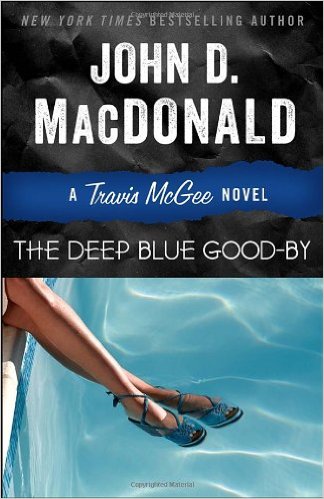
The Deep Blue Good-by, by John D. MacDonald

deep blue goodbyeWhy this book:  Mike Rowe (of Dirty Jobs fame) strongly recommended the entire John D. MacDonald Travis McGee series in his podcast interview with Tim Ferriss.  This recommendation was subsequently reinforced by my friend David Johnson who has read all of MacDonald’s Travis McGee novels (and so much more) and who said he envied me the opportunity to read these for the first time. This particular one is short, fascinating, gripping, and a fun read – I’m a slow reader and I read it in two days.  A page turner.

My Impressions:  If All the King’s Men was a literary gourmet meal, then The Deep Blue Good-by is gourmet Fast Food.  It is a mystery novel – one of the 21  books in MacDonald’s Travis McGee series, written in the first person voice of  Travis McGee. McGee  might be described as a cross between Jimmy Buffett and Jim Rockford (the James Garner character in The Rockford Files TV series of a few decades ago.)  Travis McGee is something of a boat bum in his 30s, who lives on a yacht he won in a poker game, claiming to be enjoying his retirement in installments.  He accepts work when he runs out of cash – and his specialty is helping people recoup money they’ve lost unfairly or through some chicanery.  If/when he succeeds, his cut is  half of what is left after his expenses.

Written in the early sixties, the context is late 1950s/early 1960s America along the east coast and waterways of south Florida.  The story is very well written, fun, and through the  the voice of the Travis McGee character, John D.MacDonald shares his keen and (I thought) interesting insights about American culture, men and women (especially women) and people in general.

It’s easy to like Travis McGee.  He is un-pretentious, easy-going, un-ambitious, non-materialistic, suffers no fools, principled and compassionate.  He has a good head, a good heart, and the urges of a healthy male in his 30s.  His judgment and decision making balance these three in a way that most men would envy.  He appreciates, and is respectful and solicitous of the women he meets, and in this novel, his clients and many of the supporting characters are women.

The Deep Blue Good-by is an interesting story that takes us from the air-bridge between China, Burma and India in WW2, where airmen made small fortunes smuggling gold, cash and gems, while moving men and equipment between theaters during the war, to the sad and vulnerable world of women barely-getting-by on the south Florida coast. The antagonist is a charming, glib, and attractive former felon and socio-path who seduces and preys on the most vulnerable women he finds who can serve his needs.  Our “bad guy”  steals a fortune from one of these women in a way that law enforcement could not help, and so Travis McGee agrees to see what he can do to help her recover what he can.  Travis McGee is also the type of man who just can’t sit by while the vulnerable are manipulated and exploited.  He is a courageous, humble and principled protagonist who at the same time is very much at home in the partying and somewhat debauched world of boat owners and marinas of south Florida.

It is a rollicking good story, with sympathetic and interesting characters, and as I’ve noted, extremely well written.  I am a new fan and will read more of Travis McGee’s adventures.

A few memorable passages:

I am wary of the whole dreary deadening structured mess we have built into such a glittering top-heavy structure that there is nothing left to see but the glitter, and the brute routines of maintaining it.

Reality is in the enduring eyes, the unspoken dreadful accusation in the enduring eyes of a worn young woman who looks at you, and hopes for  nothing.

I nursed a drink, made myself excruciatingly amiable, suitably mysterious and witty in the proper key, and carefully observed the group relationship until I was able to identify two possibles.

“If it’s pure recreation dear, without claims or agreements or deathless vows, I’m at your service. I like you.  I like you enough to keep from trying to fake you into anything, even though, at the moment, it’s one hell of a temptation. But I think you would have to get too deeply involved in your own justifications because, as I said, you are a complex woman. And a strong woman. And I am no part of your future, not in any emotional way…Now you know the rules, it’s still your decision.  Just holler.”

There is as much danger in overestimating as in underestimating the quality of the opposition.

Behind the agreeable grin he was as uncompromising as a hammer. Beast in his grin-mask.

Had I done any pleading  or begging, she would have slammed the door.  So I stood easy, mildly smiling. It’s a relaxed area.  There is code for all the transients.  If you are presentable, unhurried, vaguely indifferent, it is a challenge.

Bless them all, the forlorn little rabbits. They are the displaced persons of our emotional culture. They are ravenous for romance, yet settle for what they call making out…They yearn for security, but all they can have is what they make for themselves, chittering little flocks of them in the restaurants and stores, talking of style and adornment, dreaming of the terribly sincere strangers who will come along and lift them out of the gypsy life of the two bit tip and the unemployment, cut a tall cake with them, swell them up with sassy babies, and guide them masterfully into the shoal water of the electrified house where everybody brushes after every meal.

Posted in Uncategorized | 1 Comment

One Day in the Life of Ivan Denisovich, by Alexander Solzhenitsyn

One Day in the LifeWhy this book: Selected by my literature reading group. This was my 3rd time reading this book, and each time I’ve found it more insightful.  I find it very enlightening to read literature coming out of prisons, POW camps, by people who find themselves in very difficult environments, and reading their accounts of how they not only survive, find meaning in their suffering, and in some cases, even thrive.

My Impressions:   One Day in the Life of Ivan Denisovich is a fascinating study of human nature.     Similar to other books I’ve read about  surviving the brutality of prison, like Frankl’s Man’s Search for Meaning, Stockale’s In Love and War, Clavell’s  King Rat,  Flanagan’s The Narrow Road to the Deep North (which I reviewed here) One Day is a testament to the strength of the human spirit as it tries to hold on to a shred of dignity as it struggles to survive.  We see how Ivan Denisovich Shukhov and others in the gulag hold on to and assert their last remaining sense of human dignity in their resistance to a constant regimen of scarcity and brutality imposed by other human beings. In spite of the brutality, the suffering, the harshness of the environment, this is a very upbeat book.

This book is indeed about one day – from early wake up to finally falling asleep at the end of a long day, in Stalin’s post World War 2 Soviet gulag in Siberia.   But this one day can be seen in many ways as a metaphor for the life of all of us – only in a much more austere, and punishing setting. It is all men – women are only present as memories, or in some cases, as spouses or relatives who support these men with packages sent from home.   We get to know men who are cruel, selfish and self serving, and others who are honorable,  spiritual, noble and courageous.  Our protagonist,  Ivan Denisovich Shukhov is a practical survivor who also seeks to retain some sense of personal honor. In his description of  what he needed to do to survive as a PoW in North Vietnam, Adm Jim Stockale’s borrowed Solzhenitsyn’s description of Shukhov, and described how he became a “slow-moving, cagey prisoner.”   Shukhov, like Stockade, had learned to accept and make the best of what he could not change, while being alert and resourceful enough to take advantage of what few opportunities might come his way.

Almost daily,  Shukhov faced the moral challenge of how far he would go to survive – whether and to what degree he would participate in the corruption, stealing and  manipulation of others – not just the guards and trustees, but sometimes also of his fellow prisoners. For some in the camp, life was a simple and uncompromising fight for personal survival – every man for himself, no room for  compassion or generosity that might put one’s few advantages and chances for survival at risk.  Some collaborated with the guards and prison administrators against their fellow prisoners for advantages that would serve their needs.  Many other prisoners however, collaborated with and supported each other in defiance of the impersonal and brutal conditions.

Ivan Denisovich was cleverer than most in finding and working the seams of the system, cozying up to those who could help him with things he needed and wanted, and protecting himself from those who would threaten or use him to their ends.  In contrast to Shukhov, we see the former Soviet Navy captain, relatively new to the gulag, who sought to apply his civilized code of personal honor,  sense of dignity and responsibility in a very different, uncivilized context.  He suffered for his naïveté at the hands of the brutal guards and trustees. We are left wondering if, or how long, he would survive.

Here are a few bullets that occurred to me in reading this short, powerful book.

  • One Day is a study in the concept of loyalty.  Shukhov and his work crew are extremely loyal to the prisoner who heads their crew. Though their crew boss could be harsh, he is clever enough to get advantages for the crew and will take risks to protect them. And they reciprocate by taking care of him.  Loyalty within the crew is to a small circle of trusted mates. As we do in our own lives, Shukhov had concentric circles of loyalty – with only a very few in his inner circle of “friends” to whom he felt a greater degree of compassion and obligation than to those in the outer circles.
  • We see the  satisfaction that can come of working together, even in seemingly meaningless tasks. There is a memorable scene in which the work crew is hitting-on-all-cylinders building a wall which has no importance to them other than as a project they were assigned.  They  decide to do it well.  I was reminded of the Bridge Over the River Kwai. Shukhov and his fellow prisoners forget the cold and brutality as they lost themselves in the satisfaction of working together for a common goal – to build the wall well.  Time, place, cold, and suffering all disappeared – for a few hours.
  • Food was always key.  There was never enough.  When they were very cold and very hungry, nothing else seemed to matter – men became beasts – cowed and primal – willing to do almost anything for food and warmth.  Those who cooked and served the meager rations always got more than their share, and gave what was left to the others. They took care of themselves first – like many who have power and advantage the world over.
  • In this very primal world, Maslow’s hierarchy of needs is very evident.  Only a couple of times do we see indicators of men who, in spite of the brutality of the conditions, had the discipline and sense of honor to hold fast to values above meeting their most basic needs. We briefly get to know a man who “…you could see his mind was set on one thing – never to give in <to the downward spiral of brutality.>  He didn’t put his eight ounces <of bread> down in all the filth on the table like everyone else but laid it on a clean little piece of rag that’d been washed over and over again.”
  • One day at a time. Shukhov realized that to think about the future was detrimental to survival.  One event at a time; one day at a time, enjoy what ephemeral victories and satisfactions might come one’s way, but don’t dwell on them. Don’t think about the future or how much time they have left in the gulag.   I was reminded of what SEAL trainees are told about how to survive and succeed in Hell Week.

Ivan Denisovich Shukhov’s “one day” had begun with him feeling ill, but not being permitted entry into the infirmary.  But at the end of that day, Shukhov lay in his bunk celebrating his small victories of the day. “Nothing has spoiled the day and it had been almost happy.”  And though he didn’t think about it, he had 3,653 days left in his sentence, which he also knew could be – he almost expected to be –  extended arbitrarily with no justification.

Though this was my third time reading One Day,  I got so much more out of it this time.  It would be very interesting to discuss Shukhov’s  “one day in the life” as a metaphor for much of what each of us face and experience in our own much less demanding, much more comfortable and civilized lives.  My reading group didn’t give this book the attention it deserved because it was a tag-on to another much longer, more involved wonderful book, All the King’s Men.

Posted in Uncategorized | Leave a comment

All the King’s Men, by Robert Penn Warren

All the King's MenWhy this book:  Selected by my literature reading group. I had read it for the first time  about 7 years ago, and loved it then.  I was uncertain the group would like it, since it is rather long (~600 pages) and not very fast moving, but I enthusiastically endorsed it, since I recall how it affected me then. It was even more powerful for me this time.  And I hope to read it again in a few years. It is very much worth it to read the restored edition, which rescues R.P. Warren’s original work from the politically correct and often uninspired modifications of the original editors.

My Impressions:  I place this near the top of the list of books I’ve ever read.   The writing is beautiful,  the story compelling, the characters have depth and complexity and are believable – they come to life.   It is not fast-food reading –  more  a gourmet meal, to be savored slowly, when one’s appetite is ready for the best we can offer it. I could not read it when I was tired; not that the writing was complex or difficult – on the contrary.  But reading tired, I would miss the nuances and poetic descriptions of people, places, things, events. One shouldn’t go to the Louvre when one is tired and cranky.  One should visit the Louvre when one is well rested, alert, has had a cup of coffee,  is in a good mood and energized.  That’s how I felt about reading this book. I made a point to read it mostly in the morning.

The principle character around whom the novel is based is a fictional version of Huey Long, the infamous charismatic and demagogic populist governor of Louisiana in the 1930’s.  But he is not the protagonist of the novel.  The protagonist is Jack Burden, one of the governor’s personal assistants, and the novel is really about Burden’s experience of the corruption endemic to the politics of Louisiana at the time, and how he, being close to the power, played in and around the horse trading, the corruption,  and the exercise of power and political ambition.

But most important and interesting to me was Jack Burden’s  maturing process in his  relationships with key people in his life outside of the political arena – his mother, father, mentor, his childhood best friend, and his childhood sweetheart.  And his own moral development and understanding of the world, as he moved from romantic idealist, to cynicism and then to a nothing-matters nihilism, finally to an accommodation with love and man’s better nature.  Robert Penn Warren is nothing if not a realist and he demands that we and his characters see things as they are – flawed, though often striving to be good – in a clumsy, often self-centered  and sometimes tragic way.  Betrayal and forgiveness, hubris and the fall, idealism and disappointment, corruption and redemption are all part of Jack Burden’s experience and the story he relates to us as narrator.

The writing was like nothing I’ve ever read before.  Not complex, but evocative.  From the very beginning, the writing and the style pulled me into Louisiana of the 1930s and I could almost sense and feel the characters.  His descriptions were poetic but not overdone.  I offer a few samples below.  I can’t say enough about how much I enjoyed his writing.  In the last several years I have read other prose pieces written by poets, (Maya Angelou and Robert Service) and each time I have loved the writing.  Robert Penn Warren however wasn’t just a poet.  He won the Pulitzer prize twice for poetry and was the United States first poet-laureate.  Yeah, he could craft an image, and pull you into it.

All the King’s Men is mostly about flawed men. But there are some very interesting strong multi-dimensional women in the book as well.  Women will not be disappointed.

For me a possible downside was that there was not much real joy in the book.  All the characters were somehow struggling with their own humanity – struggling to be as good as they hoped to be, as others wanted them to be, but not living up to their own or other’s expectations.  His characters have to live a type of double life -pretending to be something they aren’t, while striving to be better than they are.   And Warren would have us believe that this is how all -or most of us  – are, and that this is simply part of the American experience.  His characters struggled to understand and deal with the challenges they were facing,  trying often valiantly, to achieve something of value.  I was edified and occasionally even inspired, but there wasn’t much joy or  exuberance.

There are no real heroes in this book – all the characters were very human and flawed – no one was particularly good, nor particularly bad.   You might say this book is not about the struggle between good and evil, rather between better and worse – in the simple striving hearts of the people who populate this story.

All the King’s Men does indeed have a positive message and an ending I didn’t expect.  It is a beautifully written, thoughtful, and very satisfying read.

——-

A few quotes, to give you a sense of the poetry of his descriptions and the earthiness of his language (page numbers from the Mariner Books 2001 restored paperback edition – the copy you see in the picture above.)

He learned that the world is like an enormous spider web and if you touch it, however lightly, at any point, the vibration ripples to the remotest perimeter and the drowsy spider feels the tingle and is drowsy no more but springs out to fling the gossamer coils about you who have touched the web and then inject the black, numbing poison under your hide.  266

The end of man is knowledge, but there is one thing he can’t know. He can’t know whether knowledge will save him or kill him. He will be killed, all right, but he can’t know whether he is killed because of the knowledge which he has got or because of the knowledge which he hasn’t got and which if he had it, would save him. 13

“That’s why I can see what the law is like. It’s like a single-bed blanket on a double bed and three folks in the bed and a cold night.  There ain’t never enough blanket to cover the case, no matter how much pulling  and hauling, and somebody’s always going to nigh catch pneumonia.”  194

There is nothing like a good book to put you to sleep with the illusion that life is rich and meaningful.  108

“…it’s up to you to give ’em something to stir ’em up and make ’em feel alive again.  Just for half an hour.  That’s what they come for. Tell ’em anything. But for Sweet Jesus’ sake don’t try to improve their minds.”  102

Her eyes were glittering like the eyes of a child when you give a nice surprise, and she laughed in a sudden throaty, tingling way. It is the way a woman laughs for happiness. They never laugh that way just when they are being polite or at a joke. A woman only laughs that way a few times in her life…..For all any of us really wants is to hear a woman laugh like that.  289

And he said: “Man is conceived in sin and born in corruption and he passeth from the stink of the didie to the stench of the shroud. There is always something.” 268  (this is a key quote in the book, as the Huey Long character believed and repeatedly proved that he could always find something about which any one, no matter their public virtue, was ashamed, and which he could use for blackmail.)

“Its not an explanation, ” he said, and laughed again. “there ain’t any explanations. Not of anything. All you can do is point at the nature of things. If you are smart enough to  see ’em.” 269

For years I had condemned her as a woman without a heart, who loved merely power over men and the momentary satisfaction to vanity or flesh which they could give her, who lived in a strange loveless oscillation between calculation and instinct. 601

I had given my mother a present, which was a lie.  But in return she had given me a present, too, which was a truth. She gave me a new picture of herself, and that meant, in the end, a new picture of the world.  601

…and you look at the floor where now there are little parallel trails of damp sawdust the old broom left this morning when the unenthusiastic old negro man cleaned up, and the general impression is that you are alone with the Alone and it is His move.  19

Fate comes walking thought the door, and it is five-feet ten inches tall and heavyish in the chest and shortish in the leg …19

You get into bed and you shut your eyes and you think of something you did or you didn’t do, and wanted and didn’t get, or didn’t want and got, and pretty soon it doesn’t matter which, for you are asleep.  44

..their life history is a process of discovering what they really are, and not, as for you and me, sons of luck,  a process of becoming what luck makes us.  89

Well, Willie began to appear in the Chronicle in the role of the boy upon the burning deck, and the boy who put his finger in the dyke, and the boy who replies “I can” when Duty whispers low, “Thou must.”  90

…the theory of the moral neutrality of history: “History is blind, but man is not.” 606


Posted in Uncategorized | 1 Comment

Leadership BS, by Jeffrey Pfeffer

Leadership BSWhy this book:  We selected this book for our All American Leadership reading group, and it was I who suggested it.  It had been recommended to me by Liz Barron who said it was creating something of a stir in the world of leadership consulting.  I can see why. I have several quotes in my review below, with page numbers in parenthesis, referring to the hardcover HarperCollins 2015 edition.

My impressions: This book is meant to be provocative, and it is. The book makes two major points:

FIRST:  The things we say we want in our business leaders are not what we get – the majority of business leaders do not display the attributes that the leadership development industry promotes.  Nor are these qualities widely rewarded in the marketplace.  In looking at the reality of those who have succeeded in business,  Pfeffer states that doing the opposite of much of what the leadership industry recommends might be  more sensible.

SECOND: We have a  multibillion dollar leader development industry which he claims has been spectacularly unsuccessful in improving the general leadership in the US or elsewhere.  He points out that employee engagement has decreased, and poor leadership has increased in direct proportion to the increase in leadership seminars in Corporate America.  He shares the amazing statistic that came from one study, that 35% of US employees would forgo a substantial pay increase in exchange for seeing their boss fired.

Leadership BS addresses five attributes that Pfeffer claims are often associated with and taught to be essential to excellent leadership.  He argues that some of these attributes might actually be detrimental to effective leadership, or that they are so uncommon, that no one takes them seriously, or it is disingenuous to even promote them.  These attributes are: modesty, authenticity, truthfulness, trustworthiness, and concern for the well being of others.

He devotes a chapter to each of these attributes – and below I give you Pfeiffer’s chapter title and  what I understood to be his main point:

Modesty: Why Leaders Aren’t. “Although modesty may be valued in the leadership literature, self-promotion and assertiveness seem to produce better career results in the real world. “  (78)  Pride in oneself, self-confidence, high self-esteem and a certain degree of narcissism are almost essential to get to a leadership position of any significance.  and to succeed in it.  Leaders need to engage in activities that make them, and by extension their companies, more noticeable and noteworthy. People and organizations are drawn to the self-confident and assertive, to the grandiose and the unusual. Modesty and humility are seldom rewarded. He does recognize the value of creating the “perception” of modesty.

And yet…

Authenticity: Misunderstood and Overrated. “In fact, being authentic is pretty much the opposite of what leaders must do.  Leaders do not need to be truth themselves. Rather leaders need to be true to what the situation and what those around them want and need from them.” (87)   He emphasizes how effective leaders often need to sublimate their true feeling in the interest of their duties to the organization and to others. Good leaders must also be good actors, exuding confidence even when they may not feel it, not showing fear, emotional distress, or confusion, even if that is what they feel. They must have a public face, that may be very different from their “authentic” private face. “After all,” he asks, “what if your real self is an asshole?” (94)  “One of the most important leadership skills is the ability put on a show, to act like a leader…” (98)  Being true to the role and responsibilities of the leader is much more useful and effective than being true to one’s feelings at the moment.

And yet…

Should Leaders Tell the Truth – and Do They?  “...the evidence is quite clear that leaders (and for that matter, other people) frequently don’t tell the truth and face few to no consequences for doing so.” (122) This chapter shows how “truth” is malleable and open to different versions and interpretations, and it has many different shades.  Deception in negotiations is part of the practice of business.  Leaders are expected to shade the truth to the advantage of themselves and their constituencies.  And they are not held accountable – not blamed – when they are caught in being less than truthful.  “I misunderstood.”  “I was mistaken in my analysis.”  “My memory served me poorly.”  “That’s what I believed to be true at the time.”  “Nobody asked that question at the time.”  Pfeffer points out how our culture has developed a high tolerance for untruths – like our expectation that the used car salesman will not tell us his true best price to sell us that car.  The “truth” is negotiable, and we expect leaders to use it to play the game to win.

And yet…

Trust: Where did it go and why?  “Therefore, leaders, who first and foremost are responsible for ensuring their organization’s well-being, sometimes have to take tough actions.  Such actions can entail breaking implicit promises or even abrogating contracts, undoing things that render the leader disliked and the company distrusted.” (147)  In this chapter, Pfeffer is most ambivalent.  He certainly believes that trustworthiness is a personal virtue and can serve business leaders well, but is quick to point out that when obligations to different stakeholders conflict, we expect leaders to honor their obligations to their companies first, and in fact often to their own personal interests as well, ahead of obligations to others who may have less influence.   He said that’s what most of us expect, and it is important that we are aware of that, and protect ourselves by being very wary in whom, and how much we trust.  “…people who regularly appear on most-admired lists and give talks at leading business schools – turn their backs on commitments when it suits their interests all the time.” (152)

And yet….

Why Leaders Eat First. (the title of this chapter refers to Simon Sinek’s book, Leaders Eat Last.) “…relying on leaders’ generosity of spirit or the exhortations of the leadership literature is an ineffective and risky way to ensure that leaders take care of anyone other than themselves.” (169)  Pfeffer points out that most people feel inclined to take care of people to whom they feel a connection, and in most companies, leaders have little connection to the people who actually do the work in the company, frequently don’t really know what they do, nor understand their lives.  Their incentive packages also are geared primarily toward earnings – often short term earnings – and leaders, like most people, follow the incentives.   He advocates Boards promoting people from within, so that leaders better understand and are able to connect with their subordinates, and creating programs which expose leaders to the core of the businesses activities and those who perform them (a la TV’s  Undercover Boss.)

—-After addressing these 5 attributes Pfeffer concludes Leadership BS with two wrap up chapters:

Take Care of Yourself “…nice speeches and noble sentiments notwithstanding, leaders mostly take care of themselves first  and maybe second and third, also – regardless of what they are  supposed to do. The pious conclusion: you should do the same.” (172)   He makes the point that leaders will primarily value your future contributions to the company, and give little thought to your past contributions. He has a section on why people want to put their trust in (and give up their personal responsibility to) a seemingly beneficent leader, in spite of the wisdom of not doing so.  He advocates, “Take care of yourself and assiduously look out for your own interests in your life inside work organizations.” (187)

“In a nutshell, companies will treat you well as long as you seem as though you are going to be useful in the future, and companies will probably be less inclined to treat you well or to repay past contributions the minute you are perceived as being less useful in future endeavors.” ( 179)

Fixing Leadership Failures. “I find it depressing that we would want to discuss the state of leadership in organizations from the perspective of what feels good and uplifting, rather than what the evidence shows to be true.” (194)  This chapter basically advocates acknowledging the reality of what leadership is, not what it might be, and accepting the uncomfortable truth that many, many very successful leaders got that way by violating most of the recommendations offered by the leadership industry. He does not advocate arrogant, self-centered, self-aggrandizing, self-serving behavior but says that to ignore that such behavior has not always been an impediment to success, is dishonest.  “Averting our eyes from the facts may provide solace, but it does so at the price of progress.”  (194)

His advice to aspiring and current leaders:

  • Stop confusing the Normative with the Descriptive, and focus more on What Is.
  • Watch Actions, Not Words.
  • Sometimes you have to Behave Badly to do Good
  • Advice to Leaders depends on the Ecosystem in which they are operating.
  • Stop Either-Or  thinking
  • Forgive, but Remember

He offers an intriguing list of disconnections (eg, the disconnect between leader performance and behavior,  and the consequences those leaders face) and concluded that “…the remedy for the many leadership failures seems simple, and it is: to restore the broken connections, the linkages between behavior and its consequences, words and actions, prescriptions and reality.  But this task will not be easy. The disconnections serve many powerful interests, and they serve those interests extremely well.”  (219)

AND YET…. I believe there are important caveats to his objections to how the leadership industry promotes these five (and other) attributes.  While I agree with nearly all his points, I think Pfeffer throws the baby out with the bathwater.  I cannot argue with the ugliness of the reality he describes, and the ineffectiveness – indeed the vacuousness – of much of what the leadership industry promotes. I’ve been a part of it, and have also regarded much of what I’ve seen (and participated in!) as little more than “feel-good” box checking.

But there ARE advantages to expressing and reiterating an ideal, to creating, discussing and reenforcing a higher standard. Indeed, it can be done better – and he is right that many in the leadership industry make a lot of money providing little more than entertainment and short-lived inspirational bromides to businesses, rather than truly affecting positive change.  That said, some in the leadership industry are doing it better and are truly making a real difference, and some in Corporate America are paying attention and doing significantly better as a result.  Pfeffer is right that the reality is ugly, and there are abundant examples of stupid, self-serving, short-sighted, unimaginative, insensitive leaders using their employees as mere means to advance their careers and fatten their personal bank accounts.  We will never eliminate that. That is important to acknowledge. And to fight against.

I agree with my friend George Reed who said that organizations which talk about leadership, good leadership, generally have better leadership than those which don’t talk about leadership.  Such discussions, such workshops, a positive and constant drumbeat can provide leaders, managers, employees with a standard against which to measure their reality.  And sometimes leaders, managers, employees are inspired to be better.  Because we see so little Christ-like behavior is not a good reason for Christians not to go to church.

While modesty may be over-rated, we remember the hubris of Enron’s Ken Lay and F. Ross Johnson of Barbarians at the Gate notoriety.  Do we not acknowledge the value of a certain degree of humility?  While we recognize that leaders cannot be completely authentic or truthful in their dealings with their stakeholders, are we willing to accept complete phonies and liars?  There is a wisdom in moderation, with virtue being the mean between two extremes, with good judgment and contextual considerations taking primacy.  And over the long run, combined with competence in fundamental business skills, virtue does indeed have value in the market place.

Like many such books, I believe Pfeffer makes his point too strongly, and perhaps too stridently,  and doesn’t adequately acknowledge or respect an alternate point of view.  That said, I believer this is a valuable and worthwhile book for those in business, and in the leadership industry to read and consider.

Some Quotes  ( laying out his reasons for writing the book:)   

 “The Leadership industry also has its share of quacks and sham artists who sell promises and stories, some true, some not, but all of them inspirational and comfortable, with not much follow-up to see what really does work and what doesn’t.  (x)

“…much leadership training and development has become too much a form of lay preaching…I explain why inspiration is a very poor foundation on which to build substantive change, and why and how the leadership tales we hear, stories that often have only modest amounts of validity, routinely make things worse, and possibly much worse.   (6)

“…the core of the argument- that the qualities we actually select for and reward in most workplaces are precisely the ones that are unlikely to produce leaders who are good for employees,or, for that matter, for the long-term organizational performance.”                                                                                                                                                                                                                                                                                                                                                          (7)

“Because the focus of much leadership research is precisely on demonstrating the connection between leadership and leader behavior on the one hand and outcomes such as job satisfaction, employee engagement, and turnover on the tother, these data reveal the abject failure of the leadership enterprise.”  (13)

“…people believed in the world described to them in business school and in the prescriptions for leader behavior.  Consequent try, they were surprise by and completely unprepared for what they actually encountered a work. ” (15)

The simple but important point: the oft-observed divergence in interests between individual leaders and the organizations they lead means that any prescription of what someone should do has to begin by both acknowledgtin the trade-off and sorting through that person/ real priorities and the multiple, often poorly correlated measures of a leader/s outcomes.” (19)

“…while leadership research may not be that interested in leader (as opposed to group or organizational) well-being, leaders almost always are.” (21)

“The leadership industry is so obsessively focused on the normative – what leaders should do and how things ought to be – that it has largely ignored asking the fundamental question of what actually is true and going on and why.”  (23-24)

“Without baseline measurements of leader and workplace conditions, it is simply impossible to understand what to do to make improvements.”  (31)

“What’s more, doing the opposite of what the leadership industry advocates is sometimes a much better, more reliable path to individual success. There are, in this domain as in many others, trade-offs, and the frequently unacknowledged trade-off between what is good for the individual and good for the group needs to be front and center in understanding why there is so much leadership failure over such a long time.” (32)

“…the many ways in which people conspire in their own deception, including deceiving themselves about their leaders and the organizations in which they work, would require a book in itself to do justice to this vitally important topic.”  181

THIS ONE PAGE, NEAR THE VERY END, SUMMARIZES MANY OF THE KEY POINTS OF THE BOOK

Leadership BS Connects Disconnects

Posted in Uncategorized | 3 Comments

Breakfast of Champions, by Kurt Vonnegut

Breakfast of ChampionsWhy this book:  My good friend Jay read it after I recommended  Vonnegut’s Slaughter House Five to him. I had read Slaughter House Five twice and found it really clever, creative, and powerful.  I had read Vonnegut’s Cat’s Cradle in college and it made quite an impression on me.   The irony was delicious.  Vonnegut is a very creative and eccentric writer and I thought Jay’s recommendation of Breakfast of Champions  would justify reading this one as well.

My impressions:  First, I did not “read” the book – I listened to it on audio, narrated by John Malkovich as an audible book.  I would have gotten more out of reading it, though Malkovich was probably the perfect voice to read this.  The book is indeed a bit bizarre, and following it – paying attention and appreciating the satire and nuances while driving  – was at times difficult.   It is very much a satire – and represented Vonnegut’s views on the absurdity of some of what we simply don’t notice or take for granted in the way we live.

Breakfast of Champions itself is named for a wry comment that a waitress makes to one of the characters in the book referring to a drink.  Vonnegut tells the story as if to an extra-terrestrial, who doesn’t know or understand much about human beings, the earth or how humans live together, especially in America.  So he explains everything – and his explanations highlight the absurdity of so much we see and do.  The protagonist is Kilgore Trout, an obscure very-little read science fiction writer who suddenly finds himself catapulted into the public eye as the guest of honor at an arts festival.  Up to that point, most of Kilgore Trout’s weird but creative short stories had been used as filler in pornographic magazines. Kilgore Trout is old, reclusive, not quite destitute, eccentric and now finds himself dealing with decisions he’s never made before.

Vonnegut uses a number of unusual means to make his points.  He treats sex very dispassionately and biologically, and satirizes our fascination with it by describing in laboratory terms the parts of the bodies of varies characters in the book – as though these dimensions were essential to know their character.  He injects himself into the story, remarking that the characters in the book do what they do because he, the author, makes them do these things. And then near the end, he actually becomes one of the characters in his story, sitting at the table with Kilgore Trout and other characters in the book.   He concludes with a conversation between Kilgore Trout and himself – ‘his creator.’   He convinces Trout that he is a mere character in his book and then asks him what he would like to do, ask, tell – because he – Vonnegut the author – can make it happen.   The metaphor is fascinating.  The absurdities in the book are sometimes over the top – but always attention getting, clever, sometimes ingenious, sometimes simply disturbing.

Would I recommend it?  Depends on your sense of the absurd and of irony.  It is indeed a clever book – but there really wasn’t much of a story line – some interesting and truly absurd characters – it reminded me a bit of Catch 22 in how the characters were paradies of archetypes we see in every day life -good and bad.  The story served as a vehicle for Vonnegut to share his whimsical look at the human race and things we take seriously, and as such, it wandered a bit.  Vonnegut himself was definitely out on the edge.


Posted in Uncategorized | 1 Comment

Tribe, by Sebastian Junger

TribeWhy this book:  I listened to Tim Ferriss’s interview with Sebastian Junger on The Tim Ferriss Show podcast and was impressed with his ideas.  A couple of my friends,  also Tim Ferriss devotees, who were similarly impressed.  We all agreed to read the book and get together to discuss it.  We did so within a week.
My impressions: This book makes a single point, and makes it from a number of different perspectives:  We are genetically, and socially programmed to function in close, relatively small, and inter-dependent groups, working closely together to deal with adversity.  Adversity draws us together, brings out the best in us, and holds us together, because we know that united we stand, divided, or as individuals, we fall – that is, we  do not survive. It is what we and other primate species have learned over the millennia. And natural selection and evolution have made this a key part of who we are.

But Western Civilization has taken much of the existential adversity out of our lives – in most settings, we no longer have to work together to merely survive.  Our culture promotes individualism and independence, more so than tribalism and inter-dependence.  Junger brings in a variety of examples and studies to help make the point that as a whole, humans are happier living in more communal societies, working together to deal with threats and challenges, than they are living  independently, as individuals, or in smaller separate entities, with little need to depend on, or contribute to the social structure.  One of the examples he gives is of American Indian tribes which had kidnapped and adopted whites, during the 18th and 19th centuries. Very often, the captured whites, after integrating with the native American tribes,  did not want to return to white society – in fact often whites left white society to go live with the Indians, who by and large integrated them fully into their tribes. There are few if any instances of Indians choosing to live in white society. He offers other similar examples that make his point that when people experience a close knit, interdependent and egalitarian society, they are happiest.

He offers examples of how Westerners can become more tribal and inter-dependent  – temporarily – when faced with disaster, or an existential threat.  After 9-11 people all over the US set aside differences to create a unified response to a threat – just like our ancestors did regularly.  Once the newness of the threat wore off, we reverted to competitive behavior and fostering internal competition that dissipated the unified feeling  we experienced after 9-11.  He looked at London during and after the German bombing Blitz in 1940, and gave examples of how natural disasters seemed to melt away class and income distinctions and bring people together. And once the immediate threat and requirement to support each other was past, people reverted to arguing, fighting, competing and undermining each other.  And he notes, depression increases, suicides increase.

Indeed I’ve heard of recent research that says that a sense of belonging is one of if not the most important on Maslow’s hierarchy of human needs and may be more fundamental than the need for food,  shelter, or security.  Junger says we ignore that at our peril.

His more controversial point is that much of PTSD is a result of servicemen leaving a tribal, communal, purpose-driven life in the military in combat, and return to peacetime  life disoriented and with less of a sense of community and common purpose.  He makes the case  that a certain percentage of PTSD sufferers are in fact suffering from inability to re-adapt to an atomized and alienated culture when they return from the intense and very cohesive environment of combat. They are missing that innate need to be part of a close-knit tribal inter-dependence, taking care of each other in response to threats to the tribe.

The book is a short and compelling read and I enjoyed it. Tim Ferriss’s interview with Junger covers much of the content of the book in about 2  1/2 hours.  The interview and the book complement the other, but if you are interested in the topic, but don’t have time to read the book, listen to the podcast, entitled, “Lessons from War, Tribal Societies, and a non-fiction life.”

Possible shortcomings: 

  1. David Morris, author of  The Evil Hours: A Biography of Post-Traumatic Stress Disorder  sharply disputed Junger’s claims about the extent to which PTSD may be related to inability to adapt to peacetime or civilized society.  In his Wall Street Journal review of Junger’s Tribe    he argues that Junger’s statistics are severely skewed to help him make his case.  I thought Morris’s review made some good points but was  unfair in calling Junger  a “war tourist” – Sebastian Junger has seen more of combat and war as a journalist than the vast majority of people in uniform.  Whether a fair percentage of PTSD is a indeed a consequence of an inability to adapt from a tribal to a modern world as Junger claims, his argument that the epidemic of depression, suicide and “existential despair”that one finds in Western societies is probably in large part due to people feeling isolated from each other and protected from the requirement to work together in adversity, makes sense to me.
  2. I felt that Junger could also have given credit to the many advantages that accrue from societies where individual effort, striving, and competition are primary.  Some  people indeed attain their greatest achievements and fulfillment when unhampered by often suffocating social and communal requirements.  Small villages and tribal societies are notorious for their conservatism, for squelching innovation and believing in tradition and superstition, in the face of new ideas and arguments for change.  I didn’t think Junger adequately offered counter-arguments to his points in Tribe.

SOME QUOTES from Tribe: (page numbers from hardback Twelve Hatchett Book Group edition) 

“How do you become an adult in a society that doesn’t require sacrifice? How do you become a man in a society that doesn’t require courage?”  xiv

“As affluence and urbanization rise in a society, rates of depression and suicide tend to go up rather than down.  Rather than buffering people from clinical depression, increased wealth in a  society seems to foster it.” 19

“The mechanism seems simple: for people are forced to share their team and resource more than wealthy people are, and as a result they live inclosed communities.”  21

“..the evolutionary basis for moral behavior stems from group pressure.” 27

“To the  extent that boys are drawn to war, it may be less out of an interest in violence than a longing for the king of maturity and respect that often come with it.”  38

“Communities that have been devastated by natural or man-made disasters almost never lapse into chaos and disorder; if anything, they become more just, more egalitarian, and more deliberately fair to individuals.” 44 (note: Junger goes on to dispute how the press reported how the majority of people in New Orleans responded to Katrina)

“<Charles> Fritz theory was …that disasters thrust people back into a more ancient, organic way of relating. Disasters, he proposed, create a “community of sufferers” that allows individuals to experience an immensely reassuring connection to others.”  53

“As soon as relief flights began delivering aid to the area, class divisions returned and the sense of brotherhood disappeared. The modern world had arrived.”55

“That risk-taking tends to express itself in vary different ways in men and women….risking male lives to save female lives makes enormous evolutionary sense… But women are more likely than men to display something called moral courage.” 55-57

“The beauty and tragedy of the modern world is that it eliminates many situations that require people to demonstrate a commitment to the collective good.” 59

“What catastrophes seem to do – sometimes in the span of a few minutes – is turn back the clock on ten thousand years of social evolution. Self-interest gets subsumed into group interest because there is no survival outside group survival, and that creates a social bond that many people sorely miss.”  66

“But in addition to all the destruction and loss of life, war also inspires ancient human virtues of courage, loyalty, and selflessness that can be utterly intoxicating to the people who experience them.”  77

“…the National Research Council found that a person’s chance of getting chronic PTSD is in great part a function of their experiences before going to war.”  82

“…high unit cohesion is correlated with lower rates of psychiatric breakdown.”  85

“Horrific experiences are unfortunately a human universal, but long-term impairment from them is not..”. 87

(Quoting Sharon Abromowitz) “We are not good to each other. Our tribalism is to an extremely narrow drop of people: our children, our spouse, maybe our parents.  Our society is alienating, technical, cold and mystifying. Our fundamental desire, as human beings, is to be close to others, and our society does not allow for that.”94

“..three factors seem to crucially affect a combatant’s transition back into civilian life….First, cohesive and egalitarian tribal societies do avery good job a mitigating the effects of trauma. …Secondly, ex-combatants shouldn’t be seen – or be encouraged to see themselves – as victims……Perhaps most importantly, veterans need to feel that they’re just as necessary and productive back in society as they were on the battlefield.”  101-102

“More dignified might be to offer veterans all over the country the use of their town hall every Veterans Day to speak freely about their experience at war. ” 123

“Today’s veterans often come home to find that, although they’re willing to die for their country, they’re not sure how to live for it.” 124

“How do you make veterans feel that they are retuning to a cohesive society that was worth fighting for in the first place?” 127

“Acting in a tribal way simply means being willing to make a substantive sacrifice for your community – be that your neighborhood, your workplace or your entire country.” 131


Posted in Uncategorized | 1 Comment

When Breath becomes Air, by Paul Kalanithi

When Breath Becomes airWhy This Book:  This book was recommended to me by my son, who said it was short, powerful, and very much worth reading.  Then another friend told me she had read it and her reaction was identical to my son’s.  So I put it at the head of the line of books I was planning to read.

My Impressions: This is indeed a powerful book.   I recommend it to anyone who is willing to learn about life and mortality  from a gifted and thoughtful doctor, scientist and writer, who unexpectedly was forced to face a much shorter life expectancy, just as he was hitting his stride in the prime of life. As a New York Times reviewer commented on the book jacket, this is not a book you’ll forget.  I just finished it and have already given it as a gift to three friends who I know will thank me for it.

My most recent Bob’s Corner post is entitled “Living Heroically,” and this book provides an excellent first person account of living heroically, and dying heroically.  Paul Kalanithi’s story is an example of a thoughtful, intelligent man heroically facing uncertainty and death, which unless we avert our eyes, we all face.  With his extensive background in medicine, science AND the humanities (he had a BA in English literature and an MA in Philosophy and History) he offers us a unique perspective.  I was inspired not only by how Paul Kalanithi struggled against cancer, but also how he struggled to live well, to continue his life’s work while in pain and discomfort, only retreating when his energy dramatically ebbed and he saw that his time was very limited.

The first part of the book is a brief autobiography, in which he shares his life’s trajectory up to the point he learned that he had aggressive lung cancer.  We learn a bit about his childhood, decisions to go to Stanford University, choosing medicine over becoming an English professor and writer.  We learn briefly of the struggles of medical school, how he decided to go into neurosurgery, one of the most demanding branches of medicine.   And then as a resident surgeon, he shares how he struggled with and eventually learned to serve patients who found themselves afraid, disoriented, and feeling helpless in that netherworld between life and death.  Some of the most moving parts of his story are his accounts of doing all he can on behalf of patients who did not survive, or who did survive, but with unexpected disabilities, and a few stories of those who miraculously and unexpectedly made complete recoveries.  The work of neurosurgery is figuratively and literally on the cutting edge of what we know about the brain and how it affects who we are and how we live.

He tells of courting and marrying his wife Lucy who was also going thru her medical residency in a different field, while he was.   Within a few years, their marriage is struggling because of the stress of two very demanding schedules, and so little time together. They work on their marriage, and as he becomes one of the rising stars in neurosurgery at Stanford Medical Center, and separately an award-winning researcher in neuroscience, he finds out he has cancer – that has already metastasized.

The second part, entitled “Cease Not ’til Death,” is about his struggle to hold on to his calling, to maintain some semblance of the trajectory of his life, while fighting, and ultimately losing in his battle against cancer.  The disease brings him and his wife closer together;  initially, there is hope for recovery, and they decide to have a child.  As Lucy is going through her pregnancy, his cancer returns and hope fades.   He has to give up many of the things that are most important to him as his body fails him, as his energy ebbs and as he sees his time running out.  He has to prioritize in a most severe way.  From his extensive readings in literature, he finds consolation in the wisdom of great thinkers and great stories of the past.   He shares with us insights and inspiration that gave him solace and allowed him to love and appreciate what little time and energy he had left -never abandoning his love for his family, his life, for life itself.  He shares with us a brief but beautifully inspired explanation for why he rejected a purely materialistic view of life and the “reasoning” behind his faith, stating that “…the basic reality of human life stands compellingly against blind determinism.”   He fought the temptation to feel a victim of a cruel fate, and never fell into bitterness.   His life’s final project was to write this book, to tell his story and share with the world what he learned about himself, about life, and about death through his own struggle.

The epilogue is written by his wife, who shares how important it was for him to write this book – how he struggled to write it, while under the effects of not only the cancer, but the drugs that sapped his energy as they eased his discomfort and perhaps prolonged his life.  She told us of  his last months, after he no longer had the wherewithal to write, and ultimately, of his last weeks, days, and hours. After we got to know this amazing man and his struggle in his own words, it was hard to read Lucy’s description of his final days and hours without tearing up.

My Key Take-Aways: 

  • Surgeons – especially neurosurgeons –  work really hard. The closest thing I can think of is being in a SEAL detachment, deployed into a combat zone.  The intensity, commitment and hours are similar.  Every time they perform surgery, they have the life and future quality of life of their patient in their hands – in my mind that is far more difficult than putting one’s own life at risk.
  • When Paul learned he had cancer and began treatment,  he decided to do all he could to hold on to his pre-cancer life’s trajectory. He heroically stayed committed.
  • One of his key messages was the consolations that he got from the wisdom of  literature and the humanities, teaching him not only how to live well, but how to die well.
  • He only spent about 2 pages on religion and faith,  but these two pages were very well done and profound.  He found consolation in a faith was very different from that of most people – his was a faith born of a very thorough study of science and philosophy.
  • As his time and energy shrank, he had to make hard decisions about how to spend what little time and energy he had.  We see the greatest importance he gave to his very closest friends and family – when all else was fading into the realm of no-longer-important.
  • His and Lucy’s daughter was only a few months old when he died.  But the last words in his book address how important it was to him to leave a positive legacy to his daughter.
  • A practical lesson:   He wrote-off signs symptoms of his disease as “merely” the consequences of stress and too much work, and not enough rest.  Doctors are notorious for ignoring their own guidance. If I’m tired, weak, and losing weight, I need to go get checked up, to see if I can catch this monster before it grows too big.
  • He didn’t mention this, but I was reminded of the Stockale Paradox named by Jim Collins (author of Good to Great) after VAdm Jim Stockale’s quote: “You must never confuse faith that you will prevail in the end—which you can never afford to lose—with the discipline to confront the most brutal facts of your current reality, whatever they might be.”  Stockdale advocated holding on to one’s values, principles, and fundamental identity, even (especially)  when there is no light at the end of the tunnel. VAdm Stockale was  awarded the Medal of Honor for his leadership as the senior PoW for nearly 8 years in North Vietnam. Stockade and Kalinithi fought hard to hold on to their honor and values, when there was no light at the end of the tunnel.
  • As I noted at the beginning of this piece, this  book is a primer on living well and dying well; living heroically, and dying heroically.


Posted in Uncategorized | Leave a comment

Going After Cacciato, by Tim Obrien

CacciatoWhy this book: A good friend and currently active-duty SEAL officer and I agreed to read some literature related to our chosen profession.  I had read Tim O’Brien’s The Things They Carried and liked it, and attended a lecture at which he spoke about his book, his life, his thoughts – and I was impressed. My wife Mary Anne just read another of O’Brien’s  books If I Die in a Combat Zone: Box me up and Ship me home, and thought it was well done  – reminding me of a decision I’d made a couple of years ago to read more of Tim O’Brien’s work. Cacciato  is the book that brought him into national prominence by winning the National Book  Award, less than a decade after the Vietnam War, the setting in which this story takes place.
My impressions:  Going After Cacciato is a fascinating read, creatively written, and it kept me on my toes throughout.  For the first half (or more) I wondered  where it was going – and then for a while, I thought I knew, and at the end, was again surprised.  It is very broad in scope.  I have described it to friends as a cross between Catch 22, Slaughterhouse Five, and 100 Years of Solitude, in a context similar to Saving Private Ryan.  Let me explain.

Saving Private Ryan:  On a very superficial level, the book is about a squad of soldiers trying to find one guy- in this case Cacciato, who went AWOL while serving with his squad in Vietnam. Similar to Private  Ryan, the reader and the soldiers involved sense the absurdity of taking so much effort and assuming so much risk for one guy in the midst of a crazy war, in which there is so much death.

 Catch 22:  In both Cacciato and Catch 22 we experience the absurd consequences of attempts to maintain some of the order and discipline of civilized life in the chaos and craziness of war, how those who enforce regulations meant to maintain order, can create so much havoc and chaos, and the sometimes bizarre unintended consequences that result when short-sighted people try to impose regulations on creative soldiers in an un-regulatable context.   The clever ones exploit the system to get what they want, others are victims, and many more, like Yossarian in Catch 22 and Paul Berlin in Cacciato, and most of us in our own lives, simply try to survive and get what we can, as we are  swept along by events we don’t fully understand, trying to make sense of it all….

Slaughterhouse Five: The protagonist in Cacciato, Paul Berlin, reminded me a lot of Billy Pilgrim in Slaughterhouse Five, confused, unfocused, feeling like a leaf in the wind of events blowing him around, trying to make sense of things that don’t make sense, while also trying to do his job and survive.  All the while, others around him are fully engaged in the craziness of what is happening around them, never in question, never in doubt.  Paul Berlin (like Billy Pilgrim) seems to be the most self-aware person in the world he inhabits, and we wonder if this is more a curse than blessing.  In both Slaughterhouse Five and Cacciato,  the reader shares the protagonist’s confusion about the chronology of events, and what is REALLY going on.

100 Years of Solitude: The line between fact and fancy, between reality and dream becomes blurred.  We are not sure when the narrative shifts from what “really” happened, to what might have happened, to what probably didn’t happen, but is interesting to think about – when the author is taking s0-called real events in the story, and spinning them into fantastic and yet intriguing, provocative, and inspiring possibilities.

On the book jacket, someone is quoted as saying “To call Going After Cacciato a novel about war is like calling Moby Dick a novel about whales.”  I didn’t really get this until 3/4 of the way through the book – when I saw how the scope of this novel was much larger than I had realized.   The fantasy that is built into the book allows the author to take the readers into contexts and environments other than the Vietnam war, and we recognized courage, cowardice, fear, love, compassion, integrity, confusion and disingenuousness that we know in ourselves and our own lives.

Toward the end, the author asks us to imagine Paul Berlin sitting at a table on stage in a theater with a young woman who had become his lover.  We are asked to listen to the two of them negotiate whether and how they would move forward together, based on their very different needs. I thought O’Brien brilliantly described a classic challenge that nearly every couple faces in struggling with the tensions between obligations to each other and duties to others.

This book won the National Book Award for a reason – it is a creatively written novel about a war  – but the scope is so much broader and takes the reader geographically from Vietnam to Paris and psychologically from the war in Vietnam, to a bizarre Odyssey, to our own lives.

A few quotes that I found provocative and meaningful that may help to give a sense of the book (page numbers from the paperback edition Broadway books 1999):

“Paul Berlin, whose only goal was to live long enough to establish goals worth living for still longer, stood high in the tower by the sea, the night soft all around him, and wondered, not for the first time, about the immense powers of his own imagination.”  26

“The real issue is the power of will to defeat fear….somewhere inside each man is a biological center for the exercise of courage, a piece of tissue that might be touched and sparked and made to respond, a chemical maybe or a lone chromosome that when made to fire would produce a blaze of valor that even the biles could not extinguish. A filament, a fuse,that if ignited would release the full energy of what might be.”  81

“But the lieutenant knew that in war purpose is never paramount, neither purpose nor cause, and that battles are always fought among human beings, not purposes. He could not imagine dying for a purpose.”    166

“He was a professional soldier, but unlike other professionals he believed that the overriding mission was the inner mission, the mission of every man to learn  the important things about himself.”  166

“Unreal, he thought. Just a creature of his own making – blink and she was gone – but even so he liked the way she closed her eyes to the music, the way her chrome cross bounced on her sweater, her braided hair swishing so full.”  202

“What you remember is determined by what you see, and what you see depends on what you remember.”  206

“And then, with the war ended, history decided, he would explain to her why he had let himself go to war.  Not because of strong convictions, but because he didn’t know.  He didn’t know who was right, or what was right; he didn’t know if it was a war of self-determination or self-destruction, outright aggression or national liberation; he didn’t know which speeches to believe, which books, which politicians; he didn’t know if nations would topple like dominoes or stand separate like trees; he didn’t know who really started the war or why or when, or with what motives; he did not know if it mattered….he didn’t know where truth lay….”  264

“They did not know even the simple things… they did not know how to feel… they did not know good from evil.”  270

“‘Paris is not a place. It is a state of mind.’  Paul Berlin smiled, but secretly he hoped it was  more than that.” 298

“He tried to imagine it differently, he tried hard, but the power to make a wish was no longer the power to make it happen. It was a failure of imagination.”  313


Posted in Uncategorized | Leave a comment

A Moveable Feast, by Ernest Hemingway

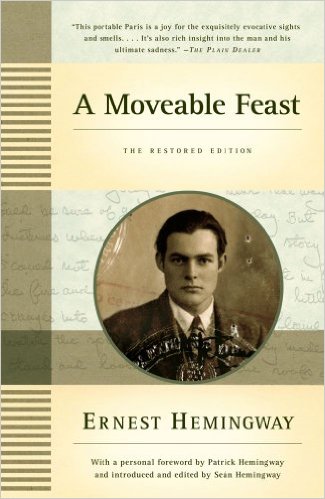
Moveable FeastWhy this Book:  My literature reading group selected it as a companion piece to The Paris Wife, since both are about Hemingway’s experiences living in Paris during the 1920s. The Paris Wife is a novel based on the experiences of Hemingway’s first wife, and A Moveable Feast is Hemingway’s own story of his experiences during that same period.
My Impressions. This book prepared by Hemingway during his final years, was published after his death, and was edited by his family and others, all of which may explain why it doesn’t feel like the other meatier Hemingway works I’ve read.  When Hemingway was preparing this in his last years, using notes and notebooks from thirty years earlier, he was probably running out of gas. This book doesn’t have the energy of his other writings.   To me it seemed like  a collection of autobiographical short stories about things that had happened to him a long time ago.  These stories, as chapters, ‘sort of’ hang together, but each can be read almost independently of the others.

While written in Hemingway’s classic sparse style, they didn’t seem to me to have been written to be a book.  Reading the Wikipedia article on the book I learn that indeed Hemingway had intended these stories to be a book – he had by chance recovered notebooks of stories and anecdotes he had written during his time in Paris in the 1920s, and worked on them off and on up until shortly before he took his own life, to make them into what became A Moveable Feast. 

It is not his best work – and my guess is that late in life, with little energy or inspiration to do anything new, he was willing to publish these stories, knowing that his name and notoriety would probably make the book of interest and probably profitable.  My recommendation is to read this book only as part of a study of Hemingway, who he was in the 1920s, and one can read the chapters separately without losing much.  I also wouldn’t recommend reading A Moveable Feast until or unless one has read several other of Hemingway works, most importantly The Sun Also Rises written during his time in Paris.  I would also read The Paris Wife first.   I would also suggest the Wikipedia article and perhaps some other analyses of  A Moveable Feast  to help better understand the background, context,  and intent of this book, Hemingway’s last published piece.  There continues to be some controversy around apparent edits to Hemingway’s draft in what finally became the published version, by his wife Mary, and grand son Sean.


Posted in Uncategorized | Leave a comment

The Sun Also Rises, by Ernest Hemingway

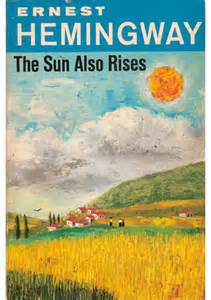
The sun also risesWhy this Book:   My reading group had selected The Paris Wife and A Moveable Feast to read for our next selection.  Hemingway wrote The Sun Also Rises during his time living in Paris described in these two books.  A member of our group noted that reading The Sun Also Rises would add a lot to understanding the other two, and recommended listening to it on Audible -that William Hurt was the reader and he did an excellent job.  He was right.   As I normally do with classics, I read the Cliff Notes along with the book – going back and forth to see what their reviewer had to say about the section I had just read.  It helped a lot. There is a lot more in the story than I had picked up, just listening to the story.

My Impressions: Listening to  William Hurt perform the various characters in this book, with different voices and accents was fascinating and enjoyable.  Given that the book had French, Spanish, Scottish and English accents as well as American, that was quite a feat and he did it well.  It was a different experience listening to rather than reading the story, and I know I missed a lot.  I know that because of insights I got out of the Cliff Notes.   In this case I realized that there was a lot going on beneath the surface of the story that I just wasn’t catching.   Listening to it, the story just rolls along, and it is easy to appreciate as an interesting story, but there was indeed much that I missed that I might have picked up, had I read it, taken it a bit slower, paused as I read,  and gone back and re-read some sections.  I will read it again, with a new appreciation.

Hemingway’s style is well known and remarkable for its simplicity and austerity.  He eschews elaborate descriptions – just tells us what he sees and what happened, and leaves it up to us, the readers to visualize it, experience it, seek to understand it, and derive our own interpretation. I’ve heard that he described his style as following the “iceberg theory” – on the surface we see only his sparse and economical prose, just the bare facts, but most of the meaning and significance is unstated and below the surface. Through his seemingly simply story telling, Hemingway seeks to build a relationship with the reader and trusts us to sense and grasp his intent, what is really happening, without having to explain things.  There is a certain Zen-like quality to his descriptions – just what is, without elaboration.   I recently listened to an interview with Paolo Coelho (The Alchemist) share the same philosophy of writing.

The protagonist in The Sun Also Rises  is Jake Barnes, a young man living in Paris, a few years after having received a wound in WWI which made him impotent.  And though this “fact” is alluded to, it is given very little explicit attention; it remains part of the iceberg in this story – unseen, but sensed, below the surface of the story.  Jake is part of a group of expat friends,  most notably Brett, a very attractive and “liberated” English woman with whom Jake is in love, and Robert Cohn, an American with whom Jake has a rather tense friendship.   Brett is very sexual, openly has a brief affair with Cohn, while also being engaged to marry one of the other members of the group.  Brett and Jake have a history – we are not clear what it was – but they clearly know each other well and are close.

The story mostly takes place in Spain during a trip the group takes to visit the running of the bulls in Pamplona. The context of the story is this adventure –  the experiences, interactions and tensions within the group during the bull fights, the running of the bulls, and the partying that goes on around this annual event.   As Hemingway describes this remarkable setting in Spain, we see the tensions grow between Jake and Cohn, and between Cohn and Brett’s fiancé, and we sense the evolving relationship between Jake and Brett. And yes, there is a bull-fighter involved.  The story finishes with an interesting and inconclusive “epilogue” that I found very well done.

This is a story about people – somehow unhappy – dissipating their time, in search of something.  This book was written during the window when Gertrude Stein referred to Hemingway as the voice of the “Lost Generation” –  those who were disoriented and alienated after the trauma and loss of idealism during and after WWI.  It was very instructive to read The Sun Also Rises after reading The Paris Wife, which I’ve reviewed elsewhere, and which it seems, pretty accurately describes the world in which Hemingway was living when he wrote The Sun Also Rises.   In The Paris Wife, we see that Sun is very autobiographical – Hemingway did indeed take a trip with a group of friends to Pamplona, and many of the characters in the book are based on real characters in Hemingway’s life who were on that trip with him.  The story itself is interesting, as is the back story on which it is based.  Indeed, a book has recently been published about the “true story” behind The  Sun Also Rises, entitled Everybody Behaves Badly.  It looks like a good read.

The Paris Wife and The Sun Also Rises together fascinated me, and I’m intrigued to know Hemingway better.  I also look forward to reading Sun again, and soon – and once again explore these somewhat self-indulgent, alienated literary misfits of my grand parents’ generation, trying to sort themselves out and find meaning, in each other and their own lives in both Paris and a small city in 1920s Spain.


Posted in Uncategorized | Leave a comment