Tijuana Straits by Kem Nunn

Tijuana StraitsWhy this book: When I recently mentioned to a friend that I lived in Imperial Beach, he recommended this book as a novel set in Imperial Beach. Wanting to know more about where I live, I picked it up. Though I didn’t particularly care for the book, I did get some interesting insights into the environment where I live – parts of the society which I see all-around me, but with which have no substantial contact and little knowledge.

My Impressions: This is one I can’t strongly recommend -it was a fun read, but not up to the caliber of the other books I’ve been reading lately.  On the plus side, the story did provide some interesting insights into the dark underbelly of the culture of the dispossessed on both sides of the border between Tijuana and Imperial Beach.  Also, Kem Nunn writes well –he has an excellent command of English and an ability to turn a good phrase –but I felt that his talent was not well used on this story.

The novel is about a beautiful Mexican woman environmental activist and social worker who someone tries to kill.   Through luck and circumstance, she is rescued by an over-the-hill, ne’er do well former champion surfer, former drug runner and convict, who was living a subsistence life-style on the edges of society in the southern rural part of Imperial Beach.  We get to know the surfer-dude – an interesting and sad character – in his 40’s and over the hill – what made him who he was, and his own disappointments with himself and his life.  Through him and his life we got a peek into the edgy world of fanatic surfers from the 70’s and 80’s.   We got to know the woman – idealistic, working hard to improve the lives of the poor in Tijuana, wiser than her young age, trying to find her path and make an impact against the greed and corruption that continue to harm the poor in Tijuana.  And we got to know the driven socio-path who was trying to kill her, shaped by a very tough childhood, consumed with hate and resentment, and a capacity for violence, killing, and survival in the nasty underworld of drugs, crime and poverty in Tijuana. The book is about the confluence of these three characters and their worlds, culminating in a fast and gripping scene that takes place in the Tijuana sloughs, just a mile or two south of where I live. It also includes some interesting insights into the smuggling, drug running, and illegal border crossing that is part of the world along the Tijuana-IB border area. I found Nunn’s writing effective, and he caught my attention with some great lines and phrases. Though at times interesting, and the story had an exciting concluding scene, the novel and the characters seemed a bit formulaic.   I also felt that the epilogue and anti-climactic ending were a bit cheesy and unsatisfying.

Posted in Book Lists, Reading | Leave a comment

Legacy – 15 Lessons in Leadership, by James Kerr

Legacy sidewaysWhy this book:  Strongly recommended to me by the Commanding Officer of SEAL Basic Training Command about a year ago. Since then, it has become almost required reading in the SEAL teams, and James Kerr has been invited several times to speak to the SEALs about the All Blacks leadership model.  I’ve gotten to meet and know him and we have had a very engaging conversation about what makes great teams.   This book has also been brought into the core curriculum of All American Leadership consulting with businesses.  It tells a great story in a truly remarkable way.

 My impressions: This is the leadership book that has resonated with me more than any other. It continues to inspire me, and I pick it up occasionally and open it to random pages for inspiration.  It is short and practical and easy to read. I suppose it works for me, because it says better than I have been able to, what I believe makes a truly ‘elite’ team. It resonates with the ideal that I and people I have admired most in my military career strived for in the teams we led. It presents an ideal based on a real team – with similarities to elite commando units and other elite high performance teams in other contexts.

James Kerr was able to embed for 6 weeks with the New Zealand All Blacks rugby team – the most successful professional sports franchise in history. Unknown to those who don’t follow rugby, they are the apogee of a great and successful team in the world of rugby, which internationally, is much more popular than America’s favorite pastimes, baseball and football.   But what they have accomplished, and continue to accomplish is the goal of any great team, in any context.

Kerr talks about how the team stumbled and struggled, but got back on their feet, stronger than ever, by returning to their core value – that individual character and dedication to the team are their most important virtues. One key theme throughout the book is how the players own their culture and hold each other accountable for living up to its values. The coaches help and guide, but the players have to enforce amongst themselves the values that make them great.   Winning comes as a result of focus on character and teamwork. Focus only on winning-in-the-short-term can lead to compromise on the fundamental values of character and team work which will cost a team over the long run. Almost every great rugby player in the world wants to be a member of the greatest rugby team of all time, but the All Blacks select their players not based on who has the most talent, but who has the best character and will fit best in their team-first ethos. Their stated policy of ‘No Dickheads’ excludes highly talented prima-donnas.  And this approach has worked for them.  Extremely well.

The All Blacks build and draw energy from their history and traditions, and an almost spiritual connection to the Maori culture of New Zealand.   Those who might find their traditions and rituals corny, won’t fit. Either buy in to the Maori haka they perform at the beginning of every game, and the extensive use of Maori language and symbolism in their team, or you don’t become an All Black. The notebook given to each new member and the on-boarding acculturation process they enforce are intense and demanding. And for that reason, players on the All Blacks rugby team value their membership in this club as among their highest life priorities.   This motivates them to live by the values of the culture, or else be told to leave.   Such dedication is a goal for any great organization.

The title of the book is Legacy – 15 lessons in leadership with the tag line is “What the All Blacks can teach us about the business of life.” Each chapter is one of these lessons. Some of the chapter/lesson titles include; Character, Adapt, Purpose, Authenticity, Sacrifice, Responsibility, Expectations, Ritual. 

A few of the many many great and inspiring quotes from this book include:

  • Aim for the highest cloud;
  • be a good ancestor – plant trees you’ll never see;
  • the strength of the wolf is the pack;
  • if you bow your head, let it be to a lofty mountain;
  • leaders create leaders;
  • ritualize to actualize;
  • leave the jersey in a better place;
  • when you’re at the top of your game, change your game;
  • sweep the sheds – never get too big to do the small things that need to be done.

And there are many more.

There is so much quality in this book, it is difficult to capture it in a short review.   If you are interested in an intense, demanding, character-driven leadership model, read this book. I recently insisted that a friend of mine, a former marine and courageous leader himself, read this book. He did -3 times through – and he can’t stop talking about how it continues to inspire him.   Maybe that’s part of why we’re good friends!

A possible short coming. The All-Blacks are an all-male team and I grew up in the largely all-male world of the Navy SEALs – so clearly, this model resonated with me.  Many teams in today’s world however are mixed-gender, and I suspect that some of the particulars of this model would need adjustment to work in mixed-gender teams.   I believe that most of the what James Kerr describes as the All Blacks model in Legacy could be adapted slightly to make it work well in mixed-gender teams.   It would be an interesting discussion – how to adapt this testosterone-fueled model of leadership and team building to mixed-gender or even to all female teams.   It would be great to get some women’s perspective on that, but I am convinced it could be done – and to great effect, but this book leaves the whether, the how, and possible considerations, unaddressed.

Posted in Uncategorized | 5 Comments

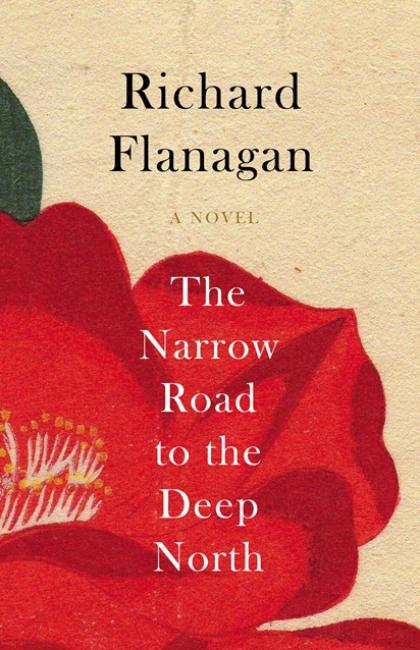
Narrow Road to the Deep North, by Richard Flanagan

Narrow RoadWhy this book: Selected by our reading group, at the insistence of my wife, Mary Anne. I recall her reading this book and repeatedly telling me that I had to read it.  She and several of those in our reading group found this to be an extraordinary book – one of the best they’d ever read.  Some reviewers are referring to it as a master piece.  I agree that it is remarkable, powerful, and extremely well written book.

My impressions: This book received the Man-Booker Prize for 2014, it is a wonderfully written book, and it covers a lot of ground.

It begins while our protagonist, Dorigo Evans is a young boy in Madagascar in the 1920’s, then takes him to young adulthood in Australia, and then into the Army as a Doctor in WWII. The center of gravity of the story takes place when Dorigo Evans becomes the senior officer over several hundred Australian Prisoners of War in a Japanese camp building the infamous Burma-Thailand Death Railway – yes, to include over the River Kwai.  Brutal. Beyond King Rat, beyond Unbroken, and yet, the author’s description of the men and the suffering in the camp has more depth and more humanity than either of those books.

What makes Narrow Road to the Deep North truly remarkable is how different sections of the book describe the very personal perspectives of several different characters – Australian and Japanese. Flanagan brings out the humanity in each. We in the west will most easily sympathize with the Australian prisoners, but we get to know the Japanese Camp Commandant – raised by kind and gentle parents – who did what he felt he had to do for his emperor and the glory of japan –though it was often distasteful to him. Brutality in the name of the emperor was not only acceptable, it was expected in their culture –he and the Japanese had been raised to fully believe that.

In one particularly memorable scene, during which one of the Australian prisoners was being beaten nearly to death as an example to the other prisoners, we experience the shame of the other prisoners, sick, emaciated, exhausted, as they stood by helplessly watching. Dorigo Evans, as senior officer, did what he could to stop it, but in so doing, made the beating much worse. And finally, Evans realizes that somehow this was as it had to be – the camp commandant was only doing what was demanded of him by his culture, his position, his upbringing, and the circumstances.

We see the horrific consequences of the Japanese unquestioning belief and total focus on their mission and cause, at the expense of any concern for individual suffering and dignity.   And we must ask ourselves, could we ‘enlightened Americans’ ever be guilty of that?

The time in the POW camp is less than half of the novel – much of this story takes place outside of the camp – before, during, and especially after the war, how Evans and several of the characters –Australian and Japanese – dealt with the aftermath. Flanagan follows the lives of several on both sides who shared that horrific experience. For all who lived and experienced the PoW camp, it shaped who they were and how they lived thereafter. A Vietnam veteran friend of mine just gave a speech in my Toastmasters club in which he shared his own experiences of grief, guilt, and regret, concluding that those who go to war never completely get over it. That is also one of the messages of this book. I would add that the closer that experience is to the killing, the dying and horror of war, the more intense the guilt, grief, regret, and the greater the psychological impact.

Though by all accounts a hero, Dorigo Evans never saw himself as a good man. He rarely felt the impulse to do good and be courageous; he merely did what he saw as his duty, and always fought the impulse to take care of himself first. But he was remarkable in his sense of duty; I was stunned by his sacrifice and his example as the senior officer and doctor at the POW camp.   Though he was renowned and revered in Australia after the war,  he was unhappy, and unfulfilled.  He was a flawed man, disingenuous with his friends and family, and inauthentic in much that he did. Though he was still driven by his sense of ‘duty,’ and  did what was expected of him,  he never followed his heart, and never did what he truly wanted to do.  He lacked the courage to step out of the roles he felt he was expected to fulfill. He never felt free to be who he truly felt he was, and never expressed his true feelings.   There is a very poignant unfulfilled love relationship that runs the length of the book, that was in part, a symptom of this reserve, and also an important source of his underlying sadness.

“The Narrow Road to the Deep North” is the title of the travel journal by the famous Japanese poet Basho.  Through his key Japanese characters, Flanagan treats us to a number of short and beautiful Haiku throughout the book. The incongruity between the beauty and simplicity of these poems, and the brutality that they somehow inspired in the Japanese elite is one of the mysteries Flanagan leaves unresolved.   As I read this remarkable book, and shared the experiences and perspectives of its many characters, Australian and Japanese, men and women, I felt the importance of accepting death as part of life, I sensed the beauty but impermanence of simple joys and happiness, that sadness and acceptance are key to understanding suffering, and that indeed our time on this earth is short…and not to be taken for granted.

Winter Ice

melts into clean water –

clear is my heart.

A world of pain –

if the cherry blossoms,

it blossoms.    

Posted in Book Lists, Reading | 1 Comment

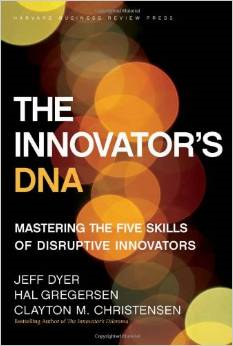
The Innovator’s DNA, by Jeff Dyer, Hal Gregorson, Clayton Christensen

The Innovator's DNAWhy this book:  My colleagues in All American Leadership selected it as a book for all of us to read and discuss. While I couldn’t make the discussion  due to a conflict, I read the book and found that it had some very useful insights.  Additionally, I read the book concurrent to my participation in Stanford’s Ignite Certificate program in Entrepreneurship and found it very complementary to the curriculum, though Ignite focused more on the commercialization of innovative ideas.

My impressions.  The authors make the simple distinction between “Discoverers”  – those who are more  creative and innovative in their approach to problem solving and life – and “Deliverers” –those who are more comfortable in managing and injecting discipline into process.  These are in fact two aspects of leadership – the openness to new and innovative approaches, and the need for disciplined adherence to process.  This book points to the healthy tension between these two, and offers a short quiz to help readers determine if they are more inclined to one or the other.  I suspect most readers already know their own predilection.

BUT the authors also make the point that with deliberate effort, one can become more innovative and creative in one’s leadership style, similarly to how, with deliberate effort, one can become a better leader. Obviously as in all endeavors –  such as leadership – some are naturally more gifted than others, but all of us can learn to think and lead more creatively – and the book offers some suggestions as to how.

The book points out how many successful businesses are founded by innovative Discoverers.  However,  managing a business is not normally a strength of most Discoverers, so boards  and investors will frequently call in a Deliverer – someone who excels in execution –  to run the business once the Discoverer’s innovation is gaining momentum.  And they point out that this step often leads to the end or the significant slowing down of  innovation for that company.  This point has been reinforced in Ignite.

Five Skills: The thesis of The Innovator’s DNA is built around  the below five  “skills,” which they associate with innovation – the first of which they classify as “cognitive,”  the other four as “behavioral.”

  1. Association between unlike events, products, experiences. Discoverers see unlikely relationships between seemingly unrelated activities, fields and endeavors;
  2. Questioning of why things are the way they are, why not otherwise, and show a natural curiosity to understand not only what is, but what might be;
  3. Observation – As part of their effort to understand their environment, Discoverers are always watching, to understand what is happening, to help them identify possibilities and opportunities. They refer to innovators as being natural anthropologists – seeking to understand how people behave and why.
  4. Networking as a means to better understand different environments. They emphasize making contact with expertise and experience OUTSIDE of one’s normal field of endeavor – and using association and questioning skills to learn what insights might apply to one’s own world. They call this “Idea Networking,” and distinguish this idea networking, driven by curiosity and a desire to learn, from networking for career connections.
  5. Experimentation – Innovators are driven by a desire to understand and succeed by learning; they understand that failures are part of that process.   Experimentation includes a strong bias for action – to try things out – even to launch products and ideas before they are fully ready – to see what happens, to see what works, and speed up the process of improvement.

Some other interesting takeaways:

Failure:  The Innovator’s DNA talks a lot about accepting failure as an important part of being creative. In fact, over and over again, they note that “the most essential part of creativity is not being afraid to fail,”  mistakes are nothing to be ashamed of, and innovative leaders and organizations don’t punish (well-intentioned) failure.   IDEO –one of the most innovative companies in America – has the slogan, “Fail often to succeed sooner.”  They quote Richard Branson : “The very idea of entrepreneurship…conjures up the frightening prospect of taking risks and failing.”

Scarcity is often a spur to creativity – figuring out how to do more with less.  It recalls to me the idea of “field expedient” solutions to problems that military people are familiar with –  finding creative ways to solve problems with whatever is at hand, without a surfeit of time and resources.

Questioning – This book echoes that great line from Peter Drucker “The most common source of mistakes in management decision-making is the emphasis on finding the right answers rather than the right questions.”   They suggest an alternative to Brain-storming: Question-storming.  When you have a problem, instead of everyone throwing up suggestions and ideas, everyone throws up questions – to help identify what is not known, as well as what might be done.

Deliverers –  Taking innovation successfully into the market place requires having skilled deliverers, not just innovators.   They list the skills of deliverers as:   Analysis, Planning, Detailed Implementation, Disciplined Execution.  At the same time, they point out how an overemphasis on delivery and efficiency can kill innovation. Innovation is by its very nature “inefficient” (over the short term) because it has to make room for activities that are not directly tied to achieving immediate results. Returning to Peter Drucker –  “People who don’t take risks generally make about two big mistakes a year. People who do take risks generally make about two big mistakes a year.”

Developing Innovators – the book has a great final appendix on how to develop innovative mindsets in children.  We could ALL learn from that.

As an inveterate associator, I think this book also applies well beyond business to how to live well and succeed in any endeavor – I believe that living well demands that we live creatively and create a unique life that fits who we are,  as opposed to accepting what is sometimes referred to as an “off-the-shelf life.”   It would be an interesting exercise to apply the principles in the Innovator’s DNA to the general art of Living Well.

A downside to the book:  The Innovator’s DNA doesn’t mention how innovators and creatives are sometimes not particularly enjoyable people and are often very hard to live with  – they are frequently so driven by their vision, their passion for creativity and innovation, that it is often at the expense of being otherwise good friends, partners, citizens, and otherwise fulfilled human beings.   Steve Jobs, Elon Musk, Richard Branson and of course, many of our most creative artists (e.g. Van Gogh, Nietzsche, Mozart among many others) are notorious for having struggled with their personal relationships and with finding happiness and fulfillment in life.  That is often the burden of being a gifted creative.   But the rest of us have benefitted greatly from their creativity – and their struggles.  It’s a point that might have been addressed in The Innovator’s DNA.

Posted in Uncategorized | 3 Comments

Dancing at the Rascal Fair, by Ivan Doig

rascal fairWhy this book:  I had read and really liked a couple of Ivan Doig’s other books – Heart Earth and This House of Sky – both beautifully written autobiographical accounts of his childhood and young adulthood in Montana in the 1930s, 40s and 50s.   A couple of months ago, I overheard a couple of my friends from the National Outdoor Leadership School  discussing Ivan Doig – he had just died.  They had each read nearly all of his books.  I mentioned that  I wanted  to read some more of him, and they both suggested Dancing at the Rascal Fair as one of his best.

My Impressions:   This is a novel of the American experience on the frontier at the end of the 19th and beginning of the 20th century – beautifully and simply written, in the straightforward style of Hemingway, or Steinbeck (but different – perhaps a bit more literary.)    The novel  is written in the first person from the perspective of Angus McCaskill a young man from Scotland who emigrates to America.

The story begins in the 1880s on the docks of Greenock, Scotland and Angus and his closest friend are facing the trepidation of leaving the only world they know, to find a relative in in Montana –and begin life anew.   Eventually these two resourceful young men find themselves in Gros Ventre, a fictional town in north-central Montana, on the edge of the Rockies, near the Canadian border.  They each decide to establish a homestead and  they both take up sheep ranching.  Dancing at the Rascal Fair is Angus McCaskill telling us his story – the key events in his life over some 35 years.   The two young men struggle to establish themselves and create a life for themselves and their families, with weather, disease, unforeseen calamity, and financial ruin always a threat.  The colorful and very believable characters in this very small ranching community help each other get through good times and bad. We experience the drama of this one man’s life against the backdrop of a harsh, unforgiving, yet magnificent natural setting – courting and marriage, love and disappointment,  children,  joy, sadness  tragedy, the seeking of redemption  –  in other words,  the struggles of life.

I very much got into Angus’s McCaskill’s  life – his head and his heart.   He is a quiet,  introspective and insightful man, who often looks to the poetry of Robert Burns for solace, to help him connect the events of his own life to something bigger – to Scotland, to the larger human experience.   He comes to accept what is, never completely giving up what might have been.   He is stoic in accepting life’s uncertainties and disappointments,  never completely trusting its joys and satisfactions.  But for Angus – we have but one choice – to do the best we can under the circumstances – and to take care of each other.

This story takes us to 1919, and we experience how the tragedies of WWI and the great flu epidemic impact this isolated Montana community.   Doig continues the story of the McCaskill family in the next book in his Montana Trilogy – English Creek, which I will get to in the next months….

Posted in Reading, story | 2 Comments

Ines of my Soul, by Isabel Allende

Why this book:  Selected by my reading group.  A number of us had read and liked other books by Isabel Allende, and some of the women were asking for a woman author after a having read several male authors.

My impressions:  This is the fourth book of hers that I’ve read – the others being  Daughter of Fortune, Portrait in Sepia, and House of Spirits.  Isabel Allende is the most widely read Hispanic author in the world – male or female – and she knows how to tell a compelling story.  This one is based on a historical figure and the novel is built around  as much as she could include of the known history surrounding the woman Ines de Suarez,  one of the first Spanish women to come to the New World in the early 16th century.   The book is told in first person,  in Ines’s voice as an elderly woman, looking back on her life  telling her life story to her step daughter just months before she dies.  Like Isabel Allende herself, Ines is a feisty and resourceful survivor, and after watching several interviews with Allende on Youtube, I sensed that she had very much injected her personality and voice into Ines – which is not only understandable, but was also enjoyable to read and experience.

The novel begins with her early life in Spain and then how she found her way to the wild and mostly uncivilized New World – very unusual for a woman of that time. She was ostensibly following her husband.  Eventually she became the mistress of one of the great conquistadors Pedro de Valdivia and accompanied him in his expedition from Peru into the wild and untamed regions south – to explore and eventually conquer what is now known as Chile.  The novel provides fascinating insights into the world of early Spanish colonization of Peru, and includes appearance of some of the early conquistadors, such as Pizarro and Almagro.  We also get a glimpse of some of the tension between the Spanish and the conquered Incas less than a generation after Pizarro and his conquistadors conqured the Inca empire.  The highlight of the book is Ines describing the hardships and challenges that she and the conquistadors faced in getting to Chile, and upon arriving, trying to establish a foothold against the resistance of the fierce Mapuche Indians.  Eventually after much hardship and fighting they were able to establish that tenuous foothold, which eventually became a seat of Spanish civilization, far from their other centers of power in the new world.

It is an enjoyable and fascinating read – especially if one is interested in the challenges that Europeans faced in their early settling of South America.  My reading group would have liked more in-depth character development of some of the fascinating men in Ines’s life – the only person we really got to know well was Ines herself – but then again, she was telling the story, and it was her story. I also enjoyed the depictions of the indigenous Mapuche Indians and their culture; apparently Allende did quite a bit of research to tell their stories as accurately as possible.  Good book. I recommend it.

Posted in Uncategorized | Leave a comment

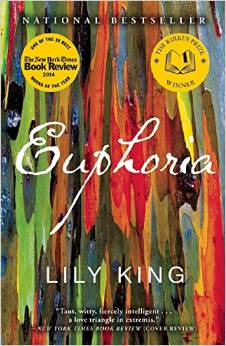
Euphoria, by Lily King

Why this book:  Recommended by a good friend.

EuphoriaMy impressions:  Euphoria is short, powerful, engrossing.  It is a good read, about very interesting people in a fascinating setting.  And it is very well crafted – a bit confusing at the very beginning, but like many good books, it quickly comes together and picks up momentum.  I finished it in just a few days – easy to get into, and stay into.  Bottom line: I really liked this book –  it didn’t move me as much as The Signature of All Things, but it was considerably shorter, and the story covered a shorter period – but powerfully so.

Loosely based on an experience of Margaret Meade in the 1930’s, it is the story of a relationship between a married pair of anthropologists living in a very remote and “primitive” village in New Guinea, and a 3rd anthropologist living in a separate village, a few hours away by boat.  The central characters are the woman anthropologist and the other man, who falls in love with her.  Much of the story is from the first person perspective of the 3rd anthropologist – who I found to be compelling and believable in how he struggled with loneliness, his love for his married colleague, his antipathy for her husband, and his struggle with the discipline required to do his work.  The story explores not only the relationship between these three anthropologists to each other, but also to the cultures they are studying in remote hunter-gatherer societies in New Guinea.

They are westerners who have injected themselves into these villages, ostensibly only to study and understand them, but their presence and avid engagement also impacted them –for good and otherwise.   This is a theme that is strongly reminiscent of Things Fall Apart by Chinua Achebe and The Poisonwood Bible by Barbara Kingsolver. We learn about the cultures our three anthropologists are studying, as we also become engaged in the dynamics between the husband and wife and our protagonist – the 3rd anthropologist.  There is good, there is evil, there is ambition and passion, there is love and frustration – there is joy and there is sadness.  All encapsulated in a relatively short, well-written book, taking place in a fascinating part of the world, so very different from that in which most of us live.   A great read and a great book for a reading group.

Posted in Book Lists | Leave a comment

Border Music by Robert Waller

Why this book:  It was selected by my reading group.

My Impressions :  A short and enjoyable read – and one that challenges the reader to look at his/her own life and decisions.  Not a brilliant piece of literature – the characters are stock and arch-typical American characters who live on the bottom end of our middle-class society –living their lives outside of the limelight of the American dream.  There is the seemingly happy-go-lucky cowboy, with an innate wisdom and sense of justice, the stripper with a good heart, who has a daughter, doing what she must to  scratch out a living, and finally, a good, solid, lower-middle class man, a husband  and father who is alienated from his work, his family and his life, who dutifully served everyone but himself – but kept his own dreams alive in a basement room where he indulged in his Walter Mitty-like fantasies.

I felt that the cowboy represented something that I believe all (American) men would like to be – completely independent, unintimidatable, but also sensitive, wise, and good.   He was an example of the “Existential Hero” in American literature – who lives by his own rules, and lives in his own way, in spite of what others may expect or demand to be ‘successful.’  The woman had to take risks and make compromises that most independent women will understand –esp at the end of the book – to take care of herself and her daughter.  The most interesting character was the middle class man who had let himself be cowed most of his life, but had diligently kept the spark in his soul alive, and in the end, broke out of the rut he had been in.

The “Music” in Border Music was an interesting twist.  The characters were constantly referring to tunes throughout the book – Country Western Tunes, Old Rock & Roll tunes, how the lyrics inspired them.  That was a clever and enjoyable piece of the book.  A good part of the book takes place in automobiles, where the music on the radio, or playing on the cassette provides a backdrop and inspiration to the dialogue.

Some in our reading group didn’t like this book –felt the characters were clichéd and the book was too formulaic and shallow.   I however enjoyed it and found that the characters can offer a challenge to any reader, if they’ll accept it: What is important in our life – and are we pursuing it?  Where is the heart?  There is some joy, and some sadness.   A short read, an easy read, a fun read, and if  selected by  a group open to looking at their own lives, one that can provoke a good discussion in a reading group, as it did ours.

Posted in Uncategorized | Leave a comment

The Signature of All Things, by Elizabeth Gilbert

Why this book: Recommended to me by a good friend.

SignatureMy Impressions: Bottom line –wow!  I’ve never read  a book like this before –found it very powerful. Elizabeth Gilbert pulled me into this story – I felt like I grew close to the main character Alma Whitaker, and was drawn into her world.

The book is about the life of a fictional woman in the 19th century who grew up in a unique family.  It began with the story of her extraordinary father – the progenitor of this new clan of Whitakers.  He reminded me somewhat of the driving figure in the book The Son by Philip Meyer.  After we got to know the father and how he became one of the wealthiest men in the newly formed United States at the end of the 18th beginning of the 19th century, the book shifted to the inner world and life of his only daughter, Alma.

The book is very much about the growth, development, and personal struggles of the main character Alma Whitaker– in a confined world in which she was educated to be precocious, in ways that did not fit then-society’s views of how women should be, act and live.  She became almost by default, but certainly also by nature, a scientist, driven by an overwhelming rational and scientific approach to everything she did.    But she struggled with loneliness, a desire for family and love, and isolation from conventional society, while driven by  a desire to know, understand and be a part of the world of scientific (botanical) discovery.  Eventually she does fall in love, with a man who is more poet and mystic than scientist, with unpredictable consequences, and her life takes a very sharp turn –especially when her father dies, and leaves his enormous wealth to her alone.  Then she comes to understand some things about her past that she hadn’t known.   (No spoilers here – I want  you to read this book!)

When the book concluded, I had come to love and admire this woman and, as is often the case with well-developed characters in well written books, when I finished the The Signature of All Things, I was sad, and immediately began to miss Alma Whitaker.  The title refers to an idea by Jacob Boehme, a German cobbler and mystic of the 16th century, who believed that all things in this world have a unique and divine signature.   In  the words of one of Elizabeth Gilbert’s characters, the signature is a clue “…that God had hidden …for humanity’s betterment inside the design of every flower, leaf, fruit, and tree on earth. All the natural world was a divine code….”   This idea is very subtly, but definitely, a theme throughout this wonderful novel.

I loved this book.

Posted in Uncategorized | Leave a comment

From Here to Eternity by James Jones

Why this book:  I have been hearing about, and seeing this book referred to for years.  I have been fascinated by the idea of the Existential Hero in American Literature since taking a course in that subject in college.  This book definitely belongs in that genre. I also really liked the movie starring Burt Lancaster, Montgomery Clift, and Deborah Kerr.

My Impressions:  Note – the below comments are excerpted from emails exchanged between a group of us who read this impressive book together in December 14 and January 15.  FHtE demands that you commit to it – like a getting into a relationship  – and reading it has included all the hard work, frustration, patience, head-scratching, joys, and satisfactions of any intimate relationship.    It’s been worth it for me – one of the best and most powerful books I’ve ever read.  These are some random points I made to my co-readers, and below, some points they made to me.

  • Two very strong personalities struggling to love each other –  Karen Holmes and Milt Warden.
  • Both of Holmes and Warden struggling with the futile goal of realizing ideal romantic, total surrender love, while also trying to hold on to their personal prerogatives, obligations, identity and goals.
  • Hypocrisy in expectations in marriage – more so then than now – my parents’ generation.
  • Men with a love-hate competitive relationship with each other
  • An underlying theme of despair throughout the book
  • Robert E. Lee Prewitt as ‘existential hero’ applying passion and no-compromise integrity in situations that inevitably led to his destruction
  • The character Jack Malloy  (not in the movie) one of the most interesting characters in the book or in any of the literature I’ve read.   Though he makes a relatively brief appearance, I think he is James Jones ‘avatar.’
  • The wise and practical survivors – Warden, Stark, Chief Choate, Malloy – willing to compromise and bend to forces more powerful than themselves, but willing to standup against the machine when something truly important was at stake – but always keeping a handle on their personal survival. Prewitt lacked this capability – though he admired it.
  • Chief Choate as a wise, but sad figure (Gary sees him as an earlier version of Chief Bromden  in Ken Kesey’s One Flew Over the Cuckoo’s Nest
  • Cpt Dane Holmes as a pitiful figure – most officers in the book, in fact are pitiful figures
  • Lorene – cold and ambitious, but transformed by a disappointing glimpse of real love (with the wrong guy) and then reverting…
  • Men as children – and the Army as their parents.  Do what you’re told, and we’ll reward you with alcohol and sex, but if you don’t, we’ll put you in the penalty box.  The Army seemed to insulate these men from confronting who they really were as adults, with responsibility for their own lives, and allowed them an extended childhood.  (This continues to be the case with being in the military, I’ll argue – I’ve lived it!) All were drawn to the idea of  the Army almost as parent or surrogate God which assumed, and they willingly gave, responsibility for their lives.  Jack Malloy saw that; I’m not sure Prewitt and Warden ever did…. They loved and bought into the security the Army provided
  • I think the women – Karen and Lorene recognized their men as the children they were, and they were ready to step in to be surrogate mothers for them, as well as lovers….In fact, I think this is something most (wise) women eventually come to realize and accept….

My friend Janar who read this with me, made the following interesting observations – his views and words, not mine:

  • Robert E. Lee Prewitt is a symbol of the Confederate States of America <Bob’s note:  Prewitt is the Montgomery Clift character in the movie>
  • He dismisses one woman who loves him because he does not want to have “a raft of snot nosed nigger brats”
  •  Another woman who loves him, sees him as an economic future as a romantic but unrealistic dream, and insists on remembering him in heroic terms, a pilot who died as a war hero trying to get his aircraft off the runway during the Japanese attack
  • Like the Confederate States, Robert E. Lee Prewitt reaches his physical high water mark in combat in a knife fight, just as the South reached its high water mark in a bayonet charge at Little Round Top; and like the Confederate States, Robert E. Lee Prewitt dies as a result of an unnecessary and ultimately stupid gunshot, just as the South lost several more thousand as a result of the unnecessary and ultimately stupid attack at Cemetary Ridge.
  • Robert E. Lee Prewitt, embodying the military virtues of the South, is a masochistic Christlike figure; Warden by contrast may symbolize the Union; at the time of the novel, 1941, America was still just 75 years removed from the Civil War; today, we are 75 years removed from 1941. (Bob’s note: Gary, one of my other co-readers also noted the Christ-like symbolism in the struggles and suffering of Prewitt)
Posted in Book Lists, Reading | Tagged , | Leave a comment