Starting again Jun 15

I am re-activating this blog post.  I have continued enjoying a fairly broad spectrum of reading since my last post here, nearly 4 years ago, but I have failed to take the time to record my thoughts and impressions.  Unfortunately.  I think it’s valuable to me to digest and then write down a few impressions after each book I read, and perhaps these impressions will be of interest to others. Time to start again.

Below is a list of the books I’ve read since reading Portrait of the Artist as Young Man, by James Joyce – my last post.  If anyone wants to discuss or share a thought with me about any of these, let me know. I’ll try to post a few brief impressions of the last few books I’ve read, just to get this blog started again.  And to force me to do a bit more digesting of what I’ve spent so much time doing.

Books I’ve read since then which are not reviewed here:

  • Lady Chatterley’s Lover, by D.H. Lawrence
  • Ploughman of the Moon, by Robert Service
  • Harper of Heaven, by Robert Service
  • What it is like to go to War, by Karl Marlantes
  • The Heart and the Fist, by Eric Greitens
  • I Know Why the Caged Bird Sings, by Maya Angelou
  • Gather together in my Name, by Maya Angelou
  • Darkness at Noon, by Arthur Koestler
  • The War that Killed Achilles, by Caroline Alexander
  • Ender’s Game by Orson Scott Card
  • The Things They Carried, by Tim O’Brien
  • Where do we go from here, by Orr Kelley
  • One Day in the Life of Ivan Denisovich, (2nd time) by Solzhenitsyn
  • One Flew Over the Cuckoo’s Nest (3rd time), by Ken Kesey
  • Source, by Leon Jaworski
  • Fearless, by Eric Blehm
  • Lolita, by Nabokov
  • War is a Racket, by Smedly Butler
  • Way out Here, by Richard Leo
  • Vagabond of Verse, by James Mackay
  • King Rat, by James Clavell
  • Life of Pi, (2nd time) by Yann Martel
  • Laura Ingalls Wilder – a Writer’s life, by Pamela Smith Hill
  • Ishi in Two Worlds, by Theodora Kroeber
  • Who moved my Cheese, Spencer Johnson
  • Tribal Leadership, Logan
  • The General, by CS Forrester
  • Good bye to all that, by Robert Graves
  • Rainforest Innovation, by Horowitt and Hwang
  • Great by Choice (2nd time), Jim Collins
  • Poisonwood Bible (2nd time) Barbara Kingsolver
  • The Road Past Mandalay, by John Masters
  • The Education of Little Tree, by Forrest Carter
  • No Easy Day, by Mark Owen
  • The Cellist of Sarajevo, by Steven Galloway
  • The Wisdom of Crowds, by James Surowiecki
  • Heart Earth, by Ivan Doig (17 May)
  • This House of Sky, by Ivan Doig (1 Jun)
  • My Uncle, Butch Cassidy by Bill Betenson (8 Jun13)
  • Little Big Man, by Thomas Berger (17 Jun13)
  • Angela’s Ashes (2nd time) by Frank McCourt (29 Jun 13)
  • Sailing the Wine Dark Seas – Why the Greeks Matter, (21 July 13) by Thomas Cahill
  • ‘Tis, by Frank McCourt (2nd time) (1 Aug 13)
  • The Sparrow (8 Sep 13) Mary Doria Russell
  • Master and Commander (Oct 13) by Patrick O’Brian
  • Caleb’s Crossing (12 Oct 13) by Geraldine Brooks
  • Tortilla Flat, (28 Oct 13) by John Steinbeck
  • Damn Few, by Rorke Denver 20 Nov 13
  • Things Fall Apart, by Chinua Achebe 8 Nov 13
  • And the Mountains Echoed by Khaled Hosseini Nov 13
  • To A God Unknown, by Steinbeck (2nd time) 1 Jan 14
  • Crossing the Unknown Sea – work as a Pilgrimage, by David Whyte 26 Dec 13
  • The Moon is Down, by John Steinbeck 12 Jan 14
  • Teams on the Edge, by Shawn Stratton 14 Jan 14
  • High Altitude Leadership, by Schminke and Ward 24 Jan 14
  • The Son, by Philipp Meyer     22 Feb 14
  • What is the What, by Dave Eggers 18 Mar 14
  • One Man’s Wilderness: An Alaskan Odyssey by Keith & Proenneke Apr 14
  • Travels with Charlie,(2nd time) by John Steinbeck
  • Shadow of the Wind, by Carlos Ruiz Zafón  16 Apr 14
  • Orphan Master’s Son, by Adam Johnson 15 June 14
  • Thirteen Clocks, by James Thurber  July 2014
  • Snow, by Orhan Pamuk  Sept 9 2014
  • Children of God, by Maria Doria Russell Oct 2014
  • The Great Santini, by Pat Conroy  Oct 22 2014
  • Adultery, by Paolo Cuelho  Oct 2014
  • In Paradise, by Peter Matthiessen 21 Nov 2014+
  • Man’s Search for Meaning,(4th time) by Viktor Frankl
  • Kingdom of Ice, by Hampton Sides  2 Jan 15
  • Shadow Lessons, Tim Reardon Feb 15
  • Legacy, James Kerr 23 Feb 15
  • Change the Culture, Change the Game, by Connors and Smith  23 Feb 15
  • No Hero, by Mark Owen  23 Mar 15
  • Conscious Capitalism, by John Mackay 23 Mar
  • Innes of my Soul, by Isabelle Allende  Apr 15
  • Anna Karenina, by Tolstoy  Mar 15
  • Turn the Ship Around, by David Marquet Apr 15
  • Farewell to Arms, by Ernest Hemingway Apr 15
  • One of Ours, by Willa Cather – May 15
Posted in Book Lists | Leave a comment

Portrait of an Artist as a Young Man, by James Joyce

Why this book:  It was selected by my reading group.  Also, I bought a copy while an undergraduate, planning to read it and never did. The copy I read is that copy, paperback, with a price $1.65 on the cover.

My Impressions:   Not an easy book to read at all.  It is commonly believed to be semi-autobiographical retrospective by James Joyce on his childhood and coming of age, into his late teens.  The ‘Artist’ is a complex and sensitive young man growing up in late 19th century Ireland of an upper middle class family; he is trying to understand and come to terms with a variety of forces in his life pulling him in different directions:   His boisterous and irreverent friends;  his parents and family, in particular his father, who is a fairly conventional and gregarious middle class burger;  the growing power and force of his own sexual yearnings; the church and it’s dictates on his life; his own reason and growing sense of intellectual independence; his romantic idealism and sense of himself as a creative artist.

The book is written in the language of the educated middle and upper classes in Britain at the end of the 19th century, when language was one of the primary indicators of education and class.  It is written for readers of this time, and people of ‘education and class’ had the time and predisposition to savor the well constructed and articulate sentence, the nuances of a reference to an obscure piece of literature that the author could assume everyone of ‘education and class’ would have read.  He quotes liberally in Latin, without feeling the need to provide translations – all of the readers for whom Joyce was writing had studied Latin for years – it was  staple of Catholic education (was there any other?) in Ireland. 

The book provides the anguished and self-conscious perspective of the introverted, sensitive ‘young man’ from his childhood into late teens.  We see the world through his eyes, and we are listening in on his thoughts, dreams, insecurities, and concerns.  It is a ‘stream of consciousness’ style which Joyce was one of the first to use, and which opened up this genre for others who have used it differently ever since (Virginia Wolfe comes to mind to me). 

I asked the members of my reading group why this is considered a classic of English literature, especially when for young people today (and not so young people – I struggled with it too) it seems so labored and difficult (one member of my group called him ‘autistic’).   I think it is highly regarded for several reasons:  1) It was an early precursor to the stream of consciousness style of writing; 2) it provides what I believe to be a subtle and nuanced perspective on the development of the sensitive, creative, introspective, and well educated mind;  3) the English is beautiful and exquisite, though sometimes difficult to follow; and 4) it is a relatively short work with which to be introduced to James Joyce, without having to labor through Ulysses or Finnegan’s Wake.

Though I can’t say I enjoyed the book, there were parts which I  will not soon forget:  1) how as a shy boy and young man he perceived his more gregarious, and boisterous classmates; 2) the emotional and intellectual disconnect between him and his firmly practical and middle class parents; 3)The moral agony he accepted from the Catholic church after his frequenting of prostitutes – and how he accepted (initially) all the guilt that the Church willed upon him.  4) His response to his sense of guilt by seeking  moral perfection through asceticism, and then his decision to embrace the world as it is, and essentially walk away from the church  and 5) How he gravitated to the aesthetic impulse as a refuge for his romantic idealism, while still struggling unsuccessfully to let go of his romantic attraction to women. 

Reading this book is a bit like look at a mosaic up close.  Each vignette at the beginning stands alone, but seems disconnected.  But as one reads further, it is like moving away from the mosaic, and one sees the patterns.  Toward the end of the book we see the picture that Joyce was painting of the development of this particular artist – himself – as a young man.

Posted in Uncategorized | Leave a comment

Slaughterhouse Five by Kurt Vonnegut

Why this book:  Selected by my reading group.  I had read it as an undergraduate and it made a strong and positive impression on me. I remember it more than most books I’ve ever read.

My Impressions: The book is ostensibly a novelized version of Vonnegut’s experience as a hapless soldier in WWII, captured by the Germans, interred in various PoW camps, and finally surviving the fire-bombing of Dresden because of the lucky coincidence that the PoW’s were kept in Schlachthof Funf – Slaughterhouse Five – just outside of town.  The running theme of the story is the story of Billy Pilgrim, something of an adaptable dolt who just seems to flow with whatever is happening.   He never seems to make a decision – just goes along for the ride – reminding me of Meursault,  in Camus’s existential classic, The Stranger, emotionally detached from the world around him.  Billy Pilgrim, like Meursault, does what people want him to do, just goes wherever life pushes him, displays no passion toward anything.  At least Meusault realizes at the end of his life, that life is to be grabbed and experienced, not simply endured.   I’m not sure Billy Pilgrim ever realizes this.  I almost had the sense that Vonnegut had PTSD after his WWII experiences, and dealt with the horror of war, by completely numbing the feelings of his character, and perhaps himself.   Billy Pilgrim is a go-with-the-flow guy to the extreme, and is never particularly happy or sad. 

But what made the story particularly different and interesting is the science fiction quality of the story (Vonnegut angrily resisted the  characterization of his book as ‘science fiction’.)  Billy Pilgrim did not experience his life sequentially in time – his life existed as a complete entity from beginning to end, like a book that had already been written.  His self awareness and self consciousness did not go thru the book sequentially through time from beginning to end; rather his consciousness simply bounced around through the book of his life.  He knew how and when he was going to die, what ‘the future’ would bring, who and how he would marry, what his career would be, what would happen to his parents and family.    This ‘knowledge’ seemingly had no effect on on him. It was as though you were to spend your life reading the same book, reading portions from the end, or the middle, and then the beginning, and shifting to other parts….forever.   His life seems to have a ‘yeah, whatever’ quality to it.  One reads, “and so it goes”  again and again, especially when a person, or a thousand people die. 

There was a clever section in which Billy Pilgrim is abducted by aliens and put in a zoo as a species from another planet.  This allowed Vonnegut to satirize human attitudes and behavior and Western Culture from the perspective of more enlightened aliens.

This book was written in the late 1960’s and at the time, it was regarded as an anti-war commentary coming from a WWII vet with a quirky personality.  He had a section in which Billy Pilgrim watches a WWII movie in reverse, which makes a very clever commentary on the absurdity of war.  

Fun, fascinating, clever, and easy read. Worth re-reading. Listed on many top 100 novels lists of the 20th century.

Posted in Uncategorized | 2 Comments

Brothers Karamazov, by Fyodor Dostoyevsky

Why this book:  I had already read it twice before, but it was selected by my reading group and I was very willing to read it again. This time I read  (I believe for the first time) an unabridged version which was also a new and very good translation ( by McAndrew). Also, I enjoyed reading the book WITH the Cliff notes. The book is rather long – nearly 1000 pages – so after each of the ‘books,’ into which the novel is divided, I reviewed the Cliff notes summaries and interpretations.  I recommend this for anyone reading a long classic.

My Impressions:  There is so much to this book.  But essentially I believe it is a look at human nature and spirituality within the context of a so-called murder mystery in mid-nineteenth century Russia.  Dostoyevsky was clearly also writing for a Russian audience, and much of the book was a commentary on issues that were current in Russia at the time. 

Much wiser and more articulate reviewers than I have studied and reviewed this book, but I offer a couple of my impressions that may be of interest.  This book was the culmination of Dostoyevsky’s life as a writer, and through it he sought to express  his ideas on spirituality and how we get along and live together in our communities.    I believe Dostoyevsky created a type of  ‘spiritual heirarchy’ in the book, with Father Zossima at the top, along with our protagonist Alyosha who aspired to Zossima-like wisdom and faith.  After Alyosha, it would be interesting to debate who would be next, since all others are distinguished mostly by their character flaws, though all have redeeming qualities.   But briefly, brother Dmitri is driven by his passions and emotions – representing the passionate life without the practical wisdom that reason can provide as a governor.   Ivan is driven by a keen intellect and a very analytical nature – representing the thinker, but with insufficient passion, or emotion, and no ‘spiritual grounding.  And Smerdyakov,  the bastard, is driven by his resentment and need for respect and as well as revenge.

Common to nearly all novels that seek to address the breadth of human nature, ‘love’ is a key theme, and we see it in The Brothers Karamazov in its many manifistations – from the lustful, to the romantic to the spiritual.  The story focuses on about 3 or 4  days in the lives of  four half-brothers, sons of a manipulating old moral reprobate.  At the end of these few days, the father is found murdered, and it is assumed that one of the brothers killed him.   The majority of the book takes place in these 3 or 4 days, and Dostoyevsky develops the characters of the four brothers through their interactions with each other and some of the lesser characters of the book.   The investigation and trial take place a couple of months later and make up perhaps the final quarter of the book.   In the trial, Dostoyevsky further develops and explores the main characters of the book, by allowing us to see their responses to the mulit-layered stresses of the trial.    Within the context of the trial, the community and culture come directly and explicitly into the lives of the protagonists, and we see some of them rise to the challenge, and others crumble.

A book which examines love in its many manifiestations will obviously include women.  The 19th century, male-dominated Russian perspective that Dostoyevsky represents is clearly ambivalent about women – there are some strong  women,  but they are all supporting characters.   Grushenka,  the sexy and manipulating  seductress for whose affections old Fyodor and his oldest son Dmitri compete is powerful, passionate, clever, but conflicted.  Katarina is the romantic idealist, in love with Dmitri who doesn’t love her, loved by Ivan who she doesn’t love.   As Dostoyevsky explores the minefield of romantic love we see passion and turmoil, moments of ecstasy, but no lasting happiness.   This we see  in contrast with the more selfless spiritual love of Alyosha and Father Zossima.

I continue to think that this book is a great book for exploring human nature and values – but it takes a thoughtful and mature reader, and one who is willing to explore these  issues through a 19th century Russian lens.   I look forward to embarking on the adventure of reading it again, but with the right partners.

Posted in Uncategorized | 2 Comments

Just and Unjust War, by Michael Walzer

Why this book:  I spent a whole semester in seminar studying this book at the Naval Academy and was stunned to learn so much about the ethics of my profession at the end of my career.  I wanted to provide the opportunity for those still ‘in the fight’ to have that same opportunity, and so offered to run a condensed version of the seminar for active duty Seals.   Alas, few came – all too busy.  But it was a good session for me, and those who were able to come.

My Impressions: It was  good for me to re-read Walzer with other warriors and discuss some of his ideas.    I learned a lot in the discussions, and I believe so did those who participated.   Our discussions were all over the map – because the Walzer readings touched on related issues that are of concern to each of us, in different ways, today.    There is still so much more discussion that we left on the table –  75 minutes for two of these chapters was hardly sufficient – but we’re all busy, and that 75 minutes was of much greater value (to me) than re-reading the book and having no discussion. 

The book and our discussions covered the basis for and against military ethics, Preventative and Pre-emptive War, justifications for humanitarian interventions,  the moral equality of soldiers,  what it means to ‘fight well,’ terrorism, and guerilla warfare.   Some of the key points that came out of the book and our discussions : 

     – The morality of any single action in combat is very much a function of context.

     – There are no (or very few) ‘rules’ that appear to apply in ALL circumstances.  Walzer’s supreme emergency argument can even over-ride non-combatant immunity, which is the fundamental principle of military ethics. 

     – He argues against the ‘sliding scale’ which is used to justify much immorality in war.  The ‘sliding scale’ is the argument that the greater the injustice that would result from my defeat, the more latitude I have to break the rules in order to prevent my defeat.

     – The obligation of assuming risk to protect non-combatants is an important part of military ethics.  He especially argues against transferring risk onto non-combatants to improve the survival odds of soldiers, or increase the odds of victory.

     -The only thing that ALWAYS seems to be a moral prohibition, is killing for any reason that cannot be somehow tied to ‘military necessity.’ 

This book should be read, and re-read by anyone in the military who claims to be concerned with the moral aspects of their profession.

“ The destruction of the innocent whatever its purposes, is a kind of blasphemy against our deepest moral commitments.  This is true even in supreme emergency, when we cannot do anything else. “ Michael Walzer

Posted in Uncategorized | Leave a comment

The Wrong War, by Bing West

Why this book:  I had read a number of reviews of this book,  and thought it would be good to learn more about the war in Afghanistan from a respected journalist on the ground there.  I also agreed to read it with two of my friends still serving with the Naval Special Warfare community.  One would read War, by Sebastian Junger, one would read,  The Warriors, by J.Glenn Gray,  and I would read The Wrong War.

My Impressions:  The Wrong War is about our ongoing war in Afghanistan, and is essentially a compilation of Bing West’s personal experiences as an embedded reporter with US Army and Marine ground units in eastern Afghanistan on the Pakistan border, and in the south during the battle for Marjah.   He writes convincingly in the first person of battles he witnessed and participated in, offering anecdotal descriptions of his experiences with the troops, and he makes comparisons with his own experience as a marine in Viet Nam 40+ years ago.  He also offers his views on the political climate, not only in Afghanistan, but also in the US.   He has several messages that he reinforces throughout the book:  first, that nation-building is not an appropriate mission for line troops; it erodes their combat skills and requires skills the military generally doesn’t have, and nation building is a long term commitment that the military is inappropriate and unable to fulfill. Secondly, he challenges the current orthodoxy that we can win this war by winning the hearts and minds of the Afghan people.  He makes this point with numerous examples that show that the cultural divide between our military troops, and the relatively primitive agrarian world they are fighting in is a gulf that is almost too wide to breach.  Thirdly, he believes that our senior political and military leaders are out of touch with the realities on the ground, and their policies and strategies are born of wishful thinking rather than the ugly truths that the soldiers on the ground see every day.  And fourth, our troops are doing an extraordinary job carrying out a thankless and probably hopeless mission.

He offers a simple solution for how to get out – though for me and for other reviewers of this book – it is too simple:  turn this baby over to the Afghans as fast as we can and get the hell out of there.  He comments on the commonly articulated position that we cannot kill our way to victory, by noting that we will not win unless we kill a lot of bad guys who are intractable enemies of the West and all that we stand for.  Yes, the “accidental guerrillas”  described by David Kilcullen in his book of the same name  are there as well, but the Taliban is indeed fueled and led by people who are fanatic in their ideological  commitment to their cause.

Bing West reminds me somewhat of David Hackworth, the most decorated officer of the Vietnam War who became a renegade and then an iconoclastic journalist.  His book About Face was read by many of  my colleagues 20 years ago and it is still widely read by young men in the military.  Like Hackworth, Bing West has the going- in position that the troops know the truth, and their leaders, the ‘political generals’ are not worthy of them.  West, like Hackworth before him, derides the political and military leaders (who Hackworth called ‘bureaucrats in uniform’), without making any real effort to understand their perspective and their dilemmas.   Life on the front can indeed be very simple: Take care of your buddies, take care of your mission, write and call home, survive.  It can be much more complicated at the national strategic and political military arena with conflicting missions, conflicting principles, a complex and uncertain group of stakeholders.  This book is about the view and experience of the soldier or marine on the ground – a reality that West does a pretty good job of convincing me is not sufficiently taken into consideration by our policy makers and strategists.

Posted in Uncategorized | Leave a comment

The Great Gatsby, by F. Scott Fitzgerald

Why this book:  Selected by my reading group.  I vaguely remember reading it in high school.  It is so often referred to I thought it would be a good book to read again.

My Impressions:  This is not the same book I read in high school. Or at least it didn’t seem to be as I read it- obviously I read it with a whole new perspective.  I guess I understand why high school English teachers assign this book – it is short and on the surface a simple morality tale about how decadence and self-indulgence don’t pay.  On the surface it provides a glimpse into the debauched lives of wealthy young people, with the satisfying conclusion that wealth doesn’t make us happy, and that people who live as if middle-class morality doesn’t apply to them, suffer in the end.  Ok, maybe.  But I think that is a very limited perspective on this fascinating little book, and that is NOT what I read this time through.  This is a much more interesting book than that, and I think Fitzgerald had a different message.

The story is told from the perspective of Nick Carraway,  a cautious, but thoughtful  go-with-the-flow  kind of guy.  He is a somewhat dispassionate, sensitive and insightful observer of others, but not very engaged or engaging himself.  Carraway reminds me of the narrator in Robert Penn Warren’s All the King’s Men.  The Great Gatsby and All the King’s Men are stories told in the first person by shy, thoughtful, somewhat retiring narrators about larger than life protagonists who meet  tragic ends.    We get to know Jay Gatsby through Carraway’s eyes and Gatsby is much that Carraway is not – self-possessed, wealthy, confident, somewhat narcissistic.  Gatsby is an enigmatic intriguing character from the beginning, and we get to know him little by little throughout the book.  Fitgerald also introduces us to Daisy and Tom Buchanan, and Jordan Baker to round out this group of well-to-do  twenty-or-early-thirty somethings with money and time to burn, living on Long Island, a short distance from NYC.   We see in their relationships with each other hypocrisy, pretense, confusion, disillusionment, resignation, and grudging admiration.  Gatsby is an admirable and tragic figure who succumbed to a passionate infatuation with a dream, embodied by poor Daisy, who was hardly worthy of his attention, but embodied his own dreams for himself and his future.   Poor Daisy, young, impressionable, beautiful,  charming, but not-too-bright, and not yet too worldly-wise.  She wanted something, but she wasn’t sure what – love, security, stability, a comfortable place in society, a good man to be married to?  Things that most women want? Gatsby surely wanted love and respectability, and was willing to go to great lengths to get it. 

I had to respect and admire Gatsby – in some ways more so than our cautious and moralizing narrator.  We know how Gatsby ended up – Fitzgerald does not leave us with the impression that the other characters would find happiness and/or fulfillment, though it is easy to predict that they would continue looking for it, in all the wrong places. 

The over-riding theme that I saw was the under-lying superficiality in the lives and relationships of people who take themselves and their good fortune entirely for granted, and give little thought to anything beyond fulfilling their own selfish fantasies.  The other sub-theme to this superficiality was how it leads to dysfunction and even toxicity in love relationships.  Gatsby and  Daisy, Tom and Daisy, Myrtle and  George Wilson,  Carraway and Jordan, Gatsby and his father, Carraway and Gatsby.

Beautifully and efficiently written, this deserves its place among the classics of American literature.

Posted in Uncategorized | Leave a comment

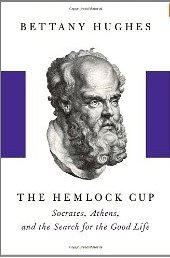
The Hemlock Cup: Socrates, Athens, and the Search for the Good Life by Bettany Hughes

Why this Book: I read a fascinating review of this book in the Wall Street Journal. Went right to my Kindle and had it downloaded.

My Impressions: I really enjoyed this book. The author of the WSJ book review is a classics scholar at Stanford, and though he pointed out some of what he called factual errors, he strongly recommended the book, and he was right to do so. Bettany Hughes writes very well, and she brought this fascinating and key period in our Western tradition to life.

The book looks at life in Athens during the Golden Age of Greece through the prism of Socrates’ life.  He fought in most of the wars and key battles of the era, knew and was well known by all of the influential people of Athens at the time.  Ms Hughes is able to connect Socrates to nearly everything that happened of significance during Greece and Athens’  golden age – the last decades of the 5th century BCE.  I was surprised to find that in some ways the turbulence Athens experienced at the end of the 5th century BCE has some parallels with our own.  The Athenians strongly believed in themselves as the most enlightened country in the world, and aggressively sought to expand their influence and their idea of democracy.  Pericles was a Bill Clinton-esque character; his mistress Aspasia was very controversial and hated for the power she exercised over and through him , and she was accused of corrupting the women of Athens.   The intrigue and back biting and viciousness of the era surprised me, while at the same time these people created perhaps the most enlightened government and culture in history to that point.  But most of the people in Athens and Greece were simply trying to live their lives and get along, as are we today.  And reading about how they lived, it doesn’t seem that they were much different from us in temperament.   I also enjoyed learning how much new material about this era is coming to light every year in archeological excavations.  Many of the most interesting facts and insights were based on findings in the last 10 to 20 years.

She offers an explanation as to why Socrates was such a controversial character and why he was sentenced to death. He drank the hemlock in 399 BC just after democracy had been restored after the infamous year of so of the Thirty Tyrants.  The Thirty Tyrants, led by Critias,  a former student of Socrates, overthrew the Athenian democracy and ruled Athens with terror, seeking to purge Athens of their enemies and to even-up old scores.  Shortly before Socrates’ trial, they were themselves overthrown and a fragile democracy was restored to Athens.  But , after so much internal blood-letting and terror, people were jumpy and scared, which in part explains why they were in no mood to continue to tolerate a Socratic gadfly. 

Yes, this was a short, easy to read, and very interesting book.

Posted in Uncategorized | Leave a comment

The Bridge of San Luis Rey by Thornton Wilder

Why this book:  Selected by my reading group.  I had read it twice before and was happy to read it again.

My Impressions: This is a short book, about 120 pages and won the Pulitzer Prize for literature in the late 1920’s.  It is a series of stories, within a larger story of a Franciscan brother in 18th century Peru trying to understand God’s justice.  After an ancient Incan bridge had collapsed and five people had fallen to their deaths, the brother decided to research their lives in the belief that this could not have been a random act – God in his wisdom and mercy must have had a reason for putting these specific five people on the bridge when it collapsed.  He believed that with enough research he could find a pattern that made sense of these deaths.  He believed that man must be able to understand God’s justice, and it was inconceivable to him that a merciful and just God would let people die capriciously. 

The book then commences to tell the stories of the people who died when the bridge collapsed.  Each of these people was at a different point in their life’s journey, and like each of us, taking care of life’s business while pursuing happiness, fulfillment, and meaning in their own ways.   We see each of the adults chasing happiness and fulfillment down a series of dead end and blind alleys, each sad and tragic in their own way, but none of them any more or less bad or deserving of an untimely death than any of the rest of us. Two of the people who died were children, innocent of the sins and excesses for which we hold adults accountable.  The stories of these individuals were (for me, but not for everyone in my reading group) fascinating, not only for their own unique approaches to living, but for the insights they gave to life in 18th century colonial Peru.  At the book’s conclusion, the Franciscan brother predictably reaches no clear conclusions about how these people might have deserved their fate.  His exhaustive research was unsuccessful in finding a meaning in these people’s lives and deaths, unsuccessful in decoding fate and chance.   He and his research are subsequently deemed heretical by the Catholic Church, for whom fate and chance, the meaning of life and death, and God’s justice are matters of faith, not science and analysis.

Within the small city of colonial Lima, Peru, our five victims had all in some way crossed paths with the Abbess of Lima, who ran a home for orphans, the sick and the destitute.  The Abbess is something of a peripheral player in most of their lives, yet, as the book concludes and we are no further along in understanding the purpose of these people’s lives and why they died, our author returns to the Abbess, and her life.    By looking at her and how she lives, we are led down a different path to find meaning and value in the lives not only of those who died, but also in those they left behind. The book concludes with the Abbess thinking to herself, “But soon we shall die and all memory of those five will have left the earth, and we ourselves shall be loved for a while and forgotten. But the love will have been enough; all those impulses of love return to the love that made them. Even memory is not necessary for love.  There is a land of the living and a land of the dead and the bridge is love, the only survival, the only meaning.”

I really like this book – it is an elegant little story about the search for meaning in life through the prism of a tragedy during a period in history and in a part of the world I find fascinating.  In a few years, I will read it again ‘for the first time,’ and again draw insight and inspiration from it.

Posted in Book Lists, Reading | Leave a comment

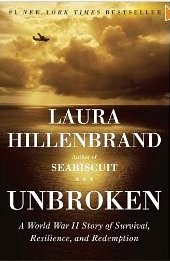
Unbroken: A World War II Story of Survival, Resilience, and Redemption, by Laura Hillenbrand

Why this book: My wife read this book and told me that I definitely needed to read it.  She reads more than I do and she doesn’t make that recommendation very often.  My friend Liz Train, a voracious reader herself, also suggested that I read it and that I would enjoy it.  But I was into about 4 books at the time, and knew that I might never get to it, so I purchased the CD version to listen to in the car while commuting.  So I didn’t really read the book, I listened to it, and listening to the story was a great way to enjoy this book.

My Impressions:  The book is written by a Laura Hillenbrand, a master story teller (Sea Biscuit), and belongs in the classics of survival literature about the triumph of will and the human spirit.    The book begins with stories of Louis Zamparini’s misadventures as a juvenile delinquent, then progresses to how he becomes a record setting distance runner and Olympian (1936 Berlin.)    After the war begins, he becomes an Army Air Corps officer, and when his plane goes down in the Pacific, the meat of the story begins.  The next section of the book describes how he (with two other men) survived 47 days adrift in the Pacific on a tiny rubber raft.  As they finally reach an island, they are taken prisoner by the Japanese, and the next section of the story is about his nearly 3 horrific years as a Japanese Prisoner of War.  At the end of the war, we learn of his liberation, his repatriation, and joyful reunion with his family.  Then more struggles ensue with his descent into alcoholism and other destructive behavior as he continues fighting the demons that he carried with him from his time in the Japanese Prisoner of War camps.   He eventually has a spiritual re-awakening, and creates a new life for himself– a life that still continues.  He was one of the torch carriers in the Olympics in the 90’s, became a prolific supporter of not-for-profit causes, and was an inspirational public speaker for decades.   Liz Train emailed me that she had lunch with him in April while he was in Hawaii promoting the book.

One of the shocking insights to come from this book was how the atrocities and humiliation that the Japanese inflicted on their prisoners rival the horrors the Nazis inflicted on their victims in the concentration camps in Germany and Poland.  Apparently because of his celebrity as an Olympian, Zamparini was allowed to survive when others were murdered; also perhaps because of his celebrity, he was targeted for even more concentrated and degrading abuse.   The dropping of the atomic bombs on Hiroshima and Nagasaki came two weeks before PoW camp commandants had been ordered to murder all their prisoners.

The books makes clear that Zamparini and other PoW’s realized that maintaining their sense of human and personal dignity, in the face of extreme and persistent degradation and dignity-robbing abuse, was key to their survival.  This point echoes Viktor Frankl in Man’s Search for Meaning.  Zamparini’s defiance in the face of brutal and degrading treatment was key to his survival.  He fought and struggled to maintain his human dignity in the most dehumanizing environment imaginable.  And somehow, he succeeded.  Laura Hillenbrand now calls him the Ambassador of Joy.  This is also a story of forgiveness and redemption.  A wonderful book.

Posted in Uncategorized | Leave a comment