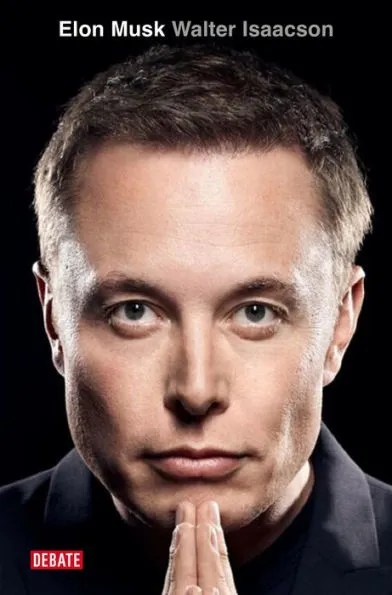
Elon Musk, by Walter Isaacson

Why this book: I had recently read (listened to) Isaacson’s bio of Steve Jobs and thought he did a great job.  My wife was reading this Musk bio and kept commenting on it. So I uploaded the audible and got started. 

Summary in 3 Sentences Elon Musk grew up in South Africa under an abusive father – and because he was clearly very precocious, and to escape from his father and teh unpleasantness in South Africa, he left to go Canada as a teenager.  Soon after got to the US, made it to Silicon Valley where he began his long journey of turning ground-breaking ideas into reality. This book goes into Musks many near failures that turned into major successes with Pay Pal, Tesla, Space X, Open AI, neuralink and other AI projects, Tesla and self driving cars and more.  It also covers his turbulent personality and private life, with judicious praise and criticism and an impressive effort to be fair and dispassionate. 

My Impressions:  Definitive biography of Musk’s life to this point. I listened to it on audio, so was unable to take notes and highlight sections as I listened to it, which is too bad – there were so many highlight-worthy quotes and insights in the book.   A good list of quotes from this book are available on Goodreads here.

This book provides the backstory on so much that  is happening in the news today – cutting edge breakthroughs in technology that are taking us into the future:  SpaceX, AI, electric vehicles, robotics, neuralink, social media and more… and Musk himself is such a remarkable, yet bizarre character.   A world leader w Asperger syndrome.  Driven, somewhat narcissistic, an idealistic visionary and of course, his personal life is unique and not one most of us would aspire to.  He was emotionally abused as a child – which continues to affect him and the way he treats some around him.  He is relentlessly driven, demands that of others around him,  and has overcommitted himself to the point of exhaustion,  unable to relax for more than a few hours at a time.  He has 10 kids w three different women, and wants to be buried on Mars! It’s a fascinating book.  And his achievements and contributions to technological progress are legendary.  And he’s not done yet. 

Though the book doesn’t say so, I assume Musk had read Isaacson’s bio of Steve Jobs which  was done with Job’s permission and a promise to be hands off.  It appears Musk gave Isaacson the same permissions to do his biography.  Musk’s conversations with Isaacson about events and people are balanced by the perspectives and comments from others affected by Musks actions and decisions – who include many who are not great fans, people who’ve been abused and fired by him, as well as his family, friends and people in his inner circle.

Musk has a unique relationship to risk which Isaacson continues to come back to. He loves drama and the process of risking it all and getting the big pay off. With his rocket launches he took many risks, which led to some epic failures but were essential to his ultimate success.  His motto is to Fail Fast,  learn and move on. 

Musk therefore had no patience with bureaucrats and processes that are designed to slow down progress and mitigate risk.  With his teams he had an “algorithm” which Musk repeated over and over gain, and which had five commandments.

  1. Question Every Requirement.  And you must know the name of the person who made the requirement.
  2. Delete any part of a process you can . You may have to add them back later. In fact, if you do not end up adding back at least 10% of the, then you didn’t delete enough.
  3. Simplify and Optimize. After step 2.  A common mistake is to simplify and optimize a process that shouldn’t exist. 
  4. Accelerate the cycle time – after following the first 3 steps.
  5. Automate. This is the final step – and shouldn’t be done until all reqiremetns had been questions and parts and processes deleted. 

Corollaries

  1. All technical managers should have hands-on experience. There is often too much of a gap between decision makers and those who carry out those decisions. Which leads to bad decisions.
  2. Camaraderie is dangerous.  Hard for good buddies to challenge each other’s work or to fire those who aren’t cutting it. 
  3. It’s OK to be wrong.  Just don’t be confident and wrong.
  4. Never ask your people to do something you’re not willing to do
  5. Whenever there are problems to solve, don’t just meet with your managers. Do a skip-level, where you meet the level right below your managers.
  6. When hiring, look for people with the right attitude. Skills can be taught. Attitude changes require a brain transplant.
  7.  A maniacal sense of urgency is our operating principle
  8. The only rules are the ones dictated by the laws of physics. Everything else is merely a recommendation. 

This biography is not only a look at an interesting life, it is a look at a man, a team, a philosophy that is changing the world with not only ideas that initially seem outrageous, but a drive and focus that  get them done and prove his detractors wrong.  He breaks a lot of eggs and makes a lot of enemies in the process – enemies of people who are invested in conventional wisdom, and slow, deliberate process. 

He claims to be politically center-right, economically conservative, and socially liberal, and to have a strong libertarian streak. He has taken on the scions of Silicon Valley and gone to war against what he calls the “woke mind virus” that has infected the progressive left.   Musk hates DEI as an enemy to meritocracy and personal accountability – he is clearly not racist, nor homophobic nor any of those other discriminatory labels – he actively seeks the most capable and driven team players who passionately buy into his vision.   Kind of like the SEAL Teams – emphasizing competence and drive, being a good operator and good teammate. That’s part of why the SEAL Team reading group I help lead has selected this book for it’s April 2024 selection.

It is also a book about leadership.  Being innovative, creative, breaking the rules, demanding and getting top notch performance, not being afraid to let people go who aren’t living up to your demands, or the demands of the job.  He insists that it is imperative for the leader to know details – and to insist that all managers and workers know and understand them as well. But we also see the toxic side of being too emotional, blunt and rude when under stress.  He is moody, sometimes unpredictable, and not easy to work for.   But no one can argue that his approach has not gotten things done and achieved amazing results – even those who work for him admit that he’s gotten them to accomplish things they didn’t think possible. 

Musk has little tolerance for mistakes or for people who want a balanced life. He routinely and unhesitatingly calls people in from vacation, at all hours of the night, on weekends and expects uncomplaining compliance.  But in this, he leads by example, constantly sacrificing time with his family or other endeavors for his work.  Often, he sleeps on the floor in his office and works 7 days a week and doesn’t know how to relax.  A number of his best employees leave, simply burned out, unable to maintain his pace and to ask the sacrifices he demands from their families.  I might have enjoyed this pace of work when I was in my 20s or 30s, but for long, and not after I had a family 

Bottom line: This is a fascinating book about a fascinating man – a somewhat off-balanced, driven,  genius.  It is extremely well written with insider perspectives from an author who was able to sit in on many of the meetings, and meet with the players.  Isaacson gets Musk’s comments on his critics and mistakes, and offers his own balanced perspectives on what he has seen, heard, observed and learned about his subject.  Can’t recommend this book highly enough.  

Posted in Uncategorized | Tagged , , | Leave a comment

The Desert and the Sea, by Michael Scott Moore

Why this book:  January 2024 selection  by my SEAL book club, in part because one of our members knows the author and was able to get him to join our discussion.

Summary in 3 Sentences:  Michael Scott Moore was kidnapped in 2012 and spent more that 2 1/2 years as hostage of Somali pirates who were demanding an exorbitant ransom payment. Not only do we learn of the boredom, frustration, discomfort,  uncertainty and fear associated with being a terrorist hostage,  but Moore also gives us background into the role of piracy in history, the history and culture of Somalia and what his experiences did to his personal values, and sense of himself and his place in the world. It is rich not only with details of his experience but also with his insights, and personal and spiritual growth that came from it. 

My Impressions:  Fascinating read about one man’s experience as a captive in a part of the world about which we read a lot, but know little.  He writes with a journalist’s flair for putting the reader in his shoes, and making his situation real and immediate.  

I have read a number of books by POWs and prisoners – among them and most notably, Stockdale’s In Love and War,  Frankl’s Man’s Search for Meaning, and this one shares some qualities with those books – all of which include spiritual insights and reflections, suffering, fear and uncertainty, and an adversarial relationship with the captors.  But this one adds something different to that genre – Moore is a journalist with a flair for keeping his audience engaged, and also his captivity was part of a commercial venture – to make money for the captors.  He had a different relationship to his captors, and he had a different hope and expectation for release in the midst of suffering and uncertainty. 

In The Desert and the Sea, we experience with Moore, the months and years of uncertainty, changing news and prospects for recovery, frustration and anger with the lies, deception and even stupidity of his captors, as well as his fear and anxiety of what would come next, and whether he would survive. He also describes Somali culture and history, his relationship with his captors and his fellow captives, and there were many fellow captives  All were being held for ransom – this is a business in Somalia, as it has been in Mexico and other parts of the developing world – capturing citizens of first world nations and holding them for ransom. 

His description of his life before the capture, his childhood and his work as a journalist are all relevant to his experiences and reflections during his captivity.  While in captivity, several times he was beat up, physically abused,  his wrist was broken, he got malaria and only received the medical care that the captors believed would keep him alive long enough to get the ransom they were demanding.  They hoped and expected to get $20m for him in ransom, because in their minds, the US is a rich country and could afford it. They didn’t believe him when he told them that governments don’t as a matter of policy pay ransom.  His captors in general had very little understanding of the world outside their own domain. 

Through Moore, the pirates were able to get in touch with his mother, who was coached by the FBI about how to respond to their demands and phone calls.  His mother’s experiences during this period make up an important part of this book.  The pirates hired negotiators to help them get the money they were demanding, but their demands were way beyond what his friends and family could pay – it then  became a negotiation over price.

Moore  was held captive in various run down remote buildings in the Somali countryside, which he described variously as stinking cess-pools or filthy shit holes. He was fed the same basic beans and gruel, occasionally a bit of meat.  For part of his captivity he was kept on the Nahan3 a ship that the Somalis had captured and had anchored off the coast of Somalia, where he was one of many other  hostages, most of whom had been ship’s crew on various vessels that they had taken. His time on the ship was more tolerable, in that they had plenty of food, he made some friends with other hostages, and there were no mosquitos.  

Throughout his captivity the pirates were aware that US surveillance was looking for him.  During his captivity, there had been a successful rescue by Navy SEALs of Jessica Buchanan and Poul Thisted who had been taken hostage and held for ransom after working on a Danish humanitarian project in Somalia. During the rescue, the SEALs killed 9 Somali pirates.  The pirates holding Moore were aware of this and very afraid of a potential rescue attempt, and vowed to kill Moore immediately if one were attempted.  When they were aware of drones or surveillance aircraft, they hid him, while Moore himself did what he could to make himself visible to any such aircraft.

Ultimately a much lower ransom was paid and Moore was released, and he describes that process at the end of the book, as well as how his life changed afterward. He was able to reconnect with a number of the other hostages who had been able to attain their freedom.

A very engaging  and well-written book.  In addition to a fascinating story, it provides insights into Somalia culture, Somali pirate culture, his strong but occasionally flagging will to survive, his personal and spiritual struggle and growth during a period of suffering and uncertainty, and the squalid and anxious life that hostages for ransom face.  

I like and agree with Barnes and Noble’s short review: 
“A sort of Catch-22 meets Black Hawk Down, The Desert and the Sea is written with dark humor, candor, and a journalist’s clinical distance and eye for detail. Moore offers an intimate and otherwise inaccessible view of life as we cannot fathom it, brilliantly weaving his own experience as a hostage with the social, economic, religious, and political factors creating it.”

Posted in Uncategorized | 2 Comments

The Count of Monte Cristo, by Alexander Dumas

Why this book: Selected by my literature reading group because none of us had read it, though it is included on most lists of the greatest novels ever written.  That said, most in the group were intimidated by its length and didn’t read it. 

Summary in 3 Sentences:  A happy young man is framed by several men who are jealous of his happiness and prospects for success and he is imprisoned with little hope of release on an Island off the coast of France. While in prison, he becomes friends and a protoge of an old Abbe who had also been framed, and who reveals to the young man where a great treasure is hidden. The Abbe dies, and our protagonist is able to escape, recovers the treasure, reinvents himself as the Count of Mone Cristo, and the remainder of the novel is how he exacts his revenge on those who had framed him and had him sent to prison.  

My Impressions: The Count of Monte Cristo lived up to its billing as one of Western Literature’s great novels. That said, one must make allowances for when it was written, for what audience, and how it would be read.  

The Count of Monte Cristo was originally written as a serial in 18 parts and was released in France over nearly a year and a half.  Knowing that, one sees how Dumas built tension into the book, created detours in his story to entertain and edify his readers, and keep them coming back as the plot evolved. 

To take on The Count of Monte Cristo is to begin a great adventure, and to fully appreciate the novel, it is best to see it that way. The story is generally well know, but what enchanted me was the feeling of immersion into the culture of France in the early 1800s.  That includes the political turmoil surrounding Napoleon’s assumption of power, the return of the King and Napoleon’s banishment to Corsica, his return to power and finally his banishment to Elba.  Edmond Dantes (Monte Cristo’s original name) is accused of spying for Napoleon prior to his return to power from Corsica, which lands him in prison, in the Chateau d’If (a real island castle off the coast of Marseille, France)

Because it is very “long form” we get to know the people, their values and prejudices, their joys and sorrows in a way that is not possible in shorter novels.  We get to know life in the middle and upper classes in France during this period and the characters indeed come to life. And of course, we compare  their culture to our own, our values and perspectives – my,  how people have stayed the same, while culture and values have changed.

The book begins with us getting to know Edmond Dantes in his world, as a happy, talented and promising young man, engaged to be married to woman he loved.  He is betrayed by men who were jealous of his happiness and success, and who after he was imprisoned, went on to profit from his absence and misfortune. The people we meet here – the three men who manufactured his “crime” and framed him,  the prosecutor who also wanted Dantes out of the picture, and Dante’s fiance – these are people we will get to know again 20 years later when Dantes reappears in disguise as the Count of Monte Cristo to exact his revenge anonymously – at first. 

The next portion of the book is about Dantes in prison, dealing with his misfortune, not understanding how or why it happened – almost Kafka-esque in the absurdity of it all. Then he meets the Abbe Faria who teaches and inspires him, until he is able, through cunning and luck, to manufacture an escape.

Dantes is able to recover the Abbe’s treasure to become suddenly extremely wealthy, but he doesn’t reveal himself to the world as Edmund Dantes.  We then lose track of him until he re-emerges as the mysterious Abbe Busoni in one identity, and the Count of Monte Cristo in another  – two identities he uses for the remainder of the book. He doesn’t admit to being Edmond Dantes until the very end.

The remainder of the book is a long story in which we get to know the mysterious Count of Monte Cristo and what has happened to his various antagonists, and how he interacts with them.  There are many side stories which entertain and edify the reader, and paint the picture of France in the early 19th century.

Key themes that I saw:

Edmond Dantes as a young man in love Dumas describes his hero in his early years as a good, eager, moral and ambitious young man, engaged to a beautiful woman and clearly on the path to success. He  someone who is admired by most, but also bitterly envied by those who didn’t have his gifts, talents, or other advantages. One of those who envied him was a competitor for a position on the ship Dantes worked on, and another was in love with the woman Dantes was planning to marry.  These are the ones who plotted to  frame Dantes, and have him arrested, which led to the rest of the story.

Dantes evolution in prison Dantes finds himself in prison on the infamouis Chateau d’If off the coast of Marseille (with many similarities to Alcatraz) with little hope for release, and he doesn’t know why.  He suffers, considers suicide, but survives.  He makes contact with Abbe Faria who also had been framed and was sentenced to life in prison, but who had learned to cope with his fate.  The two became friends, plotted opportunities for escape, and eventually the Abbe revealed to Dantes where he had left a great treasure.  When the Abbe died, Dantes was able to escape, and become “The Count of Monte Cristo.”

The Influence of Abbe Faria  Abbe Faria is undoubtedly the moral hero of the book.  He inspires moral growth in Dantes and though he dies relatively early in the book, his influence is felt in Dantes decisions and actions throughout the book.

His revenge plot – Dantes, now The Count of Monte Cristo, wealthy beyond measure after finding the Abbe’s treasure, is able to find out how and why he was sentenced to life in prison  on the the Chateau d’If, and then to plot his revenge.  It was indeed an ingenious and intricate plot, and adhered to the old adage that revenge is a dish best served cold.  It took years to unfold, and part of his intent was for the co-conspirators lives to be ruined but not to know how, or by whom, as was the case with Dantes.

His final insight – In the end Dantes has succeeded in his goals, even reconnects with his former fiance  with whom he’d remained in love, but too much had happened to each of them in the intervening years since their betrothal to renew their relationship.  Dantes took care of her and her family and then metaphorically “rode off into the sunset,” with an exotic woman whose life he’d saved.  We don’t learn what happened to them.  I did some research and several authors wrote sequels to The Count of Monte Cristo,  and some are considered quite good, but Dumas did not.  

What is missing: There is much in this book which requires the reader to suspend disbelief, but for me the biggest question is what happened to Dantes from the time he found the treasure to when he begins his effort to find and exact revenge for his imprisonment.  Over perhaps a decade, Dantes used his wealth to educate himself, to travel the world, to become multilingual, to become well-versed in the arts – to become a well-travelled man of letters and sophistication.  We are amazed at how he’d reinvented himself as the mysterious Count of Monte Cristo, but we learn little of how he did it.  Money and wealth can only do so much. 

Since I have some experience reading translations of great books, I did some research to determine the best translation, and came up with the Penguin Classics version, translated by Robin Buss and published in 1996.   Many of the other translations were done in the 19th century by Victorian era translators, and the English of that era. Buss’s translation is more accessible to modern, especially American, speakers of English, and corrects what he felt are many errors in the early translations.  The translator’s “notes on the text” at the beginning explain how and why he felt a new translation was important for modern readers.  
Also, I purchased a Cliff Notes to use to follow the book, which I do with most classics.  The Cliff notes version was ok, but used a different translation which had reordered the chapters.  I found that the Wikipedia article on the book was better, and wish I had read that instead as I read the novel. 

Posted in Uncategorized | Tagged , , , , | 1 Comment

Orbital, by Samantha Harvey

Why this book: Selected by my Sci Fi Reading Group – when I offered to bring in a friend of mine who is currently in Astronaut training with NASA to discuss it.

Summary in 3 Sentences: The book takes place during 24 hours within an International Space Station orbiting the earth – during which the space station orbits the earth 16 times.  We get the inner thoughts, experiences, impressions and perspectives from six astronauts – 2 women and 4 men, from Russia, UK, US, Japan. Italy. We get not only their impressions and perspectives, but also the author’s own thoughts about the significance of humans being in space, looking down from 250 miles, onto the earth where the rest of us live. 

My Impressions: Powerful and very much worth reading. It is short – about 200 small pages with large print, a 3, 4, or 5 hour read, but I read it in shorter intervals – and that is the way I believe it should be read it.  The book is divided into 16 chapters, each representing one of the orbits during the 24 hour period of the book.  But the chapters are not a chronological narrative of time. The sixteen chapters are simply a mechanism for the author to break up her story into various aspects of being in space and the stories and perspectives of the characters.  

Though it is a novel, it is also a meditation on being human, from the perspectives of six people from different parts of the world who are living together in a situation which is so very different from normal human life, that they can’t help but spending a considerable amount of time reflecting upon their own  humanity. There is also a cross-cultural dimension to their interactions, but the cultural differences seem trivial compared to the common humanity they share and the extensive training they’ve gone through to be there.   

They orbit the world and look down on different parts of it, 16 times a day, observing where they had lived, where their families are, countries with which their countries are either at war or experiencing significant tensions. Also with a direct view looking away from earth into the immensity of space, they are forced to confront the infinity of space, of the universe, of time, and the relative insignificance of their personal problems and the problems of earth within that unimaginable infinity.

They also have to adjust their basic human requirements to the dictates of near zero gravity in space – and this forces significant adjustments to the most basic of human needs:  sleep, eating, exercising, excretion, as well as privacy in a very confined space. In Orbital we learn about the nausea that most get during the first days in space, the challenges of adjusting to sleeping, moving, nearly all activities in a world in which there is no up or down. The author notes of one of the men:   “With the atrophying of the body, life doesn’t tug at him so much….he sleeps because he must, but his sleep is mostly tentative, not deep or robust as it is on earth. Everything in his body seems to lack commitment to the cause of its animal life, as if there’s a cooling of systems, an efficient running down of superfluous parts.” p 120 Without gravity, everything seems to slow down, and their sense of time is distorted because some how, it is tied to a  sense of space, which seems somehow to be tied to a sense of gravity. 

They think about why they are there – why THEY were selected from so many others, Why even try to live and thrive where one is not built or designed to live, much less thrive – why leave earth at all?   And thinking about the many chores and scientific experiments that they are running in space – couldn’t an AI robot do most, if not all of these tasks, perhaps better than they, and not have to deal with so many human needs and limitations?   Three of the astronauts had already been in the space station for nearly six months; three had arrived just a couple of months ago.  All were ambivalent about the prospect of leaving the simplicity and the “God’s eye view” of the earth, suspended in space.

They think about the discrepancies between what their training told them to expect and what they actually experienced in the space station, acknowledging that there’s no way to fully prepare for the dissonance between their lives on earth and their experience in a space station orbiting the earth 16 times in 24 hours.   When they look at earth, they see no borders (except the lights along the India Pakistan border,) cities and towns are visible only at night from the light they emit.   They come to prefer to view the earth during the day – “the humanless simplicity of land and sea,,” p106 where there are only patches of green, and brown, and white and many shades of blue of the various oceans and seas. 

This book entices the reader to imagine life in the confines of a small space, with a few other humans, traveling in space 250 miles above the earth.  In so doing, one may be able to distance oneself from the preoccupations and problems, that encumber our consciousness and our time here on earth.  And, I believe, that is the challenge Samantha Harvey presents to us in Orbital – to put ourselves in the environment she describes so well, and imagine ourselves apart from our earthly vanities and preoccupations, and more connected to the immense universe that surrounds us. 

Posted in Uncategorized | Leave a comment

The Stranger in the Woods, by Michael Finkel

Why this book: My wife read it several years ago and never quit insisting that I read it. She’d gifted it to our kids.

Summary in 3 Sentences: At age 20, an  unusually intelligent, but socially introverted young man decided spontaneously and with no for-thought, decided to leave behind the civilized world and all its banality and awkward social conventions, and live alone in the woods of Maine.  And he disappeared from his friends and family and lived in the Maine woods for 27 years, with no contact with other humans, surviving by breaking into cabins and other buildings in the general area of his camp to steal food and other things he needed to survive.  Once he was finally caught, he he pleaded guilty to all counts, refused to share more, but opened up about his life, thoughts and perspectives to only one man – Michael Finkel during his trial and incarceration after being finally caught. 

My Impressions: Fascinating story – a short (190 pages) and quick to read – I finished it quickly and  could hardly put it down.  It is a story I will not soon forget and have recommended it to many others.   

In 1986 Chris Knight,  the”Stranger in the Woods,” otherwise known in Maine as the “North Pond Hermit,” disappeared from society, not telling anyone what he was doing, where he was going,  and walked into the woods, where he lived for the next 27 years. Alone. Surviving only by breaking into cabins and other facilities to steal food and necessities essential for survival only, but also books and magazines, as well as portable computer games. This is the story of what he did to survive, how he lived, his thoughts and perspectives, how in 2008 he was finally captured, forced to return to society, spent time in jail, his trial, etc.. 

In addition to the story of Chris Knight – the author briefly explores the history and motivations of hermits down through the ages in a variety of religious and cultural traditions – those who have chosen to pull away from society and live alone.  He also explores the genetic and psychological dimensions of those who have little or no need for social interaction – anomalies in our very social world.   

But Chris Knight was unusual – he did not want partial seclusion, nor did he seek it for only a finite period of time. He sought no contact with other humans whatsoever, and had no plans to return to civilized life. His motivation was not anger or revenge or to run away from some specific trauma, not spiritual enlightenment, nor was he embarking on a period of contemplation to prepare him for greater success upon returning to civilized life.  He just wanted solitude, and to be left alone. Forever.  He had been unhappy in society, alienated from the civilized world he had grown up in, but he felt very much at home in the woods.  Indeed he did feel guilt at having to steal in order to live the lifestyle he’d chosen, and so he only stole things he found essential to live – nothing of significant monetary value or for sale, and he made every effort to not damage or do other harm to the homes or facilities he robbed. In order to not be discovered, he normally only left his very well camouflaged campsite at night – and eventually became very proficient at moving quietly and stealthily through the woods, and leaving no tracks.

Law enforcement had tried and failed for decades to find and catch him, but after he was finally caught, he displayed unusual honesty about what he’d done, and contrition for the stealing and the inconvenience and fear that he had caused.  Michael Finkel was intrigued by his story and was the only person able to establish enough of a rapport with him to get him to talk.  He was the only person with whom Knight would share any thoughts or feeling   In his multiple interviews, Chris Knight proved to be not only very private and eccentric, but also unusually forthright, a man of unusual integrity, intelligence and insight. He was also very opinionated about some things – especially about the banality of modern civilized life.   He had few social skills and psychologists debated whether he was on the autism or schizophrenia spectrum, but none of those traditional labels fit. He was unique.  

While living alone, he spent his time reading books and magazines he had stolen, listening to a small radio using batteries he had stolen, or tidying up his very remote and camouflaged campsite, and during the fall, preparing for the coming winter.  But mostly he spent his time just sitting and thinking. Winters were particularly brutal, and there were times when he believed he would not survive.  Indeed, he had contemplated suicide, and actually expected, even planned to die alone in the woods. He spoke of a “relationship“ with the Lady of the Woods, which is how he described death.  He said that he had met with her, and looked forward to ultimately meeting her again.  At the end of the book, the author shared that Knight demanded that Finkel never contact him again, and leave him alone.  

This was a very interesting book about a very interesting man, how his community reacted to his stealing, the mythology that grew up around “the hermit of North Pond,” how they reacted to his ultimate capture, and then the aftermath. It is also a book about a man’s pathological, though perhaps  understandable response to the busy-ness and banality of modern culture, and about solitude as an alternative.   Chris Knight’s choice to completely withdraw was indeed extreme, eccentric and ultimately immoral, as he depended on theft and preying on others to support his choice of a lifestyle.  In order to avoid contact with or dependence on others, his decision to resort to theft did not respect the property, and rights of others in his community.   The author, many in his local community, and I had feelings of respect and admiration for Chris Knight, mixed with serious qualms and discomfort with his moral compass.  Chris Knight himself shared these same feelings. 

 I’ve recommended this book to many friends.  

Posted in Uncategorized | Tagged , , , | Leave a comment

On Great Fields – the Life and Unlikely Heroism of Joshua Lawrence Chamberlain, by Ronald White

Why this book:This is the second biography I’ve read of Joshua Chamberlain.  I was so impressed with what I’d read about him in Killer Angels, and how he was portrayed in the movie Gettysburg. Also West Point chose him as their iconic “leader of character” to inspire cadets – even though he didn’t go to West Point.  A man to be inspired by and to learn from.

Summary in 3 Sentences: This biography covers Chamberlain’s life from his childhood in a small town in Maine through young adulthood, his impressive academic achievements at Bowdoin College and promotion at a very young age to professor. The middle pert of the book is about his famous service in the Civil War, which included his defense of Little Round Top at Gettysburg for which he was awarded the Medal of Honor, and the last third of the book is about his rich and varied life after the war, which included 4 terms as Maine’s governor, president of Bowdoin college, a decade as an entrepreneur and more.  

My Impressions: I listened to rather than read this book, as I knew I would not get around to reading it, but I have admired what I’ve known of Chamberlain for a long time.  It was narrated by the author – which in some ways enhanced the book, in other ways detracted, as his voice is low and bass, and was sometimes hard to hear when there was background noice.  But the content was great – especially if you are predisposed as  was I to greatly admire Chamberlain and want to get to know him as a human being, complete with his joys, and disappointments, failures as well as successes, human flaws, as well as his remarkable strengths.  To most who know of him, he is simply a mythical hero. After reading the book and learning more about him as a human being, I admire him even more.  Not a superhero, but a man and human being of great character, courage and integrity. 

The author, Ronald White, has focused much of his work on Civil War heroes, having also written Lincoln – a biography, and Lincoln in Private – what his most personal reflections tell us about our greatest President, and American Ulysses – A life of Ulysses S Grant.  He is clearly an admirer of Chamberlain – otherwise he wouldn’t have taken on the book – but he tries to be fair and judicious in his account of his decisions and life, and includes aspects which may not always be considered admirable. 

Chamberlain was born in 1828 and grew up on a small farm in rural Maine in the first half of the 19th century, but had unusual curiosity and dedication to learning. As a child and young man he stuttered, which he overcame to eventually teach oratory and  become one of America’s most sought after public speakers – especially after the Civil War on topics related to the Civil War.  Because of his hard work and gift for inspiring students he was given a professorship at Bowdoin College at a very young age – in his late 20s –  when Bowdoin was one of the top institutions of higher learning in America. 

When the South seceded from the union, he volunteered to serve in the Union army, though he didn’t have to, and Bowdoin College discouraged him from doing so.  But he felt it was his duty, and would have been hypocritical for him to encourage other young men to fight for the union cause, while not doing so himself.  At that time he was newly married and his wife was pregnant.  He was given command of the 20th Maine volunteer Company and distinguished himself as a leader, protecting the Union flank at Little Round Top at Gettysburg, which potentially saved the Union army from Confederate envelopment in this pivotal battle of the Civil War.  For his courage and leadership at Gettysburg, he was eventually awarded the Medal of Honor. He was subsequently promoted to Col and eventually to Brigadier and finally brevet Major General.  He was badly wounded several times and one of his wounds at the battle of Petersburg was considered mortal.  Though he did survive, the wound never healed and was a source of pain, discomfort and infection for the rest of his life.  He was selected by Grant to represent him and the Union army in accepting the surrender of the Confederate Army of Northern Virginia after Grant and Lee had signed the surrender documents at Appomattox.   With all the attention and accolades he’d received, he was remarkably humble and always stayed focused on what he considered to be his duty. 

The rest of the book might seem an anti-climax, but his time as president of Bowdoin College and his four terms as governor of Maine, and beyond that, as one of Maine’s most prominent citizens brought their own drama.  He did not go quietly into retirement as a hero of the Civil War.  At one point, after Chamberlain had been governor and while he was president of Bowdoin, a gubernatorial election dispute was about to lead to armed insurrection.  The then-governor called on Chamberlain as one of the most respected men in Maine to step in and help quell the emotions and bring order back to Augusta, Maine.  This was a very dicey affair, but he succeeded by standing between the armed parties and insisting that they’d have to kill him to get him to relent on his commitment to have the State Supreme Court adjudicate the dispute.  Eventually both sides accepted Chamberlains solution, which ended the insurrection, but won Chamberlain the enmity of powerful forces on both sides of the dispute.

He really didn’t care for being president of Bowdoin College and tried to resign 3 times, but his resignation request was denied each time, until the fourth time when health issues from his Civil War injuries as well as the continuing stress of the job forced him to step down.  Two aspects of being president of Bowdoin didn’t appeal to him:  He didn’t care for the resistance to change among the faculty and board of trustees – Chamberlain had many ideas and initiatives that were ahead of his time, which to us today seem self-evident and reasonable, but were resisted then by the faculty, and then not approved.  Also he hated fund-raising which was one of his main duties. But he was still “General Chamberlain” a hero of the Civil War and one of the most pre-eminent citizens of Maine.  All the while we are learning through his letters about his family, his joys, his disappointments and self doubts, and his relationship with Fanny his wife of nearly 50 years.  

What made Chamberlain remarkable? What made him Chamberlain?  First, an unwavering sense of duty to a larger calling – to God, to humanity, to his country, to what was right.  As his son said of him, he was not very adept at taking care of himself, because he was always so focused on taking care of others.   He had a great faith in God and providence and submitted himself (and his wellbeing) to whatever God and providence had in store for him – he never bewailed his fate, and though he was occasionally tired and discouraged, he remained optimistic and publicly maintained an always upbeat demeanor.  He was also intellectually curious and gifted.  He taught himself Hebrew, Spanish, French, German, classical Arabic – in fact in his 70s, he chose to travel to Europe (alone – his wife was in poor health) visited the many countries whose languages he’d learned and then went to Egypt, where he read the Koran in classical Arabic to help him better understand the Muslim religion.

For those interested in “virtue,” what it looks like under duress and in times of peace, this is a must-read book.  When we hear that virtue is its own reward, we can look at the life of Chamberlain – while in fact he did live a rich and rewarding life, he was often in need of money, and often struggled against those (and often lost) who did not share his sense of duty and right and wrong.  But he was trusted by all and I found inspiration in reading about his life.  Also for those interested in American history, his life is a fascinating lens through which to look at life on America’s East Coast during the second half of the 19th century. 

Toward the last years of his life, Chamberlain’s injuries, health, and age slowed him down considerably and he had to turn down many opportunities he would have very much enjoyed, because he physically wasn’t up to them. After his wife Fanny passed away, one of his sons and a caregiver helped him in his final years in his home in Portland. Chamberlain finally passed away, just before the beginning of WWI in 1914 at age 86, having suffered constantly from his wounds from the Civil War for nearly 50 years.    

Posted in Uncategorized | Tagged , , , , | Leave a comment

I Robot, by Isaac Asimov

Why this book: Selected by my Science Fiction Book Club

Summary in 3 Sentences: These are a series of stories told in an interview many decades in the future, with a woman at the end of her career as a robo-psychologist for company United States Robot, looking back at various incidents that have shaped the evolution of robots supporting humans.  Each of the stories presents a dilemma that those managing the robots had encountered, didn’t know how to deal with, and had to call on the the robo-psychologist to help solve the problem.  The problems all dealt with bridging the gap between how humans think and how they’d programmed the robots to “think.” 

My Impressions:  This book is actually a compilation of a number of different short stories, built into the framework of an interview with a woman, the first ever robo-psychologist at the end of her career in 2057 at the age of 88.  Note Azimov wrote this book in the 1940s and published it in 1950. so he was projecting the challenges of AI and robots nearly a century into the future.

Given that it was seven or eight individual stories loosely tied together through the interview with Susan Calvin, there was not a common plot, though there was a common theme.  The theme that was an issue in all the stories, was the challenge that humans will have learning to adapt to and live with the capabilities of highly intelligent robots programmed by humans.  The theme that was in most of the stories was the challenge that robot intelligence, what we now call AI, will have with ambiguous circumstances and having to make decisions between conflicting goods. 

Emphasized in the book and apparently a ground breaking perspective at the time, was Asimov’s three guiding principles for robots, in order of priority: 

  1. Never intentionally harm a human being
  2. Obey the orders of the human being who is the designated master
  3. Preserve yourself, unless doing so will be at the expense of human beings. 

Also several of the stories were of robots that either misunderstood human direction and interpreted it in ways that humans did not foresee or imagine, or the human direction was more than it could process and it malfunctioned.  These are problems that current AI systems also face.   Two of the stories had robots that defied human guidance, and became autonomous, but eventually that was determined to be due to poor programming by humans. 

Asimov addresses anti-robot sentiments and resistance to what he perceived as inevitable AI/robot power and influence in future societies.  The first story has a very effective robot companion for a little girl, but mother is viscerally opposed to her child having a “relationship” with a machine, and insists that the robot leave the house. The little girl is devastated as the robot was her best friend and playmate. Later in the book, much of the good that robots are doing to reduce suffering and increase human flourishing is actively being undermined by the Society for Humanity which opposes AI robotic influence in world affairs and national economies.  The Society for Humanity was largely motivated by religious concerns about giving so much authority to logic and reason-based machines, vice faith in God and transcendent values. 

At the end of the book, and in the final stories, Asimov pretty clearly makes the case that AI and robots will be a positive force for humanity, and that human societies will eventually outsource to AI/robots much of what they currently assign to very imperfect and self-centered humans.   Steven Byerley, one of the final characters with whom Susan Calvin deals, the rough equivalent of the General Secretary of the UN and a very admirable character – it is unclear whether he is fully human, an android or a very human-like robot.  Susan (I believe) speaking for Asimov, didn’t believe it was important.  Susan, and I believe Asimov, believed that properly programed robots could lead human society better, and create more prosperity and less conflict than humans.  But Byerley’s judicious and well conceived policies to build cooperation and prosperity were being undermined surreptitiously by the Society for Humanity,  and there was a foreboding that much of the good that was being done, was being undone to promote one culture or nation group over another.  

Given when the book was written, there is a certain anachronism to the personalities and the people and how they interact, that sometimes seem quaint, but were at times for me, annoying.  But Asimov was writing for the people of the 1940s and 1950s, and our culture has changed.  I thought it a bit of a stretch how he gave his robots personalities, often with their own opinions and desires, when arguing with humans.  But  It is still amazing that Asimov foresaw so clearly 3/4 of a century ago, some of the challenges that we are facing today with AI and robot-human interface.  

ADDENDUM

At our discussion of this book several points were brought up that I thought worthy of note:

  1. The human characters in the book were not particularly impressive – except for Steven Beyerley who it was not clear that he was indeed a human.  Not much real affection was shown between any of the humans in the book, or between robots or humans and robots, with the exception of the young girl with her robot playmate. That story seemed a precursort to Klara and the Sun by Kazuo Ishiguro – a book this grop had read previously. 
  2. The first law of robots – never to kill or harm a human being is ironic given the degree to which robots – or autonomous drones, and other military “robots” are designed specifically to kill human beings. When do Robtots get authority to make decisions that will result in lethal action – that is an issue that remains relevant.  I wrote an essay on that challenging issue 10 years ago: It is here/
  3. It appeared that Byerley was a robotic clone of himself – the real Steve Byerley was severely injured in a car crash and the robot was taking care of him and representing him in public.   The question of longevity for the robotic clone arose – the biological Steven Byerley seemed fragile without long to live.  The (we believe) robotic clone may have had centuries left.  Issue not addressed, but left hanging in the novel.  
Posted in Uncategorized | Leave a comment

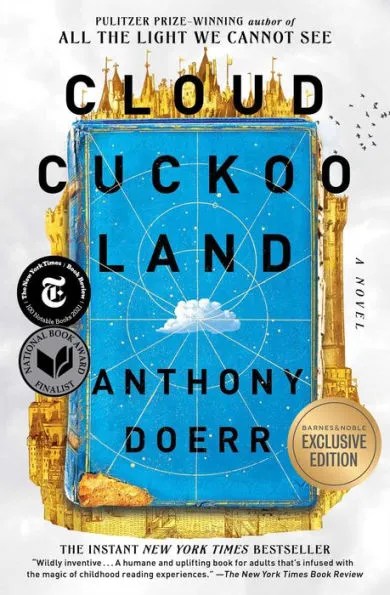
Cloud Cuckoo Land, by Anthony Doerr

Why this book: Selected by my literature reading group.  Initially suggested by my daughter who said she was reading it with her husband, so Mary Anne and I wanted to join them, so we suggested it to our reading group which liked the idea.  I listened to it in it’s entirety.  

Summary in 3 Sentences:  It’s a complicated set of 5 (or so) different stories,  that take place in different periods of time with different characters –  the earliest a few centuries after Christ, then one in the 1400s, another in the second half of the 20th century, one in the more recent 2100s and the latest 60 or 70 years into the future. All the stories are loosely tied together by a connection to a fantasy story written by Antonius Diogenes about a disenchanted shepherd who longed to escape from his dreary life into a fantasy world – a Cloud Cuckoo Land.

My Impressions: This book is a bit confusing as one gets into it, because there is initially, no clear plot line, as the author jumps from one character and time window to another, with no seeming connection – at first.  Then as one patiently gets into the book, each story gathers up it’s own momentum, and one sees the Diogenes story of Cloud Cuckoo Land appearing again and again, and having at first subtle influence, As the individual stories progress, Diogenes’s story assumes a more prominent place in the flow and the lives of the characters in each of the stories told.  

Below is a brief look at the key characters and stories that intersect around the theme and story of Diogenes’s Cloud Cuckoo Land story. (the Diogenese characer was indeed based on a real Greek author, but Doerr makes up his fictional story of Cloud Cuckoo Land)

Antonius Diogenes – is the narrator of the eponymous Cloud Cuckoo Land story from 1800 or so years ago, told in his voice from the book at the beginning of each chapter/section of the book. Diogenes is a poor shepherd who longs to fly like a bird and be free of his troubles, and so decides to go in search of a magician or witch who can transform him into a bird who can fly to a wonderful city in the sky where all is good and peaceful.  He finds a magician, but instead finds himself transformed first into first load carrying donkey, then a fish, then a crow. At the beginning of each chapter Diogenes, in first person, shares with us his experiences 

The story of the book itself and how it came to light in the 20th century is a sub-theme of Doerr’s book. Diogenes (fictional) book was written and apparently lost for centuries, re-found and then lost again, and discovered again.

Anna and Oimir two characters of about the same age who live during the period when Constantinople is over-run and conquered by the Saracens and is transformed from a center of Christian worship to a great Muslim city.  Anna is a young girl working in a monastery in Constantinople as the city comes under siege.  Anna had found a mouldering copy of Diogenes book in a run down monastery and kept it as a prize possession.  Oimer is a young muslim boy with a deformed face, living on a farm in what is now Bulgaria on the route of the Saracen army on its way to lay siege to Constantinople.  He is conscripted to join the Army and becomes part of the invasion force. Anna and Oimir connect as they escape from the war. 

Zeno and Rex  Zeno grows up as the son of a Greek immigrant in Lakeport, Idaho,  and feels ostracized as a young boy. His father is killed in WW2 and eventually Zeno joins the army during the Korean war, is taken prisoner by the Chinese and in the PoW camp becomes close friends with Rex,  a British soldier and fellow PoW who had been a classics teacher before being conscripted to fight in Korea.  They have a close and even romantic though not sexual relationship.  During their many days with nothing to do, Rex teaches Zeno ancient Greek, which many years later Zeno uses to do the one and only translation of Diogenes’ book.

Seymour and Bunny Seymour is a young boy who is mentally disturbed and socially very awkward.  Bunny his mother, is a single mom, living from manual labor cleaning hotel rooms or waiting tables at restaurants. Seymour does not fit in at school, and Bunny who is always under financial stress struggles to understand and support him while working full time to barely make ends meet.  As Seymour grows older he finds himself most at home with animals and in nature and becomes engaged with eco-terrorist groups, as he is increasingly alienated from mainstream culture. Seymour becomes connected to Diogenes incidentally as he disrupts a school play of Diogenies’ story  Cloud Cuckoo Land

Constance and Sybil Constance is a young girl on a spaceship – the Argos – that earth has sent to a distant galaxy to colonize a planet which has been determined to have an atmosphere and resources that would support human life.  The trip is expected to take several generations, and those on the Argos will live their entire lives on the Argos, but must bear children, whose children and grand children will save the species on a distant planet. Sybil is the AI computer which knows everything and runs life on the Argos.  We primarily get to know Sybil as Constance’s caregiver and surrogate parent, telling her what to do and when, and chastising her when she doesn’t follow her protocols.   Constance’s classes are with other children on the Argos, where they have a teacher who uses the Argos’s powerful computer as a classroom, which allows the students to virtually visit earth’s many wonders and places, even at different times in the past.  Constance is able to visit this virtual world on her own and through that learns that her father had owned Diogenes’ book, which inspires further interest.  

All of these characters don’t fit into, and are somehow alienated from main stream society, and are struggling under difficult circumstances. All somehow, directly or indirectly find inspiration in the story and fantasy of Diogenes’ dream of escaping to a better place.  Diogenes’ persistence in pursuing his dream inspires and gives them hope.  

There are so many tidbits of insight and wisdom in this book. Here are a few that struck me:

Superstition  Especially in the early stories, we are amazed at how much superstition drove the lives and decisions of people.  Oimir’s disfigured face was seen as an omen of the Devil and bad luck.  For Anna, reading books that were not about God and Christ were tantamount to sacrilege and evil.  Seymore saw evil everywhere.  When people didn’t understand something, they correlated unrelated events to provide a possible explanation. It is a human tendency that science tries often unsuccessfully, to overcome.

Accept where you are?  I initially thought that Diogenes misadventures trying to find Cloud Cuckoo land indicated the dangers of failing to appreciate what one has and seeking better.  But several of the chareacters only survived by putting all at risk by “going for it” – so there is no simple bromide to just kick back, dude, and go with the flow. 

Fate Key events that determined the fate of each of the characters seemed random and perhaps insignificant when they ocurred.  This was especially true of Anna and Oimer, but also of Zeno and Constance.  What ended up saving them or causing their lives to take key leaps forward were other seemingly insignificant or random events.  There seemed to be a message to follow one’s heart and accept the events, coincidences and opportunities that come one’s way. 

The drive to escape and transcend.   Each of these characters was caught in something of a dilemma that offered no solution or easy way out. They each had to persevere, and each sought a means to transcend – get beyond the seemingly insurmountable challenge they found themselves in.  And each in their own way was able to perservere through belief in themselves, persistence, and grit.  The City in the Clouds – Cloud Cuckoo Land – was a mirage, but the aspiration to get something better drove each of these characters.  

There was a sub-theme throughout the book of how Antonius Diogenes’ story made its way through the centuries.   Doerr’s story  points to how chance, coincidences, and the work and sacrifice of many have been necessary to preserve these ancient and wonderful stories from our past and make them available to us today.  And we note that these ancient stories can continue to teach and inspire us.  Each of the sub-stories in this novel contributes to how coincidence allowed this (fictional) ancient tale to impact the lives of people centuries after it was written. 

This was an enjoyable read – but the number and variety of the stories and the author’s method of going back and forth requires paying attention. It would not work to read this book slowly over time with other books – too easy to lose the thread of the various stories.  Each story was compelling and the characters are memorable in their own way. I’ll not soon forget any of them.  

Posted in Uncategorized | Leave a comment

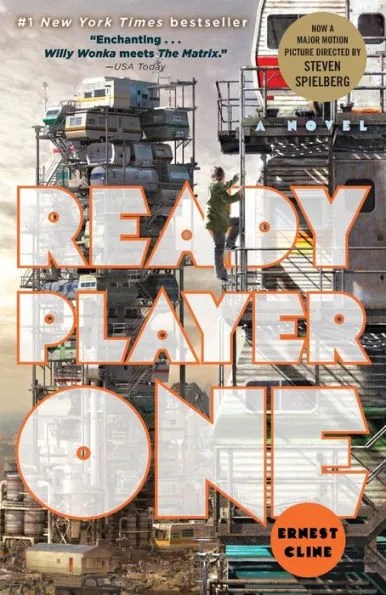
Ready Player One, by Ernest Cline

Why this book:  Selected by my Science Fiction Book Club – as one of the classics which anticipates the future development of a Metaverse.

Summary in 4 Sentences:  The time frame is the 2040s and a Metaverse-like virtual world has been developed by a computer-virtual-reality-gaming genius who has a romantic and nostalgic view of the 1980’s, when he had become fully immersed in the very early stages of the computer gaming world.  He dies, leaving in his will that the winner of a game he had created will inherit his company and all that he has developed  – worth billions of dollars.  The virtual world has become so popular because the real world has devolved into a chaotic dystopia.  The book is told from the 1st person perspective of a teenage reclusive, socially awkward computer geek who has lived most of his life in this virtual world –  and who is determined to defeat millions of other computer gaming geeks and win the game.  He competes with and ultimately collaborates with friends from the virtual world to defeat an “evil” business internet  company that wants to control and profit from controlling this virtual world.

My Impresssions: A fun and imaginative book – which is regarded as one of the predictors and shapers of the coming Metaverse – and it is an excellent follow up to Snow Crash and Do Androids Dream of Electric Sheep as one of the seminal sci-fi books that have shaped the vision that continues to drive the evolution of the Metaverse. At only about 380 pages it goes quickly.  As literature, it won’t win any prizes, but for imagination, it is a winner.    It is written in an easy to read 1st person narrative form from the perspective of Wade Watts, a teenager obsessed with popular US culture of the 1980s – because that was the obsession of James Hallliday his hero and inspiration, and the creator of the game that Wade is trying to win.

Before he died, Halliday had created the intricate and extremely demanding and complex  computer game that gamers had been unsuccessfully trying to solve for several years –  in order to win the big prize that Halliday had left to the winner in his will – ownership and control over the “OASIS”.  Halliday had named his virtual Metaverse (the word “metaverse” however does not appear in the book) the OASIS – which stands for the Ontologically Anthroporcentric Sensory Immersive Simulation.   Halliday saturates the OASIS with direct and obscure references to 80’s culture, and because of this, Ready Player One is a nostalgic journey back to the 80’s in America for any reader who was fully engaged in popular culture during that window – TV programs, computer games, music, literature – all are referenced heavily throughout the book. The goal of the game is to find the “Easter Egg” that Halliday has hidden in the OASIS.  S/he who finds the Easter Egg wins the big prize.

Because the stakes are so high, millions of gamers around the world are trying to solve it and competition is fierce. Those searching for the Easter Egg are known as “Gunters’ short for Egg Hunters, and Wade Watts is one of millions of Gunters around the world trying to solve the riddles that will help them find the Easter Egg.

That’s the setting. The book includes Wade’s experience in school – which largely takes place in the OASIS, as well as the author’s dystopian descriptions of the world of 2045 America, which drives many people to find happiness and fulfillment in the virtual world of the OASIS. Wade’s avatar in the OASIS is called Parzival –  an alternate spelling for one of King Arthur’s Knights ‘Percival’, and suggests he will be defending good from evil throughout his quest for his version of the “holy grail”.

Most of the other characters in the book we only get to know as their Avatars in the OASIS.  Toward the end of the book, these characters, who have known each other only through their avatars actually, and reluctantly meet each other in person.  In each case, these are people whose actual identities don’t fit what society celebrates.  They are somewhat embarrassed about who they really are, but feel that they can truly express themselves, confidently and with few inhibitions as their avatar.  Therefore, revealing their true identities and appearances was a dramatic event.

The story of the Easter Egg hunt is full of geeky computer gaming scenes, where the avatars in the OASIS have access to magic, crazy weapons and super-human abilities, as well as a variety of science fiction threats.  Not being a gamer myslef, it was fun to play along, and get a sense for how gamers play.  The story (naturally) has an evil powerful antagonist who threatens all that Parzival and his co-avatars are trying to accomplish.

I am not a gamer – but non-gamers should not hesitate to read this book – because it provides a glimpse into the exciting and scary implications of the continuing obsession many young people have with gaming, as well as the opportunities it offers to people otherwise restricted in their lives.  In the OASIS we experience some of the exciting possibilities for education – as Wade describes how easy it is for teachers to create engaging situations in different locations and times in history in which students can participate “directly” with their avatars.  Actual and imaginary worlds are created  in the virtual world in so much detail that the difference between actually visiting a real place,  or visiting the places virtually with one’s avatar is minimal.  And in the OASIS, the laws of physics are mutable and almost anything is possible.  

The 80’s theme.  In our discussion group we reflected on why Cline built such a strong reference to the 80s in his book.  Here are some of the ideas we had:   

  • It was his personal window of coming of age and he himself was a self-described geek who got into the  80’s pop-culture
  • The book’s hero, James Halliday was somewhat the embodiment of Ernest Cline the author – also an socially awkward and somewhat alienated computer geek.
  • The 80’s was the first and opening window when alienated teenagers were able to escape social contact into social media, computer games, and the a very primitive and pixilated virtual world.  Life still included a large dose of forced connection with people and reality, before the early 90s, when computers became omnipresent, and a few years later, when social media began to take over people’s lives. 

I felt that one of the messages of the book is that the Metaverse  – the OASIS in the book,  has both  positive and negative potential. It provides great opportunities to explore dimensions of reality that are not available to many people, including travel to distant locations and in different time periods, as well as to be creative with one’s identity through an avatar.  It also has pernicious possibilities as well, which we are already seeing – young people and gamers becoming addicted to the fast paced and stimulating virtual world, and neglecting or ignoring opportunities in the real and natural world, which require effort, persistence and discipline to fully appreciate, and which have qualities all their own.  

Wade Watts states early in the book: “The OASIS is the setting of all my happiest childhood memoies.  p 18

The Movie  I did not find the movie as compelling as the book. It appeared to me to have targeted primarily young people who hunger for crazy special effects, more action and violence and less “meaty” content.  The story was adjusted and I’d say dumbed down to appeal more to teenagers than the book.  Though it is worth seeing how the characters are portrayed, as well as their avatars, and the special effects are pretty amazing, it is not a good substitute for the book.  I suggest watching it AFTER reading the book. 

Posted in Uncategorized | Leave a comment

A Quiet Cadence, by Mark Treanor

Why this book: Selected by my SEAL book club, largely on the recommendation of Gen Jim Mattis.

Summary in 3 Sentences:  Written in the first person from the perspective of a young man from a working class familywho had been accepted into the University of Virginia, but decides to leave and join the Marine Corps to go to Vietnam.  The first half or more of the book is the narrator describing his experiences as a young recruit arriving in Vietnam, his initial combat experiences, and then how he mentally copes with the continuing horror of losing friends who are either killed, or severely wounded, week after week while on combat patrols.  The last third of the book is about his return home and his efforts to adjust to a world that hasn’t changed much, though he has, and to deal with the trauma of his experiences in Vietnam, as he tries to get on with his life, getting married, having a career, having a family.

My Impressions: Engaging and powerful.  Treanor’s intent was two fold with this book, and he achieved it in spades with me: First, he gave the reader a visceral feeling for how a young man thrust into combat reacts and adapts to the intensity of combat and losing friends to serious injury and death, as well as the demand to inflict death and serious injury on the enemy.   Second he shares with the reader the challenges of returning to normal civilized life in America – immediately after returning home from combat, and over many decades thereafter.

In the early part of the book, Marty, the novel’s protagonist and narrator, shares with the reader his  experiences of insecurity, his need to prove himself, his fear, anger, fatigue, trauma and moral uncertainty as he spends his first weeks in combat with his platoon mates.  We are privy to his thoughts and mindset in this intense and unforgiving environment.  We experience the camaraderie and tensions in his platoon, as well as the love and mutual commitment between very young men from very different backgrounds.  The setting is a Marine Corps rifle platoon in the jungles and rice paddies of Vietnam in the 1968-69 window, so we additionally are introduced to the culture of the infantry in the US Marine Corps in combat, which is very different from the military culture with which I am most familiar – the Navy SEALs.

During the combat portion of the novel, in addition to the battle scenes and the fear, anger, intensity, and emotions that Marty and his platoon mates experience, we are introduced to the frustration and anger at being constantly victimized by booby traps and snipers and threats that they don’t see, and against which they can’t fight back. This frustration is expressed toward the Vietnamese villagers who they believe with some justification to be supporting or at least passively allowing these anonymous attacks.  Marty himself almost attacks and kills a civilian in frustration, all of his platoon mates are angry and want retribution against someone – and the villagers are a convenient target,  and it is a challenge to their officers to keep this frustration and anger in check.

In the second half of the book Marty has been wounded and returns to the States, but still has some time left in the Marine Corps, which he spends partly in recuperation from his wound, and then in an administrative position in Camp Lejeune.  Here we see that Treanor – through Marty – still respects the Marine Corps and its culture, as he works for and with admirable and honorable people.  Then his enlistment is up,  he leaves the Marine Corps and has to find a career and make a living.

During the remainder of the book, Marty goes back to college, falls in love, gets married, starts a family and gets a position as a teacher in a private school at which he stays for the next 30+ years.  And during that time, he deals with being a scapegoat for anger that many Americans felt toward  US policies and behavior in Vietnam, but mostly, he is dealing with the ghosts of  platoon mates who were killed or severely wounded in Vietnam. He obviously has what is now recognized as PTSD, but he is functional and is clearly a compassionate and otherwise, well adjusted man.  But secretly, in quiet moments and in his dreams, he is still haunted by what happened in Vietnam, to his friends and platoon mates, and the apparent pointlessness of the killing and suffering.  He is angry at the US declaring “Peace with Honor’ and then essentially turning Vietnam and all he and his comrades had fought for, over to the North Vietnamese.  But Marty is very much an introvert – he keeps all this to himself, as he gets on with his life as a husband, father, teacher and member of  his community..

He reconnects with a few of the members of his Vietnam Platoon and finds that each is dealing with their experience in their own way. He is conflicted about the Vietnam memorial and refuses to attend. In the end, some 40+ years later, he  is able to grieve and come to some sort of terms with his experience – but it has been a very private affair for him – his wife and a few of his Vietnam era comrades are the only ones with whom he shares his struggles.

This is a powerful book.  Gen Mattis told me that this book hit him hard – that he had trouble getting through it – and believes it to be an important contribution to our understanding of what Vietnam did to our country.  I’ve heard that from others as well.  Mark Treanor spent many years working on this and though he had been an officer in an infantry platoon in Vietnam, he felt it important to present the perspective of a very young Marine who was sent to this ugly war still in his (late) teens, and then the decades long struggles that follow exposure to, and participation in the horror.   Treanor felt that an important function of this book was to shine a spotlight on the challenges of living with those memories and experiences   

For those interested in knowing more about the author’s perspective, I’d recommend watching/listeneing to his youtube discussion of the book here. https://youtu.be/S0tB6CONqes?si=48EySy2YHTUYT7zT

ADDENDUM: The Navy SEAL reading group met and author Mark Treanor joined us for a great discussion. We also had several former Marine guests.  Topics covered were how differently Vietnam vets were treated than recent GWOT veterans upon returning from war; the differences between SEAL and Marine and Army infantry tactics in Vietnam; SEALs operated in small numbers and had much more preparation and intelligence for their operations than young marines; whether PTSD may be in part related to the degree to which the soldier has any sense of agency or control over his fate in combat; the important role that the priest had in the book, which the author used to add a spiritual dimension to the story, and to give Marty someone with whom he could share his very personal thoughts and feelings and guilt.  Also the cathartic impact of the Vietnam memorial to those who fought.  A very good and rich discussion. 

One of the great lines of the meeting was when a retired SEAL who had been in the marine corps before becoming a SEAL told of meeting a SEAL and asking the difference between SEAL Teams and Marines. The SEAL said;  “You know how marines will go over  a hill and see a huge number of the enemy, and they’ll tell them to charge and attack, and the marines will do it?  SEALS don’t do that.”  It got a big laugh from the Marines and the SEALs in the group. 

Posted in Uncategorized | Leave a comment