
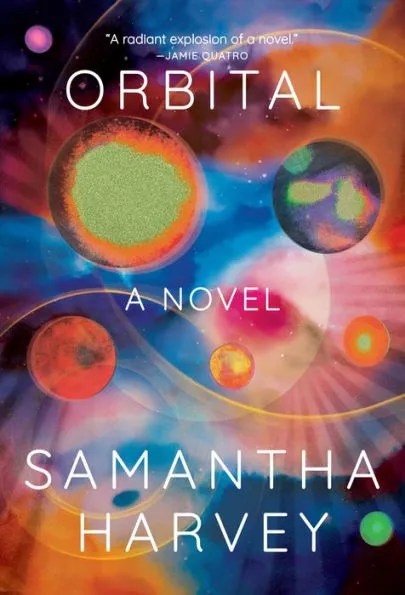
Why this book: Selected by my Sci Fi Reading Group – when I offered to bring in a friend of mine who is currently in Astronaut training with NASA to discuss it.
Summary in 3 Sentences: The book takes place during 24 hours within an International Space Station orbiting the earth – during which the space station orbits the earth 16 times. We get the inner thoughts, experiences, impressions and perspectives from six astronauts – 2 women and 4 men, from Russia, UK, US, Japan. Italy. We get not only their impressions and perspectives, but also the author’s own thoughts about the significance of humans being in space, looking down from 250 miles, onto the earth where the rest of us live.
My Impressions: Powerful and very much worth reading. It is short – about 200 small pages with large print, a 3, 4, or 5 hour read, but I read it in shorter intervals – and that is the way I believe it should be read it. The book is divided into 16 chapters, each representing one of the orbits during the 24 hour period of the book. But the chapters are not a chronological narrative of time. The sixteen chapters are simply a mechanism for the author to break up her story into various aspects of being in space and the stories and perspectives of the characters.
Though it is a novel, it is also a meditation on being human, from the perspectives of six people from different parts of the world who are living together in a situation which is so very different from normal human life, that they can’t help but spending a considerable amount of time reflecting upon their own humanity. There is also a cross-cultural dimension to their interactions, but the cultural differences seem trivial compared to the common humanity they share and the extensive training they’ve gone through to be there.
They orbit the world and look down on different parts of it, 16 times a day, observing where they had lived, where their families are, countries with which their countries are either at war or experiencing significant tensions. Also with a direct view looking away from earth into the immensity of space, they are forced to confront the infinity of space, of the universe, of time, and the relative insignificance of their personal problems and the problems of earth within that unimaginable infinity.
They also have to adjust their basic human requirements to the dictates of near zero gravity in space – and this forces significant adjustments to the most basic of human needs: sleep, eating, exercising, excretion, as well as privacy in a very confined space. In Orbital we learn about the nausea that most get during the first days in space, the challenges of adjusting to sleeping, moving, nearly all activities in a world in which there is no up or down. The author notes of one of the men: “With the atrophying of the body, life doesn’t tug at him so much….he sleeps because he must, but his sleep is mostly tentative, not deep or robust as it is on earth. Everything in his body seems to lack commitment to the cause of its animal life, as if there’s a cooling of systems, an efficient running down of superfluous parts.” p 120 Without gravity, everything seems to slow down, and their sense of time is distorted because some how, it is tied to a sense of space, which seems somehow to be tied to a sense of gravity.
They think about why they are there – why THEY were selected from so many others, Why even try to live and thrive where one is not built or designed to live, much less thrive – why leave earth at all? And thinking about the many chores and scientific experiments that they are running in space – couldn’t an AI robot do most, if not all of these tasks, perhaps better than they, and not have to deal with so many human needs and limitations? Three of the astronauts had already been in the space station for nearly six months; three had arrived just a couple of months ago. All were ambivalent about the prospect of leaving the simplicity and the “God’s eye view” of the earth, suspended in space.
They think about the discrepancies between what their training told them to expect and what they actually experienced in the space station, acknowledging that there’s no way to fully prepare for the dissonance between their lives on earth and their experience in a space station orbiting the earth 16 times in 24 hours. When they look at earth, they see no borders (except the lights along the India Pakistan border,) cities and towns are visible only at night from the light they emit. They come to prefer to view the earth during the day – “the humanless simplicity of land and sea,,” p106 where there are only patches of green, and brown, and white and many shades of blue of the various oceans and seas.
This book entices the reader to imagine life in the confines of a small space, with a few other humans, traveling in space 250 miles above the earth. In so doing, one may be able to distance oneself from the preoccupations and problems, that encumber our consciousness and our time here on earth. And, I believe, that is the challenge Samantha Harvey presents to us in Orbital – to put ourselves in the environment she describes so well, and imagine ourselves apart from our earthly vanities and preoccupations, and more connected to the immense universe that surrounds us.


