
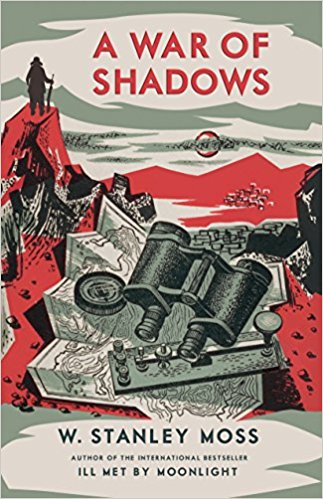
 Why this book: I read Ill Met by Moonlight by the same author, and I really liked the man and loved his writing style. I did some research and found that this book is his account of what he did for the remainder of WWII, as a member of the British SOE (Special Operations Executive) in Crete, Greece, Macedonia, and Thailand. I was not disappointed.
Summary in 3 Sentences: After the author’s successful abduction of General Kreipe from Crete described in Ill Met by Moonlight, he was sent back to Crete to continue working with Cretan partisans to harass and interdict Nazi forces on the Island. He was happy there and loved his Cretan fighters but was recalled to Cairo and sent to work with Greek partisans in the mountains of Macedonia fighting the Nazis. Though they had some successes, this was a less-than-satisfying experience for a number of reasons, and as the German forces were withdrawing toward the end of the war, he was recalled again, and this time was sent with two other SOE comrades to parachute into Thailand (then called Siam), to work with the Siamese partisans fighting the Japanese and ultimately to negotiate their surrender, prevent atrocities against allied prisoners, and assert the authority of the Allies to help restore order in a country that had been occupied by the Japanese for five years.
My Impressions: If you liked Ill Met by Moonlight because you liked the man who told the story, and the manner in which he told it, you will also like A War of Shadows. This book is not the story behind a single uniquely successful special operation, and is not filled with danger, amazing resourcefulness and close calls. But it is the same man, with the same sensibilities, the same clear and engaging writing style, telling about how he spent the rest of the war, sharing his observations, frustrations, and perspectives in less glamorous circumstances, operating with little support in remote areas. The voice of Billy Moss in this book is less enthusiastic, less aggressive, sadder but wiser, than in Ill Met.
Whereas Ill Met by Moonlight was his diary as a young idealistic and hard charging officer, new to special operations and loving his work, A War of Shadows is written after the war, and one can sense an air of disillusion and disenchantment after seeing so much death, suffering and the absurdities of war. Though still a disciplined and competent officer, he and his SOE partners are at the mercy of incompetent staffs, decisions they get no voice in, and the vagaries of war.
As a junior officer, he gets little vote in where he goes. After co-leading the operation that successfully kidnapped General Kreipe and delivered him to Allied headquarters in Cairo, Moss returned to Crete to work with his beloved partisans to continue to harass and keep the hated Nazi’s off balance and preoccupied. He has a few minor successes, but just as he feels his work is gaining momentum, he is unaccountably recalled to Cairo and told that he is being sent to Macedonia to join the few SOE operatives supporting partisans there.
Arriving in Macedonia he is surprised at how different that theater of operations is from Crete. Here, the partisans have no real sense of urgency, little commitment, little initiative, little discipline. The Greeks who he and a small contingent of SOE are there to support are divided among themselves, and can’t be trusted. Some partisan groups are communist zealots, hate the capitalist Allies almost as much as the Nazis, and are more interested in positioning themselves to take power at the end of the war than they are in fighting the Germans. Other Greek partisan groups are not communist but are unreliable in the extreme. They talk with great courage, but will not plan nor rehearse thoroughly, nor put themselves at risk against the disciplined Nazi forces. They expect the SOE operatives to give them whatever they want, and then also to do the fighting – to assume the risk in the fight against the invaders of their country. When the partisans take German prisoners, they simply kill them. There is no sense of civilized warfare, or honor in the Western sense, in how they fight. When Billy and his SOE partners objected, the partisans simply shrugged their shoulders and ignored them.
In this section of the book, Billy Moss describes working, moving, living in the remote Macedonian countryside, conducting a few successful raids and sabotage operations, but also a number of missed opportunities, aborted operations and mission failures due to their unreliable partisan partners. Billy Moss was impressive in his patience and diplomacy in working with the leaders of these undisciplined guerrilla forces, but his frustration was palpable and understandable. This frustration was very reminiscent to me of my experience working with special forces counterparts in militaries with long traditions of officer privilege, and no strong tradition of disciplined training. And this frustration is very consistent with what my colleagues have experienced working with Iraqi and Afghani forces fighting Al Quade, Taliban, and ISIS.
As the war in Europe was coming to a close and the Germans were hastily withdrawing from Greece and Macedonia, Billy Moss was recalled again to Cairo, this time to be returned to his conventional army regiment, but he successfully petitioned to stay with the SOE. He was then sent to the far Eastern theater of war to fight in the continuing war against the Japanese. Staging out of Ceylon he parachuted with two of his SOE comrades into the jungles of what was then known as Siam, now known as Thailand to support Siamese guerrilla bands in their operations against the Japanese.
They parachuted into the jungle with a considerable amount of equipment to support themselves and their partisan allies. When they were met by the Siamese guerrillas on the ground, they found that those who had prepared the equipment had not only failed to include the radios they needed for communication, but also left out other key items, and only put in right-foot boots to provide to the partisan armies. Through their partisan contacts they communicated this mistake back to their Headquarters in Ceylon, who responded that the needed equipment would be sent forthwith. They waited 3 weeks, during which there was little to do, but swim, go hunting, drink rice whiskey, smoke – simply hang out. Reminiscent of Catch 22.
As Billy Moss tells this story, there are no hair-raising, movie-worthy special operations missions, but fascinating descriptions of life deep in the jungle with the partisans, negotiating, deciding what to do next and how, and learning to deal with a whole new environment, culture, and new partners. And he is amusing in his description of how three SOE friends amused themselves often with little else to do.
Shortly after finally getting the equipment, they were notified of the bombing of Hiroshima and Nagasaki, and the subsequent surrender of Japan. Regardless of the surrender, the Japanese army was still in Siam and still controlled the Siamese peninsula. The SOE operatives now were tasked with tracking Japanese movements and ensuring that Allied prisoners (there were about 300 or so) were not massacred, and to be prepared to accept surrender of the Japanese forces in that area of Siam.
The final section of the book is his description of working WITH the Japanese and the local authorities to reestablish civil order in a remote part of Siam which had been occupied by the Japanese for 5 years. In this transition period, law and order were tenuous and fragile. Renegade bands of military deserters and criminals were at large, and as in Macedonia, communist insurgents were positioning themselves to take over after the war. Billy Moss and his two SOE partner represented the force and the authority of the Western Allies to the local civil authorities, and their word and desires were essentially law. But all knew that they were there only temporarily, and there were only three of them.
Several months after VJ day, Billy Moss is finally given leave to detach and return to Cairo to spend Christmas with his wife. But on the way home he is waylaid in India – as India too breaks out into an insurrection against British rule, and he is unable to get home. The book concludes with him finally getting to see his wife and celebrate Christmas with her – in April 1946.
The copy of A War of Shadows I read is a 2015 reprint of what was first published in the early 1950s. This later reprint includes a short bio of Billy Moss at the conclusion, which adds some details to his life story, and some context to both Ill Met by Moonlight and A War of Shadows. This man whose writing and perspective I liked and admired so much, was affected more by the war than comes out in his writing. In a WWII version of PTSD, he apparently became an adrenaline junkie and an alcoholic, costing him his family, and eventually his life. As a journalist he seems to have continued a futile pursuit of the thrill and camaraderie he had experienced in the SOE, and it appears he died of alcoholism in Jamaica at age 44 where he eventually landed, living alone as a journalist, writing feature pieces for the local newspaper. Such a remote and inauspicious circumstance to end the life of such a talented and and sensitive man.


