
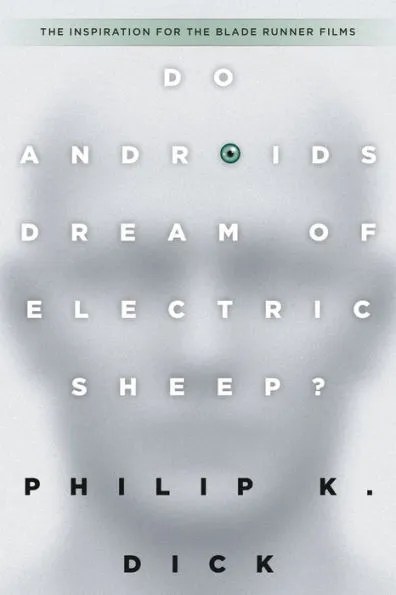
Why this book: Selected by my Sci Fi reading group, because it continues to appear on lists of best sci-fi novels, and most intriguing novels of the past half century.
Summary in 4 Sentences: After a World War apocalypse that has devastated the earth, androids have been developed to serve people as assistants and servants, but have evolved to develop agendas of their own, and human society feels threatened when some of them rebel and kill their masters. The book describes this post-apocalypse America and introduces us to a police bounty hunter who is tasked with finding and killing a group of androids who have rebelled, killed humans and threaten to spread their rebellion. In the process of interacting with these androids, the police officer begins to appreciate them as more than mere machines and has moral qualms about simply finding and exterminating them. This police officer is torn between his duty to civilization as he’s been tasked and his conscience which is repelled by what he is doing.
My Impressions: Fascinating and strange book – notable especially for its prescience, having been written in 1968, and anticipating some of the ethical challenges that will ensue from current developments of cyborg-like capabilities in humans, like neuro-link, mechanical replacement organs, automation robots and Artificial Intelligence. It is a short book at about 250 pages of normal sized print on reasonable-sized pages, and a quick and thought provoking read. After a somewhat disorienting initial scene-setting, the pace picks up and quickly becomes a more engaging page-turner.
Setting: The novel is set 53 years into the future from when the book was written (1968), so the setting is 2021 in the post-apocalyptic city of San Francisco – after World War Terminus referred to as WWT. In addition to widespread death and destruction, WWT left the entire earth contaminated with radioactive dust, so the UN encouraged migration of humans to Mars by promising emigrants a human-like android as a servant/slave as an enticement to emigrate. As a result, a significant percentage of earth’s surviving human population has emigrated to Mars. Among those who had to stay behind are those with a low IQ, referred to as “chickenheads,” and those whose health is damaged by radioactivity, referred to as “specials.” The places described in Androids/Sheep are largely depopulated, many empty buildings and expanses of desert and defoliated earth, where most wildlife, including insects have died from the radioactivity. Thus live animals – even insects – are rare and valued.
Android technology has evolved to where the latest androids are so human-like that distinguishing them from humans requires a very sophisticated and sensitive test to see if they exhibit any human-like emotions or empathy, that at least theoretically, computer driven androids would not feel. The latest Nexus 6 androids are manufactured on earth, and are a combination of organic flesh-and-blood material, and electronic/mechanical, computerized components that are programmed to learn and respond as humans would. They are algorithm driven, extremely intelligent and rational and have been programmed to speak and behave very much like humans. This level of advancement in android technology led some these highly advanced androids to resent their slave status on Mars, then to rebel and kill their masters and other humans, then to hijacking a rocketship and returning to earth. Humans still on earth are afraid that the rebellion that these androids fomented against humans on Mars will spread to earth. In response, the police departments have initiated an extermination campaign to find and “retire” (the euphemism for “kill” when referring to androids) the rebelling Androids who’ve escaped from Mars. Androids are referred to in the pejorative as “andies.”
The Story: Rick Deckard is a police officer in San Francisco who is a “bounty hunter” assigned to find and “retire” these renegade androids from Mars. In the process, he gets to know some of them and feels moral compunction about killing these very human-like androids, that though they may have committed crimes on Mars and may not pass the sophisticated test to be classified as humans, seem to him (and to us the readers) to behave as human, or even more human than most true humans. In recruiting a female android to help him in his efforts, he actually gets romantically involved with “her” and eventually sleeps with her. Eventually, his moral qualms about “retiring” these seeming sentient beings gets the better of him, and he decides to quit this line of work, but the police department refuses to let him transfer, and he needs the bounty money he gets for each android he kills. So he continues the work, leading him to “find, fix, finish” several more androids, and become one of the most successful bounty hunters ever – but he doesn’t feel at all good about it.
Themes: The obvious themes are how technology can develop robotic creatures to closely approximate and even surpass human capabilities and sensibilities, and as that happens, do these “machines’ have rights? What does it to do humans to destroy, retire, “kill” a machine that in all visible and apparent ways resembles a human being? It is significant that having empathy, a sense of “I” and an emotional (loyalty, love, affection, etc) connection to others are the key distinguishing aspects of being human. The androids we meet in the book already show recognizable versions of those human emotions, such as empathy, sadness, pleasure, excitement, fear, and loyalty – and we the readers and Deckard begin to see them as more human-like. At the same time, they also have a coldness and emotionally detached side, that we would associate with computers, but also with socio- and psychopaths. In the androids, as in humans, we see some of both.
I couldn’t help but see an analogy between the way that humans used their android servants as disposable means to their ends, not respecting them, ready to kill them as soon as they made demands upon them, as analogous to how the wealthy and privileged often viewed their slaves and employees for many centuries. The human-android relationship has many similarities to the relationship between whites and black slaves/workers in America up until just a few decades ago. Also I might note that police and government response to initial signs of rebellion in this book mirror what governments and human societies have always done in the past: Stamp it out brutally.
Another sub-theme or message is about wildlife and other living co-inhabitants of our planet. The novel shows how important living creatures are and how we would miss them. There is a message about how the apocalypse would affect more than merely human life and civilization.
Philosophies: There are several sources of external semi-philosophical input to both humans and androids that this book provides us:
- First, there is the Penfield Mood Organ – a device that a person can hold on to and will modify one’s moods and feelings. Each individual has a number which s/he can enter and get the mood s/he requests. We see several of the humans resorting to this machine when they are depressed, tired, discouraged. A technological version of taking a drink or getting high – a quick and easy antidote to unpleasant feelings.
- Second, there is a mythological or real figure Wilbur Mercer and his philosophy of Mercerism which emphasizes acceptance, a positive attitude and empathy. : “Mercerism is a technology based religion which uses a pseudo virtual reality technology called ’empathy boxes’ that connects many users simultaneously to a virtual collective suffering experience. That is centered around a supposed martyr character, Wilbur Mercer, who in the context of the virtual reality, eternally climbs up a hill while being hit with crashing stones.” (from Wikipedia) Kind of a Sisyphean character. I frankly couldn’t quite figure out what role Mercerism played in the book, but Mercer and Mercerism became very visible themes at the end.
- Third, “Buster Friendly and his Friendly Friends” is an insipid television show which is superficial, light-hearted and amusing, like a Sitcom or the Mike Douglas show – meant to appeal as light weight entertainment to a broad spectrum of not-very-thoughtful humans and androids and clearly seeks to distract them from the daunting realities of their existence. At the end, Buster Friendly announces a blockbuster breaking news bulletin – that Mercer and Mercerism are fakes. This leads to confusion on the part of those who look to Mercer as a spiritual guide, and begs the question what is the agenda behind Buster Friendly’s fake announcement? To undermine humanity or support pogroms against the androids? o ne can’t help but think of our 24 hour news cycle with FOX, CNN, MSNBC competing for the short term attention of today’s Americans.
Blade Runner I watched the movie Blade Runner – the Final Edit the day after I finished reading Androids/Sheep. It roughly follows the themes of Dick’s book with many of the same character names, and the plot similarly has Rick Deckard tasked with finding and destroying the androids who threatened human civilization. But there are a number of supplemental features and sub-plots added, that serve to “Hollywood-ize” the story, but in the end, we also see Rick Deckard in moral turmoil with ambivalence about what he has done. I recommend watching the movie in conjunction with the book – they support each other. Not sure it matters which first – the book or the movie.
Final Words: This book foresees many of the moral dilemmas that we are beginning to grapple with now, but which I believe will become more pressing in the future. Do robots have rights? Is it ok to torture or abuse a human-like machine? How do we distinguish between a human and a cyborg (part human augmented with machine and other technological enhancements,) and an android which is MOSTLY machine and technical enhancements? Where does our understanding of “consciousness” fit in, and how much does it really matter. Though certainly dated, this book tees these topics up well, and has had significant influence on Sci-fi and movies since.
Another more detailed review can be read in Wikipedia’s article on the book, available here..


