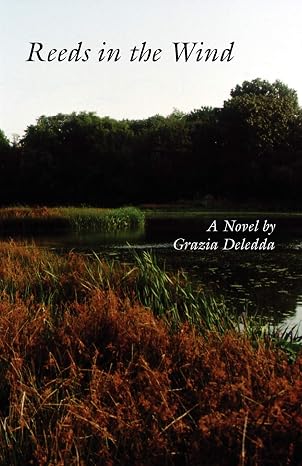
Reeds in the Wind, by Grazia Deledda

Why this book: On a recommended reading list of books to read before my impending visit to Sardinia. I looked at google and it said that Reeds in the Wind was first published 1913 and Deledda won the Nobel Prize in literature in1926. In her award, the Nobel committee specifically noted how well her books described life in her native Sardinia, how she treated guilt, aging family, regret, forgiveness, fate, human responsibility. and the feeling of being carried along by forces one cannot control – as universal. She was was the first Italian woman to win the Nobel prize.  That was enough to convince me to read the book.

Summary in 3 sentences: Reeds in the Wind is about a formerly well-to-do family, now nearly destitute, in a small village in the mountains of central Sardinia in the late 19th/early 20th century. The protagonist is Efix, the family’s servant who had served the famaily for decades and stayed on to take care of the four spinster daughters on their struggling estate after their tyrannical father died. It is about his life and the drama that ensued after the father died, and a relative arrives from the mainland.  

My Impressions: An interesting short (about 190 pages in paperback) book which tells a story that takes place primarily in a remote and isolated mountain village in Sardinia, in the window of the late 19th/early 20th century. There are no automobiles, electricity, telephones – none of technological advantages of more modern urban civilized countries – and as such we get a glimpse into how traditional villages – our ancestors – lived in previous centuries. The story is about a poor family in the village, and the story’s protagonist is a very poor servant of that family who is driven to leave the family and his village to wander out into neighboring towns and villages, and then returns at the conclusion.  

The description of life in the village includes the petty jealousies between the members of the village, the power of superstition, how most good intentions go awry or mask ulterior motives, and the suspicions and distrust of authority and those who seem to have more than others. Also, the church (in this case the Catholic Church) is the center of community life, and the stories of the bible are the primary source moral guidance and inspiration among the uneducated population. Festivals celebrating religious figures, holidays and saints are the primary source of social entertainment. I’ve told people that I believe that this book describes a Sardinian version of pre-20th century life in remote villages around the world – that a similar version of this story could probably be told taking place in Scotland, West Virginia, Germany, Lebanon, India, the Balkans- in nearly any country. The setting is similar to what I read of life in the Balkan villages in The Tiger’s Wife (my review is at: https://bobsbeenreading.com/2026/01/11/the-tigers-wife-by-tea-obreht/)

This particular story is about the experiences of the servant of what was once a relatively prosperous family in a village in the mountains of Sardinia, of originally four sisters who had been living with their father, after the mother had died.  

The background of the main story is that the mother in this family was a kind and well-loved woman who was the glue that held the family together. The family had a servant, Efix’ who did chores and manual labor around their farm/estate. The family saw itself as among the “better,” more affluent. “well-healed” segment of the small society in that village. When the mother died the father became something of an angry irrational tyrant, ruling his family with an iron fist – flagrantly and carelessly and flagrantlyspending what money they had, ignoring his responsibilities to his estate. The youngest daughter chose to escape, and with no notice, simply left and never communicated with her family again. This created something of a scandal within the village, and the family and especially the father, were humiliated – this sort of thing just doesn’t happen with the best families in town.  

The father becomes even more unhinged. He searched, turned over every stone, and unsuccessfully pursued every lead to find his wayward daughter, ostensibly out of anger to punish her for this travesty. People in the village rightly assumed that she had secretly fled the family and Sardinia for mainland Italy. After a while, the father is found dead near the village perhaps from a stroke or a heart attack, and the remaining three daughters and the servant are left with little money and few resources to maintain the farm. This is where the story begins – about 18-20 years later. 

By now, the daughters have fallen into poverty, and Efix loyally stays with them, doing what he can to take care of them and the farm, even though they promise to, but never pay him for his service. Out of nowhere they get a letter from Giacinto a young man living on the mainland who claims to be the son of their wayward sister, who he claims his mother has died, and he wants to come and live with them and is on his way. This letter and his prospective arrival create a lot of excitement and suspicion in the family and the whole village. 

After several months of uncertainty, Giacinto finally and without notice arrives and turns out to be handsome and charming, says he has some money and hopes to find work. The women in the village are all a-twitter, especially the younger unmarried ones, and the older men are interested in the money he claims to have. The three sisters, his aunts, recognize that they have a responsibility to host him, but are suspicious of his intentions. One of the sisters in particular, Noemi, by nature distant and distrustful is unwelcoming to Giacinto and wants nothing to do with him – which we later learns has subtle reasons.  

Giacinto turns out to be less mature than his general demeanor suggested. He borrows money under false pretenses, makes some mistakes and after a series of misunderstandings and recriminations, he simply leaves. He claims to intend to find work in a nearby town to make money and then to return in good stead to repair his reputation, and repay the debts he’d accumulated in the village. Efix leaves the three sisters to go find Giacinto.  

Efix finds Giacinto, they reconnect and it appears the options for reconciliation don’t look good. Efix becomes frustrated and sad, returns to his village and then leaves the chaos of the three sisters without a plan. He teams up with a blind beggar and becomes part of the community of beggars that walk around that part of Sardinia begging for money and handouts to survive. Efix turns out to be one of the few in this “community” of beggars with common sense and integrity, and after a while he leaves them and returns to the sisters and his village, to see if he can perhaps find a way to facilitate a reconciliation and bring some order to the chaos he left behind. We also learn that Efix is largely driven by the need to do penance for a sin he’d committed many years ago, which he confessed only to Giacinto, when Giacinto was confessing to Efix a burden of guilt he was carrying from his misdeeds in Italy before coming to Sardinia. 

Efix is the main character and protagonist of this book. He is a humble man, selfless almost to a fault in his dedication to others, but also a capable, resourceful and good man. We inevitably are impressed with his generosity of spirit and his character as we observe how he deals with his many challenges, from a position of very little power.  

At this point, to relate the next and final phase of the story would be to give away the conclusion of the book, which would significantly detract from the experience of reading the book. 

Would I recommend Reeds in the Wind to others? Yes with caveats. As I wrote similarly in my review of The Tiger’s Wife, if you’re looking for a page-turner with a driving plot, you won’t enjoy this book  and would probably put it down.  But Reeds in the Wind is legitimate literature – well written, with interesting and unique characters in a setting that exists in the history of nearly all of us. If you’re willing to step into a family drama in a small village in 19th century Sardinia, and get into the challenges of a loyal servant doing his best to keep the lid on a family drama and ameliorate the suffering of those he has committed himself to protect, it is a well written book, a good story and an often fascinating read. 

Unknown's avatar

About schoultz

CEO of Fifth Factor Leadership - Speaker, consultant, coach. Formerly Director, Master of Science in Global Leadership at University of San Diego; prior to that, 30 years in the Navy as a Naval Special Warfare (SEAL) officer.
This entry was posted in Uncategorized and tagged , , , . Bookmark the permalink.

Leave a comment