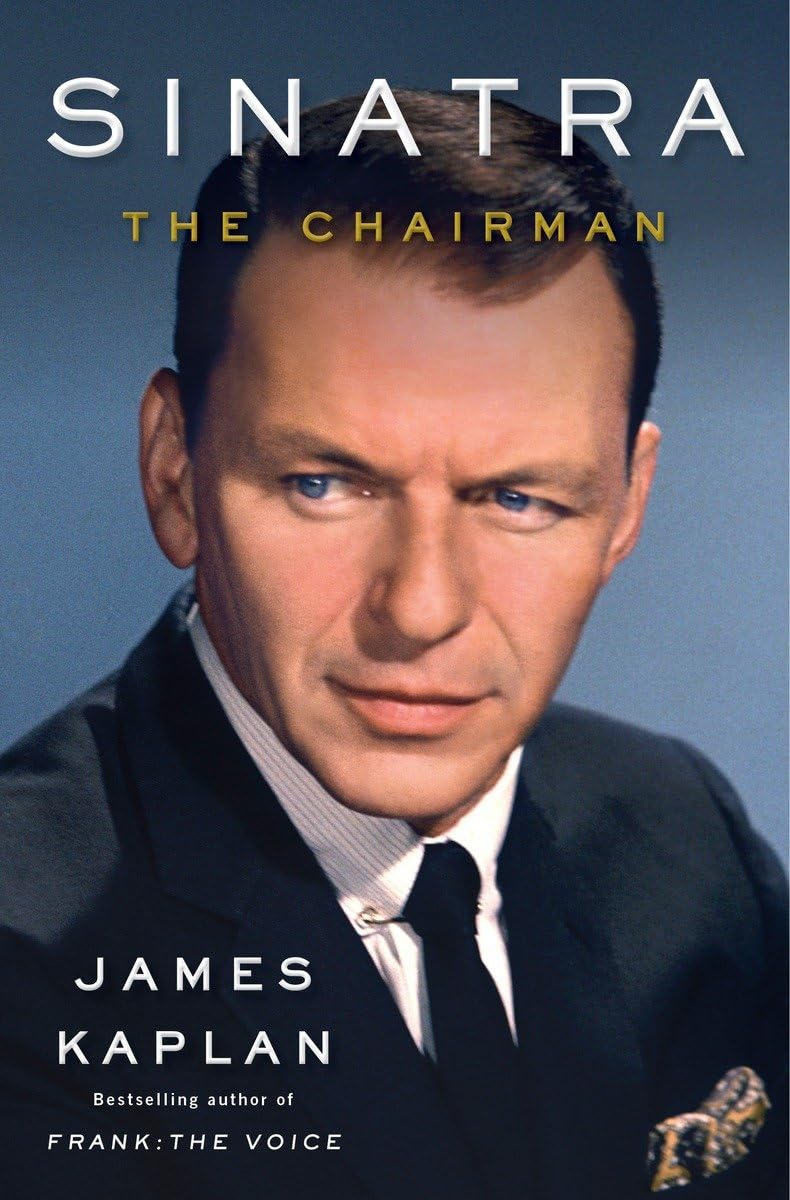
Sinatra – The Chairman, by James Kaplan

Version 1.0.0

Why this book: This is volume two of James Kaplan’s authoritative biography of Frank Sinatra – following Sintatra – The Voice, which I thought was well done (my review of it here.) . I listened to this one as well. It was longer and addressed his most productive years, when he was at the apogee of his popularity.

Summary in 3 (long) Sentences: This volume begins in 1953 – a major turning point in Sinatra’s life when his marriage to Ava Gardner begins to unravel as he wins an academy award for his surprise outstanding performance in the movie From Here to Eternity, just when Hollywood and the public believed he had been a flash in the pan, was washed up, and his career was essentially over. Afterward he went on to record some of the most highly regarded popular music of the 20th century, and he had roles in a number of follow on movies, most of them mediocre, but his fame and influence continued to rise – as he became one of the A list stars in Hollywood. This book recounts the roller-coaster of Sinatra’s life from the early 50’s until his death in 1998 – his marriages to Ava Gardner, Mia Farrow, and finally Barbara Marx, his relationship with his children by his first wife Nancy, his multitude of love affairs with the most beautiful women in Hollywood, his involvement with the Kennedy’s and later more conservative politicians, his charisma, charm, and emotional instability, how he adapted his music to changing public tastes in the late 50s, the 60s and 70s – as he held on to the spotlight into his later years – the many high points and low points of his remarkable life.

My Impressions: A remarkable book – a tour de force look at one of the most famous men in the world for much of the middle of the 20th century. Kaplan did an amazing amount of research, interviewing or reading the autobiographies of many of the people who were instrumental figures in his life – to include a thorough look at what the tabloids and gossip columnists were saying as they drooled over the chaos and drama of his life. I was truly impressed with James Kaplan’s research and writing – he gave full credit to the talent and so much that Sinatra did which deserved admiration, but also did not pull any punches when describing his foolish, immature, and sometimes violent actions inspired by anger, disappointment or simply spite. He was often an entitled hyper-sensitive narcissist, but was also a charming generous man of great talent. As many who know him said, Sinatra was a complicated man.

I listened to the book, and thought the reader Donald Corren did an excellent job reading Kaplan’s script – his voice sounded authentic and authoritative and fit the subject matter well. I have recently listened to good books which were significantly diminished by the voice of the reader not being a good fit for the text. That is not the case here.

There was so much to this long book nearly 1000 pages and 40 hours to listen to. He lived to be 83 years old, dying in 1998 after being married 4 times. His first wife Nancy was the mother of his two daughters and one son, and though his character was not suited to monogamy and family life, he remained close to that family throughout his life and by most accounts contiuned to be a friend and provider to Nancy and caring father to his children. His tempestuous marriage to Ava Gardner was fodder for the tabloids for years – they were married for several years, but in my and the author Kaplan’s opinions, were too much alike to be happy together – they fought all the time, and made up in the bedroom. The passion between these two makes up much of the book and continued throughout their lives, to include long after their divorce. Following Ava was the very controversial and short-lived marriage to Mia Farrow, and finally his marriage to Barbara Marx for the last 22 years of his life.

The following is a list of some/many of the famous starlets and women that is it was well known that Sinatra had romantic/sexual affairs with, all pretty well documented in the book, with Ava Gardner being at the top of the list. Additionally: Lauren Bacall (Briefly engaged,) Angie Dickinson, Lana Turner, Juliette Prowse (briefly engaged,) Marilyn Monroe, Judy Garland, Kim Novak, Grace Kelly, Marilyn Maxwell, Gloria Vanderbilt. Sinatra’s unlikely marriage to Mia Farrow, when he was 50 and she was 21 shocked much of the world, and didn’t last long. These are women he saw not just sexually but also saw romantically whose company he enjoyed, but he was not willing to extend them to marriage.

Frank had no problem finding beautiful women to have sex with – his valet George Jacobs and his good friend and song writer-musician Jimmy Van Heusen were nearly always in his entourage and seemed to knew all the “procurers” in the cities to which Frank traveled. When Frank travelled and wanted female company, they would find, beautiful women, often several at a time, to keep Frank company and share his bed at night.

In addition to all of these salacious stories, Kaplan gives great insights into Sinatra’s relationship over many years to key figures in the Mafia – “the mob.” It began in his early years in Hoboken, New Jersey, and when Frank became famous he was something of mascot to the Mafia. Frank did use his relationship and credibility with them as a fellow Italian-American to help his career, while also trying to keep them at arm’s length, as his relationships with well known mob figures were hurting his reputation. Kaplan seeks to explore the truths, and separate fact from fiction regarding the many rumors.

Frank was a well known advocate for the underprivileged, the poor, and for those who suffered from discrimination as he had in his youth. He never forgot his experience of anti-Italian discrimination early in his career and later, and so actively and publicly supported causes that fought racial/ethnic discrimination against blacks, jews, Hispanics, and others, as well as Italians. In the late fifties and sixties, he became enamored of John Kennedy and the Democratic party’s promise to upend such discrimination, campaigned actively for JFK, and arguably his efforts were key to his narrow victory in 1960 over Richard Nixon. His infatuation with the power and romance of the Kennedy’s was greatly diminished when, after the election, JFK and the Kennedy clan distanced themselves from Frank due to his close relationship with Sammy Davis Jr, and later when Bobby Kennedy came after Frank because of his cozy relationship to the Mafia. Frank eventually moved right politically and endorsed and supported Ronald Reagan.

The final third of the book deals with Frank’s life and career from the late sixties until his death in 1998. Though he remained in the news and a very popular figure on TV and Hollywood into the 70s and early 80s, he continued to travel, perform and produce great music. After the public drama of his ill conceived and unsuccessful marriage to Mia Farrow, his romantic life became of less interest to the public and the gossip columnists.

– Toward the end of the 70s, rather than grow old alone, he opted to marry Barbara Marx – the former wife of Zeppo Marx, who had strategically befriended and supported him living alone in Palm Springs, ultimately pressuring him into marrying her. He was in his early 60s, she very attractive in her late 40s and a marriage to Frank fulfilled her goal of cementing her position into the world of the rich and famous to which she aspired. Their marriage then became one of mutual dependence, but she kept him on a short leash and controlled much of his life. According to this book, it was a stable but not a particularly happy marriage that lasted 22 years. Older and emotionally beat up after the failure of his marriage to Mia Farrow, Frank’s once prodigious energy was waning and he he didn’t have it in him to resist or fight her control, nor to pursue the wild adventures and sexual exploits of his past.

– Like many celebrities of that era, he never took great care of himself, and a lifetime of smoking, drinking, and all-night carousing was catching up with him. Though he continued to travel and perform into his 70s, and early 80s with a lot of help from Barbara – 11 years his junior, he suffered from cardiac disease and he died of a heart attack at age 82 in 1998.

In the summary above, I hit on some of the many highlights from this fascinating book about a complex man who was, and continues to be prominent in American culture; Here are some of my key takeaways from spending some sixty hours amazed, startled and entertained listening to this two volume biography:

– As a major popular figure in America for over 40 years, his life served as a lens through which to look at American society and culture during a period of great turmoil and transition, from the WW2 generation, into the Eisenhower years of the 1950s, followed by the rebellious turmoil of the 1960s with the Vietnam war and the counterculture revolution, and then the subtle slide and transition into the very different world of America in the 70s and 80s.

-This bio provides insights into the lives of the “rich and famous,” and Sinatra’s life, values and lifestyle are a window into the lives of those in this period with lots of money and no real concern about making more. Frank hobnobbed and was good friends with everyone who was considered Hollywood royalty at the time, as well as with people of great wealth and influence in America outside of Hollywood. While “keeping up appearances” Frank was often in debt living the lifestyle of the rich and famous, but he never seemed willing to scrimp or economize. He was always confident he could make more, and he always did, but he did have to keep working to make the money he needed to live as though he didn’t need it. He spent lavishly but was also very generous to his friends and admirers. He famously often gave $100 dollar tips to valets and waiters.

-Frank got all that most men fantasize about- lots of fame, money, power, attention, as well as love, affection and sex from a multitude of beautiful women. And yet his was not a happy life. He was unable to develop emotional intimacy with women, (or arguably, with anyone,) he was often depressed, attempted suicide at least once and seemed to always be chasing the next high – either in fame and recognition, or romantic love with a desirable woman. And he was often/usually able to get what he wanted – but the joy didn’t last. He was then driven by an urgent need for the next high.

-It seemed that many if not most of the Hollywood stars with whom Frank cavorted were similarly driven – to find fame, sex, adventure – due to an unwillingness or inability to enjoy or be satisfied with simple pleasures. These drives were often fueled and enhanced by alcohol and drugs, as well as the promise of more fame, sexual adventures, and excitement. These internal drives also fueled their ambition, hard work, and drive to succeed and excel at their craft, and then to get more fame, glory and power. In many or most cases, even for the most successful, the happiness and joy achieved was ephemeral, like a drug high, and when it went away, it was followed by an emptiness that could only be filled with more commercial success, fame, sex, money adventure. And that high was accompanied by fear that it wouldn’t last and they would lose it. That was certainly the case with Frank Sinatra – he perhaps represented the apogee of that syndrome..

-I learned to appreciate how important the musical “arrangement” is to the quality and impact of music – especially popular music. Frank was very sensitive to and dependent on his music being well arranged – meaning, which instruments introduce the tune, how and what they play to accent and enhance the melody, what instrumentation is played during the “break” from the lyrics, how the instrumentals affect and color the emotional impact of the tune, and the singer singing the lyrics. Frank was regarded by the musical elite as a master in shaping and expressing his music. Of his musical collaborators, Nelson Riddle is the most famous, but also Billy May and Gordon Jenkins were important arrangers of Sinatra’s music. Since this book, I pay much more attention to and appreciate the arrangement behind the lyrics and the basic tunes in the music I listen to.

-Frank was unique in the amount of emotion he was able to put into and communicate through his singing – listeners, especially women, almost had the feeling he was singing to them personally. He worked hard at internalizing the meaning of the lyrics – the poetry – of the songs he sang, and making the writer’s intent his own, which gave the lyrics and his singing special power. When I listen to Franks hits now, I can hear the power of the emotion that he puts behind his singing.

FINALLY This was a fascinating book about a complex, fascinating and very driven and talented man, perhaps one of the most famous and popular of all of the TV and Hollywood stars while I was growing up in the 50s, 60s and 70s. The book addresses the litany of salacious rumors that surrounded his life, and attempts to validate or debunk those rumors. The author did an AMAZING amount of research – he must have read thousands of gossip columns from newspapers of the day spreading and addressing rumors of his crazy life, and read the biographical accounts of the many prominent people who had interactions with Sinatra in his lifetime. It seemed that anyone who wrote their own story and had interacted with Sinatra, felt compelled to comment on that interaction and their own impressions of the man. Ultimately, after age left the glamor and wild and crazy fun behind him, I felt it was a sad story. Almost a cautionary tale for the ambitious young stars of Hollywood.

I read a great quote from Thomas Merton that I believe applies here – as a counter to the life Sinatra lived, “Happiness is not a matter of intensity, but of balance.”

Unknown's avatar

About schoultz

CEO of Fifth Factor Leadership - Speaker, consultant, coach. Formerly Director, Master of Science in Global Leadership at University of San Diego; prior to that, 30 years in the Navy as a Naval Special Warfare (SEAL) officer.
This entry was posted in Uncategorized and tagged , , , . Bookmark the permalink.

Leave a comment