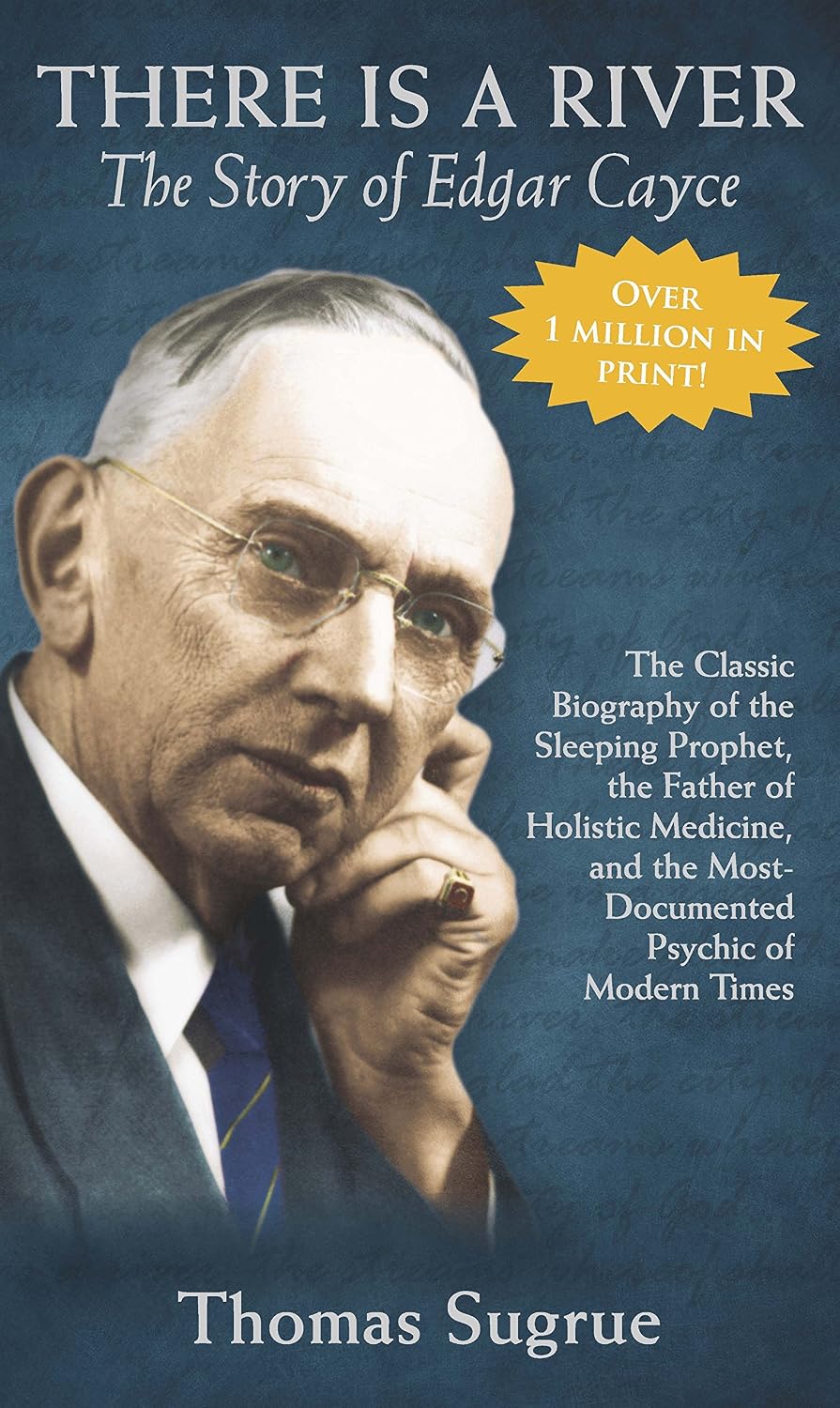
There is a River – The classic biography of Edgar Cayce, the most documented Psychic of Modern Times. by Thomas Sugrue

Why this book: I have been familiar with Edgar Cayce since I was in high school in Virginia Beach, Va , home of his Association for Research and Enlightenment. I had read some other books by/about him a long time ago and wanted to return to him and learn more about him. I listened to this book.

Summary in 3 Sentences: This biography is written by a man who had lived with the Cayce family for several years and is the only “authorized” biography of Edgar Cayce, written in his lifetime with assistance from Mr Cayce himself and his son Hugh Lynn Cayce. The first half of the book is about his childhood and young adulthood and covers the period while Cayce struggled to come to terms with this uncanny but often unwelcomed, psychic ability he found he had. The second half of the books recounts how he finally came to accept this gift and sought ways to use it to serve humanity.

My Impressions: I enjoyed the book, though at the beginning I thought Sugrue spent more time on Cayce’s childhood than I would’ve liked, and his parts of his descriptions of this period in his life were written in a style that I felt more appropriate to “a little house on the prairie” children’s story. But as we got into his young adulthood and beyond, I was more comfortable with his style.

As a teenager, Cayce stumbled upon an uncanny ability when in a trance to know things he didn’t know when conscious. He found that when he went to sleep and fell into a trance, he could diagnose and offer cures and remedies to other people’s injuries, illnesses, and other physical ailments. He had no recollection of what he’d said when he came out of the trance and had no idea where this ability, or his diagnoses or information came from. It made him uncomfortable and the more he experimented with it, the more concerned he was with where this power came from. He had been brought up in a very traditional Christian home, read the bible from cover to cover every year – and he saw nothing in the bible which validated or encouraged use of such an ability. He was concerned that its source may be evil, or that it could be used for evil.

Once people became aware of this ability, people came to him from all over for assistance in dealing with maladies that had not been resolved by traditional medicine. There was also no shortage of “supporters” who wanted to use him to help them get rich, or increase his and their fortunes. He was “led down the primrose path” several times, taken advantage of by occasionally well-meaning but foolish “friends,” and in some cases merely manipulative businessmen who wanted to exploit him. All the while he was doing readings to help people for whom traditional medicine was not solving their problems, and doing so for very little compensation. By the 1930s after a number of bad experiences, he’d become very distrustful of those who had a “good idea” for taking advantage of his unique ability. Cayce was by nature very trusting, not interested in worldly success or wealth, was primarily interested in helping people when he could – but his innocence made him an easy target to be exploited.

Also during the 1920s as he regularly demonstrated this ability to do accurate medical diagnosis while in a trance, he also found that the entity speaking through him knew things that were well outside “mere” medical questions. He expanded his readings to also “life readings” about the past and guidance for the future of his patients, and he did readiings that answered philosophical and metaphysical questions about the purpose of human life, the soul, the nature of the universe, and why things happen. Because he had no conscious knowledge of the things he said during a trance – either before, during, or after his readings, Cayce was actually a “channeler” from a spiritual entity ouside of him, who possessed wisdom and insights far beyond Cayce’s own experience.

Not knowing what, or who this entity was that was speaking through him, he remained concerned, especially when in the life and metaphysical readings, it expressed views he saw as inconsistent with the Christian beliefs he’d grown up with. Eventually after many years, much experience and his own soul searching, Cayce came to trust this entity and what it said through him. The metaphysical readings it gave through him described a much bigger and more complex universe than conventional reality accepts, validated the existence of a soul, and that it reincarnates multiple times into earthly beings, and seeks through various lifetimes to resolve karma from previous lives, and to work toward unity with God.

While in a trance and in response to questions about how these readings meshed with Christianity, the entity provided information and background on Christ’s actual teachings, what had been suppressed, why and by whom, and pointed to various sources – Jewish and early Christian mystical movements, the Essenes, the Pharisees, the Gnostics and others – where evidence exists that supports the view that Christ’s actual teachings were consistent with the metaphysics of the readings.

After years of these readings and Cayce re-reading the bible and pondering the messages of the entity, Cayce realized that the bible did indeed make room for the reality the entity described. He accepted that the Church had over centuries modified the message of Christ to make it more accessible and palatable to most people, and indeed was not in conflict with the reality the entity described. This put him at ease in the last decade or so of his life, trusting the entity who was speaking through him and believing that indeed his message was coming from a good place, meant to do good and not to deceive.

He also found that while in a trance, he could send his channeled consciousness anywhere in the world, and he did readings for people in far distant locations. He simply needed an address and his consciousness could go there instantaneously, describe the environment and provide an accurate assessment, medical diagnosis, and options for a cure for his patient.

All of this naturally befuddled scientists and the medical profession, and many sought to prove him a fake, but were disappointed to not find any chicanery. The majority of these “experts” couldn’t explain what he was able to do because his abilities and message did not fit into the world view they’d grown up with. Consequently. many chose to dismiss him as a charlatan or a bizarre anomaly that they simply didn’t want to acknowledge, accept, understand or deal with, so they simply looked away. In more than one case they had him arrested. (Shades of Copernicus.)

But because many who he had helped where traditional medicine had failed, many who believed in him and his messages about the nature of reality, he continued his work. But because he refused to use this ability to attain wealth, he charged very little for his services. He believed that using this gift to attain wealth would betray why he was given this gift, and would be tantamount to using it in the service of evil. As a consequence, he struggled for many years to make a living, finally attaining enough money largely through donations and other support, to buy a home in Virginia Beach, Virginia.

After several abortive efforts to establish a center and a hospital in Virginia Beach, his supporters, led largely by his son Hugh Lynn Cayce were able to establish a non-profit Association for Research and Enlightenment (ARE) in Virginia Beach. Cayce lived nearby in Virginia Beach, doing two readings a day, 5 or 6 days a week, and responding to correspondence with his patients, while his son managed the ARE enterprise. Partly as a result of overwork, Cayce died of a stroke in early 1945, but the ARE continues to this day, and serves as a center for continued research into and promulgation of the messages contained in the thousands of readings Cayce did in his lifetime.

I enjoyed returning to Edgar Cayce after many years away, and learning more about his whole life. I was impressed with his humility and integrity, his focus on serving rather than exploiting humanity. New to me was his long term struggle to reconcile his strong Christian beliefs with what the spiritual reality that the entity described to him. He was a man of impeccable integrity, if not always practical wisdom. His innocent lack of judgment sometimes frustrated me, as I read about his struggles to deal with those who sought to exploit him, while his only desire was to serve people with his gift, while also making a modest living.

I was also surprised to learn of two other fairly well-known cases of other individuals with a similar gift to Cayce, through whom entities spoke when they were in a somnambulatory state. One was known as Victor the Shepherd who lived in France in the late18th century and was the subject of experiments by Marquis de Puysegur, The other was Andrew Jackson Davis, known at the “Poughkeepsie Seer” who wrote a book in 1847 The Principles of Nature (still available) describing what he’d learned from his readings about the nature of spiritual existence, the evolution of the soul, and the relationship between the physical and spritual worlds. Cayce was amazed at how the spiritual reality his entity described to him, was so very similar to the descriptions given by these two predecessors – but they’re not identical. ChatGPT gave me an interesting comparison of many the similarities and a few differences between the spiritual reality described by Cayce and Andrew Jackson Davis.

Unknown's avatar

About schoultz

CEO of Fifth Factor Leadership - Speaker, consultant, coach. Formerly Director, Master of Science in Global Leadership at University of San Diego; prior to that, 30 years in the Navy as a Naval Special Warfare (SEAL) officer.
This entry was posted in Uncategorized and tagged , , , . Bookmark the permalink.

Leave a Reply