
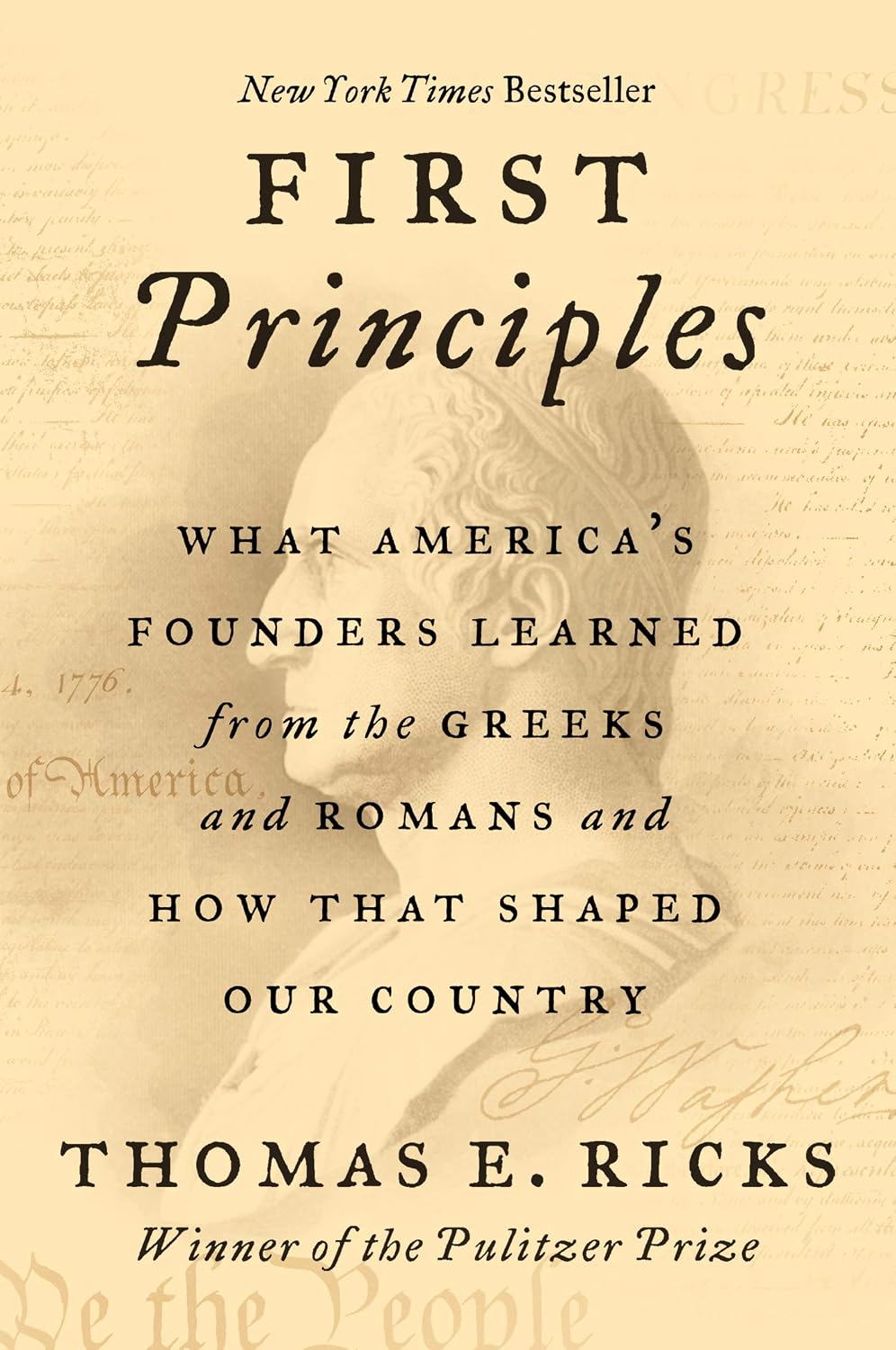
Why this book: Selected by my SEAL book club at the suggestion of Peter Rea
Summary in 5 Sentences: Tom Ricks explores the founding of our nation through the ideas, philosophies, and correspondence between the first four Presidents of the United States. We learn of their (except for Washington) strong education in the classics of Ancient Greece and Rome and how that affected their views and the direction they gave to the United States in its early stages. We learn of the rather serious disagreements and conflicts between them, how they persisted, and how these affected our early years. He concludes with how the issues and tensions between Federalism vs Republicanism (a more decentralized, state-centered, and people centered) approach evolved in the first half of the 19th century, culminating in the Civil War. He then shares his thoughts on how American culture moved away from classical concepts toward a more mercantile approach to democracy and capitalism, and conludes with his personal views on politics in America today.
My Impressions: This is not a quick easy read, though it is written in a very approachable style. Ricks helps the reader by giving sections – not just chapters – a title. It will appeal to those who are interested in American History and the philosophical battles our founding fathers fought amongst themselves over what kind of country they would create. After defeating the British, they shifted focus to “what next” and there were several different visions for what kind of country they would create. Initially our founding fathers were united in their opposition to English rule and oppression, but after the war was won, the big question – what now? was not an easy one. There were many different ideas and First Principles lays out how our first four presidents discussed, often argued, amongst themselves about what kind of country they wanted to create. And Ricks shares his surprise with us to learn that they routinely and consistently referred to the classical heroes and philosphers of Greece and Rome as they discussed and considered what kind of government and society they would form.
Much of the first part of the book is in describing the references to heroes of the classic Greek and Roman ages as depicted in writing with which all educated leaders of that time were familiar, but which have gone out of fashion today. Cato and Cicero were two of the most prominent. Jefferson in particular was a devotee of Epicurus while he described Washington in terms that made him what Ricks called the “American Cato” – the embodiment of virtue, and what a public man should be. “Washington came closer to the Roman example than his peers precisely because he was a man of deeds, not of words” p15
The early part of the book begins with chapters dedicated to each of our first four presidents – Washington, Adams, Jefferson, and Madison – their biographies and what shaped the way they saw the world.
Washington is a hero in the book but largely due to his presence, example and national credibility. He was not a key player in the philosophical discussions of principles upon which to build a nation, until be became President. Then he with support from Hamilton had overcome the strong states’ rights advocates in his government – namely Jefferson and Madison. Ricks is somewhat less sympathetic to Jefferson as (compared to the others) who he regarded as the most self-indulgent and pleasure seeking, but also the most aesthetically sensitive, personable and articulate. He paints John Adams as an intense, dedicated, and grouchy old man, more aligned with Washington and Hamilton than w the Virginians – Jefferson and Madison.
Madison gets the best reviews in this book, as more focused, disciplined, least mercurial, and the one whose essays in the Federalist papers hugely influenced the writing of the Constitution. Hamilton is a key player in this drama, though he was of course never a president. But he was Washington’s bull dog advocating for a strong central government and also a collaborator with Madison in the Federalist papers.
Washington was the least educated of the four, but clearly the most popular and powerful figure in America at that time (and since) – largely due to his unimpeachable and selfless integrity and his success in defeating the British. From his military background he (with Hamilton’s support) understood the necessities of power and authority to bring varying perspectives and agendas in line. He lived what he declared as his values and goal in life, “Honor and Reputation in the Service – the noblest of goals from a classical perspective , which he had absorbed as an aspiring member of Virginia’s ruling class.” p37 This simple philosophy is evident in his leadership during and after the revolutionary war. He was the embodiment of “selfless leadership.”
Chapter 3 is entitled “John Adams Aims to Become an American Cicero” Ricks writes “Among all the founders, it was Adams who seems most to have consciously used Cicero as a model for his life.” p50. He describes how Cicero was a key voice countering the threat to the Roman Rublic posed by a rebellious leader named Cataline. Ricks educates us on who Cataline was and why his negative example was so important a warning to our founding fathers, especially Adams. Adams “immersed himself in the works of Cicero and other ancient Romans – Horace, Ovid, Lucretius, Marcus Aurelius.” p 61 Ricks concludes the chapter saying that “if Washington is the most remote of the founders, Olympian in stuture, Adams is his opposite, the most modern – quirky, striving, self-obsessed, vibrating with anxiety and vanity.” p63
Ricks is also ambivalent in his praise of Jefferson, who he saw as more of a devotee of man as part of nature – “I say that the law of nature is the law of god…of this I have as certain as intuitive, knowledge as I have that two and two are equal to four, or that the whole is bigger than the part.” p 80 Jefferson wrote that “Happiness is the aim of life, Virtue the foundation of happiness and utility the test of virtue…virtue consists in 1.Prudence 2.Temperance, 4 Fortitude, 4 Justice. ” p84 . That belief underpins Jefferson’s writing of the Declaration of Independence – and especially that key phrase at the beginning, that all “are endowed by their Creator with certain unalienable Rights, that among these are Life Liberty and pursuit of Happiness.”
Madison apart from apart from Washington, is the hero of this book and Ricks’ rendition of the founding of the United States. He recounts how it was his intellectual capacity and work ethic (with help from a similarly focussed and thoughtful Hamilton) which created the Federalist Papers and the philosophical basis upon which the Constitution was written. He and Hamilton argued strenuously and successfully against the Articles of Confederation as viable basis for the United States of America. He was less wedded to his home state than either Jefferson, Adams or Washington, and so was able to be more “national” and ecumenical in his approach to the future. His classical roots were more with a French philosopher of whom I hadn’t heard – a fellow named Montesquieu, who was by many considered a bridge between Enlightenment values and the classical world. Skeptical of monarchy, Montesquieu was in the eyes of forward thinkers, the most influential writer of the eighteenth century and his “the Spirit of Laws “is essentially a meditation on how to inject ancient wisdom into modern governance.”p.89 Madison also inherited the firm belief from his mentor John Witherspoon president of Princeton, that virtue is that which promotes the general good, but that in any government, there must be room for many interpretations of how that virtue plays out – which must allow for discussion, disagreement, and therefore “checks and balances.” He believed that “interests can balance each other in a government expressly designed to curb excessive power in any one person or branch” p99 an approach Madison succeeded against much opposition, in writing into our constitution.
=====


